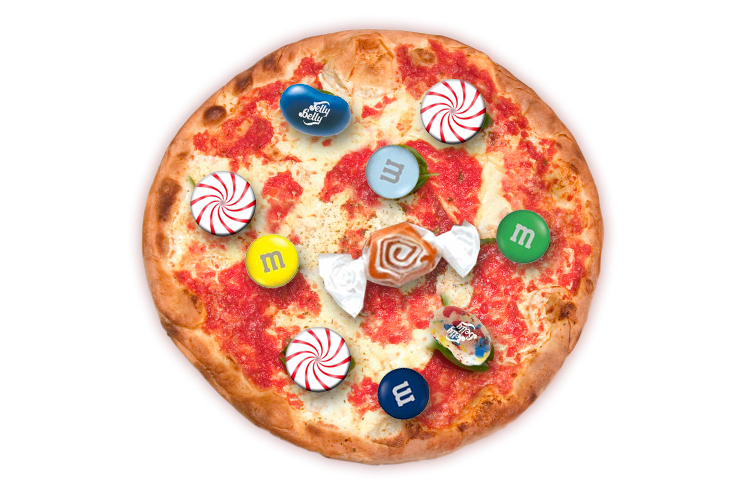

What tastes better than cardboard? Sweet cardboard! After being told by customers that their food tasted like paper products, Domino’s announced, in a painfully earnest mea culpa ad campaign, that it was revitalizing its pizza, featuring a new, sweeter sauce. A company on the ropes, losing money for six straight quarters, was confident banking its future on sauce that tastes more like candy than it already did.
But just a week before Domino’s announced its “Pizza Turnaround,” General Mills took out a full-page ad in the New York Times to announce that it would, at some uncertain point, lower the sugar content in its cereal to “single digit” levels. The two campaigns illustrate our complicated relationship with sugar.
There is a big psychological difference between “sweetness” and “sugar.” Sweetness is good. It tastes good, and it feels good, going all the way back to our reptilian brains. But our nutritional superego constantly battles our sweet-toothed id: Sugar is bad, it’s tooth decay and empty calories. We call in a seemingly endless string of substitutes, from rat-killing chemicals to low-glycemic-index nectars, to exorcise the demon of sugar from the deliciousness of sweet things.
Regardless of everything we have learned, however, our food just keeps getting sweeter and more sugary. According to a report from the Times of London, many of the foods we buy are markedly sweeter than they were 30 years ago — cereal, bread, soup and even fruit.
Susan Brown, an apple specialist with the Cornell University Agricultural Research Station, denies that the fruit she is working on has more sugar, but acknowledges that “high-quality” fruit is defined, in large part, by a high level of “perceived sweetness.” (Which she achieves by creating a balance of sugar and acids, which otherwise tend to mask sweetness.)
Sweetness has always been a sign of caloric energy, so it makes sense that we evolved to want it. But why do our tastes seem to be tilting ever more in its direction, even with calories so readily available to us? To find out, we talked to Brian Wansink, head of the Cornell University Food and Brand Lab, and author of the book “Mindless Eating,” an investigation of what we eat and why. Salon talked to Wansink about corn syrup, conspiracy theories and what happens when trendy vilification is the hallmark of our attitude toward nutrition.
Domino’s sauce is just one of many savory-sweet foods on the market now. It’s common to see flavors like “caramelized onion” and “sweet chili.” Does the savory-sweet combo make foods more appealing?
Definitely. What goes on is something called “sensory-specific satiety.” It means that if you eat lots and lots of handfuls of popcorn, eventually you’re going to get tired of eating popcorn. And if you eat M&M after M&M, eventually you get tired of eating M&Ms. But if you dump a handful of M&Ms into the popcorn, you can eat a ton. Combining the sweet and savory stimulates people into wanting to keep eating because their taste buds don’t burn out.
But even though it tastes good, we know that sugar is bad for us. Why isn’t our increased nutritional awareness bringing down the sugar levels in food?
Well, one reason was our vilification of fat. We did an environmental scan of over 370 of the most popular snack food products and what we found was, when they went to low-fat, the average calorie level only dropped by 11 percent because they replaced fat with sugar. That’s just ridiculous! If you were to ask most people how many fewer calories are in something that’s labeled low-fat, the majority of people will say between 40-50 percent. Studies show that people end up eating more of something if they think it’s low-fat, and even if it is low-fat, they end up eating more total calories as a result.
And what about all the super-sweet protein bars out there, which are marketed as a healthy food? Isn’t that fundamentally wrong?
The thing is, there was a kind of witch-hunting phase where we demonized sugar back in the late ’80s. But if you look at it, there’s a really nice case to be made for sugar. Let’s use chocolate milk as an example. If you’re trying to get kids to drink milk, and you add just a little more chocolate and a little more sugar, and add 30 more calories to it, you know, I don’t really think that’s bad compared to them ordering Goofy Grape punch with the same number of calories and really nothing in it.
I think the same thing with Powerbars. If adding the sugar makes the high concentration of protein a little more stomach-able, I’m not so sure that’s a bad thing. People eat more protein, it sticks with them longer, they have fewer subsequent cravings for food, and if the cost is a few spoonfuls of sugar, I’m not so sure that’s such a bad cost.
But the more sugar we eat, the more we need in order to taste it. Are we raising kids who have a super-high tolerance for sugar?
It’s called adaptation levels, whether it’s the amount of sugar we put on anything or the amount of salt, or Tabasco. People get acclimated to a certain level of stimulation, and below that, stuff just tastes boring. So that becomes the new benchmark they need to sort of respond to whenever they season their food.
The Times of London article claims that food scientists are breeding fruits and vegetables to be sweeter, so even our baseline understanding of what’s “naturally” sweet is changing. Is that true?
You know, it’s cool because it has the sniff of conspiracy to it, it’s like “Ooh I think I found something!” but the stuff is so mixed it’s hard to be really sure. I know data that says yes and data that says no.
Speaking of conspiracy theories, there are a lot of people, including Michael Pollan, who blame our increased tolerance for sweetness on high-fructose corn syrup and the power of corn lobbies over the food industry. Do you believe them?
I don’t know that it’s the problem with sweetness. There’s a reason why corn syrup is a substitute — because it’s cheaper. When people go, “Oh, we need to go all organic!” I think, gee whiz, who’s gonna starve? It’s not going to be you, Mr. Rich Yuppie. It’s gonna be somebody else. I’m frightened to think what the unintended consequence would be of going back to cane sugar as a sweetener for everything.
I have read studies that show that people eat more sweets when they’re stressed. We’re in a recession. People are worried about money, and Domino’s is known for being inexpensive. Does our general stress level contribute to the appeal of sweeter pizza?
We’re doing a really cool study where we’re looking at the sales of healthy and unhealthy foods across Cornell University based on exam time versus non-exam time, and the effect is less than you think. The junk food definitely goes up during exams, but what we find, surprisingly, is that in the weeks after exams there’s a reversion that ends up almost wiping out the effects.
The studies of “mood & food” stuff tend to be very episodic. It ends up being like, “OK, what we’re going to do is we’re going to run in and tell half the people in this room that their grandmother just died, and then we’re gonna see how much they eat.” This doesn’t look at whether there is any compensation or any sort of bounce-back effect that takes place afterwards. And the studies that do look at this stuff longitudinally show that there ends up being this kind of recompensation that occurs, except in the most bizarrely artificial situations, which tend to be the ones reported.
Do you think Domino’s will succeed with its new pizza?
What is a typical person who orders Domino’s? It’s not your nutritionist, it’s not your activist. It’s your typical American, and your typical American goes, “Man! Sweeter sauce! This is good stuff!” We recently had an emergency, a surprise guest, and I’ve got a Domino’s box within 10 feet of my recycling right now.
Was it good?
Oh yeah.
Last month, Gallup reported that despite economic crises brought on by financial deregulation, far more Americans still worry that there will be too much regulation rather than not enough. No doubt, the survey results reflect the triumph of conservative “free-market” rhetoric in equating regulation with job loss in the American psyche. That’s a victory of ideology over economic reality, because, as Businessweek recently noted, regulations are hardly job killers. Instead, the magazine points out, they typically “wind up creating about as many jobs as they kill.” In the process, they also mitigate major social problems, as Coca-Cola and Pepsi just proved.
In a move that could serve as the singular parable about the value of regulation, the two soft drink behemoths recently announced they “are making changes to the production of an ingredient in their namesake colas to avoid the need to label the packages with a cancer warning,” according to Reuters. The shift comes in the face of a science-based decision to designate the ingredient a potential carcinogen, which then subjected it to a California regulation mandating disclosure of such compounds to consumers.
Over the course of history, the most famous regulations — not the free market — have reduced everything from wage theft to pollution to financial implosions to mass food poisoning. Less well remembered — but equally important — is that subset of regulations that simply force companies to tell us exactly what is in their products. Those empower consumers to make more informed decisions about where to spend their money — and, as last week showed, they often end up prompting companies to preemptively produce their wares in a more responsible manner.
Even to those who think the government shouldn’t set rules dictating the terms of production, basic disclosure regulations should be considered a no-brainer in a functioning capitalist economy. Such regulations don’t say a product cannot be produced — they simply say that when the product is produced, consumers have a right to know what is in it. Why would anyone argue against that?
Why? Because money — Big Money — is involved.
Almost every time a disclosure regulation has been proposed, the moneyed interests involved mobilize to stop them — or at least slow them down. In the pursuit of profit, industries would rather keep consumers in the dark than be forced to answer pesky questions about human health, the environment and other such concerns. Consider just the last few years:
- The oil and gas industry has fought tooth and nail against state legislative proposals to at least disclose what kinds of toxic chemicals they are pumping into the ground when they engage in hydrofracturing.
- Major meat producers have opposed country-of-origin labeling regulations, successfully using the World Trade Organization to knock down those rules so as to keep consumers in the dark about where their meat is from.
- Monsanto, the agriculture bio-tech giant, has used its political clout to stop regulatory proposals in the United States that would force food companies to tell consumers whether products included genetically modified ingredients. But that’s not all: The corporate colossus has also convinced the U.S. government to use its power to try to gut other nations’ GMO labeling laws, too.
- The cosmetics industry has not only stopped state legislatures from regulations banning suspected toxins in beauty products, but has also ensured that the federal government regulations do not require the disclosure of most of those toxins. “Since the federal cosmetics law was written more than 70 years ago, the FDA has banned just eight out of the 12,000-plus ingredients used in cosmetics,” notes activist Annie Leonard. “The FDA doesn’t even require all of the ingredients to be listed on the label.”
- Most recently, the tobacco industry has used the federal court system to invalidate regulations mandating explicit warning labels about the adverse effects of smoking on human health.
Let’s be clear: These are but a few of many examples of a larger corporate opposition to basic disclosure. It is an opposition that is driven by corporations invested in the status quo — and from a business perspective, it is entirely practical because industries know full well that public information tends to change consumer behavior. Indeed, a 2000 study by Texas A&M researchers found that now-standard nutrition labels on food substantially “decreased individuals’ average daily intakes of calories from total fat and saturated fat, cholesterol and sodium.” Likewise, a 2010 Stanford University study, for example, found that calorie labeling at Starbucks resulted in a 6 percent decline in the average calories per transaction (and, countering those who claim that such regulations harm profits, Starbucks actually increased its profits in the process).
While some companies like Coca-Cola and Pepsi change their products in the face of labeling regulations, other corporations have tried to preempt such regulations and the subsequent shift in consumer behavior by rolling out their own reassuring labels. Rather than change their products, these firms have opted to try to either mislead consumers entirely or at least confuse them with information overload.
In terms of full-on misleading, as the New York Times reported in a 2011 story about the proliferation of “functional food” labels, federal regulators are now concerned “that some packaged foods that scream healthy on their labels are in fact no healthier than many ordinary brands.” When it comes to merely overloading the consumer with too much information, the already bewildering chaos at the supermarket could get even more perplexing in the coming months with Wal-Mart rolling out its own “Great for You” label for foods it deems healthy.
Information, as the old saying goes, is power. And when we consider all of this in totality, it’s clear corporate America recognizes the truth in the aphorism. Companies, in other words, understand that for all the fact-free vitriol constantly thrown at the basic concept of regulation, government regulations that increase information simply expand consumer power over the market. That may threaten companies that want to continue poisoning us, but as a political goal, consumer empowerment shouldn’t be so controversial. Continuing to keep consumers in the dark and powerless should be.
Continue Reading
Close
It was all I could do not to scarf the entire stromboli, neatly packaged for me in a Styrofoam clamshell, while in the car. The dough was soft. The balance of ham and mozzarella, just right. And so, only about half was left when I parked on Third Avenue, the main drag in Huntington, West Virginia, and offered a bite to some friends.
“Wow. That’s great,” said one.
“Yeah, where’d you get that?” asked another.
“You’ll never believe it,” I told them. “This is school lunch.”

Times have changed since celebrity chef Jamie Oliver broadcast startling and deliberately inflammatory—this was reality TV, after all— images of kids here dumping trays of fresh food untouched into the trash. For those of you who missed, Oliver’s prime-time program, “Food Revolution,” the British chef arrived in Huntington in 2009 after it was named the most unhealthy metropolitan area in America and went to work ousting greasy burgers and pizza in favor of from-scratch meals made with fresh ingredients. Two years later, on the first week of school, which began in mid-August, students in Cabell County sat down to meals of from-scratch chicken quesadillas and brown rice and, on the day I visited, creamy chicken and noodles served with freshly made coleslaw, steamed broccoli with parmesan, an orange and hot rolls, the smell of which floated enticingly through the halls.
And that stromboli? Well, it’s not one of the meals that the school district is most proud of. The dough is made from scratch, of course. But school cooks would be happier if they actually made the ham or cheese. As I said, times have changed.
School officials repeatedly point out that the county’s food already was 50 percent made from scratch before Oliver rolled into town. And you can’t blame them for wanting a little credit. The culinary crusader may have focused the national klieg lights on this otherwise quiet Appalachian city, but it’s local officials that have done the real work of overhauling school food. Over the last two years, Rhonda McCoy—the school food service director who was portrayed on the show as an aloof bureaucrat more concerned with budgets and caloric counts than kids’ health—has redeveloped recipes, held after-hours taste tests, sourced fresh and unprocessed ingredients at affordable prices, bought new equipment and trained school cooks. She also endured an unprecedented four regulatory audits to ensure that the new meals met federal nutritional and caloric standards. She passed.
McCoy hasn’t stopped there. This year, she introduced free meals for all low-income students and free meals for all students at one county elementary school. She also plans to introduce lower-sugar flavored milk, and to buy a projected 12,000 pounds of sweet potatoes for the district, grown by a county high school’s vocational agriculture students.
Now, deservedly, McCoy’s county is a model in the state. Last spring, Dr. Jorea Marple, the state schools superintendent, visited Cabell County and decided that other districts need to follow its path. As a result, eight counties—most of which are in the poor, southern coal fields— this fall will introduce 100 percent from-scratch meals at breakfast and lunch – and provide them to all students, regardless of their family’s income, free of charge.
It’s easy to imagine how this kind of warp-speed transition might be painful for those eight lucky counties. My husband and I spent six months in Huntington researching a book about how and if the town can change its food culture, and in meeting after meeting, McCoy told me that she never objected to the changes that Oliver suggested, just the way and speed at which she was forced to implement them.
But this new set of cooks won’t be starting from scratch. McCoy provided a binder full of USDA-approved recipes and order forms with all the ingredients they need to purchase. She also organized a two-day training where the now-experienced Cabell County cooks demonstrated recipes: rotisserie chicken, roasted potatoes, sugar snap peas, pizza sauce and homemade salad dressings and croutons, among others. They also imparted tips and techniques for, say, quickly chopping dozens of heads of romaine lettuce or cabbage for coleslaw rather than just opening a bag.
Alice Gue, the school cook who “Food Revolution” viewers will remember as Oliver’s grumpy nemesis, was one of the trainers. (And, for the record, she’s one of the warmest, cuddliest school cooks I’ve met in years of covering the subject.) “It’s a lot for them to take on but most were really excited,” she told me after serving stromboli to almost 200 students. “You always get some people who will say, ‘I can’t do that. We have no time. We don’t this or we don’t do that.’ Just like you get some people who say: ‘Well, why do the extra work when the kids are just going to throw away the food?’ And sure, some of them will. And if they don’t eat it today, okay they didn’t today. But down the road they will. You have to take pride in what you do and what you put out there for these kids.”
Pride is one thing. Money is another. And a lack of federal funds is the perennial reason for the piles of cheap, processed food that end up on children’s trays. And so I asked McCoy: Where would West Virginia get the money for new equipment, better ingredients and free lunches for all low-income students?
“I don’t know,” she said. “They’re just going to find it.”
It’s a non-answer. But, in a way, it doesn’t really matter. What does is that state and county leaders in West Virginia now agree that good food in schools is so important that they’ll find some way to put it on students’ plates. Or, to put it another way, remaking school food is more about leadership than cash. While chef-advocate Alice Waters and others would like to see the federal government spend $5 per student for organic, sustainable and local school lunch, the Cabell County school district is proving that it’s possible—with dedication and a little ingenuity— to put out tasty, from-scratch meals that both kids and a discriminating food writer will happily eat.
That’s not to say that more money wouldn’t help. Doling out money is how Congress leads. And school food would be a popular cause if children suddenly got the vote. But the experience in Cabell County proves that sometimes what schools need most is a push to change. “If I had to do it my way, we would have gone slower,” McCoy told me. “But now that it’s all done, I think, yes, it was worth it.”
Jane Black is a Brooklyn-based food writer who covers food politics, trends and sustainability issues. Her work has appeared in the Washington Post (where she was a staff writer), the New York Times, Slate, New York magazine and other publications. To read more, visit www.janeblack.net.
Continue Reading
Close
It was just stupid when the Washington Post’s 44 blog (“Politics and Policy”) “reported” that Michelle Obama ate a hamburger. (Or, as Ta-Nehisi Coates said, it was “the dumbest story ever written in all of human history.” He’s not wrong!) After the right-wing blogs all picked it up, as they were always going to because of their seething, inexplicable hatred for the first lady, though, it became something darker than stupid.
After everyone else began calling the story dumb and pointless and inane, the Post… ran a poll. Now the people can decide if Michelle Obama is “a hypocrite” for eating a hamburger! In order to justify the newsworthiness of “Michelle Obama eating a hamburger,” the Post’s Tim Carman Googled “Michelle Obama” and “hamburgers,” and discovered that she has eaten at least five hamburgers in the past.
Type in “Michelle Obama and salads” into Google, and you gets tons of hits about her introducing salad bars into schools. But few hits of her ordering salads in public.
It’s not actually an example of hypocrisy for someone who advocates a healthy lifestyle to eat a hamburger. And a shake. If you eat a balanced diet and get some exercise, a hamburger and shake every now and then is fine. Any educated adult understands this. The Washington Post understands this. But because the conservative movement has decided that the first lady’s anti-childhood obesity campaign is actually an attempt to ban all delicious food in order to force-feed your child organic arugula, this was presented in the original item as a “gotcha.” Michelle Obama says kids shouldn’t eat garbage all day, every day, but she ate a meal that has a bunch of calories! What a “mixed message.” She should eat only carrots in public, or else children will think it is OK to have a bowl of “Tacos After Midnight” Doritos for breakfast and then play Xbox games for 18 hours straight. (Plus, Jesus, people, this is Shake Shack we’re talking about — the vegetables are all fresh and organic and the cow was fed better than kids on school lunch programs.)
The Post probably just ran the stupid story to begin with because they know Obama’s anti-childhood obesity campaign is catnip for the right wing. Matt Drudge is obsessed with Michelle Obama and his weird fantasy idea of her as a threatening, angry, anti-white black woman (who is also a liberal nanny-state tyrant). Glenn Beck’s “The Blaze” quickly picked it up.
Fox Nation, too, jumped on the story. Their comments section is a mostly unfiltered (the most blatantly racist comments, of which there are plenty, are eventually flagged and removed) peek into the hatred and resentment that feeds Michelle Obama stories on the right-wing Web:
What’s especially insane about this is that Michelle Obama has worked very hard to not give people any reason at all to hate her. She made one ill-advised statement on the campaign trail — the misinterpreted bit about being proud of her country for the “first time” in her “adult life” — but since then she has been precisely as “controversial” a first lady as Laura Bush. She entertains. She travels. She wears nice clothes. Her sole policy issue is healthy children.
She’s a well-educated, successful woman from a blue-collar background who took a break from her successful career to basically raise their adorable children while her husband is president. She is not “threatening” like Hillary Clinton, who actually wanted to be president herself. Or, at least, she’s not “threatening” unless you’re just “threatened” by… successful, powerful, black women. (I’m sorry, I meant to say “uppity.”)
The clue that this is not related at all to anything Michelle Obama has actually done (or said), but rather who she is, is the legend of the old “Whitey” tape, which various right-wingers promised to produce, and which I, for one, still cannot wait to hear.
Sure, the right-wing Internet nuts and their enablers at every industry-funded think tank in Washington would turn a “kids should exercise” program into a full-on assault on liberty under any Democratic president — it’s what they do! — but the tone of the Michelle Obama coverage, and the commentary it generates, is pretty unmistakably racially tinged. (In addition, obviously, to being usually blatantly sexist.)
But as long as the Post continues policing Michelle Obama’s public appearances for imaginary hypocrisies, and then conducting polls about them, it can either absolve itself of responsibility or congratulate itself for the fuss it kicked up.
Continue Reading
Close
Outgoing Fox host Glenn Beck recently attacked ongoing Fox host Mike Huckabee for supporting first lady Michelle Obama’s anti-childhood obesity campaign (fighting childhood obesity is an attack on our fundamental right to feed children garbage). Huckabee, Beck argued, is a “progressive,” and progressives, in Beck’s world, are the intellectual descendants of the Nazis themselves.
Huck struck back with an entertaining, unedited blog post calling Beck a conspiracy theorist looking for “boogey men” that “he and only he can see.” “The First Lady’s approach is about personal responsibility,” Huckabee wrote, “not the government literally taking candy from a baby’s mouth.”
On the Blaze, Beck’s news website, Kevin Balfe, Beck’s primary ghostwriter, has responded today by calling Huckabee a liar. Because, he argues, Michelle Obama and Mike Huckabee do want to literally take candy from babies’ mouths:
Michelle Obama is heading up an effort to combat childhood obesity. One of the first major initiatives of this campaign was the “Healthy, Hunger Free Kids Act of 2010.” Here is what Huckabee said about it at the time: “By passing a bill that addresses the nutritional quality of school lunches, an important step is being taken to give children choices that will make them healthier and more productive.”
Ok, great, so he likes the law…but what does that law actually do? Well, according to USA Today: “it gives the USDA the authority to set nutritional standards for all foods regularly sold in schools during the school day, including vending machines…”
To translate, the FEDERAL GOVERNMENT will have DIRECT CONTROL over whether or not certain foods–say a Milky Way bar–can be put into a vending machine at a public school.
With me so far?
Ok, so now for the big reveal…the Huckabee Lie. In his public statement attacking Glenn, here’s what he claims:
“I’m no fan of [Michelle Obama's] husband’s policies for sure, but I have appreciated her efforts that Beck misrepresented—either out of ignorance or out of a deliberate attempt to distort them to create yet another ‘boogey man’ hiding in the closet that he and only he can see. The First Lady’s approach is about personal responsibility—not the government literally taking candy from a baby’s mouth.”
Actually, Governor, no. I know you‘re so immune to political spin that you probably don’t even recognize it anymore, but THAT’S EXACTLY WHAT THIS ACT THAT YOU SUPPORT DOES.
I know the definition of the word “literally” has drifted a bit since Joe Biden took office, but unless this bill calls for jackbooted USDA thugs to storm into public schools and rip Milky Ways directly from the mouths of … babies who are in school for some reason, then no, this act does not actually take candy from babies.
There is, in fact, absolutely nothing in this bill stopping any public school student from bringing an entire crate of delicious candy bars to school and eating each and every one of them during recess. Our freedom to begin the process of eating ourselves to death as early as possible is still safe!
While Balfe characterizes the bill, and Obama’s campaign in general, as “federal intervention in local issues like school lunch nutrition,” the USDA already “intervenes” in school lunches (the National School Lunch act is more than 60 years old) and sets nutritional standards for government-subsidized meals. (Of course, demanding healthier school lunches without giving schools a lot more money to spend on food is pretty unrealistic but on the other hand LIBERTY DON’T TREAD ON ME FOUNDERS FREEDOM etc. etc.)
Continue Reading
Close
Slayers of elitists and other warriors of the downtrodden: Look! I bare my throat to you, fleshy and fat and ripe for the kill. But before you draw your blade, let’s talk about this for a minute. Is the increasing cost of food in America an entirely bad thing?
A recent report in the New York Times announced that American grocery store “shoppers are paying the same amount, but getting less,” and proceeded to quote a woman whose three-box pasta dinner for her large family didn’t quite satisfy. She only later realized it was because those boxes now contain 13.5 ounces of noodles, not 16.
The report goes on to catalog other shrinkages: cans of tuna going from 6 ounces to 5; buckets of ice cream going from 2 liters to 1 ½; orange juice from 64 ounces to 59, et cetera, et cetera, et cetera.
An immediate and obvious reaction is that this is an outrage — a problem that really puts the screws on people who already have trouble affording enough food to feed their families. Hunger — and the threat of hunger that policy wonks call “food insecurity” — is no joke. (Even if we’re not entirely clear on how many people are truly hungry, and what food insecurity really means.) My point is not to minimize the difficulty this kind of price inflation will create for people truly struggling to eat.
But there is something else that struck me when reading the report. It was the ice cream. And then the Reese’s mini peanut butter cups. These, and presumably many other processed and junk foods, are among the items “shrunken” this way.
Is that really so awful?
First, Americans spend a smaller percentage of their income on food than anyone, ever. In 2008, during the economic crash, we spent an average of 5.6 percent of our income to feed our families, the lowest since 1929. At this point, overeating affects many more Americans than chronic hunger, by far. (Perversely, obesity and diet-related diseases like Type 2 diabetes are actually much more common in lower-income communities, which speaks to a prevalence of junk food that confuses the line between “hunger” and “malnutrition.”) And if current trends continue, over 40 percent of Americans will be obese within the decade.
So how do we deal with this? Anyone who tells you they have a clear answer is selling you snake oil. But a big part of it has to be eating more smartly, and yes, eating less. It’s weird to say this, but maybe food should cost more. Not because we should be poorer, certainly not because we need to be protecting the profits of corporations, but because we have real trouble valuing what’s cheap.
Food, for most of us, is blessedly and cursedly cheap. It’s plentiful. And so we plow through huge dinners nightly. And so we mow down whole containers of ice cream. It’s in our nature to want to eat more. Our bodies and brains have descended from animals that have struggled, really struggled, to get enough food to survive forever. We want to pack as many calories into ourselves as humanly possible, for when the lean times inevitably come. Only we’ve engineered and marketed away most of the lean times, and yet we keep gorging.
So there may be something significant and strangely hopeful about how this food inflation is manifesting. It’s not that prices are rising per se, but that portion sizes are shrinking. That means that if you could afford a box of pasta or a bag of chips before, you can still afford one now; no one is taking all your chips away from you. But the limiting of portion size might do us some good.
Studies by Dr. Brian Wansink at the Cornell University Food and Brand Lab regularly show that people keep eating not until they feel “full,” but rather until there is some external signal to tell them to stop. In one notable experiment, Wansink’s team rigged a bowl of soup to secretly keep refilling itself. Without realizing it, diners eating from that bowl ate 50 percent more soup on average, and some ate three times the amount of soup they might have otherwise. We eat mindlessly, as a function of habit and instinct, and so with a surplus of food, we are constantly overeating. Knowing that, maybe we don’t have to begrudge that extra couple of ounces of food companies are saving for the next bag.
Continue Reading
Close