Celebrity memoirs, of which there are a surfeit these days, tend to follow a predictable pattern: open on a moment of crisis, preferably a near-death experience (the Brush with Death); stumble upon a star turn (the Big Break); and fill the balance of the book with a succession of successes, leavened by a few instructive failures (the Happily Ever After). What brings us back to these books in spite of their predictability is the voyeuristic sensation of glimpsing the private lives of public people.
Harry Belafonte’s “My Song” is in many ways just this sort of conventional celebrity memoir. What distinguishes it — and elevates it to excellence — is the quality of experience that the book chronicles. Belafonte’s Brush with Death isn’t an overdose in a suite at the Chateau Marmont, it’s a high-speed escape with Sidney Poitier from the Ku Klux Klan to deliver a suitcase filled with tens of thousands of dollars to support civil rights activists in Mississippi. His Big Break isn’t a record label intern discovering his demo at the bottom of a box of unsolicited tapes, it’s walking onstage for his first gig to find that his backup band consists of jazz immortals Max Roach, Al Haig, Tommy Potter and Charlie Parker. His Happily Ever After isn’t a series of Billboard and box office hits, famous paramours and big paychecks (though he enjoys all of these in abundance), it’s a lifelong commitment to the cause of civil rights, both at home and abroad.
Far from a celebrity tell-all, “My Song” is a serious account of a life of service — to race, to country, to the cause of equality. The big revelation of this book, perhaps even for those who remember Belafonte at the height of his matinee idol stardom, is just how integral he was to the nation’s political life. “I wasn’t an artist who’d become an activist,” Belafonte observes midway through the memoir, “I was an activist who’d become an artist.” This activism stretches from the 1940s labor movement to the civil rights revolution; from anti-apartheid demonstrations to African famine relief; from outspoken opposition of the Bush administration to more measured but still strident critiques of the present administration.
As a memoir of activism, “My Song” can be read beside the masterful “Walking With the Wind: A Memoir of the Movement” by the civil rights icon John Lewis (with Michael D’Orso). Like Lewis, Belafonte was present at some of the pivotal moments of the era and can therefore render them on a human scale. Belafonte reveals, for instance, that for a time he acted as the primary intermediary between Martin Luther King Jr. and the newly elected Kennedy administration — while maintaining a public profile as one of two or three most famous black people alive.
Throughout his life, Belafonte leveraged his celebrity in the name of great causes. In one particularly striking example, he recalls rallying his famous friends — Marlon Brando, Charlton Heston, Paul Newman, Tony Bennett, Lena Horne and many more — to attend the 1963 March on Washington. “As a group,” he asserts, “we played more of a role in most Americans’ daily lives than their priests or pastors, their politicians, or even their teachers … To see us all together, moving as one, saying by our presence that segregation would not stand — that was powerful.”
For all its striking revelations, “My Song” is perhaps least revealing about the inner workings of Belafonte himself. In the book’s opening chapter, he posits that both his art and his activism were motivated not by love or passion so much as by a “deep wellspring of anger.” This is intriguing, even troubling, but in fact the book is marked by a curious deficit of darkness. Belafonte only gestures at the possible roots of his rage: poverty, racial discrimination, his fractured family life.
As for the credit Belafonte gives throughout the book to a lifetime spent in psychoanalysis, little self-analysis seems to be at work on the most sensitive matters within: his hints at gambling addiction, the dissolution of multiple marriages, the failures in fatherhood, the undoubted personal struggles that must have accompanied going from being one of the most famous people on the planet to being, in his own words, a regular on the Lifetime Achievement circuit who has quite literally lost his voice.
Even at 84, when many would be looking back upon a life well lived, in a memoir that is designed to do just that, Belafonte faces forward. “About my life,” he writes near book’s end, “I have no complaints. But I do have grave concerns about race and poverty in this country, about what the movement has left undone and how little of a movement remains to do it.” Rather than ending on a note of pessimism, though, the song Belafonte sings — the one he has always sung — is one of challenge, one of hope.
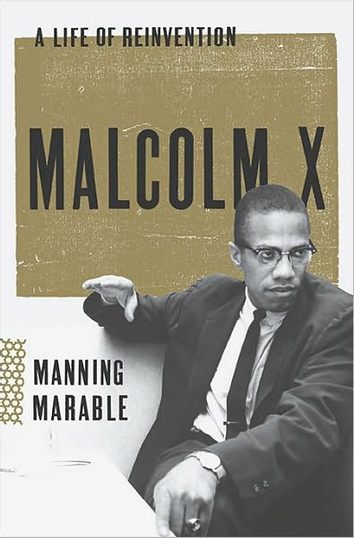
Manning Marable, the noted historian and professor of African-American Studies at Columbia University, died on Friday, April 1 — a month shy of his sixty-first birthday and just days before the publication of his masterful new biography of Malcolm X. “Malcolm X: A Life of Reinvention” is a major reassessment of perhaps the most misunderstood figure of the civil rights era. It is also the crowning achievement of Marable’s illustrious career.
Malcolm X and Manning Marable are well matched as subject and author. Marable was a Marxist historian who transcended the boundaries of any political orthodoxy, an author or editor of more than twenty books and hundreds of articles who saw no contradiction between academics and activism. This month also marks the publication of “Beyond Boundaries: The Manning Marable Reader”, a collection that gestures at the breadth of Marable’s erudition and the depth of his commitment to writing — and to righting — American history. Nowhere is this revolutionary spirit more apparent than in his account of one of the preeminent revolutionary voices of the second half of the twentieth century.
Marable’s portrait of Malcolm inevitably invites comparisons to 1965′s “The Autobiography of Malcolm X as told to Alex Haley”. What must it be like to write a biography in the shadow of one of the best known and most beloved autobiographies of our time? In the research notes that follow the biography, Marable explains that his book was born out of a “critical deconstruction of the “Autobiography”. Drawing upon newly available archival material, including audiotapes of Malcolm’s speeches from the Nation of Islam’s private vaults and declassified FBI files, the biography aims to restore the “historical Malcolm.”
As told to Haley, Malcolm X’s life has the page-turning appeal of a dime-store novel and the moral clarity of a New Testament parable. From “Satan” to “Savior,” from “Hustler” to “Minister Malcolm X,” the chapter titles alone suggest the redemptive arc of the book. The “Autobiography”, like the 1992 Spike Lee film that it inspired, revels as much in sin as it does in salvation. Malcolm as hustler, as Detroit Red, is wildly charismatic — an outsized anti-hero whose slick talk and street science seduce us. In the pages of the “Autobiography “one sees Malcolm’s myth in the making, a myth that would finally see his complexities and contradictions reduced to a symbol that could be emblazoned on a baseball cap or captured in a catchphrase: “By any means necessary.”
Perhaps the most significant departure that Marable’s biography offers from the “Autobiography” comes in the new trajectory it suggests for Malcolm’s life. Whereas the “Autobiography” spends nearly half of its 500 pages on Malcolm’s dissolute youth prior to his conversion to Islam and release from prison, Marable dispatches the hustling Malcolm in just under a hundred pages, dedicating the balance of his 500-page book to Malcolm as he would refashion himself as activist and organizer.
Central to Marable’s aim of restoring the “historical Malcolm” is a reassessment of Malcolm’s politics. Marable offers the first thorough account of the organizations that defined Malcolm’s core beliefs after his split from Elijah Muhammad and the Nation of Islam: Muslim Mosque, Incorporated and the Organization of Afro-American Unity. Marable rejects the facile claim that these organizations marked the moderation of Malcolm’s militancy. Rather, they reflected the expansion of that militant position, driven by his growing understanding of power and politics. Inspired by his travels abroad and his embrace of a more orthodox form of Islam, Malcolm made the “leap from race-specific ideas to broader ones about class, politics, and economics.”
The surfeit of detail Marable and his team of researchers uncovered, including a nearly day-by-day account of Malcolm’s activities in the frenetic final years of his life, could have made for a fact-filled but lifeless book. Fortunately, Marable never mistakes mere incident for action. His penetrating narrative gets to the soul of his subject. The result is meticulous scholarship paired with masterful storytelling.
One might expect that such a careful exegesis of Malcolm X’s life would result in the diminishment of his legend, but just the opposite is the case. With “Malcolm X: A Life in Reinvention”, the man stands even taller than the myth. Marable provides a new architecture for understanding Malcolm X as a deeply flawed individual full of unresolved personal and philosophical contradictions.
Through Marable’s lens, Malcolm emerges not as a redemptive symbol but as a political theorist and tactician. Malcolm’s fate, Marable suggests, is bound up in the tension between his constant self-reinvention and his stubborn points of stasis. At once, Malcolm is a protean figure, morphing from street hustler to convict to minister to martyr; through it all, though, he remains doggedly dedicated to certain core beliefs, the most important of which Marable identifies as his “politics of radical humanism.”
Humanism might not be the first philosophy one thinks of with someone famous for excoriating diatribes against “white devils.” But it is precisely here where Marable uncovers Malcolm’s salvific, if unachieved potential. “A deep respect for, and belief in, black humanity was at the heart of this revolutionary visionary’s faith,” Marable observes near the book’s end. “And as his social vision expanded to include people of divergent nationalities and racial identities, his gentle humanism and antiracism could have become a platform for a new kind of radical, global ethnic politics.”
The poet Robert Hayden once captured the essence of Malcolm X’s life in a paradox: “He rose renewed renamed, became / much more than there was time for him to be.” Nowhere is this more apparent than in Marable’s biography. This is history at its finest — written with passion and attention and drive. It is a fitting testament to the lives and the legacies of both subject and author.
Continue Reading
Close
The name of Jay-Z’s first book is “Decoded,” a curious title given that among the work of celebrated rappers his lyrics might need perhaps the least decoding. Unlike the Wu-Tang Clan, for instance, whose arcane allusions, slang neologisms and syncretic philosophies have spawned two books and counting, Jay-Z is decidedly plain spoken and confessional. His most powerful lyrics — and there have been many since his 1996 debut, “Reasonable Doubt” — reveal anxiety, uncertainty and an uncanny awareness of human frailty to go along with the expected bluster and bravado of the rap idiom.
Despite Jay-Z’s willingness to bare his emotions in song, we know precious little about the man himself, Shawn Carter. The general arc of his life’s narrative is clear: A child of Brooklyn’s Marcy projects transforms himself from aspiring rapper to drug hustler to global superstar to corporate mogul. He is the self-made man of American myth, remixed with a kick drum and a snare. Under the guise of his invented name, Jay-Z has become less person than persona. As he once rapped with characteristic concision: “I’m not a businessman, I’m a business, man.” Though he’s released a staggering 11 albums in 14 years, the man behind the business still remains a mystery — often seen, but rarely heard.
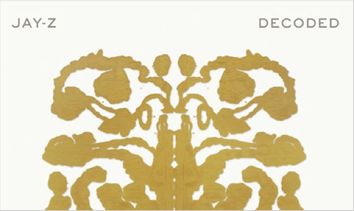
That is what makes “Decoded” such an unexpected and welcome gift. At over 300 pages, it is a multimedia, multi-genre extravaganza: part memoir, part coffee-table book, part annotated compendium of lyrics, part polemic in the defense of hip hop’s poesy. Jay-Z (with the aid of the respected hip-hop journalist dream hampton) intersperses personal anecdotes, rhetorical broadsides, and deep reflections with rich images and typography. From Andy Warhol’s striking “Rorschach” on the book’s front cover to the interior art, which ranges from Michelangelo’s “Pieta” to a vintage Little Orphan Annie button, the book is a visual feast.
What the book isn’t — and what many hip-hop fans have long anticipated — is a tell-all memoir. Though rich in anecdotes, the narrative is organized thematically rather than chronologically, underscoring the continuities across Jay-Z’s career. The themes range from poverty to fame, from sports to politics. At times, these subject-driven sections leave one dissatisfied with the level of revelation and reflection, such as in his cursory treatment of race relations. Combined, though, they provide a penetrating glimpse into the mind of one of the greatest American artist-celebrities.
As a collection of lyrics alone, “Decoded” is an essential contribution. It joins a growing body of works, such as Paul Edwards’s “How to Rap: The Art and Science of the Hip-Hop MC” and Yale University Press’s “The Anthology of Rap” (which I co-edited with Andrew DuBois), that place the rap lyric in its proper context within the American popular songbook and the broader tradition of poetry through the ages.
Jay-Z is a rapper who famously doesn’t write down his lyrics — or as he once termed it, “the only rapper to rewrite history without a pen” — and seeing his words on the page is a revelation. Syllables and sounds bounce off one another; clever figures of speech unfold before our eyes. Throughout the book, he continually makes the case for understanding rappers as poets, complex artists capable of rendering the familiar unfamiliar, embodying paradox and tension in their lyrics, and making things beautiful — and ugly too — as artists at their best always do.
“Turning something as common as language into a puzzle makes the familiar feel strange; it makes the language we take for granted feel fresh and exciting again, like an old friend who just revealed a long-held secret, ” he writes. “That’s why the MCs who really play with language . . . can be the most exciting for people who listen closely enough, because they snatch the ground out from under you . . .” “Decoded” will do just that, upending assumptions about hip-hop and leaving readers suspended in midair, staring down at a new and complex ground beneath their feet.
Continue Reading
Close