Benjamin Cheever

An antique institution

When my first marriage ended, I thought I'd figured one thing out: Don't ever get married. Not if you enjoy sex. And then I met Janet.

  • more
    • All Share Services

An antique institution

I’ve been married for 21 years now, and so the moment Salon approached me about an essay on sex and marriage, I rushed downstairs from my office and told my wife. She was making the bed. “I guess you know how to act,” I said, “if you want to come out well in this.”

“I hope you’re not going to do that weary old take-my-wife routine,” she said.

“It’s traditional,” I said, “to do that weary old take-my-wife routine. If a man alone in the wilderness says something, and there’s no woman to hear him, is he still wrong?”

“It’s also traditional,” she said, “for the wife to not like it.”

Twenty-one years is a long time. You’d think I might have something wise to say. Wisdom and sex, though — they don’t often go together.

God to Adam: I’ve got good news and I’ve got bad news.

Adam: The good news first, then.

God: I’m going to give you a brain and also a penis. The brain is capable of great intellectual feats. With the brain you can overcome many obstacles, plan a useful, joyful life. The penis, on the other hand, can provide the most extraordinary physical pleasure.

Adam: So what’s the bad news?

God: You only get enough blood to use one of them at a time.

Advice I can’t give you, but history I can. Everyone Janet and I knew assumed that our history would be a short one — nasty, brutish and short. After we first got together, we made a pact: Tell no one. We were afraid that the news might unsettle our other and more important connections. The carrying on carried on, the word leaked out, and our friends were impatient with us. When I told my brother we’d picked up a puppy together, he was not sanguine about the dog’s prospects.

“She rolls over on her back, and you see the cutest pink belly,” I said.

“I know all about those cute bellies,” he said. “The puppy will outlive the relationship. Our mother will get custody.”

Janet and I hadn’t even liked each other at first. She worked with my sister at Newsweek and had come out to my parents’ house for Christmas dinner. We were seated side by side. I didn’t say a word to her. She didn’t say a word to me. My father was at the head of the table and wearing his red vest. When he was funny, Janet would let out a little laugh. Not a big laugh, mind you, but a little laugh. Clearly audible if you were sitting right beside her, which I happened to be.

I told my father that I’d used my bonus money to buy a Smith Corona electric typewriter. “The ribbons come in cartridges. If you want to write in blue, you use the blue cartridge. If you want to write in red, you use the red cartridge. If you want to make a mistake, you use the mistake cartridge.”

This got a laugh, but not from Janet.

“I hope it will make me a better writer,” I said, and laughed. Nobody else laughed.

Janet broke the silence. “I have a Smith Corona,” she said.

“And?” I said.

“And,” she said, “you have to change the ribbon a lot.”

I was married to somebody else at the time and Janet had a boyfriend. In any case, no sparks flew.

When my first union broke up, I moved into a room off my parents’ kitchen. My father was lonely then and glad to have me around. “I love the sound of your foot on the stair,” he used to say. He felt compelled, though, to give me a fatherly grilling. He called me into his bedroom for a conference. His bedroom was my sister’s old bedroom.

When he asked me what had been wrong with my marriage, I told him first that she hadn’t liked him. This might have been enough to inflame his sense of outrage, but I went on and told him that my first wife and I rarely had sex. “We’ll go a year at a time,” I said. “She never wants to.”

“Well, that’s ridiculous,” my father told me. “Of course you had to leave her.” This was said in my sister’s old bedroom. We were in my sister’s old bedroom because that’s where my father slept. He claimed to have been ejected from the master bedroom. Had he been? Who knows? Sexual roles are endlessly complicated, aren’t they? What actually goes on in a bedroom often has nothing to do with what is supposed to go on. My father was a wonderful/horrible father. He seems also to have been a wonderful/horrible husband. Sometimes he’d shower my mother with gifts. Other times with insults. I remember him sitting at the dining room table singing:

I love my wife
I love my baby
I love my biscuits dipped in gravy
Oh, pretty little black-eyed Susie.

He was always falling in love. My mother tells me now that he never went on a plane trip without thinking that he might meet the person who would change his life.

My first wife and I traveled with him to Bulgaria. She was beautiful and highly flirtatious. The other men on the trip made cracks about how I should be burning calories with her, instead of taking the long runs with which I started every day. They thought — and who can blame them? — that I should be bedding my wife. But I was ahead of my time. I knew even then that there was such a thing as rape within the marriage. This was one crime of which I remained innocent. In the meantime my father was bedding the translator.

When my first marriage ended, I thought I’d figured one thing out: Don’t ever get married. Not if you enjoy sex.

Plus I loved being single. Why? Suddenly I was intensely popular with women. Single heterosexual men in my generation had been a glut on the market when I got married in the late ’60s. By 1979, we were a rare and desirable commodity. Strange women were sweet to me. They thought me talented, misunderstood. The very horniness that had rendered me despicable in high school was somehow precious now. It seemed that while I’d been in the nunnery of my marriage a tectonic change had taken place in the way women felt about sex. Now, suddenly, they wanted it too.

I had come to maturity in a world in which every woman had something and every man wanted it. The plan was to fool them into giving it up. And we — the men — were rotten planners. Horny single men of my generation were more apt to get a mortgage than a blow job.

My difficulties with women had started at about the age of 11. Every time I saw a female, I’d wonder. Then I’d imagine. This wasn’t just with eligible girls, either. The mademoiselle who taught French in the sixth grade was not a beauty. Nor was she at all pleasant. She used to throw open the windows in midwinter in an attempt to thicken our inferior American blood. She said that I spoke French like a sick cow. On the other hand, she had this dress with embroidered stars, and in the center of every star there was a pinhole. I wasn’t sure, but it seemed that these pinholes went all the way through to the mademoiselle. I could see light in there at her abdomen, which meant skin, I thought. Her little French belly? Through the holes down below her waist, I saw a darkening as I did up around her breasts. The artillery of the night? I was smitten.

I didn’t even need a whole woman to fall in love. A hairpin found on a dirt path might send me into a reverie. A female voice was more than enough. I’d doze in French lab and wonder how beautiful and willing the girl in the dialogues might be. “Bonjour, Jeanne. J’ai une lettre pour vous.”

The language barrier was appropriate to my fantasies. When it came to speaking with females, there was always a language barrier. Take the receptionists who used to adorn the front offices of the places I worked.

I’d come in the front door. The girl would look up. “Hello, Ben.” This translated as “Hello, Ben.”

“Hello, Sheila,” I’d say, which translated as, “God, but you’re wonderfully constructed. Can I be your slave? Can you really bear that husband who comes to pick you up? I heard you like tennis. I don’t know how to play tennis. I’ll learn.”

If a female colleague actually came into my office, I’d have trouble breathing. I wasn’t a groper, nor did I blurt out endearments to women I hardly knew, but that was only because I kept a stopper in my head, a big cork that took up most of the space and left me talking and walking like somebody in an undersea diving suit. Some of the women thought I was shy. Others considered me mildly retarded.

After decades of almost sexless singledom and a decade of sexless marriage, I’d come out into a world where women were patting me on the shoulder, asking me if I wanted to play tennis.

Me: “Do you play?”

Woman: “No, but I’d like to learn.”

I don’t know what had happened to women in the 10 years of my first marriage, but I was all for it.

It could have been Madison Avenue. C.S. Lewis speculated: “It’s natural enough in our species, as in others, that the young birds should show off their plumage — in the mating season. But the trouble in the modern world is that there’s a tendency to rush all the birds on to that age as soon as possible and keep them there as late as possible, thus losing all the real value of the other parts of life in a senseless, pitiful attempt to prolong what, after all, is neither its wisest, its happiest, or most innocent period. I suspect merely commercial motives are behind it all: for it is at the showing-off age that birds of both sexes have least sales-resistance!’

So maybe it was the rise of high commercialism that had wrought this change. In which case, hurrah for capitalism.

Not that I was promiscuous. Never had the stomach for that. I’ve always been in love with somebody, or else considering being in love with somebody, who may or may not know about it. Plus, I’m very picky.

W. Somerset Maugham expresses my feelings perfectly. This is from “The Summing Up”: “The keenest pleasure to which the body is susceptible is that of sexual congress. I have known men who gave up their whole lives to this; they are grown old now, but I have noticed, not without surprise, that they look upon them as well spent. It has been my misfortune that a native fastidiousness has prevented me from indulging as much in this particular delight as I might have. I have exercised moderation because I was hard to please. When from time to time I have seen the person with whom the great lovers satisfied their desires I have been more astonished by the robustness of their appetites than envious of their successes. It is obvious that you need not often go hungry if you are willing to dine off mutton hash and turnip tops.”

I could never go for the turnip tops. But also, I never engaged in sexual congress that didn’t fundamentally alter my character. If she thought Laura Nyro a great vocalist, then so did I. If she put hard-boiled eggs in her tuna salad, then so did I. I remember taking a shower after a workout in college and realizing that I hadn’t brought underpants to the gym. Underpants are silly, I thought, pulling on my jeans. The jeans were new, and I missed my underpants. Then I remembered that I liked underpants. The person who didn’t like underpants was the person I was sleeping with. And therefore I had left my underpants in the dorm. Love is a confusion of identities.

I once fell in love with a girl who was a musician. All her friends were musicians. I chased her for weeks and hummed along tunelessly whenever they sang or jammed together. Finally, I got her into bed. We cuddled and then went to sleep. If I’d been able to play the piano, it would have come out differently.

So I had to be very careful. Didn’t want to sleep with a charming fascist, a fetching follower of James Jones.

Still, I was hugely enjoying my newfound singleness. Maybe I was horny again, but it’s more appropriate to be horny and single than it is to be horny and married. I felt like … well, I felt like the 17-year-old girls I’d dated when I was 17. I never had a thought that didn’t furrow some pretty brow. The girls all liked me. Even my first wife liked me now, and plotted to win me back. How long could this go on? I wondered. Forever. That’s what I thought. All I had to do was hang on to my celibacy. This didn’t seem impossible. I’d been celibate for a decade while married. How hard could it be to keep up the streak while single?

Then I met Janet. Or rather, I met her again.

And what happened? Hard to explain. Blood all drained from my head. I saw her a couple of times, then wrote her a letter. I didn’t know her address, and so wrote to her at work. The letter took a week to get there. I’d given up. Or I told myself I’d given up. Which is probably nonsense. Control is often an illusion.

In any case, the letter arrived. She phoned. “We should talk about this.” We met for a drink at the Warwick Hotel. Went back to her apartment. We got in the door and kissed. She took off her boots. “Secretly, I’m a very small person,” she told me. The next morning, she got up and made me coffee. She walked into the kitchen of her apartment completely naked and ground the coffee beans. While she worked the crank, she kicked her leg up behind her, as if she were preparing to score a field goal.

I was watching and I was thinking, She’s not really all that beautiful. This needn’t be the end of life as I know it.

I told her I hadn’t been able to find her address. “That’s easy,” she said. “I’m at 100 Riverside Drive. And here’s how you remember the ZIP code. It’s 10024. You used to feel like you were 100. Now you feel as if you’re 24.” She had two phone numbers in the apartment. One was for the office. The other was for friends. She gave me the office number. She wasn’t a snob. She was heavily defended.

So was I, of course. And a lot of good that did either of us.

I was running marathons regularly in those days. She started running marathons. She was seeing lots of movies. I saw a lot of movies. I kept waiting for the blood to move back into my brain, so that we could split up. Never happened. Sometimes I’d drive into the city to see her, making up the speech as I drove. “This is no good. We both know that this is no good. Let’s just talk, and then I’ll go home.” She’d meet me at the door. We never spoke.

I began to leave clothes in the apartment. She’d come out to my parents’ house. When I went to work, she’d have breakfast with my father. Together we bought a puppy. So then I came up with another plan. The most desperate plan. I’d marry her, and we’d stay together for umpteen years, and I’d stop loving her. We’d have sex again and again, until the novelty had gone out of it. The blood would go back to my brain. We’d still be married, but I would no longer be enslaved. Instead something deeply mysterious has happened. I care more for her now than I did 21 years ago. More than I cared 10 years ago. Nothing I’ve read indicated to me that this was possible. I think she must have a soul, because I love some part of her that can’t be seen or touched.

Of course we share a life. We share a history now. I can see her now. I can picture her on our honeymoon. I see her everywhere. In the furnishings of our house. I see her face in the faces of my beloved boys.

A friend told me recently that you’re only as happy as your saddest child. It’s true and also works with marriage. I can be sad when she’s happy. That’s my business. I can’t be really happy, though, when she’s sad. Love is a confusion of identities.

So the couple that wasn’t supposed to last a month together has produced two gigantic boys, one 14, the other 17. The kids both know how much we love to laugh. Turns out Janet is deeply funny. She has all sorts of sterling qualities I hadn’t noticed when she was grinding coffee. She is, for instance, terribly loyal. Smart. Sometimes, immediately after sex, the blood will go back to my brain, and then I ask her for advice. Which she gives me, cheerfully enough.

I hate to bear good news. It’s frightfully unfashionable to come out in favor of antique institutions, but I like this marriage. I love this woman. Someday maybe my head will clear.

- – - – - – - – - – - -

We want to make you a part of this series. Salon wants to know: What is the state of your union? Did you find the one and never look back, or has finding lasting love been a marathon of trial and error? Did you have a fairy-tale wedding only to watch things crumble once the reception was over, or have you glided along in marital bliss since Day One? We want to hear your stories of joy, romance, heartbreak and pain. After all, partnership, as we all know, is a complex concoction of all of those things. (Please remember: All submitted writing becomes the property of Salon. We reserve the right to edit submissions, and cannot reply to every writer. Interested contributors should send their stories to marriage@salon.com.)

Let leaders lead

Why can't we accept the fact that great men conduct lives of indiscretion and excess?

  • more
    • All Share Services

Let leaders lead

Jesse Jackson fathered a “love child.” Ever notice how it’s always a “love child” when Mom and Dad aren’t married to each other? I guess married people only have intercourse because of the tax benefit.

Jackson got caught and made a statement. “I am truly sorry for my actions,” he said. “I am father to a daughter who was born outside of my marriage.”

The National Enquirer broke the news last week, running a picture of Jackson at the White House with then President Clinton and Jackson’s then pregnant mistress. A damning picture in lurid color. A true story.

Good, though, to keep in mind how low on the news hog we’re eating. This week’s Enquirer stories include “Meg Ryan Dumped!” and “‘Survivor 2′ contestant to wed her son.”

But that’s a quibble. What worries me? We’ve developed a system guaranteed to keep the most brilliant people out of public life. And now we’re perfecting it, tightening the net.

You don’t agree? Just imagine running a 747 the way we run the nation. Moments before takeoff, we learn that the pilot — a married man — has been cheating on his wife. Do we really want to trust our precious bodies to a character so conspicuously flawed?

“That’s what copilots are for,” you say. What if the copilot, also married, is the man the pilot has been cheating with?

Now we are offended. Supposing in the airplane, as in the nation, we have to solve our crisis with the people already aboard. No smokers need apply. Many pilots have been in the military. We wouldn’t want a man who’d dropped bombs on civilians. Well, by the time we got down off of our high horse, we’d have the cutest 9-year-old girl up there at the controls. Dang if she wouldn’t be thinking happy thoughts, too, as she drove the plane into the terminal and killed us all in our seats.

What we want in a pilot is the ability to fly an airplane. What we want in a leader is the ability to lead.

And wouldn’t it be a fine thing if talent and character were predictably linked? They’re not. Since biographies are rarely written about ordinary men and women, there’s no control group, and it may be that your average freelance writer or postal clerk is just as wretched and contradictory a creature as Ulysses S. Grant, or Lord Nelson, John Lennon or John Fitzgerald Kennedy. I don’t know. What I do know is this: You rarely find an extraordinary man or woman who is also exemplary.

Then why are we always surprised? We don’t know much about history. There’s that. But also the vast engine for getting dirt on our betters is faster and technically better than it was in the past.

Envy is the driving force of our time. H.L. Mencken defined puritanism as “the haunting fear that someone, somewhere, may be happy.” For a country whose music lyrics would have been banned in Sodom and Gomorrah, we have Puritans thick on the ground.

Jackson is 59 and his mistress, Karin Stanford, is 39. I suppose that makes it sound too much like fun for the American voter. The New York Post described Stanford as a “brainy activist.” She wrote a book about him. She titled it “Beyond the Boundaries: Reverend Jesse Jackson and International Affairs.” How many of us ever get a brainy activist in bed? Add the book, and I’m sore. It’s rare enough to get a card, but a whole book — 236 pages. About me.

No wonder I’m furious at the Rev. Jackson.

But how much bearing does this have on Jackson’s public role? I wonder. He’s a civil rights leader. That’s what he’s supposed to do, and that’s what he does. He heads the Rainbow/PUSH Coalition, “a nonprofit organization that seeks economic and political power for minorities.” Or that’s what the New York Times calls it.

Nothing about adultery in the title.

Jackson worked with the Rev. Martin Luther King Jr., a man who also looked for love in lots of places (a fact notably missing from the school presentations about him to which both of my children were subjected on the recent holiday that bears his name) — which will make it easier for us to turn our back on the next Martin Luther King Jr., should we be fortunate enough to find one.

To go into public life in this country today, you have to combine the purest possible motives with a willingness to be accused of having the worst.

It breaks my heart, but I’d guess that many of the best and the brightest have figured this out and are staying home in droves.

I find it hard to imagine the American public tolerating any of the great men of the past should they reappear, or should others like them surface. There’s a lot of moaning about the good old days and how we don’t have any heroes anymore. What we mean to say is that we don’t have any Disney heroes anymore.

But Disney heroes are works of the imagination. I grew up on Davy Crockett (1786-1836). I sang the song. I owned a coonskin cap. I remember how shocked I was to read some of Crockett’s diaries. At one point he shoots an Indian woman. She troubles him by not dying quickly enough. Crockett was an extraordinary man. He was a hero. Not a Disney hero, though. Not by a long chalk.

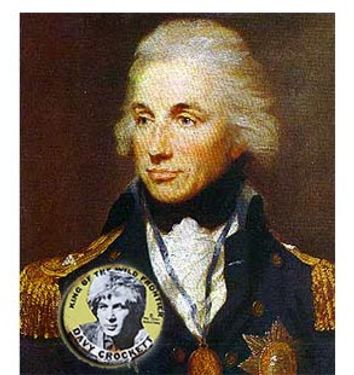
Horatio Nelson (1758-1805) was the hero of Trafalgar. He lost an arm, an eye and finally his life in the service of England. He also fell foolishly in love with somebody else’s wife. Yes, he was married at the time. He paraded around Europe with Lady Hamilton, and wore absurd uniforms. Ultimately, he had a daughter with her, whom they named Horatia. Now there’s a name I wouldn’t want to have to defend on the playground.

Churchill, you say. I knew you’d bring him up. Sir Winston Leonard Spencer Churchill (1874-1965) was a great leader who seems never to have had a mistress. Maybe so, but he was also an insufferable snob. He never wore anything but silk next to his skin, and had champagne with breakfast. Eleanor Roosevelt cringed when he came to town because he kept FDR up late drinking, smoking and talking. His father died of syphilis. And I just read a biography in which his wife had an affair. Which we can understand. The man who came to embody the English lion was definitely not a gym rat. What if the National Enquirer had published a picture of that man naked on the beach? A glance at that physique might have put an end to his political career. Then who would have faced down Hitler for us?

Grant (1822-1885) led the Union armies to victory. He couldn’t get the job today. At West Point he graduated near the bottom of his class. After he briefly demonstrated talent in the Mexican-American War — an unjust conflict that today’s high-minded public would have held against him — his career sputtered and went out. He was a drunk — a drunk still drinking when Lincoln spotted him. (Not to mention his cultural achievements. “I know two songs. One’s ‘Yankee Doodle.’ The other’s not,” he used to say. And he said, “Venice would be a fine city, if drained.”)

Grant didn’t make a very good president, but when it came to war, he knew how to keep at it. Lincoln took a chance on him back then. Today, we wouldn’t even take a chance on Lincoln. He was a melancholic, married to a nutty wife with a dagger for a tongue.

My knowledge of history is not sufficient to do all the Founding Fathers for you, but suffice it to say that Matt Drudge would have had a heyday.

And of course there’s Thomas Jefferson (1743-1826), the man who wrote the Declaration of Independence and who also fathered children with a slave named Sally Hemings and owned slaves. He managed his money so badly that at the end he was afraid he wouldn’t be able to afford the land for his own burial.

The great men of every time have been hounded, I suppose. Socrates was given hemlock. They put Ezra Pound in a cage. Oscar Wilde was jailed. Meet them on the street, we’ll bow and scrape and pull the forelock. Later at the pub, we’ll toast their early death. How dare they be so much better than we are?

Must we always martyr our betters? Maybe. But let’s not be so quick about it. Let them fly the airplane first. Let’s make certain that the dirt we’ve found has some bearing on the job we need done. Let’s make sure it’s caution we’re acting on and not envy, or simple malice.

Listen, I understand the compulsion. I’ve always been a goody-two-shoes myself. My father was a much greater writer than I am. He was also famously unfaithful to my mother. I’m faithful to my wife. Tsk-tsking is fun. I wouldn’t want to have to give it up. But remember that this is entertainment, not news.

Having threatened to leave public life, Jackson was back on TV this week with his wife of many years. Both of them were smiling. Let’s smile back. If she can forgive him the brainy activist, then so can we.

We need pilots who can fly and leaders who can lead. We need giants, men and women better than ourselves, and also not as good.

Continue Reading Close

Papa don’t preach

Nobody had to tell me that my dad was drunk. Now I am a dad -- and mum.

  • more
    • All Share Services

Papa don't preach

George W. Bush said he’d kept his bust for drunken driving a secret because he didn’t want his twin daughters to know. When the question arose if it wasn’t better to tell children the truth, Dubya didn’t answer. It pains me to say good things about George W. Bush, but I don’t think I would have answered either. Not if the children were listening. Nor would I write this, if I thought they read Salon.

I used to be a full-disclosure father. I delighted my tiny sons with stories about shooting friends with BB rifles. I trotted out my nastiest and most obscene jokes. We laughed and laughed.

Then I heard that one of the boys had been repeating the jokes at school. He might easily have been suspended. “What if they don’t find the BB gun stories amusing either?” I thought. “What if they find them instructive instead?”

Since then I’ve inhabited that anxious purgatory of half-truths and omissions where most of today’s responsible parents with “youthful indiscretions” seem to dwell. Information is released in my house on a need-to-know basis. I don’t want my boys to drink. If they do drink, I don’t want them to be alone with their remorse.

When my 14-year-old drank Scotch at a sleepover, he told me about it. So maybe this method is working. Besides it’s only fair that I should know when my children are drinking. I certainly knew when my parents were drinking. Does “always” ring any bells?

What strikes me most forcefully about the Dubya bombshell is that it is a bombshell at all. It’s extraordinary how far we’ve come, or gone, depending upon your point of view. And how quickly we’ve forgotten.

“Here is the last of that generation of chain smokers who woke the world in the morning with their coughing,” my father wrote in the introduction to “The Stories of John Cheever,” “who used to get stoned at cocktail parties and perform obsolete dance steps like the ‘Cleveland Chicken.’” And boy did they get stoned.

Nothing secret about it either. I was very little when I was taught how to lay my fingers along the side of a crystal glass so that if my father needed four fingers of Bellows Club Bourbon, I knew how to get it. Flattered to be asked, thank you. Nobody had thought up the word “enabler” yet.

I remember one festive evening when a close family friend — a full partner at Morgan Stanley, if memory serves — fell down the stairs to the dining room. It wasn’t the fall that made the evening remarkable, but rather the fact that the banker’s highly polished shoes left scuff marks up above the handrail. Scuff marks, which could be seen and admired the following morning.

My parents lived in a house with a drive that was lined with stone. My mother still lives there, although on more temperate terms. I remember standing out in the drive in the evening and watching as the dinner guests backed up until they hit the stone wall, crushed the lenses of their brake lights and then drove off, the tinkle of broken glass playing against the roar of exhaust.

Home from boarding school, I went barhopping one night, and woke up at 5 a.m. with a splitting headache and the vivid recollection of having been in an accident. I was terrified. I knew boys who had been threatened with Culver Military Academy for less. Finally, I got out of bed. I went down to the drive and examined the car. Then I breathed a great sigh of relief. The family Studebaker was so badly scraped up you couldn’t tell which was my accident, or even if I’d had an accident at all.

I remember sitting in the boot of my father’s red Karmann Ghia when he was driving my girlfriend back to her parents’ house. The car jumped off the road and went right over one of the wooded islands, sometimes left where several roads come together. Large rocks rushed by, branches swept over the hood. We bumped back onto the road and went on as if nothing had happened. Nobody said anything either. What was there to say?

Yes, I’m perfectly aware of the dangers of alcohol. My own beloved father had a terrible fight with the hooch, a fight he very nearly lost. “Allied to my melancholy is my struggle with Demon rum,” he wrote in a letter to his friend the novelist Josie Herbst. “There is a terrible sameness to the euphoria of alcohol and the euphoria of metaphor — the sense that the imagination is boundless — and I sometimes substitute or extend one with the other. My performance is sometimes comical. I leave my typewriter at a quarter after ten and wander downstairs to the pantry where the bottles are. I do not touch the bottles. I do not even look at the bottles and I congratulate myself fatuously on my willpower.”

Drinking seems to me a little like driving a motorcycle, or jumping out of airplanes. Maybe you’ll get tagged. Maybe you won’t.

Please don’t conclude, from all this, that I was primarily a victim of my father’s illness. I was, of course, a victim of my love for him. But then so was he a victim of his love for me. I was a fat, arrogant, lonely little boy. During dinner, I’d get my feelings hurt and go upstairs and hide under the bed. My poor father would climb the stairs after me, lie down on the floor and talk at me through the dust bunnies.

I’d violate parental edicts, go to a neighbor’s house and see Wolfman movies, which left me horrified. I’d wake up at night screaming. I’d go into my parents’ room, crawl in between them, fall asleep and wet the bed.

We did the best we could.

It’s great that people don’t drink or smoke the way they used to. The gains in health and sanity should be substantial. I’m afraid sometimes, that we’ve lost something also. We’re all so scared now. More scared than I was of the Wolfman. We’re frightened of cancer, and of BB guns. We seem also to be afraid of the truth.

Which may be why we so rarely get it.

Continue Reading Close