Bob Johnson

Oscar winner Octavia Spencer honored by hometown

  • more
    • All Share Services

MONTGOMERY, Ala. (AP) — Oscar-winning actress Octavia Spencer is being honored at the Alabama Statehouse, where about 400 people turned out to welcome her.

Spencer won this year’s best supporting actress Oscar for her performance as a maid in “The Help.”

She rode up to the Statehouse in a pink limousine for the Wednesday ceremony. As she stepped out, she was serenaded by the band from her alma mater, Jefferson Davis High School.

A Montgomery native, Spencer told the crowd that she would do whatever she could to see that more movies are made in Alabama. She also cautioned young people in the audience to think twice before heading to Hollywood to become a movie star.

Spencer was then honored by a joint session of the Legislature.

Former Teacher Accused Of Sex Abuse Was Popular

  • more
    • All Share Services

Former Teacher Accused Of Sex Abuse Was PopularGraphic shows key events in career of former teacher(Credit: AP)

ALABASTER, Ala. (AP) — Children used to clamor to get into Danny Acker’s classes, and he was so popular he was once named his elementary school’s Teacher of the Year.

But authorities in this well-to-do Birmingham suburb are offering a starkly different picture: a serial child molester who police say admitted sexually abusing more than 20 girls — some as young as 9 — over the course of a long classroom career.

Troublesome clues emerged when Acker was investigated by a grand jury in the early 1990s, but he continued teaching. When he retired after 25 years, he was so well regarded that the district kept him on as a substitute bus driver.

Now the community is questioning the trust it placed in Acker after a former female student alleged that Acker molested her in 2009. Police arrested him Thursday and on Friday added another count involving a second former female student.

District Attorney Robbie Owens said the case remains under investigation, and more charges are likely as police encourage any other victims come forward.

Deputy Police Chief Curtis Rigney said Acker admitted molesting the first girl who complained and many others, but he wouldn’t give names.

“We’re barely scratching the surface here,” Rigney said. “There is so much information we don’t know.”

Acker is jailed on $545,000 bond. His attorney did not return phone calls or an email seeking comment.

School officials and former students in the tight-knit community were shocked because many people knew Acker as the likable teacher known for driving around in his green Volkswagen convertible.

“He was my favorite teacher I ever had,” 21-year-old Jared Robertson said Friday.

He said Acker always had a smile and made class fun. He said students divided teachers into “nice” and “strict” groups, and everyone considered Acker “nice.”

“He was never creepy or anything like that,” Robertson said.

School officials said students sought to get in Acker’s classes.

“He was well-respected and often requested by parents. We did not have any reason to expect anything like this was going on,” district spokeswoman Cindy Warner said.

Acker, 49, is the son of a longtime county commissioner, Dan Acker. His is married, has children and helped with a church youth group in addition to teaching.

His brick home stands across the street from a Southern Baptist church and day-care center. Officials at the center declined to comment Friday, as did a man who answered a knock at Acker’s front door.

He taught at three of Alabaster’s four primary schools: Thompson Elementary, Creek View Elementary and Thompson Intermediate, which are all operated by the Shelby County school system.

District officials said Acker changed schools as new buildings went up and classes were shifted.

The only blemish on his record occurred in October 1992, when he was placed on leave because a child accused him of touching her improperly. A grand jury reviewed the case and did not return an indictment.

The school board decided unanimously in February 1993 to return him to his fourth-grade classroom at Creek View. His fellow teachers chose him that year to be their Teacher of the Year.

School officials said they never got another complaint.

A former Creek View student, speaking on the condition of anonymity because of the sensitivity of the case in the small town, said Acker liked to hug girls and made a point of keeping up with former students for years.

“He was always one of my favorite teachers because I only had him for an hour a day, but he cared about us all so much,” said the former student, who is now grown.

___

Associated Press Writer Jay Reeves in Birmingham contributed to this report.

Continue Reading Close

Ala illegal immigration law tougher than Arizona’s

Alabama schools will soon have to check if students are in the country legally

  • more
    • All Share Services

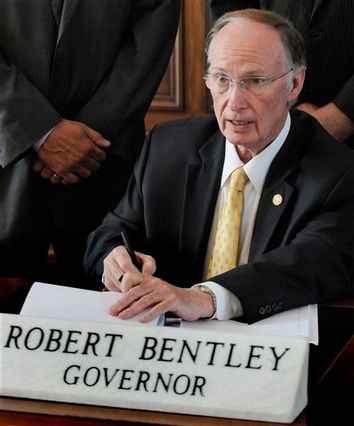
Ala illegal immigration law tougher than Arizona'sAlabama Gov. Robert Bentley signs into law, what critics and supporters are calling the strongest bill in the nation cracking down on illegal immigration, on Thursday, June 9, 2011 at the state Capitol in Montgomery, Ala. The bill allows police to arrest anyone suspected of being an illegal immigrant if they're stopped for any other reason. It also requires public schools to determine students' immigration status and makes it a crime to knowingly give an illegal immigrant a ride. (AP Photo/Montgomery Advertiser, Mickey Welsh)(Credit: AP)

Alabama schools will soon have to check if students are in the country legally and people stopped for any reason could be arrested on suspicion of immigration violations under a sweeping law being called the nation’s most restrictive against illegal immigration.

Advocacy groups promised to challenge the sweeping measure signed by Gov. Robert Bentley on Thursday, which they call even more severe than the one in Arizona that is being challenged in court.

In addition, it requires all businesses to check the legal status of workers using a federal system called E-Verify and makes it a crime to knowingly give an illegal immigrant a ride.

“It is clearly unconstitutional. It’s mean-spirited, racist, and we think a court will enjoin it,” said Mary Bauer, legal director for the Southern Poverty Law Center.

It takes effect Sept. 1.

Bentley expressed confidence it would withstand any legal challenges.

“We have a real problem with illegal immigration in this country,” he said. “I campaigned for the toughest immigration laws, and I’m proud of the Legislature for working tirelessly to create the strongest immigration bill in the country.”

Alabama has an estimated 120,000 illegal immigrants, a nearly fivefold increase from a decade ago, according to the Pew Hispanic Center. Many of them are believed to be working on farms, at chicken processing plants and in construction.

One of the legislation’s sponsors, GOP Sen. Scott Beason, said it would help the unemployed by preventing illegal immigrants from getting jobs in the state. Alabama’s unemployment rate stood at 9.3 percent in April, the most recent figure available.

“This will put thousands of Alabamians back in the work force,” Beason said.

The Alabama Business Council has not taken a public stand on the law. In neighboring Georgia, some farmers and business owners warned that a crackdown passed recently in that state would make it more difficult to hire the laborers they rely on — many of whom are illegal immigrants.

The Alabama measure instantly puts the state at the forefront of the immigration debate. Organizations such as the American Civil Liberties Union and the Southern Poverty Law Center agreed that it is the nation’s toughest crackdown on illegal immigration.

Linton Joaquin, general counsel for the National Immigration Law Center in Los Angeles, said the Alabama law covers all aspects of an immigrant’s life.

“It is a sweeping attack on immigrants and people of color in general. It adds restrictions on education, housing and other areas. It is a very broad attack,” Joaquin said.

Among other things, the law makes it a crime for landlords to knowingly rent to an illegal immigrant.

Another provision makes it a crime to transport a known illegal immigrant. Arizona’s law appears narrower: It includes language against human smuggling and makes it illegal to pick up laborers for work if doing so impedes traffic.

Alabama’s law also goes further in requiring schools to check the immigration status of their students. The measure does not prohibit illegal immigrants from attending public schools; lawmakers said the purpose instead is to gather data on how many are enrolled and how the much the state is spending to educate them.

Jared Shepherd, an attorney for the ACLU, warned that because of that provision, some immigrant parents may not send their children to school for fear of arrest or deportation.

Activists such as Shay Farley, legal director of Alabama Appleseed, an immigrant advocacy group, said the bill invites racial profiling not only by law enforcement officers but by landlords and employers.

“It’s going to make us profile our neighbors and our church brothers and sisters,” Farley said.

Alabama’s Hispanic population more than doubled between 2000 and 2010 to 186,000, or 3.9 percent of the state’s nearly 4.8 million people, according to the Census.

Some farmers and other small businesses had hoped to be exempted from having to verify the immigration status of employees, fearing the database would be too costly and add too much red tape. Georgia’s law, by contrast, exempts businesses with fewer than 10 employees.

Alabama’s measure was modeled on Arizona’s. A federal judge blocked the most controversial parts of Arizona’s law last year after the Justice Department sued.

That includes the provision that required police to check people’s immigration status while enforcing other laws if there was reason to believe the person was in the country illegally. The case appears headed for the U.S. Supreme Court.

A less restrictive law in Utah also was blocked after a lawsuit was filed. Civil liberties groups have sued to stop Georgia’s law as well.

Continue Reading Close

Lawsuit to Taco Bell: Where’s the beef?

Attorney in class action lawsuit says the chain restaurant's "meat mixture" contains less than 35 percent beef

  • more
    • All Share Services

Lawsuit to Taco Bell: Where's the beef?

An Alabama law firm claims in a lawsuit that Taco Bell is using false advertising when it refers to using “seasoned ground beef” or “seasoned beef” in its products.

The meat mixture sold by Taco Bell restaurants contains binders and extenders and does not meet the minimum requirements set by the U.S. Department of Agriculture to be labeled as “beef,” according to the legal complaint.

The class-action lawsuit was filed Friday in federal court in the Central District of California by the Montgomery law firm Beasley, Allen, Crow, Methvin, Portis & Miles.

Attorney Dee Miles said attorneys had Taco Bell’s “meat mixture” tested and found it contained less that 35 percent beef.

Miles said the lawsuit does not seek monetary damages, but asks the court to order Taco Bell to be honest in its advertising.

“We are asking that they stop saying that they are selling beef,” Miles said.

Irvine, Calif.-based Taco Bell spokesman Rob Poetsch (PAYCH) said the company denies that its advertising is misleading.

“Taco Bell prides itself on serving high quality Mexican inspired food with great value. We’re happy that the millions of customers we serve every week agree,” Poetsch said. He said the company would “vigorously defend the suit.”

The lawsuit says that Taco Bell’s “seasoned beef” contains other ingredients, including water, wheat oats, soy lecithin, maltodrextrin, anti-dusting agent and modified corn starch.

 It’s worth remembering that it is just fast food:

Continue Reading Close

Ala. court rejects $274M verdicts in drug cases

  • more
    • All Share Services

The Alabama Supreme Court on Friday threw out jury decisions awarding the state more than $274 million from three pharmaceutical companies, ruling they did not defraud the state in pricing Medicaid prescription drugs.

The court overturned jury verdicts against the drug companies AstraZeneca, Novartis and GlaxoSmithKline, accused by the state of fraudulently manipulating prices of drugs for Medicaid recpients.

The court ruled 8-1 that the state did not have to rely on the drug companies’ information in deciding what prices to pay pharmacists for prescription drugs for Medicaid recipients. The justices said state officials could have done their own research and determined the correct price.

The court ruled the state is continuing to rely on the same formulas established by the drug companies to set prices.

“The state has never altered its course of conduct since taking issue with the reporting methods,” said the majority ruling written by Justice Tom Woodall.

Justice Tom Parker cast the lone dissent.

More than 70 lawsuits were filed in 2005 by the state against drug companies. The state has settled its lawsuits against 16 of the drug manufacturers for more than $124 million.

Alabama Attorney General Troy King filed the lawsuits, charging them with causing the state’s Medicaid program to pay too much for prescription drugs for poor and elderly citizens.

The state’s case against Wilmington, Del.-based AstraZeneca, the U.S. subsidiary of a British company, was the first to go to trial in February, 2008. The jury initially awarded the state $240 million in damages, but Circuit Judge Charles Price reduced the verdict to $160 million.

Later in 2008, another jury awarded the state $81 million in damages against GlaxoSmithKline PLC, a London-based health care company with U.S. headquarters in Philadelphia and Research Triangle Park, N.C., and $33 million in its lawsuit against Novartis, the U.S. affiliate of a Swiss company with U.S. headquarters in East Hanover, N.J.

In February, a Montgomery jury ordered Sandoz Pharmaceuticals to pay $78.4 million to the state. The Supreme Court has not ruled in that case.

Similar lawsuits have been filed against drug manufacturers by other states. A jury in Kentucky on Thursday ordered AstraZeneca to pay $14.7 million in a case that claimed the company inflated its prescription drug prices for Medicaid reimbursements.

Continue Reading Close