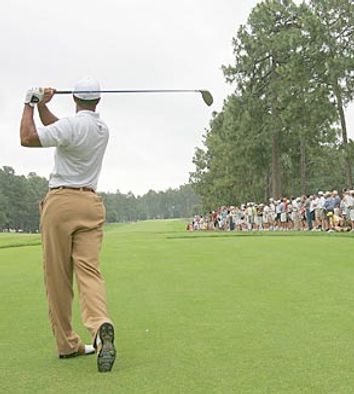
Golf, the Scots warned when they first took wooden shaft clubs to gutta-percha balls on the misty heathers, is a humbling game. For the humiliated professionals currently on the PGA Tour, whether cursed with thin skins or thick heads, it is no longer enough to deal with their over-par duffery by throwing clubs into ponds, as Tommy (Thunder) Bolt perfected the art in the 1950s. Today’s touring pros throw tantrums, not 5-irons.
It’s likely the tantrum set will be at it again at this week’s U.S. Open in Pinehurst, N.C., on the storied No. 2 course. From Thursday to Sunday, the world’s elite golfers, plus a few commoners who lucked out in qualifying rounds, will agonize their way over the kind of course not often seen on the regular PGA Tour, where 63s, 64s and 65s are as common as bogeys on par 5s are rare. In addition to the customary narrow fairways and gnarly rough found at all Open courses, Pinehurst has angular greens shaped like salad bowls, except the bowls are upside down and the salad is at the bottom of the hollowed slope where even the just slightly offline shots end up. Being on the green is no guarantee, either. In 1999, the last year that Pinehurst hosted the Open, John Daly putted off the eighth green — and then was steamed that he couldn’t get back on. He took repeated swipes at the ball, which kept rolling back to him. Finally getting atop the bowl, he holed out for an 11.
For Jose Maria Olazabal, venting at Pinehurst in 1999 after he opened with a frustrating 75 meant slamming his fist into a clubhouse wall. He broke his hand and was out of the tournament.
For those who savor gazing at golf stars suffering ego meltdowns, like people at NASCAR races who enjoy the crashes, the U.S. Open is the peak moment. Remember last June? At Shinnecock Hills on eastern Long Island, the world’s finest golfers became the world’s sorest losers. They whined about fast greens, they groused about hard fairways, they bemoaned pin placements — all that foulness caused by the tournament’s co-host, the U.S. Golf Association. The other host? God, who dared allow a gust or two of wind to break the balm of Gilead.
Shinnecock cold-cocked Tiger Woods, Ernie Els and Vijay Singh. These three demigods alone were 30 over par for the tournament. Twenty-eight players out of 66 couldn’t break 80 on the final round. Among the humbled were Els and Spanish boy wonder Sergio Garcia. Both shot final-round 80s. But they took home $225,000 between them. Instead of taking the money and running, they took it and stayed — to gripe to the media about the course that had proved them mortal. They should have remembered the oft-quoted line from the USGA: “We’re not trying to embarrass the best players in the world. We’re trying to identify them.”
Touring pros, dour and unsmiling as they walk the course, rarely kick back to express outward enjoyment of their play. P.G. Wodehouse analyzed the breed well: “I have sometimes wondered if we of the canaille don’t get more pleasure out of [the game] than the top-notchers. For an untouchable like myself, two perfect drives in a round would wipe out all memory of sliced approach shots and foozled putts, whereas if Jack Nicklaus does a sixty-four he goes home and thinks morosely that had he not missed that eagle on the seventh he would have had a sixty-three.”
Whether literally or figuratively, golf is a walk for the pros. Among professional athletes, they are the most pampered. Enriched by lush prize money at the weekly tournaments — fourth-place finishes alone earn about $250,000 — even average players can afford personal trainers, psychologists, agents, investment managers and swing coaches. Players are lavished with equipment contracts. At tournaments, automobile companies — Buick, Chrysler, Ford — supply them with new cars for the week they’re in town. In the Ben Hogan era, when purses rarely totaled above $20,000, pros worried about three things: lightning, unraked sand traps and talkative caddies. Now they fret about how fast their private jets will be cleared for takeoff by airport control towers.
Pros travel from one private country club to another, a self-enclosed world cut off from the ordinary irks of life. On occasion, they play at a public course like Pinehurst No. 2, which might as well be private, with its greens fees pumped to $315 and caddy fees at $68. Players who can hit shots on the money earn plenty of easy money by wearing corporate logos on their shirts, hats and golf bags. Fred Couples, a contender this week at Pinehurst, picks up spare change by bedecking himself with Cadillac on his shirt, Schwab on his collar and shirtsleeves, Bridgestone Golf on his visor, and Bridgestone lettering on his Brobdingnagian golf bag. Although this commercial trashiness hasn’t sunk to the level of race car drivers suited up as billboards for everything from pizza joints to Viagra, the day is long gone when one could spot only a half-inch Izod alligator on the shirt of a touring pro.
The real pampering by corporate America begins early in the week, at the Monday outings funded by corporations. Name pros can command anywhere from $50,000 on up for enduring a round with CEOs and assorted high-handicap execs whose main problem in golf is that they stand too close to the ball — after they hit it. Lesser pros, the ones who may have won the Tank Town Open 20 years ago, have to settle for what the market can offer: Ten grand is fine for a quick 18. The outings are relaxed affairs for the pros, who have no fear of finishing out of the money. Whether they shoot 65, 75 or 85, an appearance check is guaranteed. At most outings, minimum-wage club employees tool around the fairways in booze carts, pulling up to foursomes wanting the delights of the 19th hole on any of the first 18.
If that succoring is not enough, the pros are allowed to hang-glide high above still another of life’s travails: noise. Total silence is expected from gallery-ites when players are about to swing. Hush, hush, little children, the Great One is deep in thought — the train of it must not be derailed by the click of a camera, the jingle of a cellphone or the burp of a beer gut, much less the heckling, razzing or cowbelling common to other sports. When players go into their pre-hit routine of waggles and twitches, three or four marshals hold up “Quiet” signs, lest spectators forget where they are and bellow out, “C’mon Tiger, hit it a mile.” Or the opposite: Cheering when Tiger hits it out of bounds, the way Red Sox fans go wild when Derek Jeter strikes out in Fenway Park.
A low-decibel peep is enough to get a pro glaring into the throngs behind the ropes. Nastiness may result. Woods, as tightly wound as his Nike golf balls, is so touchy about noise that his caddy-manservant, Steve Williams, has taken crowd control to new depths: snatching or kicking cameras out of photographers’ hands, even before his master is over the ball. As in U.S. foreign policy, preemptive strikes are in order.
In addition to silence, motionlessness in the gallery is required. Caddies routinely yell at spectators to stand still while their man is about to putt, lest his sightline be ruined by a human being’s muscle twitch 50 yards away. Pros who flub shots often gaze pointedly at spectators with accusatory frowns: “See what you made me do?”
This needs to be asked: What’s so difficult about swinging a golf club or so rarefied about a golf tournament that the paying public can’t sound off? Or move. Athletes in other sports can handle it. If basketball players shooting at the foul line aren’t fazed by deafening roars or people waving funny sticks behind the glass backboards, why not touring pros when they’re shooting for the green?
Preparation for the Open at Pinehurst began last week when the tour made its annual stop in the Washington area, this time at the majestic Congressional Country Club in Potomac, Md., for a tournament sponsored by Booz Allen, an international consulting firm. Congressional, as the name suggests, is the playground of political Washington. At the pro-am on June 8, more than 15 members of Congress teed off. None, including Tom DeLay, the reigning freeloader of Congress, had to pay the $6,000 entry fee coughed up by all other amateurs hot to play with a touring pro.
Founded in 1924 during the Coolidge administration by two Indiana congressmen, the club now has 1,100 members, about 250 more than the average U.S. country club. Congressional’s initiation fee is $90,000, and there are 500 people on the waiting list. For decades the fee was waived for members of Congress, but with so many clogging the fairways for free golf, the practice ended in the early 1970s.
Today it’s only presidents who get a pass — up to a limit. During the first years of his presidency, Bill Clinton showed up so often that he became a nuisance. The Secret Service had to clear adjacent fairways, plus post sharpshooters at selected sites. Clinton preferred Saturdays, a crowded day, which meant the course had to be cleared for the presidential retinue. Clinton also had a disturbing habit of bringing along his relatives and pals, who paid no greens fees and chowed down for free in the men’s grill. Finally, the club, its hospitality strained, had to strongly suggest that Clinton ease up. He was soon playing at the Army-Navy golf course or at Andrews Air Force Base.
In the first years of his vice presidency in the early 1950s, Richard Nixon gave Congressional a try. But he found the course — long par 5s, blind shots over hills — more torment than treasure. He went to the shorter, flatter Burning Tree Club two miles away — a hideout of right-wing males who barred women from the grounds except the week before Christmas, when they could enter the pro shop to buy gifts for their husbands. The rule still holds. Nixon, socially stiff and not given to the 19th-hole card games that are a Burning Tree staple, found it easier to bond with the caddies. (One teenage boy in particular who idolized the vice president as his role model was Patrick Buchanan. They would travel the fairways of life together.)
Congressional is misnamed. It ought to be Networkers Country Club, so rife is the large membership with lobbyists, deal makers and favor seekers. Why labor to get access to politicians on Capitol Hill when you can invite them to the rolling and well-flowered hills of Congressional, there to slap backs, rub elbows and close deals — and write off the golf, food and liquor as business expenses?
The Booz Allen tournament proved to be another pushover for the pros. Garcia, the winner, crushed Congressional with a final-round 66 and a 72-hole total of 270 — 14 under par. Together the top 12 players were 116 under par. As happens at nearly every tour stop (except U.S. Opens), the pros humbled Congressional with countless eagles and birdies — the easily caged fowl of pro golf. But now cometh Pinehurst, threatening to push the entitled ones out of their comfort zones. Once again, it’s likely that the game will return to its Scottish roots, as an ‘umbling game.
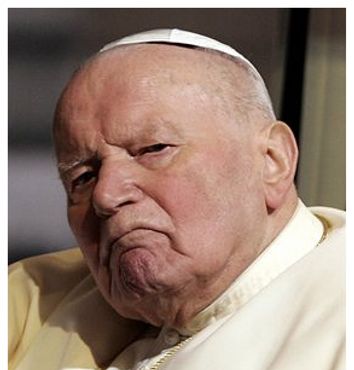
As the secretly elected leader of a male-run, land-rich, undemocratic, hierarchic, dogmatically unyielding organization headquartered in a second-rate European country, Pope John Paul II had few, if any, worries about accountability. He ruled, accordingly, as an autocrat. Organizationally, who could challenge him? Institutionally, he projected an image of a loving shepherd endlessly traveling to distant pastures to bless the flock.
Watch out, though, if he thought you were straying. Then John Paul would “crook” you by the neck and dispatch you to a stony field where black-sheep dissidents could do penance.
He found victims early in his papacy. Enthroned only two years, the pope decided in 1980 that the Rev. Robert Drinan, a 10-year member of Congress from Massachusetts’ 4th District, should get out of politics. Drinan, a Jesuit priest in the Gene McCarthy-Philip Hart wing of the Democratic Party, championed human rights and programs for the poor, and opposed Pentagon militarism. But his voting record on abortion bills wasn’t strictly pro-life.
The archbishop of Boston had no problem with Drinan’s being in politics. His Jesuit superiors had no problem. Paul VI, the previous pope, had no problem. Nor did the voters. But John Paul did. Drinan, who vainly asked the pope to reconsider his decree, obeyed and left Congress.
In 1980 John Paul had other troublesome priests on his hit list. Archbishop Oscar Romero was one. A former conservative who moved to the liberation-theology left when he saw up close the poor killing the poor in El Salvador, Romero was under surveillance by the Vatican. Jonathan Kwitny, a Wall Street Journal investigative reporter and author of “Man of the Century: The Life and Times of Pope John Paul II,” wrote that the pope “was disturbed about Romero.” Cardinals in the Vatican plotted to reassign Romero elsewhere in Latin America. Days after Romero’s March 24, 1980, murder, John Paul telegrammed the president of the Salvadoran Episcopal Conference to express grief at the “sacrilegious assassination.” “Not one word of praise,” wrote Kwitny, was offered “for the slain archbishop.” Speaking to crowds in St. Peter’s Square, the pope then expressed heartfelt grief for Catholic martyrs — in Chad, not El Salvador. Kwitny wrote: “John Paul’s treatment of Archbishop Romero, and his continued treatment of Romero’s memory, are an injustice like no other he has done anyone.”
Another victim of papal wrath was the Rev. William Rewak, a Jesuit who served for more than 20 years as president of two colleges. In September 1998, his order appointed him president of the Jesuit School of Theology in Berkeley, Calif. Neither they nor Rewak foresaw any objections from the Vatican, which had final hiring and firing power because the school offers pontifical degrees. But papal underlings uncovered some 20-year-old writings of Rewak’s on married clergy and women’s ordination that differed mildly from the pope’s view. It was enough to quash the pending appointment, even after Rewak left a college presidency to take the job.
John Paul was a Catholic fundamentalist. Small wonder he is being hailed by Pat Robertson, Patrick Buchanan and George W. Bush. The same ruler who bullied Drinan, Romero and Rewak — only three of many, many — had no objections when prelates of his own stripe dabbled in politics. During last year’s U.S. presidential campaign, for instance, Bishop Michael Sheridan of Colorado Springs, Colo., thundered to his 120,000-member diocese: “Anyone who professes the Catholic faith with his lips while at the same time supporting legislation or candidates that defy God’s law makes a mockery of that faith and belies his identity as a Catholic.” Voters who defy church teachings “jeopardize their salvation.”
Not only could John Kerry, Ted Kennedy, Patrick Leahy and other Catholic pro-choice senators spend eternity in hell but voters might burn with them.
The sorriest scandal during John Paul’s long stint was his refusal to transform Roman Catholicism into a peace church. It remains polluted by the just-war theory, devised by Augustine in the fifth century and advanced by Thomas Aquinas in the 13th. The pope opposed the two U.S. invasions of Iraq, but he never renounced the notion that war can be justified. French Cardinal Jean-Louis Tauran said during the start of the second Iraq war that “the Holy See is not pacifist.” The church has more than 1,500 canon laws. Not one applies to war-making.
With large numbers of American Catholic priests, nuns and lay people imprisoned for antiwar civil disobedience during the 27 years of his papacy, John Paul never once spoke out in their support. Nor did he visit any of them in prison during his seven trips to this country. Those Catholics who want membership in a peace church have a better chance with the Quakers, Mennonites or Church of the Brethren.
These old-line peace churches aren’t much for dogmas, decrees, doctrines or other rubrics favored by John Paul. They favor loving their enemies, laying down their swords, sharing their wealth and doing good to those who harm them — odd notions indeed, but ones that helped an upstart religion get footing 2,000 years back.
At best the chances are slim that the next pope, either spiritually or organizationally, will be able to undo the deep factionalism created by John Paul. Recent years have seen shelves sagging under the weight of books about the church’s problems. A partial listing includes “Catholics in Crisis” by James Naughton, “The Dysfunctional Church” by Michael Crosby, “Toward a New Catholic Church” by James Carroll, “The New Anti-Catholicism” by Philip Jenkins, “Will Catholics Be Left Behind?” by Carl E. Olson, “Papal Sin” by Garry Wills, “Goodbye, Good Men” by Michael Rose, “Goodbye Father” by Richard Schoenherr, “Tomorrow’s Catholics/Yesterday’s Church” by Eugene Kennedy, “In Search of American Catholicism” by Jay Dolan, “A People Adrift: The Crisis of the Roman Catholic Church in America” by Peter Steinfels, “The Coming Catholic Church” by David Gibson and “Why Catholics Can’t Sing” by Thomas Day.
The most prominent faction, at least at the moment, is the traditionalist one that has been summoned by the media to the airwaves and Op-Eds, there to hail the late pope as having been the fearless defender of all the rules that make The One True Church still true and still one. This faction, ever rankled at what Pope John XXIII wrought with the Second Vatican Council of the early 1960s — every loony idea from altar girls to the handshake of peace at Mass — saw in John Paul a no-nonsense leader. They cheered him for not yielding on the below-the-waist issues: artificial birth control, abortion, homosexuality, gay marriage. The traditionalists tend to be both theologically and politically conservative, with Antonin Scalia, Rick Santorum, Patrick Buchanan, William Bennett, Sean Hannity, Robert Novak, William F. Buckley, Phyllis Schlafly and Mel Gibson side by side in the pews.
The spiritual Catholics are those who see the papacy as irrelevant to their lives. When they pray, it isn’t the prayer of asking, as though God, or Mary hailed by rote, dispensed favors, but the prayer of cooperation: Cooperate with the gifts you’ve been given and use them to become someone who is other-centered, not self-centered. If anyone speaks for them, it may be Leo Tolstoy in “The Kingdom of God Is Within You”: “Christ could certainly not have established the Church. That is, the institution we now call by that name, for nothing resembling our present conception of the Church — with its sacraments, the hierarchy, and especially its claim to infallibility — is to be found in Christ’s words or in the conception of the men of his time.”
The pragmatic Catholics stay grounded in early church Christianity, when it was the works of mercy and rescue that kept the community together and when people practiced communism — the pure communism of the commune. The lines from the Acts of Apostles speak to them: “All believers were together and had all things in common. And those who had possessions sold them and divided to each person according to need: Not one of them spoke of the property he possessed as his own.”
These are the Catholic Worker Catholics, those who carry on the labors of Dorothy Day, who opened not homeless shelters but houses of hospitality. More than 100 of these houses can be found today, 25 years after Day’s death, in both large cities and rural farming towns. Pragmatic Catholics remain loyal to the Christ described by Phillips Brooks in 1883: “In the best sense of the word, Jesus was a radical: His religion has so long been identified with conservatism that it is almost startling sometimes to remember that all the conservatives of his own times were against him, that it was the young, free, restless, sanguine, progressive part of the people who flocked to him.”
Better than anyone, pragmatic Catholics understand the long-standing quip “Jesus came preaching the Gospel and ended up with the church.”
John Paul, the traveling man, was helpless to keep American Catholics in line, however hard he tried. Who else did he have in mind in his railings against consumerism and hedonism? Had he stopped fuming about the rebellious Americans, he might have noticed that, with some millions attending Mass regularly in 19,000 parishes and giving more than $7 billion annually to the Catholic Church, the United States has the flock with the strongest faith in the developed world. David Gibson, a Protestant-born journalist who once worked for Vatican Radio, wrote accurately: American Catholics “are the most religiously observant Catholics in modern-day Christendom, attending church and supporting the pope to a degree that has no parallel in the industrialized world.”
Someone might want to clue in the new pope.
Continue Reading
Close
Adult Roman Catholics with sharp
memories can recall priests and nuns of
their childhoods offering advice on
confessing sins — “going into the box,”
as the phrase went. Be specific, be
contrite and promise to sin no more.
Of those three standards for true
repentance, Pope John Paul II, in his
March 12 plea for divine forgiveness for
sins committed by his church in the past
2,000 years, met only one. He was
contrite.
On specific sins, the pope offered the
incense of smoky generalities. Not
included in John Paul’s confession were
the names of earlier sinner popes, most
now remembered only by hagiographers, or
Catholicism’s public crimes that were
sanctioned by churchmen or doctrine.
Specifics were also absent from the
19,000 word
href="http://www.vatican.va/roman_curia/
congregations/cfaith/documents/rc_con_cf
aith_doc_20000307_memory-reconc-itc_en.h
tml">document “Memory and
Reconciliation: the Church and the
Faults of the Past” that accompanied the
papal self-pardoning. “Past faults” and
“scandals of the past” cover a multitude
of undefined sins.
The pope’s vagueness raises a question
– not about past sins but about
possible current ones.
For what sins of today’s church might a
pope in the year 4000 — perhaps John
Paul XXXIV — be begging forgiveness?
What policies of today’s Vatican will be
weepingly regretted 10 or 20 centuries
from now?
Start with violence. At no time in John
Paul’s papacy has he renounced the
church’s just-war theory. He has never
wavered from Catholic teaching that
violence can be used to repel violence.
With some 35 wars or conflicts currently
bloodying the Earth, and with as many as
40,000 deaths a month — mostly the poor
killing the poor with weapons made in
rich nations — where is any statement
by the pope calling on Catholics to
refuse to cooperate in any way with
military violence? It is accepted as
normal that Catholic colleges in the
United States host ROTC programs, that
Catholic priests serve as military
chaplains, that Catholics pay federal
taxes that guarantee the Department of
Defense $700 million a day, that
Catholics work for weapons companies,
that Catholic pilots bomb people in Iraq
or Kosovo.
Catholics who reject church teaching on
the just war can expect no support from
John Paul. In the early 1980s,
Archbishop Raymond Hunthausen of Seattle
refused to pay that portion of his
federal income taxes — about 50 percent
– that went to the Pentagon. He
received no personal or moral support
from the Vatican.
The opposite message came through. Near
the time of the Hunthausen war tax
revolt — which philosophically aligned
him with many members of the three
traditional peace churches, the
Mennonites, Quakers and Church of the
Brethren — John Paul was appointing
John O’Connor the archbishop of New York
and, soon after, consecrating him a
cardinal. O’Connor had been a Navy
chaplain, rising to the rank of rear
admiral, during the Vietnam War.
Hawkish, he wrote a 1968 book stoutly
supporting U.S. military policies in
Southeast Asia. At the time of
O’Connor’s appointment to the nation’s
richest diocese, the pope was widely
reported to have said, “I want a man
just like me in New York.”
During World War II, Catholic bishops in
both France and Germany were claiming
that their side was waging a just war.
In June 1982, the pope visited
Argentina, a nation then at war with
Britain. The Argentine clergy supported
their government’s warmaking. On
arriving at the Buenos Aires airport,
they and the junta’s generals piously
surrounded John Paul, with banners in
the background saying “Holy Father,
bless our just war” and “May God defend
our cause because we defend His.”
Philip Berrigan is caged in the
Baltimore County Detention Center
awaiting a trial scheduled to begin
Monday on counts of sabotage, malicious
destruction of property, conspiracy and
trespass. On Dec. 19, he and three
other pacifists attempted to disarm two
A-10 Thunderbolt warplanes at the
Warfield Air National Guard facility in
Essex, Md. This type of plane was the
main delivery system for deadly depleted
uranium in Iraq and the former
Yugoslavia.
Berrigan, his wife Elizabeth McAlister,
his brother Rev. Daniel Berrigan and a
full cellblock of other pacifists have
been repeatedly imprisoned for their
conscientious objection to U.S.
militarism. They see Christianity as a
religion of nonviolence, based on the
love of enemies and resistance to the
power of Caesar and pharaohs. One
possible reason for John Paul’s lack of
support for these members of his flock
is their refusal to support church
leadership.
In his 1996 book “Fighting the Lamb’s
War: Skirmishes With the American
Empire,” Berrigan writes that the church
“is even more conservative, perhaps,
than our government. Not conservative in
the sense of ‘conserving’ the Gospel,
but in maintaining useless rituals and
policies that are designed to protect,
and perpetuate, the institution.” He
continues, “To guarantee this, control
of the clergy and Catholic laypeople is
essential.”
What, then, might a more thorough
apology from the pontiff have sounded
like? “If the church wanted to come to
grips with the Gospel,” Berrigan writes,
“it would have to give up its property
and its exemptions from the state, and
involve itself with resistance on a
major scale. It would have to resist the
violence against our poor, and stop
pretending that one political party is
more humane than the other.”
Is this the bile of an
authority-loathing crank or the words of
a prophet calling power to
accountability? History supplies the
hint of an answer. We look back at
Francis of Assisi of the 13th century,
or Teresa of Avila of the 16th. Both
were blunt-speaking truth-tellers,
critical of church leaders. Francis
joined the church’s Fourth Crusade but
after seeing the killing and gore of the
first battle, deserted. He returned to
his hometown to serve poor people.
Once long dead, and their devoutness
more remembered than their dissidence,
both Francis and Teresa were canonized
saints.
The churchmen who gave little support to
Francis and Teresa must be forgiven,
their misdeeds surely included in the
general absolution given March 12 by
John Paul. Until a few more centuries’
worth of sins pile up and a future pope
calls for Forgiveness Round II, it’s
only speculation as to whom the church is
sinning against today.
We’ll know more later.
Continue Reading
Close