Edward M. Gomez

“Musharraf has much to answer for”

After Bhutto's death, the press in South Asia and Europe fear for democracy's future in Pakistan, which could go up in "turbulent smoke and bloody dust."

  • more
    • All Share Services

Tragedy. Chaos. Shock.

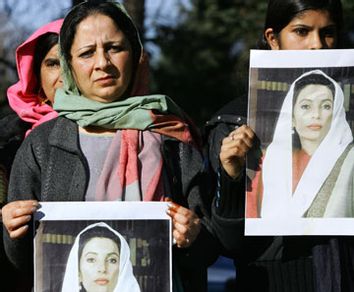
Those words — and premonitions of more dangerous uncertainty to come — have turned up routinely in the first wave of overseas news media reports and commentaries focusing on yesterday’s gun-and-bomb assassination of Pakistani politician Benazir Bhutto in Rawalpindi, an army-garrison city just south of Islamabad, Pakistan‘s capital, in the northeastern part of the country. The attack reportedly killed up to 30 other people.

Her “unbelievable and stunning” death, notes an editorial in the News, a Pakistani daily, “throws … the painfully excruciating march of the country towards a democratic polity, the carefully crafted plan for a peaceful transfer of power to an elected leadership and the reluctant strategy of an authoritarian regime to yield to the will of the people up into turbulent smoke and bloody dust.”

Bhutto, a two-time former prime minister, was the daughter of Zulfikar Ali Bhutto, Pakistan’s first popularly elected prime mister (who was deposed in a military coup in 1979 and later executed). Facing what she said were politically motivated charges of corruption and mismanagement while serving as P.M., Benazir Bhutto went into exile in 1999. In October of this year, she returned home to lead the Pakistan People’s Party in its campaign for parliamentary elections that were expected to take place in January.

Notes the News: “Bhutto was expressly aware of the threat to her life and she had been saying so publicly …That is probably why she did not bring her immediate family, husband Asif Ali Zardari and [their] three children, back to Pakistan … She had been pointing fingers at the retired elements in the state intelligence agencies, those who had themselves turned into religious fanatics or supporters of violent extremism, saying that they were after her because she supported a moderate and liberal Pakistan.”

France’s Le Monde states plainly that, as a result of “her battle against Islamism,” Bhutto had become “a target of [Muslim] extremists.” The paper’s Islamabad-based correspondent reports that she had been “targeted by a radical-Islamist fringe ever since she accused the government” of Pakistan’s U.S.-backed dictator, President Pervez Musharraf, “of not fighting hard enough against the extremists.” In Germany’s Der Spiegel, journalist Nadeem Wahid Siddiqui, a contributor to the Deutsche Welle news service, notes that on the campaign trail, Bhutto “had announced that she would go after fundamentalist-Muslim schools and terrorists.” Siddiqui adds that, given the hard-line position of Muslim militants who opposed everything she stood for, Bhutto had effectively spelled out “her death sentence” by voicing such intentions.

In India, the Hindustan Times observes: “Pakistan has fallen off the edge … [Bhutto's] death not only signifies how deeply mired in violence Pakistani politics is but it also points to the total change in the political atmosphere that [country] has undergone … under the leadership of Pervez Musharraf. This was no assassination in some jihadi corner of Pakistan. It took place in the garrison town of Rawalpindi, the heart of Pakistani Army-ruled Pakistan … It is too early to say who or which institution was behind the murder. But it has proved to be too late for … Bhutto and for any chances of believing … Musharraf’s insistence that democracy in Pakistan is only an election away.” Switzerland’s Neue Zuercher Zeitung notes that Bhutto’s murder now “puts the election in Pakistan in question.” More precisely, the Hindustan Times adds in its editorial, “It seems impossible now for elections to go ahead in the foreseeable future, not least because of one contender being horrifically taken out of the contest, but also because elections are the farthest thing from the mind of the people of Pakistan. With [yesterday's] deaths, it seems that the post-9/11 destabilizing forces in Pakistan have been joined by more sinister, historical forces that mark their presence throughout the country’s bloody history.” As the Indian daily sees it, Musharraf, who only recently reluctantly stepped down as the head of Pakistan’s army, a job he held even while serving as president, has a lot of explaining to do. The paper advises: “Musharraf has much to answer for. For Pakistan has come to this. The light of Larkana [Benazir Bhutto's hometown] has gone out of Pakistan. With it, so seems any chance of peace, never mind of democratic peace, in that unfortunate, unfortunate land.”

So far, no one in the Bush administration, which has showered Musharraf’s regime with billions of U.S. taxpayer dollars for assistance in its aimless “war on terror,” has dared to point an accusatory finger at the dictator or his minions for Bhutto’s murder. However, Italy’s Corriere della Sera and other news outlets report that Bhutto’s husband plainly asserted, referring to Musharraf: “It is the work of the government.”

Nawaz Sharif, another former prime minister of Pakistan whom Musharraf’s government had banned from taking part in the forthcoming parliamentary elections, also stated unequivocally after the assassination: “Pervez Musharraf is responsible and accountable for what happened today … I hold his policies responsible for landing this country into [this] terrible mess … Nobody has confidence in Musharraf. Everybody wants him to step down….” (Indo-Asian News Service)

For the Pakistani newspaper the Nation, the killing of Benazir Bhutto has left Pakistan “badly bruised and in a state of utter shock.” Musharraf has called for three days of nationwide mourning; banks, government offices and schools will be closed. Regularly scheduled trains have been cancelled, along with domestic flights of PAI, Pakistan’s national airline. The Nation wags a finger at Musharraf and warns that, while his “appeal for calm at this critical hour is appropriate and must be heeded,” this should also be “a moment of reflection for him” about how “pervasive and dangerous the extremist mindset, not much in evidence in the 1990s, has become since he joined hands with the U.S. in its so-called war on terror. He should be taking steps to pave the way for the restoration of real democracy.”

However, notes an Indo-Asian News Service news analysis, the assassination of Bhutto “totally derails the American-sponsored plans [for] ushering in democracy in Pakistan. In the absence of Nawaz Sharif, who has been barred from contesting the polls, the January election will lose whatever the modicum of credibility it might have had and should ideally be postponed. The West had hoped … Benazir [Bhutto] would provide a secular alternative to Musharraf and [help] channel the opposition to [his] regime through a secular political party.” Now, though, within the Pakistan People’s Party, Bhutto has no immediate, obvious successor. IANS notes that her husband, “who is powerful” within the organization, “is not popular with the masses” and lacks his late wife’s charisma.

Yesterday’s assassination, IANS reports, “has put the Musharraf government in [a] bind. If it goes ahead with the elections in the absence of Benazir [Bhutto] and Nawaz [Sharif] as candidates for the post of prime minister, they will not have any credibility. On the other hand, if it cancels them, it will be a major psychological victory for the militants … Assassination of arguably the most popular leader of Pakistan is extremely dangerous for the Islamic state. It shows that the state created on the basis of an exclusivist ideology that abhorred pluralism is finding it extremely difficult to make a transition to a democratic moderate state.”

By contrast, in Britain, the Times‘ foreign-affairs analyst, Bronwen Maddox, argues that Bhutto’s assassination “does not mean the death of democracy in Pakistan — provided that elections are held soon.” Maddox believes Bhutto’s PPP “will very likely want the polls to go ahead.” After all, if the slain political leader’s party “can produce a plausible leader, [it] could hope to sweep to a powerful lead on the back of the ‘martyr effect.’” Meanwhile, “Britain and the U.S. are also likely to argue that elections are the best way to retrieve stability,” and Bhutto’s “fervent supporters will blame Musharraf” for yesterday’s murder. That could be risky, Maddox notes. Yesterday alone, violent protests broke out in several cities in Pakistan following the news of the assassination. Musharraf has warned that the country faces the threat of similar unrest erupting nationwide. If it does, Maddox predicts, “judging by his recent reflexes, Musharraf may well invoke that threat of violence as justification for a new security crackdown.”

The Financial Times cites New Mexico Gov. Bill Richardson, a candidate for the Democratic presidential nomination and a former U.S. ambassador to the United Nations, who, in response to the news of Bhutto’s murder, said: “President Bush should press Musharraf to step aside, and a broad-based coalition government, consisting of all the democratic parties, should be formed immediately. ” Richardson emphasized that it is in the “interests of the U.S. that there be a democratic Pakistan that relentlessly hunts down terrorists.” He said: “Musharraf has failed, and his attempts to cling to power are destabilizing his country. He must go.”

Time to buy a Warhol

With financial markets weakening, VIP collectors take their investment dollars to Basel Miami -- the nation's primo art fair -- to shop, shop, shop!

  • more
    • All Share Services

Time to buy a Warhol

Thanks, in large part, to George W. Bush‘s no-end-in-sight war spending, the once-mighty dollar is tanking, a development that recently prompted a senior People’s Bank of China official to note that the greenback is “losing its status as the world currency.” Meanwhile, U.S. real estate values are reeling from the subprime mortgage crisis. The British pound, stronger than ever, now costs American tourists two dollars a pop. Even Jay-Z is letting his audience know he knows where the money is — the money that matters. In his latest video, “Blue Magic,” the rapper cruises through the Big Apple flashing wads of crisp, sexy, colorful euros.

It’s time to buy a Warhol.

Given the jitters in the money and real estate markets today, it’s probably no surprise that many investors have turned to art. Driven by an unprecedented global buying spree of everything from hot-ticket contemporary works to time-proven choices from Picasso to pop, works of art have become a de facto international currency in their own right. In mid-November, collectors and art dealers spent $315.9 million at Sotheby’s New York on modern and contemporary works in one two-hour auction sale alone; in London, Russian millionaires have become important buyers at auctions, and in Beijing, the Dashanzi gallery district in a former industrial zone has quickly become a must-see destination for jet-setting art mavens hoping to discover the next Yue Minjun or Zeng Hao. Yue, a sculptor, and Zeng, a painter, are already hot properties in art centers like Los Angeles, New York and London, far beyond their homeland. (Prices at the top auction sales in London and New York are now denominated in Russian rubles along with listings in dollars, euros, British pounds and Japanese yen.)

The frenzied buying and selling that characterize today’s international art market have found their locus at the Art Basel Miami Beach fair (Dec. 6-9), which has brought together some 200 of the most pace-setting galleries from around the world, representing more than 2,000 artists in every creative category, from painting and sculpture to photography, video and sound art. ABMB, an offshoot of Switzerland’s long-running summertime Art Basel, Europe’s leading annual fair, first opened in 2002 and quickly became the most important of the many art fairs that take place around the United States each year. Its impact has been so sudden and so powerful — besides pumping countless millions of dollars into Miami‘s tourism-dependent economy — that it has spawned dozens of satellite fairs that take place at the same time, including Scope Miami, Pulse, the NADA (for “New Art Dealers Alliance”) Art Fair, Red Dot Miami Beach, Photo Miami and Aqua Art Miami. Some of these other fairs have something of an alternative air, like Red Dot, which takes place in a hotel in the South Beach district. Smaller, regional galleries from around the United States, but also well-known outlets like Nancy Hoffman Gallery, from New York, rent guest rooms, throw out the beds and, for a few days, set up shop. The ambience is fun and folksy, with none of the “VIP vs. ordinary people” hierarchy that prevails at Art Basel Miami Beach. Then there’s a fair like Aqua Art Miami, which takes place simultaneously at two venues, the Aqua Hotel in trendy South Beach and a space in the new Wynwood district of warehouses that have been converted into galleries, perfectly embodying the fusion of art, design, fashion and entertainment sensibilities that now fuels the vibe of Miami chic.

During the first week of December, though, Art Basel Miami Beach is the undisputed epicenter of the city’s art-feeding frenzy. Overpriced and unabashedly elitist, the fair charges $14 for a plastic-flute splash of champagne and $30 per adult for admission ($10 more than the Museum of Modern Art in New York) and, like a rock concert, started selling tickets via Ticketmaster back in October. “The VVV of the VIPs,” as one financial advisor referred to the richest customers in attendance, are pampered in restricted-access lounges, where their art-buying consultants or curators and private bankers hover around them, helping them to determine where best to drop their next million. For if, in little people’s money, $10 is the new $1, in this world, $1 million is more like the new $100,000. Art Basel Miami Beach’s main corporate sponsor is UBS (originally Union Bank of Switzerland; in 2000, the bank merged with PaineWebber to form a global financial-services corporation).

Pausing to take in the minimalist display at the stand of Galería Elvira González, from Madrid, four helmet-haired, Palm Beach-style matrons chatter about two footlocker-size blocks of steel and a large abstraction made with paintstick (oil paint in a crayon form) by artist Richard Serra. “How much are the sculptures and the painting?” one of the women asks. Without looking up from his laptop, the young man at a clutter-free table responds: “One point two each” (as in $1.2 million). Checking his on-screen price list, he adds: “And 380 for the paintstick.”

The would-be buyer returns to her group and says, “Three-hundred eighty. That’s not bad.” The women move on. At this fair, no one bothers to append “hundred thousand” or “million” to quoted prices. Extra zeroes are understood.

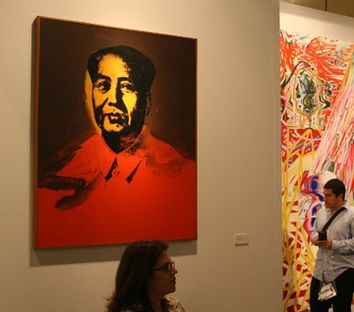
“It’s all about quality; collectors at every level are looking for the very best works,” notes a representative of New York’s blue-chip Acquavella Galleries. On the wall behind her desk, looking out over the hubbub of the fair: a 1973 silkscreen portrait by Andy Warhol of that late high priest of vitriol against “counterrevolutionary capitalist running dogs,” Mao Zedong. Price tag for the picture of communist China’s founding father: $12 million.

That canvas sold during the first few hours of the fair. Elsewhere, Gmurzynska, a gallery from Zurich specializing in classic mid-20th-century modernist works, was offering, mounted on a delicate rod-pedestal, a sponge painted by the French avant-garde artist Yves Klein (1928-1962) in his signature electric blue, for $1.2 million, and a small early Willem de Kooning painting of blue and pink geometric forms for $950,000.

“I’m sorry,” a dealer at another stand replied apologetically when asked the price of a shimmering, bushy pile of white-metal strips by the American artist John Chamberlain, “but it’s taken.” The work by the American artist who is best known for his abstract sculptures crafted from junk-car metal had sold for $2 million.

“Go ahead, take a look; I’m just standing here to protect the work,” New York dealer Jeffrey Deitch of Deitch Projects said invitingly as he stood at the entrance of his stand during ABMB’s preview for VIPs the night before the fair opened to the hoi polloi. One of the most influential contemporary-art dealers in the world, Deitch is known for spotting and promoting emerging talents who often go on to become international stars. Decked out in one of his customary Italian-made bespoke suits — this one was creamy yellow — Deitch shielded from the crush of onlookers a crystal, chrome and 24-carat-gold low-rider bicycle on a mirrored platform made by the Chicago-based Puerto Rican artist Dzine.

By the opening of the first full day of the fair, news had spread that, for $35,000, a foundation in Spain had scooped up Dzine’s super-bling-bling bike. Also on view at the Deitch Projects stand, where DJ Spooky stopped by on Thursday to survey the merch: a life-size male-nude portrait in a dreamy-realist mode by newcomer Kurt Kauper ($90,000); “A Dead Soldier” ($120,000), a 5-foot-high, 12-foot-wide oil-on-canvas painting by Kehinde Wiley, a young black artist who paints hip-hoppers against elegant decorative backgrounds and in mock-classical compositions; and a now-iconic — for Jeff Koons, at least — Koons sculpture, “Jim Bean, Log Car.” For $1.65 million, the 1986 casting in stainless steel of an actual, imaginatively shaped Jim Bean bottle came complete, its title card on a nearby wall indicated, with a supply of bourbon inside.

“Everybody’s happy, everybody’s having a good fair; there’s something for everyone here,” a dealer from South America beamed as he graciously shooed away a reporter from his stand. “I’m sorry, but we need a little privacy now,” he said, as he made way for a visitor from New York. “We have a meeting with a curator from the Museum of Modern Art.” Apparently, everyone was at least looking, if not always shopping, too; numerous curators from American museums, including the new Nasher Museum of Art at Duke University, in North Carolina, scoured the fair along with packs of their respective institutions’ wealthy benefactors in tow. The curators were making wish lists of works they hoped their moneyed supporters might acquire and lend or someday bequeath to their respective art palaces.

Meanwhile, buying and selling — and hoping for good investments and planning where to put them — continued feverishly into the weekend. After all, as one dealer at Art Basel Miami Beach told London’s Art Newspaper, “A lot of people have private museums.” In a collector-driven market, owning that kind of real estate, no matter how low the dollar falls, may be the most enduring status symbol of all.

Continue Reading Close

Is “Samson and Delilah” a fake?

Just in time for London's big Rubens exhibition, a challenge to one of the heroic Flemish painter's most celebrated pictures heats up again.

  • more
    • All Share Services

Is

There are few things the art world loves more than the whiff of scandal — except, of course, a genuine, full-blown scandal. The bigger the money, the reputations of the power players and institutions, or the assumptions and authority of the art history that are involved, the better.

Now, as London’s august National Gallery, home to one of the world’s great collections of European art, trots out more than 100 drawings and paintings by the 17th century Flemish master Peter Paul Rubens in a blockbuster survey, “Rubens: A Master in the Making” (on view through Jan. 15), a long-standing controversy surrounding one of the highlights of the show has resurfaced. At issue: the authenticity of “Samson and Delilah,” the celebrated painting from around 1609-10 that depicts the Old Testament hero Samson in the lap of the lover who betrayed him. The work was made for Nicolaas Rockox, a well-known city-government official in Antwerp, Belgium, just after Rubens returned to that city after eight years in Italy.

The dispute over its authorship pits the Athens-based artist, author and independent scholar Euphrosyne Doxiades and her supporters — unassuming Davids in a story about an artist whose subjects were often drawn from history and myth — against the Goliath of one of the world’s most venerated art repositories.

So could the National Gallery’s “Samson and Delilah,” for which it paid more than $5 million at a 1980 Christie’s auction — a record at the time — be a fake? After years of study, Doxiades believes there is ample evidence that the painting may not be the masterpiece the National Gallery believes it owns — enough evidence to, if not prove her case, at least warrant an open investigation. Among the criticisms, Doxiades and other challengers say the composition of the painting is not the same one that must have appeared in Rubens’ original; they believe the picture is painted in a style that is more heavy-handed than the master’s own renowned style and they also find it odd that, in the dramatic image, one of Samson’s feet is truncated. (The hero’s essential extremity is not fully depicted within the pictorial space.)

“Rubens is the painter’s painter par excellence; as a colorist and a draftsman, he is unique in the history of art,” Doxiades notes. Her husky voice is full of passion when she speaks about the art and artists she admires. It also carries a hint of weariness, for she has been investigating the history of the disputed painting for more than a decade. “When I first saw the National Gallery’s ‘Samson and Delilah’ in 1987,” she says, “immediately I thought it could not have been painted by Rubens and I supposed that it was a copy — a 20th century copy.” For an institution like the National Gallery to present such a work as genuine, she says, is “offensive.”

In the context of the big survey, which tracks the artist’s rise from a prodigious apprentice in Antwerp’s guild system to the leading international painter of his time, that’s a stinging criticism of one of the show’s most celebrated pieces. The arguments that Doxiades and others who dispute the authenticity of the National Gallery’s “Samson and Delilah” have put forward appear on a new Web site, AfterRubens.org, which Doxiades and her son, a London computer expert, launched to coincide with the National Gallery’s splashy Rubens presentation.

In the exhibition, along with “Samson and Delilah,” imposing works like “The Fall of Phaeton” (circa 1604-06) and “The Massacre of the Innocents” (circa 1611-12) showcase the superb draftsmanship, the sweeping, inventive compositions and the paint-handling bravura that are hallmarks of Rubens’ muscular art. In Britain, the New Statesman praised the show for doing “full justice” to Rubens’ impressive “early prowess,” and for making viewers “impatient” to learn more about his later accomplishments. In the Guardian, critic Simon Schama pointed out that the show calls attention to the “meaty, animal energy and high-voltage design” aspects for which Rubens is renowned.

Doxiades just wishes that the museum were showing, as she puts it, the real “Samson and Delilah” to help illustrate Rubens’ considerable achievements during the early phase of his career. The National Gallery, by including the disputed work in the current exhibition and effectively ignoring the debate surrounding it, believes it is doing just that.

Born in 1946, Doxiades studied with the Austrian expressionist painter Oskar Kokoschka at the school he ran in Salzburg and at the Cranbrook Academy of Art in Michigan. Later, when she was in her early 40s, she studied at the Wimbledon School of Art in London, as well. A regular instructor at the Aegean Center for the Fine Arts, an international art school on the Greek island of Paros, Doxiades wrote “The Mysterious Fayum Portraits” (Thames & Hudson, 2000), a respected study of ancient, Roman-Egyptian paintings that were used, in their time, to honor the dead, and whose haunting beauty and technical refinement have dazzled artists right up to the present day.

In 1992, along with the London artists Steven Harvey and Siân Hopkinson, Doxiades submitted a written analysis to the National Gallery challenging the designated authorship of its “Samson and Delilah.” (You can get the report in PDF format here.) For a while, it appeared that the museum took their argument seriously enough to have entered their analysis into its permanent research file on the historic work of art. More recently, however, in light of the current exhibition, the museum seems to regard the challenge as something of an annoyance.

“Anyone is allowed to say anything about any painting in a public collection,” notes David Jaffe, the National Gallery’s current senior curator, who says Doxiades and her colleagues’ questions about the painting are “welcome.” But he adds that he thinks their argument “probably just died out because there was no serious Rubens scholar who believed it.” Jaffe’s predecessor, Christopher Brown, who is now director of the Ashmolean Museum of Art and Archaeology at Oxford University, had been in communication with Doxiades about the disputed Rubens painting during his tenure in London. In response to the 1992 analysis that Doxiades sent him, Brown had written back to the Greek artist, admitting that, because of the artwork’s peculiar provenance, which was very sketchy, it was “impossible to be one-hundred percent certain that this is the picture [that Rubens] painted for Rockox.” Brown did note, however, that there was “much circumstantial evidence” to support the assertion that the painting indeed was a real Rubens. (Asked to comment for Salon on his past involvement in the controversy surrounding “Samson and Delilah,” Brown replied, by e-mail: “I am sorry but I don’t want to do this. Please address your questions to the National Gallery.”)

A few years after Doxiades and her colleagues sent their 1992 paper to the museum, the London Times’ arts writer Dalya Alberge published an article about their challenge. Doxiades recalls that Alberge contacted Brown, who “agreed to do a dendrochronology test and said that I could be present.”

At the time, Doxiades remembers, “it was very rewarding” to be taken seriously by the museum’s chief curator, and to see that Peter Klein from the University of Hamburg, one of Europe’s — and the world’s — best-known dendrochronologists, had been brought in to do the test. (Dendrochronology examines tree rings in pieces of wood to establish their age. The technique has been used to determine when old pictures on wooden panels — including many Netherlandish paintings on oak — were created.) Ultimately, though, Klein’s wood-age test corroborated the National Gallery’s claim of the work’s authenticity, at least in terms of its physical age.

Still, Doxiades had her doubts, especially since the opportunity to get up close and personal with the centuries-old artwork at the time of the test had allowed her to see it unencumbered, without a frame. It was then that she noticed that the backing board on which it had been mounted looked like blockboard, a modern kind of plywood.

“Stylistically, it was all wrong,” she says. “As an object, it had no presence.” By contrast, she notes, “Even at a distance, in a museum, when an object does have a presence, I feel like crossing myself like a Greek Orthodox, because it is almost religiously valid.” Instead, she explains, when she encountered “Samson and Delilah” up close, “There was just this piece of dead timber lying on a blockboard; it looked like it had been ironed on. It had no texture of oak whatsoever.”

(More recently, Doxiades became aware of a document issued by the Oxford Dendrochronology Laboratory, an independent tree-ring dating organization in England. It referred to the disputed painting’s wood support as lacking essential sapwood elements that would make for a more accurate reading of its age. The laboratory noted that, as a result, the work could “just as easily” have been painted as late as 1620 or 1630. Physical age alone, such remarks seem to suggest, may not precisely determine if the picture is a Rubens or not.)

Among several stylistic aspects of the painting, Doxiades also noticed that, at the lower right edge of the picture, Samson’s stretched-out right foot was truncated — and that it had intentionally been painted that way. That detail, she says, appeared inconsistent with Rubens’ usual compositional practices and with two well-known copies of the image that had been made during Rubens’ lifetime. One was a detailed engraving of his “Samson and Delilah” made by Jacob Matham just a few years after Rubens completed his picture. On his engraving, Matham even included a written dedication to Nicolaas Rockox, calling attention to the precision with which he had copied the Rubens original. A second copy of the Rubens work was actually a painting within a painting; it appears above a monumental mantelpiece in “Supper at the House of Burgomaster Rockox” (circa 1630), a view of the sitting room in Rockox’s Antwerp home where the Rubens picture had been installed. Although less detailed than a full-scale copy of the original would have been, the composition of the painting, by the Flemish artist Frans Francken II (1581-1642), clearly matches up with that of Matham’s engraving. (Today, Francken’s painting is in the collection of the Alte Pinakothek.)

Among numerous critical points or discrepancies mentioned on the AfterRubens.org Web site or in the 1992 analysis paper written by Doxiades and her colleagues is the fact that Matham’s and Francken’s “Samson and Delilah” copies show only three Philistine soldiers lurking in a doorway on the right side of the picture, whereas the National Gallery’s picture depicts five. (Delilah, accepting a bribe from the Philistines, conspired to cut her Jewish lover’s hair, the source of his strength, while he was sleeping, then turn him over, powerless, to the military men.)

The Web site also criticizes the “hack-illustration” quality of the drawing of the face of an old woman who appears next to Delilah, holding a candle, and of the rendering of Samson’s face and head (with its “abandoned, half-drawn curls” and “formless jumble of smudged browns” for a beard.) It also calls attention, most obviously, to the same old woman’s uplifted right hand, which displays none of the masterly foreshortening and understanding of anatomy that seem so effortless in much of Rubens’ other work, like another old woman’s outstretched hand in “The Massacre of the Innocents.”

The criticism of the National Gallery’s “Samson and Delilah” also raises questions about its provenance, which becomes murky and hard to confirm after Rockox’s death in 1640, when it was auctioned off with the rest of his estate. Thereafter, as far as existing official records are concerned, it disappeared. In 1674, in the records of the collection of the prince of Liechtenstein, a reference does turn up to a work titled “Caritas Romana,” attributed to “Joan Hoek.” (That would be Jan van den Hoecke (1611-51), a student of Rubens who became a well-known Flemish painter in his own right). Much later, as its subject matter became better understood, that painting became known as “Samson and Delilah” instead. However, as the former director of the Liechtenstein Collection explained in writing to Doxiades, no one knows exactly who figured out what the picture depicted and renamed it accordingly. He also confirmed that, in contrast to the usual practice, the artwork bore no royal seals designating it as the former property of the Liechtenstein Collection.

That same painting was sold in Paris in 1881, possibly to an independent art dealer. It was then acquired by a German industrialist. (Why it was put up for sale remains unknown. That curious fact prompted the AfterRubens.org Web site to note: “[W]e must accept” that, for nearly two centuries, “successive generations of curators at the Liechtenstein Collection had failed to realize that they were in possession of a masterpiece.”)

The painting resurfaced in Paris in 1929, and soon thereafter was attributed to the 17th century Dutch artist Gerrit van Honthorst before being declared a real Rubens by the Rubens expert Ludwig Burchard. At this point, too, Burchard first indicated in writing that the picture had once been part of the Liechtenstein Collection (a claim that the 1980 Christie’s sale catalog would later make again).

Supposedly, the painting that the National Gallery purchased at auction, which was sold off by the German industrialist’s heirs, was the same work that once had been in Liechtenstein. However, AfterRubens.org points out, “[T]here is no evidence whatsoever to show that the National Gallery painting, which appeared in 1929, is the same object as the Liechtenstein Collection painting which was sold [to the German industrialist] in 1881.” Thus, the question remains: After Rockox died, whatever happened to the painting Rubens had made for the good Antwerp burgher? To date, no clear, firm answer has emerged.

The Belgian painter, writer and filmmaker Harold Van de Perre, who has written a book about Rubens and authored a screenplay for a film about the artist, writes on the AfterRubens.org Web site that he has personally visited all the major museums in the world that display works by the Flemish master. “A trained eye …,” he states, “can see that the ‘Samson and Delilah’ is clearly a copy” because “what makes Rubens unique and the thing that constitutes his signature, namely his powerful brushstroke, is just not present.”

Jane Pack, an American painter who has taught for nearly 20 years at the Aegean Center for the Fine Arts, where Euphrosyne Doxiades has been her colleague, and who has followed the Greek artist’s critique of the National Gallery’s painting, specializes in the kinds of classical painting techniques that Rubens employed. These techniques include glazing, or the building up of watery layers of transparent oil paint that can give a painted image a distinct luminosity. As Pack sees the disputed “Samson and Delilah,” one of its most obvious discrepancies is that it was “painted with a post-impressionist mindset, although it’s meant to be a baroque painting.”

Rubens was known for “starting with a transparent lay-in of shadow areas” and then “building up opaque paint in the lights, which he applied quite heavily,” Pack explains. “He manipulated these opaque lights” in his work, she says, “with quite a heavy hand, making a kind of bumpy surface,” but thereafter he was “very careful about differences between transparency and opacity.” This is where the glazing technique came in, “giving that golden glow that is typical of Rubens.” Typically, she adds, in the Flemish master’s work, “the glaze looks like it is held in all the crevices” of a painting’s surface, but in the disputed “Samson and Delilah,” “that is not at all evident; in fact, you don’t … see any evidence that it has been glazed at all.”

Pack explains that the baroque artist’s bag of painterly tricks included a skilled use of glazing — which can also be thought of as an optical layering on of color — to achieve spatial effects and the contouring of forms, and to give a convincing sense of where light fell on the subject matter he portrayed. By contrast, she says, the National Gallery’s painting appears to be the product of a more modern hand, since its colors appear to have been physically mixed instead of constructed through glazing; that is, instead of building up transparent layers of color to suggest forms and shadows, its maker appeared to have taken the post-impressionist approach of placing different kinds of lighter or darker colors side by side to suggest three-dimensional modeling and the play of light. The touch and the appearance of that more modern kind of painting feel and look inherently heavier and less nuanced.

“Post-impressionist painters never deal with transparency and opaqueness very much, and they never glaze,” Pack says. “They’re more likely to try to mix colors directly and …to play with where they are placed in space. That’s what you see in the National Gallery’s ‘Samson and Delilah.’”

And then there’s that pesky foot. Compared to similar details in some of Rubens’ other works, it offers a “striking difference” and an obvious “contradiction” that even a “child can see,” AfterRubens.org points out.

Samson’s entire, extended right foot is clearly visible in the Matham engraving and in Francken’s tableau, with an ample amount of space between the tips of the sleepy strongman’s toes and the right-hand edge of each respective image. In the National Gallery’s painting, though, the toes of Samson’s extended right foot are cut off at the picture’s edge. Doxiades and her colleagues argue that the real Rubens “Samson and Delilah” that Matham and Francken would have copied would have depicted Samson’s right foot just as they did. However, senior curator Jaffe scoffs about the hair-shorn hero’s truncated toes: “Oh come on! It’s what artists do! It’s called mannerism. It’s a normal part of 16th century aesthetics.”

Jaffe admits that he often finds “that contemporary painters, of whatever ilk, or conservators, who look at things totally differently, have valuable things to say which you learn from.” But, for now, he still dismisses the challengers of the National Gallery’s “Samson and Delilah” as dissenters who are merely “trying to boost their own fame and fortune.”

Nevertheless, some significant critics have submitted comments to or have been quoted on the AfterRubens.org Web site voicing their concerns about the museum’s celebrated painting. There, the Renaissance-art historian Richard Fremantle is quoted remarking, “It is so vulgar. The crudeness of the picture, the color, the manner of portraying it is like no highly intelligent sensitive artist could have painted. Rubens is a great painter. This is not by a great painter.”

Similarly, Michael Daley, the director of ArtWatch U.K., a branch of an international monitoring organization that tries to prevent works of art from being harmed by renovation or conservation efforts and which looks after what it calls their “integrity,” notes: “It does seem astonishing that the National Gallery ever considered buying this picture as a Rubens. Everything that could be wrong with it is.”

Other presumably less authorative art lovers also jump into the fray on the Web site’s discussion boards, including Monty Python’s Terry Gilliam, who writes, “Cutting off the toes of a hero’s foot is a clear sign that this painting is not the work of a master. Rubens was a great respecter of naked feet and I am shocked that the National Gallery can hang a painting by someone who has such contempt for the sensitivities of modern, art-loving, pediphiles.” Marc Deblois, a truck driver from London, Canada, is another critic of the painting: “A master surely would not unveil such awful tripe,” he writes.

Niki Mardas, Doxiades’ son, who studied classics at Cambridge University and designed AfterRuebens.org, hopes the Web site will help to ignite another round of debate about the painting in the art world. “The government says we just need to have trust in the National Gallery. That’s fine, but … at what point are we allowed to criticize and get a debate going? … To me that just seems like you’re shutting down debate in the place where you ought most to be having it.”

As Doxiades herself puts it, also focusing on the issue of institutional trustworthiness, “I believe museums should be like doctors — you trust them. So when the public trusts a museum like the National Gallery and is told, ‘This is a great masterpiece,’ but it turns out that maybe it isn’t, that’s an insult to the Rembrandts, van Goghs, Vermeers and all the other highlights of the collection. It’s the miseducation of the public that I don’t like.”

It’s also a high-priced embarrassment for any museum, although, of course, misattributions of historic artworks do sometimes occur. Still, when they come to light, the authority of recognized “experts” can be rudely knocked down a notch. And that, for some ordinary museum-goers and art-world powers alike, is downright scandalous.

Continue Reading Close