James Hibberd

Ray Bradbury is on fire!

At 81, the veteran author of sci-fi classics "Fahrenheit 451" and "The Martian Chronicles" is suddenly very hot in Hollywood.

  • more
    • All Share Services

Ray Bradbury is on fire!

Author Ray Bradbury, now 81 and recovering from a stroke, has recently become the most sought-after writer in Hollywood.

Renny Harlin (“Die Hard 2,” “Cliffhanger”) has signed to direct Bradbury’s time-travel adventure “A Sound of Thunder.” Frank Darabont (“The Shawshank Redemption,” “The Green Mile”) will direct new productions of “The Martian Chronicles” and “Fahrenheit 451.” Bradbury is also adapting his short story collection “The Illustrated Man” for the Sci-Fi Channel and says he’s writing a script based on his novella “Frost and Fire” that will be filmed next year. And the literary establishment has also recognized him recently. Last November the National Book Foundation gave its Medal for Distinguished Contribution to American Letters to Bradbury.

The unprecedented interest by Hollywood in Bradbury’s work is coincidentally timed to one of the author’s major publishing anniversaries. Fifty years ago, the first printed version of “Fahrenheit 451″ debuted in Galaxy Science Fiction magazine.

A future shock masterpiece, “Fahrenheit 451″ was largely overlooked during recent millennial sci-fi retrospectives in favor of other dystopian works such as “1984,” “2001: A Space Odyssey” and “Brave New World.” The novel’s famed central premise (a society where firefighters burn censored books) has long suggested a metaphorical fantasy rather than serious prognostication.

Kerosene-spraying firemen aside, a closer look at the 1953 novel shows Bradbury nailed the new millennium perfectly. There’s interactive television, stereo earphones (which reportedly inspired a Sony engineer to invent the Walkman), immersive wall-size TVs, earpiece communicators, rampant political correctness, omnipresent advertising and a violent youth culture ignored by self-absorbed, prescription-dependent parents.

Far from an abstract nightmare, “Fahrenheit 451″ is now disturbing because its culture no longer seems disturbing. And its dated terminology, such as calling headset radios “seashell ear thimbles,” constantly remind modern readers the novel was written 50 years ago and that its culture — our culture — was intended only as a horrifying possibility.

One “Fahrenheit 451″ prediction was the technological evolution, and moral devolution, of television news. In the novel, a fireman protagonist accused of hiding illegal books is pursued by a carnivorous news media seeking to satiate the blood lust of home viewers. As the fireman flees down the street, chased by helicopters, he sees himself through his neighbors’ windows, running on their television screens.

The day after news helicopters pursued O.J. Simpson fleeing in a Ford Bronco, a New York Times columnist noted that the chase was the “real-life fulfillment” of “Fahrenheit 451.”

Bradbury points to a more current example. “Look at the Chandra Levy case,” he says. “It’s become a Star Chamber. The major networks, the cable networks, they’re being prosecutors. They’re judges and jurors and executioners. Well, c’mon, that’s ridiculous. But they’re doing it.”

The fictional roots of “Fahrenheit 451′s” vision of mass censorship even resemble the complaints of modern media critics.

In the novel, Fire Captain Beatty explains to Montag, the conflicted fireman, that their government didn’t ban reading. Books were simply marginalized as an increasingly inoffensive media and a growing population embraced infotainment at the expense of “slippery stuff like philosophy or sociology.”

Says Beatty: “Bigger the population, the more minorities. Don’t step on the toes of the dog lovers, the cat lovers, doctors, lawyers, merchants, chiefs, Mormons, Baptists … The bigger your market, Montag, the less you handle controversy, remember that! … Magazines became a nice blend of vanilla tapioca. Books, so the damned snobbish critics said, were dishwater. No wonder books stopped selling.”

Bradbury scored yet another prognostication bull’s-eye in his 1953 short story “The Murderer,” wherein a man is imprisoned for wrecking “machines that yak-yak-yak.” The most offensive devices were the “radio wristwatch” communicators.

Said the electronics murderer: “… my friends and wife phoned every five minutes. What is there about such ‘conveniences’ that makes them so temptingly convenient? … Convenient for my office, so when I’m in the field with my radio car there’s no moment when I’m not in touch. In touch! There’s a slimy phrase. Touch, hell. Gripped! Pawed, rather.”

As retribution, the murderer jams radio wristwatch signals on a commuter bus and delights in the “terrible, unexpected silence” he creates: “The bus inhabitants faced with having to converse with each other.”

Substitute a few product terms and “The Murderer” could be passed off as modern nonfiction. True, Dick Tracy also wore a primitive cellphone on his wrist, but Bradbury intuitively grasped how annoyingly demanding and oddly isolating such technology could become.

Today Bradbury continues to criticize modern innovations, putting him in the seemingly contradictory position of being a sci-fi writer who’s also a technophobe. He famously claims to have never driven a car (Bradbury finds accident statistics appallingly unacceptable; he witnessed a deadly car accident as a teen). He is scornful of the Internet (telling one reporter it’s “a big scam” by computer companies) and ATMs (asking, “Why go to a machine when you can go to a human being?”) and computers (“A computer is a typewriter,” he says, “I have two typewriters, I don’t need another one”).

By mocking the electronic shortcuts and distracting entertainment that replace human contact and active thinking, Bradbury shows his science fiction label is misplaced. He cares little for science or its fictions. The author of more than 30 books, 600 short stories and numerous poems, essays and plays, Bradbury is a consistent champion of things human and real. There is simply no ready label for a writer who mixes poetry and mythology with fantasy and technology to create literate tales of suspense and social criticism; no ideal bookstore section for the author whose stories of rockets and carnivals and Halloween capture the fascination of 12-year-olds, while also stunning adult readers with his powerful prose and knowing grasp of the human condition.

One secret to Bradbury’s lifelong productivity is that his play and his work are the same. When asked, “How often do you write?” Bradbury replies, “Every day of my life — you got to be in love or you shouldn’t do it.”

His new novel, “From the Dust Returned,” will be published by William Morrow in October. When I phoned his Los Angeles home for a 9 a.m. interview, Bradbury was thoughtful and cranky, and told me he’d already written a short story.

What makes a great story?

If you’re a storyteller, that’s what makes a great story. I think the reason my stories have been so successful is that I have a strong sense of metaphor. And that with my stories, you can remember it because I grew up on Greek myths, Roman myths, Egyptian myths and the Norse Eddas. So when you have influences like that, your metaphors are so strong that people can’t forget them.

You’ve been critical of computers in the past. But what about programs that aid creativity? Do you think using a word processor handicaps a writer?

There is no one way of writing. Pad and pencil, wonderful. Typewriter, wonderful. It doesn’t matter what you use. In the last month I’ve written a new screenplay with a pad and pen. There’s no one way to be creative. Any old way will work.

What about video games? If young Ray Bradbury from 1940 were here today, would he play video games where a person can experience a simulation of space travel?

That’s male ego crap. I never cared for pinball games when I was 18 or 19. Video games are a waste of time for men with nothing else to do. Real brains don’t do that. On occasion? Sure. As relaxation? Great. But not full time and a lot of people are doing that. And while they’re doing that, I’ll go ahead and write another novel.

What’s an average work day like for you?

Well, I’ve already got my work done. At 7 a.m. I wrote a short story.

How long does that usually take?

Usually about a morning. If an idea isn’t exciting you shouldn’t do it. I usually get an idea around 8 o’clock in the morning, when I’m getting up, and by noon it’s finished. And if it isn’t done quickly you’re going to begin to lie. So as quickly as you can, you emotionally react to an idea. That’s how I write short stories. They’ve all been done in a single morning when I felt passionately about them.

You suddenly have five films based on your work going into production. A coincidence?

I’ve been waiting around a lot of years — that’s the answer. I’m going to be 81 in a few weeks. So if you wait around long enough, things happen. At least in my case.

Which adaptation are you most looking forward to watching?

Oh, all of them. I love all of the arts. I love motion pictures. I love stage. I love theater. I’m putting on an Irish play here in L.A. in about three weeks based on my experiences in Ireland about 45 years ago when I was working for John Huston on “Moby Dick” ["Green Shadows, White Whale"]. And then “Fahrenheit 451″ will be on the stage in a small theater in New York early next year. And my “Dandelion Wine” musical will be opening in Florida in January. So I got a lot of theater projects going too.

You’ve been a longtime fan of movies. What is the last Hollywood picture you enjoyed?

I haven’t seen many recent films. I usually wait until the end of the year. I’m a member of the Academy and they send me 80 or 90 films on tape so I can watch them at my leisure. One of my favorite films in the last three years was “As Good As It Gets” with Jack Nicholson. Brilliant film. I’ve seen it eight or nine times. It’s absolutely perfect. Great screenplay. Helen Hunt is wonderful. Nicholson is incredible. The dog is beautiful. The whole thing is a wonderful, wonderful exercise. Beyond that, films like “Analyze This” with Robert DeNiro. Charming, wonderful and amusing film. And I love to look at things like that after seeing some of the violent films we’ve made. The sick films. The negative films we’ve made. Beyond that, I rent a lot of old films again and again.

What about modern science fiction films, such as “The Matrix”?

I haven’t seen that one yet, but I gather it’s one of the better ones. Most films these days are too long. The screenplay is everything. Otherwise I think we’re all just going to go look at the monsters, aren’t we?

In your short story “A Sound of Thunder,” the outcome of a close presidential election was altered when a time traveler squishes an insect in a prehistoric age. Do you think we were a squashed butterfly away from getting Al Gore?

That’s right.

What do you think of President Bush?

He’s wonderful. We needed him. Clinton is a shithead and we’re glad to be rid of him. And I’m not talking about his sexual exploits. I think we have a chance to do something about education, very important. We should have done it years ago. It doesn’t matter who does it — Democrats or Republicans — but it’s long overdue. Our education system is a monstrosity. We need to go back and rebuild kindergarten and first grade and teach reading and writing to everybody, all colors, and then the whole structure of our education will change because people will know how to read and write.

There’s so much competition for a young person’s attention nowadays. For the record, why is reading still important?

Are you kidding? You can’t have a civilization without that, can you? If you can’t read and write you can’t think. Your thoughts are dispersed if you don’t know how to read and write. You’ve got to be able to look at your thoughts on paper and discover what a fool you were.

Many years ago, I heard you speak and during the question period you chastised an audience member who asked about the decline of reading. You countered that books were more popular than ever. Do you still feel that way?

Well, there is no reading in some areas. Look at our students. What is our future going to be if you have all the people in school right now who don’t learn to read and write? It’s easy to teach reading and writing in kindergarten, so for chrissake do it. There are a lot of books selling today, but the number of people actually reading and digesting and thinking I gather would be quite small when compared to the population.

I was surprised you said in your Playboy interview that corporations were the only way to revitalize impoverished communities.

Well that’s true. They’ve got the money; nobody else has it. People like myself know the secret of cities and how to build them. I give these ideas to corporations and they build them and they revitalize sections of cities — like Century City [in Los Angeles]. But I’ve had to tell them numerous times over the past few years to build it in human terms. Hollywood Boulevard needs to be torn down and rebuilt completely in terms of human beings. Right now, it’s completely dead.

What do you mean “in human terms”?

Places to eat. The secret of cities is eating. In Paris there are 20,000 restaurants. You go down Main Street, people are sitting out and people-watching — that’s what I’m talking about.

The House recently passed the Human Cloning Ban of 2001.

Why would you clone people when you can go to bed with them and make a baby? C’mon, it’s stupid. Stalin and Mao had a great idea about cloning — they killed 80 million people and what’s left is your clones. If you don’t like the way the world is put together you just kill everybody. What you got left is the master race. We have more important things to do than these silly ideas. Let’s clone people in kindergarten and teach them how to teach reading and writing.

Is it better to have the future authenticate your predictions or would you have preferred society to have proven you wrong?

I would have loved to have been proven wrong, yes. I do not like what is going on in our society. Our education system, as I’ve said, is a total disaster.

Were you deliberately trying to prognosticate or simply tell a good story?

It’s a combination. If you’re living in your time, you cannot help but to write about the things that are important. As long as [social criticism is] part of the structure and muscle and blood of the book, it’s OK. As long as you don’t become too self-important, politically. The best advice I ever got was from Somerset Maugham’s book “Summing Up,” which I read in high school. His advice was: Don’t look left or right, look straight ahead, get your work done, enjoy your work, do what you want to do, not what someone else wants you to do.

And that’s been the story of my life. Not pleasing my friends, not pleasing any editor, just myself.

Hogwarts McNuggets?

A leaked e-mail from director Chris Columbus reveals his controversial plans for the Harry Potter movie.

  • more
    • All Share Services

Hogwarts McNuggets?

FROM: Chris Columbus, Director
TO: Dan Fellman, President, Warner Bros. Pictures
RE: HPSS

Dan,

Can you believe it? I’m getting bashed all over the Internet and we haven’t even started filming yet. I swear, if J.K. Rowling starts whining to the press, it could be worse than Anne Rice trashing “Interview” after Cruise was cast — journalists love that “jilted writer vs. Hollywood” angle. If anybody asks, I guess I’ll just have to use the usual mantra: “Film is a different medium, so changes needed to be made, but we’re being true to the spirit of the book.”

Anyway, here’s the pre-production update:

Cast: Just got off the phone with Robin Williams and he’s definitely on board, even for a supporting role. If I had my way, of course, he’d be Potter. (Williams could easily play a kid — ever see “Jack”?) But noooo, Rowling insisted the lead go to an actual young Brit. (Hey, it’s called acting.) So for Williams, here’s what I’m thinking: Potter’s professors at Hogwarts School of Witchcraft and Wizardry are supposedly stern and dull. But what if one professor is a zany, break-all-the-rules eccentric who mangles magic spells and does celebrity impressions?

Soundtrack: Still need a rousing power anthem for the Quidditch matches. Unfortunately, Smash Mouth have already sold “All Star” for use in, well, just about everything. (Then again, oversaturation didn’t stop us from using “Dude Looks Like a Lady” in “Mrs. Doubtfire,” right?) We’re looking for something hip and kid-friendly. Sexy, but not too sexy. Maybe the Spice Girls, they’re British — are they still around? Hmm, better call John Hughes for soundtrack tips.

Product placements: In Rowling’s books (sorry, haven’t read them yet, but don’t worry, my assistant took great notes), Potter eats bacon sandwiches, smoked sausages and steamed ham. I figure since the books are practically advertisements for the Other White Meat, we could easily justify a lucrative product-placement deal. Do they have Jimmy Dean in the U.K.? What am I thinking — who cares? Let’s get Jimmy on the phone!

And speaking of phones, instead of Potter sending messages by owl, let’s have him use an Ericsson cellphone. Sure, it’s less than magical. But the placement cash can offset our effects budget, and then I can show audiences some real movie magic. Don’t worry, by the time I’m done with the rewrite, cellphones will be organic to the story.

Script: Still need to delete more limey words. I mean, what the hell’s a “prefect”? At first I thought it was a typo for “perfect.” If anything in a script makes me reach for a dictionary or encyclopedia, it’s gone.

Cameos: Now I know this is a bit loopy, but the v. just kicked in and, frankly, it usually results in my best adaptation ideas (ever see “Bicentennial Man”?). So follow me here: Hogwarts is a school for witches and wizards. Therefore we need to cast … Melissa Joan Hart! That’s right, Sabrina the Teenage Witch meets Harry Potter, boy wizard! She doesn’t necessarily need to play the same character, but her very presence will give the Internet fan boys a thrill. It’s instant cinematic depth — just add an ironically cast cameo.

Wait, almost forgot — ABC is your competition. So maybe somebody from the WB instead? Buffy perhaps? In fact, while we’re at it, why not make her a full-fledged love interest? From where I’m standing, one of the big flaws in the dead-tree version of “Sorcerer’s Stone” is that the kid seems totally uninterested in girls. I realize Potter is only 11 or something, but the couple can at least hold hands, or maybe she can kiss his cheek. Even better: Have her kiss his lightning-shaped forehead scar, making his ugly shame a thing of beauty. I can already visualize the amber hues …

Marketing tie-ins: Our cooperative crossovers will make “The Phantom Menace” look like “Yentl.” For the kids meal, we should definitely sign McDonald’s. (Hmm, do they sell any pork products? Maybe they can create something special, like pork-based “Hogwarts McNuggets”?) I think we should also push Harry Potter educational items for use in public schools — “Harry Potter’s Spells for Spelling,” that sort of thing.

Controversy: Been considering your worries re: protests. You’re right, the last thing we need is uptight Falwell followers picketing cineplexes. So I’ve come up with a couple of script adds, nothing major, just some subtle fix-its. First, let’s have Potter wear a crucifix throughout the film. Also, just before he confronts the evil Voldemort, let’s have him say a tearful prayer asking for help and guidance. (I know it sounds cheesy, but when Culkin took refuge in his local church in “Home Alone,” our preview scores shot through the roof!) As previously discussed, I’ll balance all the sorcery talk by maintaining a lighthearted look-feel.

Bottom line: As the kids say, “It’s all good!” If every Potter fan sees “Sorcerer’s Stone” just once, we’re in the black. The only thing I need from you is a minor expansion of the CGI effects budget. It goes without saying that eye-catching digital effects are essential to success. Remember: Moviemaking is just like parenting — when in doubt, you distract, distract, distract.

Thanks,

Chris

P.S. Any news on obtaining the rights to “The Lion, the Witch and the Wardrobe”? I’m thinking James Earl Jones as the voice of Aslan and Britney Spears as Lucy.

Continue Reading Close

Take my wife, please

After his televised nuptial debacle, quasi-multimillionaire and erstwhile groom Rick Rockwell milks it -- for a lot less comedy than it's worth.

  • more
    • All Share Services

Take my wife, please

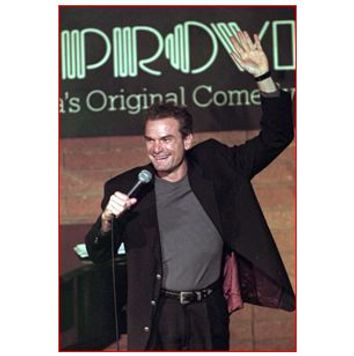
Doing his best leading-man saunter, multimillionaire groom Rick Rockwell steps into the Improv spotlight to the strains of Marshall Tucker Band’s “Can’t You See.”

He takes the microphone … looks soulfully into the crowd …

And begins to sing.

“Can’t you seeee, can’t you seeeee, what Darva’s done to meeeee.”

The hour of irony-free stand-up horror — full of wacky accents, unabashed self-pity, Ross Perot impressions and, yes, Darva Conger jokes — has begun.

Rockwell’s return to the comedy circuit Friday at the Tempe Improv was sold out, drawing surprisingly enthusiastic fans from conservative Phoenix. The gig was Rockwell’s first stop on his national “Annulment Tour,” which includes dates in Miami, Chicago, San Diego and Washington.

Outside the Improv, an assortment of network television news crews got shots of female fans holding placards (“I’d Marry You Rick!” and “Will Cook for a Millionaire”) and reporters tackled ticket holders: Do you think Rockwell will be funny?

“I don’t know,” one respondent, Shawna, told an ABC affiliate. “I’ve heard he was a pretty bad comic.”

The reporter jumped: “Then why are you here?”

“I guess I think it will be …” She paused, struggling to think of the right word. “Entertaining.”

Other attendees had similar difficulties articulating a reason for investing in a tabloid celebrity’s performance, despite expectations of mediocrity.

Allow me to take a swing at it.

Rockwell (the man who said he was a multimillionaire, but wasn’t) and Conger (the woman who said “I do,” but didn’t) are still the best and most accessible soap opera couple on television. Every detail of their train-wreck tjte-`-tjte has been nationally broadcast, from Q&A courtship and uneasy nuptial exchanges on Fox TV’s “When Good Harem Auctions Go Bad” show, “Who Wants to Marry a Multi-Millionaire?” to their fractured “how can they be lovers if they can’t be friends?” breakup.

That we, the viewers, may no longer have right or reason to know anything else about this couple has not yet occurred to us. Nor has it occurred to Rockwell and Conger. Both reinforce our sense of gossip entitlement by chatting endlessly on network newsmagazines, turning once again to television producers to improve their lives, and seeming more and more like a perfect match.

So at the Tempe Improv, fans paid $19 per ticket because they wanted to watch this soap opera’s latest episode in person. What will Rick say about Darva? After all, last week Darva filed for annulment, and has portrayed Rick as a cheap doofus.

As it turned out, Rockwell had to plenty to say.

Observational stand-up comedians mine their ordinary lives for amusing nuggets. The hotel, the family, the grocery store, the wife, the airport. This is why bits about show-biz disaster and humiliation can work so well. For once, the comic has something interesting to talk about. Take Margaret Cho’s acclaimed “I’m the One That I Want” tour, for instance, where she detailed working on a failed network sitcom.

Rockwell has amazing source material and his audience is already in on the joke. It’s an opportunity to be brilliantly funny and, even subversive. People want to know: How did he get on the Fox special? What went on backstage? How did he feel up there? How did his family react? What was Darva really like?

Instead, Rockwell gave his audience “Take my wife, please” one-liners: “What was I thinking marrying somebody named Darva Conger? It sounds like an orthopedic problem!”

At the start of his show, the audience still reeling from Rockwell’s attempt at song, the formerly unknown comic was joined onstage by Maricopa County Sheriff Joe Arpaio. The ultraconservative, notoriously self-promoting Arpaio (Bill Maher once dubbed him “America’s stupidest sheriff”) and Rockwell had an awkward, backslapping exchange that played like a “Hee Haw” outtake as written by award show scriptwriters.

“You’ve already got way too much publicity, probably more than I have,” the sheriff says in his toughest, wish-I-were-John Wayne drawl. “So I order you to be funny tonight.”

“Watch out,” warns Rockwell. “You’re looking pretty good to me right now. It was a rough honeymoon.”

A sheriff and an alleged stalker, how grand. It’s like a direct-to-video buddy-comedy duo: Joe Arpaio is the tough-talking cop; Rick Rockwell is the wisecracking partner. Together they’re chasing sound bites and slapping ex-girlfriends in “Who Wants to Get Free Publicity?”

Once on his own, Rockwell launched into his act. He never directly mentioned the ex-girlfriend who filed a restraining order against him nine years ago. But he did mention an ex-girlfriend from nine months ago, seemingly for the sole purpose of emphasizing how pretty she was.

“She’s not the one you see on TV,” he stressed, and the subtext was embarrassingly obvious: Just so you know, ladies, that skanky bitch badmouthing me on “Dateline” wasn’t the best I could get.

And then, there were the endless Conger lines.

  • “Apparently the title was supposed to be ‘Who Wants to Marry a Multi-Millionaire Who’s Never Made a Mistake in Their Life’!”

  • “I hear Darva is very intelligent — she speaks several languages. That must explain our vows. I heard ’till death do us part.’ I guess that’s Swahili for ’36 hours.’”
  • “I hope Darva does pose for Playboy. A man should see his bride naked at least once.”
  • “Everybody on TV is making fun of my house — fuck you!”

That last one was actually kinda funny, under the circumstances. It was a rare moment when Rockwell wasn’t trying so hard to be likable.

But then he would fall back once again on his Perot impersonations, Jeffrey Dahmer references and “Phoenix is so hot that …” jokes — material that has been cryogenically frozen since 1992. It’s not that the content, or his delivery, was inept. Rockwell was very comfortable onstage. It was just that it was all too typical, two-drink-minimum nightclub shtick.

Which is sad. If you’re going to milk a cult-of-celebrity disaster, you should at least aspire to say something daring — or, if not, then attempt to impart some sort of lesson aside from “I should have picked somebody else.”

Despite the singing, Arpaio and chronic lameness, the evening had one real surprise — yet another twist in a media sensation that has already twisted itself into knots. Ready? Here it is: The audience loved Rockwell.

“Rick rocks!” shouted the overwhelmingly white, overwhelmingly khakied attendees to reporters after the performance. “He was hysterical!”

The reporters, who had caught the first half of Rockwell’s gig, exchanged incredulous looks: What the hell is this?

The camera crews kept filming and kept getting more of the same. The audience loved him, and not just a little.

Two exiting Rockwell fans, both attractive young women, were snagged by an “Entertainment Tonight” crew working the lobby. They were both blond and looked not unlike young Darva Conger. Their white teeth and wide eyes nicely caught the camera’s spotlight.

“I think he was great,” said one. “He was even funnier than I expected!”

“I’d marry him!” said the other. “Definitely!”

As they enthused for the news crew, both women looked absolutely thrilled. They’re in the game, they’re part of the soap opera. They’re on TV.

Continue Reading Close

Barhopping with the Bud Girls

Despite widespread publicity about the dangers of teen binge drinking, beer distributors use curvy babes and frat-boy reps to saturate the largely underage college market.

  • more
    • All Share Services

If you owned a beer company, what would be your ultimate marketing dream?

How about placing a beer commercial in every college bar and fraternity
organization? There, luscious, tan line-free women and confident,
upper-social-strata jocks would aggressively promote your brands with all
the slick enthusiasm of a Madison Avenue production. Imagine these
commercials playing in continuous motion throughout the evening without
ever resorting to the obvious loops of promotional films. Because this
commercial would be live. That’s right, real people targeting real college
beer drinkers at that crucial moment in their lives when they establish
brand loyalty, using no other sales technique than old-fashioned peer
pressure.

For Anheuser-Busch, the parent company of Budweiser, the dream of
student recruitment is real. It wasn’t easy or cheap. Or, some
argue, anywhere close to ethical. Parenting groups have recently
attacked Anheuser-Busch for their animated frog ‘n’ lizard advertising
campaign, but a Salon investigation has found that the brewer does more
than create cute cartoon characters to court underage drinkers. By hiring
popular fraternity members and attractive female students as
representatives, Anheuser-Busch distributors directly target the
largely underage college market.

Considering Harvard’s well-publicized 1993 study declaring that 44
percent of American college students and 86 percent of fraternity
members qualify as binge drinkers, such a marketing program seems
ridiculously ill-advised. Isn’t hiring college students a potential PR
nightmare? After all, 90 percent of all rapes and most violent crimes on
campus are alcohol-related.

Such statistics may not have deterred Anheuser-Busch, but they do
explain why its college recruiting efforts are managed discreetly.
Even the beer industry’s most prominent critic, Mothers Against Drunk
Driving, was unaware that college reps existed.

“Hiring fraternity members as beer distributor reps on university
campuses where the majority of students are under the legal drinking age of
21 is frightening and unbelievably irresponsible,” said MADD’s national
president, Karolyn V. Nunnallee, upon hearing the news. “We urge the U.S.
beer industry to re-examine its marketing efforts.”

Last November, midlevel supervisors for Anheuser-Busch wholesaler Brown
Distributing allowed me to join their college representatives working a Budweiser parade leading to a University of Texas football game and a night of “bar calls” in Austin. While many alcohol companies hire attractive women to push products in bars and sporting events across the country, these Bud representatives seemed to be recruited predominantly from the college population and assigned to a college beat: They frequent popular college watering holes, sporting events and other events such as parties at the U.T. alumni center. Of more concern are the existence of fraternity members who work unsupervised in the promotion of their product for college parties. The access was unusual, and the vice president for Brown Distributing later
expressed some irritation, commenting that any media inquiries normally
require approval from a high-ranking executive.

In other words: oops.

“When we walk into a bar, all we have is ourselves,” says 24-year-old
Bud Girl Rachel Moore, a recent college graduate. “We may be passing out a
key chain or something, but we make the promotion.”

Brown Distributing Bud Girls (we’ll get to the male representatives
later) are held to strict standards. A Bud Girl doesn’t smoke, swear, use drugs or
have tattoos, non-ear piercings or a criminal record.

Her only permissible vice is drinking Budweiser, and that, of course, is
mandatory. If a potential Bud Girl passes the interviews, background checks
and drug testing, she’s awarded a $15-an-hour part-time position and a Bud
Girl wardrobe.

Bud Girl clothing isn’t simply halter tops and spandex
dresses. The wardrobe is Technicolor dream-wear that transforms attractive
yet otherwise ordinary girls into a sort of beer-touting Justice
League. Once in costume, the Bud Girls are superheroes whose sexual
power turns any bar into one of those 1980s beer commercials, where the
swimsuit model reduces men to puddles of gratitude and adoration.

“I wonder who they think we actually are,” says 28-year-old Bud Girl
Griselda Mendoza. “[The clothes] change everything. They could see me at a
supermarket and I won’t get paid much attention. But put on a little Bud
vest and all of a sudden guys want everything signed.”

At one bar promotion I attended, the Bud Girls were asked to sign a
promotional banner. They wrote: “This Bud’s For You, We Love You.” And,
in their own way, they do. And men, in their own way, believe it. Bud
Girls seem to enjoy their part-time work as hops goddesses as much as
men enjoy begging at their feet for key chains and cozies. But just how
widespread are these lust-driven promotions?

All of the Big Three American labels (Budweiser, Miller and
Coors, which constitute nearly 80 percent of the U.S. beer market)
practice some college recruiting. But Anheuser-Busch, with nearly
50 percent of the market, has the most extensive program. Miller
marketing representative Ann Espey said her company has recently “shied
away” from hiring on campus, and agreed that hiring male fraternity representatives is irresponsible. Similarly, Coors spokesman Dave Taylor says his company has “moved away” from such practices. Although “shied away” and “moved away” suggest that Coors and Miller have made significant policy changes, neither representative will say the practice is extinct.

“You need to understand the primary consumer target for beer companies
is young adult males,” Taylor says. “Historically, college programs were
very common in the industry when the drinking age was 18. Now at the local
level, with 600 independent distributors, does hiring models still occur?
Probably, yes.”

“At the local level” is another key phrase. Because beer girls and
college programs are run by independent distributors, parent companies
often feign ignorance of the practice. Likewise, while some distributors
have never even heard of student recruiting (“College representatives?” asked a
shocked receptionist at the Ann Arbor, Mich., Anheuser-Busch wholesaler. “This is
a beer distributor, sir”), wholesalers in cities like Tucson, Los
Angeles and Denver have programs in place.

To set the stage for the Bud Girls, these distributors pre-pack college
bars with streamers, table tents, coasters, inflatable footballs,
pool-table lamps, posters and, of course, neon signs. Add the Bud Girls and
the stage is set. The live commercial begins.

Two local students, Christi Voigt, 21, and Jaime Franks, 22, enter the
Austin BW-3 chicken wing franchise during a Dallas Cowboys football game.
They’re wearing blue Bud Light halter tops and denim shorts. Bud Girls say
they prefer the shorts-and-halter-top ensemble to the classic
beer can-print spandex dress, but noted the distribution company prefers
the tight dress because “It’s more visible.” (As Mendoza wryly noted, “A
lot of guys have a misconception that if a girl is wearing a dress that looks
like a beer can, they can pick us up.”)

Although Voigt and Franks give away some free key chains and beers to
the rowdy crowd, they mostly distribute charm. Bud Girls have charm on the
fly. Once in gear, the beer drinker is the center of attention. The beer
drinker is witty and attractive. But if said beer drinker refuses to change
brands or asks the nauseatingly common “Can I have you with that beer?”
query, the Bud Girl downshifts: The beer drinker is a gnat, an impotent man
unworthy of a Bud Girl’s slightest concern. They remain professional —
the smile never wavers — but the charm is gone and patrons can read “get
lost” right through their Colgate teeth.

In other words, Bud Girls can really mess with a beer drinker’s self-esteem.

Franks walks up to a table of four students. She makes eye contact with
the tallest male in the group, tilts her head, and slowly asks, “What kind
of beer are you drinking?”

He guiltily stammers something about Dos Equis.

She purposefully lays down a key chain bottle opener in front of him,
never breaking eye contact.

“What will you drink now?”

“Uh, Buh-Bud.”

She smiles: Good boy.

The display is impressive, but Voigt and Franks are rookies. Bud Girl
supervisor Eric Bradford sips his Budweiser and wistfully recalls veterans
who’d brazenly grab a customers’ non-Bud beer and dump it out.

Whether sweet or savage, all Bud Girls operate on the same basic
principle: their well-endowed bodies become the curvy slates upon which
beer slogans and men’s horny dreams are projected. The male of the Bud species
functions a bit differently …

A male college representative doesn’t wear a spandex dress. He doesn’t
even need to wear his Budweiser polo shirt. His body is not a billboard for
Budweiser. It’s a double standard straight out of traditional beer
commercials, where sexily dressed women wear the product and the cool guys
just look like … cool guys. Whenever the male rep wishes, he goes
unescorted to campus-area bars and buys Bud products for students with
his expense account.

Corby Ferrell is one of the seven U.T. college reps (or “contemporary
marketing representatives,” as Budweiser calls them), all of whom are in
separate fraternities. Together, the reps keep Budweiser products flowing
from local sellers to the frat houses and campus-area parties. Ferrell is
the 21-year-old former chairman of Phi Gamma Delta and has blond,
anchorman-quality hair. Two or three times a week, Ferrell will go in Cain
& Abel’s bar located in the heart of Greek territory and approach
attractive women drinking Miller or Coors.

“Hey, what do you think about switching to Bud Light for the night?”
he’ll ask. “The first one is on me, and I’ll buy you another before I
leave.”

Ferrell admits he has “an awesome job.”

The second responsibility of male representatives is to arrange beer
sales through local vendors. To dispel any confusion about the ethical or
legal implications of this practice, Ferrell explains that technically the
fraternity organizations do not pay for the beer: “Members who are at least
21 years old pool their cash to buy beer for parties.” When his work with college fraternity members and local vendors leads to a volume sale (five cases of beer, for example), Ferrell is given a commission by Brown Distributing.

One sales tactic is for the college rep to establish a relationship with
campus-area sellers, then ask who’s buying large quantities of competing
brands. “Then I’ll call the buyer and say, ‘I can get you 100 cases of
[Anheuser-Busch product] Natural Light for at least as cheap as what
you’re paying for Keystone Light,’” Ferrell says.

On average, Ferrell moves 300 cases per week to college buyers.

“Fraternities drink the cheapest beer they can find,” Bradford, the Bud Girl supervisor, explains.
“And his job is to make sure they drink our cheap beer.”

Neither Ferrell nor Bradford seem reckless or irresponsible, but still
– having a Budweiser representative as fraternity chairman is like having
Joe Camel as a high school football quarterback. Both popular figureheads not only have a vested interest in which brands are consumed, but the quantity as well.

“I think it’s better that we do have them out there because of the
message that we’re bringing,” says Laurie Watson, vice president of Brown
Distributing. “We’re constantly preaching responsibility.”

Watson was the only senior-level Anheuser-Busch representative willing
to comment for this story. A marketing representative for the
Anheuser-Busch corporate office at first denied any knowledge of the college program, then agreed only to confirm some facts and produce a copy of the Anheuser-Busch College Marketing Code. The code touts Anheuser-Busch’s support of alcohol awareness education and stresses that distributors must limit event sponsorship to venues that check I.D.

Bartenders and doormen do check I.D.s, of course. But the Bud Girl handing
out free beers doesn’t know how much alcohol a patron has
consumed. Likewise, frat representatives only card the one individual
buying beer for a party.

“[Students are] going to have a beer,” Watson says. “We just want them
to be responsible about it. The representatives always talk to them about
responsible drinking.”

“At least,” she adds, “I hope they do. They’re supposed to.”

Imagine a 21-year-old Bud rep arranging a sale of 100 cases of Natural
Light, then lecturing to the buyer about responsible drinking. It doesn’t
click, it doesn’t work. The people at Bud must be dreaming. And maybe they
are dreaming … still. Dreaming of college market saturation, dreaming of
young male demographics and dreaming of decades of brand loyalty to come.

One week after my Bud barhopping tour, University of Texas junior and
Phi Kappa Sigma fraternity member Jack Ivey consumed about 20 drinks, then
fell asleep on his apartment couch. He was pronounced dead the next morning
of alcohol poisoning, just the latest binge-drinking fatality. Whether Ivey
is in the dreams of any beer marketers, no one can say.

Continue Reading Close