Jodi Kasten

New Orleans barbequed shrimp recipe

  • more
    • All Share Services

Ingredients

  • 1 pound of butter (4 sticks)
  • 1 tablespoon Tony Chachere’s Cajun seasoning
  • List item 3
  • 1 tablespoon chopped fresh rosemary
  • ¼ cup Worcestershire sauce
  • 3 ounces of beer
  • 5 cloves of garlic, finely minced or pressed
  • 1 medium onion, finely minced
  • 2 ribs celery, finely minced
  • 2 tablespoons chopped fresh parsley
  • 2 teaspoons fresh-squeezed lemon juice
  • 2 pounds shrimp, heads and shells left on

Directions

  1. Melt a stick of the butter in a skillet. Saute the garlic, onions, celery, parsley, rosemary and seasoning blend for about 2-3 minutes. Melt the rest of the butter.
  2. Add the beer (drink the rest of it, of course).
  3. Add the vegetables, Worcestershire and lemon juice. Pour the butter mixture over your shrimp in a baking dish. Bake in a 350 degree oven until the shrimp turn pink, about 15 minutes.
  4. Serve in big bowls with plenty of the butter sauce and some good French bread to soak up the sauce. If you have a coronary, remember you died happy.

New Orleans shrimp: Before and after the disasters

When I was growing up, the city was a food-filled wonderland. But now its delicious crustaceans could disappear

  • more
    • All Share Services

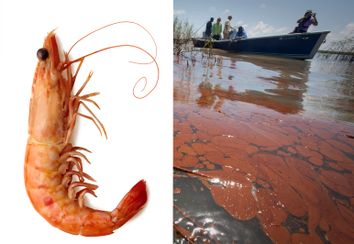
New Orleans shrimp: Before and after the disastersA boat passes through heavily oiled marsh near Pass a Loutre, Louisiana May 20, 2010. For nearly a month, roughly 5,000 barrels (210,000 gallons/795,000 liters) of oil per day have been gushing from BP's broken Deepwater oil well situated in the Gulf of Mexico, in what could be named the worst oil spill in U.S. history. REUTERS/Lee Celano (UNITED STATES - Tags: DISASTER ENVIRONMENT) BUSINESS ENERGY)(Credit: © Lee Celano / Reuters)

My first trip to New Orleans was in 1981. I was 6 years old and had just transplanted from New Jersey to Pensacola, Fla. Pensacola is the older, slightly less promiscuous sister of New Orleans. The history, architecture, music and food are echoes across Interstate 10, bouncing back and forth through Mobile, Biloxi and little towns like Pass Christian, Spanish Fort and Bayou La Batre. As a kid, we played them all in football and the girls dated the boys they met at church camps tucked into the Alabama pine forests.

I was a 6-year-old accustomed to the stony establishments of Philadelphia, New York, New Jersey and Washington, D.C., so New Orleans looked like a foreign country to me. Our family, which fanned across the metroplex, lived in shabby colonial- and federal-style houses that looked nothing like the wooden cracker boxes lining the streets of New Orleans. Stepping out of a car or a house in the Deep South is like being hit in the face with a hot, wet towel. Even at 6 I didn’t understand why the dry, cold north was set in stone and the hot, wet south was dressed in slowly rotting wood.

As the years went by, I spent a lot of time in New Orleans, especially after my father joined a Mardi Gras Krewe. Instead of a sweet 16 party, I was set loose in the city with my boyfriend, long before a cellphone could have helped us. In the ’80s, while the rest of the teenagers in America dreamed of running away to Hollywood, several of my friends had already run away to New Orleans. Back then, it was like a giant slumber party with kids crashing wherever they passed out in whatever house could be procured by other kids old enough to sign a lease and get a job in a restaurant or hotel. For me the city was a commune of runaways, vampire wannabes and hangers-on.

I may not have had the money to hit the high-end restaurants, but I knew that if you knocked on the door of the broken-looking hotel on St. Charles, just past the Dunkin Donuts and Wendy’s, $2 covered you into the “Hotel Warren” where an enterprising underage lady could procure a full Dixie Cup of Jagermeister for the princely sum of an additional $2. Try finding that in your Lonely Planet Guide.

Drinking may have been entertainment, but so equally was the food. Puffy clouds of fried dough called beignets, raw oysters sold out of the back of a pickup truck in Storyville that had newspapers spread across the tailgate and a smattering of oyster knives open for public use, high school field trips to Paul Prudhomme’s cooking school just off Jackson Square, giant hubcap-shaped muffulettas dripping with olives and dressing and the ever-present shrimp.

Shrimp came in plastic bags, Styrofoam coolers, little tin takeout boxes, laundry baskets lined with garbage sacks full of ice and in butcher paper cones sold in the French Market. While you tore off the heads, you could hear the ping-pong echo of the vendors watching little rabbit-eared black-and-white TVs while the Saints got their hopes up, then the roar of thousands wafting on the wind from the Superdome. There were voices in a dozen accents screaming, “WhoDAT?!?” or “NOOOooooo!” My favorite of those paper cones held “Barbeque Shrimp” — shrimp cooked in a tangy, smoky butter sauce with their heads left on. The funny thing about this dish is that it never sees a grill, it just tastes like it does.

New Orleans Barbequed Shrimp

Ingredients

  • 1 pound of butter (4 sticks)
  • 1 tablespoon Tony Chachere’s Cajun seasoning
  • List item 3
  • 1 tablespoon chopped fresh rosemary
  • ¼ cup Worcestershire sauce
  • 3 ounces of beer
  • 5 cloves of garlic, finely minced or pressed
  • 1 medium onion, finely minced
  • 2 ribs celery, finely minced
  • 2 tablespoons chopped fresh parsley
  • 2 teaspoons fresh-squeezed lemon juice
  • 2 pounds shrimp, heads and shells left on

Directions

  1. Melt a stick of the butter in a skillet. Saute the garlic, onions, celery, parsley, rosemary and seasoning blend for about 2-3 minutes. Melt the rest of the butter.
  2. Add the beer (drink the rest of it, of course).
  3. Add the vegetables, Worcestershire and lemon juice. Pour the butter mixture over your shrimp in a baking dish. Bake in a 350 degree oven until the shrimp turn pink, about 15 minutes.
  4. Serve in big bowls with plenty of the butter sauce and some good French bread to soak up the sauce. If you have a coronary, remember you died happy.

There are a lot of negative things that could be said about even pre-Katrina New Orleans. My own father says that when the levees broke it was God trying to flush the toilet. Harsh, but the New Orleans that Emeril Lagasse and John Besh are selling on television is not the reality for most of the residents. The median income for a pre-Katrina New Orleans resident was just over $27,000 in 1999. In 2000, 67.3 percent of the residents were African-American, yet only 27 percent of businesses were owned by African-Americans.

Years later, you need never to have stepped foot into New Orleans to understand the horror of Katrina. I still can’t think about it and I am ashamed to say I haven’t had the heart to go back yet. I am hoping if I ignore it all long enough that in a few years, when the kids are older, when the money is better, when … when …

Now “when” has gotten much longer. A giant slick of oil is closing in on the destiny the Gulf states share. Shrimping is being shut down. My hometown outside of Pensacola is bracing for the apocalypse. We’re all used to it. The hurricanes come and wipe us off the map every few years. We all know what to grab when we have to decide which objects can define our lives and fit in the trunk in case there’s nothing left when we come home again. This time it’s different, though. It’s a long, slow Bataan death march toward the unthinkable. The oil is coming and it’s still leaking.

I have roughly 20 pounds of wild Louisiana shrimp in my freezer. If you have some at your grocery store, you should buy it now. Everything that New Orleans was is now covered for me in a fine patina of pain, grief, loss and soon … oil. Just as we thought things were getting better. You may not know what it means to miss New Orleans, but you’re about to find out what it means to miss shrimp not raised in Asia.

Boycott BP and support alternative energy sources. If it hadn’t been BP, it would have been someone else. Write your congressperson today and demand federal support for alternative energy sources, drilling accountability and, for God’s sake, stop listening to that woman who says, “Drill, baby, drill.”

Continue Reading Close

An antiwar radical bakes for the front lines

During the Gulf War, a group of soldiers taught me about the realities of warfare -- and the value of cookies

  • more
    • All Share Services

An antiwar radical bakes for the front linesToby Summers

A version of this story first appeared on Trees of the Mind.

The first Gulf War began on Aug. 2, 1990. I was about to begin the 10th grade. I had become a little hippie, wearing tie-dyed shirts, saving whales, listening to R.E.M. and worshiping Abbie Hoffman. For my 15th birthday that October, I had received my first political T-shirt. It said, “Love the Troops — Hate the War” with a big peace sign around the whole works.

My uncle had come back from Vietnam with a hole the size of a softball in his chest and a matching scar that covered his entire back on the other side. He didn’t talk about the war, but he had stayed on to become a helicopter training pilot in the Army for a long career as an officer. He went to Walter Reed about the time the Gulf War started and they told him he had a 40-60 percent chance of living if they tried to take some of the thousands of staples out of his body. I hated the Vietnam War in retrospect and aimed to do the same for this little Atari war happening on my watch. I was young and radical and ready for a fight.

There were very few protests. I felt like I needed to do something, so I wrote about six letters “To Any Soldier,” determined that our generation would get it right. I would shove the flower in the gun, but I would do it while supporting the soldiers. I got replies from three soldiers. Their names are so common that I can’t find them now — Toby Summers, Chris Dunn and Rick Brooks. After I got the replies, I contacted the USO to ask how to send them goodies.

In that pre-9/11 world, we could send food and treats to the soldiers without much screening. The only instruction was to not wrap anything in newspapers (censorship!) and not send chocolate because it melts. I sent each of the three men four dozen of these peanut butter cookies.

INGREDIENTS:

2 cups peanut butter

2 cups white sugar

2 eggs

2 teaspoons baking soda

1 pinch salt

1 teaspoon vanilla extract

DIRECTIONS:

1. Preheat oven to 350°F and grease cookie sheets.

2. Using a mixer on low speed, mix peanut butter and sugar together until smooth. Beat in the eggs, one at a time, then stir in the baking soda, salt and vanilla. Roll dough into 1-inch balls and place them 2 inches apart on the prepared cookie sheets. Press a crisscross onto the top using the back of a fork.

3. Bake for 8 to 10 minutes. Allow cookies to cool on baking sheet for 5 minutes before removing to a wire rack to cool completely.

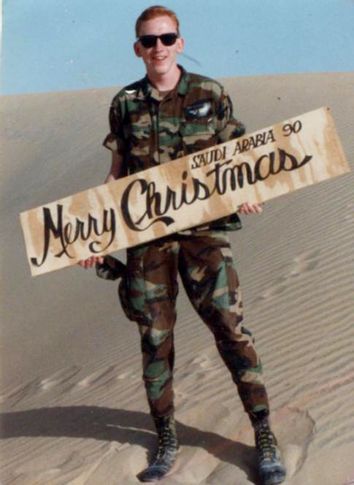
It was simple – I didn’t even need my mom to help me very much. The response I received was overwhelming. Toby’s commanding officer told him that he wasn’t allowed to have any more of them unless I made enough for his whole unit. So, I sent 400 cookies packed between wax paper and bubble wrap in the box I got my first stereo CD player in. It made it to Saudi Arabia two days before Christmas. Seventeen soldiers wrote to thank me and I got the photo above from Toby.

I’d like to share parts of some of their letters.

Feb. 16, 1991

Things here are rather the same as they were. We haven’t had as many scud alerts as before which either means he’s running out of supply or is holding back. As soon as the ground war starts it will be a little hairy for us because as soon as they start to secure Kuwait, we’ll be advancing forward into Kuwait ourselves. But, don’t worry about me. I’m a helicopter mechanic, so hopefully we won’t see much of the battle. We’ll be involved with search and rescue, though — which means I’ll be unloading the casualties that come in. (Something that I’m not looking forward to.)

My favorites came from Toby (Mr. RedHead above). He drew Calvin & Hobbes cartoons for me. 


Calvin says, “What a nightmare. I thought I was in Saudi Arabia”

Under the tent: “What he doesn’t realize until he gets out of bed.”

I started sending things to the soldiers out of a sense of frustration. I wanted to lie down in front of tanks and burn my nonexistent draft card. Those days were over, but my communications with the soldiers made me want the war to be over even more intensely. Today, we don’t really remember the old attitudes about soldiers being “baby killers” and violent thugs. But, what I found was that these were boys — not a one over 23 — who had signed up for a job they thought they would never have to do and they were just like me. They liked the same television shows and listened to Nitzer Ebb, Skinny Puppy and Ministry. They were just guys.

Each night, I called a 1-800 number to listen to the names of those missing and killed in the war for that day. I said a little prayer, hoping that none of “my” boys would be on that list. They never were. There is no tear-jerking ending to this about a fallen soldier. Toby, Chris and Rick are just men out in the world now, pushing 40. I don’t know where they are, but the cookies I made left me with feelings that have nothing to do with a yellow ribbon or nationalism.

“Support Our Troops” should be more than a slogan slapped on the bumper of an SUV. Two hundred and ninety-four American soldiers died in the first Gulf War. To date, 4,685 American men and women have died in Iraq. One thousand five hundred and thirty-four have died in Afghanistan. Countless others have been injured. Hundreds of thousands of civilians have died in those countries. Yet, the impact on our lives, unless we have a friend or family member in the military, has been minimal. My voice is small but I’ll keep saying bring them home and support them when they get back.

Nineteen Christmases later, 30,000 more Tobys are on their way to Afghanistan.

Learn how to send them some cookies by clicking here.

Continue Reading Close