John Manchester

When my larger-than-life dad finally became real

His battle with the Kennedys brought him fame and grief, but it wasn't until he died that I saw him for who he was

  • more
    • All Share Services

When my larger-than-life dad finally became realThe author and his father on the Snake River in 1980

Seven years ago early in the morning of June 1, my father’s nurse woke me to say, “Your father has passed.” I sat vigil alone at the foot of his bed, glancing at his face and then away, because it was hard to look at him. His mouth hung open, perhaps from trying for a last breath that never came.

I finally got a glimpse of who he was as a person, though that person had departed an hour ago. Despite walls plastered with awards, numerous bestsellers, bushels of adoring fan mail and the company of great men, his face was etched with disappointment.

As a boy, my vision of my father was hindered by physical fear. All I saw was a giant, one who would periodically strike me to unleash his rage.

Just as I became a man, my father, William Manchester, rocketed to international fame after the publication of his bestseller “The Death of a President.” Now he towered over me in the world. All I saw was how much he had achieved and how little I had in comparison.

Just as my father reached the age I am now, 60, the mask of the famous author slipped and I saw a very different face, that of his shadow.

As the skeletons clattered from our family closet — my father’s secret lifetime of self-destructive habits, his marriage that was something out of a horror movie — I could only blink in disbelief. How could these two men, these two lives, coexist in a single body?

Was he a writer of tireless discipline, who could work around the clock, who published 18 books, some over a thousand pages long? Or the man powerless in the face of his addictions?

Was he the man who’d met four presidents, who’d fought Bobby and Jackie Kennedy and won? Or the husband who sat alone in his own home because his wife wouldn’t let his friends inside, not even his brother?

Was he the Marine who received a Navy Cross for grabbing a machine gun and running up a hill into an enemy position? Or was he the person who cowered before his dentist, who was afraid to fire secretaries, who could barely stand to enter a roomful of strangers?

Eight years before my father died, his heart was within days of giving out on him. I drove him to the hospital for a quadruple bypass, acutely aware that these might be our last moments together. I asked him how he felt — to offer comfort, to touch his heart just once while I still could. He said, “I’m not afraid. I stared death in the face on Okinawa and said, ‘Fuck you!’” We rode the rest of the way in silence.

It’s the tough Marine whose picture stares, pipe clenched in his teeth, from the cover of his 1980 memoir of combat, “Goodbye Darkness.” After he died I found a series of outtakes from that photo shoot. He mugs for the camera, putting on mask after mask. What stuck with me was the one of him grinning, saturnine, all powerful. But not one of them was really him.

When the mother of my childhood best friend died, a woman who was dear to my entire family, my father delivered the eulogy. He was overcome by tears and could barely finish speaking. I had never seen my father cry. Maybe this was the real person coming out at last. But in the car after the funeral he said, “I disgraced myself.”

He was a frail boy, terrible at sports. His father beat him, demanding, “Don’t cry.” The jeers of his peers and blows of his father rained down on a person of extraordinary sensitivity. That sensitivity would later prove a valuable asset for him as a writer. But as a youth he could only cover it in thick armor. That armor served him well in literal combat. It also closed him off from feelings of fear and loneliness.

What he felt instead were the extraordinary highs and lows of his fluctuating self-esteem. He’d always suffered mood swings, but fame and chemicals escalated their intensity. He was forever on top of the world or at the bottom of the deepest pit, never in between.

I spoke with one of his few surviving Marine buddies, who offered this simple wisdom, “Your father was just a man. A good man, but just a man.”

And there’s the real person that neither of us could ever see: just a man.

How I came to dread Christmas

My dad instilled a love for the season in me. But his fight with Jackie Kennedy broke him -- and my holiday spirit

  • more
    • All Share Services

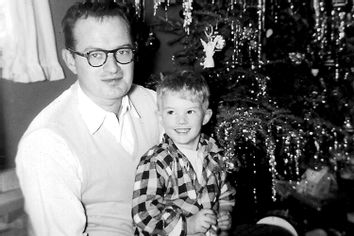
How I came to dread ChristmasFather and son at Christmas in better times

My father loved Christmas. From the time I was very small, in the days after Thanksgiving I remember him towering over me with a huge smile and gleaming eyes, proclaiming, “It’s less than a month ’til Christmas!” It was the most excited he got about anything. He always believed this Christmas would be the best, the answer to all his hopes and dreams, delivering joy to his world. 

He never went to church, never spoke of God. But he turned Christmas into his own religious rite. He played carols loudly on the stereo. Every Christmas Eve he read the same three things: “little tree,” by his favorite poet, e.e. cummings, from the same tattered volume he’d carried through the trenches of Okinawa; “The Night Before Christmas”; and the gospel according to St. Luke. As he read, he infused the words with the drama of a onetime actor. He finished on such a note of reverence that this phrase is the only thing I can quote from the Bible, “But Mary kept all these things, and pondered them in her heart.”

My father’s passion infected me. I too came to believe Christmas would bring miracles. I believed so much that when my father came to me one December with a long look on his face, bearing the terrible news that there was no Santa, I just smiled, nodded my head and kept believing anyway. The next year my father had to come explain it again. Finally I got it, but I wasn’t happy about it.

The promise of Christmas grew in me each year until it became too large. The biggest stack of presents under the tree with “John — from Santa” on them, all of Mom and Dad’s beaming looks, even the many candy canes on the tree, most of which I chewed up one year, couldn’t hope to fill the yawning cavern of hope and need I’d attached to Christmas.

I found myself late one Christmas morning sitting on the floor surrounded by the scattered remains of present opening, feeling forlorn, as torn as the wrapping paper, as empty as the boxes my sisters and I had grabbed toys from.

Yet instead of seeing that feeling as a warning to back off from my crazy hopes, I upped the ante. The next Christmas Eve I woke in the night, violently ill with anticipation. And again I found myself on the floor, alone and despairing, this time with a bellyache.

——-

I never let on that Christmas had become an ordeal. I smiled for my father’s camera. After opening each present I crowed, “Just what I always wanted!” until it became a family joke. 

 By Christmas of 1966 I had learned to stow away my wildest hopes for Christmas.  Those hopes were about to start attaching themselves to the gifts of my time of life and the times I lived in — sex, drugs and rock ‘n’ roll — the rites of a pagan religion.

My father was a writer named William Manchester. After JFK’s assassination, Jackie Kennedy commissioned him to write a book that became “The Death of a President.” But that relationship devolved into an epic battle over the book’s publication, which reached its frenzied peak in December 1966. Jackie sued my father. The story was international news. I came home from boarding school to find our house in a small Connecticut college town surrounded by TV trucks. The effect of months of stress had my sensitive father sick with the flu. Though he had a fever, he insisted on buying a tree and leading us in trimming it, as he did every year. He was reaching for his beloved Christmas like a lifeline in that impossible time. 

His face gray and haggard, he climbed up to place the star on the top of the tree. Howls of agony clashed with the Mormon Tabernacle Choir’s rendition of “Oh Come All Ye Faithful,” and he staggered from the room with his hands over his face. He had scratched the cornea of an eye. He would wear a patch through the rest of the battle with the Kennedys. The day after Christmas, his flu turned to pneumonia and he was hospitalized.

 He survived that Christmas. He settled with Jackie Kennedy that January, and his book was published. The controversy had made him world famous. 

——-

On Christmases after that awful one in 1966, I no longer suffered sick anticipation, but dread. My father’s fame had ruined my parent’s marriage, and with it any sense of well-being in our family. Yet they somehow stayed married, and my two sisters and I continued to come home for Christmas. The tension in that house was excruciating all year round. At Christmas it became unbearable. My body manufactured an escape, much as my father’s body had become sick during the height of the Kennedy Controversy.  Every Christmas like clockwork I would come down with the flu and retreat to a couch in another room so I didn’t have to sit by the tree and endure all the smoldering looks and hissed conversation.

But there was no avoiding those readings on Christmas Eve. Though my mother daily tortured my father with a torrent of verbal abuse until he mostly sat silent, she couldn’t stop him from his readings. Each year they became a little harder to endure, until I sat there wanting to jump out of my skin, waiting for those last words from Luke so that I could slink off. Why were those readings so terrible? It was my father’s insistence on maintaining a jovial façade over our disintegrating family. I’ll never know, but I hope he got something from his Christmas illusion.

In the spring of his last year, when he knew the end was near, he grabbed for that old lifeline,  briefly considering extraordinary measures in order to “see one more Christmas.” Then he realized that even if medicine could force his body to survive that long he would be in no shape to enjoy it.

Now that he’s gone and our boys are grown and have left home, my wife and I have happily abandoned Christmas rituals. We don’t have a tree. We give presents only if we feel like it. It’s nice to light a few candles to celebrate the return of the light. This December 25th we’re trying something new. We’re going to join some Jewish friends in their Christmas tradition — a movie followed by Chinese food.

I wish you a Merry Christmas, however you choose to celebrate it.

Continue Reading Close

Building my father’s coffin

My dad spent his life writing books. His final, impractical request gave us a story like no other

  • more
    • All Share Services

Building my father's coffin

In his last years my father, the writer William Manchester, told me, “When I die. I want you children to build my coffin.” He’d gotten the idea sometime in the ’70s, when a Wesleyan chemistry professor died, and his sons, following a Catalan custom, spent the night before the funeral building his coffin in their basement. My dad explained, “It will give you and your sisters a focus for your grief.”

I nodded and held my tongue. It was pointless to explain what he already knew: My sisters had never done any carpentry, and my own modest skills had diminished since I’d become afflicted by carpal tunnel syndrome.

It was a focus, all right, not for grief but for worry. How were we going to build it? In the last spring of his life, as he declined, I prayed he would just forget about it.

But the morning after he died I found a list of instructions on his desk. No. 5: “My body is to be placed in a plain pine box. I would like my children to make the box.”

Fuck. We really had to build it.

Down at the funeral home, I explained to the director how we planned to build the coffin. I felt awkward asking, but there were questions only he could answer. What were the interior measurements needed to accommodate the body? He told me, and I wrote them down. What about securing the lid? He would screw it onto the box. Good. As we spoke, I remembered my father telling me how funeral homes make their money selling fancy coffins, and wondered why this guy wasn’t trying to sell me one. But then he told me about one homemade coffin he’d encountered. “The family made it years ahead of time, and by the time the person died, it had warped.” He gave me a look: You don’t want to know the details. There was his sales pitch, and I was tempted to go with it.

I had also heard a story about a funeral where the homemade coffin disintegrated as the pallbearers carried it, and the body fell out. My worst fear. That’s what made me determined that ours would be the sturdiest, most reliable casket since Napoleon’s seven-layered sarcophagus beneath the Invalides in Paris.

How were we going to build it? I called my older son, Shawn, who was an engineering major. He was already far more competent with his hands than my father, sisters and me combined. Home for the weekend from college, he devised a plan for the box. I vetted it with a friend of mine, a master cabinetmaker. It seemed up to snuff, but we still didn’t have tools.

I called my sister, who was living in Florida. She was busy working and would have to scramble just to get to the funeral. So she’d join us in the coffin-building only in spirit.

I called my other sister, who was in Connecticut for the summer, and discussed the coffin. She explained that her mother-in-law’s partner, David, would be happy to help us. “He’s a professional. He teaches carpentry. He has a fully equipped workshop in his garage.”

David invited us down to his place in Connecticut the following Saturday. It was only a two-hour drive from our house in Massachusetts. By the time we got off the phone, I felt relieved: We had Shawn’s plan, good tools, and David to help us.

- – - – - – - – - – - -

My wife, Judy, and I pulled into the driveway. David and Shawn stood in front of the garage around a couple of sawhorses with some boards on top.

Judy said, “Thank God they’ve already started.”

I agreed.

It was one of those perfect days, the kind that comes only once or twice a year in New England. I smiled, remembering my father telling me, “One of the crucial things in my writing is my use of irony.” He would have enjoyed the irony of this task on this day. It was in striking contrast to what I’d pictured all those years — us building the coffin in my father’s gloomy basement storeroom.

For years I had a vision of me and my sisters making the coffin on top of our sad, warped Ping-Pong table, up to our waists in the tens of thousands of pages of his papers that filled the room.

I heard the bang of a hammer, looked over at Shawn and David around the sawhorse, and remembered why I was here. David looked at my worried face, rubbed his hands together, and gave me a smile that said, “This is going to be fun.” His only question was how to do it.

He looked at Shawn’s plan, nodded his head, then handed it back and said diplomatically, “Let’s make it up as we go along.” He looked down at the boards on the sawhorse, frowning, then turned and looked at the side of the garage, pointing: “It’s a door.” He added, “I know how to make a door.”

He thought another moment, then nodded. “The sides and top are also doors.” Following the measurements given by the funeral director, he cut the assembly to size. We had the first door. The rest was easy: four more doors for the sides and one for the top, and we’d be done.

I lost myself in the rhythm of making it. When we were done screwing the sides to the bottom, I asked, “Are you sure it’s strong enough?” David picked up a length of strapping and said, “I think it’s fine, but just for you we’ll box all the edges with this.” When that was done even I was pretty confident that it would hold my father, and the strapping lent it a kind of elegance.

After lunch David looked at the box and shook his head. “It’s going to be hard to carry, hard to keep hold of, with us crowded in three to a side.” I saw us pallbearers at the funeral dropping it and gave David a look. He said, “We’ll make rails.” We went to the hardware store and got two 1-inch dowels and lag bolts.

By this point we were both starting to feel pride in our work. David said, “Let’s stain it.”

I said, “No, it’s supposed to be a plain pine box. Besides, if we leave it bare, people at the funeral will realize we built it.” He nodded.

My sister, who had watched from the porch, put in a symbolic screw.

We stood around it, admiring its simple elegance. Still, I had to ask David, “Are you sure it’s strong enough?”

He said, “Only one way to find out — take it for a test drive.”

Judy bravely volunteered. We lifted it to the ground and she climbed in. Someone said, “Maybe we should put the lid on.”

She said, “No, this is fine.” We hauled her around the yard. The neighbors, out working in their yards, put down their clippers and rakes and gawked. Why not? How often did they, or anyone else for that matter, get an opportunity to watch their neighbors building a coffin on a sunny Saturday?

As we carried her, Judy laughed along with the rest of us. What else to do? Later I asked her, “How did it feel?”

“It scared the hell out of me.”

We finished our tour of the lawn and let her out. The coffin was rock solid. We congratulated ourselves: “Look at that thing!” “It only took five hours!” I thanked Shawn and David.

- – - – - – - – - – - -

As Judy and I pulled out of the driveway, I gave the coffin a last look and felt the excitement of the day dissolve. Sometime later that evening the funeral director would discreetly steal it away, then place my father’s body in it. The next time we would see it would be at the funeral.

He would not be buried in it. His instructions stated that following the funeral, he would be cremated. It felt weird to have gone to all that trouble, just to have the coffin burned up a few days later. But its purpose was never practical. My father was a storyteller at heart, and this made a good one. It even had poetic potential: something about all those trees sacrificed to make all his books offering up a few boards for his last story.

John Manchester’s music has been heard worldwide for the last 25 years on TV, radio and the Internet. You can also hear it on his MySpace page and at Manchester Music Library.
Continue Reading Close