Jonathan Beecher Field

Snobbery rules

You love virgin olive oil and homemade fromage de t

  • more
    • All Share Services

Snobbery rules

First there was Horace. Then there was Juvenal. Now there is David Kamp. Horace and Juvenal, as you may recall from your undergraduate days, each gave his name to a school of satire. Horatian satires were gentle pokes at the foibles of the day. (Think Garrison Keillor, only in a toga.) Juvenalian satires were caustic attacks on human mores. (Think Bill Hicks, but in Latin.) “Kampian satire” has not caught on as a phrase yet, but in his Snob’s Dictionary series — bluffers’ guides to rock, film and now food — David Kamp has developed a new form that can only be called aspirational satire.

Satire generally instructs by counter-example, presenting an exaggerated model of behavior in an unflattering light, and serving as a warning to readers who might be headed in that direction. Jonathan Swift’s “A Modest Proposal,” for example, lays out a scheme whereby poor Irish mothers might better their situation by raising babies for the English to eat. Theoretically, English landlords would read Swift’s pamphlet, recognize their own cruel treatment of their Irish tenants, and by treating them better, move away from Swift’s portrait of them.

Kamp’s series nominally works this way; a rock snob might cringe in self-recognition on reading the entry for Brian Wilson and see a reflection of his own snobbish pronouncements on “Pet Sounds” as the greatest artistic accomplishment of the 20th century. At the same time, by providing aspiring snobs with the requisite vocabulary, the books also work to promote the same behavior they ridicule. For instance, a practicing food snob can pick up “The Food Snob’s Dictionary” and recognize that it was bad manners to ask last weekend’s brunch hosts if the bacon was Niman Ranch; an aspiring food snob can pick up the same book and learn that Niman Ranch is a name to reckon with in the world of meat.

Kamp’s new “Food Snob’s Dictionary” (coauthored by Marion Rosenfeld) appears at a moment when food snobbery is rampant. Adjectives like “artisanal” and “house-made” appear on menus, stoves can cost more than a year at Bennington, and diners gossip online about sous chefs as if they were rock stars. Kamp has a rich vein of material to mine. But as he uses the word, “snob” does not carry the negative connotation it has in real life — it means something close to “connoisseur,” even if it is the kind of connoisseurs whose refined tastes make them a burden to their less evolved friends.

By targeting two distinct kinds of readers — those who read one of the Snob’s Dictionaries to learn the information it contains, and those who read it to congratulate themselves that they already know it — Kamp is following a trail blazed by his fellow Spy magazine alum Lisa Birnbach. Birnbach’s 1980 “The Official Preppy Handbook” is the ur-document of aspirational satire. It purported to ridicule a way of life, but it also offered anxious teens from the hinterlands preparing for their first year at Colby or Vassar a guide to the Bermuda bags and Nantucket Reds they would need to blend in.

Kamp (also author of “The United States of Arugula”) and Rosenfeld know the terrain of the food snob well enough to reach both kinds of readers. They write with knowledge and enthusiasm, but maintain the perspective that allows them to see the follies of the food world. Ruth Reichl, for instance, is a “Prodigiously maned gastro-sensualist and writer, known for a trilogy of memoirs … that chart her Zelig-like journey through various food-mad locales … as they experienced their signal moments in America’s culinary coming of age. Though prone to onanistic, self-aggrandizing prose and batty flights of fancy — wearing unnecessarily elaborate disguises while visiting restaurants, frequently invoking her dead mother as a speaking character in reviews — Reichl has more than creditably served as editor of Gourmet since 1999.”

These biographies are the most entertaining part of the book; the entry for Julia Child mentions that she was “a bawdy, fiercely liberal, whip-smart intellectual who partied harder than Anthony Bourdain.” The more useful entries are for individual ingredients, and here, Kamp and Rosenfeld do some demystifying: cepe is “a cloying French synonym for porcini mushroom, used on menus to confuse diners who think porcinis are old news.”

Beyond what is included in “The Food Snob’s Dictionary,” for real snobs a good deal of the fun of these books is seeing what is not in them. Cookbook author Elizabeth David, “who turned out two masterworks, ‘Italian Food’ (1954) and ‘French Provincial Cooking’ (1960), which though sometimes vague and imprecise in their recipes, neatly evoked a sun-dappled Southern European wonderland,” gets an entry, but her more Anglo-centric counterpart, Jane Grigson, does not. For snobs keen to make their own fromage de tête, Grigson’s out-of-print “The Art of Charcuterie” is the go-to reference. The less ambitious snob will make do with the recipe from snob darling Fergus Henderson’s “The Whole Beast.” Entry-level snobs will settle for the recipe in Ruhlman & Polcyn’s “Charcuterie,” which happens to be the most comprehensive and precise of these three books. Those snobs who celebrated when a university press began reissuing Grigson’s cookbooks will be frosted by her absence, but pleased to have out-snobbed the snobs.

That is, they will be if food snobs can see themselves as such, for it is a label that many obvious snobs would disavow, claiming instead to be simply sensible and tasteful eaters. Is the true food snob someone who passes up the Wish-Bone dressing for the Newman’s Own, or the person who disdains bottled dressing in favor of making his or her own vinaigrette — or maybe the one who insists on using estate-bottled olive oil and house-made wine vinegar? Anyone who reads the Eat & Drink section in Salon, for instance, is likely to have some food snob symptoms, but it may be easier to recognize the snob pathology at work in different milieus, such as those covered by Kamp’s rock and film dictionaries.

“The Rock Snob’s Dictionary” was the first in the series, and it is here that Kamp and this book’s co-author, Steven Daly, may have performed the most valuable public service for non-snobs. Compared to film and food snobs, the rock snob demographic skews younger and louder, and, as anyone who has tried to date a college radio DJ can attest, the arrogance of youth and the adulation of obscure musicians can be a lethal mix. It is not for nothing that Mark “Whatevs” Graham once characterized the denizens of Rock Snob stronghold Pitchfork Media as “indie grinches.” This same intensity makes the rock snob easy to spot in the wild. If a date starts lecturing you on the vagaries of Lee “Scratch” Perry’s discography, or expounds on the unheralded influence of Roky Erikson, you’ll know right away what you are dealing with.

As for film snobs, they’re happiest when they — and everybody else — are in the dark. Kamp and co-author Lawrence Levi know this, so “The Film Snob’s Dictionary” trains an usher’s flashlight on this shadowy sect, helpfully illuminating the differences between snob-approved Sidney Lumet (“Dog Day Afternoon”) and crowd-pleasing Sydney Pollack (“Tootsie”) along the way. To film snobs, “the new Cronenberg” is a film (because it has penises in it), not a movie, that must be judged against the rest of the “dystopian weird-out flicks” made by the “cheerfully depraved Canadian horror auteur.”

This kind of name-dropping is the lingua franca of film snobs; see, for example the nearly Aspergerian pop-cultural patter that passes for dialogue in film snob hero/ex-video store clerk Quentin Tarantino’s films. While most people couldn’t pronounce “Apichatpong Weerasethakul,” even if they knew who or what that was, film snobs knowingly refer to the Thai director as “Joe.” Armed with “The Film Snob’s Dictionary,” the ambitious denizen of the multiplex can graduate to dissecting Wes Anderson’s iTunes-only short, “Hotel Chevalier,” and even patronize his tailor, Manhattan’s Mr. Ned; the rest of us can respond accordingly when words like “diegesis” and “mise-en-scène” pop up in conversation.

If one snob can learn a lesson from the excesses of another, this series of books (“The Wine Snob’s Dictionary” is in the works) may undo the very culture it seeks to celebrate/mock. By offering a witty and painless entrée into the recondite shibboleths of rock geeks, film nerds and don’t-dare-call-them-foodies, Kamp has laid the groundwork for a nation of snobs. If this keeps up, will there be any philistines left for the rest of us to disdain?

Ciao, cookbooks!

With food blogs multiplying like weeds and millions of recipes available with a simple keystroke, has the Internet made the cookbook obsolete?

  • more
    • All Share Services

Ciao, cookbooks!

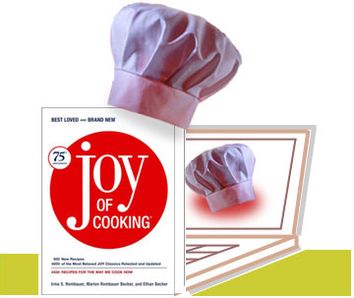
One of the bigger publishing events of the fall of 2006 was the publication of the new 75th anniversary edition of “Joy of Cooking.” Upon the book’s release, most coverage focused on how “Joy” reflects or does not reflect changing dining tastes. “Joy” fans were interested to see what stayed in the new edition, and what got cut, but for the rest of the publishing world, the more immediate question was “why”? In the age of Google, who needs another paper-and-ink tome taking up space in their kitchen? Other classic reference works have gone online, and are not coming back. This past holiday season, more than one bookseller promoted the unabridged, 20-volume, 151-pound Oxford English Dictionary as a very special holiday gift — at 70 percent off the list price. If you want one, act now, because Oxford won’t be printing any more. At one volume and 3.75 pounds, Joy is leaner than the OED, but certainly suitable for use as a doorstop. And in the heavyweight class, even “Joy” is surpassed by the 816-page 4.51-pound “Bon Appetit Cookbook.” The two behemoths (quite literally) anchored holiday cookbook displays in countless bookstores.

The market “Joy” entered is far from deserted; indeed, if you judge by utility, there are probably more inessential titles in the world of cookbooks than in any other branch of publishing. Even setting aside star chefs’ cookbooks that rehash classics in the service of brand extension, no matter how narrow the cookbook category, chances are you have the luxury of choice — this winter, hot on the heels of Molly Stevens’ Beard Award-winning “All About Braising” came Daniel Boulud’s “Braise: A Journey Through International Cuisine.”

But how many braising cookbooks, or even cupcake cookbooks, does one cook need? How many cookbooks at all? With the proliferation of clearinghouse Web sites like Epicurious.com, not to mention the enormous number of food blogs that spring up daily, any recipe you can think of is no farther away than the nearest computer. If, as of Sunday, Feb. 25, Epicurious.com serves up nine recipes for “Yorkshire pudding,” and Allrecipes.com has 43 for “black bean soup,” and Googling “vichyssoise” generates 265,000 results, who needs an all-purpose cookbook like “Joy” with only one or two recipes for each of these dishes?

The answer? You do. Over the first seven decades following its birth in 1931, “Joy” was valuable to the degree it was comprehensive. One could give it to a newly married couple, and feel that they would be ready to meet most culinary challenges of the day. As the shape and size of the culinary world changed, so did the scope of “Joy” — and there have been missteps that are hard to avoid when managing a franchise over decades and generations. Still, however much cultural evolution might change what we want or expect from such books, it is a technological revolution that has changed their role most profoundly. In the age of the Internet, the value of “Joy” — or books like it — lies not with what they include, but in what they exclude. For the cook who wants to make a familiar dish, or who is faced with a new ingredient, the current problem is not a lack of recipes, but a surfeit of them.

Imagine that an in-law asks you to bring succotash to a family feast — do you make the version from Cooks.com, or perhaps the one from Teri’s Kitchen? Wikipedia’s Wikibooks Cookbook has a succotash recipe that offers several variations, and also links to a recipe from a digitized version of “Recipes Tried and True by Presbyterian Ladies Aid.” Or imagine that weekend guests show up at your house with a haunch of venison — and the expectation that you’ll be cooking it for them. (This would be a rude guest, of course, but the same principle applies if a gardening neighbor dumps a bushel of rainbow chard on you.)

Faced with an unfamiliar ingredient, or even inflamed with a sudden desire to make popovers, you could turn to the computer and find 804,000 results from Google for “venison + recipe,” and close to a quarter-million hits for “popovers.” You could read through several recipes for the same dish and get a general approximation of what to do, but that approach works better for something like blue cheese dressing than for, say, bread, where cooking times and proportions are critical. Also, the kind of cooks who are comfortable reading a few different recipes and winging it might well be the kind of cooks who will trust their instincts and not bother with consulting a recipe database online in the first place.

All of this suggests that ink-and-paper cookbooks will survive the recipe database and the food blog explosion. This is good news, but should not be surprising. A good cookbook is more than a collection of recipes. The ones I cherish — Judy Rodgers’ “Zuni Cafe Cookbook” and Fergus Henderson’s “The Whole Beast” come to mind — offer a comprehensive approach to thinking about food from a distinct perspective. Even in the realm of general cookbooks, there are personalities. A blurb on the jacket of my edition of Mark Bittman’s “How to Cook Everything” plugs it as “A more hip Joy of Cooking.” Bittman’s book does not quite conjure images of Irma Rombauer bopping around the kitchen listening to Lily Allen, but the sentiment is reasonable — Bittman’s outlook is certainly less down-home than “Joy’s.”

At the same time, one of the unsung virtues of print cookbooks is that they do not change. When tiramisu and flourless chocolate cake lose their novelty, you can still rely on Fannie Farmer’s “Boston Cooking-School Cook Book” for your grandmother’s favorite cake recipe. Beyond their devotion to the same editions of the same books, witnessed by the market for reissues of the original “Joy of Cooking” and the “Boston Cooking School Cook Book,” many chefs have an attachment to the same copies of the same books. A particular copy of a particular cookbook provides a lasting physical link between a cook, or generations of cooks, and the meals they feed their families and friends. Many of my favorite cookbooks open naturally to my favorite recipes, because those are the pages that are splashed and stained from duty on the counter, propped open with a pot lid. Better still, a conscientious cook will produce the kind of annotations you won’t find online. When I’m home for the holidays, I like to thumb through the blue “New York Times Cookbook” that remains the cornerstone of my mother’s kitchen. Her annotations are as interesting as the recipes themselves, not just for what they say about the recipes, but also for what they say about her. A little bit of math reveals that she was cooking dishes like veal Marengo for us on weeknights, while teaching high school, and with a 4- and a 10-year-old underfoot. None of the 22,600 hits for “veal Marengo” on Google would tell me that.

The success of the new “Joy” suggests that entering (your ingredient or dish here) + recipe into a search engine is for the brave man or woman with lots of free time. The materiality of cooking and the immateriality of the Internet make for an uneasy pair. In the ether, Web sites can be devoted to things like selling portraits of yourself with Stevie Nicks, or to people who look kind of like Kenny Rogers, and the only thing it costs you is a moment of your (boss’s) time. But when these concerns translate into real ingredients, and actual temperatures or techniques, your time, your money and, most of all, your meals are at stake. If you heed the advice of some stranger to marinate flank steak in Sunny Delight, you are, quite literally, on your own. With “Joy,” you have the safe feeling of being under the watchful eye of a septuagenarian.

Continue Reading Close