Jonathan M. Katz
“Baby Doc” is accused of corruption, embezzlement
Lawyer for Jean-Claude Duvalier says the charges stem from allegations the ex-dictator pilfered the treasury
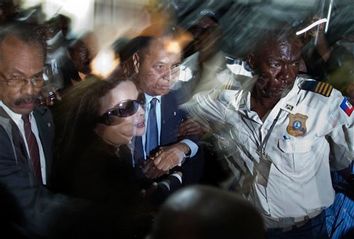
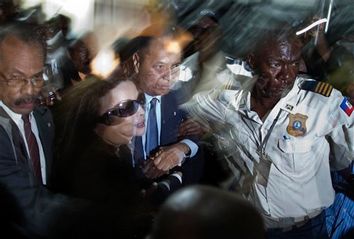
** CORRECTS NAME OF WIFE TO VERONIQUE ROY ** Haiti's former dictator Jean-Claude "Baby-Doc" Duvalier, center, and his wife Veronique Roy are helped by a police officer as they are surrounded by reporters upon their arrival to the Toussaint Louverture international airport in Port-au-Prince, Haiti, Sunday Jan. 16, 2011. Duvalier returned to Haiti after nearly 25 years in exile, a surprising and perplexing move that comes as his country struggles with a political crisis and the stalled effort to recover from last year's devastating earthquake. (AP Photo/Ramon Espinosa)(Credit: AP) A lawyer for Jean-Claude Duvalier says the former Haitian dictator is facing accusations of corruption and embezzlement for allegedly pilfering the treasury before his 1986 ouster.
Defense attorney Gervais Charles says the case is now in the hands of a judge of instruction who will decide whether there is enough evidence to go to trial.
That process can take up to three months.
Duvalier left court after a day of questions Tuesday and is headed back to his hotel.
THIS IS A BREAKING NEWS UPDATE. Check back soon for further information. AP’s earlier story is below.
PORT-AU-PRINCE, Haiti (AP) — Former Haitian dictator Jean-Claude Duvalier is leaving court after spending much of the day answering questions before a judge.
Duvalier was not in handcuffs as left the court Tuesday with his longtime companion, Veronica Roy.
He is expected to head back to his hotel. Hundreds of people cheered him as he got into SUV with a police escort.
Haitian police take “Baby Doc” into custody
Perhaps, the former Haitian dictator should've thought through his homecoming trip idea a little more
** CORRECTS NAME OF WIFE TO VERONIQUE ROY ** Haiti's former dictator Jean-Claude "Baby-Doc" Duvalier, center, and his wife Veronique Roy are helped by a police officer as they are surrounded by reporters upon their arrival to the Toussaint Louverture international airport in Port-au-Prince, Haiti, Sunday Jan. 16, 2011. Duvalier returned to Haiti after nearly 25 years in exile, a surprising and perplexing move that comes as his country struggles with a political crisis and the stalled effort to recover from last year's devastating earthquake. (AP Photo/Ramon Espinosa)(Credit: AP) Haitian police led ex-dictator Jean-Claude Duvalier out of his hotel and took him to court Tuesday without saying whether he was being charged with crimes committed under his brutal regime.
A contingent of police led the former dictator known as “Baby Doc” through the hotel and to a waiting SUV. He was not wearing handcuffs.
Duvalier, 59, was calm and did not say anything. Asked by journalists if he was being arrested, his longtime companion Veronique Roy, laughed but said nothing. Outside the hotel, he was jeered by some people and cheered by others.
Continue Reading CloseHaiti election devolves to street violence
Protesters burn buildings and erect barricades in several cities as popular candidate Michel Martelly is eliminated
The headquarters of Haiti’s ruling party was set ablaze Wednesday as protests over disputed presidential election results spread through the Haitian capital, prompting the nation’s president to call for calm.
Thousands of protesters took to the streets, erecting barricades and setting fires, furious that government-backed candidate Jude Celestin, the protege of unpopular President Rene Preval, apparently will go on to a runoff vote while carnival singer Michel “Sweet Micky” Martelly finished third in official results and is probably eliminated. Protests have also broken out in Les Cayes, Cap-Haitien and other cities.
Continue Reading CloseHaiti’s cholera death toll grows, fueling riots
Protesters blame U.N. peacekeepers for spreading the disease that has now killed more than 1,000 people
An outbreak of cholera has killed more than 1,000 people, the Haitian government said Tuesday as it sent top officials to the country’s north in hopes of quelling violent protests against U.N. peacekeepers accused of spreading the disease.
Haiti’s police chief, the health minister and other Cabinet officials headed to Cap-Haitien, the country’s second largest city, where protesters erected barricades of flaming tires and other debris and clashed with U.N. troops. At least two demonstrators died, one of them shot by a member of the multinational peacekeeping force that has been trying to keep order since 2004.
Continue Reading CloseFear of cholera outbreak grows in Haiti’s overcrowded capital
Health officials expect the disease to spread rapidly among Port-au-Prince's 3 million people
Health workers feared a surge of cholera cases in the shantytowns and muddy tent camps of Haiti’s capital as suspected cases piled up Tuesday and a laboratory confirmed a case originated in the overcrowded city.
Hundreds of people suffered the cholera symptoms of fever and diarrhea in hospitals and shacks built along the putrid waste canals of slums like Cite Soleil and Martissant.
At least 73 cholera cases had been confirmed among people living in Port-au-Prince. Physicians with the aid group Doctors Without Borders reported seeing more than 200 city residents with severe symptoms at their facilities alone over the last three days.
Continue Reading CloseHurricane Tomas floods Haiti
Seaside town of Leogane already destroyed by earthquake
A Peruvian U.N. soldiers and an aid worker take a little girl up into a U.N. truck as earthquake survivors are evacuated from the Corail-Cesselesse tent refugee camp before the arrival of tropical storm Tomas in Port-au-Prince, Haiti, Thursday, Nov. 4, 2010. Fear and confusion set in among more than 1 million Haitians advised to leave earthquake homeless camps in the country's capital.(AP Photo/Ariana Cubillos)(Credit: AP) Hurricane Tomas flooded the earthquake-shattered remains of a Haitian town on Friday, forcing families who had already lost their homes in one disaster to flee another. In the country’s capital, quake refugees resisted calls to abandon flimsy tarp and tent camps.
Driving winds and storm surge battered Leogane, a seaside town west of Port-au-Prince that was near the epicenter of the Jan. 12 earthquake and was 90 percent destroyed. Dozens of families in one earthquake-refuge camp took their belongings through thigh-high water to a taxi post on high ground, waiting out the rest of the storm under blankets and a sign that read “Welcome to Leogane.”
Continue Reading ClosePage 1 of 2 in Jonathan M. Katz