Kurt Kleiner

A mind of their own

In his compelling book "Nature via Nurture," Matt Ridley explains how genes don't serve as blueprints for behavior, but instead interact with the environment to create who we are.

  • more
    • All Share Services

A mind of their own

It should be obvious that people are the product of both nature and nurture, both genes and the environment. Take a kid with the potential to grow to 6 feet and malnourish him, and you’ll get a shorter adult. Take a potential chess champion and raise him on Nintendo, and you’ll get a video gamer.

But apparently it’s not so obvious to most people, most of the time. As Matt Ridley’s thoughtful and entertaining new book “Nature Via Nurture” shows, the study of human nature has been polarized. One side thinks our genes determine who and what we will be. The other side sees people as blank slates passively waiting for experience to mark them.

Only a few decades ago, behaviorists like B.F. Skinner denied we had any natural tendencies, and suggested we were merely unthinking machines reacting automatically to the environment, so many pigeons pecking at levers. These days, we’re obsessed with the idea of “genetic determinism.” Look at the fuss a few years ago over the so-called “violence gene,” a genetic defect that makes some men prone to criminality. People hated the idea. Protesters picketed academic conferences. Newspaper columnists dreamed up worries about babies being sentenced to prison at birth. At bottom, what people didn’t like was the idea that we were helpless before the tyranny of our genes.

People have always disliked the concept of fate and the implication that free will is an illusion. Ridley thinks genes have taken the place of fate in the human imagination. People used to rail against destiny. Now they rail against genes.

But Ridley has good news. He convincingly shows that nature vs. nurture is a false dichotomy. Genes aren’t destiny, and neither is experience. Instead, genes interact with the environment in subtle and powerful ways to determine just what kind of people we’ll be.

Ridley emphasizes that he’s not taking a “middle of the road,” “it’s a little bit environment, a little bit genetics” approach. Instead, he wants us to change the way we think about genes and the environment. Environment determines if and how genes turn on and off; put another way, genes depend on the environment to tell them what they should do, and even help change the environment they are exposed to. Drawing on the work of a number of scientists in the field, Ridley shows how this is a fundamentally different way of considering nature and nurture than most of us are used to.

We usually think of our genes as being like a blueprint for a building, a complete plan for ourselves down to the tiniest physical and mental detail. But Ridley says that genes are more like a recipe for raisin bread. They carry general instructions for the final loaf, but they don’t determine where every last raisin will end up. Between the recipe and the actual loaf, there’s a lot of room for unexpected things to happen.

For instance, scientists seemed to have found evidence for the genetic underpinnings of behavior when they bred a strain of mice that was especially aggressive. The funny thing was, these mice were aggressive for some researchers, but not for others. Scientists were puzzled until they realized that the aggressive trait only switched on if the mice were handled by humans when very young. Accidental differences in the way the mice were raised had revealed that environment could switch on a genetic predisposition. Here was evidence that genetics mattered — but so did experience.

Or look at the way monkeys feel about snakes. Monkeys raised in the lab normally don’t give them a thought. Researchers found it was easy to teach monkeys to fear rubber snakes by showing them videotapes of other monkeys that seemed to be reacting in fear to rubber snakes. But show a tape of a monkey that seemed to be reacting in fear to something else, like a flower, and the other monkeys had a much harder time learning to be afraid. Apparently, monkeys really do carry around a genetic fear of snakes, but one that has to be activated by experience. They don’t carry around a genetic fear of flowers, and so are a lot slower to learn to fear flowers.

Even more interesting was a similar effect on overall personality, again in monkeys. Researchers bred a line of high-strung rhesus monkeys that, when reared by a high-strung mother, would grow up into anxious, socially incompetent adults. But if these same monkeys were raised by especially calm and attentive mothers, they grew up to be normal and well-adjusted. For monkeys that weren’t bred to be high-strung, the kind of mother they had didn’t make as much difference. The nervous monkeys had a genetic predisposition to be nervous, but it took the wrong kind of nurture to bring it about.

Something similar seems to happen to humans, Danish researchers found. When children from families with no criminal backgrounds were adopted by other honest families, they were likely to turn out honest. Kids from honest families adopted by criminal families were only a little more likely to be criminals. If they came from criminal families into honest families, they were even more likely to get into trouble. The most likely adoptees to become criminals were the ones adopted from criminal families into criminal families. These kids carried genetically determined personality traits that made them more prone to criminality, but those traits could be tempered or exacerbated by a “criminal environment.”

So how do genes interact with the environment in this way? It’s complicated, and we don’t understand it fully. But it helps if we realize that there is rarely a single gene for a single trait. Instead, whole armies of genes interact in complex ways — with each other and with the environment — to determine who we are. They switch on, they switch off, they switch each other on and off, and they create cascades of molecular events that eventually determine what we’ll look or feel or act like.

In a sense, genes often choose their own environment. Someone with the genetic gifts of a good athlete is likely to spend a lot of time playing sports. Someone who is a poor athlete but a good student is more likely to bury himself in books. Because of genetic predisposition, these two children have selected very different environments for themselves.

“Genes themselves are implacable little determinists, churning out utterly predictable messages,” Ridley writes. “But because of the way their promoters switch on and off in response to external instruction, genes are very far from being fixed in their actions. Instead, they are devices for extracting information from the environment. Every minute, every second, the pattern of genes being expressed in your brain changes, often in direct or indirect response to events outside the body. Genes are the mechanisms of experience.”

Ridley thinks this way of looking at genes and experience opens up a new way of thinking about free will. It gets us beyond genetic determinism, on the one hand, and environmental determinism, on the other. His metaphor is of a flock of birds, wheeling around in the sky. “What is the cause of each twist and turn? Put yourself in the position of a single bird. You turn left, and this causes your neighbor to bank to the left almost instantaneously. But you turned because your other neighbor turned, and he turned because he thought you were turning before you were.”

In the same way, the complexity of the interaction between our genes and our environment means there is no simple, direct cause for any of our actions. They arise out of a “circular causality”: Environment influences genes which influence behavior which influences the environment. Hiding somewhere in this causal circle, Ridley thinks, is space for free will to exist.

I’m not sure Ridley has solved the problem of free will, but maybe he’s right, and this idea of “circular causality” is at least the beginning of a solution. Otherwise, Ridley has written a good book that takes us on a tour of genetics, human behavior, psychology, philosophy, and a half dozen other fields. You might find yourself reading more about the ins and outs of brain chemistry or the history of schizophrenia than is absolutely necessary. But most of the time Ridley uses the depth of detail to good effect. He might even have managed to put to rest this very old, and unproductive, debate.

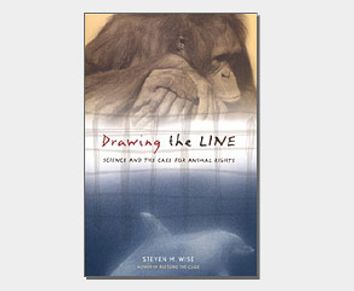
“Drawing the Line” by Steven M. Wise

A Harvard professor says science itself proves that such animals as parrots, apes and elephants should be considered persons with legal rights.

  • more
    • All Share Services

Is a parrot a person? How about a chimpanzee? Or a honeybee? Of course any kid can tell you that they’re not. Only people are people. Animals are animals.

But Steven M. Wise says it’s not that simple. In “Drawing the Line: Science and the Case for Animal Rights,” he argues that science shows that some animals really are people. At least, they’re legally entitled to be treated that way.

Wise is a lawyer and well-known animal rights activist who teaches a course on animal rights law at Harvard University. In his previous book, “Rattling the Cage,” he argued that chimpanzees and bonobos deserve protection as legal persons. Here he extends the argument, and asks whether seven different animals — gorillas, orangutans, parrots, dolphins, elephants, dogs and honeybees — are entitled to legal rights.

If your high school biology classes were anything like mine, you were taught that animals are instinct-driven automatons. If we think we see intelligence, reasoning, even emotion in animals, then we’re anthropomorphizing. But Wise details scientific work that shows some animals’ minds really do seem to work like our own. He thinks he can use these studies, combined with the legal principle of equality, as a crowbar to pry animal rights out of existing law.

So what makes a person? Wise quotes legal scholars and philosophers to make the case that the defining aspect of a person is autonomy; a person can desire, reason and act. Wise argues that many animals have what he calls “practical autonomy,” a quality that makes them much more like people than they are like things. The three-part test for practical autonomy he devises asks whether the animal 1) can desire something; 2) can intentionally act to fulfill those desires; and 3) knows that it’s he, the animal, who is doing the desiring and the acting.

Seem simple? It’s not. Concepts like intention and self-consciousness are maddeningly difficult to define, much less detect. Wise asks whether even his 4-year-old son, Christopher, has actually achieved the status of person. Does he have intentions and act on them? Does he have a sense of self? The kid passes, but it’s closer than you’d expect. If Christopher had been 1 year old when Wise asked the question, he might have been judged less worthy of personhood than an adult parrot.

Psychologists and animal behaviorists use a number of tests to try to detect various kinds of mental activity (and then argue among themselves about what the results mean). For instance, does the child or animal recognize itself in the mirror? Kids do this from about the age of 6 months. All of the adult apes are good at it, but it’s not as clear whether other animals recognize themselves.

Another basic test is for “object-permanence” — does the child or chimp understand that an object placed under a cup still exists even when it’s out of sight? Kids as young as 4 months may do this. So does Alex, an African gray parrot, who isn’t fooled when a hidden nut is transferred from one container to another.

Does the subject possess a “theory of mind” — in other words, does it seem to understand that other creatures have their own points of view and mental processes? It won’t surprise dog owners that dogs are good at this one. A dog playing fetch with a human who intentionally turns his back will put the ball down in front of the person. The dog seems to understand that the human has to see the ball before he’ll throw it.

At the summit is abstract symbol manipulation, which in its fullest form results in language. Wise details the famous case of Koko, the gorilla who knows a thousand words in sign language and seems to use them in a complex way. Even Alex the parrot, with a vocabulary of about a hundred words, is remarkably sophisticated — for instance, he seems to understand the abstract concepts of color and shape.

In the end, Wise weighs the test results and places the animals on a continuum from 0.0 (mere “stimulus-response machines”) to 1.0, full autonomy. Anything with a score above .70, he thinks, should be treated as a legal person with at least some rights.

Honeybees rank the lowest, but even Wise is surprised that they come in at a respectable .59, because of their ability to communicate with one another. Dogs don’t quite sneak into personhood, just missing at .68, in part because formal intelligence studies of dogs are rare. But, in ascending order, elephants, parrots, dolphins, orangutans, gorillas and bonobos all make the cut.

But what rights, exactly, should these animals have? Suppose new scientific studies nudge the family dog into personhood. Would it be wrong to chain him up outside when he’d rather run free? To feed him dry food when he prefers canned? To neuter him? Would it be legal to “own” a dog at all? Here, Wise gets a little coy. He admits that asking for too many rights for too many animals all at once is bad strategy. At present, he confines himself to saying that animals with rights shouldn’t be captured, confined, killed or made to suffer.

Wise is a pragmatist, and he takes a relatively narrow, legalistic route because he thinks it’s his best shot at advancing the cause of animal rights. He agrees in principle with critics who argue that animals should be granted rights based on their capacity to suffer. “But the capacity to suffer appears irrelevant to common-law judges in their consideration of who is entitled to basic rights … And so I present a legal, and not a philosophical, argument for the dignity rights of non-human animals.”

I wonder, though, if it’s not the philosophical argument that will carry the most weight in the end. It seems unlikely that many judges will extend personhood rights to animals based on these arguments. More likely, they’ll stick to the old, comfortable formulation: People are people and animals are things. (They’ll have plenty of wiggle room, once opposing expert witnesses detail the scientific uncertainty behind Wise’s evidence.)

Throughout “Drawing the Line,” Wise compares the situation of non-human animals to that of slaves before emancipation. Slave owners and others stood to lose greatly if slaves were freed, and a tremendous amount of rationalization went into justifying slavery. Today, we live in a society that depends on the use of animals as things, and Wise thinks we make similar rationalizations.

But it was not legal argument that eventually freed the slaves in the United States. It was a complicated and difficult political decision, driven in part by the belief of enough people that slavery was “philosophically” wrong.

Wise’s accounts of animals’ mental abilities are fascinating and thought-provoking. But in the end, it wasn’t their relative autonomy scores that swung my sympathies. It was the description of Koko making a joke; of a mother elephant involving her youngster in a game so she could complete a task. It was the account of Alex, the parrot, left at the vet for surgery, calling after her keeper, “Come here. I love you. I’m sorry. I want to go back.”

Call me an animal lover, call me a shameless anthropomorphizer. But I’m most convinced by the animal rights movement when I’m made to consider that animals can suffer and feel emotion. I think most people are the same.

Only if and when enough people decide that it’s morally — “philosophically” — wrong to treat animals the way we do, and then translate those beliefs into political action, will there be hope for the sort of sweeping change Wise advocates.

Continue Reading Close

“The Hunt for Zero Point” by Nick Cook

An editor for the esteemed Jane's Defense Weekly says the U.S. government has been working on Nazi anti-gravity technology in secret for 50 years.

  • more
    • All Share Services

The U.S. government confiscated secret Nazi anti-gravity technology at the end of World War II, and later may have tested it in aircraft that account for the rash of post-War UFO sightings. Some of that technology has probably made its way into the B2 stealth bomber. Some of it is probably so dangerous that it’s buried away in secret government vaults.

In the post-X-Files age, this sort of conspiracy theory won’t raise any eyebrows. What makes the allegations interesting is that they appear in “The Hunt for Zero Point,” which is written by Nick Cook, for 10 years the aviation editor at Jane’s Defense Weekly. Jane’s is the bible of the defense establishment, known for its no-nonsense, nuts-and-bolts reporting. A former Jane’s editor tackling this topic is enough to make you take a second look.

Although anti-gravity research ranks right up there with perpetual motion on the crank-o-meter, the idea of anti-gravity can’t be completely dismissed. As recently as 1996 a Finnish scientist announced he could partially “shield” objects from gravity using spinning superconductors. Although most scientists are skeptical, NASA is interested enough that it’s trying to replicate the results.

And certainly Nazi Germany was working on a lot of advanced technology by the end of the war, including rockets, jet fighters and nuclear power. The U.S. recruited some German scientists to continue their work in the U.S., most notably Wernher von Braun, the V-2 rocket scientist who later helped make the moon landings possible.

It’s also clear that the U.S. military works on secret technology all the time — about $11 billion worth every year in “deep black” programs that aren’t even acknowledged to exist. The stealth fighter and B2 bomber were black programs for years.

So even if Nazi flying saucers sound nutty on the face of it, there’s nothing crazy about Cook asking the questions he does. You might even call it courageous. It’s the conclusions he reaches that are the problem.

Cook’s search begins one day when a photocopy of a 1956 magazine article mysteriously lands on his desk. It’s called “The G-Engines Are Coming!” and is illustrated with a drawing of a U.S. airman descending the steps of a floating, wingless aircraft. Cook thinks it’s a joke, but gets interested when he sees aerospace industry leaders of the day quoted as saying anti-gravity could be the next big breakthrough.

He decides to call one of them, a now-retired engineer named George S. Trimble. A Lockheed Martin P.R. person, “Daniella Abelman,” sets up an interview, then calls back and says Trimble has cancelled.

“I don’t mind telling you that he sounded scared and I don’t like to hear old men scared. It makes me scared,” she tells Cook. “Let me give you some advice. Stick to what you know about; stick to the damned present. It’s better that way for all of us.’” (Cook has changed “Abelman’s” name, so there’s no way to call her and see if she really talks like a character in a Tom Clancy novel.)

Of course Cook’s curiosity is inflamed, and he tracks down Trimble in a retirement community in Arizona and — oh, wait a minute. That’s what you expect him to do. But here’s what he says. “My great regret was that I couldn’t contact George S. Trimble directly. Had I done so, I knew that Abelman would have gone ballistic. She’d told me to stay away from him and she had the power to ensure that I became an outcast if I didn’t.”

Unwilling to face the wrath of the flack, he retreats to the Internet where “in the silence of the night, I could roam … and remain anonymous.” He finds the story of Thomas Townsend Brown, a former Navy engineer who believed he could negate gravity using electricity and who by 1956 was demonstrating small, electrically charged flying disks. The military was briefly interested, but in the end issued a report that said there was no usable technology there.

But Cook notices something in a 1947 Army Air Force memo (famous among UFO buffs), in which Lt. Gen. Nathan Twining concludes that UFOs are real. Twining adds that it is “within the present U.S. knowledge” to construct similar aircraft, given enough money.

Cook concludes that by 1947 the U.S. must already have had a key component of UFO technology — anti-gravity. That’s why they weren’t interested in Brown’s technology years later. He suspects the technology came from Nazi Germany, and recounts allegations of German flying saucer programs from a few dubious books, as well as information he admits seems to have “magically appeared out of thin air … passed down from one researcher to the next, without attribution.”

He gets off of the Internet and starts searching through military archives for clues. He finds a few hints in old Army Air Force records on Luftwaffe technology, but nothing substantial. Then he reads that the SS was in charge of the most secret German technology. “I felt a constriction in my throat. I was so keyed, my breath was coming in short, sharp gasps.” Don’t worry, he’s not having a heart attack. He just realizes he’s been looking in the wrong place. He starts reading about the SS.

Soon we’re off to Poland. A “researcher” named Igor Witkowski shows Cook an old mine, where he claims SS scientists worked on a machine called the Bell, a glowing, rotating contraption that used up a lot of electricity. “Word had it that the tests sought to investigate some kind of antigravitational effect, Witkowski said.” Somebody else thinks it might have been a time machine. Then Cook finds yet another SS anti-gravity program, a flying saucer called the “Repulsine.”

Cook concludes that an SS official named Hans Kammler had all of this technology boxed up and flown to a safe place, later trading it to the U.S. military for his freedom.

The U.S. government kept it all under wraps for years, but probably implemented some of it in the B2 bomber. Why didn’t the U.S. make more widespread use of this technology? Partly because it would have disrupted the existing aerospace industry, with its expertise in winged aircraft. Partly because anti-gravity might tap into energies just too destructive to tamper with. And “… in the 1940s and 1950s, it wasn’t as if the world really needed it.”

It’s a story that strains credulity. But unless we’re after cheap laughs, our hope when we pick up a book like this is that the author will, against the odds, build a careful, reasonable and convincing case. Cook isn’t that author.

The first problem is that Cook is no help sorting out the physics he’s writing about. His explanation of “zero point energy” (a quantum effect caused by virtual particles winking in and out of existence) is acceptable. But he’s also capable of explaining that the Repulsine made air molecules “pack so tightly together that their molecular and nuclear binding energies were affected in a way that triggered the anti-gravity effect.” Both explanations sound equally weird to the layman. But the first is recognized science, the second pseudo-science.

OK, so physics is hard, and Cook is a journalist. But we should at least expect him to bring a journalist’s care to the sources he uses and the conclusions he draws. Instead, we’re bombarded with a hodgepodge of information trawled up from the Internet, other books and UFO and anti-gravity enthusiasts, along with some firsthand reporting. Although he makes a show of weighing this information with the critical eye of a trained aerospace expert, he doesn’t prove worthy of much confidence.

A perfect example is his reliance on Witkowski, the Polish researcher, whose information is key to Cook’s conclusions. Where did the information come from? Witkowski says a Polish government official (whom he refuses to name) allowed him to see some documents, but not make copies of them. Why does Cook believe Witkowski?

“Witkowski had been recommended to me by Polish sources through my work at Jane’s as someone who was both highly knowledgeable and reliable … Had Witkowski been in any way a lightweight, I would have turned around and got on the first plane home. But when I saw him, I knew he was OK.”

Just as shaky are most of Cook’s conclusions. For instance, the old Army Air Force memo in which Twining says UFO-type aircraft are “within the present U.S. knowledge” runs like a mantra through the book. Cook thinks it means that even in 1947 the U.S. could have built an aircraft capable of tremendous acceleration and instantaneous changes of direction, a craft that would require anti-gravity to work.

Twining actually says, “It is possible within the present U.S. knowledge … to construct a piloted aircraft which has the general description of the object in subparagraph (e) above.” What’s that description? Metallic, saucer-shaped, quiet, no trail, capable of flying in formation, with a cruising speed of 300 knots. Right or wrong, Twining’s not talking about the same astonishing capabilities as Cook is.

Or look at his conclusions about Kammler, the SS official Cook thinks traded the anti-gravity technology to the U.S. By the end of the war Kammler was the administrator in charge of most advanced research programs, including the V-2 rocket factories. But where’s the evidence he traded any technology — much less anti-gravity technology — to the U.S.? Well, a lot of Germans with technological knowledge tried to cut deals with the U.S. Kammler’s movements at the end of the war are mysterious, and there are contradictory reports about his death. Besides, Cook thinks it’s the kind of thing Kammler would do.

“My feeling was Kammler would offer them something so spectacular they’d have no choice but to enter into negotiations with him.”

In fact, a lot of the evidence here is based on Cook’s feelings. A minor but typical example is a feeling he gets while reading a “recovered transcript,” supposedly of a phone call between two Air Force officers discussing Brown’s work. Gen. Victor E. Bertrandias is the chatty one; a general named Craig doesn’t say much — only “No” and later “I see.” It’s Craig who catches Cook’s interest.

“The man’s urbane delivery earmarked him, to me at least, as someone big in Air Force intelligence.” All that from, “I see.”

What is instructive about the book is the insight we get into how conspiracy theories seduce otherwise reasonable people. Like all of us, Cook knows that real conspiracies exist. No one questions, for instance, that military technologies are being developed in secret, and that the government “conspires” to keep details from the public.

But what do you look for when you think direct evidence has been withheld or suppressed? Before searching some old records, Cook realizes “it was inconceivable that the … intelligence teams would have documented the discovery [of German flying saucers] for the world to read about … I wasn’t searching for the obvious, because the obvious would have been picked up by the censors.” So Cook is reduced to ferreting out minor inconsistencies and odd, ambiguous details which he tries to puff up into proof.

Likewise, information that is available has to be suspected as possible government disinformation. Perhaps the military has encouraged UFO reports to disguise its own flying saucer tests. Maybe the mythical Philadelphia Experiment (in which a Navy ship was supposedly sent into another dimension) was really just a story designed to discredit Brown. But, since the best disinformation always contains a grain of truth, maybe there really is a connection between anti-gravity and other dimensions.

Using this reasoning, all bets are soon off, and almost anything you turn up — lack of evidence, official denials, unsubstantiated rumors, wild conjecture — becomes evidence for what you’re trying to prove.

In the end, Cook’s argument boils down to the old proverb he invokes several times — Where there’s smoke there must be fire. But sometimes, someone’s just blowing smoke.

Continue Reading Close