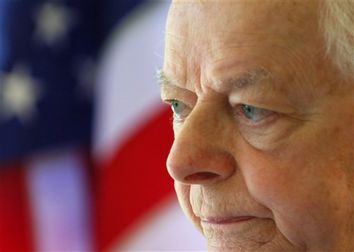
I think I was six years old when Lyndon Johnson came to my hometown of Morgantown, West Virginia to give a speech touting some Great Society programs in what must have been mid-1967. All the state’s big shots were there, up on the dais. Dad, a local attorney active in politics, wasn’t quite big enough to be on stage, since he held no office, but we were seated at the ace table in the ballroom, and I remember that Johnson, describing conditions faced by poor children, pointed at me several times (“just like this child right here…”).
I also remember that even then — even though Robert Carlyle Byrd wasn’t yet a decade into his Senate service — dad spoke of Byrd not familiarly, as he did most of the state’s pols, but quietly and reverentially. Dad knew Byrd, certainly. But there were no stories about him, no anecdotes of taking him to shake hands outside a local mine at a change of shift, no tales of seeing Byrd knock back a bourbon in the bar of long-gone Daniel Boone Hotel down in Charleston and craning forward as he delivered the inside dope on what those crazy people in Washington were really up to.
Well, Byrd was from the southern part of the state, down below Beckley. We were northerners, almost Pittsburghers. In those days especially, you could have built a wall across the state more or less along U.S. Route 50 — above it north, below it Dixie. And the roads were such back then that Beckley was far, far away; it was probably faster to get to Philadelphia. So there was certainly that.
But I would wager that even well-placed lawyers from Byrd’s part of the state spoke of him quietly and reverentially, and I bet they discovered, when they thought about it, a surprising dearth of anecdotes. He just wasn’t that kind of pol. “Pol” isn’t even the right word. He did enough flesh-pressing to get by. He’d learned the fiddle as a young man, and that certainly paid dividends on the hustings. But a lot of the time, he was probably at home reading Polybius.
Now Byrd is gone, at age 92, having served a record-setting 51 years in the United States Senate. The career is astonishing mostly for all the history he witnessed and shaped, all the eras he outlasted.
He came to a deeply reactionary Senate, dominated by the Southern barons, in which, alas, he felt all too at home. But it was a changing Senate, too: His class, that of 1958, was notable for the many liberals it elected, men like Ed Muskie, Phil Hart, Gene McCarthy. By 1963, the Southerners were being challenged. Byrd was, famously, on the wrong side of history then. He opposed the 1964 civil rights bill and spoke against it for 14 hours. He was, frankly, terrible on the question, and although his also-famous membership in the Ku Klux Klan many years before was brief, it stuck with him, and it deserved to stick with him. It took him too long to change his racial views, which always seemed to me more reflective of his part of the state than mine, although maybe I’m being naive there.
But as the Southern-baron era faded and the Senate entered its era of liberal activity, Byrd eventually joined and embraced it. By the 1970s, after he’d defeated Teddy Kennedy in a whip election, he’d become more or less a moderate-to-sometimes-liberal Democrat. In 1977, now majority leader, he hit what many regard — well, okay, what my father always regarded — as the high point of his career, when he defended handing over the Panama Canal Zone to Panamanian authority and rounding up the votes in the Senate for it.
If you weren’t around then or were too young: It was a ferocious battle marked by the kind of nativism and xenophobia with which we are alas still quite familiar. It’s almost impossible to imagine that 68 senators would have the guts to vote that way today. Byrd was instrumental in making it happen.
In the third era Byrd lived through, the era of partisanship and polarization and lobbying and money, Byrd again played an important role, and one history will largely applaud, as guardian of senatorial power. That posture wasn’t always good for the republic: As I noted on my Guardian blog, he was an ardent defender of the filibuster. But he opposed giving Bill Clinton the line-item veto on separation-of-powers grounds, and he opposed giving George W. Bush his war on largely the same grounds. He said in February 2003: “On this February day, as this nation stands at the brink of battle, every American on some level must be contemplating the horrors of war. Yet, this chamber is, for the most part, silent — ominously, dreadfully silent. There is no debate, no discussion, no attempt to lay out for the nation the pros and cons of this particular war. There is nothing. We stand passively mute in the United States Senate, paralyzed by our own uncertainty, seemingly stunned by the sheer turmoil of events.” He was also unusually prescient in warning that the war wasn’t going to be quite as easy as most were advertising.
That position cost him some points back home, in a state whose politics became increasingly conservative during Byrd’s tenure. While West Virginia was never Massachusetts, it was always heavily union and, in my youth, surprising in certain ways (one of the most liberal state supreme courts in the country, for example). Over the decades, the massive decline in union membership — barely around 15,000 UMW members in the state today — and the little-discussed incursion by the Southern Baptist Convention into the state — a handful of churches when I was little, more than 300 last time I checked — changed the state into pretty fertile Limbaugh territory.
There was talk among the state’s Republicans in 2003 and 2004 of taking Byrd out in 2006. The Republicans found a rich conservative, John Raese, a native of Morgantown, to run against him. (My dad represented the striking Newspaper Guild workers against Raese’s newspaper-owning family in 1972). But Byrd crushed him by two-to-one. West Virginians were going to let the old man run out the clock. All that infamous pork helped, of course. You can’t throw a rock in the state without hitting something named for Byrd, and no, no one feels the remotest shame about it.
But I don’t think it was only the pork. West Virginians knew they had someone of stature representing them, and a small, poor state doesn’t produce many of those. There are the university’s basketball and football teams, and Byrd and Jay Rockefeller. Mary Lou Retton maybe, although that’s getting to be an old one, and she hasn’t lived in the state in ages. In stature terms, that’s about it. West Virginians don’t take that cavalierly.
A man his age has lived a more than full life, but if there is a sad thing about his passing now, it is that he was just starting to use that stature to do something he’d never done: challenge the coal industry. Like most West Virginia politicians, he was predictably in coal’s corner. When federal judge Chuck Haden handed down a pro-environmental decision about mountaintop-removal mining in 1999, Byrd actually went to the length of trying to get Haden’s decision overturned in Congress.
Then, out of nowhere, last December he started attacking the coal industry, saying: “Change has been a constant throughout the history of our coal industry. West Virginians can choose to anticipate change and adapt to it, or resist and be overrun by it. The time has arrived for the people of the Mountain State to think long and hard about which course they want to choose.” He meant, without saying it, the rape of the mountains that was no longer ignorable. He also went after Massey Energy more recently, after the hideous deaths of the 29 miners in that April explosion in his home county. Most surprisingly, he recently voted against the Lisa Murkowski resolution to strip the EPA of authority to define and regulate greenhouse gases. Rockefeller voted for big coal. Byrd bucked it. I don’t think he ever would have done that five or 10 years ago. It would have been fascinating to see what he would have said about coal and Massey and Don Blankenship over the next few years.
Byrd is not easy to categorize or eulogize. He was not avowedly liberal or conservative, and as such doesn’t suit this partisan era. As a man who taught himself law, read ancient classics, used a few too many five-dollar words and was never any good at all on television, he was also out of place in our age. But he spanned ages, embodying the good and the bad of America over those decades, and standing consistently in what Arthur Schlesinger called the time of “the imperial presidency” against presidential power. Many of the tributes that are pouring in today from his colleagues are coming from people who haven’t the slightest idea what his career was actually about, or who do but who simply put partisan gain ahead of constitutional belief. The Senate will always need a Byrd. I’m not sure who the next one will be, but I am sure it will miss this one.
If you had a message for America’s Jewish leaders and wanted to choose a high-impact day on which to deliver it, you could hardly have chosen better than Monday, April 22. The American-Israel Public Affairs Committee (AIPAC), the country’s wealthiest and most powerful pro-Israel lobby, convened that morning in Washington for its annual conference. Most of the major Jewish political figures in America were under one roof. All you’d have needed was the megaphone.
William Safire owns, metaphorically, one of the largest megaphones in journalism with his New York Times column. He used it that day to publish a column headlined “Democrats vs. Israel,” asserting that the party of Harry Truman, who recognized the new Jewish state in 1948 within 20 minutes of its announced existence, had abandoned Israel and was now busy “transmogrifying the Arab aggressor into the victim.” He suggested that American Jews, who normally vote Democratic by about 4-to-1, should get the message and “think again.” Safire made two specific charges relating to Democratic leaders that carried particular sting. Senate Majority Leader Tom Daschle, D-S.D., he wrote, “blocked a bipartisan resolution” designating the PLO as a terrorist group. And Sen. Joe Biden, D-Del., who chairs the Senate Foreign Relations Committee, “refused to allow” Binyamin Netanyahu to testify before his committee on a recent U.S. visit. Safire’s implication was clear: Daschle and Biden had, at best, a cavalier attitude toward Israel’s security. One can imagine the impact these charges had at the AIPAC gathering, where Daschle was scheduled to speak that very day.
The only problem with these charges is that they are false. But then again, for Safire, it wasn’t about the truth. It was about a deliberate political strategy of seizing the moment when American Jews have become more uniformly hard-line in their support for Israel to try to move Jewish votes, and especially campaign contributions, to the Republican side. Safire is doing this even as other conservatives — William Bennett, The Wall Street Journal’s editorial page — are hammering at the Bush administration for wavering on Israel. It’s a good-cop, bad-cop routine that has a foreign-policy goal and a domestic political one. The foreign-policy goal is to push the administration hard to the right on all questions involving Israel and, ultimately, Iraq. The political goal — which depends in large part on painting Democrats as somehow against Israel, and pretending that no such criticisms also exist within the GOP — is to distort the record in such a way as to persuade American Jewry that its only reliable friend in these taxing times is the far right.
First, the facts. Daschle “blocked a resolution”? Not quite. Here’s what happened.
On the afternoon of April 11, Sen. Dianne Feinstein, D-Calif., announced that she and Sen. Mitch McConnell, R-Ky., were preparing to introduce legislation labeled the Arafat Accountability Act, which calls for the imposition of sanctions on Yasser Arafat until he and the Palestinian Authority demonstrate that they have taken key steps to crack down on terrorism. This was an updated and tougher version of a similar bill the two had introduced the previous fall. According to National Journal’s Congress Daily, however, Feinstein said that on the same day she and McConnell introduced the bill, they had decided not to push it until Secretary of State Colin Powell returned from his trip to the Middle East. Powell left the U.S. on April 7 and returned to Washington April 17.
That same April 11 — when a suicide bombing also killed six Israelis, and Israel moved on the Jenin refugee camp — Daschle was asked about the Feinstein-McConnell bill. He said: “I think we need to be really appreciative of the very difficult situation that Secretary Powell finds himself in today. There are many ideas that may deserve consideration at some point. But I think it’s critical for us to be as supportive of his effort, not to compound his difficulty. … The stakes are going to be every bit as high after the Powell mission. I just think that right now … I just don’t want him to have to explain what I said or what somebody else said in the heat of debate in the consideration of a resolution on the Senate floor.” Any fair-minded reading of those statements (and he made several others like them that day) leads to the conclusion that Daschle — very reasonably, and in fact with appropriate deference to the executive branch — was merely saying that he didn’t think senators should be lobbing rhetorical grenades on the Senate floor at a time when violence in the region was escalating, and when Powell was preparing to meet with Arafat and Ariel Sharon.
If that’s “blocking a resolution,” then it should be noted that Safire’s Republican friends in the Senate, like Trent Lott of Mississippi, agreed. On April 18, the day after Powell returned, Lott was asked about Feinstein-McConnell and said: “I haven’t looked at the language. I felt very strongly that we shouldn’t do anything either way as long as Secretary Powell was in the region.” Not only that, but the week before, when Sen. Chuck Schumer, D-N.Y., became the only senator who publicly challenged President Bush’s decision to have Powell meet with Arafat, it was Lott who rebuked him: “Most senators have enough sense to keep a cool head at a hot time. He needs to tone it down a little bit.”
In those remarks, we hear a conservative Republican warning a Democrat against making statements too hawkishly pro-Israel. So much for Republican resolve and Democratic weakness.
There’s still more evidence that refutes Safire’s stark partisan divide. Recall that Feinstein and McConnell had originally introduced their bill last fall. At that time, Feinstein received a letter requesting that she hold off on such tough-on-Arafat language and not seek to move the bill. From Democrat Tom Daschle? Try again. From Republican Colin Powell. So if anyone “blocked” the Feinstein-McConnell language for a period of time, it was the administration (and, I would say, for perhaps understandable diplomatic reasons). At any rate, sure enough, on April 18, after Powell had returned, Feinstein and McConnell introduced their bill, with McConnell echoing his Democratic colleagues’ caution with regard to timing by pointing out that “we should not be bringing this up for a vote in the Senate right now.” Daschle did nothing whatsoever to “block” it. But exactly none of this context or nuance was of interest to Safire, whose paragraph on the matter made it sound as though Daschle was opposed to any statements critical of Arafat as a matter of pro-PLO principle.
The Biden allegation is based on similar pretzel logic. A source familiar with these events says Biden was in Florida during a congressional recess when he received a call from Sen. Jesse Helms, R-N.C., suggesting that they have Netanyahu testify before the foreign relations committee. Biden was skeptical, and replied by asking whether Helms had run this by the White House. Helms said he hadn’t, but he would do so and call Biden back. He never did. The White House — again, this was happening while Powell was on his trip — clearly did not need the headache of a former prime minister, who is positioning himself to Sharon’s right, seizing the platform of an official committee hearing to offer his criticisms of Sharon and, more to the point, of Bush himself. Ultimately, Netanyahu was given a more informal forum, which many senators attended and which was open to the press.
That’s “refusing to allow” Netanyahu to testify? Actually, it sounds like more deference to the White House. Safire quoted Biden as saying such an appearance would be “totally inappropriate,” and while he did indeed say those words, the full quote, to Al Hunt on CNN, was as follows: “I was asked to hold a hearing, Al, this past week and have Bibi as a witness, and I refused to do it on the grounds that I thought it was totally inappropriate. I’m not Newt Gingrich. I’m not going to go ahead and, while a president has a major initiative and his chief diplomat in the region, invite someone, notwithstanding the fact that I like him, to testify to undercut that initiative.” It’s clear that Biden’s hesitation, like Daschle’s, was not based on hostility to the Israel government, as Safire implied. It was based on the principle of executive branch foreign-policy prerogative and the fact that Powell was in the Middle East. Their hesitation was shared by Lott and McConnell, as we have seen, and by Rep. Dick Armey, R-Texas, and a spokesman for House Speaker Dennis Hastert, R-Ill., both of whom said on April 18 that it wasn’t the job of Congress to make the executive branch’s job more complicated. In neither case did Safire acknowledge that Daschle and Biden were speaking while Powell was overseas negotiating, nor did he note that several Republicans had made statements similar to theirs.
But the column surely served its purpose, which Thomas Edsall explained in an April 30 Washington Post piece headlined “GOP Eyes Jewish Vote With Bush Tack on Israel.” Republicans are using the perception that Bush has stood firm with Sharon against terrorism to make a more concerted effort than at any time in recent American history to capture Jewish votes and dollars. Of the $62 million raised by Al Gore and Bill Bradley, Edsall notes, $13 million came from Jewish contributors; but of the $150 million taken in by all GOP primary presidential candidates, just $3.75 million came from Jewish donors. Safire’s column and other ongoing efforts by Jewish Republican organizations are attempts to change that math.
And yet: At the very same time that Safire and some others (Deborah Orin in the New York Post) are flogging this GOP-can-do-no-wrong spin, other conservatives are taking shots at Bush for not being pro-Israel enough. On April 30, the Wall Street Journal editorialized that figuring out the administration’s Middle East policy is “a little bit like Kremlinology. No outsider knows what’s really going on; we wonder how many insiders really do.” William Bennett warned Bush of a Republican “firestorm” if he wavered on Israel. Gary Bauer, Bill Kristol and the National Review have all chimed in similarly. And on Capitol Hill, Majority Whip Tom DeLay, R-Texas, defiantly led the effort to push through a toughly worded pro-Israel resolution against the administration’s wishes, which passed Thursday.
It’s obvious what’s going on here. The commentators of the hard right see an opportunity to steal away a chunk of a longtime and crucial Democratic constituency. They’re doing it in the first instance by rhetorically equating support for Israel with support for every decision made by Ariel Sharon, which is nonsense. They’re doing it by publishing distorted attacks on Democrats as Safire did. It’s hardly the case that Democrats are “soft” on Israel. The DeLay resolution was co-sponsored by Democrat Tom Lantos of California, and Daschle led the effort to pass similar language that passed the Senate Thursday.
And, lest one think that Democrats are merely responding to recent pressure from Safire and others, it should be pointed out that Democratic pro-Israeli sentiment hardly started upon Powell’s return. On March 21, Feinstein drafted a hard-line letter to the administration asking it not to negotiate with Arafat. Of the letter’s 52 signatories, a sizable majority of 30, Daschle included, were members of the party Safire claimed stood against Israel.
The final irony here is that whatever Jewish money Republicans do manage to shift to their side will go to finance House and Senate races for candidates whose states and districts almost uniformly have few Jews, and who stand for a larger set of positions that most Jews find anathema. Democrats are still trying to figure out how to play some post-Sept. 11 offense. If this cynical play at stealing one of their most faithful constituencies can’t light a fire under them, it’s hard to say what can.
Continue Reading
Close
When Senate Majority Leader Tom Daschle said on Feb. 28 that Democrats would start “to ask the tough questions” about President Bush’s war strategy, Republicans reacted predictably. Trent Lott accused Daschle of “trying to divide the country.” Tom DeLay issued a one-word press release: “Disgusting.” Bill Frist, the Tennessee senator who chairs the GOP’s senatorial campaign arm, called Daschle’s words “thoughtless” and “ill-timed.” The charge amounted to something just this side of giving aid and comfort to the enemy.
They’ve since calmed themselves a bit, but the intensity of their choler raises a fair question: Were Daschle’s remarks — not a formal speech or even a press release, but rather a few sentences in response to some questions toward the end of a press conference that he’d called to discuss other topics — so shockingly without precedent in American history that those blunt reproaches were deserved? More than that, what does history tell us about the appropriate parameters of loyal opposition after America has been attacked and while U.S. soldiers are at battle?
It turns out there is precedent for Daschle’s position. That precedent comes from the aftermath of Pearl Harbor, the most direct analogy in our history to Sept. 11. And it comes, wouldn’t you know it, from a Republican. And not just any Republican, but the icon of modern conservatism who was known during his lifetime as “Mr. Republican.”
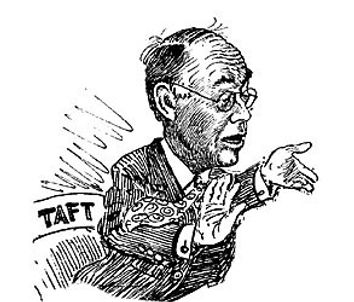
Ohio Sen. Robert A. Taft was a devoted conservative, an adversary of the New Deal, a spirited isolationist and, by 1952, the man whom the right, which harbored grave suspicions about the moderate Eisenhower’s internationalist tendencies, was backing for the presidency. While he tended to focus his legislative labors on domestic issues, Taft — his son and namesake is now Ohio’s governor — had made his isolationist views well known throughout the 1930s, and no GOP leader of the day had greater influence over his party’s right wing.
After the attack on Pearl Harbor, the GOP faced pressures similar to those Democrats are under now. There were admonitions not to criticize the sitting administration, and declarations, immediately after the Japanese attack, that politics had to stop at the water’s edge. But conservatives had detested Franklin Roosevelt, his New Deal and his foreign policy — the lend-lease program and the destroyer deal with Britain in particular. And the events of Dec. 7, 1941, seemed to stifle their ability to dissent.
What, then, were they to do? Taft had his answer. He gave a speech to the Executive Club of Chicago arguing that it was precisely the duty of the opposition party to ask the tough questions. He didn’t give this speech five and a half months after the attack, as Daschle did (and remember, Daschle didn’t even give a speech). He wasn’t speaking five weeks after hostilities began, which was how long it took DeLay to blast President Clinton on the war in Kosovo. Taft delivered his speech … on Dec. 19, 1941!
And quite a direct speech it was. His defense of criticism as patriotism is worth quoting at some length:
“As a matter of general principle, I believe there can be no doubt that criticism in time of war is essential to the maintenance of any kind of democratic government … too many people desire to suppress criticism simply because they think that it will give some comfort to the enemy to know that there is such criticism. If that comfort makes the enemy feel better for a few moments, they are welcome to it as far as I am concerned, because the maintenance of the right of criticism in the long run will do the country maintaining it a great deal more good than it will do the enemy, and will prevent mistakes which might otherwise occur.”
Taft invoked Woodrow Wilson, Oliver Wendell Holmes and Francis Biddle, FDR’s attorney general, as defending this right, and argued that “the duties imposed by the Constitution on Senators and Congressmen certainly require that they exercise their own judgment on questions relating to the war.”
There was more, a lot more. Debates were raging in Congress at the time — and, remember, American territory had just been attacked, bodies and wreckage still lay in the harbor, and U.S. soldiers were already in harm’s way — over questions like the conversion of industry to support the war and the best way to expand the draft. Taft weighed in on each, specifically opposing plans the Roosevelt administration had floated (“I see no use in sending boys of nineteen or twenty to war”).
At great length Taft argued that the higher defense appropriations Roosevelt was seeking should lead to the end of both Keynesianism (New Deal economists “are confident that a people can spend itself into prosperity”) and New Deal programs like the Works Progress Administration. Thus Taft was tying the war to domestic politics in a way that today’s Republicans have also carped at Democrats for sometimes doing. Finally, there were shades of renegade Rep. Dan Burton, R-Ind. (who, angered at the administration’s secrecy, has threatened the Bush White House with “war”), when Taft called for a congressional investigation into whether Cordell Hull, FDR’s secretary of state, had informed Secretary of the Navy Franklin Knox of the contents of his famous Nov. 26 note to the Japanese. The note contained conditions that Hull knew the Japanese would never accept, and the suspicion was rife among Republicans that Hull, and Roosevelt, actually wanted the Navy to be ambushed at Pearl Harbor to stoke war fever among the populace. “Perhaps the fault at Hawaii,” Taft said, “was not entirely on the admirals and generals.” Mr. Republican, that Dec. 19, minced few words.
And his fellow Republicans got the message. According to historian Richard Darilek in “A Loyal Opposition in Time of War” (1976), Republicans entered 1942 ready to fight the administration head-on. Wendell Wilkie, the party’s nominal leader, was an interventionist, but in a bid to placate the GOP’s isolationist wing he appointed an America Firster named Clarence Boddington Kelland head of public relations for the Republican National Committee. On Jan. 8, Kelland delivered a speech in Salt Lake City on the importance of robust partisanship. Democratic National Committee chairman Ed Flynn countered by cautioning against the election of a hostile Congress. New York Gov. Thomas E. Dewey, who would run against FDR in 1944, warned of the existence within the administration of “an American Cliveden set … scheming to end the war short of military victory” (“Cliveden set,” a reference to the Astor estate in Britain that served as a salon for government ministers, was synonymous with “appeasers”). By the time of the Republican Lincoln Day dinners — mid-February, just two months after Pearl Harbor — politics in Washington, Darilek writes, were more or less back to normal.
Two points need to be made about Taft’s speech. The first is that he was exactly right to make it. Who can possibly argue with Justice Holmes’ statement, the one Taft quoted, that “we do not lose our right to condemn either men or measures because the country is at war”? Well, we know who can, but certainly the vast majority of the American public understands such a right to be a nonnegotiable principle of democracy.
The second is that it’s virtually impossible to imagine a Democrat delivering a similar talk these last months without being labeled a traitor. Republicans have decreed that anything but blind support is beyond the pale, and the major media, in their coverage, have largely absorbed the idea that to criticize Bush on foreign policy is to flirt with signing the death warrants of American soldiers. This makes for a stark, and distressing, contrast with Roosevelt’s time.
Taft’s speech hardly caused a ripple. If the New York Times covered it at all, it did so in a small enough way to escape my notice as I looked through newspapers from that time. The Washington Post did mention the speech, but only at the tail end of a larger story that was mostly about Hull. In the American political system that existed then, Taft’s right to speak his mind on policy was a given, and no high-ranking Roosevelt official launched a major public attack.
But imagine the frenzied spasms of today’s Republicans and media if Tom Daschle had emulated Taft: asserting the right to dissent, hinting that Democrats might hold the administration’s domestic policy hostage to bipartisan agreement on war aims, and calling — on Sept. 23! — for an investigation into why our intelligence agencies didn’t know Sept. 11 was coming.
No historical analogy is exact, and some things were true then that aren’t now, and vice versa. But the real difference between then and now, of course, is that today’s hard right has made an art form of demonizing those who disagree with it and turning legitimate, necessary dissent into insurrectionist treachery. The next time they try that, Democrats should remind Republicans of a time when their own party, and one of their supposed heroes, thought differently.
Continue Reading
Close