Last night, Logo premiered “The A-List,” its new reality showsploitation series about a group of pretty, materialistic gay guys living in New York City. The series (from the production company that gave us “The Real Housewives of Atlanta”) gets you hooked on your own constant indignation while you watch guys with warped egos and sculpted eyebrows aspire to “have it all.” It’s the kind of riveting, disturbing television you consume while lying on the couch in your droopy sweat pants after a really long B-Minus-List day. But “The A-List” is also a surprisingly thought-provoking reminder of how much representations of gay men on TV have changed and how gay identity is turning into a kind of consumer bracket rather than an act of self-expression.
“The A-List” has the potential to be as addictive as “Jersey Shore,” mostly because the characters have shocking amounts of self-confidence and not a moment of doubt that being on a reality show was a good life choice.
Existing in a superficial lacquer of gay urban life, the A-Listers are models, were models, are trying to be models, deal with models or cut the hair of models. They all embody slightly different versions of a manicured gay stereotype. Mike is a beefy musclebound celebrity photographer who claims he is one of the most sought-after professionals in the business. Derek is a model agent who loves to get spray tans and says that Lindsay Lohan stays with him when she comes to New York. Austin is a cute, sly Southerner who once dated Marc Jacobs for three minutes and is coming back to N.Y. to resurrect his modeling career. Ryan has a sugar daddy husband, owns a hair salon, and has a bitchy best friend. “I consider it A-List to have a personal designer on speed dial,” he says by way of introduction. Most of them have no problem promoting themselves, and if they have an inner life, they have that important reality-show ability to suppress it while on camera.
The show’s centerpiece, however, is Reichen Lehmkuhl, who, you may recall, is the former Air Force pilot stud who, among his other talents, has both won the “Amazing Race” and dated Lance Bass. He has a jewelry line, he is starring in an off-Broadway play, and he has a new hot Brazilian boyfriend, Rodiney, whom he recently met while in Miami. Rodiney, who is new to the country, needs a job, and wants to — guess what? — be a model. The first episode reveals that cute, sly 22-year-old Austin once “dated” Reichen. (One thing the show gets right: that gay guys use the word “dated” to mean “hooked up.”)
Rodiney is not happy about Austin coming around, especially when Austin just so happens to call while the couple are making out, naked, in a hot tub in the Hamptons. Reichen answers the phone and makes plans for dinner. “That was Austin. He wants to have dinner,” he says while the hot tub jets ejaculate bubbles around them. Rodiney storms off in silence.
The drama might be gaggingly artificial, but the Reichen/Rodiney/Austin triangle actually works as a believable story line. Austin is young and crafty and seems like a total boyfriend stealer. And Reichen, who is so gorgeous even his encroaching crow’s-feet are perfectly placed, seems like one of those guys who forgets he is beautiful and desired by everyone all the time. He seems doofy and means well, but be careful: He could crush your heart accidentally as if he were Lenny in “Of Mice and Men.” It makes you worry for Rodiney, who often looks like he may actually be freaked out by the choice he made to have his soul shaped by television producers who want big ratings. Or maybe it’s just an act? Who can even tell anymore?
Like any good reality showsploitation series, the program elicits constant questions like this. Also: How did Reichen and Rodiney nab that huge Hamptons home with a hot tub? How did the producers manage to capture multiple camera angles on an impromptu fight? How is Austin affording a personal trainer and meals at Cipriani? Why does Ryan’s “salon” look suspiciously like a stage set? Are these people really that clueless or do they know what they are doing? (The answer to that last question seems self-fulfilling. Once this series gets its audience, I am sure all A-Listers will be able to parlay their attention into bigger success.)
I suppose in some way “The A-List” is groundbreaking. The series shows that no matter what sexuality you are, you have been infected by the media-soaked bizarro world of American life in the early millennium. Like the “Real Housewives,” “The Bachelor” and any other show that features hot tubs, spray tanning and mansions with curved driveways, “The A-List” takes outdated markers of glitzy life in the ’00s before the financial crash and repackages them as an aspirational consumerist lifestyle we can watch from our Ikea-decorated living rooms. This time it’s gay men, living in fabulous, increasingly unreal gay ghetto bubbles.
If you’re in New York and want to give yourself a little bit of cultural whiplash, check out the Act Up Oral History Project now up at the White Columns gallery in the West Village. At the exhibition, you can watch videos of interviews with surviving members of the important AIDS activist movement talking about that fiery time in the late ’80s when gay men were furious and essentially at war, chaining themselves to the White House and lying in front of Pfizer trucks.
Just 20 years later, we have “The A-List.” No wonder I don’t go out that much these days. Instead I sit at home in my droopy sweat pants and watch the A-Listers go out on TV. What a weird gay world it’s turned out to be.
It’s scarily easy to imagine that in the future, like next spring, universities will establish “fame studies” departments. Sober, scientific, statistical work will be done, in which academics will create microcategorized and further specialized subfields. They will deliver dry papers delineating the complex shifts of public opinion toward Pamela Anderson. They will construct Matchbox 20 tour date bar graphs. They will delineate into topological patterns the American perception of Casper Van Dien.
And here is the first fame studies textbook: “Fame at Last: Who Was Who According to the New York Times Obituaries” by John C. Ball and Jill Jonnes. This oddly serious, pseudo-sociological study of success and fame forebodes an awful future in which we have taken our notions of success and fame way too seriously, making them appear permanent and fundamental, worthy of uncritical, boring study, like air or anatomy.
“Fame at Last” bills itself as “the first book to look at success, fame and accomplishment in America through a detailed analysis of almost 10,000 obituaries.” Ball, a sociology professor, and Jonnes, a historian, have compiled a database of Times obituaries from 1993 to 1999. They’ve ferreted out pertinent information on each individual (race, sex, religion, education, occupation) and grouped their achievers into chapters — pioneering women, millionaires, inventors, actors and entertainment industry professionals, criminals and “free spirits,” among others. The book is filled with tables — most common occupations, education level, etc. — meant somehow to nail down how exactly one wins a spot in the Times obituary section, which the authors take as an unquestioned constant of success and fame.
Most important, Ball and Jonnes include tables in each chapter called the “Apex of Fame” that list individuals in their field with the longest, and therefore most successful, obituaries, culminating in an Overall Apex of Fame — those individuals of the world with the longest obituaries in inches. Richard Nixon tops the list with an obit length of 510 inches, followed by Frank Sinatra at 236 and Jackie Onassis at 210.
The wittiness of the title and playfulness of the book’s cartoonish cover are nowhere to be found within its pages. Ball and Jonnes, armed with a faithful reverence for the Times’ system, do not cheekily poke fun, examine the history of obituaries or shed light on the power structures that might reveal what’s behind the Times’ selections. Nor do they even consider the nature of our desperate fascination with fame. Instead, the chapters are filled with thumbprint obituaries and portraits of prominent people, like Rell Sunn, the first female surfer, or astrologer Linda Goodman, who descended into homelessness after the publication of her first bestselling book. Though they are interesting, these excerpted obits give off a kind of cheap VH1 effect. Like that television network’s slew of “top 100 greatest songs” specials, the chapters pretend to have substance when they are simply edited highlights of pre-written lives.
The authors’ studies elicited a few notable tidbits. It turns out that criminals have the second-largest obituaries, behind members of Congress, and that philanthropists are the only category in which the number of male and female achievers is equal. But for the most part the information remains as predictable as you’d expect from an unchallenged institution like the Times: Men predominate, minorities are marginalized, the rich are prevalent. The authors seem surprised that privilege and position are factors in determining a person’s likelihood of scoring a Times obituary. “The aggregate pattern shows the incredible advantage of the elite education,” reads a comment on the findings of the education table, as if we’re being offered a suggestion about how to die successfully.
Opinionless about the engine of fame, Ball and Jonnes fill the chapters with inane, broad statements that remind you of those bland high school social studies books with titles like “The American Tapestry”: “For writers, success can take two forms. They can be critically successful … or they can be popular successes … Sometimes important books are also popular successes.” “Inventors are incredibly creative people who are constantly driven to design new and useful products.” “If higher education is important to one’s development as an actor, it is not obvious.”
We learn about some oddly captivating people — Robert Switzer, inventor of Day-Glo, or Suzanne Railey, socialite and professional dinner party hostess for Christies — but their individual stories seem almost beside the point. “Fame at Last” shows nothing so much as that we have now entered the strangest phase of all: Fame has become boring. We already knew that fame was just another business; we read Variety and listen to Mary Hart measure success by box-office status. But November 2000 marks the moment in which fame became a completely, gaspingly dull nonsubject, one that could easily inspire students to doze off in lecture halls across the nation.
Continue Reading
Close
Reading Aimee Bender’s feverish, Loony Farms fiction, you can practically see her frantic fingers working over each sentence. At her best, Bender makes you root for her to keep furiously pressing down on the keyboard; you hope she’ll make things so crazy that you’ll turn the page and find all the words capitalized, or garbled, or bursting into fire. But Bender’s prose, always beautiful, always original, stays contained in its typeface, where it might be even scarier.
In her first book, “The Girl in the Flammable Skirt,” Bender created a world made of emotional spurts. The stories in that collection were full of mermaids, imps and strange allegories that blurred into the mundane, contemporary lives of women sitting at desks, getting engaged, living in shadowy, lonely apartments. Bender’s women live out their warped thoughts — they fly, they spit, they shred their dresses. They always dream violently and have dangerous quirks; they’re barely civil and ready to burst. One of Bender’s characters would tear off the head of a shoe-obsessed “Sex and the City” chick in two seconds flat.
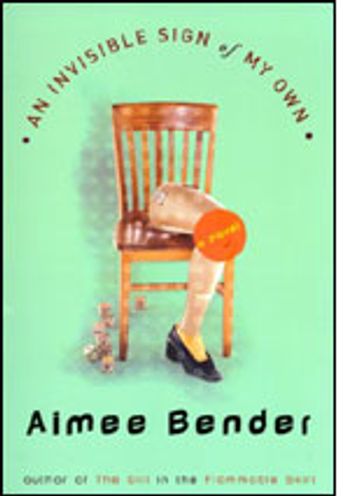
Bender once again creates a woman passionately on the brink in “An Invisible Sign of My Own,” her first novel. This time it’s Mona Gray, an obsessive-compulsive who knocks on wood until her knuckles are raw and bleeding, sleeps with the light on, washes her mouth out with soap whenever she feels sexual desire and takes an ax home for her 20th birthday, contemplating cutting off body parts in an attempt to mentally stave off her father’s impending death from a mysterious illness. Death, to Mona, is the ultimate loss of control: “A sharp, dark sliver; a loose, pale pellet. On the day of your death, it melts out through your entire body, a warm, broken bath bead.”
Mona calms herself with numbers and geometry, with which she feels a visceral connection. She counts out everything, feels “practically married” to the octagons that form stop signs and sees traffic cones as “vivid and isosceles.” Mona becomes a math teacher, excelling in the classroom, especially with her rambunctious and restless second-grade class, where she has the ultimate challenge of taming chaotic 7-year-olds with math. She succeeds by having them create numbers out of material — sticks, I.V. tubes — and what at first seems eminently manageable turns unstable as Mona involves herself in her students’ lives. Her math lessons become emotional explorations, and her associations with numbers begin to shudder with despondency, so that a 50 becomes a feeling of doom; a 42, panicky elation.
She meets Benjamin Smith, the handsome science teacher with chemical burns on his arms. They date and make out, but like death, sex for Mona is a poetry too formless and uncontained to face. She describes sleeping with her first boyfriend as poisonously awesome: “His skin was a buoyant ship over mine, and he kissed threads of silver into the back of my neck.” Afraid she will explode into meaninglessness again, she barely gets that far with Benjamin before having to run into the bathroom and scrub out her mouth with soap.
At times, the plot of “An Invisible Sign of My Own” seems too imposing to allow Bender’s unwound, poetically wandering prose to flower. As Mona moves from the violent, scratchy internal world of her home to her responsible classroom persona, she flips too quickly from crazy to controlled, and we lose our grounding occasionally. In one scene, her lovable class turns violent, and Mona seems strangely frozen, waiting for a Benderian opportunity to scoot out of the plot and do something wholly unpredictable.
The novel works best when Bender shakes free of the need to assign everything nicely into chapters, instead devoting pages to depicting Mona as she worries about death, stares at the slanted parallelograms of her alarm clock’s digital display or, at the very end, creates a heartbreaking fairy tale to comfort one of her students. In these moments, her writing becomes translucent, reminding us that she’s the rare writer who, no matter how far beyond plausible a situation is, reveals her own pain and heart in describing it. In “An Invisible Sign of My Own,” Bender’s main character must hold all that warped twitchery within the structured confines of a novel — a difficult task that Bender accomplishes nicely, though you wish, in a way, she didn’t feel she had to.
Continue Reading
Close