Nadia Pflaum

There’s nothing the matter with Kansas

Barack Obama goes "home" to one of the reddest states in the nation and promises to bridge the divide between parties.

  • more
    • All Share Services

There's nothing the matter with Kansas

It’s 10 a.m. and the snow is blowing sideways. A fast-moving cold front has knocked the temperature in El Dorado, Kan., down from 50 degrees to 30 degrees in a matter of hours. So many cars are trying to park at Butler County Community College, where Sen. Barack Obama is hosting a town hall meeting this morning, that the overflow has started to use the lot at the Star Vu Drive-In movie theater across the street.

Obama isn’t scheduled to appear for another two hours, but a line stretches from the doors of the college gym 100 yards across the campus lawn. The residents of a rural white town in a bright red state have come in droves to hear a black Democrat from a big city give a speech, albeit a black Democrat with ancient ties to El Dorado.

Obama is a son of El Dorado, 30 miles east of Wichita on the Kansas prairie, despite never having set foot in the town before Tuesday. Obama was born in Hawaii, but his maternal grandfather, Stanley Dunham, grew up in here, and his grandmother Madelyn was born in nearby Augusta. Obama’s mother, Ann Dunham, was born on the Army base at Fort Leavenworth, Kan., two hours to the east.

But the presidential candidate‘s trip to El Dorado is also a symbolic foray into what has long been enemy territory for Democrats. Obama’s visit to one of the most Republican states in the Union underlines his rhetoric about inclusion — about how the division between red and blue is artificial, and about how his own personal story, which combines black and white and Kansas and Kenya, is quintessentially American. It is also a practical political statement, a week in advance of Kansas’ Super Tuesday Democratic caucus, meant to reinforce a message about electability. It says that Obama is a Democrat who can attract votes across party lines, unlike his chief rival for the nomination, but like another woman, Kathleen Sebelius, the popular Democratic governor of Kansas. Many of those in line in El Dorado have heard the rumor that her endorsement of Obama is imminent.

Inside the gym, hung with banners that proclaim “Home of the Grizzlies,” spectators recognize that Obama’s visit is unique, and not just for its unfamiliar aura of celebrity. “This is something this community wouldn’t usually get during an election year,” says Andrew Hammond, an 18-year-old African-American freshman at Butler. “We’ve all lived in Kansas our whole lives, so we know what the whole ‘red state’ thing is about. This is the first time someone from the Democrats is really trying to do something for the state of Kansas. It’s about time.”

Obama’s speech has indeed drawn from across the aisle, as intended. A gray-haired man explains that he snagged his seat on the floor, close to the podium, because he’s a Butler County commissioner. Mike Wheeler, 59, is a Republican, appointed six years ago by Kansas’ previous Republican governor, Bill Graves.

“I think this guy’s gonna make it,” Wheeler says of Obama. Wheeler says he’s tired of back-to-back Clinton-Bush presidencies, and the Republican candidates lack personality. “It’s just that some candidates have that charisma.”

At 1 o’clock, the packed gym begins to get restless, clapping to the canned beat of Kool and the Gang’s “Celebration.” At long last, a woman named Rebecca Bidwell takes the stage. She says she was born and raised in El Dorado, and that she and her son, an Army sergeant first class, were initially drawn to Obama because of his early opposition to the war in Iraq. “[My son] would be here today, but he is one of the many being treated for post-traumatic stress disorder,” Bidwell explains. Now, Bidwell says, her 19-year-old grandson is “over there.”

“Here in Kansas, we’re excited that we have a chance to see principles return to politics,” Bidwell says, before relinquishing the podium to “our next president of the United States…” Her last two words are drowned out by cheers.

Sure enough, Obama’s pitch is about bridging the divide, as he segues into the story of his grandparents’ local origins, and his own roots. “You know, we have been told for many years that we are becoming more divided as a nation. We have been made to believe that differences of race and region, wealth and gender, party and religion, have separated us into warring factions, into red states and blue states … But it is a vision of America that I am running for president to fundamentally reject — not because of blind optimism, but because of a story I’ve lived. It’s a story that began here, in El Dorado.”

“That’s why I can stand here and talk about how this country is more than a collection of red states and blue states — because my story could only happen in the United States.”

The speech, which then ranges over topics from the economy to education to Iraq, gets many standing ovations from the crowd, but a curiously mixed reaction from Mike Furches. A burly ponytailed 48-year-old in a leather coat decorated with American flags, Furches listens intently, holding a small silver recorder. During some of the standing ovations, like the one when Obama says it’s time to bring the troops home, he remains in his seat. When Obama says he dreams that Americans can retire with dignity and afford to send their children to college, Furches stands up.

When Obama says he’d like to repeal Bush’s tax cuts “for those who don’t need ‘em,” Furches stays down.

When Obama promises to pass healthcare reform “before my first term is up,” Furches stands.

Furches, it turns out, is one of those voters whom Obama is allegedly luring across the divide. He changed his political registration from Republican to Democrat just last week in order to caucus for Obama. He’s recording Obama’s speech to air on his Internet radio show, called “Virtual Pew.” A Christian, he became a hardcore Republican during the Clinton years and says that he’ll vote for Mike Huckabee if Huckabee secures the Republican nomination. If it’s anyone else, he’s voting for Obama. His son, 18-year-old Nathan, sitting next to him in a white hoodie, is going to vote for Obama when he casts his first vote ever.

On some things, like the war in Iraq, Furches disagrees with Obama. He says he talks to soldiers in Iraq for his radio show and hears from them firsthand that the surge is working. “That’s my main disagreement, but I support Obama with the realization that he can’t influence change without the cooperation of the rest of Congress.”

On other issues, Furches has found his candidate. “A lot of Christians focus on abortion and prayer,” Furches says. “They forget the general need of service to the poor. Obama has been outspoken about helping the poor, and I think he offers a good plan. I think the Republicans have used the religious community as a pawn.”

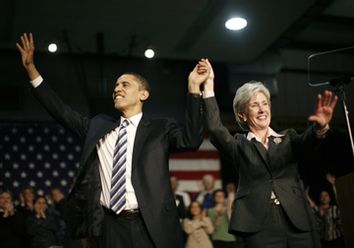
After 45 minutes of speaking, Obama signals the end of his time, but then introduces “a special guest.” Gov. Sebelius takes the stage resplendent in a pink blouse and a sparkly brooch.

Sebelius is funny, engaging, and 10 times more animated than she was on national television the night before delivering the Democratic response to President Bush’s State of the Union address. She wastes no time offering her endorsement to Obama.

“I think, right now, we are with the next president of the United States,” Sebelius says. Obama, sitting on a stool onstage, takes his finger away from his lips to smile gratefully.

Kansas Republicans evolve — into Democrats

A popular incumbent governor persuades social moderates alienated by fights over abortion and Darwin to quit the GOP and run for office as Democrats.

  • more
    • All Share Services

Kansas Republicans evolve -- into Democrats

On the last Sunday night in May, Mark Parkinson and his wife, Stacy, asked two of their best friends out to dinner at a country club in Cedar Creek, an exclusive planned community in the upscale Kansas suburbs southwest of Kansas City. They met Paul and Joyce Morrison in a private windowless room at the Shadow Glen golf course clubhouse because Mark had a secret he wanted to share with the other couple, something he needed the Morrisons to keep to themselves for 72 hours.

Parkinson, the chairman of the Kansas Republican Party from 1999 to 2003, was planning to come out of the closet that Wednesday — as a Democrat. At the request of incumbent Kansas governor Kathleen Sebelius, a Democrat, Parkinson would be switching his party registration and running as the Democratic candidate for lieutenant governor.

As Parkinson remembers it, the Morrisons weren’t shocked. The couples had been close for 20 years, close enough that Morrison was godfather to Parkinson’s oldest child, and in recent years their private conversations had often turned to their growing disenchantment with the conservative direction of the state GOP.

“There’s been a long series of Republican infighting over issues that do not affect people’s daily lives,” Parkinson explains. “I’m 49. I got tired of fighting about whether Charles Darwin was right when I was 14 or 15. I’m not spending the rest of my life on that issue.”

Besides, just a few months before, Parkinson had been part of Sebelius’ successful push to get Paul Morrison, a fellow moderate and the four-term district attorney of Johnson County, to ditch the GOP and run for state attorney general as a Democrat.

Moderates and social conservatives have been battling for the soul of the Kansas GOP since 1994, when the conservatives first won control of the party machinery. Although registered Republicans outnumber Democrats 2 to 1, Kathleen Sebelius is about to exploit that ideological schism to win a second term by a comfortable margin. In 2002, she beat a conservative Republican nominee by appealing to voters who care more about schools and taxes than abortion and evolution — and by recruiting a centrist Republican to run as her lieutenant governor. Four years later, Sebelius has again tapped a moderate Republican as her running mate, and this time eight other party-switchers will join her on the Democratic ticket. Depending on whom you believe, in her cross-the-aisle raids Sebelius has either found an effective strategy for turning Kansas a little less red, or she has used her personal popularity to mask the slow decline of her party.

Via e-mail, because she says her cellphone isn’t working while she’s on the road in rural Kansas, Sebelius explains her recruitment drive with a well-worn laugh line about her mate of 30 years: “I’m converting Republicans one at a time. First my husband, Gary…”

Sebelius, who rarely misses a chance to stress cooperation and compromise, doesn’t like to sound aggressive. “I joke that it’s my strategy, but quite frankly it’s nothing I set out to do. It’s just worked out that way in some cases. I’m happy to work with anyone who has a good idea to move Kansas forward, regardless of party labels.”

Clearly, however, it is a strategy. Every Republican who switched parties did so after talking by phone or in person with Sebelius.

The roots of the strategy that dares not say its name lie in the huge numeric disadvantage Democrats have long faced in Kansas. It’s a matter of practical necessity, says outgoing lieutenant governor (and former Republican) John Moore. “When we took office, we had ten of 40 Senate seats that were Democratic,” he says, “and 42 or 43 of 125 seats in the House of Representatives.” Democrats can’t pass bills — or win elections — without Republican votes.

In 2002, only John Moore switched affiliation. As GOP state chairman in 2002, Parkinson called Sebelius’ decision to pick Moore as her running mate a gimmick and proclaimed, “Any Republican who supports Kathleen Sebelius for governor is either insincere or uninformed.” Four years later, when Parkinson announced that he would be the governor’s new running mate, Republicans printed up fliers that featured his “gimmick” sound bite and papered the windshields of cars outside the building where he made the announcement.

Parkinson shrugs off his embarrassing quote. “I thought she was doing it as a stunt,” he says. “What she has done over the last four years is run the government in an open and independent way … She has appointed Republicans, Democrats, independents, to posts all over the state. It was not a one-shot deal to get elected, but it was her demonstrating a new way of leadership. As so often is the case, I was wrong.”

This year, the number of switchers has become an honest-to-God trickle. Besides Parkinson and Morrison and secretary of state candidate David Haley, a Republican who became a Democrat in 1992, six former Republicans are seeking House seats as Democrats. A seventh former Republican running for the House lost in the Democratic primary.

Though Sebelius did contact all these newly minted Democrats, she seems to have gotten many of their phone numbers from Larry Gates, the plainspoken chairman of the Democratic Party in Kansas. Gates is a lawyer in Johnson County, just like Morrison and Parkinson. Gates knew Parkinson and Morrison socially before any issue of party switching arose. Gates also sensed that other moderate Republicans weren’t happy with the direction of their party.

Gates casts the raids on GOP membership in terms of bipartisanship, following Sebelius’ script, but also mentions the intimacy of Kansas politics. “You can say publicly that you’re trying to reach across party lines to solve problems, and we are, but to do it on a more personal basis is when you start getting results,” he says. “So we talked to all those folks, and every time I thought that someone was interested in perhaps doing it, I certainly picked up the phone and called up the governor, and the governor was very interested and excited to call anyone we asked her to call.”

All along, however, Sebelius and Gates have been abetted by the social conservatives who dominate the Kansas Republican Party. When conservative Republicans won seats on the state school board, for example, and changed the science teaching standards to include the theory of intelligent design, Kansas became a national punch line, and moderate Republicans squirmed.

Morrison, the Democratic candidate for attorney general, says that it took more than a call from Sebelius to persuade him to switch. Morrison, who calls himself a “very, very moderate person,” felt that incumbent Phill Kline had turned the attorney general’s office into a platform for partisan politics. Kline made headlines when he attempted to access the medical records of Kansas women who’d had abortions. “So much time and energy,” Morrison says, “is being spent on pursuing a narrow partisan agenda that most people don’t agree with.”

For Cindy Neighbor, who’s running for the state House, the decision to ditch the Republican Party came when she looked at a platform that included opposition to stem cell research and support for school vouchers and the teaching of intelligent design. “Even when they say they’re a wide-open party,” Neighbor laments, “it’s, ‘If you don’t agree with us, you’re not one of us.’ It was about being able to have some freedom to be an individual rather than just a puppet.”

Her decision also says something about the dynamics of Johnson County, from which fully half the switchers hail. Just outside Kansas City along the Missouri line, affluent, suburban and booming Johnson County now holds a half million people, fully a fifth of the state’s population, and much of the state’s power. Its median income is by far the highest in Kansas.

In his famous book “What’s the Matter with Kansas?” — which attempts to explain the conservative hold on the American heartland — Thomas Frank calls his native county a “happy, humming confusion of freeways and malls and nonstop construction” and notes that a local newspaper columnist had dubbed it “Cupcake Land.” “You know what it’s like,” writes Frank, “even though you haven’t been there.”

But in the midst of those planned communities lies Sebelius’ strength, and it’s symbolic that Parkinson and Morrison had their private meeting in a Johnson County golf club. The county is strongly Republican, but local voters are not social conservatives. “They’re fiscally conservative,” explains Kansas State University political science professor Joe Aistrup, “always for cutting government and cutting taxes — except for education.” Sebelius, says Aistrup, used an emphasis on education to peel off moderate Johnson County voters, and in the wealthier northern end of the county in particular, she is especially well-liked by affluent voters turned off by social conservatism. Adding two popular Johnson County politicians in Parkinson and Morrison to the ticket only increases her appeal.

Ron Freeman, a conservative and the executive director of the state’s Republicans, scoffs at the notion that there is any ideological split in his party, and writes off all these brand-new Democrats as mere opportunists. “I think you might recall when Mark Parkinson switched, when Paul Morrison switched, and Cindy Neighbor switched, their comment was, ‘Moderates cannot win an election in a Republican primary.’ I think the whole case wasn’t because they’re moderate. They just felt they simply, individually, weren’t electable as Republicans. These people have strong political motives more than philosophical motives.”

But there is a split. The Johnson County Republicans even put up a Web site, since taken down, naming the names of the moderate Republicans In Name Only they most despised. The moderates formed their own anti-conservative group called the Kansas Traditional Republican Majority.

It may be bad news for Democrats, says Aistrup, that the moderates seem to have won the latest round in the battle. The conservatives, via Freeman and chairman Tim Shallenburger, still run the party, but the moderates knocked conservatives off the school board and won several legislative primaries. “So the Democrats in some ways were the losers,” says Aistrup, “with the moderate comeback in the Republican Party in 2006.”

At the same time, says Aistrup, the addition of former Republicans may be shifting Kansas Democrats to the right. “Any time, as a party, you start expanding the base to include former members of the other party, you’re recalibrating the party to a more moderate point of view.”

Thomas Frank views these new Democrats with a healthy dose of skepticism. “I like to see Democrats win, and I like Kathleen Sebelius,” he says. “On the other hand, I don’t think it’s that great a victory if people come to the Democratic Party without any kind of change of heart, or if the Democratic Party is just becoming full of moderate Republicans. Then that’s, in some ways, a terrible defeat for my side, for Team Liberal.”

There is certainly evidence that the Sebelius strategy has not yet made the state more Democratic. Today the Kansas House has four fewer Democrats than it did in 2002, and the number of Democratic state senators remains a dismal 10 out of 40. Both Democratic and Republican voter registrations have fallen since 2002, but the Democratic decrease is bigger.

But there are also signs of resurgence. In 2004, 39 Democrats ran for Republican-held House and Senate seats. This year, 58 Democrats are contesting Republican seats. Kansas Democratic Party leaders say that they’ve partnered with Howard Dean’s Democratic National Committee to get more people organized at the precinct level, and to get more candidates in races. In Johnson County, the real battleground, where Republicans hold 21 out of 22 state House seats, most incumbent Republicans ran unopposed in 2002. This year, Democrats will contest all but one seat.

Mark Parkinson says the real change is behind closed doors, at least in Shadow Glen and the swanker precincts of Cupcake Land. “Unless you’re running for office, there’s no reason to go down to the courthouse and change your voter registration. I talk to people every day who are registered Republicans but tend to support Kathleen and Paul, they just don’t have any reason to go down and change their registration.” “A lot of people,” Parkinson insists, “have switched mentally.”

Continue Reading Close