The deputy peeks out of his cage, picks up the phone, and his deep monotone echoes through the pod. “Meditation, meditation, everybody wanna do meditation, make your bed, go to the bathroom.”
I thought at first he said “medication,” but I already got my T.B. test, so the nurse doesn’t need me for anything. I look around confused and then my Salvadoran celly blurts out bossily, “Joga. It’s joga time.”
What? Oh, yoga. In jail. Of course. Why not?
A moment later “Hawaii,” my other celly, asks mindfully, “Is it gonna be bitches?”
Good question, Hawaii. Is it gonna be bitches indeed. We’ll have to investigate.
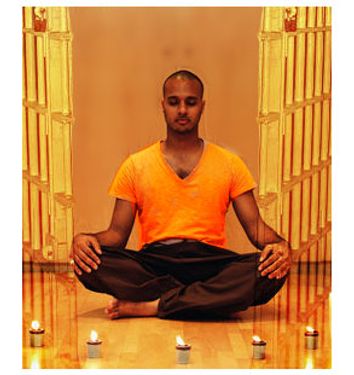
Hawaii and I shuffle through the pod up to the classroom in our county-issue orange pajamas and flip-flops. Upon opening the door, however, we realize that instead of bitches, we’ve got two of the gayest, whitest, squarest hippies in America on our hands. In sweat pants. But it’s too late. We’ve entered the “calm zone.”
Nothing left to do now but sit cross-legged on the floor with our fellow inmates and listen to the spiritual musings of our sweat-panted man Jerry and his friend, the Michael Bolton of yoga. But it’s cool.
“Stretch it out, motherfucker.” This is what thugs must say to themselves as they sneak into downward dog. It’s what I say to myself. “Don’t be a bitch. You can do this motherfuckin’ backbend. Maaan, Michael Bolton can do this shit.”
I look around nervously and spot a dozen men from my unit contorting themselves in a serious effort to appreciate the “calm zone” — because, of course, outside that door is no more calm zone. Outside that door is psycho zone.
Giant corn-fed white boy goofy teenager is smoking ice with the shadiest Mexican in California, standing on a toilet seat ducked low enough for the deputy to miss it. That toothless Italian is messing with the fat comic book nerd ’cause he borrowed a chapstick without asking. My 400-pound Samoan neighbor is crying to the tiny Filipina nurse for some methadone because it’s day three without heroin and he’s drenched in sweat. The gay Filipino is trying to handle the gun-smuggling Chinese ponytail at Ping-Pong (the winner gets a clean set of laundries or a porno, depending).
It’s a circus out there. But this is the calm zone.
For the moment, corn-fed white boy is right next to me. He is pointing his chin at the fluorescent-lit ceiling, eyes gently closed, and twisting his torso toward the Pacific Ocean. So is orange-dreadlock gold-teeth kid over in the corner. And so is oily, scabby, HIV-positive, always hungry or sleeping “Hawaii” — my celly and best friend in this motherfucking circus.
My back is against the wall and Michael Bolton is leading us through the most serene, magic, flying-bullfrog fantasy forest I’ve ever floated by. I won’t say that clocks were melting down the chalkboard, or a majestic toucan flew through the room, but time passed. And it passed without “Fear Factor” or baseball or Ultimate Fighting or beauty pageants or tanks, tanks, tanks on television. There’s also no beer or heroin or stolen cars or bruised wives or hungry daughters inside the calm zone.
Gently, we float back out of the forest and past the safe zone. We find ourselves stomping back through the circus, under the suspicious gaze of those who have not joined us — “What they be doin’ up in there, man?”
Up in there, I saw serenity in the faces of needle worshippers and droopy dog-eyed wife beaters. Fuck Ultimate Fighting and the whole three-ring “Fear Factor.” I saw serenity.
Still floating, I cross the threshold of my cell, tumbling into my cardboard-thin mattress like a mountain of miniature marshmallows. My eyelids fall again and I half smile just as corn-fed whispers to me, “Man, yoga is weak. That shit don’t do nothin’.”
Copyright Pacific News Service
When Clinton was sending troops to the border of Kosovo and I had just turned 18, I said I would head to Mexico if Uncle Sam came for me. When I saw footage of the World Trade Center crumbling on Tuesday, I decided I would go to war if they wanted me.
I went from flag burner to flag waver in a matter of minutes.
I spoke to my mother on the phone Thursday night and she told me, “Your generation will be defined by how you respond to all of this … We became known for the antiwar movement. Drugs. Free love. I won’t pretend like I wasn’t a part of it, but can you imagine? Our fathers saved the world and that is how we responded.”
As a generation, we’ve been searching for meaning. We’ve been looking for a reason to care about something. Our parents united in protest against Vietnam. Our grandparents came together to fight fascism. We couldn’t find anything better than sweatshops and Starbucks to be upset about.
Brad Pitt in “Fight Club” told it pretty well. “We have no Great War. We have no Great Depression. Our Great War is a spiritual one. Our Great Depression is our lives.”
But now we understand that we are Americans. We understand the significance of our privilege because until it was threatened, we didn’t know it could be any other way. We want to protect it. We may not know who we’re fighting yet, but this is our Great War.
In all likelihood, though, it won’t come to that. Every time I tell someone I’ll go if I’m drafted, they say, “We don’t fight wars like that anymore.” It’s true.
For one, we don’t know who the enemy is. Most likely, it’s not a country, state or people. The perpetrators have no real military or territorial objectives. So while our grandfathers fought a real enemy — Nazi Germany and its allies — we fight an enemy not directly associated with a government or even a war.
I don’t want to kill some guy with the misfortune of being a citizen of a scapegoat country. America is rightfully angry, and my fear is that that anger will be misdirected. Civilians in another country will be killed, just as they were killed here. And that idea stifles some of my patriotism.
If I join the Army, I’ll probably end up doing airport security until I’m 35, rummaging through baby strollers with an M-16 on my back.
But I’m ready. I don’t know that I’ve ever called myself an American before. I was too busy griping about what young people in this country gripe about — poverty, injustice, racism, and an inflated military budget (which doesn’t seem like such a bad idea now). All that’s been swept aside.
There are, however, people in my classes at San Francisco State University that have used this as an opportunity to talk about how America had it coming. True, we’ve bombed and slaughtered all over the globe, but the only reason these kids are in a position to say this stuff is because they’re white, upper-middle-class college students — they won’t be the ones sent off to fight. They’re lofty, Orange County-expatriate idealists. All they know how to do is rebel in the unoriginal mode of the neo-hippie faux revolutionary.
I don’t believe that we should scapegoat a nation. I don’t believe that we should kill civilians. I’m not in favor of military expansion. But now I am down with America. I’m down with the cops and the firemen. I’m down with the soldiers. I’m down with the National Guard. And to a certain extent, I’m down with George W.
I can’t say a part of me isn’t wishing this happened a year or so ago, when my man Clinton was still in office. There are a thousand reasons I dislike Bush, which I will not list. But there is one reason I embrace him — like it or not, he’s our man. And Tuesday night was his inauguration. The attacks have served to legitimize his presidency.
As our president addressed the nation, a friend of mine got excited, nodding his head and pumping his fist. He is first-generation Salvadoran-American, but Tuesday night, he became as American as John Wayne. When CNN ran footage of Palestinians celebrating, he shouted at the screen. “You won’t be laughin’ when the bomb lands on your nose, fool.”
Wednesday was not exactly like Dec. 8, 1941. Young men were not lining up at recruiting offices. But they were waving flags on freeway overpasses and cheering police officers in the street.
In my entire life, I’ve never seen young people cheer the police.
Continue Reading
Close
————
Odd boys out
By Russell Morse
Freaks. Outcasts. Weirdos. These words are now casually thrown around by Columbine High School students in reference to the two boys who opened fire, killing 12 of their classmates and one of their teachers. One girl dismissed all the taunting and name calling they endured as “just stupid teenage stuff.”
But for many of us who’ve been viewed as square pegs in round holes — and tormented for it — it’s been enough to prompt the fantasy of killing our tormentors. I remember sitting in biology class trying to figure out how much plastic explosive it might take to reduce the schoolhouse — my biggest source of fear and anxiety — to rubble. I scowled at those who teased me, and I had fantasies of them begging me for mercy, maybe even with a gun in their mouths. Those visions of having power and control over them excited me.
Was I a sick person in need of immediate psychological assessment? Was I a warped mind among millions of high school students who dealt with their frustrations by smoking pot or playing the violin? I don’t think so. I’m sure there were thousands of other students who had the same fantasies I did. We just never acted on them.
Even today, looking back on high school brings up bad memories. Sure, I was a little eccentric — quoting William Burroughs in drug awareness class and flicking boogers at pretty girls — but that didn’t warrant four years of torture and harassment. If only I had known then that the beautiful, trendy people who made my life so difficult only picked on me because they themselves were insecure, it might have helped. Maybe if I had more people to tell me they loved me and that I was beautiful, too — even though I was different — I would not have spent so many years isolated and afraid. Maybe that’s all Eric Harris and Dylan Klebold needed.
I’m not trying to put blame on anyone for the tragedy in Littleton. But we should know that in every high school across the country, there exist kids with the capacity to repeat what we saw this week in Littleton. And yet, we act baffled when things like this happen, paralyzed with fear and unable to formulate any kind of response or prevention.
An insightful choir teacher at Columbine High School said Harris and Klebold were “extremely bright, but not good students.” In “Hamlet,” Shakepeare warns us that “Madness in great ones must not unwatch’d go.” Yet every day, thousands of us go unwatched. I went unwatched. So did Eric and Dylan.
————
Scared to shoot
By Charles Jones
I carried a gun to school when I was younger. I just never had the courage to use it.
In seventh grade I was an easy target. If it wasn’t because of my size, then the clothes I wore made me the butt of jokes. My personal sense of style and fashion left me open to bitter jibes.
Imagine: I was a young black man standing 4-foot-5, with very light skin and freckles and a reddish Afro as high as a cloud. I wore turquoise jeans and Pro-wings. I was teased a lot, and I cried a lot, sometimes in class.
One day, when the teasing got to be too much for me, I decided to fight back. I got into a fight with another 13-year-old named Larry. Needless to say he beat the hell out of me. I was too weak to defend myself with my fists, but my pride kept drawing me into more and more fights.
So two days after my 13th birthday, I snuck my mother’s pearl-handled .22-caliber revolver out of the house and brought it to school. I hid it from my teachers but I knew where to get it if someone messed with me again. I had every intention of using it, against one boy in particular. I played out the scenario time and time again in my head.
What stopped me? I began to think about what would happen to me if I did try to shoot him. I fantasized about being killed by the police in a shootout. I became sick with fear, and changed my mind. I was afraid of dying at the hands of police. Two friends of mine had already been killed by gun violence. I also knew that the other boy could have had a gun. The last thing I wanted was to give him the pleasure of wounding me and laughing in my face — or even killing me.
That fear was enough to get me to hold back.
————
Suburban emptiness
By Hazel Tesoro
As a kid I had similar thoughts of rage. Only three months after moving to Stockton, Calif., from San Francisco, I was getting into fights on a regular basis. I was the outcast. I often dreamed of building a nuclear bomb and destroying everything. It is still a wonder to me why I chose not to act upon my violent fantasies, as Eric Harris and Dylan Klebold did. Theirs, obviously, was a crime of passion.
I cannot blame those kids in Littleton for what they did. Growing up in suburbia is enough to drive anybody mad. It was the move from the city to the suburbs that almost pushed me over the edge, stuck in the boonies with television as the only form of entertainment. Coming of age in the suburbs is like being raised in a padded cell.
Continue Reading
Close
I shrugged when I read the recent news from the Census Bureau that whites have officially become a minority in the state of California, making up just 49 percent of the Golden State today. It wasn’t news to me.
I grew up in San Francisco, where whites have been a minority in the city’s public schools for decades. Born to a father of mixed European descent and a Latino mother, I always had fair skin, and for me, color was destiny: From early on I was a “white boy.” My own brother often called me a honky.
The school I went to was culturally diverse, primarily Asian and black, but drawing people from every race and every neighborhood. I was a minority there. It was fairly segregated, mostly by race and neighborhood, and I spent time with a lot of different groups, especially blacks and Latinos, trying to find my place.
My Latino friends didn’t call me “huero” — the word for light-skinned Latinos — even though I had a Latin mother, because I didn’t speak Spanish, had an Anglo last name, and looked white. My black friends would introduce me as a “cool white boy.” At first, I thought this was an honor. Later I thought, “Who ever heard of a cool white boy? And if there is one, could I really be it?” Whites were usually busy trying to pretend they were another color, or spouting racial slurs, so my options were limited. Asians showed little interest in me.
I always felt as if I had to prove myself. I had to fight anyone who challenged me — not because I had violent tendencies, but because I was prejudged as a sucker by the color of my skin. White equals “weak” in urban schools today. So if my friends were stealing, I had to steal more. If they were fighting, I had to jump in and hit harder. The only white men I admired growing up were Italian gangsters. I must have watched “Goodfellas” 50 times trying to perfect the accent, dress and attitude of my role models. I altered my mother’s maiden name slightly to make it Italian, waiting to be initiated into the underworld. The call never came, but in pursuing it (wearing a double-breasted pinstriped suit and two-tone shoes to my confirmation) I became even more confused about my ethnic identity.
It may be hard for some people of color to understand, but I was plagued by an inferiority complex because I was white. I felt cursed by not being given an identity. With no particular cultural values from either side of my family, white seemed empty — the absence of culture. I also knew, from my friends, and from what I learned in school, that whites were the problem with this country. We’d stolen land from Indians and Latinos, enslaved the Africans, forced the Chinese to build our railroads. It seemed to me that all the despair in America was solely the doing of the white man. Why did I have to belong to that group? If a group of black kids beat me up in the schoolyard, I assumed I deserved it because my ancestors had enslaved their ancestors.
In the years that followed, I fell in with a racially diverse group of delinquents and felt as if my problems had been solved. Finally, I belonged. But I had only traded one set of problems for another. When I was sent to juvenile hall, the abuse I suffered based on my skin color brought my self-hatred to a boil. (It’s no accident that James William King, the white supremacist convicted of killing James Byrd in Jasper, Texas, became a violent white supremacist in prison; prisons are incubators of race hatred today.)
I’m 18 now, and finally coming to terms with being white. I got help with my anger, and my addictive personality. I live in a mixed race group home and have found a “brotherhood” there that transcends race. I’ve also learned, in the new California, that every race needs to struggle with a tendency to favor its own. Watching the Chinese sue the NAACP over access to schools; looking at data showing rising black-on-Asian hate crimes; witnessing the regular squabbles between Latinos and blacks in California high schools; it’s become clear to me that white people have no monopoly on oppression and cruelty.
One thing that helped was my mother giving me a book, “The Color of Water,” by James McBride. It was billed as a black man’s tribute to his white mother. But what came across to me was how loving the author’s mother was, which mattered much more than her race. The book started a long healing process that continues today. I learned to pay little regard to my parents based on their blood, but rather to concentrate on their love and the fact that I am a piece of each of them.
But my own experience has made me wonder: Are whites who commit hate crimes today more likely motivated by white supremacy, or white self-hate?
Continue Reading
Close