
Elliott Neal Hester

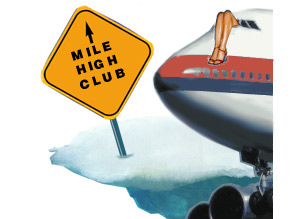
Welcome to the Mile-High Club

Our flying correspondent relates some true tales of sex in the skies.

  • more
    • All Share Services

Welcome to the Mile-High Club

Relegated to yet another all-night flight from Los Angeles to New York, my bleary mind suddenly snapped to attention when two impassioned passengers who had been cuddling in coach began kissing and groping like actors in a low-budget porno flick.

Ensconced in a row by themselves, they thrashed together unrelentingly, oblivious to the sidelong glances of my colleagues, who kept cruising the aisle to get a closer look. The cabin was dark save for a few passenger reading lamps that back-lit the performance like tiny, misguided spotlights. With so few passengers, most people were stretched across several seats and sleeping soundly, unaware of the escalating passion that seemed destined to redefine the concept of a “satisfying” flight.

In a daunting display of dexterity, the woman suddenly threw one leg across her boyfriend’s lap, straddling him with such enthusiasm that her skirt canopied like a quick-open parachute. As the couple continued, they made a mystifying attempt at camouflage by draping a blanket over their heads. The blanket could not, however, disguise the woman’s sudden, mischievous movements — she began a slow grind in her boyfriend’s crotch, accelerated to an equestrian gallop and in less than two minutes was jouncing up and down at warp speed.

Peering at the action from behind the aft bulkhead, just a few feet away, I could hear muffled moaning and the barely audible thwack-thwack-thwack of colliding flesh. When our female flyer arrived at her final destination, she let loose a shriek that echoed through the cabin. She then collapsed into her boyfriend’s arms just as startled passengers sprang upright in their seats.

Welcome to the Mile-High Club.

Throughout 14 years as a commercial airline flight attendant, I’ve witnessed numerous inductions into this infamous society of airplane passengers who engage in fellatio, cunnilingus and various other forms of sexual communion at high altitude. Though in-flight copulation is often thwarted by storm-trooper flight attendants who threaten to summon security upon arrival, most of my colleagues are like me — they tolerate and even chuckle at passenger audacity. Just as long as it doesn’t get too out of hand.

Mile-High Club liaisons are most common late at night, when lights are low, crowds are minimal and the threat of discovery is less likely. The overtly courageous — or woefully tacky — seek membership in the comfort of their seat, cloaked by blankets and pillows and prodigious amounts of nerve. (Rumors of two-minute galley “quickies” are rife throughout the airline industry, but I’ve never walked in on such an episode.)

Nevertheless, in keeping with a tradition that began soon after Wilbur and Orville wobbled across the skies near Kitty Hawk, most MHC wannabes are anointed in an aromatic airplane lavatory that only a contortionist could love.

On a recent flight from Osaka to Los Angeles, a flight attendant opened an unlocked lavatory door and got an eyeful. “One of my crew members saw a woman straddling a man on the toilet seat,” recalls flight attendant Stephanie Mueller. “She quickly closed the door and locked it from the outside.” A group of flight attendants poked their heads out of the galley to watch as the couple emerged. The man returned to his seat on the right side of the plane, and the woman took her seat on the left. “Later,” says Mueller, “we noticed the woman was holding the hand of the male passenger seated next to her.”

A similar tryst occurred on a flight from New York to San Juan, Puerto Rico. Flight attendant Santiago Guerra was tending to first-class passengers when a well-known sportscaster seduced a woman right in front of her boyfriend.

“After he finished his meal, the boyfriend went into the first-class lavatory,” says Guerra. The woman — who was visibly inebriated and undeniably star-struck — “exchanged a look with the sportscaster. They walked to the back of the plane and entered an aft lavatory together.” Some 15 minutes later, the disheveled woman returned to her seat, followed, seconds later, by the smug-faced sportscaster. The boyfriend flew into a rage. “You screwed him, didn’t you … you bitch!” he said. And to the sportscaster: “I know what you did to my girlfriend, motherfucker!”

Upon arrival in San Juan, the boyfriend bolted and so did the sportscaster, leaving the woman alone and in tears.

Cynthia Jenkins, a 20-year flight attendant, has witnessed every imaginable in-flight sexploit. “I’ve seen couples going at it in seats … usually the man sitting down and the woman on top. In bathrooms … with the woman screaming as though she was in pain and the flight attendants knocking on the door. I’ve witnessed a co-pilot and flight attendant having sex in the cockpit, guys masturbating, women too. I’ve seen many blow jobs, and a couple of men going down on their women. And one lucky guy had two women going down on him.”

Lately, the airline industry has been besieged by more sinister manifestations of passenger rebellion: physical assaults against pilots and flight attendants, the destruction of aircraft interiors, urinating and defecating in the aisles. (Yes, this actually happens.) While these hostile acts seem to be growing in frequency and intensity, victimless infractions like in-flight sex often go unnoticed.

But at a 1997 airline cabin-safety symposium, a Singapore Airlines official expressed great concern. “The increasing number of sexual offenses,” he said, is a “particularly worrying trend.”

Newspaper reports suggest that at one point, a whopping one-third of Singapore Airlines’ passenger misconduct cases involved sexual transgressions. Two years ago, a South African Airways captain threatened to divert his jumbo jet due to an onboard orgy that was gathering momentum. In a two-year period at London’s Heathrow Airport, 15 passengers were reportedly detained by police because of in-flight sexual misconduct. In the United States, where industry disclosure about sexual activity is as likely as a lobster meal in coach, only one major airline has offered public comments about the problem. “Although no one is getting hurt,” says United Airlines spokeswoman Kristina Dickson, “this type of activity is not to be tolerated.” United recognizes that onboard sex is a growing problem throughout the airline industry. “We treat it like any other form of passenger misconduct.”

Though the FBI responds to reports of terrorism, in-flight assault and “interference with a flight crew,” local authorities are responsible for handling complaints about lewd and lascivious behavior — a misdemeanor, punishable by up to one year in prison in many states. (If a child under 16 witnesses the act, the crime could be upgraded to a felony.) Unwilling to subject themselves to embarrassing publicity, most airlines are reluctant to pursue even the most outrageous cases.

Last year, aboard a South African Airways flight bound to London from Johannesburg, a business-class couple reportedly disrobed from the waist down and began having sex in full view of other passengers. Mortified onlookers summoned flight attendants who, despite their best efforts, could not get the couple to disengage. The high-flying exhibitionists finally geared down, but only after the captain yelled, “This is not a shag house!”

While most airlines deplore onboard “shagging,” at least one major airline seems to embrace the concept. A recent Virgin Atlantic Airways billboard features the perpetually horny Austin Powers straddling the fuselage of a jumbo jet. The caption reads: “Virgin Shaglantic … Yeah, baby.” Richard Branson, Virgin’s outspoken head honcho, recently pronounced, “We’re not the type of airline that bangs on bathroom doors.” Claiming to have lavatories that are “larger than on other airlines,” Virgin may soon develop a reputation for having lavatory queues that are longer than on other airlines.

But why are people so eager to have sex on an airplane these days? Christina Lawrence, a practicing psychologist who spent 30 years as a flight attendant for United Airlines, cites disinhibitors (drugs and alcohol), airplane density (people think they can get away with bad behavior on a plane full of strangers) and a relaxed dress code as possible reasons for mile-high mania.

“Years ago, airline passengers were more inhibited because of formal dress standards,” she says. “There’s a certain behavior that goes along with conservative attire.” Nowadays, it’s not unusual for passengers to walk around the cabin in miniskirts, shorts, see-through blouses, sweat suits, tank tops, flip-flops or no shoes at all.

I once saw a passenger traipsing around the aircraft dressed only in a slip. When the light hit just right, you could see — well, let’s just say she left nothing to the imagination.

Mix audacious clothing with unlimited alcohol, darkness, a long flight and smatterings of bored, sexually depraved or overstimulated human beings — and there’s bound to be lechery in the aisles.

During a flight from Auckland, New Zealand, to Los Angeles, flight attendant Carolyn Peters noticed “a man leaning back in his seat, eyes closed, with such a look of ecstasy on his face.” The blanket across his lap was “moving up and down,” she said. “Soon, the blanket fell off, revealing a woman actually giving the guy a blow job.”

At this point, one of the flight attendants tapped the man on the shoulder and said, “This type of behavior is not appropriate in business class.” To the crew’s amazement, “The lady giving the blow job was so into what she was doing, she didn’t even notice.” She continued her stellar performance until the recipient forced her to stop. They both stared at the flight attendant, who repeated her warning. Then the woman asked, “Can we take a seat in coach?”

Crew members are no less immune to high-altitude sins of the flesh. The problem is, when we get busted, our flying career may suddenly crash and burn. That’s exactly what happened to a pilot at one airline.

While taking a scheduled break from his duties in the cockpit, the pilot retreated to his designated first-class rest seat and, according to sources, started “smooching” with his flight attendant girlfriend. The couple then disappeared into a lavatory for “quite some time.” Reports were filed, management reacted and the pilot lost his job.

Despite the threat of dismissal — or in the case of brazen passengers, the threat of embarrassment or worse, a one-year layover in the slammer — sexual impropriety aboard airplanes may soon reach new and more astonishing lows.

In 1996, British Airways introduced a first-class seat that reclines 180 degrees — effectively becoming a 6-foot-6-inch bed. Singapore Airlines, Qantas, Lufthansa, American, U.S. Airways, Japan Airlines and others have followed suit by implementing sky-beds of their own. While British Airways calls them “flying cradles,” United refers to the cushy thrones as “first suites” and Singapore Airlines has adopted the magnanimous appellation “skysuites.” The industry moniker is “sleeper-seat,” but no matter what you call these airborne mattresses, they’re a frisky flyer’s dream come true.

The most coveted sleeper-seats are single units that slant toward the window on each side of the plane. This module’s high back wraps almost completely around the passenger, creating an atmosphere of unprecedented privacy. Airline companies, in their single-minded quest to pamper first-class customers, have no idea what kind of plebeian possibilities they’ve unleashed.

But Richard Branson knows. He’s even upped the sky-bed ante. By late 2000, passengers on Virgin Atlantic flights will be able to book a seat that converts into a double bed. That’s right. For around $5,500 round trip, New York-London passengers can stretch out, roll around, even join the Mile-High Club — all this behind the ramparts of a retractable “privacy screen.”

As a courtesy to passengers and crew, I hope the privacy screens are soundproof.

Common cattle

Every now and then, flight attendants must fly with the unwashed masses. It sucks.

  • more
    • All Share Services

Having worked as a flight attendant for the past 15 years, I purchase full-fare airline tickets about as often as supermodels pay for sex. In exchange for perpetual standby status, some airlines let employees fly for free. Others impose a minimal service charge on employee passes. We off-duty airline employees linger at the departure gate, batting our eyes at the gate agent, praying there’s an empty seat. “Nonrevenue” travel is an industry birthright that, over the years, has turned millions of common airline folk into members of the discount jet set. Sometimes we fly from New York to Los Angeles simply to lunch with a friend.

The downside to this wonderful perk is the risk of being bumped from the flight. When this happens (and it happens quite often) we’re forced to stand by for the next flight. And maybe the next. By the time we’re turned away from the last flight of the day, we are frazzled, bitter and worn. Then we return to the airport the following day to repeat the nonrevenue-passenger process.

Because my sister was to be married in Barcelona, Spain, on Oct. 8, I couldn’t take the chance of being bumped from my Oct. 6 flight from New York. Unless her matrimonial record ends up like Elizabeth Taylor’s, this wedding would be a once-in-a-lifetime event. Besides, the wedding rings were tucked in the pocket of my jeans. If I failed to show up, the ceremony would be ruined. I handed my credit card to a travel agent for the first time in 15 years. I actually winced when she snatched it.

The full-fare, coach-class, round-trip ticket from New York to Barcelona cost $415. As I wheeled my carry-on toward the Iberia Airlines check-in counter at JFK Airport, I experienced a traveler’s epiphany. No longer was I the lowly airline employee hoping for an empty seat. Suddenly I realized that by forking over a large sum of cash, I was one of them — a full-fare passenger, armed with the right to bitch and moan, able to demand service with a tantrum.

Almost immediately, I was pounced upon by a roaming customer service representative. “You’re going to have to check that bag,” she said as I rolled up behind the zigzag procession of passengers at the ticket counter.

“Excuse me?”

“Your bag,” she said, pointing to my one and only carry-on. “It’s too big; you’re going to have to check it.”

I looked down at my regulation Travel Pro 22-by-14-by-9-inch airline-issue roll-aboard. It’s the same black bag I’ve wheeled onto thousands of airplanes, the same piece of luggage that easily fits in the overhead bin of the Boeing 767 aircraft I was about to board. My Travel Pro could be the poster bag for carry-on propriety.

“Ahhhh … it’s not too big,” I assured her, smiling.

“Yes it is,” she said.

“No it’s not.”

“Yes. It. Is.” Her words came in a harsh staccato burst that reminded me of childhood arguments with my mother. She might as well have been telling me it was time for bed.

I understand the difficulty of spending eight hours on your feet, regurgitating airline policy upon an often infuriating and infuriated public. But the rep had been off base with her comment. I stared in disbelief at the airline employee, my colleague. Instead of acquiescing as I would normally have done while traveling on an employee pass, I decided to stand my ground. I was a legitimate full-fare passenger, after all. How dare she infringe upon my rights.

“I’m sorry, there seems to be some confusion,” I said. “My carry-on is well within the limits of airline policy. It fits in all the overhead bins that run along each side of the 767 cabin. It fits in the overhead bins above the center seats, too.”

“It’s a full flight,” she barked. “It’s too big.”

This is why so many passengers are pissed off by the time they finally make it to the airplane. Many times I’ve manned the aircraft door, greeting passengers with a “Welcome aboard” and a smile, only to have them growl like wounded lions.

“Look,” I said, exasperated. “The bag fits.”

She crossed her arms, looked me up and down and then frowned. “We’ll see,” she said.

If the customer service representative was the Wicked Witch of the North, the ticket agent was Mother Teresa. She welcomed me with a genuine smile that instantly put me at peace. “Sure, your bag can be accommodated in the overhead bin,” she said, while issuing my boarding pass. “Have a nice flight.” She meant it, too — I could tell by the song in her voice.

But when I strolled away from the ticket counter, carry-on in tow, I felt twin laser beams boring into my back. I spun around, fast enough to catch the customer service agent averting her eyes. She was going to get me. I could feel it.

When I boarded the flight 45 minutes later, guess who was standing at the departure gate? In my mind’s eye I saw the customer service rep snatch my Travel Pro and try to run away. In reality, I handed my boarding pass to the flight attendant and, just before entering the jetway, I locked eyes with the rep. She sort of shrugged her shoulders, no longer interested in me and my bag.

The plane was packed. I was seated in an aisle seat, near the middle of coach. As the final passengers trickled into the cabin, passengers in my area began to focus on four empty seats. These were crew rest seats, reserved for flight attendants during long-haul trips such as this. After the service, the attendants are allowed to take turns resting. At this time they are temporarily off duty. Most passengers don’t know this, of course — before takeoff, they look at four empty seats and see visions of transatlantic comfort.

The man in front of me made a break for one. He was a big guy and could no doubt use the extra room. But as soon as he plopped into the crew seat, a flight attendant immediately asked him to move. I could hear her explaining the policy. I could hear him saying it was ridiculous. This is an ongoing battle between passengers and flight attendants. “Just let me sit here until you guys finish the service,” passengers will say. If the attendants make the mistake of allowing a passenger to sit in the seat, they open a can of worms that can never be closed. When the first attendants come to rest, the passenger is either asleep or so comfortable that he’ll vacate the seat only after being threatened by a visit from the captain. Believe it; this has happened to me more than once.

Moments after the big guy retreated to his original seat, four last-minute passengers hustled on board. Judging by the familiar way they spoke with cabin crew, I knew they were airline employees. But the big guy didn’t know that. When the four passengers sat in each of the four crew seats, the big guy went ballistic. He began shouting at the flight attendants. The passengers are non-revenue employees, one flight attendant told him. “When the crew rests begin, they will have to stand up in the back.”

Taking great interest in this comedy of errors was the woman sitting across the aisle from me. As a matter of fact, she seemed to take great interest in just about everything. The boarding music (“inane”), the cabin interior (“unappealing”), even Spain itself (“a marvelous little country,” which no one knew more about than she). The poor Spanish girl wedged into the window seat was forced to listen to this woman’s pontifications through takeoff, the cocktail, dinner and coffee services and the beginning of the in-flight movie. Anyone sitting near ground zero was bombarded by her ramblings about Spanish museums and Antoni Gaudí architecture. She spoke with constant, deafening pretentiousness. Then suddenly, after finishing a second can of beer, the woman fell fast asleep. Bam! She was out. It was as if someone had knocked her unconscious — exactly what I had felt like doing.

Mouth open, legs spread as wide as Mike Piazza waiting for a fastball, the woman’s head lolled on her neck as if it weighed 100 pounds. In the next instant, her head fell onto the shoulder of her Spanish seatmate. Unable to pry the snoring woman from her shoulder, the Spanish woman pressed the flight attendant call light. They readjusted her limp body, reclined the seat and everybody laughed.

Everyone but me. It was at this time that the wedding rings went missing. Two 18-karat gold bands, each in its own tiny case, had been in the right, front pocket of my jeans. Every few minutes I would pat the pocket just so I’d know they were still there. During the last pat-down, I freaked. The rings were gone.

Visions of an apocalyptic wedding danced in my head. Months earlier, when I’d asked what she’d like as a wedding present, my sister — an unconventional woman to say the least — asked me to buy the wedding rings. Bursting with pride, I went to several jewelers, searching for just the right bands. Not only did my sister trust my taste in jewelry, she trusted me to fly across the Atlantic and show up with the goods less than 48 hours before she would recite her vows. Now she was going to murder me.

After five or six minutes of cardiac arrest, however, I found the precious metals. The boxes were wedged between the seat cushions.

The wedding went off perfectly. My sister and her new husband were happy with their rings. But two days after the reception, after taking a cab to Barcelona’s airport to catch my flight home, a funny thing happened.

If you have time to listen, I’ll tell you about it sometime.

Continue Reading Close

When pigs fly

A smuggled swine raises a ruckus on a cross-country flight.

  • more
    • All Share Services

In more than 15 years of crisscrossing the friendly (and sometimes not-so-friendly) skies, I thought I’d seen everything. I’ve witnessed airline brawls and in-flight pukefests. I’ve watched as lovers gained admission to the Mile-High Club. I’ve rubbed shoulders with movie stars, traded high-fives with professional athletes, listened to advice from business tycoons who steered me in the wrong direction.

My most interesting in-flight encounters have been with regular people, people like you and me. But there’s a downside to conversing with hundreds of interesting passengers every week: Occasionally you meet some real pigs.

I’ve been forced to serve passengers who ate like pigs and smelled like pigs, who dressed, waddled and snorted like pigs. I’ve waited on pig families. I’ve tried to silence pig tour groups. But like most flight attendants, I can’t claim to have ever been on an airplane with a real pig — the oink, oink, roll-in-the-mud, soon-to-be-bacon variety.

Unfortunately, some of my colleagues at US Airways can no longer make this claim. On Oct. 17, aboard a Boeing 757 en route to Seattle from Philadelphia, passengers were startled to see a pig in first class. That’s right: a pig, in the first-class cabin of a commercial jet. Reports claimed the beast weighed as much as 250 pounds.

US Airways spokesman Dave Castleveter verified the incident. “I can and will confirm that we did transport, in the cabin of our aircraft, a large animal, a pig.” “One thing is certain,” he said, “it will never happen again.”

Why on earth was a pig allowed to board an airplane?

According to a USA Today report, a mother and daughter had telephoned ahead to request special consideration on the flight. They mentioned something about a doctor’s note and said they’d be flying with a 13-pound “service” animal. Instead, they showed up at the gate with a porker that weighed as much as a middle linebacker.

Service animals, like seeing-eye dogs for instance, are allowed to fly with their owners. Large, nonservice animals are forced to fly in the aircraft’s pressurized cargo compartment. Small animals (cats, rabbits, dogs, etc.) can ride in the passenger cabin, but only if owners keep the pets in a kennel that fits under the seat.

Service animals do not bark. They don’t oink. They don’t complain about the in-flight movie. They sit quietly at the feet of the only human being they care about. Flight attendants will tell you that service animals are some of the best passengers they could ever hope to have.

It’s still not clear what kind of “service” the pig was intended to provide for its owner.

Maybe the woman had been born and raised on a farm. Maybe she was emotionally attached to the animal. Leaving it behind might have created “separation anxiety.” Without the faithful pet beside her, perhaps the distraught passenger would have flown into a fit of air rage.

Whatever the excuses, it’s difficult to understand why a gate agent allowed the pig to board the plane — and in the first-class section, no less.

The animal settled into the space between 1A and 1C — directly in front of its two human escorts. The thing was so big, according to the report, that one end of its body protruded into the aisle. This could have been the crew’s golden opportunity to eject the animal. Airline passengers are constantly told to keep carry-on items out of the aisle, by mandate of the Federal Aviation Administration. No portion of the aisle can be blocked during takeoff, during landing or while the plane is taxiing from the gate.

Nevertheless, the pig stayed put. To its credit, the creature remained quiet for most of the six-hour flight. There it lay, sleeping wedged against the bulkhead, soaking up the high-priced ambience of first class. But when the plane landed in Seattle, the pig went hog-wild.

According to published reports, it ran up the aisle, tried to enter the cockpit and then camped out in the galley. There, the redolence of leftover food drifted from service carts. Perhaps this is why the pig became so stubborn. To make it leave the galley, someone had to throw a piece of food.

Throughout this ordeal, the pig acted like a … well, it acted like a pig. Unlike real service animals that know how to keep their bodily functions in check, this fat four-legger dropped feces — more than once. Pissed-off passengers promptly told the owner to clean up the stinky mess.

This was an airplane, after all, not a pigsty.

How did the agents let themselves get duped by pig-loving passengers with a doctor’s note? Why didn’t the captain overrule them?

And I’m surprised at my flight attendant colleagues. How could they have been so insensitive to the passengers? As soon as the plane reached cruising altitude, they should have slaughtered the oinking swine and served pork chops in first class.

Continue Reading Close

When passengers rage

She hated my guts and ached to put me in a headlock, but I swear I never meant to send her to Barbados.

  • more
    • All Share Services

Though I had not uttered a word, though I had yet to take action or toss a disparaging glance her way, the woman yelled at me as if I had just pissed on her azaleas or stolen her grandmother’s purse. “This is pathetic!” she said, lurching toward me with real menace in her eyes.

For one nerve-rattling moment it seemed as though she might actually snatch my head with her massive paws and squeeze until it burst like a grape. Instead, the woman made a nonviolent, albeit equally intimidating gesture. Lips pursed, nostrils flaring, she brought her face to within a few inches of my own and thrust her hands upon hips that jiggled like huge jello molds in an earthquake. Then she sort of growled. That’s the best way to describe it. She took one deep breath after another and growled.

I was assaulted by harsh breath that shot from her nostrils as if from a high-pressure air hose. The nose blasts hit me right between the eyes, on and off, on and off, in tune to the rhythm of her animosity. Despite a nervous twitching in my upper lip, I stood in front of the boarding gate like a true airline professional: a phony smile pasted across my face, fingers locked behind my back, shoulders back, chin up, chest thrust forward like an army recruit in the face of a maniacal drill instructor. I was dauntless. Unflappable. Quite capable of handling the situation. But as the hulking passenger loomed before me, growing angrier with each blink of her eyes, I felt the first pangs of vulnerability.

She was a big woman. A very big woman. Maybe 220, 230 pounds — an inch or two taller than me and maybe 40 or 50 pounds heavier. With the exception of her hips, the rest of her body was as sturdy as an offensive lineman’s. The only barrier between us was the flimsy podium that I had been standing behind while plucking tickets from some 200 passengers who were now safely aboard the aircraft and ready to fly to Barbados.

Professionalism be damned, I clutched the top of the plucking podium and felt myself take a tiny step backward. In my mind’s eye, I saw the irate passenger turn the podium into kindling with one sledgehammer blow of her fist. But she wouldn’t do something like that, would she? It was 9 a.m. We were standing in front of a departure gate at John F. Kennedy Airport. She wasn’t going to go psycho on me. But when I looked into her eyes and saw storm clouds gathering there, I though it best to brace for the storm.

“How can you charge so much for extra baggage?” the woman demanded. “How can you!” When I opened my mouth to answer, she waved one hand, compelling me to silence. The barrage of questions continued as if I was the subject of an FBI interrogation. “Why did you change the checked baggage rates? Huh? Why are you making it so difficult for me to carry my belongings on your airplane? Do you have any idea how expensive this is? Huh? Do you? Why are you so inflexible? Why?”

She paused, gathering her hostility in one great exhalation. “You people are so … so … ughhh!”

Am I the one responsible for charging passengers for extra baggage? Am I the one to blame for a change in rates? Is my goal in life to make it difficult for passengers to carry belongings onto my airplane?

Because flight attendants spend more time with passengers than do other employee groups, we’re often hit by the crap passengers want to throw at less reachable targets: baggage handlers, catering chefs, aircraft cabin designers and airline CEOs with $10 million salaries and golden parachutes that make them twice as rich upon retirement — even if the airline goes belly-up in the interim.

We aren’t the ones who design tiny overhead bins that can scarcely accommodate a tote bag, yet we get yelled at when there’s not enough room for a carry-on bag the size of an Amana fridge. We don’t establish short connection times, though we bear the brunt of passenger rage when they come stumbling onto an aircraft, clutching at their chests due to the 30-minute sprint from gate Z-29. We don’t determine seat pitch, the boarding hierarchy or whether passengers should be served peanuts or lobster thermidor on a three-hour flight. And we most certainly don’t create the pricing structure for additional checked baggage. All this is left up to some bonus-motivated number cruncher sitting at a computer in an ergonomic airline office (far away from seething, fist-clenching, flight attendant-hating passengers), creating policies that give shareholders a more profitable bottom line.

As for the female passenger who ached to put me in a headlock, she never gave me a chance to say what I’d been trained to say: We’re sorry for any inconvenience the change in rates may have caused, ma’am. The increases were necessary due to blah, blah, blah in the blah, blah, blah because of blah-blah. She went on and on, refusing to let me speak, while lashing my ears with her ceaseless rant about unfair baggage rates.

Rather than bite the bullet and hand over her ticket as a couple of hundred passengers had done before her, the woman shook the ticket in my face. “This is ridiculous,” she continued, spraying me with spittle as she spoke. “You should be ashamed.”

“Please, ma’am,” I said, wiping my face with a sweep of one uniformed arm. I pushed both hands forward in a gesture intended to make her step backward and settle down. “I don’t know anything about a change in baggage rates. I don’t impose company policy. If you have a question about rates, you need to return to the boarding desk and speak to the agent. I am a flight attendant, ma’am. I am not here to argue with you. I am not here to be spat upon either. I am here to take your ticket voucher, return your boarding stub, welcome you aboard the goddamn — welcome you aboard the airplane and point you in the direction of your seat. That’s it. That’s all. I’m sorry!”

Apparently, my sermon fell upon deaf ears. The angry passenger proceeded to light into me with an “I’ll never fly your fucking airline again” tirade that ranked among the best I’ve ever heard. “You people are the worst. The very worst!” she screamed. “I never have this problem when I fly other airlines.”

I looked straight into her eyes, unable to quell the anger that had been bubbling inside. “When you fly other airlines, ma’am,” I said, “I never have this problem either.”

With that she was speechless.

Out of the corner of one eye, I noticed both gate agents rushing toward me. I looked at my watch. It was about a minute before departure. The agents were anxious to close out the flight on time. From about 20 yards away, one of them made a throat-slashing motion. This was a signal for me to pluck the passenger’s ticket and hurry aboard. Reluctantly, I turned to face my tormentor. Eyes wide, mouth open, face scowling like an NBA coach after another bad call by the referee, she began to shout, showering me with spittle and unmerciful morning breath. As if to make an exclamation point, she tapped the ticket against my nose.

Two seconds later she repeated the infraction.

Repressing a primordial urge to punch the woman in her face, I snatched the ticket, removed the voucher and the small portion of the boarding pass, gave the woman the boarding stub and told her to either board the aircraft or be left behind. She responded with one final insult: “Only stupid people work for stupid airlines,” or something of that nature. She then grabbed a duffel bag that seemed more like a body bag, and lumbered into the jet bridge. I followed, making sure to stay at least 10 feet behind.

Once inside the airplane, I asked the agent about the new baggage premium. The way she explained it, the airline had imposed a temporary increase due to heavy summer traffic. It was charging $50 for every additional bag to the Caribbean. Nobody was happy about it. Least of all the passenger who was presently plodding down the aisle.

After the woman found her seat, our twin-aisle DC-10 aircraft pushed back from the gate and began rolling. I’m not sure exactly how far down the taxiway we had gotten when the trouble began. It all happened after the purser announced our flying time from New York to Barbados. One minute I was gulping down some OJ and sharing layover plans with a member of my crew. The next minute a horrible scream ripped through the airplane. The sheer volume of the outburst could have made Alfred Hitchcock roll over in his grave. My guess was that a carry-on bag fell from the overhead bin and slammed into a passenger’s head. Or maybe one of the more melodramatic female attendants had discovered a run in her pantyhose. Perhaps someone saw a rat in the cabin. More likely, the scream came from an outraged passenger who found out her seatmate paid a couple of hundred dollars less for the flight. (The range and complexities of airfares can make some people mad enough to scream.)

As cabin crew converged upon the coach-cabin screamer, instinct told me not to join them. I waited in the service center — the galley area between first class and coach — running one finger across the edge of my empty cup while the drama unfolded. Somehow, I knew who the screamer was. And though I refused to acknowledge this consciously, deep down inside I had an idea why she was screaming.

After attending to the passenger along with half of the crew, flight attendant Maybelle Montrose crept up the aisle, shaking her head in the slow jittery manner of a woman who should have retired long, long ago. Maybelle was a senior mama, a dinosaur of undetermined origin. When asked about retirement she once said, “They’re gonna have to carry me off the airplane in a body bag.” Though age and mileage had diminished her physical abilities (it took her about 20 minutes to prepare and serve a first-class gin and tonic), her tongue was as sharp as a Ginsu knife. “We got chicken, we got beef, we got drinks,” she would say to startled first-class passengers. “Speak up if you want something. They tell me I’m deaf in one ear.”

Maybelle saw me standing in the service center and fixed her good eye upon me.

“Did you pluck that passenger’s ticket?” she said.

“Ahhhh … yeah.”

“Did you bother to read her boarding pass?”

“Ahhhh …”

“I didn’t think so,” she said, rolling her eyes. Maybelle put a frail hand on my shoulder. “That passenger isn’t supposed to be on this airplane.”

“What do you mean?”

“That scream you heard.”

“Yeah.”

“It came from her. She let loose when she heard this plane was headed to Barbados.”

“She’s not going to Barbados?”

“She is now.”

I stared at the floor, the grim realization of my ineptitude creeping up like a mugger in Nikes. “According to her ticket,” Maybelle continued, “She’s supposed to be flying to Montego Bay, Jamaica.”

“Shit!”

“Shit is right,” she said. “And you’re standing right in the middle of it. Where on earth did you learn to read?”

Today, this incident would have never occurred. Major airlines have spent millions of dollars on Enhanced Gate Readers, those ATM-like machines that stand before the boarding gate, swallowing and then spitting out boarding passes fed into them by flight attendants like me. Inside the belly of this electronic beast, boarding passes are scanned to check the passenger’s name, travel date and flight number. A video display shows which seats are taken. Seat duplications are supposedly a thing of the past. Above all else, the machine is designed to prevent mistakes exactly like the one I had made. Had I been privy to an EGR while boarding the Barbados flight, the woman’s ticket would have been spat out like a rotten apple. The words “Invalid Flight” would blink across the screen, urging me to send her to the proper gate.

But because EGR machines had yet to be invented, because I was rushed by agents, attacked by the passenger and driven by demons that still haunt me to this day, I failed to take a good look at her boarding pass. In frustration, I had snatched it and forced her to go on board. It was my fault, I admit it. I really screwed up this time. A Jamaica-bound woman was stuck on a Barbados-bound airplane, and there wasn’t a damned thing I could do about it.

A few seconds after Maybelle and the purser entered the cockpit, the taxiing aircraft came to a sudden halt. I knew exactly what had transpired. The two women had no doubt informed the captain of our dilemma. In the process, they named me as the culprit. After firing off a couple of expletives, the captain probably radioed dispatch for consultation. We were in the middle of the morning rush hour at JFK. Planes were lined up nose to tail, moving down the taxiway in a stop-and-go procession that crawled toward the runway. Ultimately, the captain would make the final decision as to whether the aircraft would return to the gate and allow the passenger to deplane. He was probably chewing on his options at this very moment, and wondering if I actually had a brain.

While this was happening, a couple of flight attendants continued to console the mis-boarded passenger. Her screams had diminished, tapering down to gut-wrenching sobs that permeated the cabin like audio from the in-flight movie. From my hide-out in the service center, I could hear her. I hunkered down in front of the elevator, worried about retribution, plotting an escape, afraid to show my face in the cabin for fear of being spotted by 220 pounds of pissed-off passenger.

“That woman is really upset.” Having heard a new voice, I turned to find a colleague standing next to me. Her name was Brenda or Glenda, I think. Maybe it was Melinda. We had been introduced during the preflight briefing. As is often the case with new faces (with the exception of rare characters like Maybelle Montrose) I had already forgotten my colleague’s name.

“She’s looking for you, you know,” Brenda or Glenda or Melinda said.

“What?”

“That woman. The one whose ticket you plucked by mistake. She’s looking for you.”

“You’re kidding me.”

“Nope. She said you’re the one who took her ticket. You’re the one who made her board the wrong flight. She wants your name. She wants to report you to the company. Judging by the way she keeps clenching her fists, I’d say she wants even more.”

Brenda or Glenda or Melinda raised an eyebrow. “She’s demanding to speak with you.”

I just looked at her.

“Well?”

“I’m not going back there.”

B.G.M. chuckled. “I can’t say I blame you,” she said. “She is a rather large woman and she’s really ticked off.”

Just then Maybelle and the purser emerged from the cockpit. Walking briskly through the first-class cabin, the purser wore a grim look on her face. Maybelle hobbled along, trying her best to keep up. When she reached the service center, she threw me a disgusted glance and started sucking at her dentures. Worse than chalk being dragged across a blackboard, the sucking sound was driving me insane.

I threw a look at Maybelle. Maybelle threw a look at me. Somehow, the sucking sound intensified.

Despite the high-pitched shrill of air being drawn through dentures, all eight flight attendants huddled together, waiting for the purser to speak. “The captain says he’s not going to return to the gate,” she said. “There are apparently several aircraft waiting in line behind us. We’re No. 5 or 6 in line for takeoff. It’ll take forever to get back to the gate. By the time we offload the passenger, get another departure slot and creep through traffic, the flight will be more than an hour late.”

“So what about the mis-boarded passenger?” Brenda or Glenda or Melinda said.

The purser let out a sigh. “The captain said she’s going to have to fly with us to Barbados and fly back later tonight on the return flight. There are no flights from Barbados to Jamaica. Dispatch says the company will provide hotel accommodations at JFK for the night. Tomorrow she’ll have to show up at the airport for her flight to Jamaica.”

Maybelle and the purser broke the huddle and walked down the aisle to deliver the bad news. The shouts that ensued were even louder than before. There were harsh words. Threats. The halfhearted promise of a lawsuit. Murmurs washed through the cabin as concerned passengers learned of the injustice. Above it all, there was Maybelle’s creaky, grandmotherly voice, explaining, in no uncertain terms, that nothing could be done.

Unable to contain her anger, the woman rose from her seat. She was coming for me. All 220 pounds of her. From my position in the service center, I could hear heavy footsteps falling against the cabin floor. Thump, thump. Thump, thump. Thump, thump. What should I do? Where could I go? Should I hide in the cockpit? Thump, thump. Thump, thump. Thump, thump. Sneak down the right side of the aircraft as she marched up the left? Thump, thump. Thump, thump. Thump, thump. Dial 911? Thump, thump. Thump, thump. Thump, thump. The footsteps were getting closer. No time for deliberation. In a true act of cowardice, I opened the elevator door, pushed the down button and descended to the lower lobe galley. There, out of the elevator and in the belly of the aircraft, I was haunted by the sound of footsteps from above. Thump, thump. Thump, thump. Thump, thump.

Suddenly, there were shouts from the elevator shaft. Then the frantic pitter patter of flight attendant feet. There was a moment of silence, followed by muffled sobs and a heavy-footed retreat. Thump, thump, thump, thump …

Soon afterward, the elevator engaged. As it descended, I looked through the elevator window and saw Maybelle Montrose’s scrawny ankles, then her kneecaps and the loose-fitting shape of her uniform dress — which was way too short for a woman of her age. When the elevator completed its journey, I finally saw Maybelle’s face, a face crisscrossed with wrinkles and twisted into a permanent grimace. A face that could curdle milk. A face beaten, but not bowed, from decades of confrontations with passengers and crew.

She was smirking.

The elevator door swung open. Maybelle stepped out. She folded her arms and looked at me. Moments like these are what she lived for. There was a twinkle in her eyes that had not been there before my ticket-plucking fiasco. For an instant she was a spry young stewardess, anxious to see the world and all the wonders held within it. But when she opened her mouth, the facade crumbled.

“You caused quite a commotion upstairs,” she said, her voice like a screen door on squeaky hinges. “But you can relax now. The passenger you screwed over is finally in her seat.”

“Please,” I said. “You’ve gotta do me a favor, Maybelle.”

Her smirk blossomed into a full-grown smile. It grew wider, brighter. Her false teeth seemed to clatter with anticipatory glee. She knew what I was about to ask, and I knew what her answer would be. I asked anyway.

“Will you switch positions with me?” I said. Maybelle’s jump seat was located in the first-class cabin, while mine was in coach — perilously close to the enemy. “Please? I don’t want to deal with that woman again. I don’t think I can handle it.”

Maybelle looked at me, twin beams of triumph gleaming from her ancient eyes. Without saying a word, she pointed a long, crooked finger toward the elevator. I stepped in, closed the door and felt myself rising, slowly, quietly, toward the fate I deserved.

Continue Reading Close

Look out below!

Luckless birds, wayward engine pieces and frozen aircraft stowaways are plummeting from the sky.

  • more
    • All Share Services

There’s an awful lot of stuff falling from airplanes these days.

Two months ago, a KLM Royal Dutch Airlines 747 was forced to make an emergency landing when engine pieces plummeted to the ground. Amateur video captured a huge metal cowling as it fell from the Amsterdam, Netherlands-bound plane and landed on a crowded Los Angeles beach.

Beachgoers scattered as fingers pointed toward the sky, tracing the path of the falling object. No one was injured and the plane landed safely. But the investigation uncovered interesting results. As might be expected, KLM was not blamed for the incident. The engine parts fell not because of shoddy maintenance or a mechanical explosion, but because of the flight path of a luckless bird. The Federal Aviation Administration said a Western sea gull flew into the engine, where the National Transportation Safety Board found the bird’s splattered remains.

Plane collisions involving birds are quite common. Some 5,000 “bird strikes” were reported last year. But because such reports are voluntary, the FAA believes the actual number of incidents could be five times as high.

The problem has become so pervasive that some officials are aggressively seeking solutions. Because of the large number of birds hovering over Nepal’s Kathmandu airport, hunters recently were employed to scare off the feathered creatures by setting off firecrackers or by shooting at them.

The hiring of hunters comes after two recent incidents in which airplanes collided with birds in Nepal. Last month, a Royal Nepal Airlines 757 was forced to cancel a flight after running into a bird during takeoff from Kathmandu. A few weeks earlier, another airline’s plane hit a bird as it prepared to land.

Birds aren’t always the source of trouble, however. Last month, when an engine exploded on a Japan Airlines flight bound for Tokyo, pieces of the engine fell on a neighborhood in Jakarta, Indonesia. It’s still not clear what caused the engine to explode. And although no one was hurt by the falling debris, 16 homes were damaged.

More homes were damaged in France several years ago when a chunk of ice fell from an airplane. Such an incident can occur when water leaks from waste valves beneath a plane’s fuselage. Water freezes, and more water freezes on top, until it accumulates like an iceberg and eventually breaks off.

This is what experts believe happened in December when an unidentified object slammed into a water supply dam near Sydney, Australia. “They have found a hole, but they have not found what made the hole yet,” Sky & Space magazine editor Jonathan Nally was quoted as saying. “If it had been a meteorite there would have been stacks and stacks of reports of sonic booms or big fiery lights in the sky.” There were no such sightings. The suspected ice created a crater that measured more than 100 square yards.

But there’s more than ice and engine parts falling from the skies. In August, the right wheel fell off a Blue Panorama Airlines 737. The plane, which had just departed an airport in Spain, was forced to make an unscheduled landing amid emergency vehicles lining the runway in Rome.

A similar incident happened near Los Angeles in March. An American Airlines 757 lost its right nose gear, but managed to land safely with 105 passengers on board. Because the 757 has two wheels attached to the nose gear, it was able to land on just one. The wayward wheel descended on South Gate, a small community about 10 miles east of Los Angeles International Airport, landing in a gutter next to the sign for an Albertson’s supermarket. It then bounced diagonally across the street, into the parking lot of St. Helen’s Roman Catholic Church, stopping right next to a woman who was entering the church. “Maybe she prayed a little harder,” the Rev. John Provenza told the Associated Press. “By the grace of God, it could have really been bad.”

The grace of God became apparent again exactly 15 days later, when a landing gear door fell off a Delta Airlines 727. Shortly after Flight 1827 took off from Boston’s Logan International Airport, the 30-pound, 3-by-6-foot metal door crashed into an empty street in a quiet residential neighborhood.

But last month, God’s grace was not in evidence. That’s when the body of a Russian man fell from the wheel well of a KLM plane headed to Amsterdam from Moscow. The man was already dead when he fell, and his body was found in a water-filled ditch a few miles from the Amsterdam Airport. The body of another Russian man was discovered in the wheel well of the same aircraft. Both men were rape suspects who were apparently trying to flee police.

Because airplane wheel wells are not heated, stowaways often freeze to death from the subzero climate at 30,000 feet. But a few souls have beaten the odds. In August, mechanics found a man in the wheel well of an Air France 747 that had just arrived in L.A. after a seven-and-a-half-hour flight from Tahiti. Miraculously, the man survived after being rushed to the hospital, where he was treated for hypothermia.

What’s even more astounding about the man’s dramatic voyage is that he managed not to fall out of the wheel well.

Continue Reading Close

Wham! Bam! Rocky times in the skies

Turbulence strikes while I'm in the lavatory, and I become a virtual Peter Pan.

  • more
    • All Share Services

Imagine you are floating.

Released from the grip of gravity, you soar through recirculated airplane cabin air, high above those who were wise enough to heed the captain’s P.A. announcement. You are still clutching a plastic cup in one hand, but the beverage is now dripping from your seatmate’s face. The other hand has let go of the periodical you’d been reading, bringing a whole new meaning to the term “in-flight magazine.” You see these images in the slow-motion, frame-by-frame vision of one who has been forcibly ejected from his seat.

From this new and unusual vantage point, you look around and catch glimpses of insanity — a walking cane minus its owner hurtling through the cabin, a laptop crashing against a bulkhead, an explosion of peanuts, a sea of twisting heads. No longer do you have to imagine how it would feel to fly. You are flying. You are a virtual Peter Pan — an airborne tourist caught in the grip of severe turbulence.

This is what can happen when you fail to buckle your seat belt.

And don’t forget that the seat belt sign had flashed on several minutes earlier. The flight attendants had roamed down the aisle, reminding everyone to buckle up, and the captain had warned of bumpy skies ahead. He told you to stay in your seat, to strap in tight, to be ready for a good jolt or two. However, as with most airplane announcements (except for those warning of delays or route diversions), you processed the captain’s remarks as gibberish. Besides, you don’t like wearing your seat belt; it’s too restrictive. You were annoyed when a flight attendant interrupted your conversation to tell you to buckle up. In fact, you rolled your eyes and frowned at her.

Now look at you — folded like a pretzel between Rows 27 and 28, five rows from where your seat is.

In-flight turbulence is nothing to kid about. Airline industry sources say that, each year, an average of 58 passengers are injured in the United States while not wearing their seat belts during turbulence. This is the leading cause of injuries to passengers and crew in nonfatal accidents.

In the 10-month period between October 1999 and August 2000, 72 passengers were injured in four separate incidents involving Chinese, Japanese, U.S. and British airliners. Perhaps the most serious incident occurred when a China Southern Airlines flight from China to Hong Kong plunged 2,000 feet, injuring 45 passengers. Although several of the injured were treated at a hospital and discharged, 21 had longer hospital stays and seven were in serious condition.

Chances are, none of the injured was wearing a seat belt.

I can’t help being reminded of a video that is part of the New York City Department of Motor Vehicles license application process. After finishing the drivers test, applicants are required to attend a class, which includes a video showing in glaring detail a series of gruesome accident scenes. A state trooper then appears on-screen to address the group. When the other driver wannabes and I watched the video, we began to have second thoughts about steering the streets of New York. In an authoritative, “I’ve seen it all so you better listen” voice, Trooper Johnson left us with one comment about driver safety: “In all my years on the force, I’ve never had to pull a dead person from behind a buckled seat belt,” he said.

Trooper Johnson had a good point.

Since that day, I’ve never failed to wear a seat belt while driving or riding in a car. And because Trooper Johnson’s advice can easily be applied to airplane passengers, I always wear my seat belt when traveling as a passenger. While on duty, however, I’m forced to throw caution to the wind. The nature of the job demands that flight attendants check for compliance when the seat belt sign winks on during turbulence. It’s no surprise, then, that we’re usually the first to be injured.

During one flight to the Caribbean, I stood before the toilet in the lavatory, eyes closed, pants gathered around my ankles, answering the urgent call of nature. But before my bladder could be purged, I found myself mashed against the ceiling, with my feet dangling precariously above the toilet.

Over the years, colleagues have told me they’ve been slammed against the cabin ceiling or thrown into the laps of startled passengers. I’ve heard about the busted backs, fractured limbs and bloodied faces that resulted when passengers didn’t buckle up, even after the seat belt sign flashed on, the crew completed a mandatory safety check and P.A. announcements warned of dangerous bumps ahead.

One fellow flight attendant was slammed against the ceiling so violently that his uniform shirt ended up completely covered with blood. Luckily, he sustained no permanent injuries. But when the plane landed, and the more severely injured passengers were removed, an airline supervisor walked up to him and asked him to change his shirt.

Can’t have bloodied flight attendants limping through the airport terminal now, can we?

Like most flight attendants, I’ve been forced to scramble to my jump seat during moments of rough turbulence. If I ever were launched toward the ceiling, I always imagined it would happen in the aisle or the galley, surrounded by humanity. I never thought that severe turbulence would strike when I was alone in the lavatory, with my Calvin Klein underwear at half-mast.

Without warning, I seemed to float in slow motion toward the ceiling. I was an astronaut in the middle of a weightlessness experiment. With my back pressed high against the lavatory wall and my neck smashed against the ceiling at an angle that only a contortionist could appreciate, I was at the mercy of God and aircraft dynamics.

That’s when I peed all over the toilet and the walls. I even let loose on my own shoes. This embarrassing act was not the result of fear. It happened because the turbulence hit before I could finish my business.

The experience brought back childhood memories of an amusement park ride. Twenty or 30 people entered a round room without straps or any safety apparatus. A disembodied voice then instructed us to lean against the wall. The room spun slowly at first, then picked up speed, with the centrifugal force pinning us against the wall. Then the floor dropped, and we spun around and around, stuck to the wall like wet clothes in the final wash cycle.

Everybody loved it. I did too.

But I did not love my experience in the airplane lavatory.

In the next split second, I watched in horror as a couple of gallons of d-germ came splashing up out of the toilet. (D-germ is the pungent blue chemical that swishes around the toilet bowl after every flush.) It was a surreal moment — a Salvador Dali painting come to life. My trousers were soaked with d-germ, and my only consolation was that there were no chunks.

The plane suddenly regained its composure. Wobbly as an Olympic gymnast who has been out drinking all night, I came sprawling through the lavatory door.

Nobody on the plane was hurt. Everyone, including my fellow crew members, had been wearing seat belts.

Startled and only slightly bruised, I strapped myself into my jump seat, smelling like a toilet.

Continue Reading Close

Page 1 of 7 in Elliott Neal Hester