
Salon Home
Topic

Jonathan Lethem

Thursday, Sep 23, 1999 4:00 PM UTC1999-09-23T16:00:00Zl, M j, Y g:i A T

“Motherless Brooklyn”

An author comes up with a new (and brilliant) twist for the detective novel: A narrator with Tourette's syndrome.

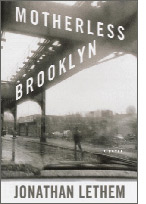
"Motherless Brooklyn"

A detective with Tourette’s syndrome narrates a hard-boiled crime novel. Sounds like a gimmick, right? Another in the endless line of diversity dicks — sleuths in wheelchairs, lesbian lieutenants, investigators who also happen to be heroin addicts or restaurant critics or codgers as old as Angela Lansbury. But Lionel Essrog, the twitching, barking, gabbling narrator of Jonathan Lethem’s new novel, “Motherless Brooklyn,” is no movie-of-the-week novelty grafted onto a noir mystery. Maybe his Tourette’s is a gimmick, but it’s a gimmick with depth, with soul. Lethem, after all, walks the serious-fiction beat, and in his hands the compulsions of Tourette’s become a kind of kaleidoscopic metaphor, ultimately (and somewhat paradoxically) reflecting the fundamental ethos of the mystery genre itself: the compulsion to restore order and rightness to a world thrown temporarily out of joint.

The world of “Motherless Brooklyn” is, of course, the borough of the title, and what disrupts its sense of order is the stabbing death of a small-time neighborhood operator named Frank Minna. Lionel is Frank’s factotum, one of four misfits from a local orphanage Frank has commandeered to work in his seedy and makeshift detective agency. Calling themselves Minna Men, the four have become vassals in Frank’s scruffy little fiefdom, and like the members of any feudal hierarchy, each has found his particular niche: Tony is the implicit second-in-command, the lesser noble to Frank’s lord of the manor; Danny is the enigmatic knight-errant, distant and of uncertain loyalty; Gilbert is the earthy, none too intelligent serf; and Lionel, nicknamed Freakshow because of his constant verbal tics and physical twitches, is the fool, the court jester, whose antics the others tolerate with the indulgence that forced proximity dictates.

With Frank’s murder, this miniature fiefdom loses its suzerain, and in the scramble to find the killer, long-submerged tensions begin to pull the Minna Men apart. (Think Yugoslavia after Tito, or the Bowery Boys without Leo Gorcey to keep them all in line.) As Frank’s deputy, Tony tries to control the investigation, but Lionel has his own reasons — some of them Tourette’s-related — for getting to the bottom of Frank’s murder: “My words begin plucking at the threads nervously, seeking purchase, a weak point …” In a sense, this is detective work as medical condition, stemming from a pathological need to poke at experience, to process its patterns, “putting hairs in place, putting ducks in rows, replacing divots.”

What follows is a fairly standard noir quest: a long, convoluted road to discovery, littered with the usual detritus of fractured conspiracies, and complete with corpses, cutthroats and big, ugly men with big, ugly guns. But as in his earlier novels (“As She Climbed Across the Table,” “Girl in Landscape”), Lethem harnesses the engine of a familiar genre to transport us to a territory uniquely his own. It comes as no surprise that he uses Tourette’s as an excuse for some heady verbal pyrotechnics. (My favorite Essrog riff: “He’s just a big mouse, Daddy, a vigorous louse, big as a house, a couch, a man, a plan, a canal, apocalypse.”) More unexpected is the sympathetic warmth he brings to the characterization of Lionel. “Motherless Brooklyn” has a few problems — including some cartoonlike stock characters and one scene near the end that flirts with maudlin sentimentality — but it works far better than the average hip postmodern novel in terms of sheer emotional impact. Because Lethem never lets the metaphorical and linguistic possibilities of his narrator’s illness overshadow his immensely appealing humanity, we really care about Lionel and his search for his mentor’s killer.

In the end, the mystery at the heart of “Motherless Brooklyn” turns out to be surprisingly modest. Readers looking for one of Don DeLillo’s or Thomas Pynchon’s grand metaphysical conspiracies may be disappointed. But really, Lethem is too inventive a writer to produce just another literature-of-paranoia knockoff, with Tourette’s as its central trope (“The Barking of Lot 49″?). Instead, he’s given us something that is at once less derivative and more traditional: a detective story that transcends its pulp roots not by adopting high-art pretensions but by bringing to the genre an originality and an idiosyncratic sympathy that few other writers could muster.

Gary Krist is the author of the novels "Bad Chemistry" and "Chaos Theory."  More Gary Krist

Thursday, Nov 17, 2011 1:00 AM UTC2011-11-17T01:00:00Zl, M j, Y g:i A T

Jonathan Lethem: The literary world is like high school

In a Salon exclusive, the "major author" reveals the downside of getting into the cool kids club

Jonathan Lethem

Jonathan Lethem (Credit: Mara Faye Lethem)

The novelist Jonathan Lethem began trying his hand at nonfiction back in the 1990s, for this very publication. He’s since proven himself a modern master of the form, having just published his second collection of criticism, essays and autobiography, “The Ecstasy of Influence.” The new book includes the now-famous title essay — a defense of collage and appropriation that’s revealed at the end to be patched together from rewritten snippets of other writers’ work — originally published in Harper’s magazine. It also features a new and currently much-discussed response to a mixed review of Lethem’s novel “The Fortress of Solitude,” written by James Wood for the New Yorker.

Continue Reading
Laura Miller

Laura Miller is a senior writer for Salon. She is the author of "The Magician's Book: A Skeptic's Adventures in Narnia" and has a Web site, magiciansbook.comMore Laura Miller

Wednesday, May 4, 2011 1:01 AM UTC2011-05-04T01:01:00Zl, M j, Y g:i A T

How a podiatrist sign became a literary icon

Happy Foot/Sad Foot has captured the imagination of David Foster Wallace, Jonathan Lethem and others

Happy Foot/Sad Foot

F. Scott Fitzgerald’s generation had its green light at the end of the dock in “The Great Gatsby,” that symbol of unattainable dreams, and today’s young literati have — a podiatrist’s sign?

The sign for the Sunset Foot Clinic on West Sunset Boulevard in Los Angeles is known to some locals as a kind of fortuneteller. On one side is depicted a foot with a woeful face, a bandaged big toe and crutches, while the other side shows an ecstatic foot in gloves and sneakers giving the thumbs-up sign. (Yes, these feet have both arms and legs.) When the sign is working, it rotates, and several residents of the nearby Silver Lake and Echo Park neighborhoods believe that whichever side they see first indicates what sort of day awaits them. Others use the sign as a guide: If they see the Happy Foot, they get to do something fun, while the Sad Foot condemns them to an afternoon of chores.

Continue Reading
Laura Miller

Laura Miller is a senior writer for Salon. She is the author of "The Magician's Book: A Skeptic's Adventures in Narnia" and has a Web site, magiciansbook.comMore Laura Miller

Friday, Oct 23, 2009 10:24 PM UTC2009-10-23T22:24:00Zl, M j, Y g:i A T

“Chronic” overachiever: Interview with Jonathan Lethem

The writer talks about his new novel's ambivalent take on New York, and how cultural obsession can lead to madness

Jonathan Lethem

Jonathan Lethem

As Jonathan Lethem grew into what critics like to call one of our most important novelists, he became increasingly difficult to pigeonhole; fluid across genres, Lethem’s biggest books (“Motherless Brooklyn,” “Fortress of Solitude”) can feel like sparkling new works from a new author rather than someone you’ve enjoyed before. His latest, “Chronic City,” with its flashes of pot-fueled magic realism and ripped-from-the-tabloid-headline riffs again reads as something completely different from Lethem, but no less enthralling.

Continue Reading
Kerry Lauerman

Kerry Lauerman is Salon's Editor in Chief. Follow him on Twitter: @kerrylauermanMore Kerry Lauerman

Sunday, Mar 25, 2007 1:00 PM UTC2007-03-25T13:00:00Zl, M j, Y g:i A T

Writing in the free world

Jonathan Lethem explains why copyright laws stifle creativity and why he's giving away the film option to his new novel.

Writing in the free world

Jonathan Lethem‘s seventh novel, “You Don’t Love Me Yet,” is a parable of sorts about the ways in which art is created and commodified by a process of borrowing, stealing and transformation. Set in Los Angeles, the novel concerns four indie rock musicians closer to their 30th birthdays than they are to success. The fetching bass player, Lucinda, strikes up a friendship with an anonymous caller to her day job, a complaint line funded by an art gallery. The man, appropriately dubbed the Complainer, happens to have a genius for words. Lucinda passes the Complainer’s musings on to Bedwin, the band’s lyricist, who transforms them into songs that finally get the band some attention. Things get tricky when the Complainer demands a different sort of compensation for his work: Rather than cash payment, he wants to join the band.

Continue Reading

Amy Benfer is a freelance writer in Brooklyn, N.Y.  More Amy Benfer

Monday, Jul 3, 2006 1:00 PM UTC2006-07-03T13:00:00Zl, M j, Y g:i A T

Destination: Brooklyn

From Betty Smith to Jonathan Lethem to Truman Capote, the chroniclers of this brownstone-lined borough are as diverse as the millions of people who live there.

Destination: Brooklyn

Because Brooklyn was once a populous, independent city, before being amalgamated in 1898 with the other four boroughs to make New York, it retains a poignant sense of lost, prelapsarian identity. Its touchy pride is tinged with the inferiority complex of the provincial living nearby, but not in, the metropolitan center. Because it became a bedroom borough for hundreds of thousands of workers commuting daily to Manhattan jobs, much of its literature inevitably came to dwell on the residential, domestic and familial. Brooklyn’s schools have spawned generations of bright little prodigies, such as Henry Miller, Norman Mailer, Arthur Miller and Woody Allen, who went on to become Americas literary lions, often moving across the river while periodically looking back with fondness or chagrin at their roots.

Continue Reading

Phillip Lopate is an essayist ("Portrait of My Body"), film critic ("Totally Tenderly Tragically"), novelist ("The Rug Merchant") and anthologist ("The Art of the Personal Essay") who teaches at Hofstra University.  More Phillip Lopate

Page 1 of 4 in Jonathan Lethem

Other News