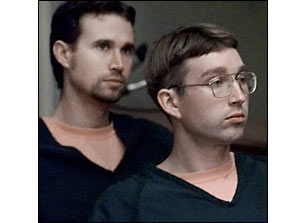

Sam Stanton

Poster boys for the summer of hate

Meet Matthew and Tyler Williams, suspects in a series of Northern California hate crimes, now on trial for murder

Sally Williams was sitting in the visiting area of the Shasta County Jail,
peering through the thick plexiglass shield separating her from her eldest
son and trying to reassure him.

“Um, I don’t, I don’t think you did what they say you did,” she told
31-year-old Benjamin Matthew Williams.

“What do they say I did?” her son asked through the telephone handset.

“They say you took out two homos,” she said in her soft whisper.

“Huh!” he shot back in a strong and certain voice, as if to boast. Then he
asked: “Why wouldn’t you think I’d do that?”

Why wouldn’t anyone? Since Williams’ arrest in early July along with his
younger brother, James Tyler Williams, 29, the two young Northern
California men became poster boys for the summer of hate this country just
endured. Both men have been charged in the July 1 double slaying of Gary
Matson, 50, and Winfield Mowder, 40, a prominent gay couple who lived near
Redding in the rural community of Happy Valley, about 180 miles north of
Sacramento.

The men also are the prime suspects in the wave of arsons that hit three
Sacramento-area synagogues two weeks before the killings, and caused more
than $1 million in damage. And they also are being looked at as
potential suspects in an arson at a Sacramento-area abortion clinic two
weeks after the synagogue fires.

The pair, both of whom are known by their middle names, have pleaded not
guilty to the murders, the only formal charges they currently face. The FBI says it is still investigating the brothers’ ties to the arsons, but there seems to be no hurry to file charges — perhaps understandably, since the brothers could face the death penalty in the murder trial.

Matson and Mowder, the murder victims, were widely admired in this
conservative area for their civic good deeds and the many hours they spent
sharing their knowledge of gardening with anyone interested. Their deaths
were grisly: First, one was apparently forced to record a new message for
their answering machine, claiming they were sick and had gone to San Francisco
to see a doctor. The voice on the machine feigned illness, investigators
say, but sounded distressed. In the background, another voice could be
heard saying, “Just calm down.”

They were then forced into their platform bed, which rose seven feet above
the floor of their bedroom. From the way the bodies were found and the
bloody mess left behind, investigators said the killer or killers stood on
chairs at the end of the bed and blasted away at the men. Their nude
bodies were discovered by Gary Matson’s brother, Roger, who had been
dispatched to their home by their father after he heard the odd-sounding
telephone message and became worried.

When the Williams brothers were arrested a week later, one was wearing a
bullet-proof vest and both were heavily armed. They also happened to be
picking up a crate of ammunition re-loading equipment that had been shipped
to a mail drop, and paid for by Matson’s credit card, within hours of the
shootings. Searches of their homes and storage sheds turned up a notebook
in which one had practiced signing Matson’s name, according to documents filed
by prosecutors in the case, as well as a treasure trove of
white-supremacist, anti-gay and anti-Semitic literature.

Investigators also found a “hit list” of 32 prominent Jewish and civic
leaders in the Sacramento area, apparently compiled after the synagogue
fires. Then, after a Jewish businessman offered a $10,000 reward in the
arsons, one had written a note that read: “Yidbizman, $10,000 on us.”

Unlike in Littleton, Colo., where investigators say they may never know why
two high-achieving teenagers killed 12 classmates and a teacher and hoped to
blow up their entire high school, Matthew Williams is still alive and
seems eager to explain his beliefs.

“My brother and I were captured by occupation storm troopers while we were
on a supply mission,” he wrote in a letter from jail that was part of a
credit card application. “We are now incarcerated for our work in
cleansing a sick society.”

The Williams brothers now are part of a nationwide FBI probe into whether
there was a larger conspiracy among hate groups to launch violent attacks
over the past few months. Was there a connection between the brothers and
Benjamin Smith’s murderous July 4 weekend rampage through the Midwest after
leaving the World Church of the Creator, for instance? Or to Buford Furrow Jr.’s
attack on a Jewish day-care center in Los Angeles?

Though no direct link has been established, the men all subscribed to the
same general white supremacist views — a belief that gays, Jews and other
minorities are subhuman and must be eliminated if the white race is to
continue to flourish.

Those appear to be the views of Matthew Williams. But before the arrest
of the two brothers, many who knew them had no idea of the hatred that
authorities say the two harbored against people they considered different
or inferior. And until law-enforcement began describing the evidence
officers had seized — everything from the purported murder weapon,
complete with Tyler’s palm prints on the barrel, to handwritten notes
boasting of being sought in the synagogue fires — few could have believed
either man stupid enough to leave behind such a compelling trail.

“You would like to have your daughter go out with this guy,” said Dennis
Williams (no relation), who manages the Redding farmer’s market where the
brothers as well as Matson and Mowder frequently sold organic vegetables.
“I would trust him, I’m serious. It’s too day and night. He had a bunch of
people fooled.”

Unlike the Buford Furrows and Benjamin Smiths of the world, the two boys
were not misfits or loners. There is no evidence of past mental illness in
either, and no one can point to any incident that could explain a hatred of
Jews or gay people. On the surface, their friends, customers and neighbors
knew them simply as friendly lawn boys.

The two operated a landscaping and lawn service out of their parents’ house
in Palo Cedro, Calif., a picturesque enclave of homes on large lots that
back up to Cow Creek, about 20 miles east of Redding. Residents there say
the boys were unfailingly polite and friendly.

Matthew “brought over a silver dollar for my son’s 13th birthday and
taught him how to read the silver prices in the paper,” said Debbie
O’Connell, who lives next door to the Williams home, which is shielded
from the street by a fence and steel gate with a “Keep Out, No Trespassing”
sign.

Tyler Williams would stop by to borrow O’Connell’s computer to check gold
and silver prices on the Internet, she said. The family itself was always
gardening, and the boys could make anything grow. Their lot is studded with
fruit trees and vegetable patches, and they prided themselves on the fact
that between their produce and their ducks and chickens they were largely
self-sufficient.

“They’re self-contained,” O’Connell said. “They eat their own chickens
and ducks, grow their own food, their own eggs. It’s almost like they’re
burying themselves in there,” she said, noting the dense shrubbery that covers
the property.

What made the family stand out, neighbors say, was the noise that would
come blaring from inside the house at all hours of the day and night.
Sometimes it would simply be religious music. Other times recorded sermons
would echo through the quiet neighborhood.

“They were heavy Bible
thumpers, really into that stuff,” said neighbor Don O’Connell. Religion
was a lifelong passion for the two boys, who grew up in a household that
valued it above all else. Their father, an eccentric, religiously devout,
retired U.S. Forest Service employee, raised the brothers to live off the land
in anticipation of the coming apocalypse.

Before they moved to the Redding area, the family had lived in the small
Butte County farming community of Gridley, about 40 miles north of
Sacramento.They lived on a narrow country lane in a small, modest home that
faced a field and had a one-acre backyard filled with fruit trees. During
the day, Matthew Williams would wander the neighborhood communing with his
God.

“He used to walk up and down the street carrying a staff and preaching
to no one,” said David Anderson, a Live Oak high school teacher who bought
the Williams home three years ago. “That does something to kids, raising
them up in that environment.”

“I always felt sorry for those boys,” added a longtime neighbor in Gridley,
who asked not to be named. “The parents didn’t allow them to associate
with anyone other than people from their church. They were just held down
that way. They never went to parties. Only with the church. I asked the
father many times what church he belonged to and he would never tell me.”
That may have been because the family had changed churches a number of times, associates say, in an apparent bid to find just the right fit.

“They were zealous in their faith, but that’s what pastors encourage people
to be: zealous in their faith,” said Craig Cook, their former pastor in
Gridley at what he described as a mainstream evangelical Bible church. “But
they were far from kooks. They were not cultish, as people would make them
out to be.”

And, Cook added, they were not anti-Semitic. “I find it
extremely hard to believe concerning the anti-Semitic bit because the
family are Semitic lovers — they love the Jews because our Christianity
finds its roots in Judaism. And the entire family was high supporters of
the Jewish faith, so I find it very hard to connect them to that.”

That stance apparently changed over the years, however, at least for
Matthew Williams, whom authorities call the “alpha dog” of the pair, and
who was able to convince his younger brother to go along with his plans.
Tyler Williams, friends say, always seemed eager to gain Matthew’s approval
in much the same way Matthew was always trying to please their father.

After moving to the Redding area, the two brothers drifted through colleges
and jobs. Matthew served a short stint in the Navy, then ended up at the
University of Idaho at Moscow, where he was drawn into a charismatic
Christian Church in nearby Pullman, Wash., known as the Living Faith
Fellowship. As was his custom, he threw himself into the church 100
percent, but, as was also his custom, became quickly disenchanted and soon
quit.

“He made a quick, almost overnight conversion from being a hardcore cultist
to being a hardcore anti-cultist,” said Jeff Monroe, a former church
member and friend. “That’s how it was with Matthew. He’d get into one
thing with his heart and soul then lose interest if those around him
didn’t share his excitement. He’d be depressed for a while and then get
into something else.”

Monroe describes Matthew as a searcher, who moved from one fad to the next — everything from nutrition and exercise to religion and politics — trying to find himself. “After he left the church he went from food-combining to eye exercises
to only drinking tea that was supposed to cure everything to tax
revolting to something else,” Monroe recalls.

But the “running theme,” he said, was “always
about purification. It was always about intense cleansing. He had very low
self esteem and he ultimately wanted to be pure and clean. He tried it
through dietary means and was always looking for something else.”

Eventually, his search for cleansing extended into the realm of the
bizarre, with Matthew exhorting Tyler to strive to achieve the perfect
bowel movement so his body could be cleansed. At times, Matthew would stand
outside the bathroom door coaching his brother’s efforts, said friends who
spent time with both of them when Tyler came out to Idaho to visit his
older brother.

“Matthew became a tyrannical freak,” said Monroe. “Tyler came out of the
shower and Matthew made him put his feet up on this block so he could
achieve the perfect bowel movement. Tyler came over and told us about it
and he just sat there and cried.”

After quitting the church, Williams found a void in his life and soon
became fascinated with white supremacist and anti-Semitic material he
studied for hours on the Internet. At one point in their friendship, he
gave Monroe a book, “Israel: Our Duty, Our Dilemma,” that Monroe said was
an anti-Semitic diatribe.

“I was appalled,” Monroe said after he read most of the 346-page book. “I
called Matthew and I tried to talk to him, but by the time he got into the
anti-Semitic stuff he was pretty much a convert. That’s how he was … fanatic about whatever he believed.”

The Redding area has been a hotbed of militia activity and a haven for
followers of the Christian Identity movement, which views Jews and other
non-Christians basically as subhuman.

Last January, the area hosted a visit by John Trochmann, founder of the
Militia of Montana and one of the nation’s leaders in militia activity.
Trochmann was visiting to spread the gospel about how to prepare for the
Y2K problems so many people believe are coming, and one woman who attended
his speech said she saw Matthew Williams inside selling literature.

At about this same time, Williams was also developing what friends say were
virulent anti-gay views. One of his closest friends, with whom he shared
camping trips and poetry readings, came out of the closet, and
when he did Williams was horrified, friends say. He developed an active,
outspoken dislike for homosexuality, something that surprised some who knew
him and saw the slender, handsome man as slightly effeminate.

“We had this debate about gays,” said Karney Hatch, who worked as a
computer monitor at the University of Idaho library, where Matthew Williams
would stop daily to tap into the Internet. “He would say the Bible said
they’re evil and wrong and not appropriate,” said Hatch, who now lives in
Los Angeles.

And 86-year-old Olin Gordon, an Olinda man who considered hiring the
brothers’ to do some landscaping work on his property but said their
$15-an-hour fee was too high, vividly recalls what Matthew said when the
men were making small talk. “I mentioned Gary Matson and asked if Matt knew
him,” Gordon said of one of the murder victims. “They were in the same
general kind of work and I was just making conversation. He said, ‘Yeah, I
know Matson. He’s a homosexual.’ It was a little weird.”

The fact that Matson was gay was hardly news to anyone in Redding, a
fast-growing city that straddles the Sacramento River and has an economy
based largely on farming and recreation geared toward the river and the
surrounding mountains. Although it’s a conservative community politically,
socially and theologically, Matson and Mowder had managed to carve out an
impressive life together in this small Northern California town of 78,000, one
that led a friend to describe them as “the soul of Redding.” Matson helped start the Redding Farmers Market, as well as a community garden, an arboretum and a natural science museum for children.

Mowder worked for a time as a florist in Sacramento and later at Orchard
Supply Hardware in Redding, where his knowledge and love of plants made him
a match for Matson. Together, the two lived on a large farm where they
helped raise Matson’s daughter Clea. They were frequent guests at the home
of Matson’s father, Oscar, a winemaker and a retired college language
professor. The two had been there the night before they died, enjoying
dinner and conversation until about 11 p.m., the last time anyone saw them
alive.

If it hadn’t been for a strong trail of physical evidence left by the Williams
brothers, the FBI might still be knocking on doors of tattooed white
supremacists in Sacramento’s suburbs searching for local arsonists, and
Shasta County deputies might never have found the killers of Matson and
Mowder.

For three weeks after the arsons, FBI agents and Sacramento County
sheriff’s deputies fanned out to talk to potential arson suspects. Anyone
with a link to the white supremacy underworld was considered a lead;
membership in the World Church of the Creator or the National Alliance put
you at the top of the list. Being acquainted with a member got you two or
more visits.

It got to the point where some of Sacramento’s burlier white supremacists,
the kind who wear Doc Maartens and sport tattoos like “Delenda est Judaica”
(Latin for “Destroy the Jews”) or “RaHoWa” (their abbreviation for
“racial holy war”), began complaining about having their rights trampled.

It also got to the point where the head of Sacramento’s FBI office, James
Maddock, and the sheriff, Lou Blanas, stopped speaking to each
other. Maddock, who already was under extreme pressure from Washington for
his failure to solve the slayings of three Yosemite sightseers earlier in the year, was coming unglued over the leaks of information about
the arson case. He called Blanas on the phone, shouting and accusing the sheriff’s
department of leaking information, cut sheriff’s investigators out of the probe
– and finally had to call and apologize when he determined the leaks were
coming from his own operation.

All the while, the Williams brothers never crossed anyone’s radar screens.
They had no criminal record, and no one had any reason to suspect them of
anything. During this time, however, Matthew Williams’ phone line was
extraordinarily busy. Calls from the telephone were being made to gun
shops, known white supremacists and others all over the country. A firm in
Arizona that makes folding rifle stocks for the Secret Service was called.
A phone call, apparently intended for the Glock pistol firm in Georgia, was
made to a young woman whose phone number was one digit off from Glock’s.
And a Redding-area man described as a militia leader got a call.

But the phone call that set detectives on the trail of the Williams
brothers came from another phone and was made two hours after Matson and Mowder
were found dead. That call went to a company in Scottsdale, Ariz., that
specializes in ammunition reloading equipment. The caller ordered $2,276.09
worth of reloading equipment and gun belts, one in waist size 32, the other
a size 34. The sizes match the Williams brothers, court documents say, and
the person placing the order asked that the equipment be shipped to a
private mailbox firm in Yuba City, Calif., in care of Gary Matson. Matson’s
Visa card was used to pay for the materials.

The credit card activity alerted Shasta County detectives, who traced the
address the materials were being delivered to and headed to Yuba City. By
sheer coincidence, they arrived just as the Williams brothers showed up.
As the brothers were loading the heavy boxes of equipment into their
father’s Toyota hatchback, officers surrounded them with guns drawn.

Matthew Williams was wearing a bulletproof vest and a fanny pack that
helda 9 mm Glock pistol, and he had Matson’s driver’s license and credit
card. He reached for the pack, then turned to his brother and asked,
“Well, partner, what are we going to do?” But for all of the weapons the
two had, they apparently weren’t ready to become martyrs for a cause. They
went meekly, giving up without resistance.

Even their father, Benjamin Hardaway Williams, seems to be disappointed in
their sloppy work. As he sat in court in Redding recently, listening to
the tape recording that was secretly made by authorities monitoring the
visit between his wife and his son, the elder Williams sat scribbling on
note cards.

Finally he shook his head and scribbled a new note to himself: “No
critical thinking!” with an exclamation point apparently to highlight his
displeasure. A few minutes earlier, waiting in line to pass through a
security screening after a lunch recess, the elder Williams had been telling a
story to a friend when he broke into an ear-to-ear grin and danced a jig
right in front of the victims’ family members and an astonished
press corps.

Tyler Williams later told a reporter from the Redding Record Searchlight
that he and his brother simply were heading to a gun range near Yuba City
when they were arrested. He has had little to say since. In court he
appears downcast and depressed, and he told one newspaper reporter he is
content to read the Bible and cast his fate to the will of God.

But Matthew Williams seems to enjoy all the attention the case has been
getting. In court, he smirks and makes eye contact with his parents, who
frequently sit smiling broadly at their sons. For the preliminary hearing
held Sept. 21, Matthew apparently decided to make a special impression: He
shaved his head.

He has maintained his public profile with regular letters to the media.
Sometimes he tries to make himself appear less of a demon. “I do want it
known that i am NOT a Hate-Filled man,” he wrote from jail in a letter to
the Sacramento Bee filled with his own odd punctuation and spellings, three
weeks after being arrested. “My beliefs encompass a deep sincere natural
LOVE for my creator (YAHWEH), my people, my country and all RACES created
by the ALLFATHER!” Whether that love extends to races not created by the
“allfather” remains unclear, and Williams helped to obscure the answer even
further with his postscript to the letter: “I’m Brittanic-Nordic, what is
your racial extraction?”

In another letter sent to the Bee just last week, Williams chided a
reporter requesting an interview with him for failing to disclose his
racial heritage to the accused murderer. “Also, you have failed to inform
me of your race,” he said in a letter illustrated with his drawings of the
Nazi Iron Cross and other hate symbols.

“Race does matter, as one Jew wrote, and is central to most
politico-religious issues. You are cognizant of my race — Aryan-Adamic
Saxon. I need yours. It is a paradigm that cannot be overlooked. Are you
ashamed of your genetic heritage? I’ll still conduct the interview
regardless of your race, even if you happen to be a yid or negro-chaya.
Yes, I am familiar with most racists (lovers of their own race) as I have
a prodigious thirst to research. This does not necessarily imply we must
harmonize our weltanshuang though.”

He complained in a letter to the Redding Record Searchlight that he has been
abandoned by other members of the world of white supremacy. A letter to the
Sacramento Bee was signed “14 words,” a phrase commonly used as shorthand
for the core tenet of white supremacists: “We must secure the existence of
our people and a future for white children.”

But Williams hasn’t been writing many letters in recent days, since a judge
ruled that there is sufficient evidence to try both brothers on double
murder charges. The charges could bring the death penalty, although the
Shasta County district attorney has yet to say whether he will seek it.
That prospect apparently hasn’t hit home for Matthew Williams, who told his
mother during the jailhouse visit that he didn’t expect a lengthy sentence.

“They, they’re not doing the death penalty a whole lot here anymore are
they?” he asked. “Are we looking at 20, 40 years or something? Then I
don’t expect to serve that, though.”

Actually, California has put seven condemned men to death in the last seven
years and authorities are expecting the pace to quicken. But Matthew
Williams apparently is already crafting his defense, telling his mother
that “God has put me here as a witness. I’m going to give them some of the
commandments and I’m going to say basically that it’s a jurisdictional
problem, you know?” he said. “I have followed a higher law … I have to
obey God’s law rather than man’s law.”

Rolling back three strikes

In California, even some tough-on-crime politicians are beginning to fight a law that sends people to jail for life for petty theft.

Joe Wilcox, a lay minister from the rural Northern California community of Christian Valley, supported California’s “three strikes” law when voters overwhelmingly approved it in 1994. But six years later, while on a jury that was considering putting a man away for life for stealing a bicycle, he couldn’t do it.

Wilcox was one of two jurors selected to sit on a three-strikes case in the Sacramento suburbs of Placer County involving Steven Bell, who had been arrested for stealing a $300 bicycle from the garage of a home in the middle of the night. The burglary occurred in February 1999, and an accomplice of Bell’s also was arrested and convicted in the case. She got probation.

Bell had two strikes against him — burglary convictions in Nevada from 1984, when he was 19, and from 1989, when he was 25.

“I told the judge, ‘I’m sorry, I just cannot do this,’” Wilcox recalled. “From a moral standpoint I will not take part in a process that sends a man to jail for life for stealing a $300 bicycle.”

Another juror joined Wilcox, and the judge removed the two from the panel. Without the dissenters, the jury came back quickly with a unanimous vote that the bicycle theft should count as a third strike. Bell is scheduled to be sentenced in the case next month and faces 25 years to life — a punishment equal to or worse than the punishment many murderers face.

Like Wilcox, many Californians are having doubts about the state’s three-strikes law, which is the toughest in the nation. There are bipartisan efforts in the California Legislature and among voters to relax the strictest parts of the anti-crime measure, which sends criminals to prison for 25 years to life for a third felony conviction.

Meanwhile, police chiefs, legal experts and jurors called to hear three-strikes cases are questioning whether California needs to step back from the most controversial part of the law, which allows prosecutors to count even the most minor crimes as a “third strike” that makes a criminal eligible for the maximum sentence.

Facing a barrage of stories about criminals being packed off to decades spent in prison for swiping pizzas, stealing bicycles or shoplifting, lawmakers and other advocates for change are looking to soften the impact of the law.

Opponents of the law are trying to get an initiative placed on the California general election ballot in November that would modify the measure to make it less strict. They need 419,260 petition signatures by June 1 to qualify for the ballot. The state Assembly’s public safety committee voted 5-3 last month to adopt a measure that would change the law so that a third strike could not be declared unless the crime involved was a violent felony.

At a rally outside the Capitol building after the vote, dozens of opponents of three strikes and family members of prisoners convicted under the law pleaded for a change in the way California administers its justice system.

“If you steal $10 worth of toilet tissue at the Rite Aid, that’s not something we should put you in jail for life for,” said Assemblyman Rod Wright, D-Los Angeles, who sponsored the proposed change in the law. “We’ve got to distinguish between people who are really violent criminals and people who are just down on their luck,” he said, referring to the many drug addicts who have been sentenced under the law.

Wright has an unlikely ally in Orange County Republican Scott Baugh, who, while not willing to go as far as Wright, at the very least wants petty theft and drug cases to be taken off the list of third-strike offenses that bring the maximum prison sentence.

“I’m one who believes that the three-strikes legislation has been the single biggest deterrent to crime in California,” Baugh told Salon.com. “That’s not to say it hasn’t had some erroneous applications.” Baugh said he also wants a study of all third-strike cases that involve convictions made before the law was passed in 1994, to make sure only those who deserve three-strikes prosecutions are getting them.

Currently, about three dozen states have a three-strikes law of some sort on the books. California’s was the second in the nation, with Washington passing one before the Golden State’s voters jumped on the idea. But unlike California, most other states require that a third strike be a serious offense, such as a violent felony. That makes a big difference, as is evident from the incarceration numbers that other states have reported.

In a study conducted in 1998, five years after three-strikes mania swept the nation, researchers found that California had sent 40,000 criminals to prison as second or third strikers, and that Georgia had sent 2,000. All the other states combined and the federal government had sentenced fewer than 1,500, according to the study by the Campaign for an Effective Crime Policy in Washington, D.C.

“While political rhetoric dominated much of the debate preceding the adoption of these laws — with claims that three-strikes laws were an essential tool for crime control and the only way to ensure that violent felons were kept off the street — the laws that resulted have had only minimal impact,” the study found.

One of the most disturbing three-strikes cases in California involved Ricky Fontenot, whose parents came up from Southern California for the Capitol rally last month.

“It’s devastating,” said Berthena McFarland, from West Covina. “That’s my only son. He was a productive citizen; he was doing so good. To go back and dig up stuff from 17 years ago and use it against him like that — it just isn’t right.”

Growing up in Los Angeles, Fontenot got mixed up with some rough kids, and he made more than his share of youthful mistakes. His role in a robbery landed him in the California Youth Authority. A purse snatching brought him another felony and more juvenile jail time.

Then, his parents said, he grew up.

At 39, he was a partner in a successful limousine company and was married with three kids. But he ended up with a life sentence five years ago because he was in a car with someone who had an unlicensed gun, McFarland said.

“When you have two very old prior felonies and then years later you suddenly go to prison for life, that’s sorely disproportionate to the offense,” Baugh said. “To have an effective justice system it not only has to be tough but it has to be fair.”

An arguably more tragic case generated national publicity in November. A small-time hood and his girlfriend killed themselves after being busted in Sacramento County for pot and methamphetamine possession. Just a day before their double suicide, the Sacramento district attorney’s office notified Steven Davis it had discovered two prior felonies on his record for armed robbery, dating back more than 20 years in Maryland. Instead of 120 days in jail in exchange for a guilty plea, as he had been promised, Davis was suddenly facing life without parole under three strikes.

If his last crimes had been committed in San Francisco, where the district attorney rarely invokes three strikes unless there is a violent felony, Davis would not have had to fear 25 years to life. Sacramento District Attorney Jan Scully, who ran on an ultratough anti-crime platform, interprets the law much more strictly. That sharp disparity in how the law is administered from county to county also has encouraged demands for change.

But so far the constituency to alter the law remains small.

“The interest lies mostly with the families that are looking at the short end of the stick when it comes to three strikes,” Baugh conceded. “But that doesn’t mean we still don’t have an obligation to look at it.”

Political support may be more diverse than Baugh believes, however. Calls for change have come from a variety of political and law enforcement sources, with Vice President Al Gore, the presumptive Democratic presidential nominee, endorsing a study of problems with three-strikes laws across the nation.

“We ought to review the nature of the crimes that are included in the calculation of this ‘three strikes and you’re out’ provision,” Gore said earlier this year at a debate in Harlem, N.Y.

Gore seemed to be playing to the African-American community, where concerns about unfair sentencing are the strongest. But even once staunch advocates of the law are now asking whether things have gone too far.

The grandfather of Polly Klaas, the little girl whose 1993 abduction and murder in California helped spark a nationwide wave of three-strikes laws, has raised many of the same questions and has spoken out across the state.

“To take someone who has committed a nonviolent crime and send them to prison for 25 years to life is unconscionable,” the 80-year-old Klaas said last week in Sacramento. “To have [Polly's] name used to perpetuate this fraud on the people of California, I think, is a disgrace.”

Increasingly, people directly involved in the administration of the law are speaking out in agreement.

Sacramento Police Chief Arturo Venegas, a strong supporter of the three-strikes concept, says it’s time to modify how the law is applied. “To say the solution to crime is three strikes is ludicrous, just as it would be to say community policing has been the solution to crime,” Venegas said. “It has helped in the sense that we’ve put away some criminals who really needed to be put away a long time.”

Venegas has a direct tie to one case that helped inspire the law — the 1992 slaying of 18-year-old Kimber Reynolds by a parolee, a case that led Reynolds’ father, Mike, to author the ballot initiative.

“I was in Fresno when the Reynolds girl was killed,” Venegas said. “I was deputy chief of detectives in charge of the SWAT team that confronted and apprehended and got into a shootout with Mike Reynolds’ daughter’s killer.

“And I have fought the Department of Corrections’ battle here on holding parolees and habitual criminal offenders accountable. That’s been part of my career and part of my life.

“On the other hand, the courts need some latitude in sentencing. A person arrested for petty theft of 15 cents — I’m not sure that’s in the best interest to have that person go away for life.”

But the efforts to change California’s law may fall victim to political reality in a state where crime has dropped since the implementation of the law. And many credit tougher sentencing for that drop.

Gov. Gray Davis, a longtime supporter of the three-strikes law, has made it plain he has little interest in seeing the law changed. “As long as you have me, you have a governor who believes in and supports three strikes,” Davis told a group of advocates of tough sentencing at a dinner in Sacramento recently.

And Davis has a large base of supporters of that stance, including the politically powerful California Correctional Peace Officers Association, the union that represents the state’s prison guards. The union gave Davis $2 million for his successful 1998 gubernatorial campaign. Three strikes has been good to the union, ensuring a burgeoning prison population and, critics say, a long-term economic base for its members.

But a more important factor may simply be the reality of a state with 33 million people, most of whom “could care less” about the state’s 160,000 prison inmates, according to longtime bail bondsman and former bounty hunter Leonard Padilla.

Padilla, who has spoken to the anti-three-strikes groups about their efforts, has taken pains to point out that their message simply isn’t interesting to anyone except the relatives and friends of three-strikes inmates.

A better approach, he believes, is to push for change based on what the law is costing the state. Some people apparently are beginning to listen to that advice. The ballot initiative campaign, for instance, is trying to win approval by asserting that the state could save at least $15 million annually by softening the law.

“I would say 99 percent of the people that I’ve talked to have pretty much said that they agree with the law, except that it should be for violent crimes,” said Wilcox, the Northern California juror who refused to levy a third-strike conviction. “And that is what they thought it was when they voted for it.

“The law as it is currently being used is costing us a fortune,” Wilcox added. But in the end his objection is more basic. “To me, it’s a moral issue. This type of a punishment does not go along with the offense. It just doesn’t.”

Continue Reading Close

Indictments issued in Sacramento synagogue arsons

Two months after one of the suspects admitted to the crimes, the Justice Department finally acts in a high-profile hate case.

After a nine-month investigation, federal officials announced Friday they have indicted white supremacist brothers Matthew and Tyler Williams on charges of torching three Sacramento-area synagogues last summer.

The indictments will include charges that the two also set a fire at a medical building in Sacramento two weeks after the synagogue fires as part of an attack against an abortion clinic inside the structure, sources say.

Both brothers are in jail awaiting trial on two murder charges in Redding, 180 miles north of Sacramento. The murders and arsons seemed to kick off a nationwide hate spree that rocked the country last summer, when they were followed by the Midwest shooting rampage by Benjamin Smith, a former World Church of the Creator adherent, and the Jewish day care killings in Los Angeles blamed on white supremacist Buford Furrow Jr.

The long-awaited indictments brought a sense of relief to Sacramento’s Jewish community, where leaders have been extremely frustrated by the slow pace of the probe.

Law-enforcement officials have said there was little reason to hurry since both brothers already were in jail on the murder charges, but in recent months even they have expressed dismay at how long the case has taken to win approval in Washington.

In an extremely unusual process, the Williams case was reviewed at the Justice Department by the criminal section of the civil rights division, the anti-terrorism unit of the criminal division and the appellate unit directly under Attorney General Janet Reno. The attorney general also personally signed off on the case.

The sensitive nature of the case stems from concern that the synagogue fires might have been related to other hate crimes that plagued the nation last year, including the Smith and Furrow killings.

The trials for the Williams brothers are expected to be explosive, particularly because of Matthew Williams’ unpredictable behavior since his arrest.

Although his younger brother has said nothing publicly since their arrests, Matthew has been outspoken in professing his anti-Semitic, anti-gay, white supremacist beliefs.

He has grown a Hitler-like mustache while in jail, and has talked about wanting to wear a Nazi-style uniform in court.

Williams has made it clear that he wants to use his murder trial as a platform to espouse his views, and has said his defense in the murder case will be based on his belief that the Bible condemns homosexuality and that killing gay people is not a violation of God’s law.

In recent months he has admitted to reporters that he committed the murders he is accused of because the two men were gay; that he was one of a group of eight or nine men who torched the synagogues last June; and that he helped set a fire two weeks after that aimed at destroying a Sacramento abortion clinic.

“This case is strictly a walk in the park,” cracked his frustrated attorney, Frank J. O’Connor. “It’s the client control that’s so good.”

Despite constant pleas from O’Connor that Williams clam up, the young landscaper and survivalist has continued his bid for publicity for his anti-Semitic, anti-gay and racist views.

In an interview with the Sacramento Bee in January, Williams gave his most detailed accounting yet of how and why he set the fires at three synagogues June 18.

“It was the state capital,” Williams said. “It just seemed to be a good hit.”

According to his account, Williams assembled the gasoline and oil firebombs used at the synagogues himself. He said he and two other men set the most extensive blaze, which damaged a large portion of Congregation B’nai Israel at 3 a.m.

“I was real nervous. Getting caught was an issue. Just the excitement of it, coming in and having the alarm go off, and I knew I was crossing the Rubicon. It was the cusp of my life where I was putting faith in my beliefs.”

He claimed that two other teams of men acting at the same time set fires at Congregation Beth Shalom and Knesset Israel Torah Center, but that he did not know their names because they intentionally kept their identities from each other. He also says his brother Tyler had nothing to do with the crimes.

The Justice Department, it should be noted, does not believe all of Williams’ claims. He was indicted in all three arsons, and so was his brother.

He claimed his involvement started when he attended a “Preparedness Expo” in Sacramento last February, a three-day event geared toward survivalists that attracted militia followers and anti-government zealots who were trying to whip up Y2K fears and capitalize on them politically and financially.

“I had on a blue backpack and I put one of those National Alliance fliers on the back of it,” Williams said, referring to the anti-Semitic hate group. “It said, ‘The White Race, The Earth’s Most Endangered Species.’

“I had that clipped to the back of my backpack hoping to meet up with someone of like interests.”

Williams said a man from Sacramento “was really impressed with the flier” and invited him to join his secret organization. But to get into the exclusive group, he needed to prove his loyalty and “do something of significance for the movement,” Williams said.

That led the committed anti-Semite to conclude that firebombing some synagogues might be the ticket.

The group met in the predawn hours of June 18 at a strip mall. “We all met at a central spot and passed out the fuel,” he said.

From there, they fanned out in three different groups, with Williams and two others headed toward Congregation B’nai Israel.

One man waited in the car as a lookout. Williams said he went in first and poured the gas and oil mixture onto the floor of the temple library, where books and rare religious manuscripts are stored.

A third man trailed with a fireplace lighter and two backup Bic cigarette lighters to set the mixture ablaze.

“We were all pretty excited about it,” Williams said. “I was in kind of a hurry. They were, too, I guess. We left behind a box with writing on it in the library and I think one of the (fuel) jugs.

“I told them I hoped it burned because it could be used as evidence. The library was burning well, so I thought that would all be burned up.”

After the fires were set, the groups met back at the strip-mall parking lot and headed back to their homes. Williams claimed the men hailed from south Sacramento, areas farther south of the city and the Bay Area. He said he never saw or heard from them again.

Williams said his success in the arsons led him toward more actions. “It did embolden me,” he said, adding that after he got away with the fires it made it easier to commit what he termed the “homo-cides.”

He confessed those killings to the Bee in November, and has been awaiting trial in a case that he clearly hopes will give him a soapbox.

Williams has said that he wants to present a defense based on his belief that killing Matson and Mowder was not a crime because his interpretation of God’s will is that homosexuals should die.

Whether a court is going to allow such a defense is doubtful, and sources now say it may be years before he gets a chance at such an effort. Instead, he and his brother, Tyler, may be pulled out of the Shasta County Jail to face the federal arson charges first.

“Even if there were no federal charges, this case couldn’t be tried before 2002,” said O’Connor. “I want to resolve this thing, and I think our case should go first because it has extremely serious charges. But if the federal government wants to do something, it’s out of our control.”

Family members of the victims, Gary Matson and Winfield Mowder, already have resigned themselves to the fact that the murder case will not come to trial.

“At this stage, we have great confidence and trust in our own district attorney and the local authorities,” said Oscar Matson, Gary Matson’s father. “And if it should happen that the federal arson case comes up first, I don’t think any of us would have any objections.

“It might even help the case up here. I’m happy the alleged murderers are behind bars and not loose on the public.”

Continue Reading Close

What the National Guard is doing for New Year's Eve

If the world doesn't end at the turn of the millennium, the FBI warns that militia groups and religious nuts might try to help it along.

For months the FBI and local police have been warning that the millennium could mean an increase in terrorist attacks and hate crimes, as fringe groups do all they can to add to the chaos the turn of the century could bring.

Some Jewish, gay and other minority leaders have been warned to keep low profiles. Security at possible targets like Jewish schools and even such public utilities as dams and power plants has been increased. Police departments from coast to coast have canceled vacations and ordered their troops to work 12-hour shifts through the New Years’ holiday.

Those who’ve been preparing for calamity got some vindication last week, when federal agents based in Sacramento, Calif., arrested two anti-government militia activists in connection with an alleged plot to blow up one of the nation’s largest propane storage facilities just after the New Year.

Documents prepared by federal prosecutors allege that militia members were waiting to carry out their plot in order to see what happened with Y2K. With doomsdayers and end-of-the-world prophets predicting chaos, they allegedly thought it might be easier to carry out the attack after Jan. 1. Then, they figured, there would be so much carnage if the tanks blew, the government would be compelled to declare martial law. Public support for militia groups would then mushroom, the conspirators reasoned, and the federal government would eventually be overthrown.

The arrests in El Dorado County came after a more than year-long undercover investigation into reports there was a plan to attack a massive propane plant south of Sacramento. The plan supposedly involved exploding 24 million gallons of propane stored at the plant, news of which sent area law-enforcement officials into a frenzy.

The Sacramento County sheriff posted a SWAT team outside the plant for a month, the company increased its own security and officials began digging a huge trench around the sprawling plant to help prevent a car-bomb attack.

The two men arrested in the plot — Kevin Ray Patterson, 42, and Charles D. Kiles, 49 — have long-standing ties to area militia groups. Patterson denied in an interview with the Sacramento Bee on Saturday that he was planning such an attack, and Kiles’ son dismissed the notion that his father was involved in such a plan.

But law enforcement sources say both have virulent anti-government views, and regularly consorted with others who share their beliefs, especially in a San Joaquin County militia group that operates south of Sacramento.

Patterson and Kile are just the sort of people the FBI and other security agencies most fear as the calendar counts down toward New Year’s Eve: those who hope to capitalize on any chaos that might erupt. But officials say there may also be danger in a Y2K that isn’t marked by catastrophe or violence. Some worry that militia groups or millennial nuts preparing for catastrophe will be driven to destruction if nothing happens.

“There are all these doomsday prophets, and what happens if nothing happens?” said Eden Mandel, a San Francisco official with the Anti-Defamation League who says the potential for a Y2K-related backlash is a real threat. “Are they going to try to bring about their own Armageddon? The truth is we don’t know what to expect, but there are a lot of different groups out there predicting a lot of different things.”

There’s precedent for the fear that fringe religious groups won’t be able to cope if the New Year comes in without disaster. In 1844, the turn of the calendar became known to Christians throughout the world as “The Great Disappointment” when the world failed to end as some had predicted.

The continuation of life on the planet triggered suicides and depression among those who were counting on it. In a recent report on the millennium, the Anti-Defamation League predicted that history may repeat itself — only this time with more antisocial violence.

That prediction dovetails with the Project Megiddo report the FBI compiled on the potential for Y2K-related problems, a report that was recently presented to many of the nation’s police chiefs to help them prepare for problems.

The report concedes there is no real way to predict whether violence will occur, but the FBI warns that the potential is real.

“Certain individuals from these various perspectives are acquiring weapons, storing food and clothing, raising funds through fraudulent means, procuring safe houses, preparing compounds, surveying potential targets and recruiting new converts,” the FBI warned.

Among those the FBI has warned about are groups like the Christian Identity; Black Hebrew Israelites, a black supremacist group; and the New Americans, an offshoot of the John Birch Society. Like the late David Koresh’s Branch Davidians of Waco, Texas, before them, they all are said to believe that the New Testament, specifically the book of Revelation, predicts an evil-cleansing, worldwide battle that will rid the world of Satanic influences and bring about the second coming of Jesus Christ.

Other extremists have predicted that widespread computer problems, part of some bizarre United Nations plot to take over a crippled United States known as the New World Order, will be the trigger to set Armageddon in motion.

“This chaos will theoretically create a situation in which American civilization will collapse, which will then produce an environment that the U.N. will exploit to forcibly take over the United States,” the FBI report said. “Therefore, these militia members, as well as other groups, believe that the year 2000 will be the catalyst for the NWO (New World Order).”

But the problems authorities have in identifying such groups — and then determining which members might have real potential for violence — are heightened by the fact that much of the recent hate violence that has plagued the country has been by loners who apparently acted on their own.

All of 1999′s high-profile hate crimes — Benjamin Smith’s July 4 weekend shooting spree in the Midwest; Buford Furrow Jr.’s attack on a Jewish day-care center; and the July 1 slayings of a gay couple near Redding, Calif. — are all believed to be the acts of people acting alone, all of whom hoped their crimes would spark some type of racial or religious holy war.

But officials are taking no chances, and have been cracking down on groups with even negligible ties to such incidents.

Smith, for instance, was once a member of the World Church of the Creator, and FBI scrutiny of the organization since then has been unceasing, according to its leader, the Rev. Matt Hale.

Hale, whose group is based in East Peoria, Ill., insists the “church” has no violence planned for the millennium or any other time, despite its fiercely racist rhetoric against Jews, blacks, homosexuals and other minorities.

Instead, Hale says the millennium warnings put out by the FBI are simply part of a plan to scare the public to the point it will tolerate strong-arm tactics by the government.

“I wouldn’t even talk to them when they came out here,” Hale said. “We’re not a violent group and I had nothing to say to them. We believe the FBI is trying to eventually soften people up for something they have planned. If people are brainwashed into thinking there wil be mayhem in the streets, maybe people will be more tolerant of mass arrests and other violations of the civil rights of law-abiding citizens the FBI says are a threat.”

But, Hale added, “It is possible there will be violence around the millennium from the people who believe in the Second Coming of Jesus Christ. People may want to jump-start things to fit in with their particular viewpoint, but it won’t be us.”

In Sacramento, where synagogues were torched in a hate-related arson last summer, rabbis are being urged to keep a low profile. Both churches and synagogues are being outfitted with new security gear. Water treatment plants, propane tanks and dams are getting special attention from government agencies as January approaches.

“I’ve asked the rabbi to lie low,” said Pat Macht, a member of B’nai Israel, one of three Sacramento-area synagogues hit by arson. “These millennium nuts are so crazy. I’m afraid they think the world is going to end Jan. 1, so they may go after anyone whose name they see in the newspaper.”

“You never know how serious the threat is, but you’ve got to prepare for the worst,” said Sacramento Sheriff Lou Blanas, whose agency has canceled all New Year’s-week vacations and is putting its deputies onto 12-hour shifts around that holiday.

Similar efforts can be found around the country.

In California, the National Guard will have units spread out conducting drills in three separate sections of the state. Guard officials say there is nothing unusual about such a move, that they simply moved up a planned January drill to New Year’s week.

In Skokie, Ill., the largely Jewish suburb of Chicago where Benjamin Smith started his shooting spree last July, authorities are taking the potential for trouble seriously, said police Capt. Jim Halas, a 44-year veteran of the department.

Most of the department is on extra alert for possible computer glitches on New Year’s Eve — “We don’t know if the electric system will work, we don’t know if the phones will work,” Halas said — but in Skokie the threat of hate crimes is always on people’s minds.

“Especially in Skokie,” Halas said. “Our Jewish community is so hyper about everything when it comes to this stuff. We have to be prepared.”

In Phoenix, where 200,000 people are expected at a downtown celebration featuring the Judds, police and fire officials have made elaborate preparations, and security at the nearby Palo Verde Nuclear Generating Station, the nation’s largest power plant, will be on “heightened state of readiness,” said spokesman Craig Nesbit.

In Denver, police have canceled most vacations around New Year’s. Officers have been placed on 12-hour shifts and leaders have spent considerable time studying hate groups and how best to defuse them.

A potentially ominous threat by a group of Denver cultists calling themselves Concerned Christians was apparently defused earlier this year when 14 members who had migrated to Israel were deported. Israeli authorities said they had come there to blow up buildings and exact other mayhem as part of their belief in the Second Coming.

The group has apparently dispersed and been quiet since its members were returned to Denver, said Lt. Frank Conner of the Denver Police Department.

“We take all this very seriously. We had people back at the FBI conference [where the hate group warnings were shared with chiefs from across the country] and we have an overall generalized plan to be ready for the millennium.” But Connor doesn’t expect violence.

“Maybe there will be some power outages and some grids will be down, but I don’t expect anything more than a big wild party,” he said.

Still, the city’s 1,400 cops will all be working. Just in case.

Continue Reading Close