Democratic Party
Down in the trenches
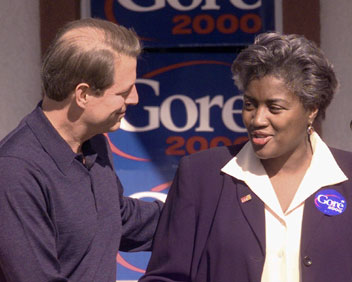
Donna Brazile, the new manager of Al Gore's presidential campaign, has a reputation as a tenacious political attack dog.
As Vice President Al Gore’s campaign workers get to know their new Nashville digs, the press is getting reacquainted with Gore’s new campaign manager, Donna Brazile. The former Dukakis operative was promoted as part of the veep’s effort to shake things up and inject new life into his lagging presidential campaign.
Gore campaign spokeswoman Kiki Moore was vague about Brazile’s day-to-day responsibilities. “The vice president wants to take the campaign in a certain direction and Donna fits in perfectly with what we are trying to do,” she said.
But according to Robert Borosage, a former campaign staffer for Jesse Jackson who heads the Campaign for America’s Future, Brazile has been called in to help the trains run on time. “The vice president’s schedule is completely out of sync with the campaign schedule. It will be up to Donna to work that whole thing out,” he said. Brazile has to get the campaign in gear and “energize the troops so that they go into Iowa prepared,” he said.
The pairing of Gore and Brazile is a contrast in styles, pitting Gore, the self-acknowledged “stiff,” against Brazile, who is loose, charismatic, chatty and vibrant. Gore speaks in cautious and measured tones; Brazile is driven and brash, given to speaking in a slew of four-letter words that do not stop in the presence of the press.
“I don’t know about him,” she said of her new boss, “but I feel opposites attract and together we can make good music, if he lets it happen.”
Known as a talented field operative and grass-roots organizer, the first black woman to head a major contender’s presidential campaign will not report to Gore directly but to forceful campaign chairman Tony Coehlo. Friends of Brazile like Borosage say she sought direct access to Gore. “She’s tough,” Borosage said. “I am sure one of the first things she asked [after being appointed] is if she could report directly to Gore.” But Gore turned her down.
Brazile said she has no problems reporting to Coehlo, and chastised members of the press corps for pushing the issue of the Gore campaign organizational chart. “Why is it men always want to know who you report to?” she said.
The question has drawn attention, however, because of lingering doubts about her “maturity” that date from her notorious 1988 comment about whose bed Barbara Bush sleeps in. She was working as a deputy field operator on Michael Dukakis’ presidential bid amid rumors that GOP nominee George Bush was having an affair with a woman named Jennifer Fitzgerald. The press was reluctant to publish the story. So she said, “The American people have every right to know if Barbara Bush will share that bed with him in the White House.”
Her remarks were a major embarrassment for the Dukakis campaign and Brazile was forced to resign. It may be for that reason that Gore decided to take full advantage of her organizational skills while distancing himself from her personally.
Oddly enough, the last time Gore ran for president, in 1987, Brazile made belittling remarks about him. Serving as director of field operations for Richard Gephardt’s presidential campaign, she said, “Gore just hasn’t captured their imagination. You don’t hear party chairmen going around saying ‘Gore, Gore, Gore.’”
It is still unclear whether in the Barbara Bush statement Brazile was following orders or acting on her own. Friends insist she made her comments only after discussing them with superiors. Others have doubts. They say she was acting on her own and cite this as evidence of her “immaturity.”
For her part, Brazile wishes the whole matter would go away. “That’s all in the past,” she said. “That was 10 years ago. I’ve come a long way from that. Let’s move on.”
Brazile is the third of nine children born to Lionel and Jean Brazile. Her father was a janitor and her mother a domestic worker. “We grew up poor,” she said, literally on the wrong side of the tracks. After graduating from Louisiana State University, Brazile took an offer from Coretta Scott King to help organize the 20th anniversary of the historic March on Washington. A year later, she joined Jesse Jackson’s 1984 presidential campaign as an advance person.
After being forced to leave the Dukakis campaign, Brazile called her mother and headed home to Kenner, La., near New Orleans. A Roman Catholic, she said she later did “penance” by spending nine months in a Washington homeless shelter with homeless advocate Mitch Snyder. She went on to run the successful campaign of Eleanor Holmes Norton for the District of Columbia’s at-large seat in Congress, and served with Norton as chief of staff before joining the Gore campaign.
Those who know her say she is more than qualified for her new assignment. Frank Watkins, communications director for Rep. Jesse Jackson, Jr., D-Ill., worked with her on Jesse Jackson Sr.’s initial presidential run. He pointed out that there is only so much she can do. “She’s not a doctor. She can’t fix what’s wrong with him. The candidate will have to do that himself,” he said.
Brazile belongs to an informal club of four black women who meet periodically in Washington to exchange political views and chat about strategy. One member of that club is Mignon Moore, Brazile’s closest friend and assistant for political affairs for President Clinton. Moore said she gave Brazile one short piece of advice: “Stay focused and do what you do best.”
What she does best, according to Bill Lynch Jr. of the Democratic National Committee, is grass-roots organizing and field operations. But, added Lynch, “That’s a misnomer, because I think Donna has got the complete package and can do anything in a political campaign.”
Keith Moore is a New York writer. More Keith Moore.
Senate Democrats heroically fund TSA
Democrats score the dumbest political victory of 2012
(Credit: Reuters/Frank Polich) On Tuesday, a Senate Appropriations Committee vote effectively highlighted everything that is stupid about politics.
The Transportation Security Administration, a universally loathed government agency, is facing a shortfall, despite its more than $8 billion budget. Instead of having a debate over what effective airport security might actually look like and how much should reasonably be spent on the honestly rare threat of commercial-air-travel-based terrorism, there was a debate over how best to come up with the money needed for all the radioactive naked picture machines and bomb-sniffing dogs. The Democrats suggested passing on the cost of ineffective, cumbersome and intrusive security theater to citizens, via higher fees on airfares. The Republicans, even more predictably, suggested cutting spending that directly helps poor people to ensure there is enough to spend on stopping imaginary future 9/11s.
Continue Reading Close
Alex Pareene writes about politics for Salon and is the author of "The Rude Guide to Mitt." Email him at apareene@salon.com and follow him on Twitter @pareene More Alex Pareene.
The Democratic Senate might just survive
A Senate map that looked bleak a year ago is now littered with surprise pick-up opportunities
Charles Schumer and Harry Reid (Credit: Reuters/Jonathan Ernst) The growing likelihood that Richard Lugar will lose next Tuesday’s Indiana Republican Senate primary is the latest in a string of unexpected developments that have bolstered Democrats chances of hanging on to the Senate.
As I wrote yesterday, Lugar’s conservative primary challenger, state Treasurer Richard Mourdock, lacks the incumbent’s broad cross-partisan appeal and is closely identified with Tea Party-flavored Republicanism. Democrats, meanwhile, are poised to nominate Joe Donnelly, a moderate third-term congressman who defied the odds to hold onto his seat in the GOP tide of 2010. Mourdock would still probably be the favorite over Donnelly in the fall, just because of Indiana’s red tint, but the seat would be in play – something that would never be the case with Lugar as the GOP nominee.
Continue Reading Close
Steve Kornacki writes about politics for Salon. Reach him by email at SKornacki@salon.com and follow him on Twitter @SteveKornacki More Steve Kornacki.
Dems desert the left
Why aren't Democratic candidates for Senate promoting liberal causes on their websites?
Victories in two Pennsylvania House districts over two conservative Democrats who voted against healthcare reform gave liberals something to cheer about this week. And they’re quite right to focus on primary elections: Nomination contests are really fights over who will control the political parties. And yet liberals appear to be missing some major opportunities to influence the next round of Democratic senators, just when they have the chance to do so. A look at the websites of the 10 Democratic candidates most likely to become U.S. senators reveals that few of them are interested in several of the issues that have been the hallmark of liberal activism and often frustration during the Obama years: marriage equality, a public option on healthcare, filibuster reform and civil liberties.
Continue Reading CloseJonathan Bernstein writes at a Plain Blog About Politics. Follow him at @jbplainblog More Jonathan Bernstein.
All for none and none for all
Forty years of culture wars and racial battles wrecked the country and the GOP – but it's not too late to change
(Credit: AP Photo/Gregory Bull) My March 4 post “What’s the matter with white people?” was Salon’s top story that week, and it got a lot of comments and online attention. I went on vacation a few days later, but I’ve wanted to address a few arguments, if belatedly.
I asked “What’s the matter with white people?” because my people are increasingly coming under fire from the right and the left. Republicans have begun to blame not the economy but “dependency” on government and rising rates of single parenthood for the economic troubles of the white working class. On the left, meanwhile, whites are dismissed as the backward base of the increasingly radical GOP, and working class whites, in particular, are derided as racists who won’t vote for Democrats because the party is now led by a black man (ignoring the fact that a larger share of working class whites voted for Barack Obama than for Caucasians John Kerry, Al Gore or Bill Clinton.)
Continue Reading CloseJoan Walsh is Salon's editor at large. More Joan Walsh.
The economic story Obama must tell
We need government investment to restore prosperity. The president needs to explain that in a way that makes sense
(Credit: AP Photo/Susan Walsh) Look at it this way: If the Wall Street banking crisis had taken place in 2007 instead of 2008, George W. Bush wouldn’t be able to leave home without being jeered. (As it is, he rarely leaves Texas.) Hardly anybody would buy the brand of tycoonomics GOP presidential candidates are selling. People would understand that save-the-millionaires tax cuts and deregulation had dramatically failed. President Obama would get more credit for pulling the economy out of a nose dive.
Alas, people have short attention spans and a weak understanding of abstract economic issues. You have to tell them a story. The failure of policymakers to do that has been driving progressive MVP Paul Krugman crazy. How can it be, he asks, that governments foreign and domestic are repeating the mistakes of the early 1930s — slashing government spending to reduce budget deficits, putting more people out of work, reducing demand, and inadvertently increasing deficits? Rinse and repeat.
Continue Reading CloseArkansas Times columnist Gene Lyons is a National Magazine Award winner and co-author of "The Hunting of the President" (St. Martin's Press, 2000). You can e-mail Lyons at eugenelyons2@yahoo.com. More Gene Lyons.
Page 1 of 165 in Democratic Party