
Healthcare Reform

Woe is HMO

Proponents of liability legislation argue that the only way to change managed care's behavior is to threaten it with lawsuits.

  • more
    • All Share Services

Woe is HMO

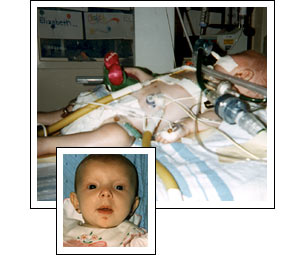
All of the pictures Glenn and Jamie Wooldridge have of their daughter, Elizabeth, are in one small photo album. It starts out, like most baby albums, with Jamie in the delivery room, proudly holding her new little girl; and continues with pictures of redheaded Elizabeth in her crib, playing with toys. But unlike most family photo collections, this one ends with just a few shots of the girl at 4 months old.

In these, Elizabeth is in a hospital bed, with tubes and machines connected to so many places on her 9-pound-11-ounce body that the weight of all the equipment looks like it could crush her frail chest and limbs. Stuck loose into the album is a newspaper clipping a paragraph or two long, celebrating Elizabeth’s short life and announcing her death on Oct. 8, 1995.

Four years later, Glenn Wooldridge points to a stack of documents — medical records, test results, doctors’ referrals — several inches thick, when he talks about what happened to her. Officially, she died of complications from cystic fibrosis, a devastating genetic disease currently affecting 30,000 adults and children in the United States. But her family, who lives in Rodeo, Calif., blames her death on their health maintenance organization’s medical group. The Wooldridges say that the medical group should have authorized a “sweat” test that could have detected the disease when it was first suspected.

The sweat test was requested by her physician to rule out cystic fibrosis, but was repeatedly turned down by her HMO’s medical group — until Elizabeth’s lungs collapsed a month before she died. “It was only a $125 test,” says Glenn Wooldridge, an iron worker who looks older than his 29 years. “If she had gotten the test would she still be alive? She would have at least had a chance, they could have done something about the weight gain, they could have put her on certain medications …”

It is still not clear that Elizabeth’s life could have been saved if she
had had the sweat test earlier. But Dr. Nancy Lewis, a specialist in
cystic fibrosis and Elizabeth’s pulmonologist at the time, believes that an
earlier diagnosis might have saved her life. “You have to realize that [in
the time it took for her to get the test authorized], she went from a baby
at home, to a baby in an
emergency room, to being admitted to the hospital, transferred to
the intensive care unit and going on life support,” she says. “I think if
this baby had been diagnosed, she would have been managed differently, she
would have been kept off the ventilator with a diagnosis of
cystic fibrosis. When babies have cystic fibrosis, the ventilator pops
holes in their lungs, and they can’t heal the holes in their lungs because
the ventilator keeps the holes going. In my experience, it’s always a grim
outcome. I don’t know if [Elizabeth] would have survived, but I would have
expected her to.” And the Wooldridges want some type of recourse for what they believe were the penny-pinching policies that valued money over their daughter’s health. But under federal law Glenn Wooldridge’s ability to sue his insurance company is limited because he is a private employee. He can’t sue for anything other than the cost of the care denied, which in this case is the cost of the test. Making things even more complicated for the Wooldridges is the fact that
the medical group is no longer in business and the HMO has merged with
another company.

“Anybody who wants to sue an HMO will tell you that it’s not about the money, it’s about proper care,” Wooldridge says.

Horror stories like the Wooldridges’ are well-known by now, and seem so horrendous that they almost sound the same, only with different names and different denied treatment options. There is the story of a child who had a brain tumor and was denied access to a specialist; the one about the person whose HMO only authorizes one colostomy bag per week, requiring her to clean it out after each use; and the one about the woman who needed a liver transplant and the HMO wouldn’t pay for it.

“Every day doctors see evidence of delays or alterations in the health plan that they have for their patients; they are frustrated; they are exasperated with it,” says Dr. Alan Baum, president of the Texas Medical Association.

It’s no secret that spending on medical services is under much tighter supervision than ever before. With the old fee-for-service system, one health policy expert says, the problem was over-treatment. The problem now with HMOs is undertreatment, she says, and either can kill you. Inevitably, there are going to be cases where cost-cutting measures have unfortunate and even tragic consequences. But these stories are generally not representative of the everyday care provided by HMOs.

“It happens every day, but generally it’s in subtle ways. Typically, it’s not that someone has terrific chest pain and you think that this person needs an arteriogram and it’s denied right on the face of it,” says Baum. “It’s more like well, maybe you need a consultant, or to try a change in medication, but that’s expensive, so how about this other medication instead?”

The right to sue an HMO for emotional distress and punitive damages has suddenly become one of the hottest political and legal issues in the United States, at the state, federal and judicial levels. Last week, the House passed legislation — the so-called Patients’ Bill of Rights — that among other things would give consumers that right. A similar bill passed by the Senate in July does not have the liability provision. The issue is now in the hands of a House-Senate conference, where the provision awaits its fate. Either way, both sides say, the state of health care in America will change drastically.

Proponents of HMO liability say it’s the crux of any health-care reform, because it will actually change the behavior of managed-care plans. Out of fear, these people argue, HMOs will stop thinking about saving a few bucks for a treatment, because they could later be faced with millions in the form of a lawsuit.

“I think it’s going to give patients the leverage they need to get more medically necessary treatment from HMOs that would otherwise be denied to save money,” says Jamie Court, director of Consumers for Quality Care, a patients’ rights advocacy group. “The point of this is to give patients a stick to use when they have to, but hopefully they won’t have to. But the threat of it will make them be more reasonable with them and their doctors.”

But will it?

“There’s no evidence that HMOs or physicians threatened by lawsuits necessarily improve their behavior in the right way,” says Walter Zelman, president of the California Association of Health Plans. “What doctors do, and HMOs are likely to do, is approve more procedures that maybe shouldn’t be done and that only aggravates the problem.”

What Zelman, representatives from other HMO associations and employers believe is that massive approvals of procedures will, of course, cost more money and that increase will be passed on to the consumer in the form of higher premiums. This, they say, will force even more people into the realm of the uninsured. According to a 1997 letter from the former head of the Congressional Budget Office, each 1-percent increase in the cost of premiums puts another 200,000 people on the street, insurance-wise. They also point out that a recent Census Bureau report says the number of uninsured in the United States is at the highest it has been in a decade.

- – - – - – - – - – - – - – - – - – - – -

Lawmakers say the answer to this dilemma lies deep in the heart of Texas. The Lone Star state is currently the issue’s legal guinea pig. Two years ago, Texans became the first residents who could sue in state courts for denied treatment. Thus far there have been only five lawsuits. However, the Texas reform has a crucial element — an external review process that both sides praise for resolving differences of opinion and keeping cases out of the courtroom. According to the Texas Department of Insurance, it has mediated 624 cases so far, deciding about half of them in favor of the patient and the other half for the HMO.

“I believe it has changed behavior. [The HMOs] are more consumer friendly and responsible to their patients,” says Texas state Sen. David Sibley, a Republican and author of the bill. “Sometimes HMOs talk about the hidden costs — what they mean is that they are giving patients what they should have gotten in the first place.” Sibley adds that the review process, which patients have to go through before they can sue, has had a big impact on this. Texas also had massive tort reform in 1995, which among other things placed a cap on punitive damage awards, a factor Sibley, and a spokesman for Gov. George W. Bush’s campaign, point to as the reason for its success thus far.

Texas is also an interesting case because of the largely bipartisan support HMO liability has garnered throughout the state, especially in comparison to the fractious partisan nature of the debate in the rest of the country. (At least up until last week’s House vote, in which 68 Republicans broke ranks and voted for the HMO liability law, reform has been supported mainly by Democrats.) Sibley is a conservative, anti-abortion evangelical Christian, and a Bush ally. Although Bush vetoed earlier health-care legislation in Texas, he let this version become law without signing it.

Even today, Bush remains evasive on the issue. A spokesman for his campaign would not say which patients’ rights legislation he supports, the one in the House or the Senate, but did offer this much: “He believes that people in federal plans should have protections similar to those in Texas. But he would not want anything passed in Washington to supersede the comprehensive reforms in Texas.”

Just how the reforms are playing out in Texas is, ironically, not that different a story if you ask Dr. Dave Morehead, president of Scott and White insurance company, a small health plan in Texas. Yes, HMOs are changing their behavior, Morehead says, and Scott and White is an example of that. But the results are not a good thing, both for the company and the consumer. “What my medical directors tell me is they feel the weight of the excess liability to the point that they hesitate to make any kind of coverage decision for the health plan which carries any delay at all,” he says. “If the doctor is not immediately available to discuss with them, or if for some reason it’s difficult to get that information, [the medical directors] will very likely authorize the procedure because there is liability risk in delaying that decision.”

What’s happening now is over-treatment, he says, and every procedure carries its own risk. Scott and White now do not require authorization for tests like the MRI. He says that costs have gone up, and although he can’t attribute it to the liability law, he believes it may have been a factor.

“Reasonable persons can be proponents of HMO liability and reasonable persons can be opponents, but neither of them can use the Texas experience as the basis of their conclusion. In Texas, the verdict is still out,” says Jerry Patterson, executive director of the Texas Association of Health Plans. He implies that the number of lawsuits will rise: The Texas law was challenged in court, and upheld only in September 1998, which has prevented a lot of suits from going forward.

But Dr. Alan Baum, president of the Texas Medical Association, says HMOs are finally facing what doctors — who can be sued for malpractice — have faced all along. “I agree that doctors sometimes over-treat because of the litigious society that we are in. Doctors are always trying to make decisions: ‘Do I need to order this test? Is it something that is truly indicated? I don’t know if they need it but if I don’t order it, I have exposed myself to litigation,’” Baum says. “But that has to do with if they are practicing in managed care or in private. Because of the environment that we’re living in, we’re all exposed to it. They are facing the same decisions that doctors not in that environment have had to face for years. Every day you have to make decisions that have potential liability for yourself or an HMO. If somebody makes a medical decision, our system says that someone should be accountable.”

Dr. Paul Handel, a urologist in private practice in Houston, says anecdotally there has been a difference. “What I’m hearing from doctors is they have had fewer problems getting approvals and a big part of that is the ability to sue. But it also has to do with the establishment of the independent review; I think it’s a godsend for the patient.” He says it has been difficult treating patients in the state of today’s managed care. He tells a joke one of his patients recently told him, which he thinks is indicative of a lot of people’s disgust with managed care. “You know how an HMO is like a hospital gown?” he asks, and then pauses. “You only think you’re covered.”

He then recites some stories of how some of his and his colleagues’ patients got stuck in HMO-authorization-denial hell. One person was diagnosed with cancer of the esophagus, and the HMO wouldn’t let the surgeon operate on her for two and a half months — all while the woman couldn’t swallow and was in pain. Another patient who had prostate cancer was in the middle of radiation treatment when he changed plans. The new one required him to change hospitals, to one 150 miles away.

A plant in a clay angel pot sits on the dining-room table in the Wooldridge family’s home about 25 miles northeast of San Francisco. Multicolored ceramic angels fill three shelves in the living room; and along the windowsill of the room of their eldest child, 7-year-old Aereanna, there are even more angels. Angels seem to guard almost every room in this white, blue-trimmed suburban home.

“After Elizabeth died, we told Aereanna that she would have a guardian angel watching over her; that’s where all the angels come from,” says Wooldridge. “We haven’t kept anything from her, she knows that her sister had it and it caused her to die.” Aereanna, a precocious second-grader, also has cystic fibrosis. (The couple also has another child, Zachary, who is 3 years old and recently had heart surgery.) And so, the Wooldridges’ struggle with their HMO continues. They say that every month they have to wait to get Aereanna’s prescription authorized. Just this past month, they say, it took a day and a half to get her pancreatic enzymes, which help her get nutrients from her food.

On the living-room floor is a machine a little larger than a computer printer, which was the source of a three-month struggle between the Wooldridges and their HMO’s medical group. It connects two tubes to a small, black vest that clips around Aereanna’s chest, and then vibrates, helping her to cough up the mucous that builds up in her lungs. She wears it for 10 minutes, twice a day.

In Aereanna’s stack of medical papers, the saga is documented: There’s the approval from the medical group for the $15,000 therapy vest, then a letter from it saying that it had approved the vest by mistake, that the couple’s coverage did not include such equipment. Then comes a final note admitting that the medical group had been wrong, that the Wooldridges did have that coverage, and granting Aereanna her vest.

“I am tired of fighting with my HMO,” Wooldridge says. “I don’t feel that we should have to put this many hours in, to get what is basically ours, because I pay a premium.”

Even Wooldridge will say that his family’s experience with its HMO’s medical group is somewhat of an anomaly; and although those in the managed-care industry acknowledge that the horror stories do occur, they say the frequency is greatly exaggerated. Compounding the problem is that unless it’s taken to court or the patients waive their privacy disclaimers, HMOs can’t legally tell their side of the story because of patient confidentiality laws. This may be part of the reason why Aereanna’s medical group didn’t return calls.

- – - – - – - – - – - – - – - – - – - – -

In California, where the Wooldridges live, Gov. Gray Davis recently signed legislation allowing residents who work for private employers — the majority of people in the state — to sue their health plans for emotional and punitive damages. That legislation will not go into effect until January 2001, assuming it withstands legal challenges.

But public employees have had that right all along. The experience of the state employees, who belong to a plan called California Public Employees Retirement System (CalPERS), played a large role in getting the recent legislation passed, according to the bill’s author, state Sen. Liz Figueroa, D-Fremont. There haven’t been very many lawsuits, she says, and premiums have not risen very much as a result of them.

“The opponents say, ‘Oh, it’s going to increase the cost.’; ‘Oh, a lot of people are going to become uninsured,’” she says. “Well, that’s just not true. The evidence shows that it’s not happening. The people who already have the right are just not doing it … I don’t believe that people will be sue-happy.” The threat of suits alone, Figueroa says, will be a major factor in getting HMOs to change their behavior.

The folks at CalPERS say lawsuits have not been an economic disaster for them. “We have had relatively few lawsuits, not enough to be a major problem,” says spokesman Bill Branch.

Like the Texas legislation, the new California law and both federal bills will require a review or arbitration process before most claims go to court. CalPERS has a variation on this as well. “We think one of the reasons [lawsuits have not been a problem] is that unlike [many] employers, we’ve long had an internal appeals process of our own. It is somewhat analogous to the independent review that is being widely proposed throughout the country.”

According to a 1998 report by the accounting firm Coopers and Lybrand, for the Henry J. Kaiser Family Foundation, there were 60 administrative appeals filed by CalPERS from 1991 to 1997 and only between 15 and 20 went to civil litigation. The report estimates that lawsuits increased premiums only between 3 and 13 cents per member per month. (CalPERS just raised its premiums by the largest amount in the past nine years. In the year 2000, they will increase by an average of 9.7 percent. The group says this increase is attributable to the rising costs of medicine such as prescription drugs.)

Not everyone sees things so rosily. “For them to claim that it’s not affecting them is disingenuous,” says Sen. Ray Haynes, R-Riverside. “What is affecting the cost of health care are these types of government mandates.” He says that more than rising prescription costs might be playing a part in increased premiums. “What else is causing it to go up? Was it paying $120 million to a DA’s [wife] — was that one of the factors, could it have been?”

Haynes is referring to the $116 million January verdict against Aetna, brought on by the widow of a assistant district attorney who died from stomach cancer. The widow, Teresa Goodrich, claimed that for two and a half years before her husband’s death, Aetna denied treatment. She sued for breach of contract and for shortening the life of her husband. The jury voted 10-2 in favor of Goodrich; it was the largest verdict ever against a health plan.

Haynes, like other critics, points to the human cost of increased premiums. “You are going to see millions of people lose their health insurance so a few can make a lot of money, and what is worse in the long run?” Haynes asks.

Before the Goodrich verdict, the largest in California, $89 million in damages, went to Nelene Fox’s family in 1993. At 38, Fox, a Temecula, Calif., woman, was diagnosed with breast cancer. Her insurance company, Health Net, would not authorize the treatment — a bone-marrow transplant — because it considered it experimental. She decided to go outside the network and raise the $200,000 for the treatment herself. She died four months after finishing the procedure, and also, before the verdict came down.

“Probably the worst part of the whole thing for her was going into the street, and having bake sales to raise the money because none of us had the money; it was humiliating to make her whole life public,” says her brother, attorney Mark Hiepler, who also represented her. “I can never prove that the delays and staying up 24 hours a day to raise the money [killed her]; I just proved that the denial was in bad faith. But it’s the emotional stress someone goes through when they’re fighting for their life and their health insurance. Many people have said that it’s easier to fight cancer than their health insurance.”

Subsequently, Hiepler has become one of the most prominent HMO liability lawyers in California. Despite these huge settlements, he doesn’t believe that a wave of lawsuits will crash onto the HMO industry.

However, the low number of lawsuits in the past, both in California and in Texas, may not be indicative of the future, especially if federal legislation or the Supreme Court essentially dismantles an old federal law, the Employee Retirement Income Security Act of 1974, known as ERISA, which has shielded HMOs from such lawsuits for the last 25 years. (The high court recently accepted a case, Pegram v. Herdrich, that delves into whether or not an HMO breached its duty to one of its patients. It will be looking at an appeals court’s interpretation of one of ERISA’s provisions, which requires HMOs to act as fiduciaries — in other words, in the interest of their patients. In this case, Cynthia Herdrich of Illinois went to the doctor complaining of abdominal pain; the doctor, Lori Pegram, found it was inflamed but informed Herdrich that she would have to wait eight days for an ultrasound. Her appendix burst while she was waiting.)

Indeed, the legal climate is definitely changing — some high-profile lawyers who have made their mark suing the tobacco industry are turning their attention toward HMOs. Just in the past week and a half, first steps have been taken to launch class-action suits against HMOs for not providing patients with health care. Two are against Aetna/US Healthcare and another one is against Humana Inc. Others are said to be in the works.

But not everybody thinks that any of this will help the situation, even if it does get HMOs to change their behavior marginally. “If you somehow put an HMO on the stand, everybody already hates them. They are like tobacco, and juries will hand out $100 million awards,” says Dr. Robert Hertzka, an anesthesiologist in San Diego and a member of the board of trustees of the California Medical Association. But he says that HMOs will simply adapt. “They will just decrease their number of services or raise the premiums to employers. We don’t think this concept of big-time lawsuits is a way to change behavior. The way to change behavior is to put decisions back into the hands of physicians.”

Whatever comes to pass, Geraldine Dallek, project director for Georgetown University’s Institute for Health Care Research and Policy, says it’s important to keep perspective on the issue.

“We are not talking about the evil empire,” Dallek says. “They have some things wrong with them, but they also have some things that improve care; it’s a mixed bag. But consumers don’t like someone telling them who they can or cannot see. Plans adopted policies with a sledgehammer, and made a lot of mistakes along the way. People became disenchanted. I really view these consumer protections as a way to rebuild trust and make managed care more consumer friendly.”

None of the proposed legislation — on the state or federal level — is retroactive, so the Wooldridges could never sue for what happened in the past. Nevertheless, they say that they have learned to work the current system, by spending time scrutinizing all decisions regarding their children’s health.

As for Aereanna, she is doing well; she’s not taking as much medication anymore, has to put on her therapy vest only twice a day instead of three times, and hasn’t been hospitalized for the last year. Overall, life for the Wooldridges has improved in recent months. But the HMO subject still gets under their skin. “Jamie spends so much time badgering them,” Wooldridge says. “It is not cost-effective for them to keep denying us.”

Dawn MacKeen covers health for Newsday.

Romney pal defends Obamacare

Sen. Roy Blunt supports part of the bill his ally Mitt Romney has pledged to fully repeal

  • more
    • All Share Services

Romney pal defends Obamacare(Credit: Reuters/ Jonathan Ernst)

Sen. Roy Blunt, R-Mo., gave a strong defense yesterday of a portion of the Affordable Care Act that allows children up to 26 years old to remain on their parents’ health insurance plans, breaking a bit from the GOP’s hard-line opposition to Obamacare.

Blunt endorsed Mitt Romney early on and led the campaign’s efforts to recruit Republican lawmakers during the GOP primary. But his comments in an interview on KTRS radio in St. Louis may give Boston some heartburn as it tries to convince conservative voters that Romney, who enacted the predecessor of Obamacare in Massachusetts, will actually repeal the healthcare law.

“It’s one of the things that I think should continue to be the case,” Blunt said of the “dependent coverage” provision, explaining that “it’s a way to get a significant number of the uninsured into an insurance group without much cost,” because young people are generally healthy.

Blunt noted that he even introduced a bill when he was in the House that would do exactly what the provision of the Affordable Care Act does now, saying, “I was for it then, and I’d be for it now.” “You’re breaking some news,” host McGraw Milhaven quipped.

While Blunt said he still favors repealing most of the health law, he would want to preserve a few sections, including the dependent coverage provision and the creation of high-risk pools for patients with preexisting conditions.

Romney has repeatedly vowed to fully repeal the Affordable Care Act, though he hasn’t spoken out specifically on the dependent coverage provision and he enacted a similar provision as governor. The provision is hugely popular, even though the overall law is not. And while Republican leaders supported the extension of coverage to 26-year-olds as recently as 2009, when it was included in the GOP’s healthcare alternative proposal, the GOP’s message today is that they’re for a complete repeal of the law, including the minimum coverage provision.

This got Sen. Scott Brown, R-Mass., in trouble after it was revealed that he takes advantage of Obamacare to make sure his daughter has insurance.

Continue Reading Close

Alex Seitz-Wald is Salon's political reporter. Email him at aseitz-wald@salon.com, and follow him on Twitter @aseitzwald.

“Birth control doesn’t matter”

A new survey reveals just how ignorant young people are about contraception and pregnancy

  • more
    • All Share Services

(Credit: restyler via Shutterstock)

When it comes to sex and reproduction, even the most mind-numbingly intuitive conclusions can be politicized or disbelieved. So they bear repeating and resubstantiation. Take this recent Guttmacher study on contraceptive knowledge. Surveying 1,800 men and women ages 18–29, the authors “found that the lower the level of contraceptive knowledge among young women, the greater the likelihood that they expected to have unprotected sex in the next three months, behavior that puts them at risk for an unplanned pregnancy.” In other words, access to factual information helps prevent risky behavior.

I’m holding myself back from saying “duh” here, but this still has to be reiterated at a time when abstinence-only education that doesn’t provide detailed information about contraceptive use, except occasionally to emphasize its limits, not only persists but recently got a federal stamp of approval. As an Advocates for Youth report on the impact of abstinence-only education noted, “Proponents of abstinence-only programs believe that providing information about the health benefits of condoms or contraception contradicts their message of abstinence-only and undermines its impact. As such, abstinence-only programs provide no information about contraception beyond failure rates.” That’s how you get terrifying statistics like this one from the Guttmacher report: In the survey, “60 percent underestimated the effectiveness of oral contraceptives and 40 percent held the fatalistic view that using birth control does not matter.” Overall, “more than half of young men and a quarter of young women received low scores on contraceptive knowledge.” It’s also how you get figures like the one from the CDC that found that 31.4 percent of pregnant teens didn’t use contraception because they “thought they could not get pregnant at the time.”

There are two reasons to be optimistic that some dent can be made in these depressing figures, and they both have to do with provisions of the Affordable Care Act. Much has been made of the mandate that insurance policies cover all FDA-approved contraceptive methods, but there’s another aspect that’s been relatively overlooked: the fact that the same provision includes free education and counseling about sex and contraception, at least for the insured. The second reason for optimism is that the mandate will make it far easier for women to get longer-acting and more effective forms of contraception like the IUD — which are also more expensive and which studies have shown women would be interested in if they could afford them. Incidentally, the recent Guttmacher study found that women who were using long-acting or regular hormonal contraception tended to score higher on overall knowledge.

It will be awhile before we know if these changes will move the needle on the nation’s unparalleled rate of unintended pregnancy. The women’s health provisions only go into effect for new plans in August 2012, and older plans will be initially grandfathered and eventually phased out. And of course, there’s another big fat if – whether the Supreme Court overturns all or part of the Affordable Care Act. The Obama campaign and its allies are keen to point out how such a move — or, perhaps, a legislative repeal down the line — will hurt women above all. The Center for American Progress recently released a report on “Women and Obamacare” (the campaign having officially embraced the derisively intended term). It declares Obamacare “the greatest legislative advancement for women’s health in a generation,” which may be true for reasons more depressing than inspiring: There have been very few advancements partly because there has been so much political defense played.

In addition to the reproductive health benefits, the report points to preventive care recommendations for which cost-sharing has already been cut: mammograms, pap smears, prenatal care and so on. According to the report, “close to 9 million women will gain coverage for maternity care in the individual market starting in 2014,” currently not covered in 78 percent of plans sold on the individual market. It notes that women are more frequent users of healthcare services than men, that they’re likelier to make the household decisions on healthcare and that they’re more vulnerable to losing coverage because they’re likelier to be listed as dependents on a partner’s plan. The Affordable Care Act also makes it illegal to engage in “gender rating” – charging women $1 billion more than men on the individual market – and bans states from discriminating on the basis of gender identity in their insurance exchanges.

The report does acknowledge two ways in which Obamacare falls short for women who were “left out of the law — undocumented and recent immigrant women and women who need abortion services.” It claims that “political compromises on abortion coverage were necessary to ensure passage of the Affordable Care Act” – still a bitter loss to reproductive rights groups, who memorably described women as having been “thrown under the bus” by Democrats – “but the work to obtain abortion coverage for all women continues.” The last part is particularly debatable, at least when it comes to any momentum on the funding issue from national Democrats, while Republicans in the states and federally have spent considerable energy trying to limit abortion coverage on even private insurance plans.

Still, if the Affordable Care Act is allowed to stand, the magnitude of having an actual, proactive reproductive health access policy shouldn’t be underplayed. Maybe we’ll get closer to a saner republic where hearing “birth control doesn’t matter” from people who don’t want to get pregnant is a quaint memory.

Continue Reading Close
Irin Carmon

Irin Carmon is a staff writer for Salon. Follow her on Twitter at @irincarmon or email her at icarmon@salon.com.

Healthcare’s foreign invasion

Obama risked a trade war with China about manufacturing -- so why isn't he outraged about medical jobs?

  • more
    • All Share Services

Healthcare's foreign invasion (Credit: gualtiero boffi via Shutterstock/Salon)
This article was adapted from the new book, "Insourced", available May 8 from Dartmouth College Press.

Approximately 15 percent of all healthcare workers and 25 percent of all physicians in the United States were born and educated elsewhere. This means that 1.5 million healthcare jobs are “insourced,” occupied by foreign-born, foreign-trained workers brought into the United States on special visas earmarked for healthcare jobs. This number is 50 percent greater than the total number of jobs in the U.S. auto-manufacturing industry. It’s amazing to consider that in 2008 and 2009, the auto industry, which makes up just 3.6 percent of the U.S. economy, received a $97 billion bailout. If we estimate that each of these 1.5 million insourced healthcare jobs has an average wage of $60,000, that’s $90 billion a year in wages going to people brought into the United States to work rather than training Americans to do the same jobs.

The healthcare industry makes up 16 percent of our economy. Yet even in these days of close to 10 percent unemployment, we do not invest enough money in our young people to train them for jobs in healthcare — an already understaffed industry that will have to serve an additional 32 million people once the provisions of the 2010 health-reform law take full effect. Instead, when faced with pressure from hospitals and nursing homes for more healthcare workers, the federal government grants visas to import nurses, physicians, pharmacists, physical therapists, and many other types of healthcare workers from countries that can ill afford to lose them.

In some U.S. industries, the outcome of globalization is positive or neutral. Take the sugar industry. Due to lower labor and land costs and better weather conditions, it’s far cheaper to grow sugar cane in the Caribbean than sugar beets in North Dakota. As import taxes fall, global transportation improves, and the number of sugar beet farms in the United States declines, more Americans are sweetening their cereal with sugar from Jamaican sugar cane. Americans save money buying cheaper sugar; the economy of the poorer sugar-growing countries improves, lifting thousands of people out of poverty; and the few displaced American sugar beet farmers generally find other work. But sugar is not a strategic commodity. If CARICOM, the Caribbean Community, were to halt sugar exports to the United States, we would experience no crisis. Sugar is not essential to our diet or life, and we have plenty of substitutes, from honey and corn syrup to NutraSweet. If necessary, within a year we could again be producing sugar in the United States.

The U.S. healthcare industry is 200 times larger than the U.S. tire-manufacturing industry, yet President Obama risked a trade war with China, our biggest trade partner, over tires. He was understandably trying to protect well-paying manufacturing jobs for American workers. Yet each year, we bring thousands of nurses from China to work in even better-paying jobs rather than train young people in this country to become nurses. The irony is that the economic costs of “insourcing” healthcare workers, including the loss of jobs no longer available to Americans, are far greater than the costs when we import Chinese tires. In 2003 the Commission on Graduates of Foreign Nursing Schools (CGFNS), a U.S.-based nongovernmental organization that administers the U.S. nursing licensing exam for foreign-trained nurses, opened a testing center in Beijing. The opening of this center initiated a “mushrooming” of new nursing schools in China and led to credible predictions that China will soon surpass the Philippines as the number one source of foreign-trained nurses imported to the United States.

Given the publicity and furor over the loss of manufacturing jobs, the lack of protest over healthcare-worker insourcing is surprising. Congress passed legislation and President George W. Bush signed a law in 2007 to protect the American sock industry from the rival Honduran sock industry. Yes, that’s right: socks. Protecting a few hundred $15-an-hour sock-manufacturing jobs based solely in the small town of Fort Payne, Ala., was worth acting on. Yet insourcing hundreds of thousands of $60-an-hour healthcare jobs has prompted no such similarly high-level response from our leaders.

Instead, on a regular basis, Congress approves and presidents from both political parties sign legislation to enable the legal entry of an ever-increasing number of foreign healthcare workers. Each year, about 20,000 new healthcare-specific visas are issued for these workers.

The United States has traditionally not allowed strategic industries to be outsourced. That’s why the U.S. steel industry and the U.S. car industry have received bailout after bailout. Access to enough steel and automobiles is essential to our economy; without a sufficient supply of each, our economy would be severely damaged. It’s time we acknowledged that the health of the population is just as important as steel and autos in keeping our economy strong. Healthcare is too important to risk continuing to insource it.

It’s not just a matter of protecting and expanding jobs for American workers. Every year, thousands of Americans die, and the health of thousands more is compromised, because of the shortage of healthcare workers in every one of the healthcare professions.

On the surface, insourcing may appear to be a harmless or even win-win solution to the country’s healthcare-worker shortage. The hospital receives a much-needed worker, and the worker escapes life in a struggling country for a better life here. But we should be training more people in this country to work in those professions, especially people from poor and minority communities. Rather than investing in our own people and communities, however, the U.S. government has decided to take the best and brightest workers from struggling countries.

Many foreign-trained healthcare workers, no matter how smart, are not adequately prepared for practice in the fast-paced, high-tech world of U.S. medicine. Whether in operating rooms, hospital wards, or nursing homes, inadequately qualified and poorly oriented foreign healthcare workers endanger the lives of their patients, as well as the lives and careers of their American-trained colleagues.

But the main reason for this country’s rise in unnecessary deaths and delayed care is understaffing — a result of the failure to train and place enough healthcare workers, especially in rural and underserved communities. Americans who live in rural areas make fewer visits to healthcare providers and are less likely to receive preventive care. The infant-mortality rate for African-Americans is twice that for the average American; Latinos are twice as likely as white Americans to die from diabetes. These health disparities are due in large part to a lack of healthcare workers, especially primary-care workers, in their communities. The quick fix has been importing foreign healthcare workers for these unfilled positions. Unfortunately, once these workers fulfill their initial contracts, most move to communities without healthcare-worker shortages; in fact, foreign-trained healthcare workers are more likely to practice in the well-served, major metropolitan areas than their American-trained counterparts.

Even if good foreign-trained healthcare workers were here in numbers adequate to meet our needs, the U.S. healthcare system is about encounter a tidal wave of demand as 78 million baby boomers approach their 60s. Older people make, on average, six visits to a healthcare provider a year, compared with two visits per year for people under 60. The healthcare workforce is aging, too: More than 50 percent of practicing healthcare workers are eligible to retire during the next 10 years, which will leave us with fewer workers to treat more and sicker patients.

In the eyes of employers, of course, insourcing healthcare workers appears to offer many benefits. Most doctors and nurses in developing countries earn a fraction of what American doctors and nurses earn: A Caribbean nurse makes around $1,000 a month; an Ethiopian physician, about $100 a month. Not only are many foreign-trained healthcare workers accustomed to lower salaries and quality of life, but they also carry little or no education debt, while their American-trained colleagues typically graduate with five- and six-figure debt burdens. With average student debt burdens of $155,00011 for newly graduated physicians and $30,375 for nurses, American-trained health workers require a higher salary just to help pay for their education. Trained in a much more hierarchical environment, foreign workers are much less likely to unionize, or even express dissatisfaction with their work. As the percentage of imported healthcare workers increases, their attitudes toward salary and terms of employment undermine the bargaining power of U.S. workers, and even affect the important feedback loop between employees and management.

Polls indicate that 70 to 80 percent of Americans want to reduce the rate of immigration into the United States. Yet the American public is not aware of our policy of using healthcare-worker-specific visas to solve the healthcare-worker shortage.

Some legislators who publicly support stabilizing immigration consistently vote to increase the number of healthcare-worker-specific visas granted each year. It’s not that American citizens don’t want to become healthcare workers and fill these jobs. This distinction is critical, because every industry that has brought in foreign workers has argued that American workers won’t do the work for the prevailing wage, or won’t do the work no matter how high the pay is. In the healthcare industry, this argument does not apply. U.S. citizens want the jobs. They just can’t access the training. The United States does not have enough positions in health-professional schools to meet industry demands.

The tens of thousands of qualified nursing school and medical school applicants who are denied entry to school each year permanently lose out on their chosen careers, work that is consistently ranked in the top tier of salaries, with excellent benefits and almost guaranteed job security. This loss of career opportunity is even greater for rural and minority young people, who are grossly underrepresented in the higher-level health professions, such as physicians and nurses, and overrepresented in the lower-level professions, such as technicians and home health assistants. Something is wrong when so many young Americans are forced to pursue other, lower-paying careers at a time when we desperately need more healthcare providers. In exchange we get foreign healthcare workers who are less well trained (they consistently score lower on licensing exams than U.S.-trained healthcare workers) and far less culturally competent than native-born Americans.

The most tragic and most preventable effect of our hiring so many healthcare workers from other countries is the unnecessary deaths of hundreds of thousands of men, women and children in developing countries. The World Health Organization (WHO) estimates that each year more than 10 million people die needlessly, from easily treatable maladies such as diarrhea, pneumonia, malaria, tuberculosis, vaccine-preventable diseases, and complications of childbirth. The WHO Global Health Workforce Alliance estimates that there are a billion people alive today who will never see a health worker in their lives. In Ethiopia, one in 10 Ethiopian children will die before his or her fifth birthday — yet there are more Ethiopian physicians in the Chicago area than in all of Ethiopia, which, with 80 million people, is the second most populous country in Africa. As their most skilled nurses emigrate to work in U.S. nursing homes, middle-income countries such as Jamaica and Trinidad have nurse-vacancy rates of 60 percent or higher.

Throughout the developing world, nurses, pharmacists, physical therapists, and many other types of healthcare workers are being approached and offered 10 times their salaries to practice in modern U.S. healthcare facilities with state-of-the-art technologies. Even the most dedicated, socially conscious worker would be tempted by such an offer. A colleague of mine relayed a conversation he’d had with the head of the Nursing Council of Kenya, who told him about the damage the exodus of senior nurses was doing to her country’s healthcare system. In the next breath, she confessed that the next time he visited Kenya, she might not be there. She was thinking about emigrating herself.

Our unofficial policy of relying on the world’s poorest countries to pay for the training of workers whom we then entice and bring to this country is devastating healthcare systems around the world. The loss to a developing country when a single physician, representing what may be a significant portion of their total number of physicians, emigrates is far greater than our gain. Our failure to provide education for our own citizens and to better plan for healthcare staffing and distribution does not justify poaching nurses and physicians from the countries that can least afford to lose them. How many additional deaths, how much more needless disability and suffering, will we allow this misguided policy to cause?

And consider American competitiveness. Certain industries are vital to U.S. global leadership. Recognizing their importance, we protect those industries. We don’t allow them to move overseas and make the United States vulnerable to the actions of other countries. Poor farmers in the developing world can certainly grow food staples more cheaply than American farmers do. But because of the strategic importance of the U.S. food supply, we subsidize some basic food crops, such as corn and soybeans.

And yet we are overreliant on foreign healthcare workers to meet our most basic health needs. This is particularly dangerous because many countries, almost completely drained of healthcare workers and tired of subsidizing the U.S. healthcare system, are trying to slam the door shut for emigrating healthcare workers. Meantime, of the world’s wealthiest nations, the United States has the worst health outcomes, with lower life expectancies and higher rates of deaths from preventable causes. In infant mortality, for instance, we rank 27th, behind Poland and Hungary. Our disability levels are higher than in most former Soviet countries.

If the United States is to remain competitive in the global economy, we need a healthy workforce. In order to achieve that, we need a healthcare workforce made up of adequate numbers of properly trained physicians, nurses, pharmacists, community-health workers, and other healthcare providers.

Continue Reading Close

Dr. Kate Tulenko is a physician with degrees from Harvard University, Cambridge University and the Johns Hopkins School of Medicine. The former coordinator of the World Bank's Africa Health Workforce Program, she currently serves as director of clinical services for a global health nonprofit.

Obama destroys Constitution with mild Supreme Court criticism

Conservatives and moderates declare SCOTUS-bashing to be "intimidation"

  • more
    • All Share Services

Obama destroys Constitution with mild Supreme Court criticism (Credit: AP)

Ruth Marcus is unsettled. Maybe even queasy. There is probably some light nausea. What has her worried for the future of the nation, today? President Obama’s shameful, horrific, vicious attacks on those nice people in the Supreme Court.

Obama said that the court overturning Congress’ healthcare reform law would be a textbook example of “judicial activism” as “conservative commentators” define it: “that an unelected group of people would somehow overturn a duly constituted and passed law.” And hey, that seems like an eminently defensible and not particularly unsettling point! Conservatives made “judicial activism” into a talking point and rallying cry and defined it vaguely enough to encompass judges striking down basically any law or statute.

Marcus, though, is stopped cold.

And yet, Obama’s assault on “an unelected group of people” stopped me cold. Because, as the former constitutional law professor certainly understands, it is the essence of our governmental system to vest in the court the ultimate power to decide the meaning of the constitution. Even if, as the president said, it means overturning “a duly constituted and passed law.”

Judicial review, as a former constitutional law professor certainly understands, is not in the Constitution — an unelected activist judge made it up! — and the founders themselves disagreed on the wisdom of the principle. (They tended, in fact, to decide whether or not they liked judicial review based on whether or not the judges ruled in a way that they approved of.) The history of the Supreme Court is replete with nakedly political and mostly conservative rulings until very recently, when we had a brief period of liberal-leaning rulings from a marginally more diverse group followed by a return to status quo conservatism.

As long as the Supreme Court has been making awful and indefensible rulings based on ideology or racism, presidents and politicians have been criticizing the court. Abraham Lincoln attacked the Supreme Court in his first inaugural address, in a passage that conservatives love to quote when they’re attacking “activist judges.”

At the same time the candid citizen must confess that if the policy of the government, upon vital questions, affecting the whole people, is to be irrevocably fixed by decisions of the Supreme Court, the instant they are made, in ordinary litigation between parties, in personal actions, the people will have ceased, to be their own rulers, having, to that extent, practically resigned their government, into the hands of that eminent tribunal.

I am stopped cold and unsettled!

Marcus, hilariously enough, supports the healthcare law and the mandate — she is the world’s most sensitive milquetoast moderate liberal newspaper columnist, after all — which theoretically means she thinks it’s constitutional, which would mean that declaring it unconstitutional should maybe upset her more than criticizing the court for being political, but on the other hand those judges seem very smart and our entire system of government could collapse if we aren’t all super polite to one another and constantly deferential to authority.

I would lament a ruling striking down the individual mandate, but I would not denounce it as conservative justices run amok. Listening to the arguments and reading the transcript, the justices struck me as a group wrestling with a legitimate, even difficult, constitutional question. For the president to imply that the only explanation for a constitutional conclusion contrary to his own would be out-of-control conservative justices does the court a disservice.

Yes, I could tell they were very seriously wrestling with a difficult constitutional question when Scalia began joking around about broccoli mandates and the legendary “Cornhusker Kickback.”

I’m not sure what more the Supreme Court could do before moderates like Ruth Marcus finally acknowledged that it’s a partisan body with a right-wing majority. If Bush v. Gore didn’t do it, maybe nothing could. But as a partisan body it is open to partisan attacks, and our fragile democracy will not descend into anarchy if people think as poorly of the Court as they currently do of Congress.

Of course, the Republican talking point is that the president is attempting to bully the Court into ruling the way he wants. (Because if they strike down the law, he’ll … yell at them during the State of the Union again? No one seriously predicts an arrest warrant for Chief Justice Roberts here.) Mitch McConnell: “This president’s attempt to intimidate the Supreme Court falls well beyond distasteful politics; it demonstrates a fundamental lack of respect for our system of checks and balances.” Lamar Smith: “What is unprecedented is for the president of the United States trying to intimidate the Supreme Court.” Mike Johanns: “”What President Obama is doing here isn’t right. It is threatening, it is intimidating.” (Did you notice how everyone used the word “intimidate”? That’s because they got their language from a memo.)

The only time, besides Lincoln’s suspension of habeas corpus, that any president has seriously threatened the independence of the Supreme Court was when Franklin Roosevelt tried to amend the law to give the president the power to appoint more justices. And Roosevelt, frankly, was right on the merits of his proposal. The court is completely unaccountable and ridiculously powerful, it always has been, and pointing that out does not a constitutional crisis provoke.

Continue Reading Close
Alex Pareene

Alex Pareene writes about politics for Salon and is the author of "The Rude Guide to Mitt." Email him at apareene@salon.com and follow him on Twitter @pareene

My son’s healthcare battle

My 14-year-old has brain cancer. Without Obamacare, he would have already exceeded his lifetime insurance limit

  • more
    • All Share Services

My son's healthcare battleSupporters of healthcare reform rally in front of the Supreme Court on the final day of arguments regarding the healthcare law signed by President Obama on March 28, 2012. (Credit: AP Photo/Charles Dharapak)
This originally appeared on Janine Urbaniak's Open Salon blog. It was written in a response to a call for essays about people's personal experiences with the Affordable Care Act. Have an Obamacare story of your own? Blog about it on Open Salon.

Mason is my 14-year-old son, who is adorable and funny, and happens to have a very stubborn and large brain tumor. We discovered the tumor four years ago, and we have been monitoring and treating it with the help of some of the finest doctors around. Mason has lived a somewhat “normal” life, despite frequent MRIs and even chemotherapy. He did his homework and hung out with friends until the fall of 2010 when his headaches became debilitating. Scans revealed that Mason’s tumor had grown for the first time since we had discovered it. Then days before we were scheduled to meet with the neurosurgeon to discuss a surgery we had tried to avoid, Mason had a massive cerebral hemorrhage.

My boy spent 65 days in the pediatric intensive care unit (PICU) at one of Northern California’s best hospitals; during that time he underwent two brain surgeries, along with operations to insert a tracheostomy and a feeding tube. We stayed with him 24 hours a day, my husband, Alan, and I, his grandparents, and his 16-year-old brother, watching his oxygen levels on a screen, tracking his heart rate in beats per minute. The doctors kept him sedated, but every morning they turned down the propofol (Michael Jackson’s drug of choice) when the neurosurgeons came to do their examination. Three to five doctors circled Mason’s bed, one of them yelled his name into his ear. When he didn’t wake up right away, they apologetically pinched him and yelled louder.

When I was alone with Mason I put a white earbud into his ear and tuned my iPod to a song I knew he liked, “Airplanes” by B.O.B. I said it was time to wake up. “You need to come back, now,” I told him in my firm mommy voice.

During our first three weeks of hospitalization Mason racked up $1.1 million in medical bills. I worried about butting up against the $5 million lifetime limit on Mason’s health insurance policy. We had a good policy with a good company.  We always paid our premiums on time and in full. But Mason wasn’t getting out of the hospital at any time soon, and there were months of rehab ahead. My then 13-year-old son would have reached his lifetime limit of health insurance had such limits not been eliminated by Obamacare on April 1, 2011. That date felt like a birthday or anniversary, something to be celebrated, when it finally arrived and we weren’t yet dropped by our health insurance company.

After two months in the PICU, we moved to a sunny room on one of the hospital’s regular floors. Our boy had just regained consciousness, though he still couldn’t talk or move his arms and legs. When the neurosurgeons came for their daily exam, we cheered when Mason managed a half-mast thumbs up. It was a huge victory.

As we celebrated our first day out of the pediatric ICU, Polly, the hospital discharge planner, introduced herself. Her job was to get the necessary approvals from our insurance company and make sure every moment of our stay was covered. This meant that she needed us to be ready to leave at any time. We needed a plan. She talked about Mason’s options for rehabilitation facilities. I soon realized that it would be challenging finding a place for a 6 foot tall 13year-old with a neurological injury. I scoured the Internet on my laptop for options.

A few days later, Polly stopped by to let me know that our insurance company representative had told her that Mason no longer needed hospitalization. Someone (she wasn’t naming names but they were clearly not a part of our medical team) suggested that we send our boy to an “interim” facility in a rundown city 40 miles away from our hospital and about 60 miles away from our home. I looked at Mason, who was enjoying his lunch through a feeding tube in his abdomen and breathing through another tube attached to a ventilator. I reminded her that Mason needed to be where he had access to neurosurgeons for emergencies. She smiled blankly and repeated something about medical necessity and pre-authorization. It was out of her hands.

Mason bought us a reprieve with a high temperature and a series of seizures.  It started when his eyes fluttered from left to right, then his body stiffened. I rang the emergency button and the nurse ran for the appropriate drug. I held Mason’s hand and told him we were riding a big wave. It was pulling us under but we would always emerge. It would pass. I kept my voice low and even.

When my husband arrived later that day, I told him that at least they were not going to kick us out of the hospital now. I was aware my thinking had taken on a new and undesirable twist.

I avoided Polly. If I saw her at the nurse’s station, I ducked back into Mason’s room and locked myself in the bathroom. If she called, I let her leave a message. I spent all of my time caring for my child. Did the nurse wash her hands when she came into the room? Had Mason received his 3 p.m. meds? It’s not that I wanted to spend any extra time in the hospital, it was just that Mason was still so fragile and we had nowhere to go yet.

The insurance company appointed one of their staff nurses to support us through our medical crisis. I believe she was a compassionate and concerned human being, but I never trusted her. I imagined that her notes would go into Mason’s file for the utilization department to examine and find reasons why they should cut back on his care, or lose him from their roles entirely. Any time she called, I heard the voice of Sgt. Joe Friday from Dragnet reminding me, “Anything you say can and will be used against you.”

Several people mentioned that TIRR in Houston was one of the best neuro-rehabilitation facilities in the U.S.  Footage of wounded Rep. Gabrielle Giffords arriving at TIRR was airing on every news channel. I don’t believe in coincidences, especially when thousands of people were praying for us. I called to see if TIRR was a part of our health insurance network. It was. It turned out that TIRR had expertise working with teenagers and there was excellent neurosurgical care available less than a mile away at Texas Children’s Hospital. It seemed like this was meant to be until Polly burst into our hospital room and told us that we couldn’t go. Though the insurance company approved the rehabilitation, they refused to pay for the air ambulance. We dipped into our savings, grateful that we could, and chartered our first airplane; this one came with a crew of paramedics.

The rehab doctors weaned Mason off of pain medication and fitted him for a wheelchair. He was out of bed every morning and dressed in sweat pants and a T-shirt. He began occupational, physical and speech therapy, though in the early days he often nodded off halfway through a session. A neuropsychologist said Mason’s prognosis was good. The healthy brain tissue had not been harmed by the hemorrhage. It was just a matter of getting the wiring back online in Mason’s brain, retraining his muscles and building his strength.

The insurance company rationed out Mason’s rehab approvals two weeks at a time. To meet their standards, Mason had to strike the balance between needing ongoing therapy and showing continued progress. If he stopped getting better, the insurance company would stop paying for his therapy, which presents a problem because brain injury patients typically hit plateaus in their recovery. I prayed daily for the faceless insurance company doctors who parsed out Mason’s approvals, wishing them insight and compassion.

A rehab hospital is not the place to visit if you want to pretend that awful things can’t happen to blameless people. In addition to stroke victims of all ages, there was a 30-year-old woman who was rear-ended at high speed on an interstate highway. Her mother brought her 2-month-old baby to visit whenever she could, though the young woman stared ahead her eyes not seeming to focus. There was a naval officer who suffered oxygen deprivation due to an illness he suffered on a ship somewhere in the Pacific. His mother brought me strawberries when she came to visit one Saturday. Then there were two other teenage boys, like Mason, with different varieties of brain tumors. One didn’t survive his stay, though I’m not sure what happened. The other walked out of the rehab to the cheers of his therapists and all the rest of us.

We never saw congresswoman Giffords, though I found the presence of the Secret Service reassuring. Nancy Pelosi toured the gym one afternoon when Mason was having physical therapy. I introduced myself. She smiled and complimented my beautiful boy who was walking in a harness mechanism. I meant to thank her for the healthcare bill, but it was too disorienting speaking to someone I usually watch on CNN. John Boehner didn’t stop by, maybe it was too much, seeing all these folks flaunting their preexisting conditions, exceeding their lifetime insurance limits with such brazen determination to pull themselves upright again.

P.S. Mason is back in school, finishing 8th grade. He is walking, talking and working out at the gym three times a week. He received an A- on his paper on “Of Mice and Men.”

Continue Reading Close

Janine is a San Francisco Bay Area writer. She is currently working on a collection of essays about surviving her son's brain tumor and the odd reality that comes with a diagnosis of childhood cancer.

Page 1 of 176 in Healthcare Reform