
Books
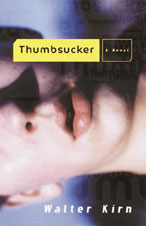
“Thumbsucker” by Walter Kirn
A sworn enemy of novelistic pain relief takes a jittery poke at American kitsch and credulousness.
Not many American writers any longer know how to mix up a nice sour cocktail the way they used to. Novels these days are more the sort of drinks you sip by the pool: heavy on the fruit juice and syrup. But in “Thumbsucker,” Walter Kirn serves a strong glassful of bitters and wry.
“Thumbsucker” might be called a coming-of-age story, but it is not, thank God, at much risk of becoming a candidate for Oprah’s Book Club. Unlike the narrators of standard-issue tales of adolescent angst and self-loathing, Kirn’s downy-cheeked hero never outgrows his awkwardness, solipsism and ingrown strangeness. Instead, he nurtures them tenderly, like exotic pets in a secret terrarium.
And Justin Cobb’s neuroses are more exotic than most. He is, as his dentist calls him, “the King Kong of oral obsessives,” a teenager who half-involuntarily still sucks his thumb. “It was the one thing I’d always done,” he explains. “Even breathing did not go back to the womb. Being part of a circle of shoulder, arm, hand, mouth, connected me to myself.” When Justin kicks this habit — if only temporarily — his fixation finds other outlets: cigarettes, alcohol, pills, the school debate team (“an experiment in concentrating on what came out of my mouth instead of what went into it”), fly-fishing.
The circularity of Justin’s thumb and mouth and arm reflects the circularity of “Thumbsucker” itself. This is a book that rejects the idea of growing up, of progress, of the transforming power of therapy and family bonding — all the old American verities. As a book critic for New York magazine, Kirn is a sworn enemy of the anodyne, and in his own fiction he puts his money where his mouth is. The Cobb family as he portrays it manages to be both sympathetic and pathetic, each member with his or her own hoard of tics and eccentricities to match Justin’s.
But Kirn’s most memorable characters are his bit players. Structurally, “Thumbsucker” is an old-fashioned episodic novel. Like “Huckleberry Finn” (an even darker and more pessimistic book), it relates a young man’s journey among a ragged job lot of charlatans and hucksters, each offering the hero his own dubious wisdom. In place of the Duke and the King, Kirn offers a sexually frustrated debate coach (“You can’t just bob and weave your way through life. Fakes get found out. At bottom, the world is fair”), a dishonest gas-station owner (“Success is like sailing: sit back and catch the wind”) and, best of all, Justin’s oily and slightly sinister dentist, Perry Lyman (“The psyche is formed in the bassinet, the stroller. A cat drops a chewed mouse inside your crib and at seventeen you’re a hand-washing fanatic”).
“Thumbsucker” is set in Minnesota in the dreariest days of the Reagan era, and its period details are perfect. (An acid-dropping, nihilistic attendant at the gas station where Justin works wears “one of those T-shirts that show the anatomy of the human body: all the muscles, bones, and organs in their actual colors.”) And as in “Huckleberry Finn,” the book’s humor redeems its mouth-puckering sourness. The last chapters — in which the Cobb family converts to Mormonism, which Kirn portrays as a kind of exaggerated version of American kitsch and credulousness — are especially Twainian. Justin goes on a church-sponsored trip to the “Garden of Eden” (in Missouri) and considers burning the place down.
Like Justin Cobb himself, Kirn’s novel is jittery, unsettled, wired with hyperactive energy. And like all interesting adolescents, it’s capable of melancholy seriousness and manic humor, often in the very same thought.
Adam Goodheart is a columnist for Civilization magazine and a member of the editorial board of the American Scholar. He lives in Washington. More Adam Goodheart.
“The Aleppo Codex”: The bizarre history of a precious book
A reporter traces the shadowy fate of the definitive version of the Hebrew Bible
Matti Friedman An ancient and priceless book, a murky history of evasions and coverups, an underground of sinister and possibly violent dealers, a former spy who drops tantalizing hints and a wily 84-year-old millionaire who says stuff like, “The problem with this story is that it could damage your health”: Are these the ingredients for a cheesy, improbable historical thriller? Yet “The Aleppo Codex,” Matti Friedman’s account of his attempts to learn the history of one of the world’s most precious books, sports all of these assets, and it’s nonfiction. If reporting this story damaged Friedman’s health, it probably happened when he realized what he’d stumbled into and his reporter’s heart started beating in doubletime.
Continue Reading Close
Laura Miller is a senior writer for Salon. She is the author of "The Magician's Book: A Skeptic's Adventures in Narnia" and has a Web site, magiciansbook.com. More Laura Miller.
Augusten Burroughs: Conquer trauma by letting it go
Salon exclusive: The best-selling memoirist says past horrors haunt us because we think about them too much. Stop
Augusten Burroughs Many people continue to feel influenced and even controlled by the things that happened to them a long time ago. Sometimes, people harbor dark, traumatic memories from childhood. Or fragments of memories — incomplete scenes, uncomfortable feelings, perhaps even a sense of certainty that something specific and terrible happened to them, but little more than this.
Others experienced something traumatic in adulthood that continues to affect them day to day many years later. Maybe an assault has left a person afraid to leave their home or enter a particular neighborhood.
Continue Reading CloseAugusten Burroughs' many books include "Runnning With Scissors," "Dry," "Sellevision," "Magical Thinking" and "Possible Side Effects." His latest book is "This Is How." More Augusten Burroughs.
Why did we move to Paris?
Leaving New York seemed ideal. Until the crazy landlord, topless exams, the French flu, the lack of credit cards...
Rosecrans Baldwin Paris’s neighborhoods, the arrondissements, are organized like a twist. They spiral from the river like toilet water flushing in reverse and erupting out of the bowl — a corkscrew or what have you, a flattened pig’s tail, a whorling braid notched one to 20. But if you walk from one neighborhood to the next, there is little to suggest the numbers changing. So it was confusing. Anyway, if you began in the middle of the Seine and snaked around, we lived on the Right Bank in the top of the third arrondissement, called the haut Marais, the upper Marais, on Rue Béranger, a quiet little street curling down from Place de la République.
Continue Reading CloseRosecrans Baldwin is a founding editor of The Morning News. His first novel, "You Lost Me There," was named one of NPR's Best Books of 2010. His latest book is "Paris I Love You, But You're Bringing Me Down." More Rosecrans Baldwin.
Robert Caro’s bloated LBJ biography
Robert Caro's latest LBJ tome has everyone -- even Bill Clinton! -- hyping it. They've been had
“Even the President of the United States sometimes must have to stand naked.” When Bob Dylan wrote that line in 1964, the naked emperor was Lyndon Johnson, which makes that image perhaps the most disturbing in all of Dylan’s apocalyptic work.
By stripping down Lyndon Baines Johnson to his essence, Robert Caro has himself become an American legend. Since the publication of “The Path to Power” in 1982, Caro has transformed LBJ’s life into a cautionary tale of Shakespearean dimensions. In some wonky circles, the release of a new volume is heralded like the Summer of Love release of “Sgt. Pepper’s.” Can Caro possibly top his “Revolver”?”
Continue Reading Close“Bring Up the Bodies”: Hilary Mantel’s power play
The sequel to her Booker-winning "Wolf Hall" is a thrilling exploration of what it took to run Tudor England
“Bring Up the Bodies,” Hilary Mantel’s follow-up to her Man Booker Prize-winning 2009 novel, “Wolf Hall,” is a high-wire act, a feat of novelistic derring-do. Mantel makes bold not with form — by now meaningful experimentation in that area seems exhausted — but with the very material that brings most readers to novels in the first place: our imaginative identification with fictional characters and the experiences we feel we’re sharing with them.
Continue Reading Close
Laura Miller is a senior writer for Salon. She is the author of "The Magician's Book: A Skeptic's Adventures in Narnia" and has a Web site, magiciansbook.com. More Laura Miller.
Page 1 of 984 in Books