
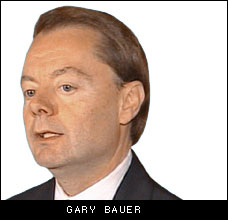

In late January Gary Bauer was riding high. The anti-abortion headmaster of the Republican Party had just won the first major GOP straw poll of Republican presidential candidates.
The poll was held at the Conservative Political Action Committee conference, the annual mecca for what there is of a vast right-wing conspiracy. (The buttons that said as much were a hot item at the conference, as were those suggesting “Lorena Bobbit for White House Intern.”)
It was apparent even then that the world would soon be seeing a kinder, gentler Gary Bauer. The former head of the socially conservative Family Research Council wanted to use the C-PAC venue to transform his activist credentials into Republican primary votes and knew he that to do so he would need to attract more than just angry white males.
Bauer shocked many Washington Republicans when he decided to support competitor Sen. John McCain’s campaign finance reform proposal. And in October he shocked everyone when he held a press conference to dispel a rumor that he was having an affair with a young campaign aide. This bizarre event attracted national media attention to what otherwise would have been nothing more than standard political insider gossip.
But no. Suddenly, Bauer was spewing lines straight out of Ms. magazine, saying he couldn’t “imagine that anybody on the campaign would object to me having meetings behind closed doors with professional women.” Now every chance he gets he repeats his favorite new phrase: he now has a glass door to connect his office to the outside world because “there are no glass ceilings in my campaign.”
Yet despite a fourth-place showing at the Iowa straw poll in August that suggested he was the emerging Christian conservative candidate to beat, Bauer now trails George W. Bush by 45 percentage points in most national polls and is still struggling to redefine himself as a mainstream candidate.
When asked if he’s the true Christian conservative candidate, he immediately takes exception. “I’m running as a conservative. It’s puzzling to me why observers want to mention my faith in describing me,” he says. “I believe everybody I’m running against in the Republican Party goes to church on Sunday and says they’re Christian.”
“There is no religious test [to run for] for office in America. The Constitution specifically prohibits it,” he continues. “I think voters will vote for me or against me depending on whether or not they agree with my China policy, my tax policy, what I think on abortion and so forth. How I worship is really none of their business.”
That’s quite a contrast to the speech he gave last April announcing his candidacy, in which he directly linked the bloodshed at Columbine High School to the crumbling of religious values in America.
“When you have a society where you’re no longer telling many of your kids that they’re created by God,” he said, “that their liberty comes from him, that virtue matters and death is never an option, whether it’s an unborn baby or settling a fight. I don’t think we can be surprised when we get the kind of horrible pictures and scenes that we increasingly see.”
Distancing yourself from your core group of supporters is quite a dangerous campaign strategy for primaries season. This early on, candidates usually work hard to keep their supporter base happy. Elizabeth Dole is exhibit A as to what happens if you don’t have a base of support beyond couch-loving Rosie O’Donnell fans. The money dries up and then you crash.
In fact, Bauer owes his staying power to a core group of evangelical activists who have donated time and money to his campaign. They’re just as passionate about their politics as they are about their sermons. To those core supporters, Bauer is a true hero for his anti-abortion work.
So why does he seem to be publicly backing away from them?
It’s obvious he’s trying to do everything he can to broaden his supporter base, which makes sense. But what he really needs to do is light a fire under die-hard Christian conservative voters, early on, in New Hampshire and Iowa, where, to everyone’s surprise, Pat Robertson finished second behind Bob Dole in the 1988 caucus. Bauer’s political franchise is built on Christian conservatism, and that’s where he’s most likely to succeed.
In many respects, Bauer seems like the logical successor to Robertson. Christian activism features prominently in a risumi that has included domestic policy positions in the Reagan administration and a 10-year gig working with religious radio broadcaster James Dobson.
Bauer capitalizes on the Reagan connection whenever he can, sprinkling speeches and fund-raising material with references to the Gipper and his view of America as the “shining city on the hill.” Like Reagan, Bauer supports decreasing taxes and increasing defense spending. He advocates a flat tax rate of 16 percent, with tax credits for families with children. He’s also already talking about trying to appeal to Reagan Democrats, playing up his blue-collar upbringing in Newport, Ky., and opposition to most favored nation status for China, even though Reagan never supported protectionist positions.
Bauer recalls sitting in his living room as a teenager watching the Gipper deliver his nominating speech for Barry Goldwater at the 1964 Republican National Convention. “I said to my father at the time that I thought Reagan would be president some day and I wanted to work with him in the White House,” he states proudly. “Twenty-one years later, I ended up being in the White House with a west wing office.”
It was an ambitious goal for any young person, let alone one who had grown up amid poverty and alcoholism in a shabby suburb, just across the river from Cincinnati. Newport was so deeply corrupted by Cleveland mobsters and riddled with bars, brothels and casinos that in 1957 Esquire magazine dubbed it “Sin City.”
Bauer’s father, Stanley, better known as “Spike,” worked various blue-collar jobs at the steel mill. The younger Bauer and his mother would often spend nights waiting for him to come home, knowing full well he was at the bar drinking his paycheck away. “I was usually at loggerheads with my father,” Bauer says matter-of-factly. “He wrestled with alcoholism his entire life, so things were always kind of dicey at home.”
Bauer’s grandmother had already lost one son to the mob, and she was intent on providing some structure and solace in her grandson’s chaotic childhood. She took him to the local Baptist church on Sundays, and eventually Bauer coaxed his parents to join him there. After his grandmother died, Bauer and his father were baptized together.
By age 17, Bauer’s already deepening moral convictions prompted him to join a group of ministers and local Republican businessmen who were organizing a crusade to push the mob out of town. He passed out leaflets and attended meetings. “It was a combination of being involved in the reform effort in town and also this exposure to Reagan that led me to be involved in politics,” he says.
The experience helped Bauer form his political views and would pay dividends down the road. When it came time to go to law school at Georgetown University and find a job in D.C., those Kentucky reform contacts came through in spades. The local Republican businessmen involved gave him a scholarship and even called the Republican National Committee and found him a part-time job in the research department. He went from the RNC to a position as a deputy director of the Direct Mail Marketing Association.
In 1980, Bauer left to take an unglamorous job as a policy analyst on the Reagan campaign. When Reagan won, he was rewarded with another low-level job in the office of domestic policy headed by Martin Anderson. For the first few months, Bauer didn’t have much of an assignment and found himself bored and frustrated. He complained at a policy development meeting that the administration was paying too little attention to values issues like school prayer and abortion. “Almost as a throw-away, Anderson said, “Fine, Bauer,” he recalls, “those issues are yours.”
Bauer soon leap-frogged his way up in the administration bureaucracy, taking top positions near the end of Reagan’s second term after other people left for private-sector work. He became deputy undersecretary of education, then undersecretary and later worked as head of the domestic policy office.
“[Bauer] became our go-to guy,” says conservative consultant Craig Shirley. “He always returned our phone calls and was more than happy to take our message and take it as far as he could inside the administration.”
While in the Reagan administration, Bauer doggedly pushed for issues like school prayer and a reversal of Roe vs. Wade — so much so that, he admits, that chief of staff Donald Regan and first lady Nancy Reagan often told him to back off. But Bauer took solace knowing he was taking orders directly from the president, who supported his work and told him to stay focused, regardless of his west wing detractors.
Dobson, head of the socially conservative Focus on the Family, began inviting Bauer onto his popular radio talk show. In 1987, he joined Dobson’s Colorado-based public policy group and spun off a Washington branch called the Family Research Council. Bauer built the Family Research Council into a $14 million dollar grassroots organization. Bauer’s political action committee, the Campaign for Working Families is the sixth largest PAC in the country, pulling in $6 million in the 1997-98 election cycle alone.
By any standards, these are solid conservative credentials. Too bad, then, that 20 years after the Rev. Jerry Falwell’s Moral Majority organized and rallied religious conservatives to become a powerful force in American politics, the movement is now losing steam, its leaders becoming increasingly disillusioned.
After Clinton’s impeachment acquittal, Paul Weyrich, president of the conservative Free Congress Foundation wrote that attempts to restore morality “through the political process have failed.” He suggested that conservatives channel their energy towards “parallel institutions” such as home schools and religious radio.
Now, as the 2000 campaign shifts into full gear, religious conservatives can’t even decide which candidate to support.
Bauer would be a credible coalition candidate, but he’s inherited some bad blood. Robertson and Dobson never got along too well, and that could ultimately hurt Bauer. Even last year, when Bauer was mulling a decision whether to run, Robertson not so casually told him to go take a cold shower. Then, nearly a month ago, Robertson told reporters the Bauer campaign was a “lost cause” and all but officially threw his support to Bush, who has done precious little to court religious conservatives.
Another recent event further underscored how difficult it’s been for Bauer to drum up support. The competition was out in force at a private February Christian Coalition meeting of various politically conservative family values groups. The Eagle Forum’s Phyllis Schlafly was there, as was the Free Congress Foundation’s Weyrich and various other moral conviction operatives. They met with most of the GOP presidential candidates and afterward went around the room disclosing who they were going to support.
Only one, Donald Wildmon from the American Family Association, backed Bauer. Weyrich decided to support Steve Forbes and Schlafly is waiting to see who emerges from the pack of candidates this year. In years past, she was burned when she supported Phil Gramm and Pat Buchanan too early on and then stood by helplessly as they dropped out of the race.
“Conservatives are individualists,” says Schlafly. “[Bauer’s] certainly become a very fine spokesman for conservatives. Everybody likes Gary — but not being elected to office before is a difficulty for him as it is for Forbes and Buchanan.”
The candidate of choice for conservative leaders boils down to power and who has the best chance of occupying the White House. Even those who share Bauer’s beliefs and uncompromising stands just don’t believe he has what it takes to win.
“People in the movement say, ‘Gary Bauer? You’ve got to be kidding!'” a Bauer campaign aide relays. “‘I remember when he was running the Xerox machine.'”
A lot of the derision may have to do with Bauer’s diminutive size and baby-faced appearance. Tough-talking conservative men have a hard time looking up to a 5-foot-4 man. Even those who compliment Bauer occasionally throw in the short man joke. It’s a harsh reality Bauer has been dealing with his entire life, but he has usually managed to compensate in other areas.
Bauer can out-debate and out-speak even the most seasoned pol. “I’ve seen people who are really in awe of Gary,” says Tom Edmonds, Bauer’s media consultant. “It’s amazing how he can field questions. He can give a speech as good as anybody I’ve ever met.”
Still even the best orator would have a hard time competing with the bundles of money both Bush and Forbes are throwing around. Early on, Steve Forbes picked off several key Christian Coalition worker bees and has been well-received among several Christian conservative organizations. Bush, himself a vocal Christian, has broad appeal among those who truly believe faith and forgiveness can erase a checkered past.
Even James Dobson, a longtime friend, refuses to throw an endorsement Bauer’s way — mainly because he’s holding out to support Bush if he should become the nominee. One religious conservative reports that Bauer’s been hectoring Dobson for an endorsement so much that it’s beginning to strain their friendship. The marital fidelity flap didn’t help things — Dobson was reportedly fuming about the way Bauer handled it.
Focus on the Family spokesman Paul Hetrick says Dobson hasn’t endorsed anyone for president this year or ever before, although he did give $1,000 to Bauer’s campaign, the maximum allowable contribution by an individual. “He is thinking about endorsing someone next year,” says Hetrick, “After a few debates and a further shaking out of the candidates.”
Bauer’s confident he’ll be one of the last few candidates standing and would welcome Dobson’s seal of approval. Bauer spokesman Tim Goeglein says he doesn’t know if his boss has been lobbying Dobson for an endorsement and he couldn’t say what has taken place in “private conversations.”
Since he first decided to run, Bauer’s been walking a thin line. He can’t afford to abandon his Christians brethren, but he doesn’t want to be constrained by them either.
But Bauer still has a long way to go to reconciliate his Christian conservatism with his desire to run as a mainstream candidate.
That conflict is evident in a campaign fund-raising video that stresses his economic and foreign policy positions, but also emphasizes what he calls the “values deficit ” — the decline of moral values in America and his belief that Roe vs. Wade made it possible for “unborn children to be treated like they were Styrofoam cups.” Bauer also defends his opposition to the gay rights movement. “I am against the political agenda of the homosexual rights movement,” he says in the video. “And so are the majority of the American people.”
Bauer’s own campaign staff is a direct reflection of his straddling efforts and how they can backfire. He has a number of non-religious Washington hired hands working for him: Edmonds, political director Jeff Bell, campaign manager Frank Cannon. Others he handpicked either from FRC, the Campaign for Working Families or various Christian groups he’s worked with over the years.
The tensions between the religious and non-religious camps have simmered under the surface since the campaign began, but erupted into the open when he refused to stop meeting behind closed doors with his young, attractive deputy campaign manager — what many in the religious faction considered a violation of Christian policy. Deeply spiritual men like Charles Jarvis, his national campaign chair, and Tim McDonald, his main advance man, as well as his long-time personal secretary, decided to walk away over the controversy.
Bauer may have viewed the situation as an opportunity to prove he’s in touch with mainstream Republicans, but if so, it has also proved to be costly with his Christian base. Some Christian activists freely admit they’re disillusioned with him and believe his campaign hit its high mark back in Iowa. “My view is that this has become a big ego trip, and I like Gary,” says one activist. “I think he peaked early and fourth place is the best he’s going to do.”
Those who have followed him on the campaign trail or watched him work a room say they would never underestimate the fire in his belly. He’s a force, they say, who won’t go away easily.
“I’m sure that Gary, in his own mind, thinks that lightning is going to strike and he’s going to be the nominee,” says longtime GOP strategist Lyn Nofziger.
