
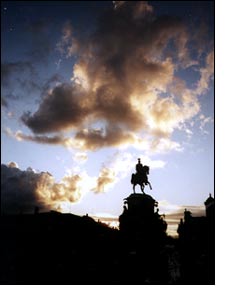
Natasha was pale and thin-lipped, with an unruly shock of brown hair that she’d unsuccessfully tried to tame with bobby pins. She worked as a librarian at St. Petersburg University, and at the time this seemed very exotic and sexy to me. Every time her friend Daniil would leave the balcony, I would kiss her, and she would kiss me back. Though we obviously weren’t destined to be lovers, it was a nice way to pass the time. It was nearly four o’clock in the morning, and neither of us was sober.
The problem with kissing Natasha was that, being a librarian, she was overflowing with interesting factoids and observations about the universe. Since she didn’t speak English, we had to stop kissing and summon Daniil every time a new epiphany struck her. Oiled, no doubt, by several hours of drinking and dancing, her epiphanies came at the rate of about one every 90 seconds.
“Daniil!” she called for the fifth time in 15 minutes. Daniil, a recent St. Petersburg University graduate, was hosting our after-hours party at his cozy, rundown, second-floor crash-pad near the popular Nevski Prospekt district. The ceilings of the old apartment were tall and grimy, empty beer bottles lined the table and an anti-hangover tea kettle boiled on the living room hot plate. The old Soviet-era wallpaper was covered with magic-markered graffiti, some of which was our own.
Daniil appeared in the door with his usual ironic grin, and Natasha spoke to him for a few moments. “Natsha wants to know who I remind you of,” he said to me. “What famous person do I resemble?”
I gave Daniil a close look. He was tall and baby-faced, with narrow shoulders and a curly mop of blond hair. “You look kind of like a young Judge Reinhold. He’s an American actor.”
Daniil translated, then laughed at Natasha’s response. “She says that you’re wrong. Apparently, I look like Von Kotzebue.”
“Who’s Von Kotzebue?” I asked.
“I have no idea,” he said. He clarified for a moment with Natasha. “Apparently, it’s not just Von Kotzebue, but August Freidrick Ferdinad Von Kotzebue. Natasha says he was an unimportant German playwright who worked in the Russian state service 200 years ago.” He paused, laughing as Natasha gave him the final details. “Natasha says his plays were superficial, he was assassinated as a reactionary.”
I shook my head in admiration. “I envy Natasha’s talent for making really weird allusions,” I said, “but I think it’s better to compare yourself to a movie star.”
Enthused, Daniil had me write down “Judge Reinhold” before going back inside his apartment.
Five minutes later, Natasha had another epiphany and called Daniil back out onto the balcony. “Natasha says we must buy American sausages,” he translated. “She says she has something very important to show you. A miracle.”
“What kind of miracle?”
“She won’t say,” Daniil said. “She says we have to get the American sausages first.”
Figuring it foolish to pass up any miraculous pre-dawn demonstration involving a professional librarian and processed meat, I gave my consent.
“And please have your cousin come with us,” Daniil added.
My cousin Dan — a 23-year-old ex-linebacker who’d recently graduated from a University of Kansas literature program — had been treated like a rock star ever since I let it slip to the Russians that he’d once had dinner with William S. Burroughs. Quiet and understated by nature, Dan insisted that he’d merely sat with Burroughs at a large gathering several years ago — but our Russian friends would have nothing of humility. Natasha had already demanded an autograph.
Once we’d corralled Dan, we headed down the stairs and onto the pre-dawn streets of St. Petersburg, ready for any miracles that came our way.
The final leg of my Beijing-St. Petersburg train journey had been simple: Dan and I boarded the midnight train at Moscow, curled into our upper berths like a couple of cosmonauts, and woke up in St. Petersburg. We walked out of the train station into a fantastic vision of stately old buildings, curving canals and sunshine.
It wasn’t until that evening that we realized our St. Petersburg arrival had coincided with the rocket-propelled-grenade assassination of local oil baron Pavel Kapysh. According to news reports, Kapysh’s armored Chevy Blazer had been blown to bits on the University Embankment in broad daylight. In a quirky, post-modern twist, a tourist had managed to capture the entire attack on videotape.
Before this incident, I’d almost forgotten Russia’s growing reputation as a place of near-anarchy.
As a tourist, it’s difficult to determine just how far corruption-tainted Russia has unraveled. Ironically, Moscow — a city which has come to represent the oligarchical excesses of the New Russia — was a beautiful place to spend a few days after my 81-hour train ride from Irkutsk. Thanks in part to renovations spearheaded by Yuri Luzhkov (the city’s free-spending maverick of a mayor), Moscow’s tourist areas looked clean, majestic, brand new. The park areas around the Kremlin were peaceful and romantic — a vision of old statues and young couples, war memorials and pizza stands. Old Arbat Street was brimming with street performers and international restaurants. Even the old underground Metro stations had a retro charm: Riding the steep, double-speed elevators down to catch my train, I couldn’t help but think that the rounded, Stalin-era, moderne design-flourishes made the place seem like the inside of a UFO.
Of course, I didn’t have to travel very far into Moscow’s dreary suburbs for the futuristic illusions to be shattered. Nor did I have to delve very far into the newspaper to realize that Russia was in trouble. The economy had collapsed over a year before and the national GDP was half of what it was in 1991; the life-expectancy of a Moscow male had actually gone down over the decade. IMF reserves were being stowed in offshore banks or disappearing entirely. Optimistic Western-led reforms had gone nowhere. War simmered in the Caucasus. Politically and economically, Russia’s future didn’t look so hot.
Interestingly, however, the demographic most commonly associated with any country’s future — the youth — seemed to be undergoing an eccentric renaissance when I was in Moscow. Nearly a decade after the advent of new freedoms, Russian youth culture was still blooming in every direction at once. Five decades of 20th-century fashion coexisted simultaneously: Teen boys in tie-dyed muscle shirts held hands with teen girls in fluorescent-orange miniskirts; felt-hatted rude-boys rubbed shoulders with nose-ringed riot-grrrls; James Dean leather jackets competed with Don Johnson summer suits; metalheads and motorheads shared beers with skinheads and Deadheads.
Amidst this vivid melange of youth culture, I found a curious absence of despair. Admittedly, three nights in Moscow discos and grunge bars hardly qualify me to analyze, but I found Russian teens and young adults to be no gloomier than their American counterparts. Furthermore, compared to the fashionable angst that seized American youth culture in the early ’90s, the Russian expression of pessimism I did see seemed downright optimistic.
Perhaps those that sing “No Future” the loudest are those who can be sure the lyric doesn’t apply to them.
Late in the night following my last full day in Moscow, I was returning to my homestay from a disco near Red Square, when I saw two teenaged boys standing under the Trinity Tower of the Kremlin, hollering their lungs out. As I got closer, I could make out what they were saying.
“Boris Yeltsin!” screamed the taller boy.
“Boris Yeltsin!” screamed the other one.
Taking turns, and yelling without discernible rhythm, the boys intoned their president’s name over and over again, stopping only to double over in laughter. Amused, I watched their spectacle as I walked by, wondering if they were trying to make a statement or if they were just entertaining themselves. I wondered if there’s any good way to discern those two activities.
I wondered if the boys knew where Boris Yeltsin was at that moment, or if they just imagined him (as I did) staggering like a zombie through the nether corridors of the Kremlin, taking deep pulls from a bottle and drunkenly demanding a heart transplant.
In the end, the only Russians I really interacted with for any period of time were Daniil and Natasha. Dan and I first met them at the Money Honey, a rockabilly club a couple of blocks over from Nevski Prospekt in St. Petersburg. The club was packed when we arrived at 8:00, and we were forced to share a table in the back with a half-dozen Russians. By traditional club standards, the Money Honey wasn’t much to look it: its interior bland; its clientele a bit frumpy, middle-class.
I was almost beginning to wonder what the sold-out appeal of the place was when a band took the stage and started to crank out Elvis covers. Suddenly, a room full of frumpy people rushed to the dance floor and (in the truest sense that I’ve ever witnessed personally) went ape-shit. Our table emptied in seconds, and the pale, thin-lipped woman to my right took me with her. My rockabilly swing-steps were decidedly clumsy, but so were everyone else’s: A roomful of people gyrated with uninhibited anti-hipster abandon, spastic and ecstatic. It was frightening and wonderful.
It wasn’t until after the first set that we all returned to the table and I found out who I was dancing with. “This is Natasha,” said the mop-haired guy who later introduced himself as Daniil. “She says she can’t decide whether or not you look intelligent. She wants to know if you read books.”
“Of course I read books,” I said.
“She says that when someone like you is left on his own, without a book, he will instantly become lost.”
“What does that mean?”
Daniil clarified for a moment. “She really wasn’t saying that,” he said. “She was quoting Dostoyevski. It was supposed to be a joke.”
“Sorry, I guess I didn’t get it.”
“Well she’s very serious about books. She’s a librarian. All the women at this table are librarians.”
I took a good look at Natasha and the other two women at the table. After having seen their antics on the dance floor, I could hardly envision any of them shelving books. “What are they,” I said jestfully. “Hell’s Librarians?”
Daniil translated, and Natasha grinned. “She likes the name Hell’s Librarians,” Daniil said. “It’s like Hells Angels. That’s a Hunter S. Thompson word, yes?”
“Well, he didn’t coin the term. He just wrote about them. They’re a motorcycle gang.”
“Yes, of course, but Natasha doesn’t ride motorcycles; she reads books. And Hunter S. Thompson is very popular in Russia. His Las Vegas book is a bestseller these days.
“Still? That’s a pretty old book.”
“Yes, but it was only recently translated into Russian. Many older American books are just now being translated into Russian. Have you heard of William S. Burroughs?”
“Of course. He lived the last years of his life not far from where I grew up. My cousin had dinner with him about three or four years ago.”
“I wish I could meet your cousin.”
“You’re sitting at the same table as him,” I said, pointing at Dan.
Daniil looked over at Dan in amazement, and said something in Russian to the librarians. Their chatter stopped, and they swerved in Dan’s direction. My taciturn cousin was the star of the table for the rest of the evening.
– – – – – – – – – – – – – – – – – – – – –
Many hours later, long after the Money Honey had closed, I stood outside a kiosk with Dan and Daniil as Natasha shopped for her miracle weiners.
“Do you know what this miracle is all about?” I asked Daniil.
Daniil shrugged. “Cheap happiness,” he said. He paused, then grinned. “Or maybe noble suffering.”
Seeing my lack of reaction, he went on. “That was another Dostoyevski joke,” he said. “Natasha does them better than me. He wrote ‘Crime and Punishment’ in this neighborhood, you know.”
“Seriously, or is that a joke too?”
“It’s true. I could show you his old apartment if you want. It’s very near to my street.”
“If Dostoyevski is your neighbor, why do you all get so excited about someone like William S. Burroughs?”
Daniil thought for a moment. “That’s a good question. I guess it’s because he’s not my neighbor.”
I decided it was now or never to ask a question that had been bugging me. “What do you think of the future here, Daniil?”
“In Russia?” Daniil sighed. “The future will be the future. I like right now. It’s 1999. In only a few years, that will sound very old: 1999. In a few years, nobody will think about right now. So I won’t think about the future. That’s fair, isn’t it?”
Natasha came out of the kiosk with a package of weiners and a sly smile. Daniil interpreted as she performed her miracle.
Natasha took out a weiner. “Does the worm have a soul?” she asked us, holding the weiner out in front of her.
“That’s not a worm,” I said.
“But does a worm have a soul?”
“I don’t know,” I said. “Let’s say it does.”
Natasha broke the weiner in half. “Now we have two worms. Where is the soul? Where did it go? Which side is the soul in?”
I thought for a moment. “Well, I’d say the soul divides as the worm does. You get two souls.”
Natasha smiled and tore the weiner into four pieces. “And if I divide these again?”
“Then you get four souls.”
“Then this is the miracle,” she said. “I have created three new souls.” She triumphantly held the ragged bits of weiner up for my inspection.
There are some times in life when you’re too tired and baffled and amused to do anything but laugh out loud. I will never be able to categorize that moment — standing in St. Petersburg at 5 a.m. with a Russian librarian who proved she was God by destroying a hot dog — but I think the real miracle was the silly set of odds that put me in that spot after 5,000 miles and two continents. The four of us giggled together like children in front of the kiosk.
I never got another chance to kiss Natasha. We ate the rest of the weiners on the way back to the apartment, and I fell asleep sitting in one of Daniil’s easy chairs almost as soon as we arrived. What was left of the party went on without me, but I don’t regret missing it.
After all, it was nearly dawn — and I’d traveled a long way to get there.
