
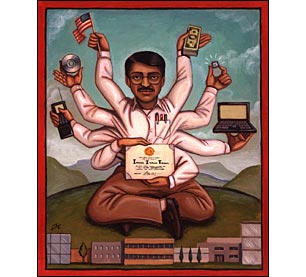

One warm day in May 1984, Venky Harinarayan sat down to take the entrance exam to the school of his dreams. Although he had ranked first in his high school class and had studied for nearly a year to prepare for this test, as soon as he opened his exam book, he began to sweat. All the years as a curve-busting computer whiz kid seemed to lead up to this moment.
He only needed to score 50 out of 100 points to guarantee his admission. But suddenly this seemingly lax criterion appeared all but impossible. His eyes sifted through a litany of seemingly impregnable questions — about Bernoulli’s principle, Doppler’s effect, Lorentz’s forces, ionic equilibria and combinatronics — things that would never appear on an SAT in a million years. Nothing in his life had prepared him for this.
“It was extremely stressful. You just looked at the thing and not a single question made sense to me. I thought, ‘Boy, I’m going to flunk this thing,'” recalls Harinarayan.
But like every other fear-wracked student taking the exam across India, Venky knew his future rested on this grueling 3-part mental torture course. He knew he had to beat out tens of thousands of other eager high school students — a regiment of valedictorians, salutatorians and district math champions in a country of nearly 1 billion souls. And he knew this examination was his best chance to escape India — in all its poverty and stratified caste system.
Despite feeling at a complete loss, he managed to navigate his way through the arcana. And six hours later, he had nailed a spot in arguably the most competitive, influential undergraduate school in the world, the Indian Institute of Technology. Not only did Venky pass the exam, he placed an astounding 40th in the country. With this ranking, he got a coveted spot as a computer science major at the IIT campus in Madras.
Flash forward to the summer of 1998 when Amazon.com purchased an e-commerce software company named Junglee for $180 million. That day, Venky Harinarayan, along with four other Junglee co-founders (also IIT graduates), became an overnight multi-millionaire.
The trajectory of Harinarayan’s career has certainly been dramatic, but not exactly unheard of. Like so many expatriate Indians educated at IIT, Harinarayan has ridden his sheepskin to high-tech fame and fortune. In fact, per capita, IIT has probably produced more millionaires than any other undergraduate institution. A glimpse at how Harinarayan’s classmates have fared shows just what his diploma means in the high-tech world.
“Out of 25 people (in the computer science major), I think 13 of them are in Microsoft right now. Four of them went in 1988 when Microsoft came to IIT to recruit. Three of them are at Qualcomm [a telecommunications firm whose stock has risen 1200 percent this year alone],” says Harinarayan, currently an executive at Amazon.com. He then adds modestly, “I have done reasonably well.”
AnnaLee Saxenian is a University of California at Berkeley professor in the department of city and regional planning who studies Silicon Valley. She says Indians, most of whom graduated from IIT, founded about 10 percent of the start-ups in Silicon Valley between 1995 and 1998. IIT grads also make up a surprising proportion of the world’s best programmers, as well as some of the most sought-after executives. In his book “The New New Thing,” Michael Lewis tracked the dominant role of IIT graduates in Healtheon, a high-powered start-up venture run by Netscape founder and Silicon Valley legend Jim Clark. IIT graduates turn up in boardrooms of companies like CitiGroup, U.S. Airways, Novell and in managing director positions at top Wall Street investment banks.
“You find IIT graduates all over the place. Sometimes you get a feeling that it’s someone from IIT by default and that all you have to do is ask what IIT they are from. Their success rate, if you chart it, looks like a hockey stick,” says Yogesh Sharma, the editor of siliconvalleyindia magazine.
Pavan Nigam, IIT graduate and chief technology officer of Healtheon, agrees: “Anybody who makes it into an IIT, you are now set for life. You might end up in the bottom five percent of your class but you are still set for life.”
How have IIT graduates come to represent such an economic and entrepreneurial juggernaut? Educated in English and ready to travel at the drop of a hat, IIT grads embody all the ideals of the new economy: They are flexible and brilliant technological knowledge workers who easily cross borders and cultures to pursue their entrepreneurial and employment dreams.
Founded in the 1940s, IIT was the brainchild of India’s first prime minister, Jawaharlal Nehru, who sought to create a techno-elite to build dams, highways and bridges for the freshly minted nation. Modeled as a bigger, publicly-funded Massachusetts Institute of Technology, the IIT system consists of six campuses located in Kharagpur, Kanpur, Delhi, Bombay (renamed Mumbai), Madras (renamed Chennai) and Guwahati.
About 2,000 undergraduates enroll each year, as well as a handful of graduate students. The Indian government subsidizes 75 percent of the approximately $3,000 expended on each student’s tuition, room and board. Before 1993, IIT students paid less than $200 per year for room, board and tuition. Declining subsidies since then have translated into steadily rising tuition. But an IIT degree remains a world-class educational bargain.
Yet the very success of IIT’s educational system has bred controversy. As more and more IIT grads leave their homeland for the United States, the brain drain out of India has turned to a virtual hemorrhage. Radicals in India have suggested the government should privatize the IIT system rather than continue to subsidize the education of fair-weather patriots. Other critics claim the IIT system does little to engender a sense of responsibility that might sway wealthy grads to do more than send fat checks back to India.
“The IIT education makes you a very technically literate person,” says Supratik Chakraborty, an IIT Kharagpur graduate. “But there is this other part of education — how you contribute to your society. It’s not always in terms of money but in terms of services or participation in the community at large.”
But the IIT system churns out engineers and not priests or social workers. And most IIT grads revel in their quest for cash. “To me, creating wealth is a noble activity. I don’t consider this to be a trivial or cheap thing to do,” says Kanwal Rekhi, an IIT Bombay graduate who sold his company ExceLan to software giant Novell for $200 million and now often backs companies started by younger IIT graduates. Rekhi’s refrain represents a kind of mantra among IIT grads who have begun to give India the economic power (and, by extension, political power) that eluded decades of carefully planned development.
Yet only the top 1 percent of applicants have the chance to experience an IIT education. Such odds make the most prestigious U.S. school pale in comparison. Harvard, for instance, has a 13-percent acceptance rate. And unlike American colleges, admission to IIT almost solely depends on three brutal exams covering physics, chemistry and mathematics. Most questions on those exams would thoroughly flummox the vast majority of U.S. college students, let alone top-notch U.S. high school students. “I still have a copy of the mathematics exam. But I couldn’t explain the math questions in English,” says Ramesh Parameswaran, a graduate of IIT Bombay who went on to work at Microsoft and then co-founded an Internet business called XpertSite.com.
To prepare for this braincrusher, some applicants start studying two years in advance when they are 14 or 15 years old. They may log three, four, five or even 10 hours per day, seven days a week, to hone their skills. Some wait to take the exam until after they have graduated from high school and have time to study. But the majority study for high school graduation and the IIT exam simultaneously, giving new meaning to the term sleep deprivation. “I spent a year doing that, studying, for both end of high school and IIT. I don’t much remember doing anything else that year,” says Parameswaran.
Behind this insanity lie justifiable hopes and fears. No other school in India can hold a candle to the IITs. And for many smart young Indians — both low and high caste — who lack the influence often required to gain acceptance to other campuses in the nepotism-ridden public university system, the IITs represent their best shot at an affordable college education. “I am a Brahmin. In the state where I lived there was reverse discrimination,” explains V. “Seenu” Srinavasan, a professor at Stanford University’s graduate school of business and a 1966 IIT Madras graduate. “Even though I was No. 1 in my college, as a Brahmin I could not get into any of the engineering schools in my state.”
Of course, the IIT admission exam favors middle-class and affluent city dwellers, who have access to good high schools and time to study. To address these inequalities, the government reserves just over 20 percent of the IIT places for “scheduled castes” and “scheduled tribes.” But this does nothing to help women, who make up less than 5 percent of the IIT students.
Still, such government meddling irks many IIT graduates, who sweated blood to get in and view affirmative action as more harmful than helpful. Others feel that IIT has successfully undermined an inherently unjust social system. “With women in India, it is a general problem but I think the IITs should make it their own,” says Harinarayan. “But IITs are not completely dominated by people from the cities. The system really does work incredibly well in many cases. There are people from remote villages that will show up and they blow your mind with how smart they are.”
IIT freshmen arrive to find campuses sparse by Western standards but plush for India. The campuses boast green hills, ponds and open spaces — an archipelago of privileged semi-rural redoubts on highly prized real estate in one of the world’s most crowded nations. Big American computer companies, their logos displayed prominently on campus buildings, endow professorships, allowing the well-funded faculty to concentrate their attentions on small groups of students. Recently, affluent IIT alumni have begun to send generous donations to their alma mater, allowing for facilities far superior to those of most Indian universities. Famous musicians and celebrities often perform for free at IIT campuses, giving students a sense that they have become members of a privileged class. “Apart from the opportunities one gets at the IIT, the very feeling of belonging to an exclusive club is exciting,” says Avneesh Sud, 21, a final year engineering student at IIT Delhi. “You work hard for two years and when you finally make it, you are the king of the world!” he says, borrowing a line from the popular movie “Titanic.”
But the cozy environs can only provide so much comfort to incoming students who have always sailed along confident in their brilliance. “You walk into an IIT and you expect to be No. 1 or No. 2,” says Raj Mashruwala, a 1975 IIT Bombay graduate and current vice president of TIBCO Software. “But everyone else there was also No. 1 or 2 in their region. And very soon you realize that you are no longer the smartest person in the world.”
IIT’s curriculum also creates a humbling effect. Along with general engineering courses and a smattering of social sciences, the first two years include mandatory courses in carpentry and metal shop, in which students are subjected to lessons in rigor and frustration. Harinarayan remembers one particularly onerous project in which he had to file down two centimeters off a piece of metal by hand over a period of weeks. “It took a long time and was hard work,” he says. “But that was great for discipline.”
Yet despite the concentration of so many hyper-competitive scholars, the culture never descends to the cutthroat paranoia of, say, American pre-meds. The dorms themselves function like miniature high-tech companies. Team problem-solving and study sessions are interspersed between all night bridge binges, drinking outings and midnight firecracker raids. At times, this teamwork and camaraderie emerges out of necessity. On one unusual occasion, Harinarayan and his 24 computer science classmates had to share a single textbook for a class. “We used to have a system where everyone would have two hours with the book. If you got the 3 a.m.-to-5 a.m. slot, you would have to get up then,” he recalls.
IIT students carry approximately 50 percent more courses than the typical U.S. undergrad, gaining a mastery over their subject matter that often makes graduate school in the United States a breeze. “My first year at Berkeley when I was doing my master’s, that was the easiest year I had ever had in my life,” recalls Mashruwala. “I either knew it or I could sit at home and do the whole subject in one-quarter the time of everyone else.”
Such rigorous training also makes IIT grads especially appealing to high-tech companies like Microsoft, Intel and Cisco, who send recruiters across the Pacific on yearly trips. Between American companies and American grad schools, IIT grads have become a major force of immigration. In recent years, 40 percent to 50 percent of IIT grads have elected to come to the United States to pursue graduate degrees, according to Mashruwala. About 20,000 IITans live in the United States right now, almost 20 percent of the total IIT grad population since the system’s inception. Most never return to India.
IIT grads had begun filtering into U.S. industry and academia by the early 1970s, but they didn’t crack the executive ceiling until 1982 when IIT graduate Vinod Khosla helped bootstrap Sun Microsystems — making Khosla an entrepreneurial poster boy for IIT grads. Since then, more than 1,000 Indian entrepreneurs have started companies in Silicon Valley, creating hundreds, if not thousands, of multi-millionaire IITan entrepreneurs with companies worth more than $40 billion. Mashruwala estimates the average net worth of the 60 classmates he keeps in touch with in this country at between $6 million and $7 million.
Not surprisingly, the money men have noticed the green hue of the IIT imprimatur. “People are writing blank checks” says Mashruwala. “I have a guy who runs what used to be a conservative investment fund who is weekly calling me and asking me, ‘Could you find me a deal or a place to invest my money through your networks?'” Several Silicon Valley venture capitalists who preferred to remain unnamed say any startup involving an IIT graduate has an advantage in attracting funding.
Where does this leave India, a still-impoverished nation that continues to subsidize these new American entrepreneurs? The brain drain troubles many Indians who see the government-subsidized education at IIT building U.S. companies and the U.S. economy but not contributing to India. IIT graduates tell of some Indians who have expressed feelings of betrayal at their brethren who used the system to escape and didn’t look back.
“It has mostly been a one-way street. I don’t think the return to India was commensurate with the investment,” says Chakraborty, who has made a rare decision to return to IIT Bombay as a professor this year.
Despite money donated by IIT graduates to charities in India or to their alumni associations, the ultimate payoff to India may come circuitously from the West itself in the form of rising salaries at computer companies in India and in the border-less business world engendered by the Internet. A rash of start-ups in India has given IIT grads the option of staying home and still striking it Internet-rich. Several Indian companies already trade publicly on the NASDAQ exchange. As more and more Western companies establish Indian subsidiaries, the flood of IIT graduates to the West may begin to ebb.
What cannot be overstated is the historical influence that IIT and its expatriate alumni will exert on India. A group of IIT graduates is spearheading a drive to establish a world-class business school in India, on par with anything in the West. And IIT grads who live in the United States now get audiences with top politicians in India who a decade ago would have spurned them as capitalist colonial tools. “They are building major trade relationships which will help India more than if they had stayed in India,” says Mashruwala. “Twenty years from now, the IITs will be recognized as the one single entity that generated the single most amount of wealth in India. They will be recognized as the wisest decision.”
Beyond India, the IIT clan now looks to cast an even wider web. Alumni organizations in the United States and abroad have begun to double as networking units for getting IIT business ventures staffed and funded. In the United States, many influential graduates talk of fulfilling their civic obligations by getting involved in politics to help shape a society they have claimed for their own. In the distant future, historians of Silicon Valley will undoubtedly dedicate significant ink to the exploits of IIT grads — who grabbed the intellectual brass ring, got filthy rich and created their own legacy of can-do capitalism.
