
Books
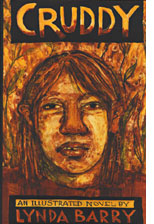
“Cruddy” by Lynda Barry
A funny and harrowing illustrated novel about a kid whose parents' beatings can't keep her down.
One summer afternoon on a porch in Madison, Wis., someone handed me “The Fun House,” Lynda Barry’s 1987 collection of comic strips. The bright blue book was open to a strip about some bored kids who wonder “what would it be like to cross 23rd Street and take a field trip up there where we never hardly were before.” As they attempt to cross the busy street, one of the kids is hit by a car. The rest of them run back to their neighborhood “thinking if we can go fast enough, it didn’t really happen.” Having expected something like “Peanuts” with a gag line, I felt as if I’d been punched in the stomach.
Sometimes, though, feeling as if you’ve been punched can be a good thing. Barry’s latest book, the richly illustrated novel “Cruddy,” is as wrenching as Dorothy Allison’s “Bastard Out of Carolina,” but funnier. Here, 16-year-
On a bus in the middle of nowhere, sitting next to her passed-out father who has recently given her a black eye and bruised ribs, Roberta wants to write a letter to someone, but she can’t think of anyone who would want to hear from her. Finally, she starts a letter to Jesus but can’t think of anything to say. “Have a Good Summer,” she writes, “and Stay Crazy.” Barry is master of scenes that make us want to laugh and then, immediately afterward, cry.
The patterns of the novel parallel patterns of abuse, in which fear and pain so often follow close on the heels of laughter or tenderness. In the novel’s present, we find Roberta in the dirty kitchen of “a cruddy rental house” where her mother is yelling at her for hitting her sister, Julie, with the Cutex nail polish remover bottle — a normal enough situation in a house with two teenage girls. But during this scene, Roberta remembers another time her mother got mad at her, picked up the telephone receiver and bashed her in the face with it. “A broken nose,” Roberta writes. “A boxer’s nose. One of my many distinctive features.”
“Were you like, in a car accident?” someone asks her, referring to “the various smashed aspects” of her face. She is scrawny from the year of malnourishment on the road with her father, and she has always looked like a boy — “a pug ugly one was how the father said it.” Her father calls her Clyde and tells people that she is a boy. The sheriff they meet at the horrific Knocking Hammer slaughterhouse calls her Ee-gore, but her ugliness only encourages him to try to use her as a receptacle for his perversions. Luckily, her father has given her Little Debbie, the knife that saves her life many times but also dooms her to feeling that she is as “corroded” as her parents.
Like Allison, Barry shows how completely children are at the mercy of the adults around them. But the issue is not uncomplicated. Barry characterizes children as both the most vulnerable and the most resilient creatures on earth. Most of the adults in Roberta’s life have tried to victimize her, but she remains analytical, cynical, funny and less confused about right and wrong than she thinks she is. She knows, for instance, that her mother gets maddest not when Roberta does something wrong but “when she remembers all the ways she’s been ripped off in life.”
But the abuse takes its toll. While Roberta’s romantic side clings to the equation “Truth plus Magical Love equals Freedom,” she struggles with the urge to jump in front of trains. She fights her own lack of remorse for the bad things she has done either in self-defense or out of spite by carving “I’m sorry” into her arm, but when her friend the Stick asks her, “Are you sorry?” she admits she isn’t.
Barry is an expert in the too-often neglected vernacular of working-class childhood in urban America, and Roberta, with her haunting and often jubilant voice, is a typical Barry kid, screwed by circumstance but still searching for integrity. “Cruddy” adds to Barry’s already impressive body of work another fine novel that is tender, goofy, scary and thrilling.
Heidi Bell's fiction and reviews have appeared in Crazyhorse, the Beloit Fiction Journal and Third Coast. More Heidi Bell.
“The Aleppo Codex”: The bizarre history of a precious book
A reporter traces the shadowy fate of the definitive version of the Hebrew Bible
Matti Friedman An ancient and priceless book, a murky history of evasions and coverups, an underground of sinister and possibly violent dealers, a former spy who drops tantalizing hints and a wily 84-year-old millionaire who says stuff like, “The problem with this story is that it could damage your health”: Are these the ingredients for a cheesy, improbable historical thriller? Yet “The Aleppo Codex,” Matti Friedman’s account of his attempts to learn the history of one of the world’s most precious books, sports all of these assets, and it’s nonfiction. If reporting this story damaged Friedman’s health, it probably happened when he realized what he’d stumbled into and his reporter’s heart started beating in doubletime.
Continue Reading Close
Laura Miller is a senior writer for Salon. She is the author of "The Magician's Book: A Skeptic's Adventures in Narnia" and has a Web site, magiciansbook.com. More Laura Miller.
Augusten Burroughs: Conquer trauma by letting it go
Salon exclusive: The best-selling memoirist says past horrors haunt us because we think about them too much. Stop
Augusten Burroughs Many people continue to feel influenced and even controlled by the things that happened to them a long time ago. Sometimes, people harbor dark, traumatic memories from childhood. Or fragments of memories — incomplete scenes, uncomfortable feelings, perhaps even a sense of certainty that something specific and terrible happened to them, but little more than this.
Others experienced something traumatic in adulthood that continues to affect them day to day many years later. Maybe an assault has left a person afraid to leave their home or enter a particular neighborhood.
Continue Reading CloseAugusten Burroughs' many books include "Runnning With Scissors," "Dry," "Sellevision," "Magical Thinking" and "Possible Side Effects." His latest book is "This Is How." More Augusten Burroughs.
Why did we move to Paris?
Leaving New York seemed ideal. Until the crazy landlord, topless exams, the French flu, the lack of credit cards...
Rosecrans Baldwin Paris’s neighborhoods, the arrondissements, are organized like a twist. They spiral from the river like toilet water flushing in reverse and erupting out of the bowl — a corkscrew or what have you, a flattened pig’s tail, a whorling braid notched one to 20. But if you walk from one neighborhood to the next, there is little to suggest the numbers changing. So it was confusing. Anyway, if you began in the middle of the Seine and snaked around, we lived on the Right Bank in the top of the third arrondissement, called the haut Marais, the upper Marais, on Rue Béranger, a quiet little street curling down from Place de la République.
Continue Reading CloseRosecrans Baldwin is a founding editor of The Morning News. His first novel, "You Lost Me There," was named one of NPR's Best Books of 2010. His latest book is "Paris I Love You, But You're Bringing Me Down." More Rosecrans Baldwin.
Robert Caro’s bloated LBJ biography
Robert Caro's latest LBJ tome has everyone -- even Bill Clinton! -- hyping it. They've been had
“Even the President of the United States sometimes must have to stand naked.” When Bob Dylan wrote that line in 1964, the naked emperor was Lyndon Johnson, which makes that image perhaps the most disturbing in all of Dylan’s apocalyptic work.
By stripping down Lyndon Baines Johnson to his essence, Robert Caro has himself become an American legend. Since the publication of “The Path to Power” in 1982, Caro has transformed LBJ’s life into a cautionary tale of Shakespearean dimensions. In some wonky circles, the release of a new volume is heralded like the Summer of Love release of “Sgt. Pepper’s.” Can Caro possibly top his “Revolver”?”
Continue Reading Close“Bring Up the Bodies”: Hilary Mantel’s power play
The sequel to her Booker-winning "Wolf Hall" is a thrilling exploration of what it took to run Tudor England
“Bring Up the Bodies,” Hilary Mantel’s follow-up to her Man Booker Prize-winning 2009 novel, “Wolf Hall,” is a high-wire act, a feat of novelistic derring-do. Mantel makes bold not with form — by now meaningful experimentation in that area seems exhausted — but with the very material that brings most readers to novels in the first place: our imaginative identification with fictional characters and the experiences we feel we’re sharing with them.
Continue Reading Close
Laura Miller is a senior writer for Salon. She is the author of "The Magician's Book: A Skeptic's Adventures in Narnia" and has a Web site, magiciansbook.com. More Laura Miller.
Page 1 of 984 in Books