
Books

Himmelfarb vs. the '60s

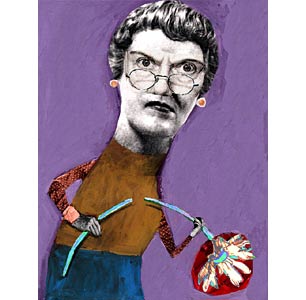
There's no room for real life in Gertie's America.

At the college I went to, each student was required to attend the fall convocation ceremony that marked the beginning of each academic year. It was so deadly boring, though, that barely anyone did, except for my best friend Dana and me. During our freshman year we discovered a delight that we returned to witness faithfully each fall. At some point, the dean of the college, a woman who’d been there forever, would rise to address the assembled and, without fail, would work in the phrase “the turbulent ’60s.” Watching her mouth tauten and twitch as she said those words was something akin to seeing Emily Post forced to spew obscenities in public. It was irresistible.

In the spirit of my college dean, Gertrude Himmelfarb’s new screed “One Nation, Two Cultures” can be seen as one prolonged, taut-lipped twitch.

As well as being professor emeritus at the graduate school of the City University of New York, Himmelfarb is also one of the most widely respected scholars of the Victorian age, which she has written about in books like “Victorian Minds” and “Poverty and Compassion.” Such is her formidable reputation that even liberals acknowledge it. Having stuck only the daintiest toe into the waters of her erudition (an op-ed here and there, a few pages of “Poverty and Compassion”), I must say, after having waded through this shallow but stagnant pond, that I hope her other work does something to justify her repute.

The intellect on display here is about the caliber of the village biddy who sticks her blue nose into everyone else’s business, offering opinions nobody asked for about how everybody else should live. Like “99 Bottles of Beer,” the tune Himmelfarb sings throughout “One Nation, Two Cultures” is repetitive and seemingly endless, and you always know exactly what’s coming next. It’s that golden oldie, top of the pops on the conservative hit parade for the umpteenth era in a row, baby! — “America Is Going to Hell in a Handbasket (And It’s All the Fault of the ’60s).”

What did conservatives do before they had the ’60s to blame? It’s been such a boon to them that, secretly at least, they must be grateful for it (the way liberals have always been grateful for Nixon). When Himmelfarb writes, “Whatever cultural revolution America experienced in the 1920s or before, it was a faint foreshadow of what was to follow,” she’s using a Saturday-afternoon serial technique, keeping us hooked before unveiling the dastardly scheme that Ming the Merciless has in store. She doesn’t take long to get to the wicked plot: the destruction of the Victorian virtues of “work, thrift, temperance, fidelity, self-reliance, self-discipline, cleanliness, godliness” (in her view, America’s traditional strengths) by the Kryptonite of the ’60s.

Himmelfarb assigns the era just the legacy you’d expect: the “social pathology” of “crime, violence, out-of-wedlock births, teenage pregnancy, child abuse, drug addiction, alcoholism, illiteracy, promiscuity, welfare dependency.” And that’s just a warm-up:

The loss of parental authority, the lack of discipline in schools (to say nothing of knifings and shootings), the escalating violence and vulgarity on TV, the ready accessibility of pornography and sexual perversions on the Internet, the obscenity and sadism of videos and rap music, the binge-drinking and “hooking up” on college campuses, the “dumbing down” of education at all levels — these too are part of the social pathology of our time.

“One does not have to be nostalgic for a golden age that never was to appreciate the contrast between past and present,” Himmelfarb writes, but nostalgic is exactly what she is. Implicit in all conservative hand-wringing about the sorry state of our culture, in whatever era that hand-wringing has appeared, is a longing for some lost golden age. But when was this paradisiacal era? If you started with “One Nation, Two Cultures” and worked your way backwards through all the similar tomes that have appeared in the last hundred years, it would be like traveling through an infinity of mirrors, each reflection leading you farther back without ever reaching an endpoint.

If nostalgia is the first major component of the fantasy Himmelfarb has constructed here, disease is the other. “One Nation, Two Cultures” is rife with references to it: “More recently, we have confronted yet other species of diseases, moral and cultural”; “In its most virulent form this ‘decay’ manifests itself in … ‘moral statistics’”; “Affluence and education, we have discovered, provide no immunity from moral and cultural disorders”; “Civil society has been described as an ‘immune system against cultural disease,’ but much of it has been infected by the same virus that produced the disease.”

Yearning for an idealized mythical past while vilifying the “diseases” of contemporary culture inevitably results in isolation from that culture. By the end of the book, Himmelfarb is identifying herself as a political dissident, abstaining from what she views as the culture’s dominant, corrupt values. Yet she won’t cop to the fact that this abstention also means that she has disengaged from the culture. Himmelfarb is absolutely right when she says that dissidents may be more active members of a culture “precisely because they find themselves in a position of dissent.” The trouble is that, applied to the author of “One Nation, Two Cultures,” this definition of “dissident” will not hold. Everything about this book, from Himmelfarb’s prim, disapproving tone to her condemnation of Americans’ growing refusal to attach shame to the choices people make in their private lives, reveals someone profoundly out of touch with her era. In order to oppose an idea or an epoch, you must first give it its due, and Himmelfarb simply will not.

The lists that dot this book, and the associations made in those lists, tell the story. “What was once stigmatized as deviant behavior,” she writes, paraphrasing Daniel Moynihan, “is now tolerated and even sanctioned.” Himmelfarb goes from a perfectly reasonable example of this — the deinstitutionalization of the mentally ill that swelled the ranks of the homeless — to “divorce and out-of-wedlock births,” events she describes as also “once betokening the breakdown of the family … now viewed more benignly.” Who but the most extreme among us would be willing to characterize divorce and children born outside marriage as examples of deviant behavior? In another passage she praises policies that have reduced “the incidence of crime, welfare, out-of-wedlock births, and the like” (emphasis added). Who but a fanatic would equate welfare or a child born outside of wedlock with crime?

Himmelfarb tells us that we are living in a world where privacy and decency are not just outmoded but ridiculed. But her conception of “privacy” does not include sexual relations which, she is quick to point out, are never a private matter. Like a busy little seamstress with a back order of scarlet letters, Gertie devotes herself to branding whatever behavior she thinks is destroying the fabric of society: extramarital sex, single parenthood, abortion, divorce. And the fact that many Americans would laugh at that notion only makes her needle and thread fly even faster.

In her preface, Himmelfarb claims to have taken “special pains” to document her arguments with “the hardest kind of evidence, quantified data.” Later, however, she concedes that “I believe there are other sources of knowledge that are more compelling than numbers” and that “Statistics can be faulty and polls deceptive, and neither should be taken too literally … but used in conjunction with other kinds of evidence … they have been invaluable in establishing some hard facts and correcting some common misconceptions.” What this means is that she’s willing to twist the data to match her theories. One of her favorite strategies is to imply a causal relationship between two different facts when no such relationship has been established. Thus we read that the rise of employed women parallels the rise in the divorce. And that the kind of people who go to church and stay married live longer than people who don’t. (Despite how she makes this sound, there’s no evidence that divorce or agnosticism cause early death.)

For someone who is willing to allow that common sense and anecdotal evidence are legitimate sources of knowledge, Himmelfarb ridicules those who dispute the conclusions she reaches from her statistics, including those who have argued that the actual experiences of nontraditional families may provide more truth than the statistics of social science. What does your experience tell you about the assertion that you’ll live longer if you go to church? Or about the relative health of married and divorced people? I have known a great many people whose parents were divorced, and without exception they were all far happier than even the grown children of people who persisted in marriages that made them, and their children, miserable. (If Himmelfarb is concerned about the reputation of marriage, she should talk to people who’ve been exposed to lousy ones.) What does it do to your health, physical as well as mental, to stay in a situation like that? It’s not unreasonable to suggest that being in a happy marriage may promote longevity — but that doesn’t prove that being trapped in an awful one will do the same.

Himmelfarb castigates the English sociologist Jeffrey Weeks for saying, “For many people today family means something more than biological affinity.” Where does that leave the friends who are as dear to us as siblings, or the friends of our parents (or our friends’ parents) who, when we were growing up, treated us as if we were their own kids? On my wedding day, my father’s best friend, a man I’ve known since I was born as my Uncle Marty, walked up to me, took my face in his hands, kissed me and said, “I was at your parents’ wedding, kid, and I intend to be at your kids’ weddings.” The love I felt for him then (and whenever I remember that moment) couldn’t have been any dearer if he’d been my blood relative.

These are the realities of our lives that Himmelfarb’s doctrinaire insistence on rigid, traditional forms of family and behavior (she is in favor of making divorce more difficult) would deny. Himmelfarb is like those people you used to run into who insisted that they weren’t against interracial marriage but merely “felt sorry for the children.” Her pompous insistence that we restore the outmoded stigmas attached to things like divorce is the sort of thing that causes at least as much misery as divorce itself.

Himmelfarb’s remove from the realities of most peoples’ lives would be laughable if it wasn’t so insulting. Conceding that some single mothers must work, she writes, “but married women who work to supplement their family income may decide to forgo the amenities provided by that additional income.” Amenities? The married working women I know aren’t working for amenities but for necessities. How can someone who extols the virtues of family be so ignorant of what it takes to sustain a family today? And why should working mothers swallow this blinkered insult from a woman whose professed dedication to stay-at-home mothering apparently didn’t impede her own career as an academic and a writer?

Himmelfarb is so intent on blaming the changes in traditional family structure on the ’60s that she never considers the economic reasons behind those changes. (Those reasons include the decline in well-paid, staple jobs as businesses have increasingly turned to using cheap foreign labor.) Himmelfarb does offer some hope, though, for families who might need to supplement their incomes: Child labor. “Nineteenth- and early-twentieth-century accounts of working-class life are replete with stories of children laboring part-time and contributing their meager earnings not only willingly but proudly to the family,” she writes. Child labor, she tells us, would deter the destructive effect of “children commonly receiv[ing] allowances from their parents to be spent for their personal satisfaction.”

Here again, Himmelfarb simply ignores the economic realities of labor. According to her, today’s working women are merely looking for “amenities,” while the working children of the 19th and early 20th centuries proved themselves good little doobies by “proudly and willingly” contributing to the family income. Funny, I’ve never heard those lofty ideals espoused by my father, who as a schoolboy in the Depression commonly worked from the end of the school day to midnight delivering groceries because his family needed the money. And I doubt if I’d hear such ringing tales of civic virtue from his contemporaries who were in the same position. They wanted to save their own children from this kind of drudgery.

As with all this moaning and groaning about the decay of society, it’s both inevitable that Himmelfarb gets around to the “diseases” of popular culture and predictable that she has no idea what she’s talking about. She makes the now-familiar mistake of identifying “The Basketball Diaries” as one of “the movies that so eerily prefigured the Littleton school massacre,” obviously referring to the clip endlessly repeated on the TV news in which a black-jacketed Leonardo DiCaprio shoots up a classroom. Never mind that the movie — released before DiCaprio became a star with “Titanic” and “Romeo and Juliet” — was a flop that played mostly in urban art houses, and that the sequence is a fantasy that occupies less than a minute of a film whose subject is drug addiction. (How come Leo hasn’t inspired a wave of high school junkies?)

It goes without saying that the right to an opinion includes the right to an uninformed one. But for far too long the pronouncements of academics and politicians and other “experts” who have no understanding of popular culture, no notion of the ways in which audiences actually experience movies and music, have been accepted as unimpeachable. “The obscenity and sadism of videos and rap music,” says Himmelfarb. Crap, say I. Gertrude Himmelfarb couldn’t name three rap songs; she couldn’t name one song currently in the top 10 and couldn’t tell Jay-Z from Q-Tip if her life depended on it. (Even the phrase “rap music,” instead of “hip-hop” tells you how little she knows.) For someone with a reputation for being so learned, she seems never to have learned something most people find out early on: If you have no experience of the subject at hand, the smart thing to do is shut the hell up.

It just never occurs to Himmelfarb that the courteous and decent thing to do is to shut up when it comes to matters about which she has no knowledge or that are none of her business. In her view, there are those who need to be told and those equipped to do the telling. Near the beginning of “One Nation, Two Cultures” she quotes Adam Smith’s observation that the well-to-do may be able to safely indulge in vices that would be ruinous to the lower classes if “all the more difficult to resist because they came with the imprimatur of their social and intellectual betters.” Then, a few pages later, Himmelfarb bemoans the “loss of respect for authority and institutions” as one of the signs of societal decay. But just as she never gives any reasons why the well-to-do should be regarded as the “intellectual betters” of the lower classes, she never tells us why authority and institutions automatically deserve our respect. The notion that authority has to earn respect never occurs to her. Has she never had a stupid boss, never encountered some rule that made no sense? And just where has blind respect for authority ever gotten us? Certainly not to nationhood.

That’s one reason I’m deeply suspicious of Himmelfarb’s calls for a return to “civility.” I have yet to hear that word used by a contemporary conservative in a way that didn’t make me suspect that what they were talking about was actually servility, a world where everyone knows his place and acts according to a single accepted — or enforced — standard. Himmelfarb seems greatly threatened by any questioning of what she sees as self-evident standards of acceptable behavior. And so she writes to close questions down, to deny any mysteries or complications in American life that cannot be solved or contained by those standards.

It’s not just the obvious people who don’t fit her vision of a civil society — people who choose not to marry or who choose to have kids outside marriage or to not go to church. There are whole spectrums of our national experience and expression that her narrow vision of America cannot admit. Himmelfarb’s is not a country that would find room for the utopian yearnings of the transcendentalists; the search for freedom in Huck and Jim’s journey down the Mississippi; the simultaneous desire for communion and declaration of individuality you hear in Ray Charles’ or Elvis Presley’s explorations of American music; the breezy disrespect that has always characterized American comedy; or the casual, cheerfully cynical and deeply anti-elitist tone that most of us would recognize as our collective native character.

Finally, “One Nation, Two Cultures” betrays a deep discomfort with the idea of democracy itself. I don’t mean that Himmelfarb would prefer a dictatorship, but the idea that democracy is strengthened and not weakened by allowing people to make personal choices that some of us may find deeply distasteful clearly drives her crazy. And surely, it can’t be just liberals who are bothered by the intrusiveness she espouses. For all of her talk about conservatives being dissidents within the prevailing culture, there must be conservatives who feel as if they are dissidents within their own party, like a woman interviewed on CNN before the Iowa caucuses, a former Republican who was voting for Gore or Bradley because, she said, she was sick of being judged by the Christian right.

Himmelfarb tells us that “the Republican Party is still dominated by a largely secular business community and by pragmatic, nonideological politicians,” but surely they have ceded the upper hand to the fundamentalists and ideologues. Is it any coincidence that the death on New Year’s Eve of Eliot Richardson — the former attorney general who resigned rather than follow Nixon’s directive to fire Watergate Special Prosecutor Archibald Cox (that dirty work was done by that great respecter of authority Robert Bork) — passed almost unnoticed? What place would there be in today’s Republican Party for Eliot Richardson, or for that matter what place is there for the conservatives who defined themselves in that vein?

Implicitly, they too are the people Himmelfarb judges and finds wanting. Conservatives (with some justification) used to complain that liberals had unreasonable expectations of people’s goodness. But unreasonable expectations are at the heart of the folly of what Himmelfarb espouses. She stands for a strain of conservatism demanding a level of virtuousness that both common sense and basic understanding of human nature will tell you is unreasonable.

Himmelfarb says that we live in an age of people reluctant to make moral judgments. Let me appease her by offering one. It is morally obscene to propose, as she does, the sacrifice of people’s happiness and even their lives in order to “raise standards.”

“A moment comes and if you wish to look upon yourself as human you take some action,” says a character in Alan Furst’s novel “Dark Star.” Himmelfarb prefers principles to action. But nowhere does she own up to the consequences of those principles. We can outlaw abortion — but if we do, young women will maim and kill themselves trying to rid themselves of unwanted pregnancies. We can babble on about the perils of “value-free” sex education — but kids will experiment sexually with or without information that might save their lives. We can make divorce more difficult — but people will grow bitter in loveless marriages and pass on a deep suspicion of the institution to their children. We can insist that private charity must replace government assistance — but people will lose their homes, will starve, and some will die.

This is not an alarmist vision, but the perfectly foreseeable result of the standards Himmelfarb endorses. If human misery and even death are an acceptable price to her, she should have the guts to say so. Then we can see whether the principles she upholds are those of a fool, a damn fool or a scoundrel.

Charles Taylor is a columnist for the Newark Star-Ledger.

“The Aleppo Codex”: The bizarre history of a precious book

A reporter traces the shadowy fate of the definitive version of the Hebrew Bible

Matti Friedman

An ancient and priceless book, a murky history of evasions and coverups, an underground of sinister and possibly violent dealers, a former spy who drops tantalizing hints and a wily 84-year-old millionaire who says stuff like, “The problem with this story is that it could damage your health”: Are these the ingredients for a cheesy, improbable historical thriller? Yet “The Aleppo Codex,” Matti Friedman’s account of his attempts to learn the history of one of the world’s most precious books, sports all of these assets, and it’s nonfiction. If reporting this story damaged Friedman’s health, it probably happened when he realized what he’d stumbled into and his reporter’s heart started beating in doubletime.

The Aleppo Codex is the most authoritative version of the Hebrew Bible, produced in the 10th century by the great rabbi Aaron Ben-Asher and the scribe Shlomo ben Buya. Friedman, who lives in Israel and has covered the Mideast and the Caucasus for the Associated Press and other publications, explains that the codex’s significance to Jewish faith and identity is more than symbolic. As a people scattered across the globe, “instead of being bound by a king, a temple, or geography, [Jews] needed to be bound by something else, something portable. What emerged was the idea that a people could be held together by words.” Yet in the centuries before printing, when words were transmitted orally and by copyists, it was all too easy for mistakes and variations to creep in, and “Jews could not be held together by a book if they were not reading precisely the same one.”

The codex was the perfect version of the Bible, a sort of atomic clock of Judaism, and intended to be the model for all subsequent copies. Its early history was fraught: captured by Crusaders in the fall of Jerusalem, ransomed by the Jewish community in Cairo and consulted by the fabled sage Maimonides, it was eventually taken to the Syrian city of Aleppo. There, it resided for half a century. Although it was well-cared-for by Aleppo’s Jewish community, it had come to be revered as a relic or treasure; few were allowed to see it and no one was allowed to copy it.

All that changed in 1947, when the establishment of the state of Israel by a United Nations resolution led to unrest in the Arab world and the harassment and persecution of Jewish communities in Muslim nations. In Aleppo, this took the form of riots and the sacking of the synagogue. The codex — commonly referred to as the Crown — was supposed to have been consumed in a fire set by the mob.

It was not, and in 1958, the Crown was smuggled into Jerusalem by a cheese merchant who was one of the few Syrian Jews to receive official permission to emigrate to Israel. Friedman became interested in this “lonely treasure and millennium-old traveler” in 2008, when he decided to write an article about it. He imagined the piece would be “an uplifting and uncomplicated account of the rescue of a cultural artifact,” but what he discovered instead was a thicket of conflicting reports, missing records, puzzling omissions, stonewalling officials and obsessed amateur sleuths.

The mysteries surround not the ancient history of the book, but what happened to it between 1947 and the mid-1970s, although even establishing where things got dodgy proved to be a challenge. Friedman relates each piece of the story as he untangled it himself, and part of the pleasure of “The Aleppo Codex” is getting to tag along on the heels of a real-life investigative journalist as he does his detective work. Those years spent writing wire copy have not eroded the author’s eloquence, either, as the book’s headier touches attest: “Down in those streets, the stores now shuttered, the women of the manzul were receiving clients, and the men were submerged in cafe smoke like deep-sea divers, tubes between their lips, inhaling the rose-scented oxygen of water pipes.”

While the official story simply states that the Crown was presented to the president of Israel, Itzhak Ben-Zvi, upon its arrival in Jerusalem in 1958, Friedman unearthed evidence that this was no simple handoff. Most of the Jewish community of Aleppo had immigrated to Israel, and their rabbis insisted that the Crown was supposed to have been delivered to them. The cheese merchant maintained that the rabbis still living in Aleppo, the ones who had passed him the book, told him no more than to give it to “a religious man.” (The Syrian government prevented communication with the Jews in Aleppo, so his story could not be confirmed or disproved.) The Aleppo rabbis decided to take their complaint to court.

This dispute embodied major tensions within the newly formed state. The Aleppo rabbis had presided over what was, as Friedman writes, “an old community by the time Roman legions destroyed the Jewish temple in Jerusalem in AD 70.” The Israeli leadership, “largely secular European socialists,” did not strike the Aleppo Jews as “representing the entire Jewish people.” Why should these interlopers be allowed to appropriate a book that had been the focal point of Aleppo’s venerable Jewish community for half a millennium?

The codex lawsuit was also a dramatic example of what Friedman describes as a “largely untold story” concerning the migration of the Jewish Diaspora to Israel after the formation of the state. Along with the movement of people, there was also a “great migration of books.” Jews from all over the Muslim world were forced to leave neighborhoods their families had inhabited for centuries. Not only did distinctive local cultures vanish overnight, but so did many of their treasured texts, left at docks and airstrips with the promise that they would be forwarded on to their owners in Israel, and then never seen again. Well, not exactly never: Some of these books and scrolls turned up later in state archives and even in booksellers’ shops.

If that were all there was to the story of the Aleppo Codex, it would be fascinating (and dismaying) enough, but after wrestling with the shadowy story of how the Crown got to Jerusalem, Friedman turns to a second and even more disturbing question: Where is the rest of it? About 200 pages, some 40 percent of the Crown, are missing. These are the most important parts of all: the first five books of the Bible, also known as the Pentateuch and the Torah. Again, the official story holds that portions of the Crown were burned in the 1947 fire, but this has since been disproved. A couple of single pages have been found in places as far-flung as Brooklyn, N.Y., where they were carried around by Aleppo old-timers as good-luck charms. The bulk of the Torah, however, remains MIA.

This is where Friedman’s investigation gets especially lively, as he consults with a former Mossad case officer and secretly records an impromptu interview with one of the dozen or so men rich enough to have bought the missing pages. Supposedly, this collector and his daughter were approached by two dealers with a briefcase at a Jerusalem book fair in the 1980s. They were shown an old codex identified as part of the Crown, but the collector says he refused to buy it because the price was too high. One of the dealers later turned up dead in a Tel Aviv hotel room registered to a man who didn’t exist.

Friedman has his suspicions about the collector’s story: Would this man really consider $1 million too much to pay for a supposedly priceless text? He devotes most of his energy, however, to getting to the bottom of who is responsible for ripping out the heart of the Crown and selling it on the black market. As he settles on three likely culprits, “The Aleppo Codex” builds to a moral crescendo more impressive than the climactic fight scene in any thriller. “A volume that survived one thousand years of turbulent history was betrayed in our times by the people charged with guarding it,” Friedman writes. “We might file this tale between Cain and Abel and the golden calf, parables about the many ways we fail.”

Continue Reading Close
Laura Miller

Laura Miller is a senior writer for Salon. She is the author of "The Magician's Book: A Skeptic's Adventures in Narnia" and has a Web site, magiciansbook.com.

Augusten Burroughs: Conquer trauma by letting it go

Salon exclusive: The best-selling memoirist says past horrors haunt us because we think about them too much. Stop

Augusten Burroughs
Excerpted from "This Is How" by Augusten Burroughs. Copyright © 2012 by the author and reprinted by permission of St. Martin’s Press, LLC.

Many people continue to feel influenced and even controlled by the things that happened to them a long time ago. Sometimes, people harbor dark, traumatic memories from childhood. Or fragments of memories — incomplete scenes, uncomfortable feelings, perhaps even a sense of certainty that something specific and terrible happened to them, but little more than this.

Others experienced something traumatic in adulthood that continues to affect them day to day many years later. Maybe an assault has left a person afraid to leave their home or enter a particular neighborhood.

For a certain kind of person this will be the end of the story. What ever experience they endured essentially continues to this day, ever present in the background, shaping the choices made on a daily basis, affecting the quality and range of their life. This kind of person might be angry all the time or feel guilty or afraid. They just accept these states as a part of themselves.

Then there are people who are keenly aware of their experiences, who are psychologically ambitious; they wish to “get over” these historical traumas and might see a therapist to help them.

The therapeutic process takes time, commitment, and funding. Then, insight leads to understanding, which leads to choice. At last, they are free to move on.

It’s such a clean, well-defined structure for the process of healing. Almost like a paint-by-numbers portrait where all those black outlines are confusing at first, but in time, as you apply the correct colors in the right areas, the tangle of lines resolves into a perfectly clear image.

Unfortunately, our brains tend to color outside the line. First, there is the matter of understanding our past and the events that transpired.

Understanding what happened in the past is rarely truly possible. Because true understanding must incorporate context. Not merely what we experienced, but why. And the why requires knowing the motivations of the other people involved. Without the perspective of this context, our understanding will always be biased; it will be from a single perspective: Ours. And therefore, not necessarily accurate or true.

If you are on a highway and you drive past a car accident so severe that the hood of the car has been crushed up against the windshield, you may very well assume the occupants are dead. And perhaps this will haunt you because as you passed by the car, you glimpsed a little girl’s doll on the shelf behind the backseat. One look at that accident was all anybody would need to know what “unsurvivable” looked like. And you have never been able to forget that doll or the little girl who must have loved it and who died in such a terrible crumple of steel and glass. Let’s imagine that you are haunted by dreams where you come upon the accident and you see the doll and you do nothing.

Let’s say that what was unknown to you was that the car was a high-end Mercedes that featured crumple zones designed to absorb the impact of a crash while protecting the occupants within a safety cage. And let’s say that the two occupants inside the car were sitting there as you drove by and the man in the driver’s seat was on his cell phone.

“No, I mean totally like, trashed, totaled. We’re waiting; they’re supposed to send a tow truck. She’s good except she has to pee so she’s—”

“Oh my God, did you just tell Jason that I have to pee? Now he’s going to imagine me peeing. Don’t forget to tell him we found the doll at a tag sale but we need to buy wrapping paper. At least we think it’s the doll.”

“You hear that? Yeah, don’t think about her peeing. And we’re pretty sure it’s the right doll; we had to spend like three hours on Craigslist to find one.”

Imagine that after the tow truck arrives and our couple has been safely installed into a rental vehicle, they don’t really ever think about that crash again except both are pleased with the new car’s color. Neither liked the wrecked Mercedes’ particular shade of red.

In this example, you can see how your entire perception of what happened — and you were a witness — is completely distorted by your point of view.

So, if you were to enter therapy over being disturbed by this wreck, you could spend years discussing why the sight of the doll was so upsetting, and how impotent you felt being unable to stop and help but even if you could stop, what could you have done?

Possibly, the therapist would have you write letters to the dead little girl.

What this really accomplishes is the creation of a sort of personal myth. A series of well-remembered events with finely honed details. As accurate as they may be, they are accurate from only one perspective.

For many years, I believed that one’s past had to be fully understood in order to move through and beyond it. I see now that I was wrong about this. I know now that scrutinizing one’s past and trying to gain understanding and “make peace” with it is a kind of addiction that keeps one focused on the past and not on the present.

As with any addiction, the first step to overcoming it is to see it.

And once you see it, you have to stop it.

- – - – - – - – - – - – - -

Once the current moment moves into the past, it is entirely gone. It ceases to exist except in documents, photographs, and an impression left in a sofa cushion. The past — and all the moments it contained — are no longer sharing this world with us.

They are no more real than Cinderella.

To spend time — year after year — in therapy or on your own thinking about your past and forming conclusions and stitching the elements into a narrative that you can name, “the truth,” in order to be “free” of it, is not how you become free from your past.

The past does not need to be reconsidered in the present and given a structure. The events of the past cannot be understood when you are the only element of the past actively engaged in reliving it.

When somebody says, “Therapy has been really helpful to me in terms of resolving some of my issues from the past,” what does this actually, in practical terms, mean?

Or somebody is “haunted” or controlled by their past. How is this possible?

When I first moved to New York, I became friends with a guy who seemed to be exactly the guy I wanted to be. He was very outgoing and had lots of friends and they probably all felt as I did: Like his best and closest friend.

After we’d been friends for almost a year, one night we were out drinking and he told me he had a confession to make, something he wanted me to know about himself.

I nodded and tried to look very sincere and open, while inside my mind it was the Kentucky Derby, with most of the money being placed on female-to-male transsexual. That wasn’t it.

He proceeded to tell me in great detail about the utterly atrocious physical abuse he’d experienced at the hands of his father and mother during his childhood. It was well beyond anything I myself had ever come close to experiencing.

After this evening, my friend spoke of his past abuse frequently. And I realized that all the time we’d been friends, all those moments prior to his revelation had probably been, in his mind, moments leading up to The Telling.

Only after The Telling could he be fully himself with me. His story of his past abuse was a large part of his identity. It was a protected secret that was kept out of view for acquaintances and coworkers. Only after a measure of trust and intimacy had been formed would there be almost a ceremony in which he detailed his abuse. Rather like unwrapping, slowly, an extravagant gift one knows is going to blow the mind of the recipient.

When we first became friends it had amazed me that he was single. I now understood that he was single because of
how guys reacted when my friend finally revealed his history. It was like encountering a new person. And my friend’s abuse was now like a third person with us wherever we went.

Who could blame him? It was a wonder he was still alive.

Today, I see it differently.

My friend is a dramatic example of somebody who is haunted by their past. But because the past is gone, how does it haunt? Of course, it does not. The past does not haunt us. We haunt the past. We allow our minds to focus in that direction. We open memories and examine them. We re-experience emotions we felt during the painful events we experienced because we are recalling them in as much detail as we can.

We enter therapy and discuss our past. We formulate opinions about what happened. We create a rich, detailed world. In therapy or on our own, we focus our attention on something that no longer exists in order to understand or have perspective or acknowledge or own what has happened. And only after we decide this understanding or recognition has taken place do we stop worrying that particular tooth with our tongue.

For years, I believed this was how to live.

I was wrong. It’s how to stagnate.

I know now how to get over the past. It has worked for me in a deeper, more enduring way than any therapy I have ever had.

Writing six autobiographical books is what freed me from my past.

If the books had been cookbooks I expect I would feel just exactly as free. That I wrote six books about my past is the red herring; nothing I have written has in any way altered the past or healed me clean, so no scar remains.

Perhaps the process of writing — being fully in the moment, while I write letter by letter — has soothed me because it’s kept me busy. When you’re busy, you lack the time to fondle your emotional baggage. And if that sounds too reductive, remember we crawled from the swamp. Simple isn’t such a terrible thing to be in this respect.

For the same reason, being out of a job and just hanging around is depressing in a thousand different ways. All you have is time. Sooner or later, you end up wandering around bad neighborhoods inside your head. Neighborhoods like, “They never should have fired me, those assholes.” Which may be true or it may be untrue but it’s irrelevant to everything. It is through work that challenged me and required continuous freshness that I began to occupy not the past but this, right now. My advertising career had not been challenging. Being busy is not the same as being focused. Being focused means being here.

And this, here, this line, that comma.

That’s what freed me from the past. The present kidnapped me. I climbed into its car when it held up its hand and showed me the candy. I hopped right in.

When something from my past upsets me here in my present, it’s because I let my mind think back to the past and grab hold of something.

This is how the past haunts us. We think about it.

Therapy could be of tremendous benefit to “getting over” one’s past if the therapy is focused on specific ways to stop submitting to the temptation to obsess.

Many people with difficult histories carry these histories with them, burnishing the past with each retelling. Sometimes, a particular trauma may be the largest thing we have ever experienced. So we kind of move into it, make it our home. Because there’s nothing in our lives on the scale of that loss or that trauma.

So, you need a larger life. Something that can successfully compete with your past.

To live with your mind in the past — in the name of healing or understanding or overcoming — is to live in a fantasy world where nothing new or original is created. To “understand” one’s past is to handle clay that no longer exists and shape it into a bowl nobody can ever see or touch.

Denial of the painful events in one’s past is the same as obsessing over one’s past. To actively refuse to discuss or think about, if need be, what happened is to imbue it with power. Recycling the past into a new business, a not-for-profit to help others, a workshop, a painting, a book, a song — these are ways to explore the past in the context of the present. These are things people who are actively alive do.

You must never allow something that happened to you to become a morbidly treasured heirloom that you carry around, show people occasionally, put back in its black velvet pouch, and then tuck back into your jacket where you can keep it close to your heart.

Then, when asked to join the pole vaulting club, pull the coach aside and whisper, “I can’t. See” — and remove your gem from your pocket — “this is my terrible thing and as I expected, showing it to you has taken your breath away and made you sympathetic. So I will be excused, I assume?”

Other people will allow you — they will never blame you or challenge you — to use your past as an excuse to not face the normal fears everybody has when facing their future. Even if you were brutally physically assaulted, you must not withdraw because you are afraid it will happen again. This is not a valid exit.

Your fears that it might happen again are perfectly reasonable and justified: It might happen again.

Many people believe that if something really bad happens to them, they have paid their dues and nothing else really bad can happen again. But on the day you attend your mother’s funeral or declare personal bankruptcy, there is no law in the universe that prevents you from also getting a speeding ticket and your first grey hair.

When multiple bad things happen, it can feel like “life is out to get you.” It’s not. And it’s not a sign, either. What you do is, you keep going. You stop waiting for fairness.

- – - – - – - – - – - – -

You do not need to work through your past so you can heal. You need to move forward and then you’re as healed as you’re likely to be.

Unless.

Unless you experienced something so unspeakably terrible, something so out of scale in magnitude that it simply doesn’t fit into the past. It is too large to be contained by time or space. And if this is you, the thing you can do for the duration of your existence is to tell your story over and over. So that other people can hear you tell it and they can be moved, changed by it. This can help others.

Which is the single comfort for people who will always remain locked in their history, inside something that is really a different species of awful.

I met somebody whose grandfather had survived the death camps in Germany.

He told me that his grandfather was a very quiet, broken man. He rarely spoke and when he did, he told the same stories about how he survived.

I told him, “Do you listen, every time he tells you?”

He said, “No, I just kind of let him talk and do my thing; I’ve heard it all a thousand times.”

I wondered if he had ever truly heard it once. I suggested he listen, hang on every word and try to see visuals in his mind of the story his grandfather was telling him.

Some stories must be carved into the present and the future by telling and telling again and then again until the story is part of us.

From “This Is How” by Augusten Burroughs. Copyright © 2012 by the author and reprinted by permission of St. Martin’s Press, LLC.

Continue Reading Close

Augusten Burroughs' many books include "Runnning With Scissors," "Dry," "Sellevision," "Magical Thinking" and "Possible Side Effects." His latest book is "This Is How."

Why did we move to Paris?

Leaving New York seemed ideal. Until the crazy landlord, topless exams, the French flu, the lack of credit cards...

Rosecrans Baldwin
Excerpted from "Paris, I Love You but You're Bringing Me Down," by Rosecrans Baldwin, published in May 2012 by Farrar, Straus and Giroux. Copyright © 2012 by Rosecrans Baldwin. All rights reserved.

Paris’s neighborhoods, the arrondissements, are organized like a twist. They spiral from the river like toilet water flushing in reverse and erupting out of the bowl — a corkscrew or what have you, a flattened pig’s tail, a whorling braid notched one to 20. But if you walk from one neighborhood to the next, there is little to suggest the numbers changing. So it was confusing. Anyway, if you began in the middle of the Seine and snaked around, we lived on the Right Bank in the top of the third arrondissement, called the haut Marais, the upper Marais, on Rue BĂ©ranger, a quiet little street curling down from Place de la RĂ©publique.

We’d chosen the apartment so we could be within walking distance of nearly everything. I’d overlooked its darkness and short ceilings for location’s sake: 15 minutes to Notre Dame; 25 to the Louvre.

Earlier generations of Americans wanted to live on the other side of the Seine, in the Latin Quarter, where artists and students rambled, but the Left Bank had long ago priced out the artists and students. Now it was home to the rich of Paris, the wealthy of the retired-expat class, and Russian moguls, while the youthful and creative tended to live on the Right Bank, especially in the higher, cheaper numbers, the 19th or the 20th — if not the Right Bank of Berlin, or Toronto.

But we were very happy about our neighborhood, if not our quarters. Our apartment, located above a costume jewelry shop, was dismal and dark. The apartment above us was being renovated — I hadn’t heard the noises during my initial visit. So during our first days — we had a solid week before I was required at work — we tried to get out as much as possible.

Behind our street was a village of elbow streets, sunny walls and filthy corners, and many tucked-away shops. A ten-minute walk south was the proper Marais, the former Jewish quarter that had become a trendy shopping zone, but our northern district was still untrafficked. There were tailors and art galleries. Cafés and butchers. A store that sold athletic trophies and one that sold model trains. A blood-samples lab, a computer-repair agency, a video rental. On a leafy corner was a brightly lit lingerie-and-sex-toy boutique.

And where roads didn’t cross was an old covered market, the MarchĂ© du Temple, blue with a dirty glass roof. Some weekends, men trucked in what appeared to be stolen leather goods, but otherwise the market stood empty — Thursdays, maybe it was Tuesdays, a tennis league strung up nets inside — and the surrounding quadrant would be filled with people dawdling over cafĂ© tables that they’d occupy for hours, chatting with friends. Then behind the market was Rue Bretagne, a picturesque street that wasn’t trendy yet. It would be soon, but not yet. Rue Bretagne had a park with a playground, two bookstores, a boutique that sold vintage radios, a booth that sold found photographs—it was the Left Bank I’d seen in picture books, preserved in time. At the center stood the oldest Paris farmer’s market still operating, Le MarchĂ© des Enfants Rouges, built in the 1600s, now ringed by food stalls that sold Moroccan tagines, huge piles of Turkish desserts, West African stews, even sushi.

It was fantastic.

Rachel and I tramped from dawn to late at night, and collapsed each evening. We also spent a lot of time having our pictures taken. Every service we signed up for in Paris — cell phones, Internet, electricity — required passport photos, with strict rules about their composure. On two separate occasions, we were asked to resubmit our photos; too much smiling. No visible happiness was allowed in official pictures — pas de sourire, visage dĂ©gagĂ©.

To become Parisian was business trĂšs serieux.

Anyway, we set up home: Bought dishes, stocked the larder, purchased a mop and broom. We ate cheaply so we could afford a few good meals, including an expensive lunch one day inside the MusĂ©e d’Orsay, under rows of dazzling chandeliers, where we drank too much wine. Later we got caught in a rainstorm, running for shelter alongside the Seine. That week we must have seen … we saw a lot. But there were also errands to do.

For example, we visited a bank to open a checking account and apply for a credit card. Well, France didn’t have credit cards. Perhaps didn’t grasp them, conceptually — it wasn’t clear. The bank representative, who did not speak English, said I shouldn’t be bothered, that yes, our accounts included debit cards.

“No,” I said in French, “I apply for a card of credit.”

“This is what you have, a debit card,” she said.

“No. The debit card, it takes money, when I have money,” I said, going slowly to find the words. “I want a card that does not have a need for money.”

The banker rumbled it for a second. “Well,” she said, “we have an option where the card does not remove the money until the end of the month. Is that what you want?”

“No,” I said. “Something different.” I smiled cheerfully and tried again. “I want the card when I do not have money.”

“Maybe I do not understand,” she said. “What type of bank has cards like these?”

“American banks,” I said. “For example, if I want a computer for 2,000 euros, but I do not have 2,000 euros? I have a card. The card buys the computer. I give money to the card. Each month, a little money. Then: 2,000 euros.”

“Ah,” the banker said, pleased now, “you would like to arrange a loan!”

“Yes, but no,” I said. “I want a card. A card that gives a loan.”

“I’m sorry, I don’t understand, what kind of card again?” the clerk said.

“Its name is ‘credit card,’ ” I said.

The clerk looked at me closely to make sure this wasn’t all one big joke.

“I’m sorry,” she said, “I do not think we have this in France.”

- – - – - – - – - – - – -

Toward the end of our first week, Rachel and I were sneezing, dizzy, exhausted, light-headed, almost fainting, lacking jet fuel, and coughing up sea-green mucus.

“The Paris Flu,” expats said. A persistent chest cold caused by French germs. “Everyone gets it,” I was told over a drink in Beaubourg, by an editor at the Herald Tribune, a friend of a friend. “Trick is,” he said, “you gotta eat the local honey. Go to that farmer’s market near you, Enfants Rouges. Introduce antibodies to your system from the Paris bees. Make sure you look for the sticker that says the bees are from Paris, that’s important.”

The next day, after a morning rain, there was a huff of good weather, and Rachel and I went out and purchased the honey of local bees. Then our stove broke. I was eating honey off a Kit Kat when the repairman rang the buzzer.

The repairman looked at our stove and drew squiggles on a ticket. He made to leave, so I handed the ticket back to him and attempted to explain that I couldn’t read his handwriting.

He wrote in block letters, CRÈME POUR LA PLAQUE.

So for lack of a creamy topping . . .

“The stove has plaque?” Rachel said from the doorway. She sniffled and went back into our living room, a cavern with dark beams.

I said quietly to the repairman, “Where do I find the cream for the plaque?”

But he’d already walked out. He was kind of a bastard.

In the hallway, he stopped in front of our neighbor’s door. There were buzz-saw sounds, and sawdust pouring in through an open window from the apartment upstairs. The repairman snatched the paper back from me and scrawled in carpenter pencil, “BHV,” then stomped downstairs, just avoiding a pregnant girl and her boyfriend.

“BHV,” I announced, closing the door. “What’s that?”

“Oh, the hardware store,” Rachel said, “near Hîtel de Ville. Bay-ash-vay. It’s the one with the lingerie section. I heard about it, I’ll take you later.”

- – - – - – - – - – -

Several letters arrived that week from the government. One said Rachel and I needed to be weighed, measured, and scanned for tuberculosis, immediately. Also, I’d be asked to pass a language test, since I’d be the one taking a job that could have gone to a French person.

Our appointment was the same day as the repairman’s visit. The health clinic was located near Place de la Bastille, not far away. We were in that paunch of Paris summer when the heat ballooned at one p.m., and the weather was lovely in a vehement way, glares everywhere.

At the clinic, Rachel and I were assigned to different waiting areas. After X-rays and measurements, I was directed to a language examiner’s office, for my French quiz.

“What do you do for a living?”

“I work in advertising.”

“What do you do in advertising?”

“I write.”

“What do you write?”

“I write for babies. Milk for babies.”

“Where are you from?”

“New York City.”

The examiner sat forward and said in English, “Wow, you are?” For five minutes she described to me how she was planning to visit Manhattan soon, it was a long-standing dream. “But isn’t it very dangerous?” she asked in English, her consonants sharp as thorns. “Do blacks and whites really get along?”

We stopped for a bite to eat on the way home, in a cafĂ© on the Boulevard Richard-Lenoir. We ordered some white wine and frites, which came served with awful ketchup — and here I’d thought Heinz was universal.

“So,” Rachel said, “a lot of scientists have now seen me topless.”

“Oh, I know the feeling,” I said. I was holding my tuberculosis X-ray up to the window.

“Trust me, no, you don’t,” Rachel said.

She cinched her jacket, a green coat she’d bought especially for our move to France, and explained that things for women in Paris were quite different. “So the doctor is asking me questions. I have no idea what she’s saying. I think she tells me to remove my top. I’m pointing — This, my bra, she wants off? Yes, she wants off. Then I’m instructed to leave. Now that you’re topless, please go out that door. Only it’s a door for a closet with a yellow bulb inside, and at the other end there’s another door. I’m to go into the closet and wait for the other door to open.”

Rachel drank some wine. “So I’m asking myself, do I cover up, or go out full-frontal? Because I want to do it right. Do it the French way. What would Chloe do? I figured, probably a Frenchwoman would just walk out, you know, breasts on parade.”

“And?” I said.

“I went out French. The door opened, I checked my posture. It’s a big room, like an operating theater, with three male technicians. But they barely notice me. I’m like, You’re not even going to look? What does that say? Then I’m instructed to smoosh my chest against an upright X-ray machine, which was freezing, and they’re saying, Do it again, it’s not quite right. I mean, they’re wearing lab coats, but they’re also wearing jeans. How was I to know it wasn’t some crazy French reality TV show?”

- – - – - – - – - – - – - -

Friday evening of the weekend before my first day at work, Pierre and Chloe invited us over for dinner. In the same room where I’d slept during my interview weekend, we drank tequila and listened to Charles Trenet and Wu-Tang Clan until about three a.m., when Pierre and Chloe’s downstairs neighbor complained about the noise.

Outside, the black sky combined Paris, summer, and the oncoming morning. Noises floated over our heads, but on Pierre and Chloe’s street it was quiet enough to hear the traffic signals buzzing. To get home, we rented VĂ©libs. These were the new bicycles that Paris had installed in a bikes-for-rent program. They’d become the latest badge of chic. Misty mornings, columns of riders pedaled beside the river, and pictures were everywhere of bare-legged women cycling around town in Chanel. Columnists filed reports on VĂ©lib trends, VĂ©lib crime especially — how the city’s bright young things rode VĂ©libs home after partying and crashed them into the Seine.

On the map, one street, the Boulevard de Magenta, appeared to run straight to our apartment. We looked down the hill, and there it was: four empty lanes plunging into blackness, flanked by gracefully decaying Haussmann slabs brambly with iron balconies. Rachel went first, her dress flapping in the wind. There was neon in her hair, then she was eaten up by the dark. I took off after her, 20 feet behind. Fifty feet behind. Soon she was gone. The boulevard flattened out, but for all my pedaling I was slowing down.

Rachel reappeared and found me gliding, kicking with my toes. The chain had come off my bicycle and was grinding on the road. There was no one around.

“We shouldn’t have had the tequila,” Rachel said, pedaling a circle around me.

“No, no,” I said, stopping, “not the tequila.”

We stood next to a bus stop and stared around. A Vélib stand was nearby. We parked the bikes and walked home. It was one of those moments when nothing could go wrong.

- – - – - – - – - – - – - -

The next morning I tried to take out the garbage, but the shed door wouldn’t budge. I yanked it, banged on it, was about to quit when Asif, the gardien, our building manager, whose rooms abutted the shed, rattled his shutters and yelled at me to shut up.

Asif came out, smoking. He wore an unbuttoned paisley shirt and blue jeans with embroidery on the seat. Asif appraised me and said something in French. I didn’t understand and attempted a retreat. That just pissed him off more. He whipped back his hair and snatched my trash, unlocked the shed, and tossed the bag inside.

His hair had the slow-motion buoyancy of a mermaid’s.

“I’m sorry,” I said. “But I do not have a key.”

“Give me your keys,” Asif snapped in French, with a destabilizing Pakistani accent. I could barely understand him. He was tall and lank, posing like a model. He pinched the neck of a four-inch key on my key ring and handed it back to me with two fingers, like a silver snake.

“You’re American?”

“From New York,” I said. “My wife,” I said, pointing at our bedroom window, just above his head.

“I love New York,” Asif said. “I’m going soon. You’ll tell me where your family lives?”

He pulled me inside his rooms. They smelled of sex. A cute brunette in a bathrobe was sautĂ©eing peppers and chicken. She smiled at me. Asif downed some whiskey from a glass on top of a trash can, and poured us shots. We did a toast to New York City. He gripped my arms, beaming. When I explained I needed to go run errands (faire les courses), Asif went slack. “Fine, then leave!” he shouted, frowning, and disappeared into the bedroom.

Over time, I’d learn that Asif gained and lost euphoria faster than anyone I’d ever met.

That same morning, Rachel and I walked down to BHV, the home-and-hardware store with a lingerie section — it also had a jewelry section, and cabinets of designer handbags, and a lumberyard in the basement, and a kitchen-items section with space for cooking classes — where we bought cream for our stove. Turns out the cream worked. Our coils didn’t conduct electricity when they lacked moisturizer; apparently they’d gone dairy-free too long. And the same day, just when we couldn’t face one more spoonful of honey, our flu vanished.

We lived in Paris, Paris being not only the city of milk and honey, but also the city where milk and honey were solutions.

No one wonders, because who needs to ask?

That afternoon, we walked halfway across the city and rode a bus home, and collapsed in bed. Lying there on top of the comforter, staring at the dark beams crossing the white plaster ceiling, suddenly I was anxious and out of breath, overpowered by homesickness.

I wanted out of that apartment, out of Paris, as fast as possible.

Rachel said something into her pillow about being hungry. Ice cream, I said, I’ll go get ice cream.

I don’t even like ice cream that much.

I ran outside, le monde Ă  mes pieds, to Place de la RĂ©publique, the large traffic circle behind our apartment. RĂ©publique was a racetrack with four lanes of vehicles whipping around two parks. No square in America looked so majestic, yet in Paris RĂ©publique was considered a retail zone — hardly special except for being where protesters gathered whenever the government threatened to raise the retirement age. In the center was a statue of a robed woman. She was Marianne, symbol of the French Republic, proud and tall, perhaps unaware that her robe was slipping. In several ways, she reminded me of Mireille. I stood on an island in the middle of the Boulevard Saint-Martin, which flowed into RĂ©publique, and waited through several traffic lights, just watching. New, new, new, I was thinking. Our previous life would be reversed within 24 hours: Me working in an office, in a language I barely spoke, and Rachel at home writing when she wasn’t attending French lessons. Was this a good idea? Was it the right thing to do?

It seemed like a colossal mistake.

But would I really prefer to be anywhere else? Hadn’t Rachel’s breasts passed inspection by Parisian experts? As long as no one talked to me about topics other than New York, wouldn’t I be fine?

I was scared. Well, so what?

I got the ice cream. We ate it in bed. Through the windows came fragrances from the trees outside and Asif ’s vegetable garden. We heard only birdsong. I remembered a letter Edith Wharton wrote about Paris in 1907 that I’d seen excerpted in a magazine back in the States: “The tranquil majesty of the architectural lines, the wonderful blurred winter lights, the long lines of lamps garlanding the avenues & the quays — je l’ai dans mon sang!” (“I have it in my blood!”)

At the time, I’d thought I knew what she meant. But now I knew.

Excerpted from “Paris, I Love You but You’re Bringing Me Down,” by Rosecrans Baldwin, published in May 2012 by Farrar, Straus and Giroux. Copyright © 2012 by Rosecrans Baldwin. All rights reserved.

Continue Reading Close

Rosecrans Baldwin is a founding editor of The Morning News. His first novel, "You Lost Me There," was named one of NPR's Best Books of 2010. His latest book is "Paris I Love You, But You're Bringing Me Down."

Robert Caro’s bloated LBJ biography

Robert Caro's latest LBJ tome has everyone -- even Bill Clinton! -- hyping it. They've been had

“Even the President of the United States sometimes must have to stand naked.” When Bob Dylan wrote that line in 1964, the naked emperor was Lyndon Johnson, which makes that image perhaps the most disturbing in all of Dylan’s apocalyptic work.

By stripping down Lyndon Baines Johnson to his essence, Robert Caro has himself become an American legend. Since the publication of “The Path to Power” in 1982, Caro has transformed LBJ’s life into a cautionary tale of Shakespearean dimensions. In some wonky circles, the release of a new volume is heralded like the Summer of Love release of “Sgt. Pepper’s.” Can Caro possibly top his “Revolver”?”

I am proud to be one of those wonks.  Anticipating the release of “The Passage of Power,” I went full-metal LBJ, and reread every word of the previous 1,040 page “prequel” – “Master of the Senate.” Much like catching up on the last season of “Mad Men” before the new one begins, I time-traveled like the hero from the new Stephen King JFK-themed novel back to 1958, as the Master Senator (and Master Biographer) prepared for their rendezvous with world history.

The release of this new book has seen Robert Caro morph from legend to Literary Saint, a transformation aided and abetted by the Northern Liberal Media that Johnson so ridiculed. Charles McGrath of the New York Times recently wrote a piece  where Caro’s monastic work habits, nurturing relationship with his longtime editor and publisher, and total immersion into the life of his subject is detailed in every, and I mean every, detail.

And after this lengthy profile and slide show, the Times then unleashed crack literary critic Bill Clinton for a hagiographic “review” – which, no surprise, revealed more about Clinton than Caro or, yes, LBJ. The final premiere event was the by now traditional preview of coming attractions in the New Yorker. This time, the sneak peek  excerpt was Caro and historical writing at its very best. Things you thought you knew, things you think you have seen, are transformed. The background of the iconic photograph of Johnson being sworn in as president next to a bloodstained and haunted Jackie Kennedy on Air Force One take on entirely new meaning through Caro’s literary filter. Here are the last words of the article. “The oath was over. His hand came down. ‘Now let’s get airborne,’ Lyndon Johnson said.”

Few works of fiction, let alone history, are written that vividly, and after reading those words and that article, well, that’s when I decided to go back into the 1950s Senate and the wonderful world of cloture, cloakrooms and clout. A symbolic 1,776 pages later – 1,040 of “Master of the Senate” and 736 pages of “The Passage to Power,” here I now sit.

Remember that naked Emperor I mentioned earlier? I feel I’ve just read the same book twice. “The Passage to Power” breaks down to four books, one worth reading. Twenty-five percent is fresh, brilliant reporting (that New Yorker extract is by far the best part). Twenty-five percent is explicit and oft-cited retellings of stories from the previous three books. Twenty-five percent is editorial observations about LBJ repurposed from those previous three books. And 25 percent reads like a book proposal for what (hopefully) is to come in the next book.

Sadly, this is no “Sgt. Pepper’s.” It’s a greatest hits collection. Lyndon Johnson contained multitudes? Check. Adoptive father of civil rights movement? Check. Power that does not corrupt, but reveals? Check.

Caro also wanders off on tangents. These are not the fascinating tributaries of the history of the Senate that illuminated “Master of the Senate” or the luminous description of the Texas hill country in “The Path to Power.” Here there are chapters, long chapters, devoted to John Kennedy’s biography, even down to yet another recounting of the PT 109 saga. The chapter called “The Drums” seems entirely researched from watching readily available footage of the Kennedy funeral, with Caro’s insights on those days and that footage more appropriate for a DVD’s director’s commentary.

There are, of course, priceless nuggets of research gold scattered in this meandering stream. In the second to last chapter (and first part of the tease to the next book), Caro recounts LBJ’s eager questioning of an aide when he hears Robert Kennedy had been shot. “Is he dead? Is he dead yet?” This wishful thinking even shocked Johnson’s staff, and by 1968, they were not easily shocked. And then, there were the odds. According to Caro, before accepting the purgatory of the vice presidency, Johnson had his staff look up the odds for a president dying in office. Those odds worked out to a little less than 1-in-4 for a modern president. And as Johnson said to Clare Booth Luce on the night of Kennedy’s inauguration, “I’m a gambling man, darlin’, and this is the only chance I got.” And we wonder why he gets cast as the fall guy in many episodes of “Conspiracy Theatre“? But apparently, Caro doesn’t want to go there — any possible Johnson role gets dismissed in about a page.

My disappointment, as LBJ would say, comes “with a heavy heart.” The first book in the Caro series, “The Path to Power” and the third, “Master of the Senate,” are masterworks, deserving of any praise, hagiographic or otherwise. But the second, “Means of Ascent,” seemed a padded-out novella – it could have been edited down to a single, long New Yorker piece. Same thing here. These 736 pages could have been culled to 250 and still hit their target very hard.

Caro assumes the reader has not read any of the others in the series, so endlessly recounts what he wrote in them. At the same time, he wants to make sure that the reader is panting for the next installment to arrive, hence a lengthy tease to the next work-in-long-progress. It’s as if the 76-year-old author has made a deal for immortality, as long as he can just tease the reader into waiting another 10 years for him to get on with it.

Of course, each book should be able to stand by itself, and not require an act of devoted rereading before picking up the new one. Yes, but these books are also being written and produced as a definitive series, one long book now broken into five. They should stand with the big boys: Edward Gibbon‘s “Decline and Fall of the Roman Empire,” Carl Sandburg’s life of Lincoln, and Shelby Foote’s three-volume narrative of the Civil War.

In Caro’s defense, although he treads water in “The Passage of Power,” what water. His incisive look at the fear and loathing Johnson had for Robert Kennedy (and vice versa) is a highlight. There are flashes of descriptive writing that achieve a kind of Stephen King-esque kind of time travel. In the case of his account of the food at a Texas state dinner for German Chancellor Erhard, Caro’s literary powers summon a longing for a bib, a handiwipe and some of that thar barbecue. But these passages are few and far between, surrounded by lengthy flashbacks to previous books, long quotes taken from those same books, and even, quotes recycled yet again from the book you are still holding in your hand. The book cries out for the Ghost of William Shawn and a red pencil. How can a book take 10 years of obsessive work and still seem sloppy? It is no service to either Caro or history that he has achieved what every great writer thinks he wants, but should not necessarily have: an editor with Stockholm syndrome.

There is another non-editor-related problem that haunts this book. An omission that will definitely haunt the new work in progress no matter how exhaustively teased: the absence of the erudite voice of Bill Moyers.

Moyers was Johnson’s press secretary when the Credibility Gap was being invented and perfected. But he still has not spoken in any insightful detail of those days, to anyone. Thanks to the New Yorker excerpt, I did learn that Moyers was standing in the back of the crowd during that traumatic swearing in on Air Force One. He’s the guy with glasses, standing upper right. But although a recent profile mentions that Moyers shares an office building with Caro, he remains AWOL in “The Passage to Power.”  Moyers has stated he is writing a book about Johnson where he will grapple with their shared past. But will he? One wonders if the long arm of LBJ will throttle him into silence. For a man of Moyers’ eloquence and moral insight to remain silent, when even Robert McNamara finally and very publicly grappled with his demons, is a loss to Caro’s lifework, to history, and worse, to the America that Moyers has served so well.

McGrath and Clinton’s full admiration for Caro — and their grudging respect for LBJ — does make one wish that Caro had learned just a few things from The Master. Perhaps, in an upcoming elevator ride as he and Moyers head to their respective offices, Caro might grab Moyers by the lapel, pull him close, and give him a bit of persuadin’ to attend a Texas-style chinwag. Hope so. Time is not on either man’s side.

If the 10-year gap between Caro’s book and the 45-year gap since Moyers resigned during the “Sgt. Pepper” summer is any indication, time is not on our side, either.

Continue Reading Close

“Bring Up the Bodies”: Hilary Mantel’s power play

The sequel to her Booker-winning "Wolf Hall" is a thrilling exploration of what it took to run Tudor England

“Bring Up the Bodies,” Hilary Mantel’s follow-up to her Man Booker Prize-winning 2009 novel, “Wolf Hall,” is a high-wire act, a feat of novelistic derring-do. Mantel makes bold not with form — by now meaningful experimentation in that area seems exhausted — but with the very material that brings most readers to novels in the first place: our imaginative identification with fictional characters and the experiences we feel we’re sharing with them.

As with “Wolf Hall,” the central character in “Bring Up the Bodies” is Thomas Cromwell, master secretary to King Henry VIII of England. The son of a drunken, abusive blacksmith, Cromwell has risen about as high as any commoner could hope to, entirely on the strength of his acumen, industry, cunning and resilience. As an often-quoted passage from “Wolf Hall” declares, “He is at home in courtroom and waterfront, bishop’s palace or inn yard. He can draft a contract, train a falcon, draw a map, stop a street fight, furnish a house and fix a jury.”

This is, incidentally, Cromwell’s own assessment, but he’s saved from vanity by the fact that his confidence is not just well-placed but precisely placed; he is the ultimate realist, and he possesses that most potent of assets, an excellent knowledge of himself. In the thousands of fictional retellings of Henry’s reign — most of them focused on his ambitious second wife, Anne Boleyn — Cromwell is typically depicted as a ruthless schemer. He got rid of Henry’s first wife, Catherine of Aragon, when Henry wanted Anne, and he got rid of Anne, too, when the time came. The first ejection led to the foundation of the Church of England and the second to the execution of six people.

As Mantel tells it — she describes the novel as “a proposal, an offer,” rather than an assertion of historical truth — Cromwell represents the vanguard of a new era, one in which ability trumps noble birth. He can countenance any number of insults from the arrogant aristocrats he works with because he knows that “chivalry’s day is over. One day soon moss will grow in the tilt yard. The days of the money lender have arrived, and the days of the swaggering privateer; banker sits down with banker, and the kings are their waiting boys.”

He would never dream of voicing such thoughts, of course, and part of the marvel of Cromwell the character is his self-control. “I never forget myself,” he tells the ambassador from the Holy Roman Empire at a moment when his temper has been sorely provoked. “What I do, I mean to do.” The style Mantel employs to write about this exemplar of the will is declarative to the point of bullishness; her voice is his. The character’s allure lies in his energy and his resilience, and it’s thrilling to hitch your readerly perspective to a man who can seemingly do anything and furthermore has the nerve to try.

But if Cromwell is a man of action, he’s also, at age 50, prone to reflection and haunted by the dead. “Bring Up the Bodies” opens with falconry in the picture-book English countryside during the king’s summer “progress” (a sort of nationwide tour) of 1535. Cromwell’s falcons are named after his two daughters, who, with his beloved wife, died in London’s intermittent epidemics. He hasn’t forgotten them, but it’s significant that he’s memorialized them as birds of prey. Above all, Cromwell nurses a grudge against all who participated in the downfall of his mentor, Cardinal Thomas Wolsey. Yet, he is not without warmth. A conscientious and covertly tender householder, he presides over the lives of assorted dependents from various social classes. His carefully concealed soft spot for distressed gentlewomen and exiled court figures like Catherine and her daughter, Mary Tudor, leads him to make small but largely unappreciated efforts on their behalf.

We are shown that Cromwell is ruthless — there’s passing mention of hangings in Ireland, among other things — but we also know that he is loyal. This is his saving virtue. His allegiance is to England and to Henry, who, like the late Cardinal, has recognized his worth and raised him up. Some of the more notorious highlights of Cromwell’s career — the dissolution and sacking of monasteries and other Church property and the execution of Thomas More, depicted in “Wolf Hall” — are cast in this light: England’s riches should belong to the state, not to Rome, and be utilized for the benefit of her king and people. Like a modern Labor Party politician, Cromwell tries to pass poor laws and work programs in the face of mighty resistance from Parliament and the aristocracy.

Throughout the first two parts of “Bring Up the Bodies,” this is the Cromwell we accompany. He is the king’s most valued councilor and is effectively running the country. His enemies are preening, scornful and often foolish noblemen, out to promote clannish interests or reconciliation with Rome. Anne Boleyn, his former ally, has turned on him, and turned off the king. “He has always rated Anne highly as a strategist,” Cromwell thinks. “He has never believed in her as a passionate, spontaneous woman. Everything she does is calculated, like everything he does,” yet she has overestimated her own security. They are two of a kind, perhaps, but unlike him, she has let her success go to her head and will, in consequence, lose both.

Discouraged by Anne’s inability to give him a son and harried by the vixenish ways that once enthralled him, Henry falls for Jane Seymour, “a plain young woman with a silvery pallor, a habit of silence and a trick of looking at men as if they represent an unpleasant surprise.” It becomes Cromwell’s job not only to clear the way for Jane to become Henry’s third wife, but to make the king feel that he is justified in discarding a second spouse. Cromwell pursues this goal in the conviction that sooner or later Anne would have come after him and his friends.

That’s the setup, but as the interrogation and trials of Anne and her alleged lovers commence, Mantel carries the reader into harrowing territory. Cromwell tricks a foppishly romantic musician into boasting of having slept with the queen (Mantel does not endorse the view that the man was tortured into this admission) and conducts a series of interviews with the four doomed noblemen accused of being her lovers and of plotting against the king. The four also happen to be Cromwell’s political enemies and, furthermore, key participants in a satirical court entertainment that depicted Cardinal Wolsey being dragged to hell by devils. “He needs guilty men,” Cromwell tells himself. “So he has found men who are guilty. Though perhaps not guilty as charged.”

Political horror is not a new literary mode — you can find it in the New Testament as well as in such 20th-century works as George Orwell’s “1984.” However, the protagonist in those stories is invariably the victim. “Bring Up the Bodies” devotes 270 pages to developing its hero, investing the reader in the superiority of his personality and cause, and then ushers him into the interrogator’s chair. Cromwell is contriving to send these people to the scaffold for crimes they quite possibly did not commit, however “guilty” they may be of others. Because he is our man ever bit as much as he is Henry’s man, we are, in some obscure way native to the laws of fiction, implicated. These are not easy chapters to read, although they are magnificently realized.

As assured as her implacable protagonist, Mantel walks the edge of a very sharp knife in the last part of “Bring Up the Bodies.” I don’t believe she cuts her feet on it, but sometimes it felt as if she were cutting mine. It’s impossible to repudiate Cromwell, but embracing him has become infinitely complicated. Of all the many fictional depictions of the moral quandaries involved in the exercise of great power, this may be one of the most disturbing. It comes much closer than any I’ve ever encountered to letting you know how it must feel to manage the fate of a nation: how intoxicating and how very, very perilous.

Continue Reading Close
Laura Miller

Laura Miller is a senior writer for Salon. She is the author of "The Magician's Book: A Skeptic's Adventures in Narnia" and has a Web site, magiciansbook.com.

Page 1 of 984 in Books

www.salon.com/topic/books/