
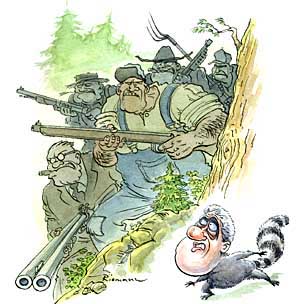

Although the campaign to scandalize and destroy Bill and Hillary Clinton involved politicians at the highest levels of the Republican Party, it also attracted freelance operatives whose motives were more pecuniary than ideological. During the 1992 election campaign, two of the most energetic of those in pursuit of scandalous allegations was a pair of raffish Arkansans named Larry Nichols and Larry Case.
A disgruntled former state employee fired at then-Governor Clinton’s behest after he got caught using a toll-free state phone to solicit funds for the Nicaraguan Contras, Nichols played a key role in bringing Gennifer Flowers’ allegations of her alleged 12-year affair with Clinton to The Star tabloid newspaper. (A musician and composer of ad jingles, Nichols shared the same talent agent with Flowers.) He later went on to national fame as the narrator and star of “The Clinton Chronicles,” a Jerry Falwell-sponsored videotape which alleged that the president was involved in drug-smuggling, money-laundering and murder.
Case was a colorful Little Rock private eye with a flair for searching out the sexual secrets of public figures.
Forming a sometimes uneasy partnership during the summer of 1992, Case and Nichols hooked up with several tabloid newspapers and television programs that promised to pay them top dollar for scandalous revelations about the Clintons. The team also formed mutually beneficial friendships with several reporters from the establishment press who were camped out in Arkansas that summer seeking information about the Clinton’s sex lives.
As was his custom, Larry Case tape-recorded virtually all of his telephone conversations with Nichols and his newfound media friends, which is perfectly legal in Arkansas. For reasons best known to himself, he turned those tapes over to the authors.
– – – – – – – – – – – – – – – – – – – –
–
Not long after Larry Nichols told reporters about the enormous sums the tabloids were prepared to pay for smut about Bill Clinton, he took on an informal partner to help him earn his share. Nichols’s new associate was Larry Case, the Little Rock private detective with a reputation for digging dirt on local public figures. The big, bearded Case was an inveterate gossip with a gleefully dim view of human nature; he operated on the assumption that everybody was guilty until proven innocent. He liked heavy-caliber handguns and microcassette tape recorders.
Between them, Nichols and Case quickly established ongoing relationships with the Star, the National Enquirer, and the TV programs “Hard Copy” and “A Current Affair.” Through Nichols’s extensive connections with Sheffield Nelson and the Arkansas Republican Party, the pair also formed jolly, mutually beneficial ties with reporters and producers from the Los Angeles Times, the Washington Post, Cable News Network, and other mainstream outlets. What few of his sophisticated new friends ever surmised was that Case habitually recorded his telephone calls, and often went around wearing a wire. This is perfectly legal in Arkansas. At times, he can be heard on tape assuring people he’s not taping them, when in fact he is. (Following a later dispute with Nichols, whom he derided as a liar, a fraud, and a cheat, Case decided to share his tapes with the authors.)
Case and Nichols hoped to get rich by derailing the Clinton campaign, a quest they began in early 1992 with great confidence. In Arkansas, private detectives are licensed and regulated by a division of the state police. Case had cultivated a few friendly troopers who slipped him copies of investigative materials, including surveillance videos from the 1985 drug case against Roger Clinton, the governor’s younger brother. Those tapes became a featured part of his inventory. Typically, Case’s potential customers from Washington and New York didn’t know that portions of those tapes had been broadcast on local television years earlier. For the right price, he bragged, he could produce videotapes that showed Bill Clinton himself sitting next to a bowl of cocaine at a party thrown by a flamboyant Little Rock financier named Dan Lasater. Due partly to evidence provided by Roger Clinton, Lasater had also gone to prison for possessing cocaine and giving the drug away to his friends. Case’s idea of this tape’s market value was more than a million dollars.
He and Nichols soon found themselves occupied full-time, frantically interviewing women of all ages and descriptions who were willing to accuse Clinton of sexual impropriety. With Case’s tape recorder silently running, the pair regaled each other with bawdy imaginings about everything from Hillary Rodham Clinton’s alleged frigidity to what would later be called the “distinguishing characteristics” of her husband’s genitalia. When Betsey Wright talked to the Washington Post about suppressing “bimbo eruptions,” she was thinking primarily of Case and Nichols.
The Case-Nichols conversations are reminiscent of “the Duke and the Dauphin,” those itinerant hucksters in Mark Twain’s “Adventures of Huckleberry Finn” who flimflam Arkansas yokels with vulgar tent shows. In 1992, however, it was the Arkansas yokels who tried to con the big-city sophisticates. As the campaign heated up, several reporters cultivated Nichols and Case for leads, but their most oddly symbiotic relationship was with William Rempel of the Los Angeles Times. Betsey Wright sensed that the California reporter “had an obsession and a mission to destroy Bill Clinton, and had the resources of a big organization behind him. I had never known that there were reporters whose full-time mission in life was destroying people.”
As he told Case and others, Rempel felt he was merely doing his job, that the public had a right to know whether a presidential candidate had a secret life. In that pursuit he seemed perfectly comfortable exchanging tips with a private detective trying to dig up scurrilous information for personal profit. (A regretful Rempel later said Case had dishonestly “duped” him into sharing information about allegations against Clinton. “I can say absolutely that nothing he told me in the weeks and months leading up to the 1992 election, nor in the months and years since, has ever influenced, informed or otherwise contributed to a single syllable of type in the Los Angeles Times,” he added. “I must confess to wasting a fair amount of valuable time [talking to the Little Rock detective].”) Acting on tips from Rempel, with whom he recorded scores of long, rambling conversations, Case spent a great deal of time and energy trying to persuade a thirty-eight-year-old Oklahoma woman to go public with her tale of an extended affair with Bill Clinton in the mid-1980s. As narrated to Case on the telephone, the story was improbable: Over a two-year period, the governor and his entourage of troopers slipped out of Little Rock forty to fifty times to meet her in a downtown Oklahoma City motel roughly four hundred miles from Little Rock, then nipped back without arousing undue curiosity. (State law requires the governor to notify the lieutenant governor whenever he leaves Arkansas.) How Clinton managed all this, Case never thought to wonder, possibly because the woman did mention a name familiar to him: Arkansas state trooper Larry Patterson.
According to the woman, who identified herself to Case as Michelle Purdom, Clinton used the alias “Bill Wilcox”; she’d thought her secretive lover might be in the Mob. Lately, she said, both the National Enquirer and the Los Angeles Times had been pestering her to go public with her charges. Both newspapers had been tipped off by a disgruntled former employee of a certain Louwanda Faye Mason, who was some relation to Michelle. Louwanda had since moved to Southern California.
But the disgruntled former employee-whose identity Case failed to weasel out of Rempel-identified not Michelle but Louwanda herself as Clinton’s Oklahoma paramour. He was also said to have described a photograph of the nude or partially nude candidate, sufficiently revealing to give a clear view of those “distinguishing characteristics.” Case desperately wanted to put his hands on this valuable item. But first he needed to get the cast of characters straight. Posing as a journalist, he phoned Michelle in April 1992, pretending to have seen a copy of the infamous photo.
“There’s a lot of question about who the hell everybody is,” Case told her. “Everybody thinks that Louwanda is you. Everybody thinks Louwanda is the one that was involved with Bill Clinton.”
“That’s not true. I’m not Louwanda, Louwanda’s not me. She’s a separate person,” Michelle insisted. “As far as I know, she never saw him. I don’t know how she ever could have. Him and I had a personal relationship. I didn’t just have sex with him just for nothing. I cared about him. He cared about me. We had a personal relationship. I wasn’t just a sex bunny to him…. I think he makes personal relationships with the people he sleeps with.”
“Everybody thinks that everybody’s somebody else.” Case was becoming frustrated.
“That’s just not true. Louwanda had nothing to do with this. Believe me. I don’t like Louwanda,” she said. “I wouldn’t do anything to cover for her.”
“Then why did she call you when I contacted her?” he asked.
Michelle launched into a complicated explanation, which boiled down to gossip from a third relative. When a Los Angeles Times reporter had presented himself at Louwanda’s door, “she knew it was me,” Michelle insisted. “Louwanda shut the door in the L.A. Times guy’s face. But he came back again. And she told me, ‘This is not gonna work, you’re gonna have to talk with this guy.’ Then he called me, and it’s gone on from there.”
Meanwhile the Enquirer, she told Case, had offered her $75,000 for her tale, and twice that if she could somehow corroborate her claims. “He’s not gonna give me $150,000,” she said, “if I can’t prove it was me…. But see, if there is no proof, I don’t want to talk for $500,000. Because one, I don’t want to get on TV and be called a liar and be shredded apart. But if somebody has proof….”
“I have seen it,” Case fibbed. “But nobody seems to know who anybody is. Everybody’s talked to a different Louwanda.”
“But see, her and I kind of look alike,” Michelle insisted. “We both have an oval kind of face. We both have large lips. We both have a small, puggy-type nose. We both have blondish-colored hair. We’re both a little chesty. We’re both short, about five-two, five-three.”
“Is there anybody who remembers you?”
“Larry Patterson would. Does he still work for him? But he wouldn’t say nothing.”
“What name would he remember?” Case asked.
“I don’t know,” she admitted. “It wouldn’t have been Michelle Purdom. It could have been Suzanne James. It could have been Michelle James…. See, I have some blockages in my mind. Some things I just don’t remember real clear. It could have been that name, I don’t know.”
Michelle not only couldn’t remember her own name, but at some points she said ledgers could exist that show a “Bill C.” paying $30,000 for her services; at other times she insisted that theirs was an affair of the heart, and that while her famous paramour bought her little presents, money never changed hands. She did affirm, however, that as Gennifer Flowers had already told the world, the candidate was very good in bed. Although she claimed that Clinton had eventually revealed his identity, she hadn’t realized he was married until she saw Hillary on TV. That upset her greatly, as she had a firm policy against dating married men. She wanted to know more about the mythical snapshot. “Was it a small woman or a large woman?”
“It was a busty woman,” Case chortled.
“I’d like to see if it was me,” she said. “Couldn’t you get a driver’s license picture flashed up on the screen? I’m very unphotogenic. I kind of look like a Barbra Streisand and a Goldie Hawn and a Suzanne Somers. I don’t have Barbra’s nose, but I do have her mouth, I have Suzanne Somers’ facial shape, and Goldie Hawn’s nose. You think of her when you look at me sometimes.”
That was as close as Case ever got to the elusive photo. When Case tracked Louwanda down in California, she insisted that she’d never met Bill Clinton, never met anybody who said he or she knew Bill Clinton; indeed, she had never heard of the candidate until she’d seen him on TV. Louwanda also hinted that Michelle had what she called “problems” that might account for the inconsistencies in her story.
Several months later, Case and his fellow investigators learned the nature of Michelle’s “problems.” On July 25, 1992, Michael Isikoff wrote an article for the Washington Post detailing the Clinton campaign’s success in quelling “bimbo eruptions.” In it, he quoted Case saying he had been paid $500,000 — a huge exaggeration — by “three separate news organizations” to investigate Clinton’s sexual behavior. Isikoff also chronicled the work of San Francisco private investigator Jack Palladino on behalf of the Clinton campaign. According to Betsey Wright there had been nineteen new allegations from women purporting to be Clinton’s ex-lovers, in addition to seven earlier ones, since the Democratic convention two weeks earlier. “Since the convention, the gold-digger growth is enormous,” Wright told the Post.
She drew a distinction between rival candidate H. Ross Perot’s reported use of private detectives to investigate business and political rivals, and the Clinton campaign’s counterintelligence operation against tabloid journalists and Republican operatives. “I don’t think I’ve used [Palladino] on anything except bimbo eruptions,” Wright claimed, in a phrase that to her chagrin passed instantly into the political lexicon. “We’re trying to do a self-defense thing.” She described the $28,000 paid to Palladino as “legal expenses.”
Isikoff cited as Palladino’s greatest triumph his debunking of Larry Case’s taped interview with “a 38-year-old Oklahoma City woman” who claimed to have had an affair with Clinton. “Shortly after the interview,” he wrote, “Palladino flew to Oklahoma City and took a three-page affidavit from the woman flatly denying the account. The woman said in a recent interview that she told Palladino she had never met Clinton and that she had been ‘tricked’ by Case after she had had surgery to remove a brain tumor. The tumor had caused her to suffer from ‘amnesia’ and a ‘multiple personality disorder,’ accounting for her willingness to agree to Case’s suggestions that she had had an affair with Clinton, the woman said.”
Of all the bad things that had been written and said about Case, nothing irritated him like the notion that he’d badgered a woman into making up a phony story over the telephone. Clearly, he hadn’t. The woman had eagerly volunteered her tale. “They make her look better than me,” he moaned to Rempel, “and hell, she’s the damn nut.” Despite the fact that Isikoff had been spending a good deal of time with Larry Nichols, Case assured Rempel that the Post reporter was “a wiseass, and a big-time Clinton buddy.”
More consequential than detectives or brain surgery in persuading Michelle to abandon her unlikely story, perhaps, was something Isikoff didn’t report: the extensive history of arrests of both Michelle and Louwanda, under several pseudonyms, for prostitution.
Betsey Wright had been dealing with allegations like these for as long as she’d worked for Bill Clinton. Born and raised in Texas, Wright had first met Clinton in 1972, when he worked in Austin for George McGovern’s presidential campaign. After managing his comeback campaign for governor ten years later, Wright remained in Arkansas to serve as both mother hen and political commando. Although it’s been widely reported that she confronted Clinton with a “bimbo list” in 1988, persuading him to forgo a presidential bid, she insists that never happened.
“There was no list,” she said. “I discussed the issue with him. I didn’t see any opening in 1988. I thought it was a long shot. Even in 1992, I didn’t think the race should be run, because of what would happen to Hillary and Chelsea. Listen, the guy represented generational change. He was a baby boomer. He’d been on campuses during the Vietnam War. He did not go to Vietnam. He had been on campuses when birth control pills were first invented, and, quote, free sex, unquote, became a big deal. He had a brother who had gotten in trouble with drugs, and he was on campuses when drugs were used. He was attractive to women. There were a million rumors, and there were lots of people who would be willing to make allegations.
“I just knew that there was no way we were going to make that kind of generational change in this country without a struggle. That was what was going to happen to the first baby boomer who got out there by himself.”
Early on, Wright’s reluctance had kept her out of the 1992 presidential campaign. But as a resident at Harvard’s Kennedy School of Government during the early weeks of 1992, she found herself transfixed in the middle of the New Hampshire media market. Then, having tried in vain to alert the campaign to the dangers posed by the likes of Larry Nichols and Gennifer Flowers, she was recruited by campaign lawyer Mickey Kantor on the morning after the crucial primary. Within days, she was back in Little Rock, organizing counterintelligence against Nichols, Case, and their journalistic allies.
Stifling Michelle and Louwanda wasn’t Wright’s only success. Another was Connie Hamzy, aka “Sweet, Sweet Connie,” Little Rock’s most notorious rock groupie. During the seventies, Hamzy had achieved minor national notoriety thanks to a song by a band called Grand Funk Railroad. According to the lyrics, “Sweet sweet Connie was doin’ her act / Had the whole band, and that’s a natural fact.” An inveterate publicity seeker, Hamzy was once the subject of a Cosmopolitan profile marveling at her sexual escapades. (Her interview included evaluations of the penis sizes and copulative skills of various rock stars.) Nothing could keep Hamzy from running to tabloid TV with a tale about Clinton passionately pursuing her, but Wright prevented the story from appearing anywhere else.
It was much the same with Sally Miller Perdue, a fifty-three-year-old former Miss Arkansas. Regarded as kooky and unreliable by most reporters in her hometown of Pine Bluff, Perdue had once kicked off a quixotic campaign for mayor with a press conference strenuously denying that she was a lesbian-a charge nobody present had ever heard. Not long before the Democratic convention, the Clinton campaign learned, Lenora Fulani of the fringe New Alliance Party planned to launch her own presidential candidacy in a joint appearance with Perdue, who would detail what she claimed had been her own passionate love affair with Bill Clinton. The New Alliance Party was a strange, quasi-Marxist group based on Manhattan’s Upper West Side, whose members were mostly psychotherapy patients of the party’s leaders. (Eventually it dissolved into another group that was simultaneously allied to Louis Farrakhan and H. Ross Perot.) Behind the scenes, Nichols and Case had helped broker the deal between Perdue and the eccentric New York activists. In their phone conversations, the two Arkansans had a derisive nickname for the New Alliance Party: “the Snake Doctors.”
Clinton denied ever having met Sally Perdue. Assisted by Wright, the Palladino firm lined up several relatives and former associates who agreed to talk to reporters about the woman’s eccentricities. The tactic succeeded. Although Perdue made an appearance on the nationally syndicated Sally Jessy Raphael TV program, no major news organization gave credence to her account.
The National Enquirer, of all papers, derided Perdue’s tale under the headline “WEIRD CULT OUT TO DESTROY CLINTON.”
Betsey Wright’s success in stifling Clinton sex stories drove Case and Nichols crazy. Having been in close contact with an Enquirer reporter named David Duffy for several months, the pair could not understand the tabloid’s motives for debunking Sally Perdue. “Tell me this world ain’t upside-fucking-down,” Nichols growled. “I’m still trying to fathom why Duffy put an unfucking story in the Enquirer.”
“I know why he did it,” Case said hopefully. “To shake some fucking people out of the bushes that know about the affair.”
Nichols suspected darker motives. “What I think, and I talked to [Bill] Rempel and he agreed. I told him if you want to see the unstory of the fucking century. I told you Duffy told me he was waiting to get his orders from the top. And I’m gonna guaran-fuckin’-tee you it’s gonna be…”
“A whitewash?” Case guessed.
“Yup.”
“It’s kinda terrible when you have a tabloid running a whitewash.”
A more immediate setback involved the saga of yet another woman, named “Denise,” who claimed that Bill Clinton had beaten her up during a sexual liaison at Little Rock’s Excelsior Hotel. Partly at Case’s insistence, the allegation had been previously investigated by the Pulaski County prosecuting attorney and found to be without foundation. The woman herself had filed no complaint. But Case had in his possession a photocopy of what purported to be a handwritten letter from Clinton to “Denise,” apologizing “for getting rough with you last night,” and signed: “Your friend, Bill.”
Anticipating a big payday, the detective had flown to California at the behest of the tabloid TV program “A Current Affair” and surreptitiously used a hidden camera to videotape an interview with the woman. The program’s decision not to broadcast his tape — or pay him — was exasperating. Case phoned producer David Lee Miller and accused him of having been bought off by Betsey Wright and Jack Palladino.
“I’ll take it to the fuckin’ FBI myself!” Case shouted. “I will bring this thing to a head. I’m not no wayward, dumb son of a bitch that don’t know how to operate. And if I have to accuse people to get my work done, I’ll do it. I want the truth put out about the fuckin’ tape. I want the truth put out about the fuckin’ letter. I don’t know if the letter’s right. Nobody knows if the letter’s right.”
“If I thought the letter was right, we’d do it,” Miller replied coolly. “Larry, we paid handwriting experts a lot of money to look at the letter, and it came back bogus.”
“Isn’t it a story that somebody’s out there trying to pass bogus letters? Put me on the air. Put Betsey Wright on the air. Ask Clinton to come on. Ask Jack Palladino to come on the air. Ask them all to take a fuckin’ polygraph. If people can’t see through what this man can do because he has the power and money, they’re crazy.”
“We looked at the story in good faith because we thought it might be true,” Miller patiently explained. “We wouldn’t have gotten into it if we didn’t. We spent a lot of time and money, and we talked to a lot of people involved in the case. If the story can be confirmed and corroborated, we will run with the story. But right now it isn’t, and we can’t use it.”
Ordinary news standards, honored in some respects even by tabloid media, confused and upset Case and Nichols. Yet they could sometimes see the humor in their situation: On one tape, Nichols can be heard telling Case about coaching yet another eager informant on how to present her story of a torrid love affair with Clinton to the press. Above all, Nichols laughed, he had warned her to avoid any mention of the “demons” that were haunting her.
Often frustrated by the media, the two Larrys were no more enamored of the Republicans who were feeding rumors to Nichols. He mentioned Sheffield Nelson and Cliff Jackson, a local Republican lawyer whose distaste for Clinton dated back more than twenty years. “God, those guys are sick,” Nichols told Case on the day Isikoff’s story appeared. “Jackson and Nelson. They want to stick it to Clinton so bad they can’t hardly see straight.” In the Post article, Betsey Wright had blamed local Republicans for the bimbo glut. “One of these days,” Nichols chuckled, “I’m just gonna probably give Betsey a kiss, and tell her it is coming from them.”
The tantalizing question of how the prostitute “Michelle” knew the name of Trooper Larry Patterson, a member of Clinton’s security detail, was a mystery Case and Nichols never solved. Case spent hours cultivating acquaintances at Arkansas State Police headquarters who he thought could give him the lowdown on the governor. At one point, Nichols convinced him that Clinton’s bodyguards actually had placed a battery-operated radio transmitter in a vase somewhere inside the governor’s mansion. All Case needed to do, said Nichols, was slip into the building and replace the batteries.
More to the point, Nichols believed that for the right inducement, some of the troopers might be persuaded to expose their employer. “The main ones I’ve been talking to are [Carl] Kirkland and Patterson. I think they’ll talk,” he said.
“One of them can retire,” Case suggested.
“I think it’s Patterson, the white guy,” Nichols said. “He’s obviously in the middle of it, but… I figured him to be like Buddy.” Nichols was referring to Buddy Young, the head of the governor’s security detail. “You know that sumbitch ain’t gonna crack. You know, most policemen are trained liars.”
“They better be, hadn’t they,” opined Case, “dealing in this kind of shit.”
Significantly, Case also had extensive conversations with Bill Rempel about the possibility of “turning” Clinton’s bodyguards. He told the reporter about the hidden bug in the governor’s mansion, and discussed a scheme to slip into the building on some pretext to activate it. Supposedly, the device was located in the bathroom of the Clintons’ living quarters.
“What would it have besides the sounds of the john?” Rempel asked. “Which is certainly not something I’m interested in.”
“You’ve come up with some stuff before that I’m not interested in,” retorted Case, “and that’s the size of somebody’s private parts. And I ain’t figured that shit out yet. I know you ain’t gonna write about that.”
Rempel guffawed. “That’s the kind of information I’m just going to have to keep to myself,” he agreed. “A family newspaper is just not the place for that.”
It was, however, the kind of information Rempel had gone out of his way to obtain. In another of their tape-recorded chats, Case badgered the reporter for information on that very topic. Rempel had told him that an anonymous source claimed to have seen a sexually explicit photograph of Clinton in bed with a woman. If he flew to California and managed to put his hands on the photograph, the detective wanted to know, how would he recognize the real thing?
Rempel replied that Clinton had a large mole “in an area that normally wouldn’t see that light of day…. I have extensive descriptions, as you know.”
“You say you don’t want to use tabloidism,” Case chided, “but this sounds like tabloidism.”
“I’ll gather it. I’ll ask all the questions and get all the information,” the reporter answered. “But what I put in the newspaper will always be less than what I know.”
“…. There’s a face in it?”
“Yeah, there’s no question about it. There’s more than a face,” Rempel laughed. “You know what I mean.”
“You can get somebody’s body,” Case cautioned him. “I may have one on mine. I haven’t looked lately. Haven’t had the opportunity.”
“But there’s a face to go with the mole,” Rempel insisted. “It’s a full-body shot.”
Neither man had ever seen this racy photo; neither ever would. As was his and Nichols’s custom, Case had no compunctions about embroidering information he’d gleaned from Rempel and passing it along to other reporters. Soon after their discussion about this “distinguishing characteristic,” CNN correspondent Art Harris showed curiosity about the same topic. He was reporting a rather damaging profile of Gennifer Flowers to accompany a photo layout in Penthouse.
“Did either of them [Michelle or Louwanda] describe Bill’s equipment,” Harris inquired, “and how big or little it was? Because I know from other sources….”
“I heard his equipment was rather dainty,” Case laughed.
“Yeah, you got it.” Harris laughed, too. “And that he makes up for it with a lot of oral sex.”
“That’s exactly what Michelle says,” Case assured him. “She says that she agrees with everything Gennifer says because that’s exactly how he is. She says that on the tape now!”
In fact, Michelle didn’t say anything about oral sex or Clinton’s penis. But then Harris had explicitly asked Case if he was taping their conversation, and been solemnly assured that he was not.
Not all of Case’s conversations with Rempel were as friendly and jocular as those concerning the candidate’s “equipment.” Rempel was annoyed when he learned that Case and Nichols were passing his information to other reporters. Although Case pressed him repeatedly for the names of his sources, the reporter never relented. When the frustrated detective demanded to know what kind of proof would justify publishing a story about Clinton’s alleged misconduct in Rempel’s newspaper, the reporter categorically refused to tell him. Plainly, he suspected Case and Nichols might manufacture the required evidence.
Meanwhile, the continuing effort by Case and Nichols to persuade Clinton’s state police bodyguards to accuse the governor of sexual misbehavior was also getting nowhere. All they had accomplished was to supply Rempel with the names of several troopers they thought might be amenable to persuasion. For the time being, none was yet willing to risk making public accusations against their boss, who might become president.
As the campaign summer wore on, in fact, it was beginning to look as if Case and Nichols would never make their big score. They had received minimal remuneration, if any, since Nichols’s payment from the Star in January. In early August, however, Case got an exciting phone call from Little Rock lawyer Cliff Jackson.
A Fulbright scholar at Oxford while Clinton was a Rhodes scholar there during the late sixties, Jackson had developed an obsession with what he saw as Clinton’s character flaws. Others speculated that the somewhat dour Jackson had always been jealous of his fellow Arkansan’s seemingly effortless charm, and had resented traveling all the way to England only to find himself in Clinton’s shadow. Back home, Jackson’s own political career had never gotten off the ground. He had run for Pulaski County district attorney some years earlier and done poorly.
During the 1992 campaign, Jackson developed a national reputation in media circles as a principled Clinton opponent who knew his old rival all too well. A member of the fundamentalist Assembly of God church, he held political views that were roughly in accordance with those of the religious right. During the New Hampshire primary, an organization formed by Jackson called the Alliance for the Rebirth of an Independent America had taken out full-page ads in the Manchester Union-Leader and distributed circulars that assailed Clinton as an unpatriotic draft dodger.
Washington Post reporter and Clinton biographer David Maraniss, the author of “First in His Class,” took Jackson’s opinions most seriously-despite the fact that, as his own careful reporting of the draft controversy proved, Jackson’s accounts of his Oxford classmate’s struggles with the Selective Service System were at least as self-serving as Clinton’s.
Jackson had provided Maraniss with several contemporaneous, but not particularly reliable, letters he had written on the subject in 1967. Specifically, in his letters Jackson had exaggerated his own role in assisting the candidate’s efforts to avoid induction. He had also provided an inaccurate chronology obscuring the fact that, partly out of guilt over the Vietnam combat death of a high school friend, Clinton had surrendered his draft deferment two months before drawing a high lottery number in December 1969. For all of Clinton’s efforts to avoid the draft, surrendering his deferment had been unusual back then. (Jackson himself got a medical deferment.)
Now the high-minded Jackson wanted to offer Larry Case something less elevated: a photograph sufficiently explicit to doom Clinton’s candidacy and end his political career. He wouldn’t tell Case who had this picture, but he wanted the detective to broker a lucrative deal.
“Is the photo good?” Case asked. “I mean, is it better than what we’ve seen around here? Because I’ve seen a bunch of photos, but nothing that’s really spicy.”
“This one is spicy,” Jackson assured him. “I haven’t actually seen it, but I know what’s in it. I don’t want to say over the phone, because that’ll identify her to the Clinton people if my phone were bugged. Or yours.”
“Aw, they wouldn’t do that,” Case said in a mocking tone.
“Bullshit.”
“Shit,” Case laughed. “I can’t go out this door that ol’ Betsey Wright don’t already know what I’m doing.”
“I told them that I didn’t want to get in the middle of this type stuff,” Jackson said. “That I’d pass it on to someone who can say what the market is. I’d put them into direct contact…. Let me just tell you this. My perception of it? If it’s what’s been represented to me, it ought to be worth two million…. If this woman has what she says she has, it’d be totally incriminating…. I think it’d absolutely do in the campaign.”
Jackson’s client — a friend of a friend, he said — wanted cash; no checks, no wire transfers. The lawyer wanted his own fingerprints kept off the deal, but he also wanted it done. Before he took another step, Case called Rempel. “Did you have Cliff Jackson make a run at me?”
“No, I didn’t,” Rempel replied. “I was surprised to hear you guys got together.”
“We didn’t get together on my call. And I assure you, I can play you his call.”
The reporter laughed. “I’m sure you could. You could probably play this call.”
Case denied taping Rempel. “He initiated the call. I don’t know if he was trying to trick me. But I wouldn’t burn him.”
“One thing about Cliff Jackson,” said Rempel. “I’ve never known him to lie or exaggerate. He’s about the straightest man I’ve met in this state.” The reporter told Case he hadn’t seen the photograph, but if Jackson vouched for it, that was good enough. Thus encouraged, Case phoned an editor at the National Enquirer. Like many tabloid journalists, David Duffy spoke with a brisk British accent. Having been falsely promised raunchy photos of Clinton by the detective on an earlier occasion, he was understandably leery.
“She might as well stick it in her left ear,” Duffy said, “until we’ve satisfied ourselves that it’s a picture we want to buy. And if it’s the genuine article, Christ, you’re right. ‘There’s Bill Clinton. He is in bed with a woman.’ Then you start to negotiate, and it’s a very straightforward piece of negotiation…. We would not part with any money until I get that picture. Unless she’s an imbecile, she can get the phone number of the National Enquirer from the papers. She must be a real nutcase if she doesn’t know how to make a telephone call.” His doubts proved prophetic. The $2 million picture never materialized. And Rempel, though fully aware of Jackson’s attempt at brokering this deal, continued to describe him as a principled, thoughtful critic of Clinton’s character. “Jackson said he regretted making the call to Case and said it made his skin crawl to be involved even that much,” the reporter explained. “I believed him.”
