
Hillary Rodham Clinton

Impeachment's little elves

How a pack of conservative lawyers used Matt Drudge and Clinton-accuser Kathleen Willey to scuttle a deal in the Paula Jones sexual harassment case.

  • more
    • All Share Services

Impeachment's little elves

If the lawyers for Paula Jones and President Clinton had reached a
settlement during the summer of 1997 — an outcome both sides were trying to
achieve in good faith — the nation would have been spared the Monica
Lewinsky affair
and the impeachment fiasco that followed. Jones’ attorneys, Gilbert Davis
and Joe
Cammarata, thought they could work out a deal with Robert Bennett, the
President’s high-priced private counsel.

But a settlement, no matter how favorable to Jones, wouldn’t have served the
political purposes of the so-called “elves,” an informal group of conservative attorneys who were secretly assisting her case. At a delicate
stage, the settlement discussions could be scuttled by creating distrust
between the Clinton and Jones camps. And there was no better way to raise
tensios among the lawyers than by leaking sensitive investigative material
about the president to the press.

This was explosive stuff, not wholly reliable but very juicy, and known only
to a few insiders. It was to be used only if a settlement was impossible. Or
so Davis and Cammarata believed– until they came to suspect, much later,
that they had been deceived not by the Clinton attorneys, but by their own
clever little friends.

- – - – - – - – - – - -

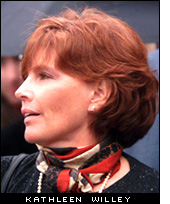
On July 25, 1997, Joseph Cammarata and Gilbert Davis moved to subpoena Kathleen Willey. Although their settlement negotiations with Robert Bennett had progressed slightly, both sides remained stuck on what kind of statement Clinton might issue to satisfy Paula Jones’s need for an “apology.” The Jones lawyers hoped to strengthen their bargaining hand with the threat of a devastating new witness. The mercurial Bennett reacted to the subpoena by threatening to withdraw from the negotiations. Any exposure of Willey’s claims, he warned darkly, would be a deal breaker.

Like his client, Willey’s lawyer Daniel Gecker had been cultivating both sides, talking to both Cammarata and Bennett. With Cammarata he had discussed ways to “preserve Willey’s testimony” without a subpoena, such as obtaining her affidavit. From Bennett he had sought a promise that the White House wouldn’t publicly attack Willey if she resisted testifying for Jones. Still insisting that she was a “reluctant witness,” he filed motions to quash the subpoena, claiming that she had no information relevant to Jones’s complaint.

Under additional pressure from the two insurance companies that were paying most of Clinton’s legal costs, the settlement talks intensified. There was one scenario where everyone could minimize their losses: Jones and Clinton would settle, Willey would remain silent, and the White House would release no derogatory information about her.

The worst mistake Davis and Cammarata made was to confide all those sensitive details to their behind-the-scene advisers, a little group of committed conservatives led by Philadelphia lawyer Jerome Marcus. (It was Marcus’s name that appeared most often on the time sheets kept by the Jones lawyers, although they frequently spoke and communicated with George Conway in New York, and less often with Richard Porter in Chicago.) Both men valued the assistance donated pro bono by the group, though they had believed from the beginning that Conway, Marcus, and Porter all were motivated more by hatred of Bill Clinton than by any desire to rescue Paula Jones. Yet Davis and Cammarata, although Republicans themselves, wouldn’t countenance the misuse of their lawsuit to advance a partisan agenda. They took their duties as officers of the court seriously, and consistently placed their client’s interest ahead of politics. They had also assumed that the advisers would behave honorably despite the fact that all three had insisted upon keeping their work in support of Jones secret from their own law partners.

Cammarata and Davis treated the group with absolute trust, faxing internal documents to them and often including them in strategic discussions as negotiations with the president’s legal team proceeded. According to Davis, both Conway and Marcus knew about Kathleen Willey, and they certainly understood that public exposure of her allegations would badly complicate any prospects of a settlement. He simply expected them to keep their mouths shut. “There were many times back then that they were both on the phone with us on conference calls,” he said. “We talked as lawyers. They did good, workmanlike work and we just assumed that they would keep all information confidential.” In Davis’s view, “Working with us, they were ethically required to do that, just as if they were attorneys of record on the case.”

If Conway or Marcus did not feel bound by such strictures because they weren’t in fact Jones’s attorneys of record, neither ever said so to Davis or Cammarata. They did urge the Jones lawyers, more than once, to keep quiet about their own identities. “We didn’t put Conway’s name on our time records, but we talked with him extensively,” recalled Davis. “There were numerous times when he and Marcus were both on the phone with us in conference calls.”

Those calls provided useful guidance and consultation to the Jones lawyers, as Davis would readily admit (although he understandably took umbrage later when Isikoff suggested that he and Cammarata were small-time practitioners who would have been lost without all the outside help). Youngish hotshots who had gone to better schools and made partner early at important law firms, Marcus and Conway both exhibited a brash self-confidence.

Marcus’s own wife had thought him “arrogant” from the day they met. At the University of Chicago Law School, where he had been friendly with Richard Porter, Marcus had been the kind of student who needed to shout out answers before the professor called on him. After graduating in 1987, he had eventually joined Berger & Montague, a heavily Democratic firm specializing in the kind of corporate tort lawsuits that Republicans have long tried to stifle. (Both name partner Daniel Berger and his son, also a firm partner, were personally friendly with Clinton; together, they donated almost $175,000 to the Democratic Party during the 1996 election cycle.) A registered Democrat married to an “inveterate liberal” and living in a Philadelphia suburb, Marcus was an unlikely anti-Clinton conspirator. But he despised Clinton profoundly, had voted for Bush in 1992, and had made his views known in articles for the Washington Times. It was Porter who brought him into the Jones clique early on, as a specialist in the constitutional separation of powers. Having helped put together the Jones legal team, Porter had foreseen the need for expert advice to counter Bennett’s argument that the president cannot be sued while in office.

Though a few years younger than the others, George T. Conway III was even more successful and considerably higher profile. In his early thirties, he had made partner at New York’s Wachtell, Lipton, Rosen & Katz, one of the biggest and richest litigation shops in the country. His primary occupation was defending the major tobacco companies, and he reportedly made as much as $1 million a year doing it.

With his name and Yale Law School degree, Conway looked on paper like a scion of old wealth; he was in fact the middle-class son of an electrical engineer from suburban Boston. Short, dark, slightly overweight, and painfully shy, he was also, at the age of thirty-three, unmarried and without a regular girlfriend at the time. He aspired to date tall blondes, preferably of the conservative persuasion. Laura Ingraham, the woman he was pursuing in 1997, epitomized that desire. The willowy Ingraham had become a budding celebrity early in 1995 when the New York Times Magazine profiled young Washington conservatives, featuring her on the cover in a fetching leopard print miniskirt. For Conway and other right-wing males of his generation, she was an intellectual pinup.

He began to pursue her several years after both had clerked for Ralph Winter, a federal judge and leading patron of the Federalist Society. Conway’s magnanimous courting behavior included inviting Ingraham on all-expense-paid ski trips and island holidays. On a Caribbean trip they once ran into Bob Bennett, an embarrassing moment for Ingraham. Before commencing her television career, she had been an associate at Skadden, Arps, Slate, Meagher & Flom-the firm where the president’s lawyer was a partner and her friend.

Evidently it was Ingraham who connected Conway with Matt Drudge during the summer of 1997, though she and the tobacco lawyer insist they played no part in the Internet gossip’s Willey scoops. Fascinated by the Drudge Report, as so many in Washington were, Ingraham had befriended its author after they met at the White House Correspondents Association spring awards dinner. In late June, she and David Brock hosted a gala dinner party at Brock’s Georgetown townhouse, with Drudge as guest of honor.

About two weeks later, when Drudge returned to spend the Fourth of July weekend at Ingraham’s home in northwest Washington, she presented him with a new source and a valuable scoop. Two knowledgeable sources affirm that on the evening of July 3, Ingraham took down the details about Kathleen Willey from Conway over the telephone while she and Drudge composed his stunning holiday “exclusive” about Isikoff’s investigation of alleged sexual harassment in the White House. He headlined it “Ants in the Picnic Basket.”

But Ingraham, who was working as a commentator for CBS News at the time, said she hadn’t brought Conway to Drudge. “Believe me, if I had been a player or a source that first helped expose the lengths to which the President would go to save his own skin, I would have already claimed credit for it.”

And Conway was just as emphatic in an August 1999 letter to the authors: “I never received any confidential information from Mr. Davis and Mr. Cammarata; nor did I ever provide such information to Mr. Drudge.” He also insisted that he had never tried to “scuttle any settlement discussions” in the Jones case, because he had believed that settlement “was strongly in the interests of both sides … .”

Nevertheless, there is reason to believe the source’s account of that July 4 weekend.

Drudge’s July 4 blind item about Kathleen Willey and the issuance of a subpoena to her had shaken up the president’s lawyers, who now pressed for a deal. Then, on July 28, Drudge posted a “World Exclusive” that Gil Davis believes was planted to disrupt the delicate negotiations.

“WILLEY’S DECISION: White House Employee Tells Reporter That President Made Sex Pass,” the headline proclaimed. The brief item had just enough detail to infuriate Bennett-and to sharply prod Isikoff, whom Drudge accused of “holding back” the “explosive story.” It explained that Willey still refused to go on the record with the “Newsweek ace investigative reporter” about her allegation that Clinton had “fondled” her. In the week that followed, Drudge posted four additional stories. On July 29, he confirmed that Willey had indeed worked in the White House, and added in his own peculiar language that “the President made sexual overtones towards her as she made her request [for a job], according to intelligence familiar with her conversations with a reporter.” Two days later, Drudge had the Willey subpoena, as did CBS News and several other news organizations, adding, “If Willey tells lawyers the same story she has told Isikoff-Washington will be rocked.” Meanwhile the Web gossip had demoted his new rival to “Newsweek’s once ace reporter.”

On August 1, Drudge featured Gecker’s public announcement that Willey intended to resist the Jones subpoena. In an aside, he attacked Isikoff again, blaming the reporter for the leak of the Willey story and suggesting that the story wouldn’t have appeared without Drudge’s intervention. He seemed to mock Isikoff for talking too much: “Reporter shares, he likes to have friends on all sides so he’ll seem all-knowing for stories that he’ll probably never print.”

As he scrambled to get into print with the story Drudge had purloined, Isikoff naturally wondered how this disaster had befallen him. Tripp thought he had leaked Willey’s name himself, and she wasn’t entirely alone in that suspicion. That insinuation enraged Isikoff, who insisted he had told no one but his editors and a couple of trusted colleagues. Maybe, he thought, Drudge had hacked into the magazine’s computer system.

Or else someone had gotten impatient waiting for Newsweek to publish the Willey story. Someone with both the inside knowledge and the motive to disrupt a negotiated settlement of Jones v. Clinton. By the time he wrote Uncovering Clinton, Isikoff had deduced the source and motive behind the Jones leaks. In the book he quotes Ann Coulter — another blonde conservative attorney, media figure and, also like Ingraham, a member of George Conway’s circle — about the dread inspired among Jones’s advisers by the prospect of a settlement.

An outspoken enemy of the Clintons who consulted on political strategy with Conway, Coulter admitted that they had given various journalists the story of the “distinguishing characteristic” of Clinton’s penis, supposedly observed by Jones when he exposed himself to her in 1991. The reason, as she eventually explained to Isikoff: “We were terrified that Jones would settle. It was contrary to our purpose of bringing down the President.” (Later still, in confirming that leak to the Hartford Courant, she remarked that her work with Conway and his colleagues had amounted to “a small, intricately knit right-wing conspiracy — and I’d like that clarified.”)

Coulter claims that she helped Conway and Marcus with legal research in the Jones case, but according to Gil Davis neither he nor Cammarata ever heard of her while they were working on the lawsuit. Both felt that there was no permissible reason for any of the attorneys to have revealed confidential information to Coulter.

In addition to Coulter’s boasting, there is documentary evidence that Conway operated in such a way as to frustrate a settlement-even after Davis and Cammarata had resigned from the case. On October 8, 1997, Conway sent a long E-mail message via America Online to Matt Drudge.

“Subject: Your Next Exclusive” is the caption on that message. “Remember me?” it begins. “I’m Laura’s friend. We talked once about Kathleen Willey … This is being given to you, of course, subject to your not disclosing the source.” (Conway forwarded the same message to Ingraham the following day.)

The main topic of the October 8 message was not Willey but the “distinguishing characteristic,” a matter nearly as sensitive as the Willey allegations. Like Coulter, Conway must have realized that with the leak of its details to Drudge, any further settlement negotiations could again be disrupted.

Davis certainly thought so. “Conway’s leaking of this stuff certainly jeopardized a settlement,” said Davis after examining the Drudge E-mail in 1999. “I had no concept, no idea that they did or would do such a thing [as to leak Willey's name].”

With his exclusive blown by Drudge, Isikoff moved fast to capitalize on his inside information about the Willey matter. Her lawyer Gecker told him to forget about Willey going on the record, and added that it was “a horrible injustice and invasion of privacy” for the press to explore his client’s personal life. Worse still, when Julie Steele returned Isikoff’s call on the morning of July 31, she administered a crippling blow to her friend’s credibility. According to her sworn affidavit in a lawsuit she filed in 1999 against Newsweek and Isikoff, Steele told the reporter that Willey had asked her to lie about the alleged incident when he first interviewed them both in March 1997. In truth, Willey hadn’t “mentioned her so-called encounter with the President in the White House on the day that it had allegedly occurred or at any other time.” She apologized to Isikoff for lying and said she didn’t want him to have “egg on his face” for publishing her friend’s phony story.

Steele contended that he called her back in the afternoon, telling her that their morning interview was going into his story with quotes from her. That stunned Steele, she later said, because he had agreed earlier that their conversation was “off the record.” She recalled Isikoff explaining that “there’s so much pressure to get this out … I have to do it.” (Isikoff and Newsweek have denied he ever agreed not to quote Steele.)

The following day, Isikoff contacted Tripp to get her version on the record. Meeting in a coffee shop, she told the reporter he could quote her saying that when she ran into Willey that day in the White House, the Richmond widow was “disheveled. Her face was red and her lipstick was off. She was flustered, happy and joyful.” She also wanted Isikoff to state that she had come forward “to make it clear that this was not a case of sexual harassment.”

Bob Bennett, who had been trying without success to speak with Tripp, wasn’t grateful to her for making that distinction. Denying that Clinton did anything “improper” with Willey, he declared that Tripp “is not to be believed.”

Isikoff’s story, “A Twist in Jones v. Clinton,” appeared in the edition of Newsweek dated August 11, which actually came out on August 4. It plumbed the “complicated and murky” background of Willey’s accusations, her marriage, and her tenure in the White House. It presented Steele’s confirmation and recantation. (However, the Newsweek version is different from the version in Uncovering Clinton. In Newsweek, Steele was said to have admitted actually hearing about the incident from Willey “weeks after it happened.” That detail is excised from Isikoff’s book.) But what Isikoff omitted entirely from his story were Tripp’s allegations that Kathleen Willey was conniving to seduce the president. Almost two years later in his book, Isikoff drops his mask of neutrality long enough to suggest a reason. He states clearly, more than once, that he believes Willey-in part because of an anonymous phone call he got from another woman who told him a similar story about being groped by Clinton.

Linda Tripp was frightened and angered by Bennett’s cutting remark about her, taking it as a veiled warning that she could lose her Pentagon job. (Some of her friends felt she was also excited by the attention focused on her in Newsweek.) Tripp’s fury in turn scared Monica Lewinsky, who worried that her friend would someday make good on a muttered threat to “write a tell-all book” about the Clinton White House. Linda would never reveal her relationship with the president, would she? Lewinsky asked. “Of course not,” Tripp replied. Together, they decided that Tripp should send a letter to the magazine correcting any impression that she was a disloyal employee.

That letter, which Tripp allowed both Lewinsky and Isikoff to edit, noted that the reporter had showed up in her office uninvited by her. “I was compelled to respond when he asserted that Ms. Willey had given him my name as a purported contemporaneous witness who could corroborate her new claim of ‘harassment’ or ‘inappropriate behavior’ on the part of the president.” That charge was “completely inaccurate,” she wrote. Moreover, “her version in 1993 and her version in 1997 were wholly inconsistent.” As for “the comment made by the president’s attorney about me, which appeared in the same article, I am acutely disappointed that my integrity has been questioned.”

The letter didn’t run, and Isikoff later dismissed it as “quibbling.” Certainly it would have amplified questions and facts about Willey that Newsweek had chosen to downplay. And what no one seemed to notice then was the letter’s blunt confirmation that this supposedly silent, reluctant witness had been guiding Isikoff all along. In addition to protecting Willey’s fragile credibility, the suppression of Tripp’s letter allowed the double game being played by the Richmond widow and her lawyer to continue. The uproar over Kathleen Willey eventually died down long enough for the lawyers on both sides of Jones v. Clinton to resume their negotiations. Within a couple of weeks, they had reached an understanding. If Jones would forgo an explicit apology, Clinton (or his legal fund and insurance policies) would pay her $700,000 — the full amount her lawsuit had originally demanded. Furthermore, the defendant would issue a statement that she had engaged in no “sexual or improper conduct” at the Excelsior Hotel that day, and would express regret at the damage Jones had suffered to her character and reputation.

Not only did Davis and Cammarata regard this outcome as a “complete victory” on the merits for Jones, but they knew that the president never would offer a humbling statement along with the money. They also knew, as they indicated to her, that their client had a terribly weak case.

Joe Conason blogs in Salon several times a week and writes a weekly column for the New York Observer. His latest book is "It Can Happen Here: Authoritarian Peril in the Age of Bush."

Arkansas Times columnist Gene Lyons is a National Magazine Award winner and co-author of "The Hunting of the President" (St. Martin's Press, 2000). You can e-mail Lyons at eugenelyons2@yahoo.com.

The politicization of the Secret Service scandal

What was once one of the right's favorite government agencies becomes a symbol of waste and moral degradation

  • more
    • All Share Services

The politicization of the Secret Service scandalPresident Obama, surrounded by members of the Secret Service, upon his arrival in San Diego, Sept. 26, 2011. (Credit: AP/Pablo Martinez Monsivais)

It’s hard to work up much outrage about the Secret Service prostitution scandal, in which 11 members of the president’s elite protective service and various military personnel were found to have picked up escorts in Colombia, where they were doing advance work for the president’s visit. I guess it is probably not a good idea for the people in charge of protecting the president to leave themselves vulnerable to sexual blackmail, but on the other hand we do not live in a John Le Carré novel or “24″ episode, and I don’t think the threat of a honey-trap assassination conspiracy plot is very credible. If members of the Secret Service want to get drunk and hire escorts after work, that is their business. (As Melissa Gira Grant says, the only actual scandal here — and the reason this became an international incident — is that all these guys tried to bilk one of the women out of the money she was owed.)

But the predictable Washington mixture of prurient interest and moral posturing has turned this incident into grist for the scandals-and-investigations mill. And now we have the attempts at somehow making this a winning partisan issue for Republicans. Chuck Grassley, the senator from Iowa who triumphed over adversity and became the ranking Republican on the Senate Judiciary Committee despite being functionally illiterate, would like to know whether any White House staff also slept with escorts that evening. No one has made the claim, but Grassley’s asking just in case. (For a live peek at a future paranoid right-wing myth in its embryonic stage, read the comments on that Washington Times story: “I can just hear those paper shredders going a mile a minute in the white house, and the document forgers are being called in, you know the same ones that did the birth certificate.”) Grassley was on Fox last night to make sure viewers repeatedly heard baseless speculation as to the involvement of White House staff.

Rep. Pete King, Long Island Republican and stalwart publicity monger, has sent Secret Service Director Mark Sullivan a list of 50 questions about the scandal in order to make it appear that he is very seriously investigating this very serious incident.

For those outside Congress, for whom insinuating escort patronage by unnamed White House staff seems a bit of a reach, the game is to attempt to use the scandal to prove some point the fecklessness of Obama as a leader and his shameful failure to make everyone in Washington stop being so awful and wasteful all the time.

NRO’s Mark Steyn, after praising the fiscal discipline of the agent who attempted to bilk his escort (ugh), suggests that the moral of the story is that we pay too much for presidential security, and that all those agents and fancy bullet-proof Suburbans are wastes of taxpayer funds and evidence of broke post-Imperial America’s profligacy. Sarah Palin, who had every right to be personally aggrieved for once, after it was reported that the agent at the center of the scandal wrote gross sexist things about her on Facebook, was among the first to declare that the problem was with the “culture” Obama has created at the White House. (Karl Rove, smarter than most of these people, suggested that politicizing a Secret Service scandal was dumb and counterproductive. Secret Service Director Mark Sullivan, coincidentally, was elevated to his position under George W. Bush.)

The makeup of the Secret Service, obviously, has very little connection to the political party of the person occupying the White House. Like most American law enforcement agencies, it’s primarily white and overwhelmingly male, and, historically, the culture of the agency has had more than a whiff of machismo. These are not exactly the sort of public sector employees right-wingers get off on demonizing.

In fact, the right has had for years a sort of Clint Eastwood-inspired fantasy of the Secret Service agent as folk hero. Decent, hard-working men putting their lives on the line to protect a bunch of elitist ingrates. That ingratiating phony Bill Clinton and his frigid, hectoring monster of a wife weren’t deserving of such stolid, unflinching loyalty and service.

The fullest expression of this fantasy is in this classic chain email that made its way to every inbox in the nation during the second president Bush’s first term. According to this email, attributed to the unnamed author’s former neighbor, the president’s security detail was constantly disrespected by those awful Clintons and their terrible staff. Hillary Clinton was “arrogant and orally abusive.” “She forbade her daughter, Chelsea, from exchanging pleasantries with” agents. “Al Gore resented Bill Clinton and thought he was to centrist. He despised all republicans.” Agents prayed for Bush to win the election, and their reward was the joy they all felt in the presence of President Bush and his amazing, wonderful wife.

This nonsense has its roots in fake anti-Hillary attacks, attributed to imaginary Secret Service members, that Republican operatives spread to sympathetic media voices starting more or less the day Bill took office. Former Secret Service agents do plenty of gossiping and bitching, most frequently to Ronald Kessler, but their complaints don’t tend to track quite so directly to right-wing fantasy narratives.

But a popular trope is of the upstanding agents blanching at being asked to look the other way as libidinous Democratic presidents — Kennedy, Johnson, and Clinton — womanized. (Clinton was said to have threatened to fire agents who stymied his attempts to have trysts with Monica Lewinsky, though the agent who made the claim admitted to having invented it.) The pat moralism of the conservative Secret Service fantasy makes the agency’s lurid misadventure a bit funnier. It also explains why various people have to somehow convince themselves that the Obama administration somehow degraded the agency, through a lack of “management skills” or the widespread embrace of sexual deviance that is the logical end result of repealing the military’s ban on out gays and lesbians.

Continue Reading Close
Alex Pareene

Alex Pareene writes about politics for Salon and is the author of "The Rude Guide to Mitt." Email him at apareene@salon.com and follow him on Twitter @pareene

The silly 2016 speculation game

It may be impossible to make any serious predictions about a far-off race, but that has never stopped a pundit

  • more
    • All Share Services

The silly 2016 speculation game (Credit: AP/Shutterstock/Salon)

Being that it’s still March 2012 and we have no way of knowing who will actually be president by the end of January 2013 (besides “not Ron Paul,” obviously), it would seem to be a bit premature to speculate as to how the 2016 presidential race will shake out. And yet political reporters, finally bored perhaps with the inevitable Republican nomination of Mitt Romney, are already spewing forth predictions. Chris Cillizza at the Washington Post has even created a “Sweet 2016″ bracket. 

The most important lesson of terrible premature presidential-campaign speculation is that nearly everyone who engages in it will be terribly, hilariously wrong. It doesn’t matter if you’re a complete buffoon, like Dick Morris, author of the 2007 classic “Condi vs. Hillary: The Next Great Presidential Race,” or someone fairly serious and “savvy,” like New York Times politics reporter Matt Bai, who posited current nobody Mark Warner as the future of the party in a 2006 Times magazine cover story now best (if barely) remembered for its altered and unflattering photo of the subject.

There will be events no one could’ve predicted — like “obvious” future Republican presidential contender George Allen using an obscure racial slur on camera, or John Edwards being generally John Edwards — that destroy promising careers in an instant.

And there is also the plain fact that the sort of politicians that Washington-based reporters and pundits and political operatives like, and the sort of politicians they think “voters” would like, are often people who have no appeal for anyone outside of their districts or the Beltway. (Like Evan Bayh. Jon Huntsman. And Mitch Daniels, probably.)

Some people turn out to be awful at campaigning: Like Wesley Clark, the general who was going to sweep a troop-worshiping country off its feet and away from George W. Bush, until it turned out that he did not blink like a human. Or Rick Perry, who, it turned out, seems too dumb to dress himself when asked simple questions on television.

There are times when this sort of long-range forecasting is easy until you overthink it: John McCain was the logical 2008 front-runner the moment he addressed the 2004 Republican convention, until you started daydreaming about Fred Thompson’s seductive drawl. Al Gore was pretty obviously going to be the Democratic nominee in 2000, and boredom with his inevitability might’ve had a hand in how the political press helped destroy him that year.

A hell of a lot will obviously depend on whether or not Barack Obama wins reelection. If he loses, Democrats might suddenly find white candidates from the West or the South more attractive. If he wins, we might have to take Joe Biden semi-seriously for a few unlikely news cycles. If Obama ends a second term as popular as Clinton, someone associated with his administration is certainly more likely to be nominated than if Obama’s 2015 numbers look more like Bush’s in 2007.

So let’s get to the predictions, shall we? According to Cillizza, the “number one seed” for 2016 is New York Gov. Andrew Cuomo. (Mark Warner is still on the shortlist, by the way. His time will come!)

Cuomo is the reasonably popular governor of a very populous state. He’s thus far managed to balance liberal base-pleasing deeds (gay marriage!) with “moderate” newspaper editorial-board pleasing things (going after the pensions of public employees!). But we’re still talking about a Northeast liberal (or “liberal”) — from New York! — who’s living with but not currently married to a celebrity television cook who makes awful-looking garbage food out of prepackaged garbage food. The Democratic Party might not want to chance another blatantly culturally urban candidate. (I mean urban in the literal sense, and not as weird racial code.) Plus he’s in the honeymoon portion of his governorship, and that job has utterly destroyed its last two holders.

Plus, Cuomo looks like he’s on pace to use up much of the goodwill he built up with liberals after signing gay marriage into law. (So far there’s been his apparent lack of interest in transit, signing awful gerrymandered legislative and congressional district lines, and his property tax cap.)

Joe Biden has run for president twice and never come remotely close to winning a single primary. He’ll be 74 in 2016. As Steve Kornacki already pointed out, Republicans are much more likely than Democrats to nominate 70-somethings. He’s also a gaffe-prone goofball whose appeal is that he’s a ridiculous character. I would not put a lot of InTrade money on Joe Biden winning the Democratic nomination in 2016.

Hillary Clinton is a bit younger than Biden, and a lot more serious than Biden. But does she still want to be president? Who knows. (Anyone who says they know is lying.) And if she runs in 2016, does she hire the same asinine campaign team that lost her the nomination in 2008?

After those three, we’re already essentially in “who?” territory with the Democrats. Not to say that someone no one has heard of now won’t be the nominee — with Democrats, you may be more likely to get a relative unknown than with Republicans — but we can’t know which governors or senators will turn out to be Barack Obama (or even John Edwards) and which ones will turn out to be… well, Mark Warner.

And theoretically there would be more women vying for the nomination than just Hillary Clinton. Cillizza posits New York Sen. Kristen Gillibrand — a long shot, in my estimation — and senatorial hopeful Elizabeth Warren, who, if she loses her election, would surely be out of the running, and if she wins, would be … a liberal senator from Massachusetts. So, I dunno, Amy Klobuchar? Sadly, four of the current six female governors are Republicans. The two Democrats are North Carolina’s Bev Purdue, who is currently polling poorly enough that she’s announced that she won’t seek reelection, and Washington’s Christine Gregoire, who seems cool, so let’s just put her on the fantasy shortlist. (Oh, I guess the Times already did.)

But you see where we are, at this point: Randomly tossing out names. It’s like predicting the 2016 NFL Draft. Some of these kids are still in high school!

As for Republicans: If Mitt Romney wins the election, there’s the candidate, fun speculation time done. (Unless Newt and Ron Paul mount a primary challenge?!?) If he loses, the party likely learns the lesson it always learns and lurches to the right for a while, and your front-runner in that case (assuming he doesn’t blow up the party at the convention, I guess?) is Rick Santorum. I made this point already and Dave Weigel concurred. He’s a “true conservative” and he looks like he’ll “come in second” this year, which are both substantial advantages in the Republican race.

Maybe it’s Marco Rubio if Romney makes him the running mate, but the GOP does not often nominate losing running mates, because why would you?

Is Paul Ryan, who frantically introduces numbers-laden fake-serious budgets every year, the future of the party? I happen to think he’s basically a bland weenie who only excites people predisposed to thrill to rich-on-poor economic warefare, but a not insubstantial portion of the Republican Party “elite” seems to like that sort of thing. Mitch Daniels is somehow even less electrifying, but as a governor he has a better shot than Rep. Ryan. And Santorum still seems to have a massive advantage over them all.

(Oh, what about Chris Christie? Yes, well, he’d certainly be fun but he is pretty moderate for the national Republican Party, even if he masks it by being an obnoxious, belligerent bully. And he is woefully unprepared to protect us from CREEPING SHARIAH.)

One guy changes this calculus, obviously: Jeb Bush, because the Bush name exerts some sort of weird hypnotic power over the Republican Party, and they are often forced to do their bidding, even when, afterward, they all regret it. I like to imagine that the nation as a whole has decided that it’s done with Bushes forever, but that is pretty naive. I mean, Nixon got elected twice. Jeb Bush has not actually held office in a while — by 2016 he’ll have been a regular private citizen for nearly a decade — and it’s possible the family has decided to wait for George P. Bush to come of age before reasserting their claim over the White House (oh man, guys, he just turned 35).

The sick need to treat politics like it’s fantasy baseball ensures that there’s absolutely nothing anyone can do to make people not wildly speculate as to what will happen years after an election that is still months away, so I just encourage you to be sensible and responsible about it. (Like, it won’t be Rand Paul.)

Continue Reading Close
Alex Pareene

Alex Pareene writes about politics for Salon and is the author of "The Rude Guide to Mitt." Email him at apareene@salon.com and follow him on Twitter @pareene

Bill Keller writes newest, dumbest Biden-Clinton 2012 swap piece

Former New York Times editor combines hackneyed analysis with shopworn topic, with predictable results

  • more
    • All Share Services

Bill Keller writes newest, dumbest Biden-Clinton 2012 swap pieceJoe Biden and Hillary Clinton (Credit: AP/Jason Reed)

Bill Keller, a bad opinion columnist, has written a bad opinion column. It is about how Barack Obama will replace Vice President Joe Biden on the 2012 ticket with Secretary of State Hillary Clinton, a thing that will not actually happen.

The former New York Times editor has lately been celebrating his return to writing by fearlessly tackling hacky column ideas already exhausted by everyone who was writing bad opinion columns during Keller’s tenure as a person with an actually important job. Having offered his own takes on classics like “The Huffington Post isn’t as good as a real newspaper” and “Twitter is dumb,” Keller today tries the old “running mate switcharoo” scenario.

John Heilemann made the case in August of 2010, but Bob Woodward really kicked it off by pretending a Biden-Clinton switch was “on the table” in October of 2010. That notion — supposedly — can be traced back to pollster grifter Mark Penn, which should have stopped anyone else from bringing it up ever again. But Jonathan Alter took another crack at it last October, and publishing speculation on the switch has become reliable Drudge-bait ever since.

Keller’s column frames the switch as something wished for, instead of predicting it based on the “chatter” of “insiders,” which helps make it merely stupid instead of inherently dishonest. But here are his arguments as to why it would be a good idea instead of a bizarre and desperate stunt:

One: it does more to guarantee Obama’s re-election than anything else the Democrats can do. Two: it improves the chances that, come next January, he will not be a lame duck with a gridlocked Congress but a rejuvenated president with a mandate and a Congress that may be a little less forbidding. Three: it makes Hillary the party’s heir apparent in 2016. If she sits out politics for the next four years, other Democrats (yes, Governor Cuomo, we see your hand up) will fill the void.

One: What? Prove it, maybe? Two: Haha what, again? Congress will get ungridlocked if the president switches vice presidents? To a Clinton? Three: OK, but what if Obama/Clinton loses? And if Obama wins again wouldn’t any Democrat be at a disadvantage in 2016 due to historical trends anyway, making it a “safer” bet to not be his running mate, assuming she actually wants to be president still, which is not at all a given?

But we’re not dealing with observable reality here, as the bit about Clinton’s magical power to un-gridlock Congress demonstrates. We’re in the world of vague assertions about “warmth” and “voltage.” How many electoral votes would running mate Hillary Clinton be worth? Keller never bothers to attempt to make a quantitative guess. This is the closest we get:

Moreover, even if Obama can win without Hillary, there’s a lot to be said for running up the score. If she can do in 2012 what Obama did in 2008 — animate that feeling of historic possibility — the pair can lift some House and Senate candidates along with them. One reason Republicans did so well in the 2010 Congressional elections is that they overcame the gender gap and carried women voters 51 to 49. Those voters will flock back to Hillary, the more so if the Republican ticket is locked into a culture-war agenda. So, by the way, will Hispanic voters, securing such endangered states as Florida, New Mexico, Nevada and Colorado.

Ooh, actual data! The Republicans won women in a midterm election. Hillary Clinton is a woman. So in a presidential general election, women will “flock back to Hillary.” Those women may be Republicans, voting in a Republican wave election, but they are women and so they will vote for Barack Obama if he is next to a woman on the ballot. (Though what about those Hispanics? Shouldn’t Obama replace Biden with a Hispanic woman, in this case? Or isn’t he in fact best off retaining Joe Biden, who is, after all, a white man? From Scranton? White men will “flock back” to Obama once they see that he is friends with a white person.)

The column isn’t just bad analysis — it’s also oddly condescending to Secretary Clinton! It complains that she owes “us” a vice-presidential run after she “raised our expectations” by running for president last time. It calls Clinton “the dutiful Methodist schoolgirl.”

Here’s the line that is secretly the worst:

But the idea that she should replace Joe Biden as Obama’s running mate in 2012 is something else. It has been kicking around on the blogs for more than a year without getting any traction, mainly because it has been authoritatively, emphatically dismissed by Hillary, Biden and Team Obama.

Did you see that? “Kicking around on the blogs.” That’s Keller-speak for “not worth anyone’s time until a real journalist like New York Times opinion columnist Bill Keller brought it up.” The “bloggers” kicking this idea around, as I mentioned earlier, are New York magazine political writer John Heilemann, Washington Post living legend Bob Woodward, and former Newsweek senior editor and best-selling author Jonathan Alter. Those bloggers and their crazy notions!

As a blogger, I know that my silly opinion is not as carefully considered and well-informed as that of former New York Times editor Bill Keller, who is not at all simply talking out of his ass. But even if there were any hint at all that the switch was a possibility, which there isn’t, it would be a stupid idea. Hillary Clinton is already part of the president’s Cabinet, and she and her husband will already campaign for the president’s reelection. Running mates barely nudge the numbers in presidential elections, unless they’re historically awful, which Joe Biden isn’t. The Clintons are among the most divisive figures in American politics — Hillary Clinton’s recent high approval rating has come because she’s not running for anything — and relitigating every Clinton scandal would consume the national political press for weeks if she ended up on the ticket.

The running mate switch hasn’t been successful since the Franklin Roosevelt administration, and the last time a president made a strategic switch to help win a tough reelection, it failed.

And I bet if Obama did make this stupid switch, Bill Keller would write some awful column about how desperate it made the president look. Unless he will have by then moved on to finally writing his “kids today sure are sexting each other a lot” piece.

Continue Reading Close
Alex Pareene

Alex Pareene writes about politics for Salon and is the author of "The Rude Guide to Mitt." Email him at apareene@salon.com and follow him on Twitter @pareene

Fake Democratic pollsters have stupid idea

The Wall Street Journal publishes nonsense from Doug Schoen and Pat Caddell, because they think you're an idiot

  • more
    • All Share Services

Fake Democratic pollsters have stupid ideaHillary Clinton and President Obama (Credit: AP/Charles Dharapak)

I think it’s best to understand the Wall Street Journal editorial board’s decision to publish any given column by con artist pollsters Doug Schoen and Pat Caddell as basically an expression of contempt for people who read the Wall Street Journal editorial page.

Caddell and Schoen, two loser “Democratic” “pollsters,” regularly publish very lame link-bait columns about how if Democrats want to succeed electorally, they must immediately cease being Democrats, and become, instead, Republicans. This week’s variation on that theme: Barack Obama should step aside (already heard that one last year around this time) and allow himself to be replaced by Hillary Clinton, for the good of the party and the nation.

Even though Mrs. Clinton has expressed no interest in running, and we have no information to suggest that she is running any sort of stealth campaign, it is clear that she commands majority support throughout the country.

Because she’s not running for anything.

So Hillary Clinton should be president instead of Barack Obama, because Obama is too partisan and divisive. America needs a bipartisan plan to attack the deficit and also create jobs, and it is Obama’s fault that that is a vague, magical fairy tale. Hillary Clinton will make this fairy tale real, thanks to the fact that, as we all know, Republicans love cheerfully working with the Clintons for the good of the nation. When a Clinton’s in the White House, partisan politics are always put aside!

This is self-evidently dumb on about ten different levels — Clinton won’t run, President Clinton wouldn’t have any more success negotiating with Congressional Republicans than President Obama, Clinton’s popularity is a result of her not being a partisan candidate for office anymore, if there was such a thing as a “bipartisan” plan to reduce the deficit while also stimulating job growth (and protecting entitlements!) we’d presumably have already decided to act on this fantastical plan, everything resembling such a plan is explicitly supported by the White House and rejected by Republicans, Republicans would not endorse said plans if President Obama promised to go away because then they’d simply want to wait for a Republican to take over for him, and Pat Caddell and Doug Schoen are not, as they claim to be, Democrats — but the Journal published this regardless, as they always do with fresh tripe from Schoen and Caddell.

Schoen — who works for hypothetical future independent presidential candidate Michael Bloomberg, though that fact is never, ever disclosed — is a simple hack, precisely as dumb and unprincipled as you’d expect anyone who was once Mark Penn’s right-hand man to be. Caddell angrily left the Democratic party 20 years ago, which is seldom mentioned when he’s trotted out to trash the president on behalf of the right-wing media outlets that pay his rent. But the fact that they’re classic “Fox Democrats” matters much less than the fact that all of their editorials are predictable, wrong, and patently stupid.

As I said, printing their editorials is an implicit admission that you think your audience is credulous and moronic. The people in charge of the Wall Street Journal are savvy enough about politics to know that all of this is bilge and bullshit. They know both that this will never happen and that it’d be a stupid suggestion even if it were within the realm of possibility. They just don’t care. They don’t care that they’re printing garbage, because they figure garbage will get some traffic from those engaged in the same game.

If I were a conservative American I’d be less outraged at the specter of liberal elites hypothetically disrespecting me from their coastal enclaves and much more pissed off that the people on my side are constantly peddling this bullshit.

Continue Reading Close
Alex Pareene

Alex Pareene writes about politics for Salon and is the author of "The Rude Guide to Mitt." Email him at apareene@salon.com and follow him on Twitter @pareene

Does Hillary Clinton get too much credit?

She's a huge foreign policy asset to the president but this week's hosannas feel like overkill

  • more
    • All Share Services

Does Hillary Clinton get too much credit? Hillary Clinton (Credit: Reuters)

I’m on record as a great admirer of Secretary of State Hillary Clinton, going back to her days as New York senator and certainly through her 2008 presidential campaign. But this week’s set of stories depicting the U.S. Libya intervention as “Hillary’s War” (The Washington Post) and an example of Clinton’s “smart power” doctrine (Time Magazine’s cover) go a little bit too far for me. They feel like someone’s effort to upstage or diminish President Obama. For the record, I don’t think the effort is Clinton’s. It may just reflect the mainstream media’s inability to give Obama his due.

Clearly Clinton’s competence is an asset to the president, and her power and credibility reflects well on his ability to work with a former rival. And the Time piece, in particular, makes clear, while praising Clinton, that ultimately Obama makes most of his decisions with a small team of confidantes, and she is not among them. He’s the commander in chief.

And there’s fine reporting in the two pieces. Certainly Clinton deserves credit for using her role to leverage support and resources from other agencies, getting greater control of foreign aid funding and even Defense Department funds to bolster her agenda at State. Elevating the role of the State Department took particular work after George W. Bush ignored and degraded so many American alliances.

But neither piece apportions any share of blame for the downside of Clinton’s expansive diplomacy – her role in pushing a bigger continued U.S. presence in and around Iraq, for instance, flagged Monday by Glenn Greenwald. The continued Iraq presence will also use more of the sometimes lawless private contractors whose role she opposed during the presidential campaign. It also seems a little early to be declaring Libya a decisive victory for American interests, or the cause of human freedom, as the nature of the government that will emerge there remains unclear.

Still, at a time when Obama struggles to get the kind of credit he deserves on the foreign policy and domestic security front – for killing Osama bin Laden and other top al Qaida leaders, winding down the military role in Iraq and toppling Muammar Gaddhafi without losing a single American life – it strikes me as a little unseemly that when credit is given, so much of it goes to Clinton. For her part, at least publicly, Clinton works to turn the spotlight on her boss, telling David Gregory on Meet the Press 10 days ago that “President Obama has passed with flying colors every leadership challenge.” And while she insisted, not convincingly, “I’m out of politics, as you know, David, I don’t comment on it,” she quickly boosted her boss against his potential 2012 rivals.  “I think Americans are going to want to know that they have a steady, experienced, smart hand on the tiller of the ship of state, and there’s no doubt that that’s Barack Obama.”

It feels a little mean-spirited to be raising these questions about Clinton’s coverage on the day she lost her mother, Dorothy Rodham, at 92, but this is the week of the adoring press coverage. Again, I’m a strong Clinton admirer. But there’s something a little odd about the worshipful tone of these pieces. I still see a faint echo of Maureen Dowd’s analysis propping up Clinton and other female administration “hawks” in her continued effort to diminish Obama’s leadership and masculinity.   Dowd seems to be on vacation, or else we might see her to use these two profiles as another reason to pit Clinton against her boss.

I spoke with a close Clinton friend last week who insists the Secretary of State has no interest in either the role of vice president in 2012, or a presidential run in 2016, so I don’t think there’s any crusade for either job behind these admiring stories. Maybe her allies are just trying to make sure she gets credit for the great work she did, against all odds, for a man she was once accused of trying to destroy.

Continue Reading Close
Joan Walsh

Joan Walsh is Salon's editor at large.

Page 1 of 239 in Hillary Rodham Clinton