
Sex

Hello kitties

In a country that favors group-feeling to individualism, two fashion-based subcultures, "egg girls" and "little gals," cause a big stir.

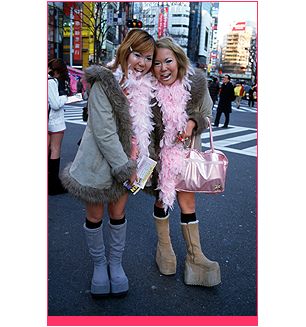
Akari wears a pleated navy miniskirt and a white sailor middy, standard issue of junior high schools all across Japan. But the skirt is minuscule, and her middy hangs down below its hem. Akari’s brown, gently bowed legs are bare on this icy January night save for the “rusu-sokusu” (loose socks) gathered in folds at her skinny ankles. She wobbles a bit on her eight-inch platform boots. Completing the look (modeled on the anime character “Sailor Moon,” from the eponymous series about a clumsy, lazy and tear-prone 14-year-old who transforms herself, through magic, jewelry and makeup, into a cute, sailor-suited, love-and-justice-defending crime-fighter) is her hair, which is dyed a brassy gold to offset the burnished walnut tan of her round young face. Dolled up in her tiny uniform (purchased secondhand for about $100 from a friend who outgrew the skirt long ago), a sucker lolling from her pink mouth, Akari is one of Japan’s many “kogaru,” “ko” from the Chinese character for “little,” and “garu” coming from the English word “gal.”

Haruna, who is standing arm-in-arm with Akari on the street corner, wrinkles her nose at her friend’s schoolgirl-sexy getup. She favors instead what she calls a “darker image.” In her tremendous silver wig, brittle as an electrocuted bird’s nest; her glittery false eyelashes that sweep down past her cheekbones when she blinks; and her mangy fleece jacket worn over Day-Glo orange hot pants and “sockboots” (tall beige socks extending down over foot-high rubber soles), Haruna looks like a pretty drag queen in the tradition of RuPaul. Her skin is a patchy ochre. To achieve this hue, she admits to paying regular and pricey visits to a Kanazawa franchise of the national tanning salon “Blacky.” Some label her look the “ike ike onna,” the go-go girl. Most call it “ganguro,” which translates literally as blackface.

Lately, everyone in Japan seems to be talking about the growing number of kogaru and ganguro girls. In their huge shoes and tiny clothes, faces pierced, hair bleached and teased, they are as easy to spot and as easy to dismiss as those Americans who, in the ’80s, forced their bangs, by spray and perm and will, into crispy arcs towering above their faces. An outsider, particularly a foreigner, might mistake a kogaru for a ganguro. But despite their shared predilection for platform soles and body piercings, the two subcultures have completely different fashion aspirations.

Kogaru want to look young, the younger the better. They wear their school uniforms out around town, on dates, probably even to bed. They wear their uniforms but they mess with them, rolling their waistbands so high that their creamy Polo sweaters hang down below their skirt hems, violating school hair and sock codes.

Ganguro want to look black and American, like their idols TLC and Lauryn Hill. In pursuit of a color that’s beyond tan, they frequent tanning salons, purchase sunlamps and smother their faces in brown makeup. It’s not uncommon for a girl of limited means to color her entire face with a brown magic marker. For those ganguro with the funds, however, Japan’s hippest hair stylists will coerce usually rail-straight Japanese locks into bulbous “afuro” (afro) perms that take half a day to set and cost about $400. Whereas kogaru dress like sexy little girls, many Japanese believe that ganguro are prematurely aged by sunning and excessive makeup. Another name for ganguro is “yamanba,” mountain grandmother, the name given to a mythical hag said to haunt the Japanese mountains.

Kanazawa is no Tokyo, no fashion hub of the world or even of Japan. Styles take a while to catch on here in the northern province, a famously subdued, bourgeois city of 400,000. Kanazawa is about as likely to set image trends as Providence, R.I. But Haruna’s ganguro look is catching on fast, and not just with hostesses, either. While most Japanese employers are reluctant to hire orange-faced women with platinum dreadlocks, growing numbers of “OLs” (office ladies), shop workers, cashiers and even young, stay-at-home mothers are playing the weekend ganguro, putting on tall boots and vibrant wigs for a night on the town. Weekend ganguro can be seen pushing baby strollers down busy sidewalks every sunny Sunday.

In 1999, while the Japanese economy lagged, two new boutiques — Glamour Jean and Key West — opened on Kanazawa’s main shopping drag, catering exclusively to ganguro. Egg magazine and other glossies aimed exclusively at ganguro are frequently sold out at convenience stores. Signs posted outside hair salons advertise the newly popular “buraku” (black) or afuro hairstyles. And in the cosmetics aisles of mainstream supermarkets, dark beige powders and tanning lotions are now sold alongside the formerly ubiquitous skin-whitening creams and industrial-strength sunscreens.

But despite their growing ranks, both kogaru and ganguro encounter hostility here. In a recent interview published in Kansai Time Out, Japan’s eminent novelist Haruki Murakami called them a big problem for Japan, and said that he feels sadness and disgust when he passes these bleached and flamboyantly outfitted young ladies on the streets of his neighborhood, Shinjuku, in Tokyo.

Some of the general prejudice against ganguro style has even become legislative. In Osaka, as of February, it is officially against the law for women to drive wearing tall boots. Apparently they just can’t brake fast enough with the platform soles. One woman got in an accident and blamed her platform soles, so a battery of crash tests were conducted with drivers wearing differing sole heights. A maximum allowable platform of only a few centimeters for anyone driving a vehicle was determined.

But if ever there were girls who just wanna have fun, it’s these kogaru and ganguro. So why is everyone making such a big deal out of these particular fashion victims?

Here in Japan — the child pornography export capital of the world — childishness and sexiness are inextricably bound. So, while it may not be difficult to grasp the kind of naughty appeal that Akari has to men suffering from a “rori-kon,” or “Lolita complex,” it’s not as easy to understand the broader, more pervasive appeal of her childish-but-sexy look.

Even Japanese adolescents seem to equate the two. Just last week, a trio of eighth-grade girls in my English class flipped through an issue of Teen People magazine I’d brought to school for use in a culture lesson. Peering at pictures of teenage stars, my students were unwilling to believe that girls as “mature” and “grown-up looking” as Britney Spears and Christina Aguilera could possibly be under 20. They were particularly shocked by their “mature” clothing and “adult” hairstyles — no pigtails in sight.

“Kawaikunai,” one of the girls said, pointing to a glamour shot of Mena Suvari: not cute.

While the Japanese term “romansuguray” (“romance gray”) is commonly used in reference to sexy members of the male salt-and-pepper set, there is no equivalent word for desirable older women. On her 25th birthday, an unmarried Japanese woman automatically becomes what’s laughingly referred to as “spoiled sponge cake,” in honor of the Christmas sponge cakes that are discounted and rarely purchased after Dec. 25.

This, perhaps, is one of the reasons why Akari is not entirely anomalous here.
She may be wearing the national lower-school uniform, but the 19-year-old is well past her student days. She works as a hostess at the Lullaby Girls Pub in Kanazawa. In the evenings, before the night show begins, she stands with her “masuta” (hostess bar manager, or pimp, from the English word “master”) on a bustling street corner and hands out flyers depicting a young, uniformed schoolgirl sitting sprawled like a toddler on a linoleum floor, fingers teasingly splayed over her bare crotch. The photo is framed by a keyhole. According to the flyer, “Guests can enjoy peeking through a real high school student’s keyhole without fear of arrest!”

Men who find kogaru hostess bars indiscreet or overly staged can procure real junior high “dates” through local kogaru cell-phone-sex rings. Bus stops and street corners frequently display flyers with the first names and cell phone numbers of willing schoolgirls or convincing substitutes. For a small fee, girls will come, in uniform, to pre-designated meeting places, often “love hotels” rented by the hour.

One such ring was recently broken up at a school where I was a teacher. In order to keep their preteen daughters’ records pristine, none of the girls’ families pressed charges. Despite the occasional incident, however, kogaru is not a synonym for “call girl.” Every school has its kogaru group, and every town has streets and shops where they hang out. Kogaru is simply a fashion statement with lucrative options.

Despite their fondness for schoolgirl uniforms, those kogaru who opt to stay in school are not exactly model students. They exist solely to be “kawaii” (cute), a word they repeat like a mantra. And although they live in their uniforms, they are frequently in trouble for altering them, violating school codes by shortening their skirts, bleaching and perming their hair. Kogaru are easily distinguishable from their more serious female classmates whose hems hit midshin and who wear their glossy hair black and sensibly cut.

After reaching the age of 20 or so, the uniformed vixens graduate from kogaru status to mere garu. These things in mind, it’s easier to understand why girls on the outset of adolescence might choose to outfit themselves as kogaru and buy a few more years of pimply prime. At 19, kogaru Akari is almost too old to play the nymphet.

Although business is booming at the Lullaby Pub, few men will admit to finding kogaru attractive. At least, they won’t admit it to me. And yet, wander into any Japanese convenience store at any hour of night or day and you’re sure to find a row of men and boys standing square in front of the kogaru manga rack. These novel-length comic books are among Japan’s most popular. The artist’s eye — like the reader’s eye — is trained upward, as though he were rendering the image reflected on cleverly positioned patent-leather shoes. From this perspective, pantie-less pudenda flash beneath pleats and the undersides of breasts bulge out from middies. A penchant for kogaru manga is by no means confined to the furtive and trench-coated, either. Even mainstream Japanese fitness and lifestyle magazines occasionally include a bonus kogaru manga special, tucked among recipe cards and articles suggesting family weekend getaways.

“Teachers like the Lullaby Club,” my friend Ritsuko Yamagishi tells me with a wicked grin. She herself is a teacher; we met when I was placed by the Ministry of Education as an assistant in her eighth-grade English class. She mentions several of our male colleagues’ names, including that of the doughy sumo instructor who occupies the desk — bedecked with photos of his infant daughter — across from mine.

“Maybe,” Ritsuko says, “at the club, teachers can recognize former pupils in their old junior high uniforms and feel happy and enjoy a closer look, or even invite them onto their laps for a feel.”

In Japanese public schools, all forms of self-decoration are strictly policed, whether they lean toward sex kitten kogaru or drag queen ganguro. The high school at which I spent a year teaching held regular hair and face inspections. Homeroom teachers measured bangs with rulers, removed earrings from self-pierced lobes, scolded students who plucked their eyebrows and required even seniors to scrub off all traces of lipstick or powder. Before school assemblies, junior teachers were handed aerosol bottles of black spray with which to return our “kinpatsu” (golden-haired) students to regulation black. Teachers talked despairingly of “rebellious” kids who came to school with hair illicitly afuro, who rolled the waistbands of their skirts and donned slouchy rusu-socks, in flagrant disregard of the school uniform.

In Japan, uniforms are worn both in schools and workplaces, and their impact goes beyond making it easier for people to dress in the mornings. In a recent city high school debate over whether students should continue to wear uniforms into the 21st century, those in favor won with a high margin. Their main contention, that uniforms help provide “a group-feeling,” mystifies most non-Japanese. The cozy concept of group-feeling doesn’t even translate properly into English.

In other words, it’s hard for foreigners to grasp why these “little gals” in shortened uniforms and cake makeup come across as insolent, and even, according to some teachers, “dangerous.” They are refusing to conform to “the group.” And in Japan, “the group” — a system of circles within circles with Japan overlapped across the whole — begins at, and is centered upon, school.

But strict teachers aside, there are many who believe that the ganguro and kogaru may have an impact on traditional Japan, for better or worse. According to Australian artist and Japan scholar Kirsten Farrell, these girls — dedicated solely to the subjective pursuit of cute — are unwitting feminists and radicals, rattling the status quo simply by hanging around, being visible and cropping up in every corner of Japan.

By showing off their indolence and trying to project an image of a life lived idly, kogaru and ganguro make a point of bucking the national work ethic. They challenge the stereotype of the average Japanese worker — stoic “sarariimen” (salary-men) and demure OLs stashed in airless offices shuffling paper for 10 hours a day, like post-industrial cogs in a machine — by pretending they have nothing better to do than tan, get manicures, try on wigs, flirt and giggle.

However, even if they qualified as such, there is no ganguro manifesto that unites or incites these accidental radicals. According to many Japanese young people, the kogaru and ganguro subcultures are set apart from the mainstream largely by their sexualized schoolgirl or go-go attire, and not by any distinct system of beliefs. Are these girls, with their stage makeup, body piercings and over-the-top costumes, setting out to make a dramatic statement against Japanese conformity? Or, as skeptics maintain, have the ganguro hairstyles, makeup and clothing already become a new kind of uniform?

“I hate them,” exclaims 24-year-old Keiko Suzuki, assistant director of a club music program on Tokyo’s MTV. “They are always at clubs like Pylon, dressed head to toe in the club’s colors, dancing with each other only. They are another culture completely. I can’t understand them at all. They are only show, no substance.”

And while the color of their skin lends them a group identity and ganguro label, they seem to give little thought to the historical or sociological implications of their so-called blackface. An advertisement for the tanning salon “Blacky” in Egg magazine shows a close-up of a pretty African-American girl, beckoning to the reader with a crooked index finger. The italicized caption reads, “Come wid mi,” — a Japanese stab at “black English.” Asked why they work so hard on their tans, why they want so desperately to approximate “black America,” every ganguro I interviewed gave the same curt and unexamined answer: Because it’s cool, because it’s sexy.

In the words of resident high school English teacher Jenna Levy, “No one buys tall boots alone.” You buy them with your friends and you wear them with your friends; it has to be a group decision or else you’re going to look ridiculous. Both kogaru and ganguro are indisputable pack animals. Together they tower over the flat-heeled and the demure. Egg magazine displays spread upon spread of ganguro in groups, shot from underneath to accentuate their long brown legs. In the photos, ganguro laugh hysterically or mug goofy faces at the camera. They remind me of the popular girls in high school, working hard at looking good, working hard at looking like they’re having the time of their lives, demanding constant attention and totally unsure of what to do with it once they have it.

Although Keiko Suzuki hates the kogaru and ganguro and believes they belong to a culture entirely separate from her own, she readily admits that it’s dress rather than life philosophy that sets them apart. Although they model their look after prominent African-American musicians and ’60s activists, their behavior falls far short of rebellious. Even critics as harsh as Suzuki are quick to point out that “these are nice girls; strange, but nice.”

Akari and Haruna are nice, cheerful, willing to answer all of my questions, eager to try out a few words of junior high English. Their bashful young masuta is also friendly and eager to please. Twenty-four years old, he says he’s working at the Lullaby Club to save money for a plot of land. What he really wants to do is farm daikon radishes. Akari and Haruna have no future plans, but they definitely don’t want to work as hostesses forever. Akari plans on staying in kogaru uniform for another year, tops. Haruna says she’ll keep her image evolving with the current Egg styles. What they both know for sure is that they want to stay cute. “Itsumo kawaii.”

Whenever I stop by my local grocery store to pick up a bag of fresh udon noodles or a block of tofu, I pause to chat for a moment with my favorite cashier. Hitomi has cheeks more round and pink than most kindergartners. Last year, she was a senior in my roommate’s English class at the second-to-lowest-ranked high school in the prefecture (according to a list printed annually in the newspaper). Before graduation, she spoke excitedly of the job she’d landed in the city with the New Sankyu chain of grocery stores.

In Japan, when a person is hired by a company — even as a gas station attendant or cashier — it is said that he or she “belongs to” the employer. This brand of “belonging” implies equal measures of employee comfort and employer control. When Hitomi took the job in the city, she was quickly installed in the New Sankyu apartment complex, located directly behind the store. It is a dreary, cement-block “Melrose Place,” populated entirely by clerks and store managers too exhausted for sex or scandal. The New Sankyu apartment stairwells are festooned with row after row of freshly washed aqua uniforms hung to dry on makeshift clotheslines.

When she was still a high school student, Hitomi was often in trouble for rolling up her skirt waistband and donning “rusu sokusu,” kogaru style. These days, she wears a different kind of uniform. She is seldom out of her aquas, and is often too tired to bother with changing into street clothes when she gets off work. The last time I saw the usually ebullient Hitomi, she looked pale and slack, passing foodstuffs listlessly from basket to plastic bag.

“How are you?” I asked, going as usual for the one English question she’s mastered.

“Very, very bad,” she said, shaking her head and avoiding meeting my eyes.

“Doushitan?” I asked — what’s wrong? — switching into a Japanese too hushed for her coworkers and neighbors to overhear.

“Ii koto ga nai,” she said. “I have no good things.” She proceeded to tell me what I had been waiting to hear since September. She had taken the job at New Sankyu to earn her own money and live away from her family in her own apartment in the city. At $6 per hour, however, she could barely afford to purchase the food she spent all day shelving. She had found no love, no excitement, few friends, since moving to Kanazawa from the country.

“I’m thinking,” she whispered conspiratorially, “of becoming a ganguro. At least it’s something new.”

That’s when I noticed the midnight-blue eyelashes.

Malena Watrous is a writer and teacher currently living in Japan.

Massage therapists rubbed wrong by sex talk

A Jennifer Love Hewitt show and the Travolta allegations have masseuses tired of being confused for sex workers

(Credit: iStockphoto/sybanto)

Joe, a licensed massage therapist, knows what it’s like having a famous client who expects something extra. He had an Academy Award-winning actor begin gyrating on his massage table before raising his hips in the air to show off his erection. “He was hoping that I would play with him in some shape or form,” he says.

Needless to say, Joe isn’t surprised by allegations by two masseurs that John Travolta got handsy during massages. (Travolta’s attorney has denied all the allegations, and called them “ridiculous.”) “It happens all the time,” he says, and not just with celebrity clients. He frequently encounters men who try to fondle him, usually while he’s working on their glutes or lower back and their hand happens to be level with his crotch. “They think they’re so original, but they’re all so much the same,” Joe says, his voice rising. “They all use the same tactics, the same body movements, the same gyrations and grinding my table, the [heavy] breathing.”

Usually it’s men, but he’s had a couple of women do it, too: One grabbed his crotch and then pulled his sweat pants down before he could stop her. Then there’s the woman who had an orgasm just from him massaging her thighs. “All of a sudden her knees locked and her legs became straight and I thought, ‘Oh no, maybe I hurt her, maybe she has boundary issues.’” Afterward, though, she made it clear what had happened — and that it was the best massage she’d ever had.

Even massage therapists who haven’t personally experienced sexual harassment or abuse on the job are fed up with the need to constantly reaffirm the fact that they are licensed medical professionals. Shows like Lifetime’s “The Client List,” which stars Jennifer Love Hewitt as a single mom trying to make ends meet by providing happy endings, certainly don’t help to diminish the nudge-wink side of massage, nor does the ubiquity of euphemistically driven ads for massage parlors. And, for the record, many object to the use of the terms “masseuse” and “masseur” because they leave too much room for misinterpretation.

Even still, some question the legitimacy, or at least earnestness, of the allegations against Travolta and suggest that it’s the massage therapist’s responsibility to avoid sketchy situations. Barbara Joel, a massage therapist and former president of the New York State Society of Medical Massage Therapists, tells me, “I disagree how he is being portrayed as the brute and the therapists as the innocent victims … I doubt that the therapists were unaware as to what they were walking into.” Joel says experienced massage therapists understand that “many male politicians, celebrities and men of power feel a sense of self-righteousness and that they are above the law.”

To others, that sounds too much like blaming the victim. Turning down clients — particularly high-powered clients that could make your career — is challenging. Joe was voted the best masseur in New York several years in a row, but when the economy tanked his business did too, and he moved to Kentucky for the affordable rent. Now he finds it hard to reject new clients during the initial screening process because he sorely needs the gigs. “It’s difficult when you’re a therapist trying to make money in this economy,” he says. Usually, he simply tries to dodge the wandering hands. “I move my legs away from the table and after a while they’ll mellow out,” he says. “If it starts to get really bad, I’ll grab their hand and press it firmly down onto the table and say, ‘C’mon now, I’m a licensed massage therapist, this is not about sex.’”

Like Joe, Cameron Richards, a massage therapist in New York, describes encountering inappropriateness from both genders. He recently had a male client ask to be undraped during the massage. “This was all red flags,” says Richards, who’s only been in the business for four years. “To make a long story short, he wanted me to fondle him.” Once, he had a female client try to urgently book a session within the hour and then she attempted to get him to massage her breasts. “She told me when she went on a cruise they massaged everything, which I knew was a lie,” he says. Richards also knows a massage therapist in Florida who is thinking about quitting the industry because “she is getting lots of phone calls from men looking for happy endings.”

In over a decade of massage therapy, the worst Eva Pendleton has ever encountered is a client grabbing her butt. “I just quickly stepped out of the way,” she says. But Pendleton had plenty of clients get “a little frisky or flirty” when she worked in a health spa. Now she specializes in geriatrics and end-of-life care, but still she’s encountered a hospice client who asked flirtatious questions like, “Who massages you?” He was also “really into having his abdomen rubbed, hinting about wanting me to work lower.” (That’s an example of the hospice saying, “You die as you lived.”)

Massage therapists often become accustomed to the hint of an erection under the sheet. “It’s tricky because the male body sometimes sends a signal just as part of the relaxation response,” says Pendleton, “not because they’re having a sexual reaction, so I learned to ignore erections and I usually gave the client the benefit of the doubt,” she says. “It’s rarely as obvious as perhaps some of Mr. Travolta’s massage therapists experienced.”

On the whole, the female massage therapists I spoke with reported less frequent in-person sexual harassment, maybe because they are more motivated to screen aggressively. Whenever she gets a call from a potential client, Denise mentions that she offers both massage and martial arts classes — which is not easily confused as a sexy euphemism. Most people who are looking for sex hang up after that, but the ones who stay on the line usually send up red flags by asking for “adult” or “full body” massage, or asking what she looks like or what she wears during the treatment. Recently, she had a man call to ask if he could “confess his bad behavior.” She suggested that he seek “psychological or spiritual counseling” and he hung up.

Elise Constantine has been working as a licensed massage therapist for 14 years and only once had a client cross the line: He kept asking to be naked during a Thai massage, which is usually done on a clothed body. “I was infuriated,” she says, “but did not engage in any further discussion beyond saying, ‘There is the exit. No payment is expected. Do not contact me again.’” Since then she’s developed strict policies to avoid inappropriate clients and dangerous situations. She only books new male clients when one of her colleagues will be in her office suite and never does outcalls for men unless they come with a direct, reliable referral. Constantine also makes a point of dressing “modestly” and not posting photos of herself on her professional website.

The erotic plagues the industry for some of the same reasons that massage is a good cover for sex work: the intimacy of nakedness and the sensuality of healing touch. We have a hard enough time separating nudity from sex, let alone naked touch. So it’s no surprise that there’s a genre of porn that eroticizes the tension between the legitimacy of massage therapy and the naughtiness of a paid-for hand-job. “Some people don’t get touched very often, they don’t have a love life, and to them it’s like, ‘Oh my god, this feels so good,’” says Joe. “It’s synonymous with sex or foreplay to them.” Of course, there’s a crucial difference between the occasional boner on the massage table and trespassing on another person’s body. One represents a natural physiological response, the other a raging dick.

Continue Reading Close
Tracy Clark-Flory

Tracy Clark-Flory is a staff writer at Salon. Follow @tracyclarkflory on Twitter.

A night at the vibrator museum

Early vibrators were hand-cranked, two-person jobs -- and prescribed by doctors. How far we've come since then

(Credit: Antique Vibrator Museum)

I can now say that I’ve used a turn-of-the-century vibrator — on my hand, but still.

The silver, hand-cranked contraption is usually kept behind glass at Good Vibrations’ Antique Vibrator Museum in San Francisco — but staff sexologist Carol Queen made a rare exception. “This is very special,” she whispered, unlocking the case and carefully pulling out Dr. Johansen’s Auto Vibrator, a relic from 1904. The “auto” part is not so much: It was a two-person job, with her having to crank the device’s handle to get it thrumming. Pressing my finger tips to its inch-wide circular platform of pleasure, I was pleasantly surprised by its power.

As I was by the two other vintage vibrators that I got to try out — the White Cross Electric Vibrator from 1917, which has a pronged aperture that makes it seem like the ancestor of Jimmyjane’s Form 2, and the Beautysafe Vibrator from the 1940s, which is reminiscent in look, feel and sound to a car waxer.

The U.S. release this week of “Hysteria,” a Maggie Gyllenhaal flick about a Victorian-era doctor who invents an electric massager and uses it to bring about “paroxysms” of relief in female patients with “hysteria,” seemed like a good excuse to get a private tour of the museum, which provided vibes that appear in the film, to learn about the history that’s left out of the movie’s fictionalized story line — and, of course, to try out antique pleasure devices while on the clock.

While the movie is set in the 19th century, doctors’ “manual manipulation” as a treatment for female hysteria goes back as far as the second century. “That took too long,” said Queen. “So doctors started training midwives to do it.” In Rachel P. Maines’ “The Technology of Orgasm: ‘Hysteria,’ the Vibrator, and Women’s Sexual Satisfaction,” she quotes a 1653 medical book that advises:

When these symptoms indicate, we think it necessary to ask a midwife to assist, so that she can massage the genitalia with one finger inside, using oil of lilies, musk root, crocus, or [something] similar. And in this way the afflicted woman can be aroused to the paroxysm.

Of course, this paroxysm was orgasm, but it was rarely acknowledged as such. Instead, it was said to be the exorcism of hysteria, a vague, catch-all diagnosis for female ailments thought to arise from a displaced uterus or, charmingly, a “wandering womb.” “Some of these women probably had PTSD, some of them were overworked, some of them had extreme stress in their lives, some of them almost certainly had sexual issues going on,” Queen explains. As Maines points out, “many of its classic symptoms are those of chronic arousal: Anxiety, sleeplessness, irritability, nervousness, erotic fantasy, sensations of heaviness in the abdomen, lower pelvic edema, and vaginal lubrication.” Married women were often given the prescription of sex with their husbands.

Eventually, doctors turned to technology to speed up the laborious treatment. “It started with hydraulic devices, water jets, but that really only worked well at spas,” said Queen. In 1869, an American physician patented the Manipulator, a padded table with a steam-powered vibrating mound that rested between the legs. A decade later, British physician Joseph Mortimer Granville – who’s at the center of “Hysteria,” albeit heavily fictionalized — patented a battery-operated vibrator for treatment of muscle pain. Interestingly, he was vehemently against the device being used for hysteria. He wrote, “I have avoided, and shall continue to avoid the treatment of women by percussion, simply because I do not wish to be hoodwinked, and help to mislead others, by the vagaries of the hysterical state.”

Ads selling vibrators as home appliances began to appear in women’s magazines, often showing “women in attractive nightclothes, using it on their chest,” Queen said. “You see facial massage shown from time to time.” These spots referred to them as “aids that every woman appreciates” and promised “all the pleasures of youth … will throb within you.” But when vibrators started showing up in stag films in the 1920s, the ads started to disappear, Queen says.

“Within the next 10 years or so, the doctors close up shop,” she said, perhaps in part because it became impossible to deny the sexual nature of these therapies. “In 1952, hysteria is taken out of medical books,” Queen explained. “The medical associations voted to say, ‘Nothing to see here, there’s really not a disease – no, no, no, we haven’t been treating this with clitoral and vulva massage.’”

Vibrators were still sold direct to consumers, but manufacturers made no mention of hysteria and instead “talked about body massage and vague promises of health, vigor and beauty.” The ’60s did away with the subtlety and euphemisms: Maines explains in her book, “When the vibrator reemerged during the 1960s, it was no longer a medical instrument; it had been democratized to consumers to such an extent that by the ’70s it was openly marketed as a sex aid.”

Asked whether doctors or patients saw the treatment as sexual, Queen said, “One of the schools of thought is, ‘How could they not?’ They’re touching the genitals, she starts to sweat and flail around and vocalize and her breathing changes and she gets a flush.” But others argue that “the definition of sex and sexual functioning for a woman was so associated with intercourse,” it was so male-centric, that this treatment, which was most often external, wasn’t seen as sexual. As Maines puts it, “Since no penetration was involved, believers in the hypothesis that only penetration was sexually gratifying to women could argue that nothing sexual could be occurring when their patients experienced the hysterical paroxysm during treatment.”

Paradoxically, Queen explains that hysteria was overtly linked to sex “in that they said women without husbands who were spinsters or widows or whose husbands had become incapacitated were more likely to suffer from it,” she said. “So there was a subtext of, ‘What this lady needs is a good fuck and, sadly, she can’t have one — but this is the next best thing.’” Maines attributes the demand for the treatment to two sources: “The proscription on female masturbation as unchaste and possibly unhealthful, and the failure of androcentrically defined sexuality to produce orgasm regularly in most women.”

We haven’t exactly escaped the expectation that women should be able to climax from penetration alone, but we’re slowly improving on that front — and the mainstreaming of vibrators has played a big part. That point was only driven home as I left the museum, which is located in the back of a Good Vibrations store, and walked past scores of sleek and sexy toys in every color of the rainbow, all unabashedly advertised as what they are: Tools for sexual pleasure.

Continue Reading Close
Tracy Clark-Flory

Tracy Clark-Flory is a staff writer at Salon. Follow @tracyclarkflory on Twitter.

Maggie Gyllenhaal on sexual liberation

The beloved indie star tells Salon about her "vibrator movie" and why she loves playing transgressive women

Maggie Gyllenhaal (Credit: Reuters/Mark Blinch)

When I met Maggie Gyllenhaal about six weeks ago, she was enormously and gloriously pregnant, stretching out on a sofa with her shoes off and feet up in a Manhattan office building. (Since that time, Gyllenhaal and husband Peter Sarsgaard have welcomed their second daughter, Gloria Ray, to the world.) We were there to talk about “Hysteria,” the charming, lightweight feminist farce from director Tanya Wexler that explores a key event in the history of female sexuality: the invention of the vibrator by Mortimer Granville, a Victorian doctor who was seeking to cure the mysterious “female malady” that lends the movie its title.

While I wouldn’t assume there’s a vast amount of historical and social accuracy to “Hysteria,” it’s a lot of fun, and could definitely provide a viable moviegoing alternative for adult women eager to move on from “Iron Man” and “Captain America.” Gyllenhaal’s character, the crusading feminist and social worker Charlotte Dalrymple, who becomes the comic and romantic foil to Hugh Dancy’s stuffy, stammering Granville, might be described as a supporting character who takes over the movie. Charlotte effectively becomes the modern viewer’s window into the world of “Hysteria,” insisting as a matter of course that women indeed enjoy sexual pleasure (but are often plagued with partners who don’t know how to deliver it) and espousing then-outrageous views about women’s right to vote, go to college, work outside the home and so on.

Although still best known for her roles in independent films like the 2002 spanking-liberation manifesto “Secretary,” Spike Jonze’s “Adaptation” and the underappreciated “Sherrybaby” (not to mention her early role opposite real-life brother Jake Gyllenhaal in “Donnie Darko”), Gyllenhaal has also appeared in several major Hollywood productions, including “The Dark Knight,” “Crazy Heart” and the forthcoming “Won’t Back Down,” in which she stars with Viola Davis as parents trying to rescue a failing public school. Her prodigious on-screen charm is matched by a reputation as one of the most genuine and easygoing people in the movie business, and although I’d never met her before, this was one of the most relaxed interviews I’ve ever conducted.

We began our conversation, in fact, by talking about the Park Slope Food Coop, the legendary Brooklyn collective grocery store where we are both members. Unlike some celebrity members I could name, Gyllenhaal and Sarsgaard perform their assigned Coop work shifts personally. (She works in the basement, wearing a kerchief and packing nuts, teas, spices and cheeses, although like any other new mom she now has a one-year work exemption.) Is the Coop’s produce both better and cheaper than the pretty but nosebleed-expensive stuff for sale at Manhattan’s outdoor markets, we asked each other rhetorically? It is. Then we moved on to “Hysteria.”

So it seems like this must have been a fun character to play. You get to be the totally uninhibited character in a movie where everybody else has the 19th century hanging over them. You’re the liberated woman at a time when there almost weren’t any.

Right. Sometimes, a movie is set up where you’re meant to be winning, you know what I mean? I’ve certainly played a lot of characters who were really flawed and did horrible things, and where the challenge is to ask the audience if they can be compassionate enough to still have empathy for you. That’s really important to me, and I think that’s a really interesting thing to do with film — play a character who’s really flawed and ask the audience to practice being compassionate. Or who does things that are really outrageous that the audience might have judgments about, and make them question where their judgments come from.

This is completely different. This is like, you walk in and the movie doesn’t work if Charlotte isn’t winning. But the one thing I really did think — I mean, the script was so great, and so much of the tone of the movie was in place. I didn’t think it needed to be shifted almost at all. But one thing that I think comes from me is that I didn’t care at all about her being historically accurate. About her not having the 19th century over her, like you said. I think the movie is served better if she seems wild even now, if she seems so full of life that she could come from any time. Or any planet!

Because what she’s talking about in the movie — the actual politics — is very simple. The movie doesn’t have room for a complicated discussion of socialism. She says, “Socialism is a lot of people working together.” Well, you know, I mean — there’s a lot more to say about it! (Laughter.) Or, you know, women should have the right to vote, women should be able to go to college. We’re good with that here! So because her politics are so simple, and because the things that were so outrageous that she was saying do not sound outrageous now, she needs to be more outrageous in her spirit. So, yeah, it was fun to be able to just go, “You guys are constricted and constrained by all these things, and I just don’t feel them!”

I have to say the question of historical accuracy, or lack thereof, really never bothered me. It’s not that kind of movie.

Yeah. I think you’re on the wrong track if that’s what you’re worried about!

But one thing the writers really got right — or maybe this is your theatrical background and English-lit education at work — is that Charlotte feels like the heroine of a George Bernard Shaw play that Shaw never got around to writing.

Right! Right! She fits into a history of great wild women, you know? Even, like, ’40s women, screwball women, who you love even though they’re pissing you off. So, yeah, I agree with that. I liked that about it. I thought it would be fun!

You know, I probably can’t push this analysis of your career too far, but you do have a pattern of playing transgressive women, women who are defying social norms. Do you see it that way?

Well, I guess I think — and this might not be true either — but if you think about who might be interesting to watch, is it interesting to watch someone who’s absolutely following the norm and the pattern you’re used to watching? Sometimes people write those characters and they’re much more secondary characters meant to give you some exposition or whatever. Usually, the interesting character in a movie is either making a big change or transgressing somehow — making you think about how you live. So, yes, that is what appeals to me, but I also think it appeals to many people.

But no, I think maybe you’re right. When I think about Chekhov’s “Three Sisters,” for example — did you happen to see the production that we did last year?

No. I really, really wanted to. I love that play.

Well, so, of the three sisters, the transgressive one is Masha, and that’s who I played. But of course Olga is such an interesting character, and she’s not really transgressing at all. And in the movie I did after this, which is called “Won’t Back Down,” I’m also fighting against everything. It’s coming out in September, I think. I’m so pregnant! I’m all like, “It’s coming out sometime! I’ll talk to people about it!” Then there’s my character in “Crazy Heart” — she’s transgressive too, in a way. In her heart.

And of course everybody’s going to bring up “Secretary,” which, although it’s quite a different movie from “Hysteria,” is also about liberating female sexuality.

Well, yeah. That’s why people think about me that way. It’s always about what your first big movie is, that anybody knows about. And that movie is about transgression. I mean, that movie is overtly about what it means to transgress, and how it feels, and how you can live as a transgressor. But maybe it’s true: I am interested in people who are thinking — although the girl in “Crazy Heart” definitely isn’t thinking, or she wouldn’t do a lot of the things she does! I don’t know, you probably can’t tie them all together.

No, I wasn’t arguing that they all fit into that template. I’m always curious about the effect of having appeared in a really big movie. Do people see you on the street now and recognize you just because of “The Dark Knight”?

Some people do, yeah. It’s funny, because I’ve moved back and forth a lot. Even last year, I made “Hysteria” and then I made “Won’t Back Down,” which is a studio movie. There’s such a different feeling in terms of schedule, in terms of time, in terms of subject matter. I used to find it much easier to work on little movies: the pace and the way of working was just better for me. But I think I’m starting to change. I think I work the same way now on a smaller movie as I did on “Won’t Back Down.” It depends on the style of the movie. It’s harder when you’re in and out, like on “Dark Knight” or “World Trade Center.” I find that difficult. You’re not going to work and working for two months, going into the tunnel and just getting in your body who you are.

How has moving into your 30s changed your career? Don’t get me wrong, you’re still young! I was actually thinking it might have opened up some different possibilities.

Yeah, I actually feel like getting older has opened up a spectrum of roles to me. When I was younger, a lot of the roles that were coming to me were like, especially from a more Hollywood standpoint, the wacky girl. (Laughter.) Now I feel really drawn to playing grown-up women. I’m 34, and maybe it’s the way people age now or whatever, but I still feel like some roles I play are not grown-up women and some roles are. In “Won’t Back Down” she’s a child. In “Hysteria” she’s a woman, and in “Crazy Heart” she’s kind of half and half. You know, I have one foot in and one foot out. But thank God I’m done with, like, the wacky 25-year-old girl! That never worked that well for me. Plus, it’s so interesting to see a crop of really talented new actresses who are in a different generation.

Tell me who you especially like.

I love Rooney Mara. I was absolutely blown away by her performance in “Girl With the Dragon Tattoo.” Absolutely blown away. And to be honest, when you’re an actress, you go in and say, “All right — show me what you can do!” And every turn of that performance was excellent, and not just excellent in the way that some young actors are, where they’re just working on instinct and they have no craft. That was a crafted, excellent, beautiful performance. So to root for someone younger, that’s new for me. (Laughter.) You know, I’m sort of not in that young group anymore! I’m in another group now, but I like seeing talented young women come along. It’s exciting! What are they like? What I loved about Rooney Mara in that movie was that she wasn’t asking for anyone to love her. That’s hard to do!

“Hysteria” opens this week in New York and Los Angeles, with wider national release to follow.

Continue Reading Close

Mother-daughter sexperts

Susie Bright and her daughter, Aretha, make parental talks about sex look easy -- and fun

Most parents loathe talking to their kids about the birds and the bees, let alone pubic hair grooming, faked orgasms and “water sports” — but most parents are not legendary “sexpert” Susie Bright.

Better than talking about these things, she penned an advice column in 2009 with her daughter, Aretha, then 19, for the ladyblog Jezebel. Their answers to questions about everything from porn to Paxil were unflinching but playful, and at times controversial. Now the pair have collected those columns into a new e-book, “Mother/Daughter Sex Advice.” Together, they read as an irreverent version of “Our Bodies, Ourselves” for the Internet age. The mother-daughter team also reflect on what the experience of writing the column was like, and it turns out it wasn’t as weird as many would think: For the most part, it was just a continuation of conversations they had been having throughout Aretha’s life.

I spoke with them both by phone about sex-positive parenting, where they draw the “TMI” line with each other, and their tips for making “the sex talk” less awkward.

Aretha, this might be an annoying question, because I’m sure you’ve gotten it for most of your life, but: What’s it like having a “sexpert” for a mom?

Aretha: I’ve been getting this question since second grade. Kids brought it up in the line at the cafeteria. I remember being way more defensive about it then, because just saying the word “sex,” it was like a four-letter word.

But now? It’s the same answer I always give, which is that it was pretty cool. I was the envy of all of my friends throughout puberty and high school. It’s interesting because now that I’m college-aged, I can see differences in how kids were brought up and, you know, I can see how my upbringing has affected me.

Did you have friends in high school who desperately wanted to come over and ask your mom for advice?

Aretha: I started community college when I was 13, so I had college friends who were in their 20s and late teens, and they felt really comfortable talking to my mom. Sometimes I got really jealous because they’d want to have alone time with her to talk about their relationship problems. With my high school friends, they felt too shy and inhibited. It was more that they’d come to me with a crisis and then I’d bring it to my mom.

Were you ever uncomfortable talking to your mom about sex when you were younger?

Aretha: No. Never. From age zero to now, I don’t think it’s ever been uncomfortable.

Susie: There’s an important distinction between “Do you feel comfortable talking about your personal sex life with your parents?” and “Do you feel comfortable talking about other people’s sex lives and sex in general, sex in the news and ‘what if’ sex, where you say, ‘I have a friend …’” All of that we’re very comfortable with. I think anybody would be shy when you feel like you need a little distance between you and your parents.

Sometimes I talk to kids and they tell me, “I have the opposite problem. My parents confide to me as if I was their little friend.” For me, that isn’t a healthy, sex-positive parental frame any more than being uptight and refusing to let a single word be said about it. Somehow, it’s the opposite but the same thing. A good parent says, “You can talk to me about anything and it can be in general terms. If you’ve got a physical problem and you’re uncomfortable talking, can I help get you to a clinic or a doctor that you would feel comfortable talking to?” Don’t get all hurt that they don’t want to tell you, just help them find someone that they can talk to instead of getting all sulky about it and saying, “You have to tell me everything or else I won’t help you!”

Aretha: I think we’ve always been sensitive about talking about each other’s sex lives. Except for when it comes to things that happened earlier in her life. I remember being really curious about how my mom lost her virginity. I could hear that story a million times.

Susie: There’s so many different levels of what it’s like to have conversations about sex, and because so many families don’t discuss it at all, they think that once you open the door it’s somehow like there’s no privacy, there’s no boundaries, there’s no self-respecting way to talk about anything. But I knew that wasn’t the case, even from my own growing up. My mom told me about getting her period, which I thought was fascinating, because she told me about the nuns stuffing a rag down her pants and they wouldn’t tell her what was happening. Her moral was, “I’m telling you this because you’ll never have to go through that, because I’m going to tell you the scientific reason for menstruating.”

My dad was the same. He would say, “I was so shy, I never kissed anyone until I kissed your mom, and I was in college,” but there were other things he wouldn’t have expressed to me — and of course not. It just starts to feel creepy, and I guess not everyone’s creep line is in the same place.

It’s just knowing that you can hold your privacy and yet you can share things that are part of a valuable conversation. Part of what I liked so much about writing the Jezebel column, and writing this book, was that I could hear Aretha’s reactions to things and it made me realize how strongly she felt about certain topics. I wasn’t going to just say to her, “So, Aretha, what do you feel about oral sex personally?” No way, I would have been too embarrassed and she would have been like, “Are you out of your mind?” When I heard her sticking up for other girls getting satisfied in bed and not just lying there and crying afterward …

Aretha: Why would I want them to do that? That makes no sense!

Susie: Well, you say that, but I know plenty of women who would say, “What do you expect, you shouldn’t be so romantic or you should try harder.” There are some really negative, shaming answers. The fact that you were such a good advocate, it just made me so happy inside. It wasn’t like I had dragged you over to a desk every day and said, “Now, Aretha, how do you spell ‘orgasm’?”

Susie, what sort of parental anxieties did you have about sex?

Susie: Well, I still have them in the sense — this is more dating and relationships — when she meets someone new, I wonder if I’ll like her boyfriend. If I don’t think they did something right or they hurt her feelings, there’s part of me that wants to run over and slap them — even though I’m supposed to just listen and be cool because they’re probably going to make up in 10 minutes and then I’ll look ridiculous.

Aretha: From my side, I see my mom worrying, like, “I want Aretha to feel like she can ask for what she wants with anyone, because not everyone’s had the same upbringing she’s had, so they might not know that everything’s supposed to be egalitarian.”

Susie: Yeah, but you haven’t had any really terrible sweethearts. You’ve had pretty open-minded people in your life so far.

Aretha: Well, there might be ones that maybe you don’t know about …

Susie: OK, now it all comes out! [Laughs] When you first asked that question, Tracy, I wondered what you meant, if it was, “Were you worried that Aretha would get pregnant too young?”

Well, here’s another question: What do you think most parents are afraid of when it comes to sex and their kids — is it the fear of them getting pregnant, of them having sex too soon?

Susie: I think the fear of having sex too soon is this big, tender topic that covers a lot of things. On the surface, they would say, “An early pregnancy or some sort of STD could be tragic and wipe my kid’s life out.” But if you scratch at that a little bit, lots of times it’s because the parent identifies with the kids and is having memories about regrets, about things they did or didn’t do when they were teenagers. So their child’s coming of age is like their chance of doing it over again.

As much as it’s true that I could just jump in there and completely micromanage every detail for Aretha, it is so important not to do that, to be a good listener and let them know that you hear them, to respond if they want your help but to mostly just be really solid and say, “I’m there for you.” You have to take every lesson you ever learned from a good therapist and bring it to bear and give them the space to figure it out on their own — not to be neglectful but not to be a busybody either. It’s such a hard line to walk, I’m not trying to make it sound easy.

Why is it so hard for most parents and kids to talk about sex with each other? We make such a big deal about the Sex Talk, as though it’s one talk that happens, ever, between parents and their kids. Why is that?

Aretha: Where to even start?

Susie: There’s so many fingers you want to point. For me, it had a lot to do with being raised in a religion that was very condemning of sexuality outside of procreation and women’s subjugation.

That sure covers a lot territory. So how can you make talking about sex with your kids, or with your parents, less awkward?

Susie: I got some of my first lessons of how to handle this when I worked in a vibrator store and someone would say, “How do I raise this with my husband?” or “How do I raise this with my wife?” I got really good at answering this: First of all, if talking is the part that freaks you out, buy a book and leave it in the bathroom or on the coffee table.

Aretha: I think you have to be careful with that, though! So many people complain, “My parents left a book under my bed about our changing bodies and they never said word one, they just expected me to find the book and come to them with questions later.” And guess what, they never came to them with any questions because they figured, “My parents are too shy to talk to me about it so I shouldn’t talk to them.” Not to, like, totally slam your suggestion, mom.

Susie: But they did something! People are always asking me, “Are there any particular books I should have in my house for sex education?” and I say, “You know what? If you have books at all, that’s great.” Books! Newspapers! Talk about what you’re reading on the Web! Sex will inevitably come up if you’re talking about it like you’d talk about anything else — in politics, in science, in arts. It’s not a ghettoized topic.

Here’s another thing: I call it “the cool aunt theory.” You realize that you, the parent, are too upset and uptight about sex to say anything, but your sister or friend or ex or someone you know very well has a sense of humor and has a good head on their shoulders and you go to them and ask, “Could you do this?” Or here’s another thing, when your kid raises an uncomfortable question, to just say, “You know, that is a really good question and I’m not sure I know the answer.” You’ve given yourself some time, but you’ve been friendly about it and then you can decide if you bring in somebody in the family or you get a book or find a documentary on PBS. The point is you don’t just freeze like a deer in the headlights and go, “Ahh!”

You can use that for a million things. People act like this is the only difficult topic — try talking about death in the family or money issues. There are so many things where people feel tense and if you can find some calming, loving ways to handle touchy questions in one area, you can pretty much apply it to everything.

Aretha: And definitely you can never start too early. Kids are talking about sex in one way or another starting in kindergarten.

Generationally, how were your youthful sexual experiences different?

Aretha: My mom was in high school in the ’70s — you know, a lot of free love everywhere. Seriously, when I was in high school and I liked two boys at the same time, my mom would suggest that we have an open relationship, like it was the most normal thing in the world! And she was like, “Why are you so possessive of each other? You’re so young, you don’t know who you are yet, so just experiment! They can’t even say they’re straight yet.” I just remember feeling like, “She does not understand. It is so different now.”

There’s also way, way more virgins and people who are waiting to have any sexual experiences. In some ways, I think kids know more, but they also know less, practically speaking.

Susie: I knew I was being kind of snotty when I was saying, “Why not have an open relationship?” but I just had to make my little feminist point.

Aretha: Well, you said it a lot.

Susie: I have a lot of feminist points to make, I guess. You know, all these people that are trying to live out the romance bible are going to grow up and realize that life is more complicated, and why not be exposed to reality? People either are having open relationships or they’re cheating, and here are these people in ninth grade acting like they’ve got to take their vows and it’s just so silly!

I not only came of age in the ’70s, I was also in a major urban high school and I was in a feminist consciousness-raising group, I was involved in an underground commie anarchist newspaper. So it’s like, yes, I was in an extremely different scene, but the tenderness, the inexperience, the shyness and all the drama that happened every day, that was the same.

Did you notice any themes in the questions that you got for the column?

Aretha: Um, that they have horrible boyfriends and that they should dump them?

Susie: The funniest line was people would always say, “Our sex life is awesome, but …” and then they would tell me this problem that would negate it being “awesome.” This is from my crabby old feminist dyke warrior lady position, but I was constantly saying, “Why would you give a fuck what he thinks?” Or I’d think, “What you need is a nice, big lesbian experience.” I would think that the lesbian cure, if you were in a lesbian milieu, you wouldn’t be so second-guessing yourself and your femaleness all the time, but I realized that’s a generation gap too. I get some questions from young lesbians and some of them are just as fragile as any straight girl. I realized it’s more my feminist point of view rather than gay or straight.

What was your favorite question that you got for the column?

Aretha: This wasn’t my favorite question, it was what happened afterward: Someone sent us a picture of her hand and an engagement ring on it and I was like, “Yes! It worked out!” I liked the throw-up column, the girl who throws up every time her boyfriend comes in her mouth. I liked the boyfriend who asked how he could ask his girlfriend to shave her pubic hair, politely.

Susie: Aretha’s answer to that is, “There is no polite way!”

Aretha: I stand by that.

Susie: My favorite was we answered a question from a girl who was given a Paxil prescription after a five-minute intake and it had a terrible impact on her libido. We wrote her a super-sympathetic, supportive thing that basically said, “Go see someone who will pay attention to you.” We thought it was a great answer, but it got a lot of pushback from people who are using and approve of the SSRI’s in their life. The Paxil cheerleaders were enraged!

But the girl who wrote the question really, really liked our answer and felt encouraged. It felt good, it makes you feel great when you’re a total stranger and you’re able to make a positive difference in someone’s life or their health. That’s what I like about my job in general, and it was even more poignant to do it with Aretha. It was like suddenly having a million daughters instead of just one.

Continue Reading Close
Tracy Clark-Flory

Tracy Clark-Flory is a staff writer at Salon. Follow @tracyclarkflory on Twitter.

On the rack: A cultural history of breasts

Did breasts evolve for lactation or to enhance sex appeal? A new book explores why they matter

(Credit: iStockphoto/NadyaPhoto)

It’s hard to be boobs. Sure, breasts are cherished as givers of milk and the pinnacle of sex appeal, but the modern world hasn’t been good to mammaries.

As Florence Williams writes in “Breasts: A Natural and Unnatural History,” they’re the most tumor-prone organ in the human body. They “soak up pollution like a pair of soft sponges,” and transmit environmental toxins to babies through breast milk. “Breasts are bellwethers for the changing health of people,” she says. While we’ve “genetically modified our crops to be able to protect them from the ill effects of pesticides,” Williams writes, “we haven’t yet figured out how to modify our breasts.” Aside from using saline and silicone, of course.

Speaking of, breast implants are more popular than ever: It’s the most common form of plastic surgery, above even nose jobs and liposuction. Even cosmetic enhancement notwithstanding, breasts are bigger than ever, and girls are getting them at increasingly younger ages. These recent dramatic changes are the heft of Williams’ book, although she also covers evolutionary basics, like why we have them, what they’re made of and how they work. It’s an interesting and engaging read peppered with factoids the kid from “Jerry Maguire” would no doubt appreciate (e.g., “the average breast weighs just over a pound”). Occasionally, it veers into technical territory that will put some readers to sleep, but overall it’s a much-needed look at why breasts matter more than we realize, even in our boob-obsessed society.

I spoke with Williams by phone about the myth of the perfect pair, growing bra sizes and toxic breast milk.

One of the trickiest questions posed by the book is the simple one of why breasts exist. After all of your research, where do you stand on that question?

It’s a pretty contentious debate and surprisingly so. I think both sides have some biases and also some logic behind them, but where I see it coming down is between natural selection — like, “Are these breasts for women and their babies?” — or sexual selection, as in, “Are they signals for men?” Ultimately, I really fall down on “Let’s look at how breasts work and what they’re made out of.”

So, for me, it made sense that these are naturally selected organs, which is true for mammary glands in every other mammal that we know of. There are no other mammals in which breasts are sexually selected. It just makes sense that in our deep evolutionary past we really needed those extra few percentages of fat, and breasts gave us a place to put that, and really helped gestate and lactate the human infant, which has these unique fat requirements. The mammary gland in the breast in humans is filled with estrogen receptors and those actually make fat. There’s this relationship between fat and estrogen, and where there’s estrogen, that’s going to tell cells to start storing fat, and as there’s more fat, that’s going to help make more estrogen.

So it’s possible that breasts are the result of natural selection but they also play their part in sexual selection?

Yeah, absolutely. There’s no doubt at all that a lot of men are really, really attracted to breasts! But it could be that that attraction came later or was secondary, and it’s never really been satisfactorily proven that all men in all cultures across all times are obsessed with breasts.

It so totally goes against common wisdom, but it’s common wisdom that hasn’t been proven?

It hasn’t been proven. In fact we have such strong cultural biases about breasts that it’s easy to see how some of these anthropologists may just be projecting their own beliefs back into evolutionary times, and that’s just a classic no-no. We don’t really have fossil evidence of when breasts evolved because you can’t dig up a fossil of an early human and know what her cup size was.

So, there’s no “perfect” breast in terms of male sexual preference?

Well, certainly Hollywood and plastic surgeons would like us to believe that there’s a universally preferred large breast, but the evidence just doesn’t really bear that out. There are a lot of men out there who like small- or medium-size breasts, and there are some men out there who don’t seem particularly interested in breasts. In fact, breasts are so varied in humans that if there really was this evolutionary or even sexually selected preference for large breasts, you’d think we’d see a lot more of them. Women with small breasts are just as capable of nursing infants and that’s why those traits persisted.

Speaking of plastic surgeons: You actually had one evaluate your own breasts for the book. What was that like?

It was really bizarre and funny. I always thought my breasts were sort of perfectly fine. I kind of went in there thinking, “Oh, he’s gonna tell me that, ‘Congratulations, your breasts are fine,’ because he’s this great judge of breasts and presumably he’s seen all these incredible deformities.” I walk in there and take off my robe and he squeezes me and squishes me and pulls out a measuring tape and gives his final pronouncement, “Well, let me just say you would be a perfect candidate for augmentation.” I had to just crack up. So much of that industry is about the soft sell — they’re just so good at making women think that they’re not good enough the way they are.

When did breast implant mania really begin?

The first silicon breast implant was performed in 1962, so 50 years ago. It was up and running pretty quickly after that. It was particularly popular among women who made their living onstage — the go-go dancers and the burlesque dancers and the topless dancers and then Hollywood. Eventually it leaked into the broader culture, and certainly by the ’70s and ’80s women were going for this. Then there was the implant scare of the ’90s, in which a lot of women had problems with their implants, and the FDA actually banned them for 14 years. But now they’re back; they’ve never really been proven to be linked to disease or cancer. In fact, more women are getting implants now than ever before — over 300,000 a year.

And breasts are getting bigger in general, not simply because of plastic surgery. What’s going on there?

The main factor there is, of course, the American diet. Women’s bodies are getting bigger and their breasts are getting bigger along with it. Men are getting bigger, too! In fact, men are getting breasts more often and male breast reduction surgery is becoming more and more popular.

There also may be other factors at play that have to do with hormones in food and birth control pills and in hormone replacement therapy, and of course we have all these estrogenic chemicals in our environment. All of those things appear to be interacting with our breasts on some level.

Somewhat related, why are girls experiencing puberty and getting breasts earlier and earlier?

I would say similar reasons. We don’t know for sure, but it appears that diet is the major factor there. Girls are sort of undergoing what’s sometimes called over-nutrition. A third of kids now are overweight or obese. You’re also seeing skinny girls getting breasts earlier, so the obesity theory does not seem to fully explain the phenomenon. There are researchers out there that have tried to examine the role of chemicals and pharmaceuticals, but the jury is still out.

Turning to the function of breasts for feeding infants, one of the purposes of breasts that’s not actually up for debate: How and why did lactation evolve?

Lactation evolved 200 million years ago, even before there were mammals as such. It evolved in the precursor to mammals, probably not as a food but as an anti-infection substance. It helped fight pathogens and helped the immune system, and many of those qualities have been conserved. Breast milk today is not just filled with nutritional substances but it’s filled with these immune system-boosting substances that scientists are just beginning to understand. There are proteins and enzymes and complex sugars that are really quite amazing at inhibiting parasites and killing E.coli on contact. It also seems to be filled with bacteria too, and so it may be inoculating the infant’s immune system or educating it as to which bacteria are good and which are bad.

It’s an amazing, complex, highly evolved substance. It’s the only food on the planet that’s really meant to be eaten by humans.

It seems that nearly everything breast-related is controversial and lactation is no exception. What’s your position on the breast-is-best debate?

Really, throughout human history there have been women who just didn’t want to breast-feed, and I totally get it. Breast-feeding can be really hard. One of the earliest professions was not prostitution but actually being a wet nurse.

Certainly in Western societies it’s really safe to be raised on formula. Where you see the more dramatic benefits from breast milk are with preemies; they do much, much better. When you go to developing countries where the water isn’t safe, formula isn’t a great option, and you can really use these extra immune-boosting benefits because of these pathogen rich environments. It makes sense from a public health standpoint to really advocate breast milk in developing countries. In our country, what would be great is to really support women who want to breast-feed through better workplace policies.

We see negative entities in breast milk as well. The weight of the book is devoted to ways that our breasts are, as you write, “the catchment for our environmental trespasses.” Why are we seeing toxins show up in breasts and breast milk, of all places?

A lot of these substances, if they exist in the breast they also exist in the blood and in a lot of cells in our body. But many of them are attracted to fat and our breasts are among the fattiest organs we have next to our brains. So breasts are these soft sponges and they soak up a lot of things in our environment. They’re incredibly good at converting these substances into breast milk. It’s a little creepy.

What about the transmission to nursing babies?

It appears that the benefits of breast milk still by far outweigh the risks, and even though we have these unnatural substances in our breast milk it still exists for the most part in small quantities. Nonetheless, we don’t really understand what the health effects of this are. It seems wise to look harder at these chemicals. If they’re not proven safe, maybe we should try to use something else. It would be great to provide greater incentives for manufacturers to put safer chemicals on the marketplace.

I’m so curious what you think of sexualized attempts at raising awareness about breast cancer — ads like the “Save the Boobs” PSA, which pictured a pair of bouncing bikini-clad breasts, and the explosion of “I (heart) boobies” bracelets.

I guess the sexualization of breasts is a reality and we’re not going to change that any time soon. I did like that those ads tried to reach a younger audience, so there you have it. Breasts are filled with contradictions and conflicting messages, but the more we can understand their complexity and appreciate that complexity, the healthier we’ll be down the road.

Continue Reading Close
Tracy Clark-Flory

Tracy Clark-Flory is a staff writer at Salon. Follow @tracyclarkflory on Twitter.

Page 1 of 403 in Sex