
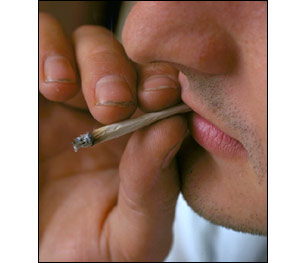

The pungent perfume of grass wafts down the Amsterdam street where you walk, under shade trees on a curving canal fronted by landmark brick buildings. You look up, nostrils flaring. Neon lights wink from the facades of cafes with names like the Grasshopper, Dutch Flowers or the Bulldog.
Better known as “smoking coffee shops,” these Dutch dope dens dispense soft drugs, marijuana and hashish, to a mixed bag of customers. Tourists and locals saunter in then stagger out in a cloud of smoke. Inside the air is blue. People puff and joke, some of them laughing crazily, others digging into snacks while lounging in armchairs. Seventies rock alternates with cool jazz and house music. Soft-drug menus are passed from behind the bar, where an “ethical dealer” has just delivered half a kilo of “skunk nederwiet” — the Netherlands’ prized, domestically grown high-THC power weed.
A couple of bucks buys you a joint of it. Even if you don’t light up your head begins to spin from a contact high. You glance around nervously, expecting the cops to show up. But they don’t. And they won’t. As long as the coffee shop plays by the rules.
That’s where the confusion comes in. Popular misconceptions about the Dutch approach to consuming and regulating
drugs have remained firmly rooted across Europe and America since the Dutch began liberalizing drug-use policies in 1975.
It’s true that you can still smoke grass or even shoot up without fear of punishment in Holland. But drugs, even marijuana and hash, have never been legal, are not legal now and are unlikely ever to be legalized in the Netherlands. Like Americans, most Dutch want drugs to remain illegal; unlike Americans, the Dutch are realistic about who should go to jail.
The Dutch are progressively tightening the screws: The number of
drug-related arrests in Holland — many involving the booming synthetic drugs trade — has more than doubled since 1995. Lately the Dutch Ministry of Justice has even begun using the outdated and inaccurate American nomenclature “war on drugs” in reference to their efforts to fight international drug trafficking. That’s in part because the Netherlands has become not only Europe’s cannabis and cannabis-seed capital, but also a
major production, warehousing and shipping center for ecstasy (and related synthetic drugs), as well as a transit country for heroin and cocaine.
The popular misconception about the Netherlands’ drug policy — that anything goes — stems from two quintessentially Dutch attitudes that have underpinned Dutch society for the last 400 years: tolerance and ambiguity. Tolerance, which the Dutch call “gedogen,” has been a way of life since the Catholic-Protestant religious strife of the 16th and 17th centuries.
Drugs — alcohol, tobacco and opiates — have been tolerated at least that long. Scholars now point out that the merrymakers in the fanciful Golden Age paintings of Jan Steen (1626-1679) and Adriaen Brouwer (active 1620s-30s) appear to be more than merely drunk as they stagger, swoon and grope through atmospheric inns and taverns.
They may well be tripping, too. Indeed, historians wonder whether the Golden Age Dutch mixed narcotics with their tobacco. The institution of the Brown Cafe — so called because the walls of such places haven’t been scrubbed since the Golden Age — is still going strong, booze and cigarettes being the demons of choice.
And demons they are: In its November 1999 report, “Drug Policy in the Netherlands,” the Dutch Ministry of Health, Welfare and Sport (MHWS) clearly states that “the social and health damage that results from alcohol abuse and alcoholism [in the Netherlands] is many times greater than the damage resulting from drug use.”
As it relates to narcotics today, the Dutch sense of tolerance means that use of small quantities (5 grams or less) of “soft drugs” — marijuana and hashish — is not a criminal offence. Use of even smaller quantities (0.5 grams) of “hard drugs” — cocaine, heroin, ecstasy — is also tolerated, though users will be referred to rehabilitation centers, and repeat offenders can be forced to choose between long-term detoxification or prison.
Here’s where the ambiguity comes in: Use is not a crime but possession of any drugs, hard or soft, is. More ambiguity: Possession of small quantities for personal use (5 grams and 0.5 grams, as per above) is generally tolerated, unless the user is a repeat offender or a troublemaker (i.e., causes a public nuisance). In any event, all illicit drugs, no matter how small the quantity, found during police searches of persons or places are systematically confiscated. The number of searches and seizures continues to rise dramatically. Importing, exporting, selling, trafficking, manufacturing or growing any illicit drugs is also a crime subject to fines (5,000 to 1 million Dfl, or $2,500 to $500,000) and/or imprisonment (four to 16 years).
Related to this is another series of ambiguous facts to put in your pipe and smoke. The country’s 861 “smoking coffee shops” (290 in Amsterdam alone) are allowed to sell adult clients (18 and over) small amounts (5 grams per person per transaction) of soft drugs. But in theory they can’t advertise the drugs, can’t sell alcohol on the same premises, can’t allow clients to cause a public nuisance, can’t sell drugs for take-out use or have more soft drugs on hand than the coffee shop conceivably needs to supply clients’ daily demands (500 grams, just over a pound).
But if importing or growing dope is illegal, you might ask, how do these legitimate establishments get their supplies? The question makes Dutch government officials queasy. “This is the inherent paradox of the Dutch drug policy,” says Frank Kuitenbrouwer, a legal commentator and member of the editorial board of the NRC Handelsblad, a leading centrist Dutch newspaper. “It’s known as the front-door/back-door problem: if the Dutch government tolerates people going in the front door of the coffee shop, what about the back door, the supply?”
Unofficially, police authorities allow “ethical dealers” — individual small-scale suppliers untainted by international trafficking rings — to handle transactions. But an Amsterdam city official, speaking on condition of anonymity, told me he believes that 90 percent of smoking coffee shops in the city are controlled by organized crime.
This is where tolerance and ambiguity become dangerous. “The front-door/back-door policy has created an enormous amount of organized crime in Holland,” confirms reporter Kurt van Es, a drug specialist at Amsterdam’s top daily Het Parool, and pro-legalization author of a book on smoking coffee shops and soft drugs. “The Dutch have become the Colombians of marijuana and hash trafficking in Europe.”
The Netherlands is a major marijuana growing country (of plants and, especially, seeds for export). Estimates are that if they were allowed to, Dutch growers could supply about 75 percent of domestic demand, thereby undercutting organized crime. But Dutch anti-drug squads systematically root out hemp plantations, and growing will probably remain illegal due partly to pressure from the E.U. and America. “This is a very bizarre situation,” adds van Es, “but somehow we don’t dare take the further step of legalizing the trade of soft drugs at coffee shops or other points of sale — bars or pharmacies.”
– – – – – – – – – – – – – – – – – – – – –
Curiously, at the perfumed floating Flower Market in central Amsterdam you can tiptoe through tulips and buy blooms in any season — and marijuana starter kits. They sell for about 15 Dfl, around $7.50. Follow instructions and you get smokeable, albeit weedy, plants in about 10 days. You see pot plants on cozy barges along picturesque canals, and on the window sills of old brick houses. Illegal? Yes, but tolerated. The Dutch officially call their confusing brand of ambiguity regarding drugs “The Expediency Principle.” That means officers and officials can decide case-by-case whether it’s in the public interest to arrest or detain drug users, growers and suppliers.
In recent years another recreational substance has sprung up in the forest of Dutch ambiguity: magic mushrooms. The Dutch call them “paddos” or “smart drugs.” They are sold dried, powdered or as spore starter kits at dozens of New Agey stores (they’re most popular in Amsterdam). Many smart drug boutiques also sell mescaline, and boast pause-for-thought names like “Conscious Dreams.” Attempts to regulate them are under study (they may soon become illegal, but tolerated). The Dutch MWHS concedes that “no reliable data is available on the scale of [their] use.”
The ultimate stated goal of the Dutch government’s drug policies is to “protect the health of individual users, the people around them and society as a whole,” according to the Ministry of Justice. In concrete terms that translates into decriminalizing — while actively discouraging — personal drug use; separating the markets and use-patterns of “soft” and “hard” drugs; keeping all drug users out of jail; rehabilitating and reintegrating addicts rather than repressing and punishing them; controlling the trafficking, import, export, manufacturing and growing of illicit drugs.
This approach is markedly different from America’s $18 billion a year war on drugs, better known to many in Holland as “the John Wayne” approach. Of the 2 million U.S. prison population, 500,000 are non-violent drug offenders (though the classification is itself ambiguous). The prevailing view in the U.S. appears to be that there should be no distinction between soft and hard drugs, that “use is abuse” and that tolerance leads to increased use of drugs of all kinds.
The Dutch have been applying their imperfect methods — like other countries they seem unable to control organized crime or ecstasy/amphetamine production and use — to fighting narcotics for about 25 years. By a variety of measures (notably habitual use and addiction rates) they appear to be working. For example, it’s estimated Dutch authorities reach 75-80 percent of heroin users. After rising sharply from 10,000 in 1979 their number has hovered between 25,000-28,000 for years and is falling as addicts’ average age (currently 36) increases. Dutch rehab efforts are applauded by European, and even American, drug-control agencies.
The Dutch argue that there is no statistical evidence to suggest tolerance has spawned a “drug culture,” or that soft drugs dispensed by smoking coffee shops are a “gateway” leading to hard drugs. But U.S. officials disagree. “I don’t think the argument is premised on, is marijuana a gateway drug?” says Rob Housman, assistant director of strategic planning at the Office of National Drug Control Policy (ONDCP) in Washington.
“I’m insisting that marijuana on its own is not benign. That marijuana has dramatic, terrible consequences for large numbers of the youths that use it and independent of any other impact on any other drug, those are risks that are unacceptable for America’s kids. Separate from that, does societal acceptance of drugs, hard or soft, create an attitude that in turn leads to other drug use?”
The answer, according to the ONDCP, is yes. However, according to the November Dutch MHWS report, the percentage of Dutch adults (age 12 and over) that have used cocaine is 2.1 percent in the Netherlands, compared to 10.5 percent in the U.S. — five times as high. Cannabis has been used by 15.6 percent of Dutch (age 12 and over) while the U.S. figure is 32.9 percent for the same age group.
The U.S. contests the validity of these data, citing incomparable survey methods. “I don’t think we ought to worry about whether there is a bigger Dutch problem or a bigger U.S. drug problem,” notes Housman of the ONDCP. “The problem is we all have a problem. We have different approaches. What is acceptable, what is workable within one society, may not be the right solution for another society.”
Data from the E.U.’s nonpartisan European Monitoring Center for Drugs and Drug Addiction (EMCDDA) show that in many other European countries (which do not have Dutch smoking coffee shops) consistently higher rates of drug use prevail (especially in Spain, the U.K. and Denmark), compared to the Netherlands.
Rates of problem drug use (defined by the EMCDDA as “intravenous or long duration/regular use of opiates, cocaine and/or amphetamines”) are lower in the Netherlands than in Belgium, Denmark, France, Ireland, Italy, Luxembourg, the U.K. and Norway, and almost on a par with those reported in
Germany, Austria, Finland and Sweden.
“I wouldn’t say drugs are banal,” notes Frank Kuitenbrouwer of the NRC Handelsblad. “They’re normal, we talk about them with our kids. The idea is not to criminalize or demonize drugs. Everyone agrees that tolerance has worked, but coffee shops are a nuisance and there has been a backlash.”
In fact hundreds of operating licenses have been pulled from smoking coffee shops in the last five years because of complaints about public nuisance. Drug tourism in Dutch border cities routinely “disgusts” and “revolts” locals. “Amsterdam is not only the marijuana and marijuana seed capital of Europe,” says Kuitenbrouwer, “it’s also the ecstasy capital of Europe and
that’s something that really worries the Dutch and gives rise to public revulsion.”
Is the sleaze — the noise, the smell and the cat-and-mouse presence of organized crime — engendered by smoking coffee shops worth it? Ultimately most Dutch seem to feel it is, though they are troubled by it and are the first to see its flaws. Kurt van Es of Het Parool cautions, however, that “The most disturbing thing for neighbors living around coffee shops is young people gathering outside, parking their cars or leaving the engine running to dash in and buy their stuff then go away again. But if you live
near normal bars and pubs you have similar problems and I don’t know whether you can say this is specific to coffee shops.”
One key argument against the Dutch has long been that their policies are too culture-specific to be exported. However, after decades of resistance, the rest of the E.U. is now reluctantly adopting some elements of the Netherlands’ drug policies, though each country’s approach differs widely.
The EMCDDA remarks that Denmark does not prosecute for possession or supply of small quantities of cannabis, and gives users “warning” for “drugs other than cannabis.” Imprisonment is reserved for offenses “involving supply for commercial reasons or organized trafficking.”
Frank Kuitenbrower suggests that decades ago the Danes actually applied a similar “separation of hard and soft, but they didn’t preach about it, whereas we Dutch had to make noise and use ‘the lifted finger’ to tell everyone that what we were doing was right. That’s why we were reviled by the French and Germans in particular. Yet the Germans have now largely adopted the Dutch policy in big cities.”
EMCDDA data confirm that Germany no longer prosecutes for use, import, export or possession of “insignificant quantities” of drugs; ditto Austria and Luxembourg. Ireland now levies fines for cannabis use. Sweden fines or requests users to seek counseling. In the United Kingdom, proceedings are often dropped for “possession of small quantities, occasional or personal use.”
Spain and Italy apply “administrative sanctions” (fines, suspension of driver’s license, etc.) for personal use — de facto decriminalization. “There are laws under consideration to totally decriminalize drugs,” says Dr. Silvia Zanone, an Italian drug policy consultant at the Social Affairs Ministry’s Prevention and Rehabilitation Activities Coordination Unit in Rome.
Zanone, acknowledging Dutch influences on Italy, adds “there have been calls for the creation of something like the coffee shops. If drug use is completely decriminalized then logically there must be a legal way for people to get them other than the illegal trade in drugs. But all of these proposals have been held up for years in parliament.”
In France “occasional users of illicit drugs” are now warned or referred to health or social care services. Michel Bouchet, head of the French Interior Ministry’s Anti-Drug Commission, confirms that “the use of all drugs is illegal in France but that does not mean you’ll waste away in prison if you take them.”
He adds, however, that France rejects the notion of toleration or separating drugs into hard/soft, and is in opposition to most Dutch policies. “I do not think there are ‘soft’ or ‘hard’ drugs. It’s difficult for there to be ‘soft use’ of hard drugs, and it’s certain there is hard use of soft drugs.” As the French government pushes citizens to stop
smoking cigarettes and reduce drinking, fears of Dutch-style liberalization are compounded by perceived risks of increased domestic multiple-drug abuse (tobacco and alcohol plus narcotics), as well as higher synthetic-drug consumption.
It’s tempting to wonder whether features of Dutch drug policy —
decriminalization of use combined with rehabilitation — could work in America. Detractors point out that America’s Puritan heritage makes it unlikely, an argument that, if it ever made sense, becomes steadily less compelling as the U.S. goes global, multiethnic and multicultural.
Consider the Dutch: like Americans, they’re always ready to “raise the finger” and preach; their roots are in Calvinism, a Puritanical form of Protestantism. Ask the Dutch what country theirs most resembles and the overwhelming response is America. Holland, like America, is a dynamic, high-tech driven multiethnic hodgepodge of some 145 nationalities (nearly half Amsterdam’s population is of non-Dutch origin). Certainly, the Netherlands resembles America more than it does Italy or Spain (Catholic cultures with millennial traditions) yet even these hidebound societies have moved toward liberalization.
“We need to provide alternatives to incarceration for first-time
non-violent drug offenders, and others who are non-violent offenders a second time, who don’t sell to kids and who aren’t using weapons,” admits Housman of the ONDCP, citing the Clinton administration’s multibillion-dollar anti-drug education and rehabilitation campaigns. “We absolutely agree that we need to refocus the efforts of the criminal justice system with respect to drugs.”
But while Congress and American law enforcement agencies contemplate whether to pursue the war on drugs or to emphasize decriminalization and rehabilitation, the Netherlands’ smoking coffee shops will continue to fill with curious Americans. As a proud proprietor once told me, “Americans are some of our best customers.”
