Women writers
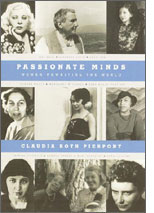
“Passionate Minds” by Claudia Roth Pierpont
A writer to reckon with takes on a dozen women who were writers to reckon with.
In “Passionate Minds,” her collection of critical essays — all of them originally published in the New Yorker — Claudia Roth Pierpont considers a dozen female writers of widely disparate sensibilities. What were her criteria for including Hannah Arendt in the same volume as Margaret Mitchell, not to mention Mae West and Ayn Rand? Simple: They are “literary women of influence (very different from women of literary influence) whose domain is somewhat off the usual critical path.” These writers wielded power, often out of proportion to their artistry. They started cults (Rand), engendered myths (Mitchell, of an Old South that never existed) and defined the self-perceptions of an entire generation of women (Doris Lessing, with “The Golden Notebook”).
None of the subjects of “Passionate Minds” has escaped the attention of prior critics. The 1970s saw the rediscovery of several who had dropped from sight, including Olive Schreiner, Anaos Nin and, most notably, Zora Neale Hurston. In a sense, then, Pierpont’s contention that these writers are off the usual path more accurately describes her own approach to them. She traces the connections between their lives and work with ease, treading lightly between the twin snares of polemic and psychoanalysis. Each of these portraits constitutes a short but satisfying critical biography; each contains at least one line so right that you can’t resist reading it aloud. (For example, Pierpont notes that Lessing’s forays into science fiction beginning in the late 1970s “inspired more critical shock than should have been felt by anyone who’d read ‘The Four-Gated City’ or, for that matter, by anyone who paused to think what a furiously willed sense of fantasy it required to remain a Stalinst through the mid-1950s.”)
The first piece, on South African writer Schreiner, establishes many of Pierpont’s major themes, including the problem of reconciling love (and sex) with literary achievement and the enduring influence of mothers. Schreiner’s own mother was implacable; she raised her children in a hut yet “charged herself with the perfect preservation of London drawing-room gentilities.” Her strength both repelled her daughter and equipped her to write “The Story of an African Farm,” a novel that found a huge audience among Victorians who had lost their religion yet sought some sort of spiritual comfort.
Pierpont’s other subjects were similarly scarred or inspired by the maternal example. West learned the all-important lesson from her mother that “one man was about the same as another.” Throughout her life she carried a photo of her adored parent, carefully retouched with West’s own cosmetics. Mitchell’s mother, who was simultaneously a suffragist and an apologist for the lost Southern cause, tried to chivy her child into acquiring an education. Mitchell resisted vehemently but went on to create a heroine who was strong-willed and independent, if as hollow (Pierpont notes) as Mitchell herself.
The mother-daughter struggle figures most fiercely in the life and writing of Lessing, whose rebellion against her unaffectionate mother began with teenage sexual activity and may have included her abandonment of the two small children from her first marriage. “To a reader,” Pierpont writes, “comes the awful but unavoidable thought that Lessing may finally have duplicated her mother’s perfect two-child family precisely in order to throw it away.”
Which brings us to another quality of these women’s lives: that “children are nearly impossible” in them. Though many of them married, unhappily or often or both, only three produced offspring. Mary McCarthy’s relations with her son, Reuel, are not recorded here. Lessing did raise a third child but dispatched him to boarding school at the age of 12. As for Marina Tsvetaeva, the Russian poet of all-encompassing romantic love, she responded to the privation that followed the October Revolution by putting her young daughters in an orphanage. Although she soon rescued her older (and favorite) child, the younger one, who was only 2, starved to death. Ironically, it is Gertrude Stein who emerges as a fount of maternal love; Pierpont depicts her as realizing, at the end of her life, that she had been “giving and feeding and advising and encouraging and (is there another word for it?) mothering [the] men whom she loved and admired.”
In truth, most of these women made life nearly as difficult for those around them as they did for themselves, with the exception of Eudora Welty. (Pierpont makes a convincing case that Welty willed her once unruly art into the constricted work of a perfect lady.) The ancient question bubbles up: Is bad behavior the prerequisite of creativity? And so, almost immediately, does the feminist answer: If these were men, we wouldn’t bother to ask.
That Pierpont explores the issue and delivers a nuanced response is one of the many pleasures of this book. She is surprisingly sympathetic to Rand, self-proclaimed prophet of selfishness, pointing out that her “novels are riddled with syntactical loopholes that permit … just the compassionate behavior she claims to disavow.” Yet Pierpont never hesitates to issue a verdict when one is needed. “The real and bottomless subject of Nin’s diary is not sex, or the flowering of womanhood, but deceit,” she asserts, echoing McCarthy’s declaration that every word Lillian Hellman wrote was a lie, “including ‘and’ and ‘the.’”
Although Pierpont has expanded and revised many of these essays since their first publication, some evidence remains that they began life as book reviews. Yet their wit, conclusions and unwavering intelligence make this second appearance (unlike some gatherings of magazine assignments) seem absolutely necessary.
Polly Morrice is a Houston writer. More Polly Morrice.
Dear female students: Stop writing about men
Guys in my class don't feel the need to dissect broken relationships. Why do the women? For that matter, why did I?
(Credit: Adam Radosavljevic via Shutterstock) My college students write a 20-page piece of creative nonfiction at the end of every semester, many of them memoirs. Over the years, I have heard about suicide attempts, rapes, arrests and the deaths of friends. I can never predict what they’ll write about, but here is one constant: The females in the class tend to write about a romantic relationship, and the males do not.
I’m not saying my male students are not sensitive. Some have detailed abuse at the hands of relatives; years spent in the foster system; hunting trips with their fathers; the thrill of learning to race motorcycles; but only once or twice in the nine years I’ve been teaching these courses has a guy expressed his need to understand why a relationship has fallen apart.
Continue Reading CloseLorraine Berry is a contributing writer at Talking Writing and a columnist at Does This Make Sense? Her unpublished memoir, "Word Lovers," for which she is seeking literary representation, has been optioned for film. She lives and teaches in the Finger Lakes region of New York. More Lorraine Berry.
I’m a writer who doesn’t write
I'm writing constantly in my head. How can I find the time to put these things on paper?
(Credit: Zach Trenholm/Salon) Dear Cary,
I have been formulating a letter to you on and off for the last year, as I would greatly appreciate your thoughts. This is the first time I have actually taken pen to paper (so to speak). I hope to be concise, but feel it is unlikely given the nature of my question. It regards the degree to which a Writer can write as a hobby and be satisfied, without disrupting all other aspects of life.
Much to the annoyance of your readers, and perhaps you, I feel the need to give some back story. First, the present. I am a scientist, a wife and a mother of three children. For all but a dalliance that lasted a couple of years, I am and have always been a Writer who doesn’t write (credit to John Irving, who first articulated that very apt concept). How do I know I am a Writer? Well, perhaps a better description is that I am a storyteller. Since I was a child of maybe 11 or 12, perhaps younger, I have spent almost the entirety of my interstitial moments making up stories. Some of them terrible, some of them interesting, all of them amusing to me in some way. It seems to be something my brain needs to do to relax. If I have more than 30 seconds, I am creating or revising a scene of some kind. I am writing or revising dialogue, organizing story arcs, imagining how to verbalize emotions. So just as some people read compulsively in every spare moment they have, I write in my head. For a long time, perhaps even until graduate school, I romantically viewed myself as an observer of life (versus a participator). Likely this was a protective mechanism. Still, I observed and I created and I lived vicariously through my own imagination. Oddly, I did have a social life, with friends, boyfriends and much merriment so I was participating to a degree. State of mind, I guess.
Continue Reading Close
Cary Tennis writes Salon's advice column, leads writing workshops and creative getaways, publishes books, writes an occasional newsletter and tweets as @carytennis.
- Send me a letter! Ask for advice! Letter writers please note: By sending a letter to advice@salon.com, you are giving Salon permission to publish it. Once you submit it, it may not be possible to rescind it. So be sure.
- Make a comment to Cary Tennis not for publication.
- Send a letter to Salon's editors not for publication.
More Cary Tennis.
Chick lit reimagined as respectable fiction
We team up with TheGloss.com to find out how to turn that best-selling genre of female writing into real literature
How much better would Gabriel García Márquez's book be if it was about shopping?? “Chick lit” is one of the most depressing terms I can think of in the publishing industry. Then again, I don’t know that much book-selling jargon, so there are probably worse ones (“Magical tweenism?”), but that phrase — applied to frothy writing about “modern” women (and their love lives) – is almost a derogatory term, implying the type of fluffy romance masquerading as post-post-post-new-wave feminist spiel. Yet for some reason, agents are encouraging female writers to think about chick lit marketing when writing their first books. I mean, no one is denying that the genre has mass appeal. But you know what else had mass appeal? “Two and a Half Men.” And Hitler.
Continue Reading CloseDrew Grant is a staff writer for Salon. Follow her on Twitter at @videodrew. More Drew Grant.
When a love for art turns into lust
Anne Roiphe's passion for literature led to flings with male talents of the time -- until she found her own voice
Anne Roiphe in the Hamptons in the late 1960's If you can’t be a creator, you might as well play the muse. That was the deal, such as it was, that noted feminist and fiction writer Anne Roiphe made in the early 1950s — and so did countless other women with serious aspirations, literary and otherwise. She attended parties with great talents like George Plimpton and Norman Mailer, where intellectual debate took center stage, but women were not a part of the main act. “The weight in the room, the power in the room, that was all male,” she writes. As for the women on the edges of these conversations: “Beauty was an asset. It always is in a Harem.” So, Roiphe utilized that asset.
Continue Reading Close
Tracy Clark-Flory is a staff writer at Salon. Follow @tracyclarkflory on Twitter. More Tracy Clark-Flory.
Literature’s gender gap
Women are underrepresented in literary publishing because men aren't interested in what they have to say
Last week, the website for Vida, an organization for “women in literary arts,” published the results of a survey of 14 literary publications, American and British, ranging from the venerable New York Review of Books to such relative newcomers as Tin House magazine. They counted up the percentage of female contributors, female book reviewers and, finally, reviews of books by women. The results were dispiriting. Poetry magazine came the closest to parity, with its reviewers divided almost evenly and books by women constituting a slight majority of those reviewed (even if men still made up the majority of contributors overall). The New Republic and the New York Review of Books made the worst showings.
Continue Reading Close
Laura Miller is a senior writer for Salon. She is the author of "The Magician's Book: A Skeptic's Adventures in Narnia" and has a Web site, magiciansbook.com. More Laura Miller.
Page 1 of 4 in Women writers