
Books
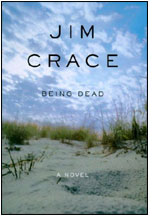
“Being Dead” by Jim Crace
A haunting novel about a couple caught and killed in flagrante delicto -- how they got there, and what happens before they're found.
Jim Crace’s new novel starts off like a genre mystery, with the savage murder of two middle-aged lovers on a remote and windswept beach. But anyone looking for the traditional mystery plot line — that old reassuring journey from crime to detection to punishment — is reading the wrong book. Instead, “Being Dead” takes off on a more eccentric course, swerving backward and forward in time in order to put these two deaths in context. The result is an odd, gorgeously written but curiously abstract novel that’s easier to respect than to love.
Joseph and Celice, the unprepossessing zoologists who find themselves in the condition described by the book’s title, are not the kind of married couple you’d expect to see on the beach doing anything other than collecting sea-cricket specimens. But on an impromptu visit to Baritone Bay, where they met 30 years before, they take a short, nostalgic detour: “They had made love for the first time in these same dunes. And they might have made love there again if, as the newspapers were to say, ‘Death, armed with a piece of granite, had not stumbled on their kisses.’” Discovered in flagrante delicto by a mentally deficient miscreant, the two are heartlessly bludgeoned and left to die — “traduced, spread-eagled and absurd” — in the sand.
|
Crace takes this violent ending as a beginning. Using as his model a funeral ritual he calls a “quivering” (during which neighbors and relatives reminisce about the dead, starting with the most recent memories), he proceeds to “upend the hourglass of Celice and Joseph’s life together.” Working backward from the murder, he relates in reverse order the mundane events of the day that led up to their final moments on Baritone Bay. At the same time, he reconstructs their lives in the other direction, from the time of their first meeting. These two thematic lines, along with a third involving their daughter’s reactions during the six days between their disappearance and their discovery by police, intertwine in a kind of narrative fugue, spun out in chantlike prose that often takes on the measured rhythms of blank verse.
But there is a fourth line to this fugue — an ostinato played by nature itself. As Joseph liked to say to his students, “Whatever philosophical claims we might make for ourselves, humankind is only marginal. We hardly count in the natural orders of zoology.” With this thought in mind, Crace also describes the purely physical changes that Joseph and Celice undergo during their six days in the dunes, as the forces of nature have their say: “Again the crabs and rodents went to work, while there was light, flippantly browsing Joseph and Celice, frisking them for moisture and for food, delving in their pits and caverns for their treats, and paying them as scant regard as cows might pay a turnip head.”
Readers prone to queasiness might want to skip a few sections here (as when “the flies lined up like fishermen along the banks of the bodies’ open wounds”). But it’s this last element of Crace’s strange eulogy that ends up being the most interesting aspect of the novel. As characters, Joseph and Celice are a little difficult to take — prickly, small-spirited, almost willfully unsympathetic. But by placing their lives and obscene deaths in the context of the larger natural processes of decay and regeneration, Crace allows the couple a measure of redemptive grace, something that might have proved impossible in a more conventional narrative. And so in “Being Dead” he pulls off a remarkable bit of legerdemain, combining various unappealing parts into a whole that somehow — despite those descriptions of oozing, gull-pecked, maggot-infested wounds — achieves a rough, uncompromising beauty.
Gary Krist is the author of the novels "Bad Chemistry" and "Chaos Theory." More Gary Krist.
“The Aleppo Codex”: The bizarre history of a precious book
A reporter traces the shadowy fate of the definitive version of the Hebrew Bible
Matti Friedman An ancient and priceless book, a murky history of evasions and coverups, an underground of sinister and possibly violent dealers, a former spy who drops tantalizing hints and a wily 84-year-old millionaire who says stuff like, “The problem with this story is that it could damage your health”: Are these the ingredients for a cheesy, improbable historical thriller? Yet “The Aleppo Codex,” Matti Friedman’s account of his attempts to learn the history of one of the world’s most precious books, sports all of these assets, and it’s nonfiction. If reporting this story damaged Friedman’s health, it probably happened when he realized what he’d stumbled into and his reporter’s heart started beating in doubletime.
Continue Reading Close
Laura Miller is a senior writer for Salon. She is the author of "The Magician's Book: A Skeptic's Adventures in Narnia" and has a Web site, magiciansbook.com. More Laura Miller.
Augusten Burroughs: Conquer trauma by letting it go
Salon exclusive: The best-selling memoirist says past horrors haunt us because we think about them too much. Stop
Augusten Burroughs Many people continue to feel influenced and even controlled by the things that happened to them a long time ago. Sometimes, people harbor dark, traumatic memories from childhood. Or fragments of memories — incomplete scenes, uncomfortable feelings, perhaps even a sense of certainty that something specific and terrible happened to them, but little more than this.
Others experienced something traumatic in adulthood that continues to affect them day to day many years later. Maybe an assault has left a person afraid to leave their home or enter a particular neighborhood.
Continue Reading CloseAugusten Burroughs' many books include "Runnning With Scissors," "Dry," "Sellevision," "Magical Thinking" and "Possible Side Effects." His latest book is "This Is How." More Augusten Burroughs.
Why did we move to Paris?
Leaving New York seemed ideal. Until the crazy landlord, topless exams, the French flu, the lack of credit cards...
Rosecrans Baldwin Paris’s neighborhoods, the arrondissements, are organized like a twist. They spiral from the river like toilet water flushing in reverse and erupting out of the bowl — a corkscrew or what have you, a flattened pig’s tail, a whorling braid notched one to 20. But if you walk from one neighborhood to the next, there is little to suggest the numbers changing. So it was confusing. Anyway, if you began in the middle of the Seine and snaked around, we lived on the Right Bank in the top of the third arrondissement, called the haut Marais, the upper Marais, on Rue Béranger, a quiet little street curling down from Place de la République.
Continue Reading CloseRosecrans Baldwin is a founding editor of The Morning News. His first novel, "You Lost Me There," was named one of NPR's Best Books of 2010. His latest book is "Paris I Love You, But You're Bringing Me Down." More Rosecrans Baldwin.
Robert Caro’s bloated LBJ biography
Robert Caro's latest LBJ tome has everyone -- even Bill Clinton! -- hyping it. They've been had
“Even the President of the United States sometimes must have to stand naked.” When Bob Dylan wrote that line in 1964, the naked emperor was Lyndon Johnson, which makes that image perhaps the most disturbing in all of Dylan’s apocalyptic work.
By stripping down Lyndon Baines Johnson to his essence, Robert Caro has himself become an American legend. Since the publication of “The Path to Power” in 1982, Caro has transformed LBJ’s life into a cautionary tale of Shakespearean dimensions. In some wonky circles, the release of a new volume is heralded like the Summer of Love release of “Sgt. Pepper’s.” Can Caro possibly top his “Revolver”?”
Continue Reading Close“Bring Up the Bodies”: Hilary Mantel’s power play
The sequel to her Booker-winning "Wolf Hall" is a thrilling exploration of what it took to run Tudor England
“Bring Up the Bodies,” Hilary Mantel’s follow-up to her Man Booker Prize-winning 2009 novel, “Wolf Hall,” is a high-wire act, a feat of novelistic derring-do. Mantel makes bold not with form — by now meaningful experimentation in that area seems exhausted — but with the very material that brings most readers to novels in the first place: our imaginative identification with fictional characters and the experiences we feel we’re sharing with them.
Continue Reading Close
Laura Miller is a senior writer for Salon. She is the author of "The Magician's Book: A Skeptic's Adventures in Narnia" and has a Web site, magiciansbook.com. More Laura Miller.
Page 1 of 984 in Books
