
Drugs
Extreme Ritalin
The drug should not become the moral equivalent of, or substitute for, better parenting and schools.
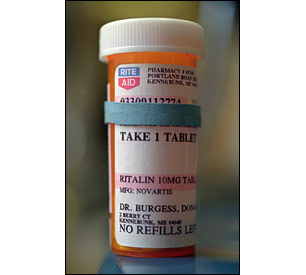
Ritalin was very busy last week. Twice, the controversial drug for the treatment of attention deficit-hyperactivity disorder (ADHD) made it to TV network news shows and the front pages of newspapers across the country. First Hillary Clinton, in her capacity as children’s advocate, announced that the National Institutes of Health would fund a multimillion dollar study of ADHD and Ritalin use in very young children. This followed publication in JAMA of a survey that found toddlers in increasing numbers were being given Ritalin and other psychiatric drugs. Later in the week, a story on the death of a college student from illegal use of psychiatric drugs also reported on the widespread availability of prescription stimulants on campuses throughout the country.
A preliminary study from Wisconsin has found that one in five college students has used Ritalin, Dexedrine or Adderall without a doctor’s supervision. The medications are usually obtained from students who’ve received the drug legally from a doctor for the treatment of ADHD.
At the extreme these stories of Ritalin use serve to highlight concerns that many doctors, school nurses and child psychotherapists have had for years over the increasing use of stimulants in our country. Ritalin production and use, nearly all for the treatment of ADHD, increased 700 percent in the 1990s. Only the most die-hard skeptics challenge the notion that something we call ADHD exists. The problem is defining who has and doesn’t have the excessive impulsivity, inattention and hyperactivity that are the cornerstones of the ADHD diagnosis. Widely varying rates of Ritalin use attest to the subjectivity of the diagnosis.
The answer to the question “Is Ritalin over- or underprescribed?” is yes depending upon the community you assess and your threshold for the ADHD diagnosis and Ritalin treatment.
This problem is highlighted with Ritalin use now extending down to preschoolers. How much hyperactivity is “excessive” for a 2- or 3-year-old? What is expected of a toddler these days that could constitute a problem great enough to require psychiatric medication? In what ways, if any, has children’s environment contributed to the problem by failing to provide the consistency of affection and discipline these children often need in abundance? While the toddler questions are grabbing the nation’s attention, these same issues apply to the use of Ritalin in school-age children as well.
According to the JAMA survey, most of the toddlers taking psychiatric drugs were not getting any other services. This is also consistent with patterns of treatment for older children. That Ritalin “works” in the short term to improve the focus of children with ADHD is well known. That does not make Ritalin the moral equivalent of, or substitute for, better parenting and schools.
Some say we simply cannot afford the costs of effective non-drug treatments for ADHD; Ritalin is cheap compared with paying for parental counseling and smaller classroom size. A Swiftian response might modestly propose the following: With about 4 million children currently taking Ritalin and classroom size averaging 30 kids per class, why not increase the number of children taking Ritalin to 7.5 million so we could increase classroom size to 45 and save a lot of money?
A less well known fact is that Ritalin improves everyone’s performance, child or adult, ADHD or not. College students are discovering on their own the “universal benefits” of stimulants. Unfortunately, it appears that every 20 years or so American doctors and patients lose their collective memories about the dangers of doctor-prescribed stimulants. Our last epidemic occurred in the late 1970s when Dexedrine was used unsuccessfully as a diet aid and many women became addicted to the drug.
Ironically, the only thing paradoxical about using stimulants for hyperactivity is that they’re actually safer for children than for adults. Children do not self-medicate and they complain when they feel weird or nervous on higher doses — not necessarily so for their adult-counterpart ADHD sufferers.
America’s century-long love affair with stimulants continues. No doubt there is a place for these drugs for a limited number of children and adults who are compromised in virtually any situation. But every day another Tom Sawyer or Pippi Longstocking gets a Ritalin prescription because their round or octagonal personalities do not fit into their school’s square educational holes.
Despite 60 years of stimulant use in children, uncertainty remains about its long-term effectiveness. The only thing for certain is that the controversy over Ritalin will continue. However, in the near future I doubt the questions and controversy over Ritalin will significantly slow our appetite for these drugs in performance-driven America.
Pick of the week: An early-’60s hipster time capsule
Pick of the week: Shirley Clarke's once-banned "The Connection" is a lean, mean saga of jazz, junk and rebellion
A time capsule loaded with smack from the bohemian underbelly of JFK-era America, Shirley Clarke’s 1961 film “The Connection” is an illustration of how much things change, and how much they stay the same. I’d be stretching to call “The Connection” a great film — it’s mannered and edgy, in a way that’s partly deliberate but also distinctive to its period — but it’s an important one in cultural and historic terms, despite being largely unknown. Watching this ensemble drama about a multiracial group of New York jazz musicians and beat philosophers in a run-down apartment, waiting for their drug dealer to show up, is like traveling back 50 years in time, only to encounter the same people you might meet on the street today (at least, in certain neighborhoods of Brooklyn, San Francisco, Austin and so on). At one point, the characters even debate the illusory distinctions between “hipsters” and “squares.”
Continue Reading CloseDrug-personality misconceptions
Alcoholic writers? Coke-head stockbrokers? The links between personality type and addiction are largely overblown
Ernest Hemingway (Credit: John F. Kennedy Presidential Library & Museum) Here’s Ernest Hemingway, dead drunk on a stool in Cuba with his face on his hand and his hand on an ever-present mojito. He’s the tormented writer, hard at work at the daily scrubbing of his sins. Like the Hard-Drinking Writer, we’ve come to expect certain personality types to have certain habits: The Morose Musician with Keith Richards’ appetite for heroin; the Insecure Starlet with Marilyn’s taste for pills; the Monomaniacal Money Manager with a nose for cocaine. They are generalizations that have been imprinted by generations of popular culture. But the types don’t necessarily line up.
Continue Reading CloseFormer neuroscientist Jacqueline Detwiler edits a travel magazine by day, but moonlights as a science writer. Her work has appeared in Wired, Men's Health, Fitness and Forbes. More Jacqueline Detwiler.
My suburban pot secret
I thought starting my own medical marijuana operation would be easy and safe. Then the DEA crackdown started VIDEO
(Credit: Yellowj via Shutterstock) It was sometime around 2 a.m. when I heard the car doors slam. I live on a very quiet street in Fort Collins, Colo., surrounded by working families who are usually falling asleep under the blue glow of their TVs by 10 p.m., and any noise in the night usually means that something is about to happen. And on that night I was certain it was about to happen to me.
Six marijuana plants were growing in my basement and because of shortsighted planning on my part, their odor had gotten completely out of control. Having never grown pot before, I foolishly overlooked the prominent admonitions printed in every growing guide I relied upon to help me with my harvest, that odor control was of the utmost importance. But equipment designed to mask the smell (ozone generators, activated carbon filters) is expensive. How much stench could six little plants really produce? I remember thinking. Well, a lot.
Continue Reading CloseGreg Campbell's new book is called "Pot, Inc.: Inside Medical Marijuana, America's Most Outlaw Industry." He is the author of "Flawless: Inside the Largest Diamond Heist in History," "Blood Diamonds: Tracing the Deadly Path of the World's Most Precious Stones" (the source material for the Leonardo DiCaprio movie of the same name) and "The Road to Kosovo: A Balkan Diary." Campbell is also an award-winning journalist whose his writing has appeared in The Wall Street Journal Magazine, The Economist, The San Francisco Times, Paris Match, and The Christian Science Monitor, among others. He lives in Fort Collins, CO. More Greg Campbell.
America’s pill-popping capital
Welcome to Kermit, W.Va. -- ground zero of the prescription drug epidemic
(Credit: iStockphoto/Salon) KERMIT, W.Va. — It takes less than a minute to drive past Kermit, five to tour the place entirely. An old coal mining town with barely 300 residents and one blinking light between the train tracks, Kermit has no supermarket, no clothing store, no main drag. Main Street is really a side street with rows of cottages, its biggest building, the Kermit community center, empty and boarded.
Yet in this tiny town, the Kermit Sav-Rite Pharmacy used to be as busy as a New York deli. Six employees worked the counter, lines at the drive-through window snaked around the square cinder-block building, and the parking lot was full day and night.
Continue Reading CloseEvelyn Nieves, former staff writer and columnist for the New York Times, is working on a book. More Evelyn Nieves.
Recovery’s new poster boy
Bill Clegg's first addiction memoir shocked readers. We talk to him about his follow-up -- and his newfound fame
Bill Clegg (Credit: Brigitte Lacombe/Little, Brown & Co.) Two years ago, Bill Clegg’s first memoir dropped like a bombshell on the New York media world. “Portrait of an Addict as a Young Man” chronicled the handsome and hugely successful book agent’s descent into a harrowing crack addiction that cost him his career, his boyfriend and his savings — and left him broke and in rehab. In one harrowing part of the book (excerpted in New York magazine) Clegg decides to blow off a first-class flight to Berlin after a week without sleep for a crack binge and sex with the cabbie driving him to his airport hotel. Staring at his pile of drugs, he wrote, “I wonder if somewhere in that pile is the crumb that will bring on a heart attack or stroke or seizure. The cardiac event that will deliver all this to an abrupt and welcome halt.”
Continue Reading Close
Thomas Rogers is Salon's Arts Editor. More Thomas Rogers.
Page 1 of 70 in Drugs
