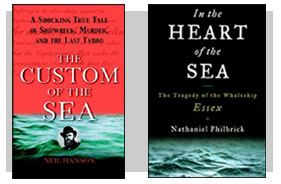

“The Custom of the Sea” by Neil Hanson and “In the Heart of the Sea” by Nathaniel Philbrick
Two new books serve up hair-raising histories of maritime cannibalism with all the gory details.
By Mark SchoneTopics: Books, Entertainment News
Life gets cushier all the time. Every month or so the wired world crosses another threshold of ease, and now we don’t even have to stir from our mouse pads to get sorbet and videos: Point and click at someone further down the food chain and the fruits of privilege will appear.
But in the land of plenty and the age of comfort, sometimes it’s hard to get our rocks off, and that’s where the suffering of others comes in handy. The past four years have seen a boom in danger porn. Around the time that even Grandma got e-mail, the public developed a taste for painful accounts of physical ordeals heroically endured by someone else. Danger-porn voyeurs peep from a safe remove as proxies battle “The Perfect Storm” or launch themselves “Into Thin Air.” The more strenuous the travail, the more alien it is from our cosseted lives, the more titillating it seems.
The safest distance is the distant past — rife with bummers, free of vaccines and anti-lock brakes. Two new contenders for the danger-porn canon raid the 19th century for twin ordeals so impeccably awful and so damn gross that the movie versions were probably cast before the book contracts were dry. “The Custom of the Sea” and “In the Heart of the Sea” are, as the former’s subtitle proclaims, “shocking” true tales of “shipwreck, murder, and the last taboo.” Both books tell a story of terrified, starving sailors who, adrift in open boats, are forced to kill and eat their companions.
Survival cannibalism was once so common that it was “The Custom of the Sea.” Neil Hanson’s book of that name recounts the most notorious instance of this custom in British maritime history. Off the coast of Africa in 1884, a freak wave crushed and sank the Mignonette, an unseaworthy yacht bound for Australia. Three crew members survived in a dinghy for four weeks by killing and devouring a 17-year-old cabin boy, Richard Parker. Rescued by a German steamer, the men of the Mignonette returned to a sympathetic British public and a government determined to prosecute.
With appropriate penny-dreadful gusto, Hanson exploits every blood-drinking, marrow-sucking, human-jerky-curing moment. The Mignonette’s captain, Tom Dudley, a former ship’s cook, did the butchering: “He reached into the still warm chest cavity and pulled out the heart and liver … The three men ate them ravenously, squabbling over the pieces like dogs.” Trial transcripts and contemporary newspapers aid Hanson’s poignant re-creation of the crew’s emotional voyage from horror to elation to a second round of torture courtesy of Queen Victoria’s courts.
What lifts “Custom” above the tabloid, however, is Hanson’s evocation of context. He relates the history of maritime cannibalism in one sleek chapter. He makes a strong case that the Mignonette and the 560 other British vessels that sank that year were victims of greed: Their owners had no incentive to keep them seaworthy because lost ships meant big insurance paydays and no wages owed to the sailors. The Mignonette disaster had a still larger social significance because the show trial of the survivors was the Crown’s attempt to end the custom of the sea forever.
“In the Heart of the Sea” has no such significance to justify it, but it does have a higher body count. Nathaniel Philbrick’s book centers on the 1820 death match between Nantucket, Mass., whale hunter Essex and a really big whale, which the Essex lost. Twenty men in three small craft escaped and wandered the Pacific; three months later there were two boats and five men left. Rescuers found bug-eyed stick figures hunkered over a pile of human ribs, with finger bones stashed in their pockets.
Had Philbrick needed a reason to revisit this gorefest beyond the mere gnarly fun of it, he might’ve chosen metaphor. Never before had a whale rammed a ship, and it was as if a lone titan were finally protesting a holocaust: The Essex was hunting west of Chile because Nantucket’s whalers had scoured the Atlantic clean. Metaphor, however, was taken — the 85-foot bull that sank the Essex inspired “Moby-Dick.”
Philbrick grasps instead at historical context — and misses. Issues handled ably by Hanson elude him. For example, Hanson notes that in eating the cabin boy, the Mignonette trio followed a second custom of the sea. Though tradition required drawing lots, over the centuries the short straw seemed to have a strange attraction to women, boys and blacks. On the Essex, a third of the crew was black, and not one black sailor survived — but Philbrick never mentions the long record of rigged contests or fully engages the possibility of bias.
Unlike the case of the Mignonette, the Essex case is notable only for sheer calamity. It didn’t spark a shift in the whale trade or set a legal precedent. Philbrick masks this lack of meaning with a lot of talk about Nantucket. His asides about local quirks and lingo turn from irrelevant to annoying, but as a loyal islander Philbrick keeps them coming. Why should we care that in 1997 some kids from Newburyport cut up a beached whale? Just because Newburyport “was where many of Nantucket’s first settlers had come from”?
As danger porn, Hanson’s “Custom” has the kind of edifying art-film trappings that make you forget you’re a voyeur. Philbrick’s book works best if you skip to the dirty parts.
Mark Schone is Salon's executive news editor. More Mark Schone.
You Might Also Like
More Related Stories
-
Serena Williams blames Steubenville rape survivor for "putting herself in that position"
-
Watch the trailer for "Anchorman 2"
-
Country music has always been feminist, even if Taylor Swift isn't
-
John Horne Burns: The writer Hemingway and Vidal envied
-
John Mayer offers up "Paper Doll" as your new Prancercise jam
-
There are no unicorns in North Korea
-
Is Cindy McCain actually a gay "hero"?
-
On "The Bridge," normal is dangerous
-
Ai Weiwei on his incarceration: "They never looked away from me, 24 hours a day”
-
Is there a "liberal bias" in academia?
-
Dan Harmon apologizes for comparing "Community's" season 4 to rape
-
Former intern sues Atlantic Records
-
All about Kaidence, the reported name of Kanye West and Kim Kardashian's baby
-
Exclusive clip from "How to Make Money Selling Drugs"
-
Vice apologizes, pulls suicide-glorifying photo spread from Web
-
What "The Bling Ring" gets wrong about Valley girls
-
Must-see morning clip: "The Daily Show" on the return of Sarah Palin
-
Lil Wayne dances on top of American flag in new music video
-
Charles Saatchi cautioned over assault on wife
-
From "Bling Ring" to Oprah, "The Secret" lives on
-
A head trip to a haunted recording studio
Featured Slide Shows
Gripping photos: The people of the Turkey protests (slideshow)
close X- Share on Twitter
- Share on Facebook
- Thumbnails
- Fullscreen
- 1 of 11
- Previous
- Next
-
The protests take on a festive element as police forces move out of the park and square. Wearing a gas mask, this young man dances to traditional Turkish music in front of Taksim Square’s Ataturk Monument.
-
In Gezi Park since March 31st, this protester, originally caught off-guard by the Government’s teargas and water cannons, went out and bought a Russian army mask from WWII, preparing for what was to come.
-
This rambunctious boy seems to be enjoying the chaos. After taking this picture he threw a stone at the already destroyed building in the background.
-
Forming a line, the police face off directly with protesters in Taksim Square. After a while, they retreated and there was a general cheer – a back-and-forth dance that has been common since the beginning of this protest.
-
An elderly woman in Gezi Park reads the news. The tent community occupying the park was violently destroyed on June 16th.
-
Many different groups had set up booths to promote their cause in Taksim Square and Gezi Park. Standing in front of one, this man waves his flag while posing with conviction.
-
Many home-remedies are used to minimize the effects of tear gas. This woman has put a milky solution on her face, removing her mask after the tear gas dissipated. Before sunrise, the police came again for another round of teargasing.
-
People capitalize on the uprising -- selling flags, beer, gas masks, sky lanterns and spray paint to name just a few of the popular items.
-
On Monday morning, June 11, the police execute a strong offensive. Many plain-clothed police officers, like the ones seen here, clash with protesters in the side streets away from the main stand-off in Taksim.
-
The authorities seem to be most aggressive in the night, pushing protesters away from the square and park. After being teargassed this young woman catches her breath with other protesters on Siraselviler Street.
-
Recent Slide Shows
-
Gripping photos: The people of the Turkey protests (slideshow)
-
The week in 10 pics
-
Photos: Turmoil and tear gas in Instanbul's Gezi Park - Slideshow
-
10 summer food festivals worth the pit stop
-
- Share on Twitter
- Share on Facebook
- Thumbnails
- Fullscreen
- 1 of 11
- Previous
- Next
-
The week in 10 pics
-
10 summer food festivals worth the pit stop
-
The week in 10 pics
-
The week in 10 pics
-
9 amazing drive-in movie theaters still standing
-
The week in 10 pics
-
The week in 10 pics
-
The week in 10 pics
-
The week in 10 pics
-
The week in 10 pics
-
The week in 10 pics
-
Netflix's April Fools' Day categories
-
The week in 10 pics
-
The week in 10 pics
-
The week in 10 pics
Related Videos
More Related Stories
-
Serena Williams blames Steubenville rape survivor for "putting herself in that position"
-
Watch the trailer for "Anchorman 2"
-
Country music has always been feminist, even if Taylor Swift isn't
-
John Horne Burns: The writer Hemingway and Vidal envied
-
John Mayer offers up "Paper Doll" as your new Prancercise jam
-
There are no unicorns in North Korea
-
Is Cindy McCain actually a gay "hero"?
-
On "The Bridge," normal is dangerous
-
Ai Weiwei on his incarceration: "They never looked away from me, 24 hours a day”
-
Is there a "liberal bias" in academia?
-
Dan Harmon apologizes for comparing "Community's" season 4 to rape
-
Former intern sues Atlantic Records
-
All about Kaidence, the reported name of Kanye West and Kim Kardashian's baby
-
Exclusive clip from "How to Make Money Selling Drugs"
-
Vice apologizes, pulls suicide-glorifying photo spread from Web
-
What "The Bling Ring" gets wrong about Valley girls
-
Must-see morning clip: "The Daily Show" on the return of Sarah Palin
-
Lil Wayne dances on top of American flag in new music video
-
Charles Saatchi cautioned over assault on wife
-
From "Bling Ring" to Oprah, "The Secret" lives on
-
A head trip to a haunted recording studio
Most Read
-
Why Sarah Palin actually matters again Joan Walsh
-
GOP plan to appeal to millennials: "Make abortion funny" Alex Seitz-Wald
-
Why didn't anyone help? Mary Elizabeth Williams
-
Lynda Obst: Hollywood's completely broken Lynda Obst
-
To my daughter on Father's Day: Sorry I used to be a sexist Mo Elleithee
-
Rahm Emanuel is losing control of his city Mark Guarino
-
The best of Tumblr porn Tracy Clark-Flory
-
TSA agent allegedly tells teenage girl to "cover herself" Mary Elizabeth Williams
-
Museum that discriminates against people says it is being discriminated against Katie Mcdonough
-
Study: Reading novels makes us better thinkers Tom Jacobs, Pacific Standard

Popular on Reddit
links from salon.com

311 points312 points313 points | 7 comments

61 points62 points63 points | 22 comments


Comments
0 Comments