
Tennis

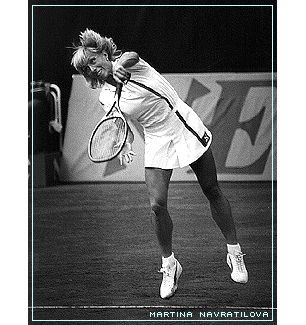
Martina Navratilova

The most daring player in the history of tennis, her attacking style and superb athleticism revolutionized the sport.

  • more
    • All Share Services

Martina Navratilova

If it weren’t for the quick cut to the tennis court, you might at first have trouble recognizing Martina Navratilova in the new Subaru commercials. Only six years have passed since she wrapped up the greatest career ever in women’s tennis — whether in terms of victories or just plain style — but already Navratilova’s tennis playing seems incidental, because there’s simply no one out there now to remind us of her dynamic, attacking, serve-and-volley style (and that goes even for the amazing Williams sisters and for Navratilova’s namesake, Czech-born Martina Hingis).

Navratilova, once too controversial for TV ads because she talked openly about her love of both men and women, is today as well known for her intelligence and willfulness as for her tennis game. This is the joke behind the TV spots, in which Navratilova plays off the idea that only men know cars. “What do I know about performance?” Navratilova says with easy, tart sarcasm, and then, at the close of the commercial, featuring her and other prominent female sports stars: “What do we know? We’re just girls?”

Not so long ago, Americans saw Navratilova as the embodiment of otherness: the mysterious, left-handed Soviet-bloc athlete using her obviously state-manufactured prowess and strength to do battle with lovable blond American sweetheart Chris Evert and her wicked two-handed backhand. Like other athletes from Communist countries, Navratilova faced an inconsistent blend of bias — hatred and scorn mixed with resentful awe. Yet as far back as when she was growing up outside of Prague, twig-thin and tiny but even then ready to swing big, Martina in many ways thought of herself as American.

“I was so stubborn, so independent, that I was more American than Czech, even as a little kid,” she reflects in her autobiography, written in 1985 with New York Times sportswriter George Vecsey. “I didn’t feel I belonged anywhere until I came to America for the first time when I was 16. I’m not a mystic about many things — I tend to be pretty pragmatic about life — but I honestly believe I was born to be American.”

Now, long after she became a naturalized citizen, Navratilova’s American identity is firmly established, so much so that when she shows up in the Czech Republic, as she did last year to receive a medal from Czech President Vaclav Havel, it’s a big event. And that’s fitting, because Navratilova is as American as Jay Gatsby, self-created in the way of people who take seriously the idea that they are free to live as they wish.

Navratilova retired in 1994 with a record 167 singles championships, still the all-time women’s record, and was ranked No. 1 in the world seven different years, including 1982 to 1986 consecutively. She won the Australian Open three times and the French twice, but it was before the rowdy, vocal crowds at the U.S. Open (which she won four times) and the respectful, proper crowds at Wimbledon that she made her most enduring mark. Wimbledon intimidated her at first with its tradition, its all-white clothes and strawberries and cream, but she ended up winning there an amazing nine times, including every year from 1982 to 1987.

“Martina revolutionized the game by her superb athleticism and aggressiveness, not to mention her outspokenness and her candor,” Evert told Women’s Sports and Fitness magazine when Navratilova retired. “She brought athleticism to a whole new level with her training techniques — particularly cross-training, the idea that you could go to the gym or play basketball to get in shape for tennis. She had everything down to a science, including her diet, and that was an inspiration to me. I really think she helped me to be a better athlete. And then I always admired her maturity, her wisdom and her ability to transcend the sport. You could ask her about her forehand or about world peace and she always had an answer. She really is a world figure, not just a sports figure.”

- – - – - – - – - – - – - – - – - – - – -

Navratilova’s parents divorced in 1959, when she was 3 years old, and Martina moved from a ski lodge in the Krkonose Mountains to her mother’s childhood home in the village of Revnice, just outside of Prague. These were Communist times, of course, and people did not have their own tennis courts. But Navratilova’s mother’s family had once had a 30-acre estate, and when the Communists took power in 1948, they took the land and left the family the house and a red-clay tennis court in the yard.

Tennis history owes a lot to the Czech Communists’ small show of restraint in leaving the court outside of what would be Martina’s window, but the loss of so much of what had been theirs left a mark on the family. Martina would sneak into the grove across the street and steal apples, consciously seeking to reclaim a little of what was lost. “I think my mother and my grandmother carried a sense of litost, a Czech word for sadness, that I picked up, a feeling of loss at the core of their souls,” Navratilova writes in her autobiography.

Agnes Semanska, Martina’s maternal grandmother, a tennis player herself, had beaten the mother of Vera Sukova in a national tournament. (Sukova reached the finals at Wimbledon in 1962.) Martina was athletic even as a toddler, and still remembers zipping downhill on skis when she was 2. Showing the local boys she could compete with them in ice hockey and soccer also made an early impression. But tennis was impossible to ignore. Her mother and father (her “second father”) spent most of their time at the town tennis club, except in winter, and Martina was given one of her grandmother’s old wooden rackets. It had no grip tape, was a little crooked and was ridiculously oversized for puny little Martina, but even at age 4 she would spend hours hitting balls against the wall as her parents played matches.

“I remember the first time I played tennis on a real court,” she wrote in her autobiography. “The moment I stepped onto that crunchy red clay, felt the grit under my sneakers, felt the joy of smacking a ball over the net, I knew I was in the right place. I was probably about 6 years old when that happened, but I can remember it as if it was yesterday.”

Martina’s father told her she could be a champion, and hit with her for hours every day. He pushed her hard, and could be tough and analytical about her technique, but he stopped short of becoming one of those tennis fathers or mothers who try to live their lives through their children. He made sure she was having fun and would say things like “Make believe you’re at Wimbledon.”

Martina was so boyish, short-haired and wiry, that when she turned 9 and her father took her to meet Czech champion George Parma for possible lessons, Parma looked at her warily and said, “How old is he?” Parma took her out and drilled balls all around the court, and she chased them down. Protigi and coach developed a close relationship, and Martina developed a big enough crush to wish she was old enough to marry him.

Parma had Martina ditch her two-handed backhand, which she had been using all her young life, so she could have more reach and make better volleys. He forced on her the good advice that a mastery of routine shots makes all the difference, and worked with her on strategy and the psychology of match play. Parma wanted her to have the foundation of training he never had, and the Czechoslovak system made that possible.

“In the mid-’60s, the communists could see the value of sports as a way of making people proud and keeping their minds off the less pleasant aspects of life,” Martina would later write. “The Communists more or less emphasized a different sport in each country: weight-lifting in the Soviet Union, track and field in East Germany, gymnastics in Rumania, tennis in Czechoslovakia.”

In 1968 she lived through the single largest event in Czechoslovakia until the country achieved its independence during the Velvet Revolution in 1989 — the Soviet crackdown on the Prague Spring. The Czechs beat the Russians in ice hockey in the winter Olympics in France that year, Alexander Dubcek had people believing in the possibility of greater freedom and even an 11-year-old girl felt the excitement in the air. Martina was at a junior tournament in Pilsen — famous for its beer — when the Soviet tanks made their move the night of Aug. 20. As much as the Czechs tried to maintain an independent spirit — unfurling banners like “Ivan, go home. Natasha has sexual problems” — “socialism with a human face” was history and more than 100,000 defected in the next year, many of them prominent writers, artists and athletes.

“When I was 12 and 13, I saw my country lose its verve, lose its productivity, lose its soul,” she writes. “For someone with a skill, an aspiration, there was only one thing to do: Get out.”

But she kept working on her tennis, and she even believes her resentment of Russians made her a better player. Offended that a Russian she had defeated wouldn’t shake her hand one time, Navratilova told her, “You need a tank to beat me.” The same would be true of her opponents when she hit her peak on the women’s tour a few years later.

“Martina is probably the most daring player in the history of the game,” legendary TV analyst Bud Collins said when Navratilova retired. “She dared to play a style antithetical to her heritage without worrying about making a fool of herself. She dared to remake herself physically, setting new horizons for women in sports. And she dared to live her life as she chose, without worrying what other people thought of her.”

- – - – - – - – - – - – - – - – - – - – -

It wasn’t so long ago that Navratilova ruled women’s tennis; it just feels that way. Saying “Martina and Chrissy” has a way of making the late ’70s feel current again. Navratilova and Evert were rivals and friends, and one of the greatest sports tandems ever. “We’re matched like chocolate-or-vanilla, jazz-or-classical, two champions with opposing styles competing for limited space at the top of women’s tennis history,” Navratilova wrote in her book.

The two women played so many memorable games, they all roll together into one endless, up-and-down carnival ride. An intense, wild tennis match between opponents who know each other perfectly can have a transcendent appeal, but the best tennis, like the best novels or movies, has characters people feel they know, personalities who make us care. Navratilova and Evert did that like no one has since.

Navratilova had been Czechoslovakia champion, and she had played in West Germany and England in the West, and Bulgaria, Hungary, Poland and East Germany in the Soviet bloc, but it wasn’t until she traveled to the United States in 1973 as an unknown 16-year-old that her life in tennis really got started. Her serve-and-volley game made an immediate impression. She gave former Wimbledon champion Evonne Goolagong a good match before losing 6-4, 6-4, and in the first round of a tournament in Akron, Ohio, lost 7-6, 6-3 in her first match with Evert, who had reached the semifinals at the U.S. Open in 1971 and been a semifinalist at Wimbledon in 1972.

It was Navratilova’s pairing with Evert that vaulted her into the realm of unforgettable sports stars. Evert did not just dazzle Navratilova with her talent, experience and easygoing personality, she also posed an obstacle that would eventually require the young Czech to reinvent herself. It wasn’t until their sixth match, two years after their first meeting, that Navratilova finally beat Evert. But later that same year, they met at the U.S. Open and Evert won, 6-4, 6-4 — one of many such victories in that early period that at one point gave Evert a 14-2 edge.

Navratilova was still just 16 when she returned from that first eight-week tour of the United States. She beat a top American, Nancy Richey, to make it to the quarterfinals at the French Open the next year before losing to Goolagong, and played in her first Wimbledon, the pinnacle of tennis. “Everything is Wimbledon,” Navratilova would write. She soaked up the atmosphere and won two matches before succumbing.

The Czech authorities let her travel to the United States again in 1974 and in Orlando, Fla., she won her first professional tournament, beating Julie Headman, 7-6, 6-4, in the final. That was enough to give Navratilova a clear idea of what she wanted: a free, unfettered shot at success in America. There was just one small problem: She lived in a Soviet satellite state. Soon she was colliding with the Czech tennis authorities, who called her “too Americanized” and criticized her for being too friendly with Americans like Evert and the great Billie Jean King. Sukova, now the Czechoslovak women’s coach, told Martina: “You’ve got to cool it. You’ll get yourself in trouble and everybody else in trouble.”

But by then Navratilova knew it was just a matter of time before she had to take action. She knew that at some point, she could lose her travel privileges, even though she was soon regularly winning tournaments. She made her firm decision to defect around the time of the 1975 U.S. Open, and spent most of that tournament sequestered in her hotel room with attorneys and FBI agents. After she lost to Evert in the semifinals, Navratilova met with the Immigration and Naturalization Service on Manhattan’s Lower West Side and ended up having to flee her hotel room the next day, while her asylum application was still being processed, when news of her defection broke.

The Czechoslovak government condemned her, and would soon do its best to rub out all traces of her existence. Neither was the transition to life as an American easy for Navratilova, who was no longer Czechoslovakian but not yet American. By Wimbledon the year after she made her move, she was “a candidate for a nervous breakdown,” as she put it. Back at the U.S. Open, exactly a year after the high jinks with the FBI and the INS asylum process, she dropped a first-round match to unseeded Janet Newberry, and broke down afterward, sobbing. Newberry said she’d never seen anyone so distraught.

The next day, she bought a house in Texas, so she could move from Los Angeles and begin turning herself into a polished pro athlete. She ran. She lifted weights. She watched what she ate. She dropped from 167 pounds to 144 over the course of the next year.

She was fit and confident and on a roll by 1978 when she started the year by winning 37 straight tournament matches and beating Evert for her first Wimbledon championship, which also vaulted her to her first No. 1 ranking. There were ups and downs, but the resolve and discipline that kicked in that first year in Texas renewed itself later when her career started faltering. She lost a match 6-0, 6-0 to Evert in 1981, the worst loss of her career, and soon began working out with Nancy Lieberman, a professional basketball player at that time. Even as the tennis press occupied itself with articles asking, “What’s wrong with Martina?” Navratilova dropped her body fat to 8.8 percent and her weight back down, and this time was ready to keep working at it. She even consulted with a dietitian, something then unheard of and now routine among top athletes.

This was the Martina who would become so unbeatable that women’s tennis became almost boring for a while. She worked with Dr. Renee Richards and former men’s pro Mike Estep and just kept getting better, so much so that it seemed a shame she couldn’t play the men. “My only regret is she didn’t play on the men’s tour,” said Ilie Nastase when she retired. “I would have liked the chance to play her.” But before she reached that highest plateau of her career, she had to face another huge disappointment — losing the 1981 U.S. Open final to 18-year-old Tracy Austin, who wore Navratilova down in the third set, leaving her devastated. But she discovered something in her moment of despair.

“I was still crying when the announcer called my name for the runner-up trophy,” she wrote. “But then something marvelous happened: The crowd started applauding and cheering. Their ovation lasted for more than a minute, and I stood there and finally started to cry, but I cried tears of appreciation, not sadness … It was really strange, not like tennis at all, but really something you expect to see in opera, where the soprano steps out of her role on the stage for a curtain call, and the crowd cheers and throws roses. That’s how I felt. They weren’t cheering Martina the Complainer, Martina the Czech, Martina the Loser, Martina the Bisexual Defector. They were cheering me. I had never felt anything like it in my life: acceptance, respect, maybe even love.”

Wimbledon: Another year, another grunting grumble

Why are the Brits so particularly obsessed with grunting women's tennis players, anyway?

  • more
    • All Share Services

Wimbledon: Another year, another grunting grumbleSerena Williams of the US returns a shot to France's Aravane Rezai at the All England Lawn Tennis Championships at Wimbledon, Tuesday, June 21, 2011. (AP Photo/Sang Tan)(Credit: AP)

Ian Ritchie, the head of England’s Wimbledon tennis tournament, has told the Daily Telegraph in an interview that officials would “prefer to see less grunting” from athletes in the competition. Ritchie says he blames the grunting trend in tennis primarily on an “education problem with younger players.” (It seems this year’s particular problem comes in the form of Belarus’ Victoria Azarenka.)

Much has been made of Ritchie’s remarks today (let’s face it: How often do most journalists get to use the word “grunt”?). But grunting complaints are hardly new. In fact, grunting is a pet issue for the British press, almost as much of a go-to at Wimbledon time as strawberries and cream.

Last year, a Press Association report on Maria Sharapova’s loss to Serena Williams at Wimbledon declared that the Russian player “remain[ed] champion” in the “grunting stakes,” emitting wails of up to 104 decibels (compared to Williams’ more modest 91).

“Aircraft overhead and cheers from the crowd were at times drowned out by the pair during the pivotal first set tie-break,” the piece noted. (A study published later in 2010 claimed to present “unequivocal” evidence that grunting gives players a “real advantage.”)

In 2009, a Guardian article about the Women’s Tour Association’s stance on grunting noted that the WTA had long considered the practice a “construct of gnarled British news reporters armed with decibel-recording ‘gruntometers’” — pointing up the press’ seeming fascination with the topic.

Indeed, 2009 was a banner year for grunting controversy; that summer, BBC radio commentator (and former Wimbledon men’s singles victor) Michael Stich caused an uproar when he called grunting “disgusting, ugly, [and] unsexy” — adding that he thought “sex appeal” was a large part of what female tennis players “sell.”

In the same year, Martina Navratilova lashed out against on-court noisemaking (“The grunting has reached an unacceptable level. It is cheating, pure and simple. It is time for something to be done”), and the year’s most notorious offender, teenage Portuguese phenomenon Michelle Larcher de Brito, hit back:

“I’m not here to be quiet for anybody. I’m here to win. If people don’t like my grunting, they can always leave. … Tennis is an individual sport and I’m an individual player. If they have to fine me, go ahead, because I’d rather be fined than lose a match because I had to stop grunting.”

Before the 2009 tournament even began, the London Times had written of de Brito:

A 16-year-old Portuguese tennis player tipped as a future great, Michelle Larcher de Brito, emits a wail while hitting shots that seems to last longer than it takes the ball to reach the other side of the net. Sometimes her moans are loud enough to be heard three courts away. …

Tennis officials are now calling foul on grunting. The problem they face is determining whether a noisy exhalation of air is natural or done on purpose to put off an opponent.

Just over a week later, it had assembled a handy Q&A on “the main issues” about grunting at Wimbledon, since the topic had proved such a persistent talking point.

A Times piece from 2005 offers further back story:

Monica Seles [first] took things to a higher pitch in the 1990s, prompting British newspapers to measure the decibels on centre court. Seles registered 93.2 decibels, enough to make Jennifer Capriati scream “shut the f*** up” across the net.

Given grunting’s robust history of attention in the press, there’s no reason to assume we won’t be writing about it again this time next year. Until then, watch this clip for a sampling of Victoria Azarenka’s trademark vocal trill, and judge for yourself: Is it distracting? Is it cheating? Is it even “grunting”?

Continue Reading Close

Emma Mustich is a Salon contributor. Follow her on Twitter: @emustich.

Navratilova hospitalized after Kilimanjaro attempt

Tennis icon "disappointed" not to be able to reach mountain summit

  • more
    • All Share Services

Martina Navratilova has been hospitalized in Kenya with an accumulation of fluid in the lungs after attempting to climb Africa’s highest peak, according to a statement released Friday evening.

The 54-year-old tennis great has been diagnosed with high-altitude pulmonary edema, said Dr. David Silverstein, a consultant in cardiology and internal medicine at Nairobi Hospital.

“It is potentially dangerous when someone is at high altitude, but once brought down, recovery is quick,” he said. “Martina is doing well and will continue to do well.”

Navratilova had been assisted down Mount Kilimanjaro by porters and driven to the Kilimanjaro Christian Medical Centre for assessment after having to abandon her attempt to climb the mountain in Tanzania for a sport charity.

The 27-person climbing team Navratilova was part of has faced heavy snows and mist since beginning the climb up the 19,340-foot (5,895-meter) mountain Monday.

“I’m disappointed not to be able to complete this amazing journey,” she said in the statement. “It was something that I have wanted to do for so long but it was not to be.”

Navratilova, who won 18 singles Grand Slams, told The Associated Press last weekend that she has never climbed higher than 12,000 feet. She had reached nearly 14,800 feet (4,500 meters) when she was forced to give up after feeling unwell, according to the charity.

The Aspen, Colorado resident told AP she was “petrified” of failing to reach the summit “because then the whole world will know.”

Navratilova was climbing the mountain to raise money and awareness for the Laureus Sport for Good Foundation. The rest of the team will continue the climb and should reach the summit Saturday.

——

On the Internet:

Laureus Sport for Good Foundation: http://blog.laureus.com

Continue Reading Close

McEnroe: Ease up on female players

The tennis champ warns that women are being given more court time than they can handle

  • more
    • All Share Services

McEnroe: Ease up on female playersJohn McEnroe of U.S. gestures during his match against Sergi Bruguera of Spain at the Masters Senior tennis tournament in Madrid March 29, 2008. REUTERS/Juan Medina (SPAIN) (Credit: © Juan Medina / Reuters)

When John McEnroe opens his mouth, he has a knack for getting in trouble. That was true on the tennis court and it is apparently still true even now that he’s offering commentary from the sidelines. During a CBS conference call, the U.S. Open champion suggested that female tennis players are ”unable to deal with both the physical and mental demands of the game,” the Los Angeles Times paraphrases. It’s a bold contention considering the New York Times Magazine’s current cover story is about … the tremendous power and strength of female tennis players.

“I think that it’s asking too much of the women,” he said. “They shouldn’t be playing as many events as the men. … You shouldn’t push them to play more than they’re capable of.” He added, “They should be required to be in less events, there should be less events for the women. It seems it takes an actual meltdown on the court or women quitting the game altogether before they realize there’s a need to change the schedule.” Presumably, he’s referring to Vera Zvonareva’s teary-eyed “meltdown” at Wimbledon in July and at last year’s Open.

As McEnroe well knows, though, women aren’t the only ones who have meltdowns on the court. And, while it may be true that a number of top female players have suffered injuries this year that have taken them out of the game for some time, Michael Joyce, Maria Sharapova’s coach, points out in the Times that “reigning U.S. Open men’s champion Juan Martin del Potro is sitting out the Open — and has sat out most of the season — because of a wrist injury and … Rafael Nadal was absent from Wimbledon in 2009 because of his own injury issues.” He also added this biting remark: “The game is a lot different than when John was playing with wooden rackets 20 years ago. It’s not only the women.” 

I’ll leave the core of this debate up to the experts — or, really, to anyone who knows anything about tennis (because I sure don’t). It’s interesting, though, to think about the differences in how we evaluate players’ emotional and physical capacity. It seems there is a tendency to either overreact to female displays of anger on the court, or to instead see these fits as emotional breakdowns rather than passionate, enraged outbursts à la, well, McEnroe.

Continue Reading Close
Tracy Clark-Flory

Tracy Clark-Flory is a staff writer at Salon. Follow @tracyclarkflory on Twitter.

Celebrating female tennis players in slo-mo

A New York Times video slide show highlights the power -- or is it the sex appeal? -- of these top athletes

  • more
    • All Share Services

Celebrating female tennis players in slo-mo

I was very excited to read a Web preview of a piece in this weekend’s New York Times Magazine about, as the headline puts it, “Women Who Hit Hard.” In the sprawling article, Michael Kimmelman writes that professional female tennis players are “stronger, bigger, faster, better trained and pushed above all by the example of the Williams sisters. Serena, glorious and musclebound, and Venus, long-limbed and tall, have redefined the sport around power.” The point, you see, is to celebrate the strength and athleticism of the sport’s top female players.

That’s why I was surprised when a link to an accompanying video slide show titled “The Beauty of the Power Game” was forwarded to me by a co-worker with a note that he found it “kind of weird and creepy the way they glammed them up.” Having glossed over the slide show when reading the piece earlier, I clicked the link and started watching the first clip of Kim Clijsters. In slo-mo, she bounds into the frame, muscles rippling, and nearly goes into the splits as she brings her racket to the ball. She looks like a lioness on the hunt — long blond curls falling around her face, a sneer on her lip, her eyes narrowed with a singular, predatory focus. She is an awesome sight to behold. I think: What’s weird or creepy about this?

But then follow several more clips of various players, all in slow motion, with a swelling classical soundtrack. There is Serena Williams with her makeup meticulously done, her skin covered in glitter. She hits the ball and yet more glitter flies every which way. Elena Dementieva is up next wearing a bizarre strappy dress. She gracefully twirls in slo-mo, looking very much like a ballerina. Samantha Stosur’s arms look cut from stone, and her movements send mesmerizing ripples up her powerful thighs, but she is wearing a dissonantly delicate bandeau bra top (which prompted a friend of mine to comment: “Hello, nipples”) and a pleated lavender skirt.

I suppose part of the difficulty in fairly evaluating these videos is that we don’t do so in a vacuum. The common critique when it comes to women in sports is that they get attention only for being sexy, and that is especially true with tennis. But the Times didn’t toss Anna Kournikova in front of the camera in a teeny-tiny tennis outfit. These are truly some of the most powerful women in the sport, and they do challenge mainstream notions of femininity. (In particular, Williams, who has talked about past discomfort with her “super-curvy” body. Note, though, that she is one of two players who are filmed only from the chest up.) So, is it creepy or beautiful? A totally scientific poll of my instant-message buddies resulted in no clear consensus.

Personally, I find it to be a little bit of both. As a general rule, I’m not opposed to seeing female athletes as sexy or sexualized. That would make me quite the hypocrite, as I didn’t complain when Vanity Fair came out with its issue featuring male soccer players in their underwear. (Quite the contrary — I ran out and bought a copy the first chance I got.) Athletes’ bodies are in top form; they are exquisite and godlike. But the glamorous makeup and wardrobe — and that freaking glitter — in the Times slide show do seem a touch odd. As the co-worker who forwarded the link to me said: “The vibe seems to be ‘we will show you that female power can be sexy’ — which it can, of course. But then, they couldn’t just trust that — they had to add this other stuff, as if to say, well, it can’t be sexy on its own.”

Continue Reading Close
Tracy Clark-Flory

Tracy Clark-Flory is a staff writer at Salon. Follow @tracyclarkflory on Twitter.

Federer loses to Berdych in Wimbledon quarters

For the first time since 2002, the six-time champ won't be on Centre Court for the finals

  • more
    • All Share Services

For the first time in eight years, Roger Federer won’t be striding onto Centre Court for the Wimbledon final this weekend.

The six-time champion was upset in the quarterfinals by hard-hitting Tomas Berdych on Wednesday, stopping his bid for a record-tying seventh title at the All England Club and extending his recent stretch of disappointing play.

The 12th-seeded Berdych used his big serve and forehand to beat Federer 6-4, 3-6, 6-1, 6-4, on Centre Court for the biggest victory of the Czech’s career.

It’s the first time since 2002 that Federer has failed to reach the final. Since losing in the first round eight years ago, Federer had played in the championship match a record seven consecutive times. He won the title six times and finished runner-up once, bolstering his reputation as the greatest player of all-time.

Winner of a record 16 Grand Slam titles, Federer said he was unable to play his best tennis Wednesday because of pain in his back and right leg.

“I couldn’t play the way I wanted to play,” said Federer, who had been chasing the record of seven titles won by Pete Sampras and 19th-century player William Renshaw. “I am struggling with a little bit of a back and a leg issue. That just doesn’t quite allow me to play the way I would like to play. It’s frustrating, to say the least.”

Berdych ripped a clean forehand winner on his second match point to become the first Czech to reach the men’s semifinals since Ivan Lendl in 1990.

“It’s really tough to show this crowd how I’m just feeling right now, it’s amazing to play in this stadium, to play such a great player as Roger is, and come here and be here as a winner is just really amazing,” the 20-year-old Berdych said.

Berdych will next face Novak Djokovic, who swept past Yen-hsun Lu in straight sets to reach the semifinals for the second time. The third-seeded Djokovic never faced a break point as he beat the 82nd-ranked Taiwanese player 6-3, 6-2, 6-2 in less than two hours on Court 1.

In other matches, No. 2 Rafael Nadal played No. 6 Robin Soderling, and No. 4 Andy Murray faced Jo-Wilfried Tsonga.

With the loss, Federer will drop to No. 3 in the ATP rankings next week for the first time since Nov. 10, 2003. Since winning the Australian Open in January, he has failed to win a tournament.

Federer said his leg and back have been bothering him since the grass-court tournament in Halle, Germany, the week before Wimbledon. He hadn’t previously mentioned any injury problems.

“When you’re hurting, it’s just a combination of many things,” Federer said. “You just don’t feel as comfortable. You can’t concentrate on each and every point because you do feel the pain sometimes. You tend to play differently than the way you want to play.

“Under the circumstances, I think I played a decent match,” he added. “But I’ve been feeling bad for the last two, three matches now. If there’s anything good about this, it’s that I’m going to get some rest.”

Federer was playing in his 25th consecutive Grand Slam quarterfinal. He had won 23 straight, but now has lost two in a row. Federer fell to Robin Soderling at the French Open earlier this month.

Federer had won 76 of 77 grass-court matches dating to 2003 coming into this month, but has now lost two of the past six, including to Lleyton Hewitt in Halle.

Federer was clearly outplayed Wednesday by a man who has always possessed enormous talent but often failed to live up to expectations.

The 6-foot-5 Berdych was on the offensive for most of the match, smacking first serves consistently in the 130s mph (above 210 kph), winding up to rip forehand winners and not buckling under pressure. He hit 51 winners, compared to 44 for Federer.

“He played well when he had to,” Federer said. “It was brutal for me. Every time he had a chance, he took it. On the break points, he played great on those. … When I did have chances, I played poorly. It was just a frustrating match the way it all went.”

Berdych broke Federer four times, with the final break coming in the seventh game of the fourth set. Berdych served 12 aces, was broken just once and saved seven of eight break points.

Federer came in with an 8-2 career record against Berdych, having lost the first match at the 2004 Athens Olympics and the last in Miami this year.

“I don’t think I played poorly,” Federer said. “I think he went after it. I know Berdych. I think I’ve played him 10 times already before. That’s the way he plays.

“I think he’s been able to play more consistent last year or so, and I was just not able to defend well enough and I didn’t come up with the good stuff when I had to. It was disappointing.”

Lu stunned three-time finalist Andy Roddick in the fourth round, but couldn’t replicate that performance against Djokovic, the 2008 Australian Open champion.

Djokovic lost just 12 points in 13 service games. He won 26 of his first 28 service points, including 15 in a row. The Serb had 29 winners and 17 unforced errors, and converted five of 15 break points.

“Nothing is easy these days, especially at this stage of the tournament,” Djokovic said. “But the way I played, I deserved to win. I was hitting all the shots and I was really playing very solid from all parts of the court. I’m very, very happy with the performance today.”

Djokovic reached the semifinals here in 2007 but had to retire against Rafael Nadal with a foot injury while trailing in the third set.

“This time physically I’m fitter,” Djokovic said. “Those were very strange conditions and circumstances. I had to play three very long matches in three days and couldn’t hold on in the semifinal. This time everything is in order and I’ll give my best.”


Continue Reading Close

Page 1 of 6 in Tennis