
Books
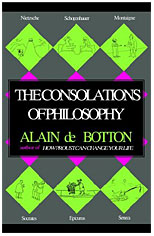
“The Consolations of Philosophy” by Alain de Botton
Six great philosophers on six big problems, rendered in terms that even Bart Simpson could follow.
The early “for dummies” books — on computers and auto repair — were a fine idea. The car titles spoke to everyone who thinks she should grasp the internal combustion engine but would settle for a few troubleshooting techniques beyond popping the hood and looking concerned. But then the publishing phenomenon (908 “for dummies” titles were listed on Amazon.com at last check) took an alarming dive. Given the existence of “Astrology for Dummies” and “Coffee for Dummies,” how long before we see “Doing Bong Hits and Watching Cartoons for Dummies” or “Drooling on Your Shirt Front for Dummies”?
Alain de Botton’s new book represents another, equally useless side of dummymania. His “The Consolations of Philosophy” is essentially “Socrates, Epicurus, Seneca, Montaigne, Schopenhauer and Nietzsche for Dummies,” and one has to ask, Who is this book for? Readers interested in the interplay of thought and language or of earthly and ideal beauty are likely to be insulted by de Botton’s boiling down the impassioned struggles of these six thinkers into “Chicken Soup for the Soul.” And those who aren’t interested in such things are unlikely to read a book with “philosophy” in the title, anyway.
De Botton isn’t even providing a way into his consolers in the manner of the “For Beginners” series of illustrated books on Sartre, Nietzsche, Foucault et al. Those volumes provide decent overviews of the subjects’ lives and works, whereas de Botton rarely discusses specific writings but instead sprinkles unconnected, unattributed quotations around his recitations of his own troubles. His last book, the 1997 “How Proust Can Change Your Life,” was the same twee blend of self-help manual and illustrated fanzine, but it at least encouraged the reader to take a crack at the seven volumes now known as “In Search of Lost Time.”
De Botton introduces his Big 6 as “a group bound by a common interest in saying a few consoling and practical things about the causes of our greatest griefs.” He then assigns each one to something that has made him feel bad — Socrates to “unpopularity,” Montaigne to “inadequacy” and, most bizarre of all, Schopenhauer to a “broken heart.” Schopenhauer, whose closest companions were poodles, wrote that “women exist solely for the propagation of the race and find in this their entire vocation” and that love “casts itself on persons who, apart from the sexual relation, would be hateful … and abhorrent to the lover. But the will of the species is more powerful than that of the individual.”
De Botton is a graceful, amusing writer, and the highlight of each chapter is the thumbnail biography. Of Schopenhauer he writes:
After lunch … he reads the Times — the newspaper he feels will best inform him of the miseries of the world. In mid-afternoon, he takes a two-hour walk with his dog along the banks of the Main, muttering under his breath. In the evening, he visits the opera … where he is often enraged by the noise of late-comers, shufflers and coughers — and writes to the authorities urging strict measures against them.
Perhaps de Botton meant the unlikely pairings of woe and consoler as an ironic exercise. But smothering the misanthropic fire of a Nietzsche or a Schopenhauer under a snuggly feel-good blanket is pointless: There’s a difference between the postmodern flattening of high and low art and plain old dumbing down. The Schopenhauer chapter is a good example of the intellectual corners de Botton cuts to get from philosopher to platitude. Working from the German thinker’s biological determinism, he concludes that “we are not inherently unlovable” and “we have as much choice in the matter [of love] as moles and ants — and are rarely any happier.” Finally, he follows Schopenhauer’s exhortation to conduct oneself “more as a knower than as a sufferer” with his own prim “We must … endeavor always to transform our tears into knowledge.”
There’s a reason people read de Botton’s Big 6 decades or even centuries later, and it’s not the same reason they hang a needlework sampler of the serenity prayer in the kitchen. Here’s what Nietzsche, de Botton’s consolation for “difficulties,” might say about de Botton’s endeavor: “These teachers of resignation! Whatever is small and sick and scabby, they crawl to like lice; and only my nausea prevents me from squashing them.”
Virginia Vitzthum is a writer living in New York. More Virginia Vitzthum.
“People Who Eat Darkness”: The disappearing blonde
A true crime story set in Tokyo illuminates the complicated truths behind media cliches
Joji Obara and Lucie Blackman (Credit: Estate of Lucie Jane Blackman) Lucie Blackman, 21, went out for the afternoon in 2000, phoning her roommate and best friend Louise to arrange a meeting later that night. Lucie never showed up, and within a few days she’d become one of those vanished blondes whose fates fuel headlines and hours of speculative media coverage. She was British, a former flight attendant, and she and Louise were living in Tokyo. They were also bar hostesses, a profession with a very specific meaning in Japan, difficult to explain to foreigners and not entirely clear to the Japanese themselves. Lucie both did and didn’t match the classic Missing Blonde profile, and for a while the mystery of what happened to her threatened to lapse into permanent obscurity.
Continue Reading Close
Laura Miller is a senior writer for Salon. She is the author of "The Magician's Book: A Skeptic's Adventures in Narnia" and has a Web site, magiciansbook.com. More Laura Miller.
Corporate criminals gone wild
The maker of the documentary film "Inside Job" has a new book excoriating Wall Street -- and President Obama
A detail from the cover of "Predator Nation" “Inside Job,” Charles Ferguson’s Oscar-winning documentary film on how government, Wall Street and academia colluded to deliver us the worst financial crisis since the Great Depression, made a powerful case that something was very very rotten at the heart of the American political/economic nexus. His follow-up book, “Predator Nation: Corporate Criminals, Political Corruption, and the Hijacking of America,” can be considered the legal brief that dots every “i” and crosses every “t” in his argument. A tightly argued, profusely footnoted and deeply enraged castigation of everyone involved, “Predator Nation” isn’t just a factually unchallengeable account of how Wall Street blew up the global economy. It’s a denunciation, a call for justice and a warning: After getting away with the crime of the century, Wall Street still isn’t satisfied.
Continue Reading Close
Andrew Leonard is a staff writer at Salon. On Twitter, @koxinga21. More Andrew Leonard.
Can you identify?
Science shows that the only way around some readers' prejudices is to trick them
(Credit: Shutterstock/Salon) The news of recent research documenting how readers identify with the main characters in stories has mostly been taken as confirmation of the value of literary role models. Lisa Libby, an assistant professor at Ohio State University and co-author of a study published in the Journal of Personality and Social Psychology, explained that subjects who read a short story in which the protagonist overcomes obstacles in order to vote were more likely to vote themselves several days later.
The suggestibility of readers isn’t news. Johann Wolfgang von Goethe’s novel of a sensitive young man destroyed by unrequited love, “The Sorrows of Young Werther,” inspired a rash of suicides by would-be Werthers in the late 1700s. Jack Kerouac has launched a thousand road trips. Still, this is part of science’s job: Running empirical tests on common knowledge — if for no other reason than because common knowledge (and common sense) is often wrong.
Continue Reading Close
Laura Miller is a senior writer for Salon. She is the author of "The Magician's Book: A Skeptic's Adventures in Narnia" and has a Web site, magiciansbook.com. More Laura Miller.
“The Aleppo Codex”: The bizarre history of a precious book
A reporter traces the shadowy fate of the definitive version of the Hebrew Bible
Matti Friedman An ancient and priceless book, a murky history of evasions and coverups, an underground of sinister and possibly violent dealers, a former spy who drops tantalizing hints and a wily 84-year-old millionaire who says stuff like, “The problem with this story is that it could damage your health”: Are these the ingredients for a cheesy, improbable historical thriller? Yet “The Aleppo Codex,” Matti Friedman’s account of his attempts to learn the history of one of the world’s most precious books, sports all of these assets, and it’s nonfiction. If reporting this story damaged Friedman’s health, it probably happened when he realized what he’d stumbled into and his reporter’s heart started beating in doubletime.
Continue Reading Close
Laura Miller is a senior writer for Salon. She is the author of "The Magician's Book: A Skeptic's Adventures in Narnia" and has a Web site, magiciansbook.com. More Laura Miller.
Augusten Burroughs: Conquer trauma by letting it go
Salon exclusive: The best-selling memoirist says past horrors haunt us because we think about them too much. Stop
Augusten Burroughs Many people continue to feel influenced and even controlled by the things that happened to them a long time ago. Sometimes, people harbor dark, traumatic memories from childhood. Or fragments of memories — incomplete scenes, uncomfortable feelings, perhaps even a sense of certainty that something specific and terrible happened to them, but little more than this.
Others experienced something traumatic in adulthood that continues to affect them day to day many years later. Maybe an assault has left a person afraid to leave their home or enter a particular neighborhood.
Continue Reading CloseAugusten Burroughs' many books include "Runnning With Scissors," "Dry," "Sellevision," "Magical Thinking" and "Possible Side Effects." His latest book is "This Is How." More Augusten Burroughs.
Page 1 of 984 in Books