
Books
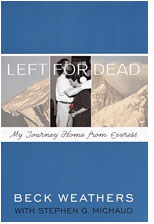
“Left for Dead: My Journey Home From Everest” by Beck Weathers
A member of Jon Krakauer's ill-fated Everest expedition gives his version of the spring '96 mountaintop disaster.
For those obsessive followers of the 1996 Mount Everest debacle who have a hankering for yet another angle on the story — and after four prior books, two films and innumerable press accounts, obsessive seems more than a fair qualifier — this latest report, penned by a member of Jon Krakauer’s famous expedition, offers few if any revelations. Those still in search of a smoking gun should look elsewhere. In fact, Beck Weathers, the middle-aged Texas pathologist/mountaineer who arose from the ice a hairsbreadth from death after 22 hours in the storm, takes careful pains in “Left for Dead” to avoid any of the rancorous blame calling that has so defined the debacle’s aftermath.
Weathers hails Krakauer’s bestselling “Into Thin Air,” which targeted for partial blame the late Anatoli Boukreev, a rival team’s guide, as the “definitive account.” But he also lauds Boukreev, who left Weathers and a teammate half-buried in the snow while saving three of his own clients, as a hero:
Anatoli later told at least three stories of what occurred out there. It doesn’t matter which one was true. In that moment, by saving those three people who otherwise surely would have died, Anatoli became a hero. Let that be the way Anatoli is remembered.
The vulturous obsessives who seem determined to cast the events in black and white, bent as they are upon ferreting a villain from among the corpses, might call this attitude evasive; I call it refreshing. “Guides don’t kill people,” the bumper sticker might read, “mountains do.”
By most accounts, Weathers was unqualified to climb the world’s highest peak — in “Into Thin Air,” Krakauer characterized his mountaineering skills as “less than mediocre” — but this deficiency hardly set him apart from the bulk of the climbers scaling Everest that spring. And he might well have made it to the top, too, had his eyes not failed him. Fifteen hundred feet above High Camp, en route to the summit, Weathers found himself effectively blind: The altitude’s low barometric pressure was flattening and thickening his cornea, thus negating the radial keratotomy he’d undergone a year and a half earlier to better ensure his safety on the mountain. Giving up on his climb, he told Rob Hall, the team’s guide, that he was heading back to High Camp, but Hall said no: “I want you to promise me that you’re going to stay here until I get back.” Weathers agreed, waiting dutifully, but Hall never returned.
Hall had perished with another client in the blizzard that detonated atop the mountain, while below Weathers huddled with members of Boukreev’s team, including the much-maligned Sandy Hill Pittman, who Weathers says began screaming, “I don’t want to die! I don’t want to die!” Her shivery shrieks furnished Weathers his last memory — until 22 hours later, that is, when he awoke, rather implausibly, having been left for dead by Boukreev, one of Boukreev’s teammates and several Sherpas. “About four in the afternoon, Everest time,” he writes, “the miracle occurred: I opened my eyes.” His hands were frozen (he’d lose one later, along with the fingers of the other). His face was blackened with frostbite (he’d lose his nose, too). He hadn’t eaten in three days, hadn’t had water in two and was still, moreover, blind:
Several improbable, if not impossible, events would follow in succession. I would stand and struggle alone back to High Camp. Next day I’d stand again and negotiate the Lhotse Face. Then there would be the highest-altitude helicopter rescue ever. Those were the big things. The miracle was a quiet thing: I opened my eyes and was given a chance to try.
But those events on Everest, chronicled so many times (and, alas, often better) elsewhere, end at Page 89. “Left for Dead,” however, is a book of nearly 300 pages — and that’s unfortunate. Some of the book’s latter two-thirds explains Weathers’ mountaineering background, which was mostly of the climbing-school and guided-ascents variety that another Texan with limited skills, Dick Bass, inspired in the ’80s by bagging the highest peak on each of the seven continents — having been ushered up each one by pricey guides. As Weathers explains to Krakauer in “Into Thin Air”: “Assuming you’re reasonably fit and have some disposable income, I think the biggest obstacle is probably taking time off from your job and leaving your family for two months.”
Earnest alpinists might bristle at that sentiment, but Peach Weathers certainly wouldn’t: The strain that her husband’s climbing put on their marriage is the main subject of the book’s later sections, much of the story recounted via Peach’s often seething interjections. In this respect, “Left for Dead” bears less resemblance to the standard climbing memoir than it does to “Cleaving,” Dennis and Vicki Covington’s soul-stripping marital memoir of last year — “‘Cleaving’ with crampons!” a publicist somewhere may have already chirped.
This isn’t, by nature, uninteresting stuff; anyone who has ever had to sit across the dinner table from a spouse trying to stammer out why climbing some volcano in South America is a perfectly reasonable notion will find much to relate to here. (Bruce Barcott, for one, plumbed the subject beautifully in a profile of late climber Alex Lowe last spring in Outside.) Nonetheless, there’s a flatness here: Peach nags, Beck whines, their friends analyze — and the reader feels icky. Passages like the following might better have remained in the bedroom:
Peach: I think he was looking for a way to ditch all of us.Beck: That’s not true!
Peach: You said you were depressed, and that it was my fault.
And so on, often embarrassingly. It’s like listening to an acquaintance’s parents bickering far too openly in front of you. The writing of this book was probably excellent therapy for Mr. and Mrs. Weathers. Reading it, however, felt like sucking in too much thin air.
Jonathan Miles, a contributing editor at Men's Journal, writes regularly for Salon Books. More Jonathan Miles.
“People Who Eat Darkness”: The disappearing blonde
A true crime story set in Tokyo illuminates the complicated truths behind media cliches
Joji Obara and Lucie Blackman (Credit: Estate of Lucie Jane Blackman) Lucie Blackman, 21, went out for the afternoon in 2000, phoning her roommate and best friend Louise to arrange a meeting later that night. Lucie never showed up, and within a few days she’d become one of those vanished blondes whose fates fuel headlines and hours of speculative media coverage. She was British, a former flight attendant, and she and Louise were living in Tokyo. They were also bar hostesses, a profession with a very specific meaning in Japan, difficult to explain to foreigners and not entirely clear to the Japanese themselves. Lucie both did and didn’t match the classic Missing Blonde profile, and for a while the mystery of what happened to her threatened to lapse into permanent obscurity.
Continue Reading Close
Laura Miller is a senior writer for Salon. She is the author of "The Magician's Book: A Skeptic's Adventures in Narnia" and has a Web site, magiciansbook.com. More Laura Miller.
Corporate criminals gone wild
The maker of the documentary film "Inside Job" has a new book excoriating Wall Street -- and President Obama
A detail from the cover of "Predator Nation" “Inside Job,” Charles Ferguson’s Oscar-winning documentary film on how government, Wall Street and academia colluded to deliver us the worst financial crisis since the Great Depression, made a powerful case that something was very very rotten at the heart of the American political/economic nexus. His follow-up book, “Predator Nation: Corporate Criminals, Political Corruption, and the Hijacking of America,” can be considered the legal brief that dots every “i” and crosses every “t” in his argument. A tightly argued, profusely footnoted and deeply enraged castigation of everyone involved, “Predator Nation” isn’t just a factually unchallengeable account of how Wall Street blew up the global economy. It’s a denunciation, a call for justice and a warning: After getting away with the crime of the century, Wall Street still isn’t satisfied.
Continue Reading Close
Andrew Leonard is a staff writer at Salon. On Twitter, @koxinga21. More Andrew Leonard.
Can you identify?
Science shows that the only way around some readers' prejudices is to trick them
(Credit: Shutterstock/Salon) The news of recent research documenting how readers identify with the main characters in stories has mostly been taken as confirmation of the value of literary role models. Lisa Libby, an assistant professor at Ohio State University and co-author of a study published in the Journal of Personality and Social Psychology, explained that subjects who read a short story in which the protagonist overcomes obstacles in order to vote were more likely to vote themselves several days later.
The suggestibility of readers isn’t news. Johann Wolfgang von Goethe’s novel of a sensitive young man destroyed by unrequited love, “The Sorrows of Young Werther,” inspired a rash of suicides by would-be Werthers in the late 1700s. Jack Kerouac has launched a thousand road trips. Still, this is part of science’s job: Running empirical tests on common knowledge — if for no other reason than because common knowledge (and common sense) is often wrong.
Continue Reading Close
Laura Miller is a senior writer for Salon. She is the author of "The Magician's Book: A Skeptic's Adventures in Narnia" and has a Web site, magiciansbook.com. More Laura Miller.
“The Aleppo Codex”: The bizarre history of a precious book
A reporter traces the shadowy fate of the definitive version of the Hebrew Bible
Matti Friedman An ancient and priceless book, a murky history of evasions and coverups, an underground of sinister and possibly violent dealers, a former spy who drops tantalizing hints and a wily 84-year-old millionaire who says stuff like, “The problem with this story is that it could damage your health”: Are these the ingredients for a cheesy, improbable historical thriller? Yet “The Aleppo Codex,” Matti Friedman’s account of his attempts to learn the history of one of the world’s most precious books, sports all of these assets, and it’s nonfiction. If reporting this story damaged Friedman’s health, it probably happened when he realized what he’d stumbled into and his reporter’s heart started beating in doubletime.
Continue Reading Close
Laura Miller is a senior writer for Salon. She is the author of "The Magician's Book: A Skeptic's Adventures in Narnia" and has a Web site, magiciansbook.com. More Laura Miller.
Augusten Burroughs: Conquer trauma by letting it go
Salon exclusive: The best-selling memoirist says past horrors haunt us because we think about them too much. Stop
Augusten Burroughs Many people continue to feel influenced and even controlled by the things that happened to them a long time ago. Sometimes, people harbor dark, traumatic memories from childhood. Or fragments of memories — incomplete scenes, uncomfortable feelings, perhaps even a sense of certainty that something specific and terrible happened to them, but little more than this.
Others experienced something traumatic in adulthood that continues to affect them day to day many years later. Maybe an assault has left a person afraid to leave their home or enter a particular neighborhood.
Continue Reading CloseAugusten Burroughs' many books include "Runnning With Scissors," "Dry," "Sellevision," "Magical Thinking" and "Possible Side Effects." His latest book is "This Is How." More Augusten Burroughs.
Page 1 of 984 in Books