
The other night, my 3-year-old nephew and I received an unexpected economics lesson in the form of a picture book called “Rainbow Fish.” The plot is deceptively simple: Rainbow Fish is an underwater denizen distinguished by a set of unusually attractive silver scales. A small, blue fish asks R.F. to give him one of his scales and R.F. refuses. Shunned, as a result, by all of the other fish, R.F. consults a wise old octopus, who encourages him to reconsider. Give your scales away, the octopus advises. You won’t be as pretty, but the other fish will like you and you’ll be happy. So he does and he is. The end.
My nephew understood immediately that the book was about sharing, but he is also at the age of the perpetual “why?” and trying to answer his whys about R.F.’s epiphany, I felt queasy. It’s important that children learn to share, but this clumsy little book’s more prominent message is that people will like you if you give them your possessions, particularly the possessions they envy. The unwitting moral of “Rainbow Fish” is that you can buy love.
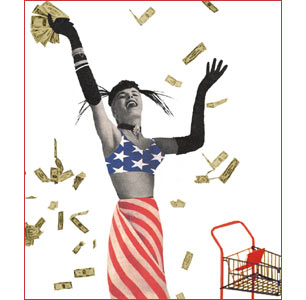
Anyone who reads to children knows that such ill-conceived homilies abound, but what’s interesting about these sloppily reasoned kids books is what they tell us about our own atavistic beliefs. It seems to me that “Rainbow Fish” unwittingly exposes the confusion inherent in one of our most deep-seated convictions — that materialism, the love and acquisition of things, is intrinsically evil.
In her interesting new book, “Do Americans Shop Too Much?” Harvard economist Juliet Schor laments what she calls the “new consumerism,” a frenzy for “high-status” goods she attributes to the increased concentration of wealth at the top of the economic ladder: “Trophy homes, diamonds of a carat or more, granite countertops, and sport utility vehicles are the primary consumer symbols of the late 1990s.” This rampant consumption is unfortunate, she argues, not only because it squanders environmental resources but because it forces people on the lower rungs of the income ladder to try to keep up.
Schor believes that we consume competitively, with an eye on the consumption habits of the proverbial Joneses — except that the Joneses, who used to live down the street and were probably our socioeconomic peers, are no longer our frames of reference. Now, because of television, more sophisticated marketing techniques and the fact that most women are working in jobs, our new frame of reference, she argues, is “Lifestyles of the Rich and Famous.”
This, Schor says, explains one of the more disturbing trends of the past 30 years: that while our buying power has doubled, we are increasingly dissatisfied. Her solution? To limit consumption by taxing luxury goods. This, she believes, would take the pressure off those of us struggling so hard to keep up with all the new stock-market and dot-com millionaires.
But the urge to buy is so much more complicated than Schor — perhaps limited by the brevity of her essay, perhaps by an academic discipline whose theories have often proved irrelevant in the real world — even begins to suggest. Status is clearly not the main reason most people buy things. Just because I see the Joneses’ SUV and think, “I, too, would love to own an SUV,” doesn’t mean that I am competing with them. It could simply be that I think owning an SUV seems like a pretty good idea.
Personally, I can’t stand SUVs because they guzzle gas, block my view and represent a transportation menace. But I don’t have children; both of my sisters, who own Chevy Suburbans, do. One borrowed a Suburban for a vacation with her husband, his mother and the couple’s three small daughters and became addicted to all of that wonderful space. The other has a weakness for labor-saving devices and imagined easily carting her two sons and all of their friends to Little League games and having plenty of room in the back to stash their equipment.
Wanting to acquire the things that we see and like is as natural as breathing. Babies want to touch things, taste them, bash them against the wall. We appease them with shining objects, distract them with new toys. When one child sees another child playing with a toy, he or she wants it not because of envy of the other child’s relative social position but because it looks like fun. When we see other people having sex, eating an ice-cream cone, setting a table with pretty dishes or using a clever new tool and want to do the same, it’s not necessarily because we’re jockeying for position. It could be that we, too, just want to have fun.
Of course, we do sometimes buy things with status in mind — a nice suit for a job interview, a cool pair of shoes in junior high, a certain kind of car or house because we imagine it contributing to our allure. But the mundane truth is that things, especially new things, just please us. Examining something, taking it home, rearranging our homes to accommodate it — it’s all part of what social psychologists describe as the human need to affect (and be affected by) our surroundings. Even the urge to create is connected to the urge to acquire.
If, as Schor notes, “the level of income needed to fulfill one’s dreams doubled between 1986 and 1994,” it’s because there are so many more interesting and relatively affordable things to dream about. Some of them didn’t even exist in 1986, and others — personal computers and cars, for instance — are so much cheaper now. The most compelling reason to buy these new things is not the status they afford but their promise to make life easier and/or more fun. Parents are using pagers and cellphones to keep in touch with their teenagers. Teenagers are using them to keep in constant contact with their friends.
And if SUVs are mainly status symbols, why has there never been the same sudden widespread interest in acquiring Mercedeses? SUVs are more the equivalent of the 1950s station wagon, an updated version of a car with enough space to accommodate a family. With gas almost obscenely cheap and car companies building light trucks that are both comfortable and easy to drive, the popularity of SUVs seems in retrospect almost inevitable.
And if we are breaking records in running up credit card debt and declaring bankruptcy, isn’t it less because we are trying to keep up with rich people than because credit has never been so widely available or collective economic optimism so high? One of the most profound cultural gaps in contemporary America is between my generation — people in their 40s and 50s — and our parents, whose formative experience was the Great Depression. A growing number of us have never experienced widespread poverty and unemployment without the security of a government safety net. If this were the fable of the grasshopper and the ant, we would be grasshoppers who had never experienced winter.
Schor calls for controlling consumption — thus protecting us from the “new” emphasis on “luxury, expensiveness, exclusivity, rarity, uniqueness, and distinction” — by taxing “high-end versions” of products. “Why not stand for consumption that is democratic, egalitarian, and available to all?” It’s ironic that Ralph Nader is the author of an enthusiastic foreword to Schor’s essay when the consumer movement he launched some 30 years ago is, along with the counterculture of the 1960s, at least in part responsible for our hunger for high-quality goods.
Paul Hawken, co-founder of upscale garden tool company Smith & Hawken, predicted in his 1983 book, “The Next Economy,” both the growing gap between rich and poor and an increased demand (among the new rich) for quality. Should we penalize people for buying fine art when reproductions are so much cheaper? For buying hardcover books instead of mass-market paperbacks? For paying more for whole wheat when they could be surviving on Wonder Bread?
Of the nine responses by an assortment of scholars that follow Schor’s essay, the most compelling are (unexpectedly) from an assistant professor of advertising at the University of Illinois, Douglas Holt, and an associate professor of marketing at the University of Wisconsin, Craig J. Thompson. Holt argues that it’s almost impossible to control consumption anyway, given today’s market in which companies compete to appropriate every new idea the instant it becomes popular. “The market would find the nonstatus values that Schor’s agenda encourages and turn them into salable goods,” writes Holt, citing businesses that have already exploited symbols of the counterculture, from Benetton to the Nature Company to Ben & Jerry’s.
And in his essay, “A New Puritanism?” Thompson maintains that any “moral critique of consumerism is steeped in a phobia of feminization and an infatuation with puritanical asceticism. It effects a rejection of the sensual and emotive aspects of human experience and an extreme suspicion of ‘unproductive’ pleasures.” He suggests that if sex sells at least in part because it is a forbidden pleasure, we might become less compulsive shoppers if we allowed ourselves to truly savor the shopping experience.
Yet the real weakness of Schor’s approach is her assumption that happiness is a function of relative affluence and the pressure to consume. In Schor’s world, Rainbow Fish can indeed buy happiness — for everyone — by giving up whatever he has that might provoke envy. (Never mind that people envy all sorts of things they can’t buy — good looks and good health, talent, confidence, charisma.) While it’s clear that unfettered consumption is a threat to the planet, and it’s well established that, despite our unprecedented affluence, Americans are increasingly unhappy, a far more satisfying analysis of this crisis is David G. Myers’ “The American Paradox: Spiritual Hunger in an Age of Plenty.”
A professor of psychology at Hope College in Holland, Mich., Myers helped pioneer the study of happiness (as opposed to the discipline’s traditional focus on psychopathology), and he has spent most of his career deconstructing the components of psychological well-being. One of the most interesting things researchers like Myers have discovered is that the old saw is true: Money does not buy happiness. Subjective well-being has no relation to income once people can afford the basic necessities of life.
Myers argues that the true source of our new dissatisfaction is embedded in American culture — and in the same free market that has made us wealthy. Both encourage a radical individualism that lies “at the heart of the American dream.” On the one hand, he says, people who live in democratic countries that guarantee basic individual freedoms tend to be happier than people who don’t. “Yet for today’s radical individualism, we pay a price: a social recession that imperils children [Myers reports that the teen suicide rate has tripled over the past 30 years], corrodes civility, and diminishes happiness. When individualism is taken to an extreme, individuals become its ironic casualties.”
In Myers’ view, the problem is cultural, not economic, and therefore requires a constellation of social and political corrections. We have allowed the free market, which has benefited us in many ways, to determine values — and the free market values only one thing: money. “Pretend some devil wanted to design a program to corrode families,” he writes. “They might begin by lowering the job prospects and earning power of young men. To accomplish this they might encourage corporate CEO’s to act like yesteryear’s robber barons and redirect rewards to themselves. Justifying their actions with talk of freedom, they might also deregulate television, legalize gambling, structure taxes to penalize marriage, and shrink the value of the minimum wage (which was created to be a ‘family living wage’ that protected families and children).” Sound familiar?
Not that Myers wants to abolish the free market. “Capitalism, as Winston Churchill might have put it, is the worst economic system, except for all the others,” he writes. But citing studies showing that people who believe in God and/or participate in community activities tend to be happier than people who don’t, Myers sees the solution in an emerging communitarian movement that transcends the culture wars: “one that affirms liberals’ indictment of the demoralizing effects of poverty and conservatives’ indictment of toxic media models.” People who feel connected to others — through their churches and other community activities — are more likely to take responsibility for one another and for the culture as a whole, he argues.
We have a long tradition of changing the way we do things even without market incentives, Myers points out. We do it when enough people come to believe that we are being hurt in ways that can’t be calculated on a balance sheet. Thus, we’ve abolished slavery, regulated polluters and outlawed child labor and sexual harassment. Already, we’ve begun to encourage the auto industry to redesign SUVs to make them less dangerous to other vehicles, and we are moving to hold them to the same fuel efficiency standards that apply to cars.
Myers is an optimist, perhaps, but he sees people coming together “on the common ground of concern for our children and their future” — more of them going to church, more (both liberal and conservative) speaking the same language when they talk about the family and about moral values. In Myers’ world, Rainbow Fish would find happiness not by renouncing his material good fortune but by recognizing that (no matter his momentary status) he is inescapably responsible for and connected to all the other fish in the sea.
Ever since I first watched my dad drive his chocolate brown Datsun 280 ZX back in the early 1980s, I’ve been inculcated to believe that driving — true driving — can only be performed with a stick shift. From that childhood experience, I came to see the manual transmission as a birthright passed down from my grandfather, to my father, and eventually to me via a series of tense, stall-filled lessons when I turned 16. In my case, after ripping apart the transmission one too many times, my dad went barking drill sergeant on me, eventually teaching me that a stick requires a special kind of focus, and that I needed to ease up more slowly on the clutch in order to get into first gear on those damn inclines. Through the experience, I learned to consider my stick-shifting skill a special talent with transcendent value.
Yes, of course, in the intervening years I’ve had the chance to drive an automatic transmission. But that has always felt a bit like playing a post-Konami Code game of Contra — a bit too easy, a bit too idiot proof, a bit too, shall we say, inauthentic. On top of that, the automatic always seemed like a wasteful luxury because it always was more expensive and less fuel-efficient. That difference consequently added an ascetic populism to the inherent machismo of the engine-revving manual transmission.
No doubt, for stick shift enthusiasts, these factors have all conspired to create an alluring mystique around the manual transmission — one that, according to new data, is on the rise.
Last week, USA Today reported that while “the percentage of new vehicles with stick-shift gearboxes remains a small slice of the new vehicle market,” the “the first quarter this year manuals were in 6.5 percent of new vehicles sold, and that’s getting close to double each of the past five years.” The stick shift is back in a big way — but is that really such a good thing?
Upon hearing the news, my initial thought — for aforementioned reasons — was that, yes, of course it’s a good thing. In an ocean of bad drivers and wasteful vehicles, the news seemed like a distant island of hope. I thought that perhaps more motorists are being converted to the automobile religion (cult?) I first was exposed to in Dad’s Datsun 280 ZX. And maybe, just maybe, that’s a sign that American drivers are wising up, both stylistically and efficiency-wise.
Then I did a bit more investigation, and realized the news might not be so good, and that my quasi-religious fervor for the gearbox may have blinded me to my catechism’s new downsides.
In the past, the stick shift was an all-but-guaranteed fuel saver. But not anymore. As AOL Autos notes, computer technology has advanced to the point where “automatics have become so efficient that most of the time their fuel economy is on par with manuals — and in some cases even better.” USA Today notes that such a trend may eventually erase the long-term price differential between manual and automatic transmissions, meaning the manual will lose its frugal-chic appeal. Meanwhile, according to AOL, new technology also boosts automatics’ overall performance (read: speed), meaning many driving aficionados have come to prefer the automatic over the manual.
Thanks to all this, on the days I don’t bike to work and instead fire up my 11-year-old Saturn and shift it into first gear, I no longer feel so righteous or populist. I feel like part of the problem — not just because I’m driving a fossil fuel-dependent vehicle, but also because the manual transmission seems like a silly relic. Likewise, word that manual transmissions may be coming back no longer seems like such great news; it seems like more proof that when it comes to transportation, we’re still prone to making shortsighted decisions.
And yet, I can’t let go of my love for the stick — or maybe “can’t” isn’t the right word. Perhaps “don’t want to” is more appropriate. If the automobile is still one of the key chronological markers in a typical American’s life (and, unfortunately, it still is), the stick shift is a special symbol of our general heritage, and my specific family traditions.
That’s why I was happy to see that there remains one significant reason to still love the manual transmission — a reason that’s substantive, rather than just aesthetic or experiential. In the age of distracted driving, many believe the stick shift might encourage kids to stay focused on operating their vehicles, rather than operating their smartphones. The idea is that because a manual transmission requires special attention to operate, it doesn’t allow for as much multitasking as an automatic.
While there’s no science (yet) to prove the manual-transmission-as-deterrent-to-distracted-driving hypothesis, the memory of those first harrowing stick-shift lessons — with my dad imploring me to “really focus, goddammit!” — suggests to me that there’s something to the theory.
At least, that’s what I’m going to tell myself to justify my stick-shift fetish — that is, until the automatic fully surpasses the manual in every other way.
David Sirota is a best-selling author of the new book "Back to Our Future: How the 1980s Explain the World We Live In Now." He hosts the morning show on AM760 in Colorado. E-mail him at ds@davidsirota.com, follow him on Twitter @davidsirota or visit his website at www.davidsirota.com.
More David Sirota.
The grand unifying theory of the American consumer has been that we are, first and foremost, low price fetishists. There’s ample evidence supporting this view: From Wal-Mart’s prominence to the fast food industry’s ongoing success, vast swaths of the economy are indeed built on the premise that buyers will prioritize discounts and quantity over premium prices and quality.
But ever so quietly, we are starting to see the rise and success of a competing vision, one that turns the old assumption on its head. In the technology arena, for instance, Apple is successfully challenging the PC world with a business model that convinces consumers to pay higher prices in exchange for better reliability, durability, efficiency and customer service. Likewise in the transportation world, more and more consumers are willing to pay higher prices upfront for hybrid and electric vehicles in exchange for the promise of lower long-term energy costs. This has encouraged companies like Philips to introduce more expensive light bulbs, in hopes that consumers will pay more for illumination that promises to use less electricity and last 20 years.
Nowhere, though, is the battle between the low-price/quantity business model and the higher-price/quality business model more clear than in the world of beer. In the fevered battle between the macrobrew behemoths and the craftbrew insurgents, both sides are digging in for an epic confrontation.
The history of the face-off is illustrative. For decades, the big brewers (Anheuser Busch, MillerCoors, etc.) have marketed their products less on the basis of taste or quality than on identity branding. What you drank subsequently became a statement not necessarily of what your taste buds enjoyed, but of your self-image. The Miller versus Budweiser wars and Old Milwaukee ads, for instance, were so often a pitch to guys looking for working-class street cred. Meanwhile, Pabst Blue Ribbon lately has been pitched as a retro-themed statement of hipster style.
This kind of marketing made a certain sense, because while macrobrew brands are certainly appealing, the actual beers in question are basically terrible. Produced through the macrobrews’ low-price, high-volume process, they don’t contain high-quality ingredients, they don’t contain much alcohol and, thus, they simply don’t taste good. Knowing this, the macrobrews have logically designed their marketing campaigns to focus on everything (the can, the type of people who drink it, the logo, etc.) but the actual product. Indeed, if there’s one ubiquitous reference that macrobrewing companies make to the beer itself, it’s usually one telling you how cold the beer is or should be — a temperature that, quite deliberately, helps hide just how bad the beer actually is.
The obvious assumption in this business model is that Americans generally reward low price over everything else, and specifically preference beer that is cost-effective to drink in mass quantities, rather than beer that delivers more alcohol or taste in less volume of liquid. In other words, the model assumes consumers see beer as a homogenized, undifferentiated commodity and that therefore less can never be more. In this view, more is always more, and since cheaper means more, cheaper is inherently better.
This is not a silly assumption, of course, in a country whose college binge-drinking culture teaches kids to prefer quantity at an early age. However, it ignored a potentially profitable market of beer drinkers with a different set of priorities. That’s where the craft brew industry came in.
In the last few years, small brewers have filled the vacuum left by macrobrewers, specifically marketing higher-priced products based on premium quality and taste. It’s been a wildly successful endeavor. 2011’s sales results tell that story: In a year that saw an overall decline in the beer market, the craft brewing industry increased its year-to-year sales by 15 percent and substantially grew its share of the total market. And here’s the key stat: according to the Brewer’s Association, “craft brewing sales share in 2011 was 5.7 percent (of the total beer market) by volume and 9.1 percent by dollars.”
That gap between share of total volume and share of total dollars generated is the high-price/high-quality/low-volume business model at work. Basically, craft brewers are generating a much larger share of beer revenue than they are contributing to the overall volume of beer in America — meaning that, contrary to previous trends, a growing share of consumers are willing to pay more for less, as long as the product is the comparatively higher-quality product that craft brewers provide.
Will this trend continue? Will the craft brew industry follow in, say, Apple’s footsteps and become the next high-quality David vanquishing the quantity-over-quality Goliath? It’s hard to say, but unlike in most other industries, the battle doesn’t look like it will be muddled by compromise — which makes it a hugely important test case.
Recall that in other major industries, the establishment’s low-price titans have typically tried to crush the high-price/high-quality upstarts by partially mimicking them — think Microsoft copying Apple or Wal-Mart partially pantomiming Whole Foods. In the beer industry, by contrast, it’s the opposite. Save for a few mini-brands like Coors’ Blue Moon line, which pretend to be a craft brew product, the macrobrew moguls are largely doubling down on their old low-price/low-quality/high-volume formula.
So, for example, Coors Light isn’t changing its watered-down product; it’s simply going with color-changing cans. Pabst is thinking about introducing not any higher-quality lines, but instead trying to brand its products to the military. And most blatantly, Miller has just launched this television campaign promoting a new can that allows the beer to be consumed as quickly as possible.
Though thinly veiled as a mechanism for better drinkability, the new “punch-top” can is obviously developed as the first specifically engineered to shotgun beer — that is, specifically designed to drink beer in a way that makes sure you don’t actually taste the beer. The unique selling proposition of the campaign is incredibly blatant in its embrace of the low-price/high-volume model: It is screaming at you to buy the cheap product exclusively because everything about it — the beer and even the can — is aimed at helping you pour it into your body without even having to taste or savor it. In this “punch top” innovation, Miller is effectively acknowledging that its customer base is those who drink only for volume — and it’s trying to thus convince more beer enthusiasts that speed drinking is a virtue.
The craft brewing industry, by contrast, is going in the opposite direction, trying to direct the beer-drinking population away from volume for volume’s sake. Visit a liquor store with a wide selection of microbrews and you’ll find an ever-more diverse selection of specialized offerings, from double IPAs to sour beers to barley wines. Notably, many of these products are sold in smaller sizes — four-packs or single pint-size bombers — making their price-per-ounce of beer far higher than the typical macrobrew. Additionally, what innovations the industry has made to beer technology tend to be fundamentally different from those of the macrobrew companies: They tend to be aimed at making the beer itself actually taste better (best example: Left Hand’s breakthrough creation of a bottled, widget-free milk stout on nitro).
In the competition for the future of drinking, both sides are obviously trying to exploit their strengths and minimize their weaknesses. The massive macrobrewing corporations are trying to take advantage of their size and corresponding ability to produce volume — all while playing down the fact that their beers have little local character or quality. The craft brewing industry, composed mostly of independent small and medium-size businesses, know they can’t compete in a volume game, and so they are trying to promote quality and diversity. It’s a straightforward fight — one that may seem only interesting to drinkers, but one that truly transcends the inebriation industry. It underscores both consumer shifts and questions about what kind of economy we want in the future.
Will we be a country of high volume and low quality? Or can we become an economy of quality and price premium? Whether it’s drinking, buying computers or choosing what industrial policy to support, we are in the process of answering those questions.
A Macrobrew Economy — a high-volume, low-price model — asks us to compete with other such economies throughout the world, and the problem is that countries like China will always have lower-priced labor, more lax environmental regulations and lower production standards to win a battle that rewards more and cheaper for more’s and cheaper’s sake. By contrast, a Craft Brew Economy — a high-quality, lower-volume model — is a different proposition. It follows the German model, which, as Time magazine notes, is all about being “committed to making the sort of high-quality, high-performance, innovative products for which the world will pay extra.”
The choice is ours — and it starts with the beer in your fridge.
David Sirota is a best-selling author of the new book "Back to Our Future: How the 1980s Explain the World We Live In Now." He hosts the morning show on AM760 in Colorado. E-mail him at ds@davidsirota.com, follow him on Twitter @davidsirota or visit his website at www.davidsirota.com.
More David Sirota.
Two bursts of recent headlines here in Colorado had me feeling more than a wee bit conflicted. First came the news that the much-celebrated Trader Joe’s is coming to our state. Then came word that the Denver City Council had been threatened into ponying up $5 million in public funds to bring yet another Target to the Front Range.
Between my exuberant reaction to the first story and my disgust at hearing the second story, I wondered: Why did I feel psyched about one mega-chain coming to my area but disgusted at the news of another coming to the same locale? As someone aspiring to be an “ethical consumer” who cares about my community (if that’s not, unto itself, an oxymoron), aren’t I supposed to hate both bits of news? Or is it possible that not all national chains are created equal? Is it possible, in fact, that some are better than others?
Upon some hearty investigation, I think the answer is yes, some are better than others — and I’m not saying that (only) because it helps me avoid feeling like a complete sellout to the corporate machine.
No doubt, thanks to Wal-Mart and Target’s infamous record of sucking up public subsidies, crushing unions, destroying local economies, paying substandard wages and homogenizing supply chains to the lowest quality standards, the reputation of the national chain retailer is that of a pack of rabid wolves. We’ve come to believe that if you see suits from the national chains lobbying your local legislators and zoning board officials, everything you love about your community is about to become the red-meat entree in the pack’s next dinner. Invariably, by the end of that gorge-fest, your town will face economic wreckage, unemployment and, according to a new study, even a rise in hate groups.
But while they are all classified as national chain retailers, the differences between the Wal-Mart/Target business model and the Trader Joe’s business model are the differences between wolves and Golden Doodles — both may technically be canines, but the former are a helluva lot less cuddly and more dangerous than the latter.
Let’s start with size and scope: Trader Joe’s may be one of the biggest privately held companies doing business in America, but its stores are purposely designed to fit into — rather than take over – communities. As Businessweek notes, Trader Joe’s “stores tend to be on the small side — less than 15,000 square feet vs. 50,000 or more for conventional supermarkets.” Thanks to this antipathy to the “megastore” structure, Trader Joe’s can build its outlets in communities instead of on the outskirts of town — a geography that doesn’t suck commerce out of population centers and encourage driving-related sprawl, but adds to the commerce already happening in such population centers. Additionally, unlike Wal-Mart and Target, which sell everything from groceries to hardware to clothing, Trader Joe’s isn’t a one-stop-shop outlet aiming to siphon business from the entire economy, or even from one whole sector of the economy. It’s a specialty food store whose limited selection makes it less of a staple grocery store than a niche addendum to a town’s larger grocery ecosystem — and, mind you, not some elitist addendum just for rich yuppies with tons of disposable income, but an addendum that delivers “bourgeois products at proletarian prices,” as Slate notes.
This smaller-is-better approach has its analog in Trader Joe’s slower-is-better pace of growth. As Fortune reported in 2010, the company “has a deliberately scaled-down strategy,” opening only a few new stores every year. That stands in stark contrast to many competitors, whose blitzkrieg tactics of throwing open as many stores as possible seems more like an imperial strategy of economic conquest than an integrative business model. Indeed, whereas many communities now see grass-roots opposition campaigns mounted against proposals for yet more Wal-Marts in their vicinity, towns all but beg Trader Joe’s to consider opening a store in their region.
That gets to another admirable difference between Trader Joe’s and its national competitors: Many localities covet a Trader Joe’s specifically because the company compensates its workers at much higher levels than the industry standard.
According to Businessweek, the company’s original founder, Joe Coulombe, “wanted to make sure his employees were paid fairly, instituting a policy in the 1960s that full-time employees had to make at least the median household income for their communities.” That tradition continues under the Albrecht family, which now owns the company. Though the company is as union-free as its big-box competitors, Fortune notes that store managers “can make in the low six figures … full-time crew members can start in the $40,000 to $60,000 range” and the company “annually contributes 15.4% of employees’ gross income to tax-deferred retirement accounts.” And Businessweek points out that the company even “allows part-timers to earn health-care benefits” — a rare benefit in the cutthroat retail industry.
None of this, of course, is to imply that Trader Joe’s is inherently better than genuinely local businesses. Nor is it to suggest that Trader Joe’s is perfect. It’s not — not even close.
For example, even though the company ultimately agreed to make changes, it initially refused to listen to progressive organizations when they pressured management to make more ethical decisions. Similarly, there remain real questions about how much the firm’s stores are committed to local sources. While we know that for efficiency and distribution purposes, the stores’ proximity to product sources is an important part of the company’s site selection process, we don’t know how much that affects each store’s willingness to support local food producers. Same thing for its claims of sustainable practices: For every pledge that can be independently verified, there are others that can’t because the company is so opaque. And, as a personal grievance, I don’t understand why Trader Joe’s hasn’t prioritized opening more stores in food deserts where they are most needed, rather than in already-saturated markets.
This, in fact, raises the one overarching criticism of Trader Joe’s in comparison to its publicly traded competitors: namely, that its management uses its status as a privately held corporation to prevent transparency and keep its decisions cloaked in secrecy.
Before you fully scoff at that status, though, recognize that it is likely integral to many of the aforementioned reasons you can like a company such as Trader Joe’s, dislike its national mega-chain competitors, and not feel like a hypocrite.
To understand this key point, consider this Philadelphia magazine profile of Wawa, a mid-Atlantic convenience store chain with a corporate structure, cult following, and business model much like Trader Joe’s. The magazine notes that precisely because such companies are private and refuse to franchise, they can expand “at a consistent but sensible pace, avoiding Wall Street’s destructive imperative to grow at an ever-faster rate.”
When it comes to national chain retailers, then, ownership structure often explains the difference between threats and opportunities. When your town is accosted with huge conglomerates trying to exclusively please speculators in Lower Manhattan, your community is most likely under siege. By contrast, when your town is invaded by Trader Joe’s, Wawa, Wegman’s or any other family-held concern that has gone national but still emulates some ethical business practices, there may certainly be dangers — but there may also be more opportunities for symbiosis, because the parent company doesn’t answer only to the financial speculators.
It’s not an ironclad rule, of course — a private owner can be just as bad as management in a publicly traded corporation. The point is only that ownership is yet another critical factor complicating all the questions surrounding mega chain stores. As much as we’d like simple answers to such questions — as much as some would like to insist that they are all pure evil — nuance still exists. Sure, this may be an oligopolized economy, and we certainly should do everything we can to maintain local small businesses, but even among the big behemoths, there are still distinctions that matter.
David Sirota is a best-selling author of the new book "Back to Our Future: How the 1980s Explain the World We Live In Now." He hosts the morning show on AM760 in Colorado. E-mail him at ds@davidsirota.com, follow him on Twitter @davidsirota or visit his website at www.davidsirota.com.
More David Sirota.
When I was a kid, you know what we called Legos for girls? Legos. When my own young daughters were small, you know what they called them? Legos. They came in blue and red and green and yellow. But lately Legos, like damn near every other object in the toy aisle, have felt the need to assert their gender.
It started when the company began aggressively marketing to boys back in 2005, offering up what BusinessWeek recently described as “spaceships and laser cannons … martial arts and supernatural powers,” a world in which “80 percent of the characters are boys.” But the extreme genderfication of Legos put the company in a self-imposed bind. How to respond to the demands of consumers who want a more daughter-friendly Lego? There was only one thing to do next – make some girly Legos!
Just in time for the holidays, the Danish brand rolled out a pink-themed line of Lego Friends last December, featuring curvaceous, pretty girls who play in pastel-themed, gently constructed cafes, beauty shops, puppy houses and their own little stages. That’s the life of a girl for you – looking pretty, “decorating your house” and eating cupcakes.
From the get-go, the Lego Friends were met with a not-so-friendly response. The International Association of Eating Disorder Professionals called the line “devoid of imagination,” and said it would “promote overt forms of sexism.” US News offered “5 Reasons Not to Buy Your Daughter Pink Legos.” In Time, Ruth Davis Konigsburg bemoaned that “With its emphasis on physical appearance and limited career choices — [is it] really any different from that of Disney’s princesses?” She continued, noting how the Friends sets require the barest of construction, “LEGO Friends doesn’t give girls the same sense of mastery and accomplishment that it gives boys.”
So it’s a hopeful sign that on Friday, members of SPARK (Sexualization Protest Action Resistance Knowledge) are sitting down for a meeting with Lego executives. The goal, as SPARK optimistically explains, is that “We want [Lego] to commit to dramatically increasing the female characters in their non-Friends lines. (The current numbers are pretty dismal.) We want them to consider female representation when choosing pre-existing material to adapt into new toys. And we want them to improve the Friends line.”
It’s a bold hope, especially when Lego reports that Friends line is “off to a very strong start” just the way it is. But it would be wise for a company founded nearly 50 years ago with the imperative to create toys for “girls and for boys” to remember that goal doesn’t mean “girl toys and boy toys.” We don’t need to ostracize our sons and daughters to the divergent wildernesses of ninja land and beauty parlors.
The conservative Christian group One Million Moms is angry. Angry like just-missed-an-awesome-sale angry. Sure, the down-home-sounding offshoot of the reliably right-wing American Family Association exists in a perpetual state of twisted knickers. It’s whipped itself into a frenzy of indignation at the not-quite-exclusionary-enough tactics of Macy’s, Levi’s, Jenny Craig and Oreos in just the past few months. But its outrage at JC Penney, the jeans supplier to at least 800,000 of those million moms, is especially intense of late.
At issue is the group’s contention that by hiring Ellen DeGeneres for a new campaign, the department store is “jumping on the pro-gay bandwagon” and turning away from “traditional families.” The organization warns darkly that “Unless JC Penney decides to be neutral in the culture war then their brand transformation will be unsuccessful.” There is so much to love in that sentence alone. Culture war! Brand transformation! Fearless disregard for the rules of comma usage after a subordinate clause! “The majority of JC Penney shoppers will be offended,” they continue, “and choose to no longer shop there.”
JC Penney, however, which recently declared that “We share the same fundamental values as Ellen,” has remained unmoved from its perch on a “pro-gay bandwagon” in the midst of a “culture war.” (I hope that bandwagon is reinforced.) Also unmoved: the woman at the center of the controversy.
On her daytime talk show Wednesday, DeGeneres cheerfully opened by talking about Proposition 8 being overturned in California, then segued into a riff about her partnership with Penney’s. “Normally I try not to pay attention to my haters,” she said, “but this time I’d like to talk about it.”
After announcing she was “proud and happy” that JC Penney was sticking by her side, she explained to America that “Being gay or pro-gay is not a bandwagon. You don’t get a free ride anywhere. There’s no music, and occasionally we’ll sing, ‘We Are Family,’ but that’s about it.” And she noted that “For a group that calls itself the Million Moms, they have only 40,000 members on their [Facebook] page. They’re rounding to the nearest million.” It was a witty retort to a campaign of hate, though frankly, not nearly as hilarious as the Million Moms’ depiction of DeGeneres as an “open homosexual spokesperson.”
On her show, DeGeneres read some of the hundreds of supportive messages that have been posted on the Million Moms’ own Facebook page since their campaign against her launched. DeGeneres has also received public support from, of all people, Bill O’Reilly, who said on his program Tuesday that the protest was “a witch hunt and shouldn’t happen.” When you’re too loathsome for Bill O’Reilly, you’ve really outdone yourself, loathsomeness-wise.
One Million Moms describes itself as an organization for people who are “fed up” and “tired,” one that devotes itself, seemingly exclusively, to complaining “on behalf of our children.” On her program Wednesday, DeGeneres said, “I stand for honesty, equality, kindness, compassion, treating people the way you want to be treated, and helping those in need. To me, those are traditional values.” Even the most die-hard shopper knows that values aren’t just reasonably priced furnishings from the Cindy Crawford collection. They’re how you live. And if you’re going to be on a bandwagon, who wouldn’t choose the one without all those angry people on it?