
Food
Hey, man, it's Cayman
Turtle meat, pirates and 10 sunken ships: The grand island has something for everyone.
The motto on the national emblem of the
Cayman Islands reads: “He Hath Founded
It Upon the Seas.” On the seas indeed:
No point on any of the three islands –
Grand Cayman, Cayman Brac and Little
Cayman — that compose this British
crown colony is more than a few minutes’
drive from the ocean.
Christopher Columbus is credited with
the discovery of the Caymans in 1503. In
subsequent years, sailors descended
on the islands for fresh water and
turtle meat, of which there was plenty.
Fishermen and shipbuilders soon
followed, and pirates — Sir Henry
Morgan and Blackbeard, among others –
are said to have made camp there. But it
wasn’t long before the spot was luring
tourists, and in the early 18th century,
visitors began sticking around to build
homes.
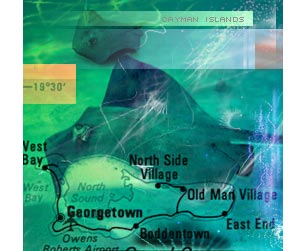
The most popular of the islands, Grand
Cayman, is divided into five districts.
George Town, on the sheltered western
side of the island, is the smallest and
has the best port. Once the site of an
enormous pigpen, the town was first
called Hog Stys — not exactly an
inspiring name for a vacation spot. At
some point during the early 18th
century, the name was changed in honor
of King George III. The pigs moved out
and the people moved in. Today it is the
seat of the government, the center of
the nation’s banking and business
interests and the most populated area.
And, of course, one finds the duty-free
shops in this district, too.
George Town is also the site of a house
worth seeing. In 1935, Carroll Henderson
started buying conch shells. When his
collection exceeded 4,000, he began work
on his dream house: conch shells
anchored in 12-inch-thick concrete
walls. He could set only 30 shells a
day, so it took more than two years to
build the place. But when it was
finished, it had been made so well that,
during the Second World War, the U.S.
Navy used the house as a bomb-storage
depot. Today, the builder’s son lives
there and apparently doesn’t mind
sightseers taking a peek.
For a more traditional example of Cayman
architecture, hop over to nearby West
Bay, on the northwest part of the
island. In the central district of Grand
Cayman, called Bodden Town, you’ll find
Pedro’s Castle, one of the oldest homes
on the island. Built in 1780, it has
rock walls 3 feet thick, a nice view and
underground dungeons. What more could
you ask for?
In one of those bursts of creativity
that overcome early settlers, the
eastern end of Grand Cayman was named
East End. It’s one of the least
populated parts of the island, still
home to a very rural lifestyle. Tourists
go to the district to see the action at
the blowholes, which are openings in the
top of underground coastal caves. Great
plumes of sea spray are created each
time a wave dives into a cave and
explodes through the hole.
From the nearby beach, you can see
what’s left of a group of British ships
that foundered on the reef in 1794. The
event became known as the “Wreck of the
10 Sails.” The story goes that the ship
in charge of navigating sent back a
signal to the rest of the fleet reading,
“Stay clear.” The sailor who interpreted
the signal understood it to say, “All
clear.” Ten ships were lost in the
translation.
The fifth district on the island is
North Side. It was the last part of
Grand Cayman to be settled and it has
the smallest population. North Side also
has the most fertile land and the
island’s best farms. For years, the lack
of roads kept it isolated. These days
access is easier, bringing the district
more traffic. Plus, there’s a public
ferry from Seven Mile Beach, the busiest
part of the island, to the tip of North
Side. The ferry runs throughout the day
and will deposit you on Rum Point, which
is considered by many to be the most
beautiful beach on the island.
Rum Point got its name from a ship that
wrecked on the reefs in front of it. The
ship’s cargo — barrels filled with rum
– floated ashore. When residents
discovered the barrels, they also got
wrecked. A number of bars and
restaurants on Rum Point can help you
re-create the experience.
About 200 yards to the west of Rum Point
is one of the most interesting
underwater attractions in the world:
Stingray City. It offers snorkelers and
scuba divers an opportunity to hang out
with a couple of hundred friendly
stingrays. Despite their name, stingrays
rarely sting; it’s only when you step on
them, when they are nestled on the sandy
floor, that they pose a threat. Needless
to say, it’s wise to tread lightly in Stingray City.
Finally, Grand Cayman offers tourists an
entirely one-of-a-kind experience: A
visit to Hell. Sharp, rough pinnacles,
known as ironshore, cover this part of
the island. When one of the early
British commissioners was shown this
area, he said, “This must be what hell
looks like.” The name stuck and now the
town is officially known as Hell. One of
its main attractions is a post office
that will stamp your cards with a
postmark from Hell. So when you return
home, you can tell everyone you’ve been
to Hell and back.
Burt Wolf's TV show, "Travels & Traditions II," appears on almost 300 public-television stations weekly. His column appears every Wednesday in Salon. For more columns, visit his archive. He also writes regularly about food and cooking equipment for Burt Wolf.com. More Burt Wolf.
The making of the term ‘pink slime’
A simple nickname that forever changed an entire industry
FILE - In this March 29, 2012 file photo, the beef product known as lean finely textured beef, or "pink slime," is displayed during a plant tour of Beef Products Inc. in South Sioux City, Neb., where the product is made. Gerald Zirnstein, the microbiologist who coined the term "pink slime," says it came to him in the spur of the moment as he was composing an email to a coworker at the U.S. Department of Agriculture a decade ago. Although it's been used as a filler for decades, the product became the center of controversy only after Zirnstein's vivid moniker for it was quoted in a 2009 New York Times article on the safety of meat processing methods. (AP Photo/Nati Harnik, File)(Credit: AP) NEW YORK (AP) — “Pink slime” was almost “pink paste” or “pink goo.”
The microbiologist who coined the term for lean finely textured beef ran through a few iterations in his head before pressing send on an email to a co-worker at the U.S. Department of Agriculture a decade ago. Then, the name hit him like heartburn after a juicy burger.
“It’s pink. It’s pasty. And it’s slimy looking. So I called it pink slime,” said Gerald Zirnstein, the former meat inspector at the USDA. “It resonates, doesn’t it?”
Continue Reading CloseDid slaves catch your seafood?
Thailand, a major source of fish imported to the US, depends on forced labor for its product
(Credit: Alena Brozova via Shutterstock) PREY VENG, Cambodia, and SAMUT SAKHON, Thailand — In the sun-baked flatlands of Cambodia, where dust stings the eyes and chokes the pores, there is a tiny clapboard house on cement stilts. It is home to three generations of runaway slaves.
The man of the house, Sokha, recently returned after nearly two years in captivity. His home is just as he left it: barren with a few dirty pillows passing for furniture. Slivers of daylight glow through cracks in the walls. The family’s most valuable possession, a sow, waddles and snorts beneath the elevated floorboards.
Horrors we hide
From slaughterhouses to sweatshops, modern society is constructed to let us ignore atrocities
Workers at a Seagate Wuxi factory in China (Credit: Robert Scoble / CC BY 2.0) Would Americans eat less meat, and would animals be treated more humanely, if slaughterhouses were made with glass walls and we all could see the monstrous killing apparatus at work? This is the query at the heart of Timothy Pachirat’s new book, “Every Twelve Seconds” — the title a reference to the typical slaughterhouse’s cattle-killing rate.
Continue Reading Close
David Sirota is a best-selling author of the new book "Back to Our Future: How the 1980s Explain the World We Live In Now." He hosts the morning show on AM760 in Colorado. E-mail him at ds@davidsirota.com, follow him on Twitter @davidsirota or visit his website at www.davidsirota.com. More David Sirota.
Lessons of a reluctant hunter
A transplant to Oregon teaches me about growing up in rural Mexico, killing iguanas and grilling chicken
Jazmin Rudin with her mother, Esperanza Jazmin is 27 years old and beautiful. She has the fierce, dark beauty of a Mexican Indian, but she’s tall, and when you see her move, you think Masai warrior or maybe ninja. And it’s true: She does have ninja skills. When I first met Jazmin, she’d just killed a pheasant. She was sitting on the deck talking with a friend when she spotted the bird at the edge of the yard, 20 feet away. She casually picked up a two-by-four and hurled it. The missile hit the pheasant in the head, a neat kill. Jazmin walked over and picked it up. “Dinner,” she said.
Continue Reading CloseFelisa Rogers studied history and nonfiction writing at the Evergreen State College and went on to teach writing to kids for five years. She lives in Oregon’s coast range, where she works as a freelance writer and editor. More Felisa Rogers.
Pink slime monster runs amok
The beef product processing industry is in a world of pain. Another scalp for social media?
The beef ingredient dubbed “pink slime.” (Credit: AP/Beef Products, Inc.) The battle over “pink slime” is getting messier. Blaming an “unfounded public outcry over the use of boneless lean beef trimmings” in the nation’s commercially sold ground beef supply, meat processor AFA Foods Inc. filed for Chapter 11 bankruptcy protection on Monday. Beef Products Inc. — the South Dakota-based meat titan that invented the pink slime manufacturing process — is also reeling, idling plants in multiple states. In response, Iowa Gov. Terry Branstad, a politician who hails from a state where there is a whole lot of boneless beef extrusion going on, called for a congressional investigation into the causes of the public uproar.
Continue Reading Close
Andrew Leonard is a staff writer at Salon. On Twitter, @koxinga21. More Andrew Leonard.
Page 1 of 238 in Food