
LGBT

The gay Nabokov

The novelist never could face the secret that cost his brother his life.

  • more
    • All Share Services

The gay Nabokov

In 1918, a year after the Russian Revolution, Vladimir Nabokov and his four siblings posed for a photograph as a present for their mother. The children were in Yalta, in exile from their native St. Petersburg. In the photo, the air of the fabulous wealth and privilege they grew up in still clings to them. The girls are wearing matching sailor suits. Little Elena, Vladimir’s younger sister, holds a patient pet dachshund in her lap.

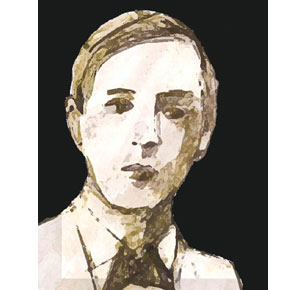
In the background looms a serious and rather beautiful young man dressed entirely in black. His intense gaze meets the camera’s through an exquisite pince-nez. He is not Vladimir, who is wearing a bow tie and looking hilariously full of himself. He is Sergei Nabokov, born 11 months after his famous brother and with a very different fate ahead of him.

Vladimir Nabokov, of course, would go on to become one of the most important writers of the 20th century, earning not only critical acclaim but international fame and financial success as well. Sergei would never be famous — in fact, his existence has been all but covered up by his family — but in its own way his life would be just as remarkable. Shy, awkward and foppish, the opposite of his gregarious brother, Sergei had a secret: He was gay.

Sergei’s homosexuality would cast a long shadow over his strange and heroic life, and it would also, ultimately, be the cause of his horrifying and untimely death. It cast a shadow over Vladimir’s life as well: He loved his brother, but whatever else he may have been — a brilliant writer, a loving father — Vladimir was a confirmed homophobe, and his gay brother was a constant source of shame, confusion and regret to him.

Vladimir’s tortured relationship with Sergei is one of the secret stories of an otherwise very public life, and Nabokov scholars are only now slowly coming to terms with the depths of Nabokov’s prejudice. They’re also becoming increasingly aware that Sergei is a crucially important figure in his brother’s work, a presence with whom Nabokov grappled, in different ways and with different degrees of success, throughout his lengthy oeuvre. Meanwhile, the facts of Sergei’s life are still obscure — forgotten or concealed behind euphemisms or confined to the dusty realm of footnotes and archives.

It’s a question worthy of a Nabokov novel: How could the lives of two brothers, both brilliant and talented, both rich and handsome, have led to two such different places: one to literary immortality, the other to the hell of a Nazi concentration camp?

Sergei Vladimirovich Nabokov was born in St. Petersburg on March 12, 1900. The Nabokovs were members of imperial Russia’s most exclusive social circles, and the children grew up in a glamorous whirl of country estates, liveried servants, balls, boating parties and annual vacations in Biarritz, France, and on the Riviera. The family was extraordinarily wealthy; their lineage included princes and generals and government ministers, and even their faithful dog, Box II, was descended from a pair that belonged to Anton Chekhov. Nabokov once told an interviewer, “I probably had the happiest childhood imaginable.”

But Sergei did not. While Vladimir was the eldest and the center of attention, Sergei grew up out of the limelight, shy and unhappy and somewhat odd. Elena Sikorski, nie Nabokov, the girl with the dachshund in her lap, is now 93 and the last surviving Nabokov sibling, but she remembers her aristocratic Russian youth with absolute clarity. When I telephoned her at her home in Geneva to ask about Sergei, she spoke of him fondly, but not without regret. Her voice is surprisingly deep, with an elegant, stateless European accent and just a hint of a quaver. “He was not the favorite of the family,” she recalls. “I think that he was rather miserable during his childhood.”

Nabokov was fascinated by doubles, and his work is full of them — mirrors, twins, reflections, chance resemblances. Sergei was his brother’s double, a “shadow in the background,” as Nabokov put it. All his life Vladimir would be the golden wordsmith, the master of language; Sergei was afflicted with an atrocious stutter that would only get worse as he got older. He idolized Napoleon and slept with a bronze bust of him in his bed. He also loved music, particularly Richard Wagner, and he studied the piano seriously. Vladimir, by contrast, was almost pathologically insensitive to music, which he once described as “an arbitrary succession of more or less irritating sounds.” He would creep up behind Sergei while he was practicing and poke him in the ribs — something he remembered with bitter remorse in later life. “They were never friends when they were children,” says Sikorski. “There was always a sort of aversion.”

Nabokov said that he hardly remembered Sergei as a boy. He once wrote, “I could describe my whole youth in detail without recalling him once.” But Sergei lurks in every corner of “Speak, Memory,” Nabokov’s 1951 memoir, “quiet and listless,” peering at his older brother “like a little owl,” or stumbling around a roller rink in Berlin as his indefatigable brother repeatedly laps him. In a photo of the two boys taken in 1909 in front of their grandmother’s mansion, 10-year-old Vladimir stands with his hands on his hips, legs apart, imperiously staring down the camera. Sergei hides under the brim of his sun hat, one arm held protectively across his midsection, the other stroking his cheek in a strikingly girlish gesture. In retrospect it seems surprising that it took the rest of the family as long as it did to discover what Sergei probably already knew.

When he was 15 and Vladimir 16, Vladimir found Sergei’s diary open on his desk and read it. He showed it to their tutor, who showed it to the children’s father. In retelling the incident Nabokov writes, with uncharacteristic dryness, that Sergei’s journal “abruptly provided a retroactive clarification of certain oddities of behavior on his part.”

Among those oddities was Sergei’s withdrawal from the famously progressive Tenishev school, an all-boy private school also attended by Nabokov and by poet Osip Mandelstam. According to Nabokov’s principal biographer, Brian Boyd, Sergei left because of a series of “unhappy romances.” It’s unlikely that he found much sympathy within his immediate family. According to Sikorski, who quaintly refers to Sergei’s homosexuality as his “attitude,” the family instituted a kind of “don’t ask, don’t tell” policy. They took Sergei’s revelation “absolutely quietly. Nobody ever spoke about it to him, and he was left to do as he wished.” Marina Ledkovsky, Sergei’s second cousin and a professor emerita at Barnard College, remembers that her own mother “pitied him quite a bit … He adored his mother, and adored his father. He was so affectionate — that’s why it was so very hard for him.”

When the revolution came in 1917, the Nabokov family fled Russia, barely escaping with a fraction of their fortune on a Greek cargo boat loaded with dried fruit. Neither Vladimir nor Sergei would ever return to his motherland. After brief stops in Athens and Paris, Vladimir wound up enrolled at Cambridge University; Sergei started at Oxford but joined his brother at Cambridge a semester later. There they played tennis together — Sergei lacked a backhand but never double-faulted — and hung around with the same set of displaced Russians. In Sergei’s letters from the period, which have never been translated or published, most of his worries are about money and about his parents, who settled in Berlin.

The two brothers went on to earn identical degrees, seconds in Russian and French, but in all other respects Vladimir and Sergei were utterly different. “No two brothers could have been less alike,” wrote Lucie Lion Nohl, another imigri, in a memoir of her acquaintance with Nabokov:

Vladimir was the young homme du monde — handsome, romantic in looks, something of a snob and a gay charmer — Serge was the dandy, an aesthete and balletomane … [He] was tall and very thin. He was very blond and his tow-colored hair usually fell in a lock over his left eye. He suffered from a serious speech impediment, a terrible stutter. Help would only confuse him, so one had to wait until he could say what was on his mind, and it was usually worth hearing … He attended all the Diaghilev premieres wearing a flowing black theater cape and carrying a pommeled cane.

Composer Nicolas Nabokov, cousin to Vladimir and Sergei, paints much the same double portrait:

Rarely have I seen two brothers as different as Volodya and Seryozha. The older one, the writer and poet, was lean, dark, handsome, a sportsman, with a face resembling his mother’s. Seryozha … was not a sportsman. White-blond with a reddish tint to his face, he had an incurable stutter. But he was gay, a bit indolent, and highly sensitive (and therefore an easy butt for teasing sports).

When the brothers graduated in 1922, they joined their family in Berlin, which had become the social and cultural center of the Russian diaspora. Sergei fit easily into the growing gay community there, and he was friendly with German activist Magnus Hirschfeld, founder of the world’s first gay tolerance organization. Sergei and Vladimir went to work at a bank, but the 9-to-5 routine didn’t suit them: Sergei quit after a week, Vladimir in a matter of hours. Vladimir remained in Berlin, where he met and married his wife, Vira, but Sergei moved on to Paris.

Paris in the ’20s meant the legendary Paris of expatriates, the Paris of modernists and the avant-garde, of Joyce, Hemingway, Stein, Picasso and the surrealists. Sergei would spend much of the next two decades there. While Vladimir never stopped mourning the Russia of his youth, Sergei most likely felt at home for the first time in a city that celebrated art and music, and that took his gayness in stride.

It becomes more difficult to track Sergei when he passed out of his brother’s exhaustively documented life, but some details of his time in Paris survive. We know that in the winter of 1923 Nicolas introduced him to painter Pavel Tchelitchev, whose work now hangs in New York’s Museum of Modern Art and who painted sets for Sergei Diaghilev. Tchelitchev was also gay and also a Russian imigri, and the two of them shared an apartment with Tchelitchev’s lover, Allen Tanner.

The flat was so tiny that when Tchelitchev saw it he remarked, “We are to live in a doll’s house!” It had no electricity and no bath — they had to wash themselves in a zinc tub using water heated on a gas stove. Sergei survived by giving lessons in English and Russian. His circumstances may have been straitened, but the cultural scene in which Sergei found himself was rich beyond all measure. According to Andrew Field, Nabokov’s first biographer, Sergei was good friends with Jean Cocteau, and he was also connected, through Tchelitchev and his cousin Nicolas, to Diaghilev, to composer Virgil Thomson, to those aristocratic aesthetes the Sitwells and even to the legendary salons conducted by Gertrude Stein and Alice B. Toklas at 27 Rue de Fleurus.

He must have cut quite a figure. Sergei was an incorrigible dandy, and he wore a bow tie at all times. According to one story, told by a former archbishop of San Francisco, he was notorious for attending Mass in full makeup. Nicolas’ son Ivan is now in his 60s, too young to really remember Sergei, but he remembers his mother’s account of him. According to her, Sergei was “the nicest of all the Nabokovs … a sweet, funny man … much nicer, much more dependable and much funnier than all the rest of them.”

According to Ledkovsky, Sergei was deeply kind, “always a gentleman,” devoted to music but also steeped in Russian, French and English poetry — all languages that, along with German, he spoke fluently. “He could recite anything by heart, and when he recited poetry, he would not stutter at all.” He was also himself a poet, in her opinion a good one, though none of his work survives. “He was a very talented, brilliant man,” says Ledkovsky. “If he were not so timid and shy, if he didn’t feel so … out of place, who knows? He might have been the equal of Vladimir.”

The story of Sergei’s life in Paris has a Cinderella ending. Sometime in the late ’20s or early ’30s he met and fell in love with a wealthy, aristocratic Austrian, whom Nabokov’s biographies have heretofore referred to as “Hermann.” After a great deal of research, he emerges as one Hermann Thieme.

Charming, handsome, something of a dilettante, Thieme was the son of an insurance magnate. His family owned (and still owns) Schloss Weissenstein, a magnificent 12th century castle in the tiny Alpine village of Matrei im Osttirol near Innsbruck, Austria. During the ’30s Hermann and Sergei often retreated to Schloss Weissenstein. Iva Formigoni, Hermann’s niece, now lives in Milan, Italy, but she still remembers the two of them lounging around the castle grounds together and playing tennis and bridge with her and her parents. When Sergei came to stay with Ledkovsky’s family in Berlin, he kept a picture of Hermann on his night table. (“I immediately noticed him,” she says, “because he was so extremely good-looking!”)

In a letter that Sergei wrote to his mother, he describes the joy his relationship with Hermann gave him. “It’s all such a strange story, sometimes even I don’t understand how it happened … I’m just suffocating with happiness.” Some of Sergei’s shyness seems finally to have left him. “There are people,” he wrote, “who would not understand this, to whom such things would be completely incomprehensible. They would rather see me in Paris, barely surviving by giving lessons, and in the end a deeply unhappy creature. There is talk about my ‘reputation’ and so on. But I think that you will understand, understand that all those who do not accept and do not understand my happiness are strangers to me.”

Was his own brother one of those strangers? After Vladimir met Hermann for the first time, he described the scene to his wife in a letter: “The husband, I must admit, is very pleasant, quiet, not at all the pederast type, attractive face and manner. All the same I felt rather uncomfortable, especially when one of their friends came up, red-lipped and curly.”

Nabokov simply didn’t like homosexuals. Even after Sergei’s death, Nabokov used homophobic slurs that make the modern reader cringe. In one letter he describes Taos, N.M., where he spent a summer, as “a dismal hole full of third-rate painters and faded pansies.” And he referred to gay Russian critic Georgy Adamovich as “Sodomovich.”

According to Andrew Field, his first biographer, Nabokov considered homosexuality to be a hereditary illness. Nabokov’s homophobia is in fact one of the dirty little secrets of 20th century literature, on a par with T.S. Eliot’s anti-Semitism. “I believe Nabokov was quite homophobic,” says Galya Diment, vice president of the Nabokov Society and a professor in the Slavic department at the University of Washington. “It behooves his fans and admirers to admit it — and also to regret it.”

Where did this prejudice come from, in a man who spoke out vehemently against both racism and anti-Semitism (his wife was Jewish)? Nabokov’s father, also named Vladimir, was a politician, and he was deeply involved in legislative debates over homosexuality. In pre-revolutionary Russia consensual homosexual intercourse was a crime (as it still is in parts of the United States), and although V.D. Nabokov, as he was known, argued for the decriminalization of sodomy, his attitude toward homosexuality was complicated: He made it abundantly clear that his legislative arguments were based on purely constitutional grounds, on abstract notions of freedom and privacy, and that he personally considered homosexuality to be “deeply repugnant” to any “healthy and normal” person. V.D. Nabokov died in 1922 in Berlin, shot in the chest while breaking up the attempted assassination of a visiting Russian dignitary. Nabokov’s diary records that in their last conversation, the night before, Vladimir and his father had discussed Sergei’s “strange, abnormal inclinations.”

Abnormal or not, homosexuality was actually an important part of life in the Nabokov family. In “Speak, Memory,” we meet little Vladimir’s beloved governess, “lovely, black-haired, aquamarine-eyed Miss Norcott,” who “was asked to leave at once, one night at Abbazia.” What grown-up Vladimir doesn’t tell us is that Miss Norcott was dismissed because she was a lesbian. Nabokov also had no fewer than two gay uncles. Konstantin Nabokov, his father’s brother, was chargi d’affaires at the Russian Embassy in London. Vasily Rukavishnikov, Vladimir’s maternal uncle, was also a diplomat, though a less successful one. He did succeed, however, in making an indelible impression on his young nephew.

Uncle Ruka, as he was universally known, was a wealthy, eccentric dilettante, and there’s every indication that he was in love with the young Nabokov; certainly his attachment to his favorite nephew went beyond what was appropriate. He appears to have subjected Nabokov to a mild form of sexual abuse: “When I was eight or nine,” Nabokov writes in “Speak, Memory,” “he would invariably take me upon his knee after lunch and (while two young footmen were clearing the table in the empty dining room) fondle me, with crooning sounds and fancy endearments.” In his biography of Nabokov, Boyd notes “Humbert’s first feignedly nonchalant fumbles with Lolita,” and suggests that “the adult Nabokov’s disapproval of homosexuals and his solicitude for childhood innocence may all have their origins here.”

Like Sergei, Uncle Ruka was gay, stuttered and loved music passionately. He considered his greatest achievement to be an original poem that he set to his own accompaniment, but of all the Nabokovs it was Sergei who learned to play it by heart. Of course, Uncle Ruka paid no attention to him. When he died in 1916 he left his entire estate — a mansion, 2,000 acres of land and a fortune in rubles — to his favorite nephew, Vladimir, who was a wealthy 17-year-old for a year before the Russian Revolution took it all away again.

Since Nabokov’s death in 1977, the responsibility for managing his posthumous reputation has fallen to his son Dmitri, who is fiercely protective of his father’s public image: One member of the Nabokov family interviewed for this article later asked to retract her statements, for fear of incurring Dmitri’s wrath. Dmitri himself declined to be interviewed — “out of respect for his uncle,” according to his literary agent — but in 1997 he did take part in a revealing exchange on the Internet.

When his father’s attitude toward homosexuality came up on NABOKV-L, a public e-mail list devoted to Nabokov’s work, Dmitri leapt into the fray. “I knew it was only a matter of time before the sexual-preference police would go to town on my father,” he wrote. He summed up Nabokov’s ambivalence perfectly: “He had a sense of justice, a homosexual brother, and not one but two homosexual uncles. Among the writers he admired there were plenty of homosexuals, from Proust to Edmund White. He had a number of homosexual friends. I also know he would have been less than happy had his son inherited those genes.”

After Sergei’s death, Vladimir described him in a letter to Edmund Wilson as “a harmless, indolent, pathetic person who spent his life vaguely shuttling between the Quartier Latin and a castle in Austria.” Nabokov rarely mentioned Sergei in print — at least not by name. It wasn’t until the third published version of his “Speak, Memory” that Nabokov even felt able to include an account of Sergei’s life. In an early piece of autobiography, recently published in the New Yorker, Nabokov describes his brother “drifting in a hedonistic haze, among the cosmopolitan Montparnassian crowd that has been so often depicted by a certain type of American writer. His linguistic and musical gifts dissolved in the indolence of his nature.”

At no point did Nabokov, who in “Lolita” would wring pathos from the sufferings of a child molester, ever have the courage to publicly state that his brother was gay. “It may be a kind of prudery,” muses Michael Wood, author of a book on Nabokov, “The Magician’s Doubts,” and chairman of Princeton University’s English department. “He obviously had a terrific affection for his brother. He also had a fixed distaste for homosexuality.”

But however distasteful he found it as a person, Nabokov as a writer found homosexuality perversely irresistible, and gay characters turn up in almost every one of his 17 novels. There’s invariably something strangely wooden about them. Nabokov was the archenemy of clichi, a writer passionately committed to overturning tired literary conventions through careful observation of the real world, but his homosexual characters are as a rule egregiously stereotyped.

From the giggly ballet dancers of Nabokov’s first novel, “Mary,” to the ghastly Gaston Godin, Humbert Humbert’s neighbor in “Lolita,” to the egomaniacal narrator of “Pale Fire,” they are vain, silly, usually effeminate — he uses the word “mincing” a lot — shallow, intellectually trivial and ineffectual, and the narrator generally introduces them with a nudge and a wink and a snigger. Many of them are pedophiles. Not once did Nabokov, the master observer, describe an instance of mature love between adults of the same sex — even though a glowing example of that love was right before his eyes.

Although Nabokov’s gay characters are two-dimensional at best, Sergei found other, more interesting ways to haunt his brother’s fiction. In “The Real Life of Sebastian Knight,” Nabokov’s fictional account of a man’s attempt to write the life of his mysterious half-brother, one finds uncanny references to Sergei everywhere, from the title character’s name, which alliterates with Sergei’s, to his foppishness and his failures at sports, to a series of uneasy meetings between the brothers in Paris that closely parallels those of the real-life Nabokov brothers. “The similarities of Sebastian and Sergei fit so well together, it’s an aspect of the work that you really have to consider,” says Michael Begnal, an English professor at Wesleyan University who writes on Nabokov. “My impression was that he had to put the whole Sergei situation to rest in his own mind, and in a way that’s what he’s trying to do.”

When he learned of Sergei’s death in 1945, Nabokov was in the middle of writing “Bend Sinister,” his most political novel. Like Sergei, the hero of “Bend Sinister” speaks out against a brutally repressive regime, and like Sergei, he would pay for his courage with his life. But Nabokov’s feelings about his brother were never simple: In “Bend Sinister” it’s not the hero who’s gay but the dictator who orders his death. In 1967, when he finally told the story of Sergei’s life, Nabokov’s writing conveys a sense of unspoken strain and remorse: “For various reasons,” he writes, “I find it inordinately hard to speak about my other brother.”

In “Ada,” his longest novel and one of his last, Nabokov made his best and final attempt to come to terms with his feelings about his brother in print. “Ada” is the story of an incestuous love affair between Van Veen and Ada Veen, brother and sister. Their younger sister, Lucette, is also passionately in love with Van, and she spends most of the novel trailing around after the couple, getting in the way and generally making a pest of herself. Van’s indifference drives Lucette to despair, and toward the end of the book she throws herself from a cruise ship in the middle of the Atlantic.

Brian Boyd, who is probably the single greatest living authority on Nabokov, believes that the real inspiration for Lucette was Sergei. “The centrality of Lucette in ‘Ada,’” he argues in an e-mail, “in some ways seems to reflect Nabokov’s sense of Sergei: the non-favorite, the frail one beside his confident sibling, the concentration camp victim … the one we’re invited to ignore, and even want to dismiss from the story, but eventually realize we should never have overlooked.”

If Boyd is right, “Ada” gives us a last glimpse of Nabokov thinking about Sergei — and maybe, at last, starting to think about him in a new light. “I think that Nabokov often tries to be inhumanly secure, and confident, and happy, and unregretful,” Wood observes. “If he pulled that off, he would be a monster. It’s a fine thing to try — and an even finer thing to fail.”

Whatever peace Nabokov may have made with Sergei in fiction, it came long after Sergei’s death in fact. Did the two brothers ever bridge the gap between them? “Absolutely not” is the firm answer from Sikorski, their sister. “Perhaps the last years of his life they were closer, but otherwise never.” It can’t have helped that by all accounts Sergei didn’t get along with Vira, Nabokov’s wife.

Still, in the late ’30s, when both brothers were living in Paris, there were signs of warmth. Vladimir writes in “Speak, Memory” that they were “on quite amiable terms” at the time. When their mother died in Prague in 1939, and Vladimir was unable to get away from Paris, Sergei described the funeral for him in a letter. Writing on the spare, elegant stationery of Schloss Weissenstein, he closed the letter affectionately: “I want you to know that I am with you with all of my heart.”

If they had any last words to offer each other, Sergei and Vladimir never got to say them. In the spring of 1940 Hitler invaded France, and by May the Germans were bombing Paris. Vladimir and his family left for America on the last boat out of St. Nazaire, but Sergei was away in the countryside at the time. He returned to Paris to find their apartment suddenly empty.

He chose to stay in Europe with Hermann. The Nazis were already rounding up homosexuals as actively as they were Jews, and to avoid attracting suspicion Sergei and Hermann saw each other only rarely. Sergei took a job as a translator in Berlin, but he had no stomach for war, and the Allied bombings frightened him horribly. “He was just so terrified, poor thing,” Ledkovsky remembers. “Even my mother was consoling him.” The fighting grew more intense, and flight became impossible; Sergei had almost no money, and as a refugee from czarist Russia his only travel document was a flimsy Nansen passport.

In 1941 the Gestapo arrested Sergei on charges of homosexuality. It released him four months later, but he was placed under constant surveillance. It’s ironic that at that moment, after a lifetime of shyness and stuttering, Sergei could not keep silent. He began to speak out vehemently against the injustices of the Third Reich to his friends and colleagues. On Nov. 24, 1943, he served as best man at Ledkovsky’s wedding. Three weeks later he was arrested for the second time.

The file that the police kept on Sergei accuses him of “staatsfeindlichen Au_erungen” — subversive statements. There may have been more to the story: Princess Zinaida Shachovskaya, a fellow Russian imigri (whose relations with the Nabokov family have sometimes been strained), has written an as yet untranslated memoir in which she asserts that Sergei was in fact involved in a plot to hide an escaped prisoner of war, a former Cambridge friend who had become a pilot and been shot down over Germany.

After his arrest Sergei was taken to Neuengamme, a large labor camp near Hamburg, where he became prisoner No. 28631. Conditions were brutal: The camp was a center for medical experimentation, and the Nazis used the prisoners to conduct research on tuberculosis. Of the approximately 106,000 inmates who passed through Neuengamme, fewer than half survived, and as a rule, the guards singled out homosexuals for particularly harsh treatment.

Sergei’s conduct in the camp was nothing less than heroic. Nicolas Nabokov’s son Ivan says that after the war, survivors from Neuengamme would telephone his family out of the blue — they were the only Nabokovs in the book — just to talk about Sergei. “They said he was extraordinary. He gave away lots of packages he was getting, of clothes and food, to people who were really suffering.” Meanwhile, Hermann had also been arrested, but he was sent to fight on the front lines in Africa. He would survive. He spent his later life at Schloss Weissenstein, without a career, caring for his invalid sister. He died in 1972.

In America, Vladimir was beginning a triumphant new life. While Sergei was at Neuengamme, he spent the summer of 1944 sunning himself in Wellfleet, Mass., with Edmund Wilson and Mary McCarthy. That fall he collected butterflies for Harvard’s Museum of Comparative Zoology, enjoyed the benefits of American dentistry and taught Russian to Wellesley College undergraduates, with whom he flirted shamelessly. The New Yorker was beginning to print his poems. He became the first person under 40 to receive a Guggenheim Fellowship. He knew nothing of what was happening to his brother in Europe.

In “The Real Life of Sebastian Knight” the narrator has a dream the night before Sebastian dies. He imagines that his half-brother’s hand has been horribly maimed in an accident. In the early fall of 1945, in his apartment in Cambridge, Mass., Nabokov dreamed of his brother Sergei. He saw him lying on a bunk in a German concentration camp, in terrible pain. The next day he received a letter from a family member in Prague. According to camp records, “Sergej Nabokoff” had died on Jan. 9, 1945, of a combination of dysentery, starvation and exhaustion. Neuengamme was liberated four months later.

Lev Grossman is a novelist and journalist who lives in New York.

Victory, unprecedented

How the gay movement's successes surpassed feminism and civil rights -- and became a model for a new era

  • more
    • All Share Services

Victory, unprecedented (Credit: iStockphoto/lisafx)
This article is an excerpt from "Victory: The Triumphant Gay Revolution," available June 5 from Harper.

At the height of the real estate boom in the 2000s, Robert M. “Robby” Browne, 2007 Corcoran Real Estate National Sales Person of the Year, put on his woman’s bathing suit and silver heels and walked out onto the Club Exit stage. A thousand screaming, cheering, photo-snapping real estate brokers roared their approval. The openly gay Browne, six feet tall and nearly two hundred pounds, danced a sweetly amateurish version of the Village People’s gay anthem, “YMCA,” as ten half naked male Broadway dancers backed him up.

“Is there any question of who the star is?” Browne asks proudly, watching the video today. For most real estate brokers, a third year as Corcoran’s top producer would have been stardom enough, but when Corcoran CEO Pam Liebman began planning the 2007 event, Browne thought he wouldn’t bother to attend. He’d had enough top-earner, $100-million-club years. He was turning sixty, and he was thinking about his life as a whole. Finally he said he would show up, but only if he could accept the award in drag. Browne’s beloved gay older brother, Roscoe Willett Browne, died of AIDS in 1985. He’d never forget the day when President George H. W. Bush said that dying of AIDS wasn’t as important as losing your job. “George H. W. Bush did not acknowledge the sacrifice of my brother and our love. My brother. He’s in his eighties and he still has his brothers and I don’t have any brothers,” says Browne. “And my brother was a Yalie and he was in Vietnam; Bush, how could he be more your person?” We exist, says Browne, looking at the video of his awards ceremony. “This show says we exist.”

Exist? You can’t pick up a paper without seeing evidence that gay people exist and are compelling American society to acknowledge them. The federal government protects them from homophobic violence and twenty-one states have laws against discrimination; 141 cities across the country constitute enclaves of equal treatment. A federal nondiscrimination bill gains more support in Congress with each passing year. Poll numbers show Americans overwhelmingly support protection for gays and lesbians against hate crimes and equality in health benefits, housing, and jobs. In July 2010, a federal judge struck down the federal law, the Defense of Marriage Act, that excluded gays from the federal benefits for which married people were eligible and that allowed the states to refuse to recognize the marriages if they pleased. In August, another federal judge invalidated the amendment to the California constitution, added by Proposition 8, that limited marriage to a man and a woman. September had hardly dawned when a third federal judge found the policy requiring gay soldiers to hide their sexual orientation, don’t ask/don’t tell, unconstitutional as well. The United States Congress repealed the law prohibiting out gays and lesbians from serving in the armed forces. Right after the Fourth of July in 2011, the federal courts in California ordered the United States military to stop screwing around getting ready and just cease enforcing it at once.

Gay playwright Edward Albee’s play about the unbounded nature of love objects, “The Goat, or Who Is Sylvia?,” won the Tony Award for best play in 2002; the heroic biopic about San Francisco gay activist Harvey Milk, “Milk,” won two Oscars in 2009. So many people in show business have come out as gay that some gay media are now pooh-poohing their confessions as cheap shots meant to bolster their flagging careers.

Two of the most famous heterosexual lawyers in America, David Boies and Ted Olson, brought the suit against the California marriage ban in 2009. Win or lose, Boies and Olson’s case has already achieved the crucial social goal of making same-sex marriage a legitimate claim. On the eve of the closing argument in the case in 2010, a New York Times editorial called same-sex marriage “A Basic Civil Right.” In 2011 the poll numbers in favor of same-sex marriage crossed 50 percent. Regardless of intermittent setbacks, gay people like Robby Browne have succeeded in forcing society to acknowledge that they exist—as humans with a right to life and as American citizens with a claim to equality under the United States Constitution. Most of all, they have staked their claim to be treated, without lying or hiding, as moral persons, whose lives, loves, and ambitions have value and cannot be discounted.

The year 2009 saw the fortieth anniversary of the uprising in a New York gay bar called Stonewall. In 1969, “homosexuals,” people who wanted to have sex with members of their own sex, were considered sinful by the church, their sexual practices were criminal in forty-nine states, the psychiatrists said they were crazy, and the State Department held that they were subversive. Forty-two years later, almost to the day, Andrew Cuomo, the governor of the state of New York, signed the law that enabled them to marry in New York. The Empire State Building was lit up in the rainbow colors of the symbolic gay flag.

How did this tiny minority of despised and marginalized people do it? They did it in America, what we philosophers call a “liberal (small L) state.” America’s roots go back to the beginning of modern Western political thought in the seventeenth century, when the philosopher Thomas Hobbes speculated that people create their governments; states are not handed down from God to Adam to the king. During the century and a half after Hobbes wrote, the English and their American colonists launched a variety of social movements—the English Revolution and the American Revolution among them—that pushed and pulled on the deal between people and government until they produced the basic outline of the modern western state, the liberal state. The liberal state makes three promises to its citizens. First, security: the state will protect its citizens from one another and not hurt them worse than the people it is protecting them from. Second, liberty: citizens have certain rights as human beings that even the state cannot interfere with. And finally, self-governance: for those aspects of life the state can control, citizens must decide for themselves on equal terms what they want the state to do. It’s a good deal. No wonder so many people want in.

By the late twentieth century, Americans had already undertaken two great social movements for inclusion in the liberal state, the racial civil rights movement and the feminist movement. Since people aren’t all that easy to organize, theorists have often speculated about how they did it. Their conclusions are that movements arise only when people come to see that their problems are political, not natural or personal, what theorists call “oppositional consciousness.” This “aha!” moment in the civil rights movement dates back at least to W. E. B. Du Bois in 1903, when he observed that “the problem of the Twentieth Century is the problem of the color-line.” In addition, movements need access to resources, as when the NAACP started getting hold of real money and the movement gained astute leaders, such as Martin Luther King Jr.

Students of the racial civil rights movement made the assumption that before people engage in new movements they do a rational cost-benefit analysis, weighing the benefits of political action against the cost. When people created social movements against all odds and acted against their own individual self-interest on behalf of the group, theorists had to rethink what really drives people to take action. As the racial civil rights movement gave way to other movements—the feminist, and, finally, the gay-liberation movement—sociologists produced more theories to explain the new movements; indeed, the later thinking is often called “new social-movement” theory. In the newer thinking, theorists speculated that people draw their sense of who they are from the groups or social networks they are already in. From those starting places, they conceive a positive vision of themselves and then a desire to change the way the larger society perceives them all. New social-movement theorists came to the realization that sometimes group identity is so strong that people act on behalf of the group whether it benefits them individually or not.

Classical or new, each of the movements before the gay movement was seeking citizenship in the liberal state. Women and racial minorities did not necessarily ask the dominant society to love them or approve of them. They sought to be secure against violence, to be tolerated as they exercised their human liberty, and to have equal access to political and economic life. Each movement got traction in these crucial areas. But both of them fell short of achieving all the elements of a full human life for most of the people they represented: they got little or no economic assistance or cultural validation, and, when the inevitable backlash came, they stalled or lost ground. It would take a newer new movement to make the next moves: it would take the gay revolution.

The gay revolution achieved more because it faced different challenges. The path to liberal equality almost always involves mimicking as much as possible the behaviors and beliefs of the straight white men in power. The racial civil rights and feminist movements both made substantial detours into defending difference—black separatism and difference feminism. They failed to establish that their divergent cultures were as worthy as the dominant one and all they did was to split their movements. At the end of the day, both these modern movements got most of their traction from maximizing their similarity to dominant political and social hierarchies.

By definition, people involved in the gay revolution could not replicate the majority behavior. Their very political identity was behavior that distinguished them from the majority, including, but not limited to, their sex lives. The liberal state has a basic concept of a person entitled to be a citizen. When gay activists began their efforts, the churches considered them sinful, all but one state criminalized their sex acts, the doctors thought they were crazy, and politicians saw them as traitors to the nation. Sinners were kept away from sacred rites like marriage; criminals were imprisoned; crazy people were put in asylums; and people of doubtful loyalty were fired from their government jobs. Sinful, criminal, crazy, and subversive, the gays who made the gay revolution had the vastly harder task of convincing society to recognize they were even suitable candidates for citizenship despite their difference. Although liberalism pretends to be morally neutral, homosexual sexual behavior pressed that liberal commitment to the limit. In so doing, instead of bringing their marginal group into conformity with the mainstream norms, they challenged the accepted versions of sin, crime, sanity, and loyalty and changed America for everyone.

The movement succeeded, uniquely and in large part because, at the critical moments, its leaders made a moral claim. “Gay,” as movement pioneer Franklin Kameny put it on the iconic button of the gay revolution in 1968, “Is Good.” Even though it’s different. No one told it better than activist Arthur Evans: “It was more than just being gay and having gay sex. We discovered who we were and we built authentic lives around who we were and we supported each other doing that and in the process came to very important questions about the meaning of life, ethics, the vision of the common good and we debated these issues and we lived them.”

Morally ambitious and clearly identified as different, the gay movement came from further behind than either the civil rights or the feminist movements had done. It took on the liberal state and achieved formal equality, as did the other two movements. During the AIDS epidemic, it took on not just oppression, but neglect. And then it took on the traditional institutions of heterosexual morality—marriage and the military—and is rapidly conquering those arenas as well.

Fueled by its moral ambition, the gay movement is the model of a new era. It is ironic, yet fitting, that the only counterpart to the morally driven gay revolution is its contemporary and fiercest opponent, the morally driven religious right. Indeed, it is the moral certainty of the gay revolution that explains why, unlike the racial and feminist movements, it has been able to stand up to that powerful counterforce and, slowly but surely, prevail.

The theories all suggest that a whole lot of things have to go really right for people to act collectively against legitimate political authority. Lacking the religious and historical jet fuel of racial civil rights and the demographic advantage of feminism, the gay revolution started out from much the weakest position of any of the modern movements. Brilliantly led, endlessly resourceful, and stunningly creative, it came the furthest. When we ask how a cross-dressing homosexual activist got to be the poster boy of the most successful real estate brokerage firm in New York, we are also asking how people cooperate to get anything done, much less take on their whole society and wrench it onto a different path altogether. The gay Victory is not just a story, although that would be enough. It’s an epic.

From the book “Victory: The Triumphant Gay Revolution.” Copyright © 2012 by Linda Hirshman. Reprinted courtesy of Harper, an imprint of HarperCollins Publishers.

Continue Reading Close

Linda Hirshman is the author of “Victory: The Triumphant Gay Revolution,” forthcoming in June 2012. Follow her on Twitter @LindaHirshman1

Disneyland: Japan’s gay pioneers

A recent ceremony at Tokyo Disneyland highlights how far the country still needs to go for gay rights

  • more
    • All Share Services

Disneyland: Japan's gay pioneers (Credit: Cindy Hughes via Shutterstock)

TOKYO, Japan — In one respect, the decision by Tokyo Disneyland to allow a gay couple to hold their “wedding” at the theme park is a sign of progress in a country that has, until recently, largely ignored the issue of same-sex unions.

Global PostBut some campaigners have argued that leaving it to Mickey Mouse to give his blessing to Koyuki Higashi and her partner, Hiroko Masuhara — in a strictly symbolic ceremony — is also a mark of how far Japan has to go before it affords the same rights to the lesbian, gay, bisexual and transgender (LGBT) community as it does to heterosexual couples.

Tokyo Disneyland condoned this and all future same-sex ceremonies after receiving an inquiry from Higashi. Cue a confused response from a subsidiary, Oriental Land Company, which licenses the name and characters from Disney in the United States.

Higashi, 27, and her partner could “marry” at the park, they were told, but only if they dressed “like a man and a woman.” Park officials were worried that other visitors might be offended by the sight of two women in wedding dresses or morning suits.

The park relented on the dress code after a storm of protest on Twitter and other social media networks — it had all been a misunderstanding by an individual employee, it said — but the couple will not be allowed to exchange vows in the park’s chapel due to “Christian teachings.”

Those restrictions go to the heart of the flimsy protection offered to the rights of LGBT people in Japan, say campaigners. Homosexuality is not illegal, but same-sex marriages are not legally recognized.

“There needs to be more pressure for legal unions between gay people in Japan,” said Taiga Ishikawa, one of only a handful of openly gay politicians in the country. “This is only a guess, but I’d say there are more people now who are in long-term relationships and want that to be recognized in the form of a civil partnership.”

The 37-year-old, who won a seat on the Toshima Ward assembly in Tokyo last year, is campaigning to introduce an ordinance in the area to offer some form of marital recognition and to increase the number of administrative rights and services afforded to same-sex couples. But he admits that it’s “some way off.”

If Disneyland was being held up as an agent of progress, one of Japan’s most popular celebrities popped up to demonstrate that, in some quarters, ignorance reigns.

Commenting on TV on President Barack Obama’s recent declaration of support for gay marriages in the US, the film director and comedian Takeshi Kitano told a fellow guest: “Obama supports gay marriage. You would support marriage between humanoid and animals eventually, then,” before questioning the ability of gay couples to raise children.

Kitano has since tried to explain his outburst: “I was only talking about people who love their pets so much that they may think of marrying them,” AFP reported him as saying. “There is no way I look at gay people in the same way as I do animals, let alone implying sexual relations with animals.”

His were not the first comments with homophobic overtones to be made by a high-profile public figure in Japan. In late 2010, Shintaro Ishihara, the outspoken governor of Tokyo, suggested gay people were “deficient” after watching same-sex couples take part in a parade in San Francisco. “We have even got homosexuals casually appearing on television,” he said. “Japan has become far too untamed.”

Yuji Kitamaru, a journalist who writes about LGBT issues, said he was “very disappointed” by Kitano’s remarks, particularly as he has spoken up for minorities, including transgender people, in the past. “I felt it was a big betrayal not only to us and the audience, but also to himself. Public figures like Kitano can easily indulge in that kind of bigotry because Japanese people in general haven’t considered the difference between public discourse and private gossip.”

Yet Kitamaru, who has written on LGBT issues in Japan for two decades, believes social media has quickly become the forum for a more open discussion about sexuality, citing Twitter’s role in the Disneyland decision and a meeting held in Ni-chome, a gay neighborhood of Tokyo, to thank Obama for his support.

Higashi and her partner, meanwhile, have visited Disneyland to break their good news to Mickey Mouse. They have yet to set a date for the wedding, and there are reports that their inquiries were intended only to test the theme park’s commitment to equality.

Ishikawa welcomed Disneyland’s decision, which apparently came after officials in Tokyo contacted the company’s US headquarters. “I wrote 10 years ago that I looked forward to the day when gay and lesbian couples could hold hands and go to Tokyo Disneyland, so I’m very happy,” he said. “But we’re still not at the point where a man or woman can tell people, especially co-workers, that they have a same-sex partner.”

Continue Reading Close

It’s time for Dharun Ravi to apologize

Tyler Clementi's roommate gets a month of jail time in the Rutgers intimidation case. Will he ever say "sorry"?

  • more
    • All Share Services

It's time for Dharun Ravi to apologizeDharun Ravi (Credit: AP/John Munson)

Tyler Clementi’s mother calls his actions “evil and malicious.” His father says they were “the cold-hearted violations” of his son, who committed suicide in September 2010. And a young man known only as “M.B.” said in a written statement that he “caused me a great deal of pain.” So, does Dharun Ravi’s punishment — 30 days jail time, 300 hours of community service, three years’ probation, and $11,900 total in fines — fit the crimes of which he’s been found guilty?

In March, Ravi was convicted of charges of bias and intimidation stemming from the death of Clementi, his Rutgers roommate, whom he had secretly filmed, in Ravi’s words, “making out with a dude.” It was a story that reverberated around the world, and helped invigorate the anti-bullying movement. As Judge Glenn Berman handed down the sentence Monday afternoon, calling Ravi’s actions “offensive and unconscionable,” he said that he would not recommend deportation. But the judge did pointedly tell Ravi, “I haven’t heard you apologize once” for his callous behavior. And he said he made “no comment” regarding any further civil actions the Clementis might take.

Though Berman said he believed the sentence “disenchanted both sides,” it’s one that shows respect for the law as it stands in New Jersey. It also offers what Berman calls the “hopeful” possibility that Ravi — and others who have so cavalierly shamed and exploited people — might learn something about the quality of mercy. Maybe all those hours of service can teach Ravi something he, as an 18-year-old college freshman, was so devastatingly lacking.

In her remarks to the court Monday, Clementi’s mother tearfully said that a piece of her died when her child killed himself. And M.B., the anonymous young man whom Ravi secretly recorded with Clementi in September 2010, said in a statement to the court that while he bore Ravi no malice, he “just wanted him to acknowledge that he had done wrong and take responsibility for his conduct.” That atonement isn’t something a judge can impose. And it’s a statement Ravi has yet to make.

Continue Reading Close
Mary Elizabeth Williams

Mary Elizabeth Williams is a staff writer for Salon and the author of "Gimme Shelter: My Three Years Searching for the American Dream." Follow her on Twitter: @embeedub.

HGTV: Winning the war for gay marriage

For nearly 20 years, one network has redefined domestic bliss -- and taught Americans to love their neighbors

  • more
    • All Share Services

HGTV: Winning the war for gay marriage (Credit: Karina Kononenko via Shutterstock)

There are two ways to bring about positive, long-term social change: the fast one and the slow one. In the first version, statues are toppled, walls are torn down, laws are dramatically enacted. There is, forever, a clear before and after. It’s days like July 24, 2011, when New York state approved same-sex marriage. Or May 9, 2012, when Barack Obama became the first president to announce his support for the issue — an occasion that prompted incoming Human Rights Campaign president Chad Griffin to remark, “You will not forget where you were when you saw the president deliver those remarks.”

Then there’s the subtler version. The kind where you look around one day and suddenly realize that gay people have been building families and creating homes together this whole time. They’re your neighbors. They’re your fellow parents on the PTA. And they are totally the couple building an amazing new deck this weekend. For 18 years now, HGTV has been a steadfast force for exactly that kind of tolerance, simply by advancing the radical notion that homosexuals are out there in the world obtaining mortgages and painting their interiors just like straight people.

It’s not that LGBT-friendly content doesn’t exist elsewhere on television. I mean, Christ, have you ever seen Bravo? We could start with Andy Cohen and not even get around to “Project Runway” for days. There are entire gay-oriented networks, like Logo. But what distinguishes HGTV is both its durability and its ordinariness.

HGTV doesn’t trade in drama or high camp; it doesn’t offer “Wig Parties and Threesomes” stereotypes. Sure, one might suggest that the network’s high population of flamboyant gay designers panders to a different kind of typecasting. But the presence of hosts like David Bromstad and the married, father of two Vern Yip seems more like a logical, ordinary reflection of the makeup of the field. It’s also likely why there are so many gay contestants on its competitions as well. Just look at last year’s “Design Star” combatants, which included the lesbian former Dallas Cowboys cheerleader (and mother of four) Leslie Ezelle, and “average gay dad” Tyler Wisler.

More significant than its regular on-air talent pool, however, is the network’s consistent depiction of America’s gay and lesbian population as normal, carpooling, Home Depot-shopping folks whose agenda includes upgrading the kitchen backsplash. Far from the cavalcade of dysfunction on networks like TLC, the network regularly presents typical families of different ages and ethnicities — some of whom happen to be same-sex — on shows like “Property Virgins” and “House Hunters,” where the most shocking element of an odyssey is likely to be the property’s price tag.

That a network built around design would position itself as gay-friendly might seem like a no-brainer. But it’s also a network that  still has an overwhelmingly female core audience that isn’t necessarily going to identify with male same-sex couples. But by depicting a variety of couples and families, the Scripps-owned empire is broadening its base and appealing to a wider demographic. It’s also reflecting the reality of contemporary America.  As “Property Virgins” casting director Michael Barrick said when he put out the call for Atlanta-area LGBT parents last month, “I do prefer to see as diverse a population featured on television as possible. People like to watch a show that they can relate with, be it black, white, Asian, interracial, gay and straight. If they don’t see that representation, they are more likely to change the channel – and that is something as a casting director, that I just don’t want to see.”

There are still plenty of people out there stuck with antiquated ideals. Some of them are even running for president. But the fact that the American family doesn’t always resemble an Eisenhower-era sitcom is something more and more of us accept. It’s been a long time coming and it’s still a work in progress, but our American image of home and family is, in the words of the president, evolving. It evolves when a law is changed or a leader speaks out. And it evolves when two guys buy a house together on basic cable, and then another two, and another two, and the two ladies. Suddenly it’s not weird or unique or groundbreaking at all. It’s improvement. One home at a time.

Continue Reading Close
Mary Elizabeth Williams

Mary Elizabeth Williams is a staff writer for Salon and the author of "Gimme Shelter: My Three Years Searching for the American Dream." Follow her on Twitter: @embeedub.

Manny Pacquiao doesn’t want you dead

A gross misquote gets out of hand -- but the iconic boxer still has a long way to go on the sensitivity front

  • more
    • All Share Services

Manny Pacquiao doesn't want you deadManny Pacquiao (Credit: Reuters/Steve Marcus)

Updated below

Let’s get something straight, so to speak, right off the bat. There’s no disputing that Manny Pacquiao is not the most enlightened guy to ever put on gloves and fight for a belt. In a story for Examiner.com this past weekend, blogger Granville Ampong wrote of how the boxing champ takes issue with Barack Obama’s recent groundbreaking declaration of support for same-sex unions. “God’s words first … obey God’s law first before considering the laws of man,” Pacquiao told Ampong, in what the writer described as “an exclusive interview.” Pacquiao was further quoted explaining that “God only expects man and woman to be together and to be legally married, only if they so are in love with each other… It should not be of the same sex so as to adulterate the altar of matrimony, like in the days of Sodom and Gomorrah of Old.”

OK, it’s generally accepted that invoking Sodom and Gomorrah in general — and Sodom and Gomorrah of Old, in particular — is not going to win anybody a seat at the GLAAD awards. Sure enough, Pacquiao’s statements quickly set off a chain of angry and just plain disappointed responses from across the Net, where Pacquiao has been celebrated as a Filipino icon, and beloved for his humanitarian works. On Tuesday evening, the Los Angeles shopping center the Grove, where Pacquiao was to be interviewed for “Extra,” called off the event. “Based on news reports of statements made by Mr. Pacquiao,” read a statement from the center’s spokesman Bill Reich, “we have made it be known that he is not welcome at the Grove and will not be interviewed here now or in the future. The Grove is a gathering place for all Angelenos and not a place for intolerance.”

It’s a relatively free country, which means that the Catholic Pacquiao is welcome to express his views, even views many of us find backward and exclusionary. In return, a business like a shopping mall may choose to decline his patronage. What is not OK is what happened along the way.

You see, within the original Examiner.com piece, Ampong went off on a bit of biblical tangent. “Pacquiao’s directive for Obama calls societies to fear God and not to promote sin, inclusive of same-sex marriage and cohabitation,” he wrote, “notwithstanding what Leviticus 20:13 has been pointing all along: ‘If a man lies with a man as one lies with a woman, both of them have done what is detestable. They must be put to death; their blood will be on their own heads.’”

That’s Ampong. Quoting Leviticus. You could go ahead and infer that this is what Pacquiao was alluding to in his remarks, and you definitely could say that’s some convoluted writing there. But Pacquiao himself clearly didn’t issue the quote. But let’s not let the barest understanding of attribution get in the way of a sensational headline, shall we? Before you could say gross perversion of the facts, Change.org was running a petition asking Nike to drop “homophobic boxer Manny Pacquiao,” declaring, “In an interview published Tuesday, March 15th with the conservative Examiner newspaper, the world-famous boxer and Los Angeles resident quoted Leviticus…” And except for the fact that Pacquiao didn’t quote Leviticus, Examiner.com is not a conservative newspaper, and the interview didn’t run on Tuesday, sure.

The confusion stems largely from a Tuesday L.A. Weekly blog post by Simone Wilson, in which she wrote, “Pacquiao told the National Conservative Examiner over the weekend that gay men should be ‘put to death’ for their sexual crimes.” She then backpedaled a tad by noting “Yes, he was quoting Leviticus 20:13, but he hasn’t backed down from his harsh stance.” She continued further in the piece to invoke “what Pacquiao said” and ponder that “For the sports star to announce that he thinks thousands of gay Angelenos should be ‘put to death’ for loving a same-sex partner should hugely alienate him to the locals,” adding that “Because … uh … ‘put to death’? You just don’t say that kind of thing in 21st century America.” Maybe that’s why he didn’t. And by the way, calling the source “the National Conservative Examiner” greatly glorifies Examiner.com, a site anybody with an Internet connection and rudimentary typing ability can write for, “even if you’re not a professional writer.” It’s a site with all the journalistic credibility of, oh, L.A. Weekly.

But what kind of commitment to facts could we have expected from Simone Wilson? This is the person who, when real journalist Lara Logan was attacked in Egypt last year, hastily banged out a grotesquely offensive fantasy version of events, writing, “In a rush of frenzied excitement, some Egyptian protestors apparently consummated their newfound independence by sexually assaulting the blonde reporter.”

Wilson’s colleague Dennis Romero added more fuel to the mythic Pacquiao interview story Tuesday, in a piece headlined “Manny Pacquiao Says Gay Men Should Be ‘Put to Death.’” USA Today then jumped in, reporting that “Pacquiao also invoked Old Testament, and recited Leviticus 20:13, saying: “If a man lies with a man as one lies with a woman.” And the Village Voice blog, for good measure, reported, “The Bible Via-Manny Pacquiao: Gays Shouldn’t Get Married, They Should Be ‘Put To Death.’” How ridiculous did the whole thing get? On Pacquiao’s own “official” website Tuesday, writer Keith Terceira said, “Manny Pacquiao was recently quoted in the USAToday as invoking the old testament.” [sic]

I get that nobody really pays attention to what anybody posts on Examiner.com, but seriously. If you’re going to quote someone, read the damn source material already. You need to have an eighth-grade reading proficiency level to get a driver’s license, yet apparently you can be functionally illiterate and work for L.A. Weekly and USA Today.

On Wednesday, Granville Ampong wrote a follow-up post on the matter, saying of the Leviticus quote, “Pacquiao never said nor recited, nor invoked and nor did he ever refer to such context.” And Pacquiao likewise issued a statement, saying, “I didn’t say that, that’s a lie… I didn’t know that quote from Leviticus because I haven’t read the Book of Leviticus yet,” and adding, “I’m not against gay people … I have a relative who is also gay. We can’t help it if they were born that way. What I’m critical off are actions that violate the word of God. I only gave out my opinion that same-sex marriage is against the law of God.”

Pacquiao inarguably has a long way to go in the tolerance department. And his remarks were ignorant, to be sure. But you can’t cure ignorant with stupid. And you can’t change minds with lies.

UPDATE: LA Weekly writer Simone Wilson called us Wednesday to clarify our assertion that she initiated the story that Pacquiao himself deployed the Leviticus quote, telling us that “USA Today, the Village Voice, and his own Web site had already reported it” by the time she wrote her piece. Though the misleading content of her story remains the same, her place in the fray was not first. For which we apologize — and offer the sincere hope that the story can’t get any more meta now.

Continue Reading Close
Mary Elizabeth Williams

Mary Elizabeth Williams is a staff writer for Salon and the author of "Gimme Shelter: My Three Years Searching for the American Dream." Follow her on Twitter: @embeedub.

Page 1 of 129 in LGBT