
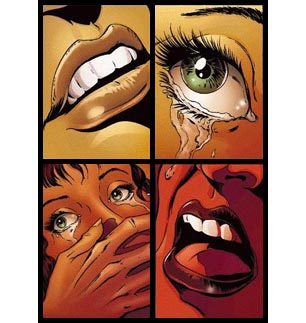

“Every organism has its place in nature. That of woman is at the foot of man,” Tarl Cabot thinks while training his slave girl in “Beasts of Gor.” “Beasts” is Book 12 in the venerable and controversial “Gor” series of 25 science fiction novels written by John Norman (the pseudonym of a philosophy professor at a respected university in New York). Beginning with the first book in the series, “Tarnsman of Gor” (1966), Norman has spun tales of the planet Gor, also known as “Counter-Earth” because it occupies a position in our solar system exactly opposite us on the other side of the sun. This shadow planet’s gravity is weaker than ours, which probably accounts for the preternatural perkiness of all the women’s breasts in the books’ illustrations.
In Gor’s violent, low-tech society, men are Men and women are slaves. This, the novels say — and say and say and say again — is the proper and rightful state of things because it is in consonance with the true evolved nature of the sexes. The basic Gorean culture is modeled on the ancient city-states of Greece and Asia Minor, but there are variants of other cultures, too, like the Mongols, the Vikings, the Inuit and various African tribes.
There are free women on Gor — treasured mothers, sisters, daughters and “Free Companions” to free men — but they generally sequester themselves with their children at home behind high walls. Their freedom, such as it is, is precarious. They are always subject to being kidnapped by a rival city-state’s raiders — or even outlaws of their own city — and forced into slavery.
This is not great literature, and even Norman’s most avid fans admit that the writing itself leaves a lot to be desired. The narrative tone is at times hilariously bombastic (think of the portentous voice-over in the movie version of “Conan the Barbarian”), and the story lines, especially in the later installments, are frequently interrupted by long passages of repetitious philosophical blather.
In spite of the books’ reputation as male-centric erotic literature, there are, surprisingly, no really explicit sexual passages, and several of the books are written from a female point of view, tracing the characters’ acceptance of the “paradox of the collar,” that is, the “inner liberation” women find in a life of utter obedience to a masterful man.
Whatever its narrative shortcomings, Norman’s politically incorrect world was once enormously popular. Hundreds of thousands of copies of his books were sold, and they were translated into several languages. Gradually, though, his work fell out of favor — some say it was spurned by gutless publishers and distributors in spite of audience demand — and it is largely out of print.
Yet today, despite the fact that most of the series is no longer available except in secondhand stores (the first six books were recently rereleased by erotica publisher Masquerade Press but met with retailer resistance), Gor has experienced a huge revival in the virtual world of online role-playing and, perhaps most surprising in this post-feminist era, also serves as the philosophical template for a self-styled community of “lifestyle Goreans,” who enthusiastically embrace and practice consensual female slavery in their everyday lives. The lifestyle Goreans also adhere to other rituals, codes and precepts of the fictional Gor, and community sites such as Silk and Steel and the Gorean Public Boards and individual offerings such as the Slave Siren’s Page serve as an important means of education, fellowship and recruitment to the lifestyle.
A major theme running through the Gor novels, and often echoed in Gor fandom, is that the free women secretly long to be owned by dominant and powerful men. “Slavery, of course, is the surest path by means of which a woman can discover her femininity,” the author observes in “Magicians of Gor.” “The paradox of the collar is the freedom which a woman experiences in at last finding herself, and becoming herself.”
On Gor, only the slave women completely indulge their sexuality; free women are supposed to maintain a chilly dignity. So if a free woman should make the error of behaving with less than Madonna-like circumspection (for example, by flirting too whorishly with a man), she has revealed her fundamental desire to submit to him — her “instinctive” wish to be mere chattel at the man’s mercy — and thus forfeits her right to remain free. She’s usually stripped of her face veils and slapped into chains forthwith.
There are also dramatic incidents in the books in which a free woman, overcome with lust for some heroic muscleman, throws off her robes, falls naked to her knees and begs the man to put his collar around her neck and his brand upon her thigh. “Own us, dominate us! Enslave us, properly, so that we may love you as women are meant to love, wholly and unreservedly, totally, without a thought for ourselves!” demands a female character in “Renegades of Gor.”
Even taking into consideration that many online role players use multiple names, there have to be thousands of virtual Goreans, and it is unusual for any fan base of that size to be left untapped in today’s cutthroat publishing industry. But Norman’s current publisher, Vision Entertainment Ltd., has faced an uphill slog the past few years in its attempt to bring the series back to the market. The small New York publisher plans to return six of Norman’s Gor novels to print and to publish a new Gor novel (“Witness of Gor”) by the author, and it has invested heavily in the creation of GOR Magazine, a serialized graphic novelization of Norman’s books — all with Norman’s approval and oversight.
Vision has run into a series of setbacks, however, culminating in a run-in with Canadian customs that scuttled plans to introduce the graphic novelization to the public via an excerpt in Heavy Metal magazine. Under Canadian customs law, according to Darrell Benvenuto at Vision Entertainment, “You can show a lady with her hands tied. You can show a naked lady. But you cannot show a naked lady with her hands tied — that’s ‘bondage,’ and is not allowed across the border.” In spite of these reversals, Benvenuto expects the hundreds of thousands of dollars that Vision has already sunk into Norman’s works to eventually pay off, and after looking at the phenomenon that is Gor fandom, I have little doubt that he’s right.
The Gor society on the Internet is in many ways a microcosm of society in general, complete with “religious” conflicts, “in” groups and “out” groups, wars and rumors of wars, hoaxes, celebrities, propaganda, changing fashions, romance, boredom and widespread emotional misadventure (arising from both virtual iniquity and actual crimes). The fights are mostly over matters of interpretation, definitions of terms, what a particular reference from the books means in context, whether free women should be allowed to drink in a tavern, whether “no kill zones” are legitimate, how much “respect” — if any — a master should show a slave and so on. People also fight over how much license should be allowed for the fact that they are not on Gor but on Earth, and not actually swinging swords on Gorean battlements but talking to one another over a computer network.
But the main schism within Gor fandom is between the role-playing Goreans and the tiny minority of real-time lifestyle Goreans, and it is a bitter split indeed.
“Bear,” a prolific poster on the Gorean Public Boards, has lived a Gorean lifestyle for almost 20 years. He is married to a “free companion” and has two female slaves. One of the slaves has lived with him and his wife for the past eight years. The other, his slave for about a year so far, is married to another man, and she and Bear are only occasionally able to see each other in real life (with the full knowledge and sanction of her husband).
Bear has “collared” and later dismissed other women, who have lasted, on average, about one to three years. A slave “fails” when she is unable to submit herself totally to a man’s control, when she rebels against her collar or wants release from her Master. (Failure is possible only on Earth, because on Gor slavery is not consensual, as it has to be here.)
Bear considers the Internet role players a threat to his way of life. “These people harm us by reputation — our philosophy comes from a series of SF books, we have a hard enough row to hoe here in our pursuit of simple regard and respect — without the kids taking the ethos and philosophy and turning it into a game, with rules for rolling dice to see if your slave is pregnant.”
“Ubar Luther,” the leader of a “city” of Gorean role players on America Online and author of the definitive Educational Scrolls of Delphius, says that the lifestylers’ antagonism toward role players is based on a fallacious argument: “The books were written as entertainment only. They were not written to be a lifestyle guide. So anything outside the books has the same validity. Role-playing and real-time are on the same level. Neither was intended. Real-time has no special claim on the books.” And, he says, “even the real-timers engage in some role-playing. They hang out in a ‘cyber’ tavern and get served ‘cyber’ food and drink. They often assume fictional nicknames.”
Luther’s idea that the lifestylers have made a “special claim” on the books is revealing. Among Goreans, conflicts about how to interpret and use what Bear reverently refers to as the “source texts” are rampant. There is a kind of continuous holy war going on over what constitutes Gorean orthodoxy and non-Gorean heresy, and not only between the lifestylers and the role players. Internecine conflict often breaks out within the lifestyler and role-playing communities, too.
In the online role-playing community there are literalists, traditionalists, liberals, sophists and the Gorean equivalents of dervishes, charismatics, voodooists and snake handlers. The virtual cities, taverns, camps, caves and castles are often at war with each other, and the excitement of these virtual “raids” can add to a slow night at the Web site. Contemptuous rhetoric flows freely in all directions, and the faithful are exhorted and admonished, chaffed, chivied, reprimanded — and regularly excommunicated from one sect, only to join another.
There are some common ritual requirements for most Gorean role-playing venues. Free women are supposed to be rare — their participation is even prohibited by some Goreans — but they are fairly common on most of the role-playing sites. Masters and Mistresses (free women with slaves) take names with capital letters, and slaves’ names are all in lowercase, followed by the initials of their Masters in “curly” brackets. Bear’s married slave, for example, would identify herself online as “tessa {B}.”
Some slaves also identify their “caste color,” or the color of the “silks” worn by each different kind of slave. Red is for the “pleasure slaves,” white for the “reserved” or “virgin” slaves, black for the most menial (and usually not sexually attractive) “kettle slaves” and so on. The brackets are referred to as the “collar,” or “ko’lar” in Gorean parlance, and the initials are the slave’s “tag.” Although not universal, it has become common for slaves to refer to themselves in the third person, avoiding all use of the words “I” and “me,” and to capitalize all pronouns that refer to Free Persons.
The majority of online interactions in role-playing Gorean chat rooms and IRC (Internet Relay Chat) channels have some sort of sexual or flirtatious subtext, although surprisingly little explicit cybersex occurs publicly in Gorean venues, unlike in many other straightforwardly prurient Internet hot spots. Most of the cyber “furring” occurs in private channels and via Instant Message. The Gorean virtual slaves usually portray themselves as childlike: young, giggly and gorgeous. And they spend great amounts of time detailing — in the flowery language of 19th century potboilers — their ritual “serves” of food and beverages, complete with lowered heads, trembling lips, wide and worshipful eyes and so on. I found that a dozen variations on “pert nipples tightening in the chill of the tavern coolery” were more than enough for me to get the idea. I started to tune them out and spent more time enjoying the less repetitious activity and interaction with the Free Persons.
One of the things that causes most of the doctrinal screaming and carrying on in the role-playing community is the laxness of narrative discipline. A great deal of OOC, or “out of character,” commentary — like references to real-life phone calls, the other screen names of a character or a dinner from Taco Bell — occurs in what is supposed to be, say, a Gorean desert oasis. Traditionalists object to things like slaves making disrespectful comments in their “thoughts.”
Then there are the more serious outrages against honor, like warriors pledging allegiance to more than one “Home Stone” (the Gor symbol of an independent community or tribe), slave girls begging collars from multiple Masters under different slave names and slaves who turn out to be men and Masters who turn out to be women.
To say that none of this matters because it is only a game in cyberspace is to misunderstand the nature and meaning of these interactions and relationships. While some people are blithe or cynical, most role players see the Gorean game as legitimate social interaction that can have real consequences for real people. It is at least as serious a matter to most of them as the arts and professional sports are for people who follow them. For many online Goreans, their “play” is a deeply meaningful enhancement to their real life, in which they try out different roles, experiment with their sexuality and test-drive a philosophy. It is also no accident that the vast majority of lifestyle Goreans started out as role players.
But IRC slavery and lifestyle slavery are definitely two different things, says “sura,” one of the real-life Gorean slaves whose Master, “Bill,” commanded her to speak to me via e-mail. “Obedience isn’t really all that hard,” she told me, but “surrender of one’s self is.”
No naive schoolgirl, sura had been in the military and was a police officer for 16 years. “Sometimes,” she says, speaking in the approved third-person form, “this girl felt that she took such work in hopes of driving out of her that which she sought, but could never find … peace and contentment at a man’s feet.” Married for more than 18 years, she raised four children and was the decision maker and major breadwinner in the partnership. That life, she says, left her “unfulfilled as a female, and dissatisfied as a human being.”
Virtually collared by her Master last year after being abandoned by another, she moved in with him and his other slave girls, “feli” and “ciosa,” about three weeks ago. The transition has been difficult for all of them: “Sura has been beaten more times than she cares to count, mostly for displeasing acts; her mouth, actions that belong to only free women, the fear of giving up everything.” She says she has also endured punishment because of conflicts and angers brought on by her reaction to the behavior of one of her “chain sisters.”
There is, sura says, little furniture in the Master’s house. His chair dominates the living area and the “girls” kneel on the floor. They sleep in a “kennel” with a slave mat, pillow, blanket and footlocker for the few possessions their Master lets them keep. The Master keeps them on a diet, which is the only food that sura is allowed to eat other than what he gives her out of his hand, a “gentle reminder,” sura says, “that our substance comes at his discretion.”
She says she fought her Master’s will at first, “kicking, hitting and screaming,” and she still fights, “but she grows weaker. The teachings of her youth, an emasculated world, cause her to fight and give her what little strength she still has to continue to fight, but in the end he will win, and she will be conquered, turned into nothing more than a helpless, whimpering pet.”
The experience of helplessness is apparently a crucial part of what sura is seeking from her Master. “When he took both of this one’s wrists in his one hand, this one knew she had been captured, held captive by a man; she was his, now and forever.” And the sexual conquest was a major turning point: “It took this one about 11 days in Master’s house before she would submit her body to him, beg for his touch and his use. The day this one begged for her rape is one of the happiest of this girl’s life.” Summing up how she feels about her new life, she says: “The answer is simple: when he breathes, I breathe; as his heart beats, my heart beats; my sole purpose is to please him; and when he dies, so too shall I.”
Sura’s Master, Bill, says that he was drawn into the lifestyle by a former girlfriend, who wanted him to make her his slave. “I started attending a Gorean discussion group that was an offshoot of the local [bondage and discipline and sadomasochism, or BDSM] scene,” he says. The group was “tightly focused on the intensity of the Master/slave relationship described in the Gor series, and had as its purpose the exploration of that relationship to see if it was viable. At first, I was pretty skeptical about the idea that women could be contented and fulfilled at a man’s feet, but I liked the girl a lot, so I was willing to give it a try.”
Fourteen years later he has three slaves, all of whom have some college education. “Everything that I have experienced in the intervening years has led me to believe that what [Norman] said is true of a great many women. I have seen, again and again, intelligent, strong-willed women grow happier, more beautiful, less stressed and more contented when made the slaves of men.”
There is little question that BDSM scenarios have enormous erotic appeal for many men and women, heterosexual and homosexual alike, so it is not surprising that a fantasy series like Gor would have an enthusiastic following. Goreans take the very popularity of these fantasies, and the power the narrative has to make a willing lifestyle captive of women like sura, as proof of one of their central beliefs: that men and women have been programmed by evolutionary history to be, respectively, naturally dominant and naturally submissive and that people can be truly happy only when they live in accordance with their biological instincts to be either a Master or a slave.
The Gorean Argument, something of a definitive statement by “Marcus of Ar,” a major contributor to the Silk and Steel site, says that “the process of evolution has naturally selected for strong, competitive males, and females who were both desirable to such men, and who were in turn attracted to such men.” This is a familiar simplification of some currently popular theories in evolutionary psychology, and it has a ring of truth to it, although those most disposed to salivate at that bell are the ones most flattered by it — namely, strong, competitive men. Even science has its seductive narratives.
Marcus goes on to elaborate his understanding of human evolution: “Weak males would not survive the competitive selection process to reproduce. Females who were not attractive and responsive to strong men would not be selected to reproduce. Therefore, nature being what it is, the non-competitive and unattractive geneaological [sic] lines would fade away and the strong and attractive lines would continue to survive.”
There’s only one little problem with this idea: Weak males and unattractive females obviously did survive to reproduce; otherwise most of the men in the world today would be George Clooney and most of the women would be Jennifer Lopez (with better clothes). The reason that “mediocre,” “ugly” and “wimpy” genes are still around and being expressed in the human population — and in quantities far greater than Clooney and Lopez genes — is not, as Marcus later goes on to charge, because the moral constraints of civilization interrupted the marvelous process of winnowing the race toward perfection. It is because human sexual activity and reproductive strategies have always been amazingly elastic and complicated. Even at the dawn of time, it probably wasn’t just a matter of bigger and stronger cave men whacking lesser men and dragging their women home by the hair. Female choice and female resistance to sexual control (even if it had to be by means of subterfuge and secrecy) have always played a huge role.
“Males who were unsuited to combat would not live long,” Marcus says. “Females who refused to breed with the combative males would not do so, and would not propagate the species.”
The scientific and logical errors in this statement are manifold: It assumes that combat was a constant and crucial fact of early human evolution, that if women refused one kind of man they would not mate with others, that the only way for a man to live a long life was to fight with other men, that combat was the sole means of reproductive competition and that submission to her mate’s physical dominance was the female’s only means of reproductive success. All these ideas are just plain wrong.
Brian Ferguson, professor of anthropology at Rutgers University, says the popular idea that our distant past was a sanguinary “war of all against all” is a “fable.” Archaeological evidence tells us that deaths by interpersonal violence, especially violent deaths from organized intentional mayhem — war — seem to have been far more rare in prehistory than they became later. He cites the case of Japan in particular: “Evidence of violent death goes from .002 percent of approximately 5,000 skeletons from hunter-gatherer times to 10 percent of all deaths in the subsequent agricultural period.”
Aggressive domination of man over man, or man over woman, was also not the sole basis of reproductive competition or any guarantee of reproductive success. In fact, being too combative and aggressive could reduce reproductive success, because combat and killing are inherently risky propositions. Not only would warriors get killed themselves, their violent ways made it more likely that they and their women and children would be targeted for retaliation later on. Meanwhile, back at the hearth, chances are the wimps would be having it on with all the widows. Bearing out this scenario are some recent studies of the primitive Yanomamo tribe in South America, showing that war leaders are likely to leave behind fewer surviving children than other men.
Furthermore, women’s reproductive priorities have always demanded that they mate with men who would be less likely to indulge in domestic violence against their mates and their children, and who could be counted on to stick around and provide child-rearing help and sustenance at the hearth, instead of running off to kill the guys in the next valley and bring home a new girlfriend as booty.
So while violence and conquest certainly played some role in human evolution, so did cooperation and conciliation, and — contradicting the macho, individualistic romanticism espoused by some evolutionary psychologists today — peaceful men probably bequeathed just as many, if not more, survivors to history as the warlike ones did. In any case, both kinds of traits were selectively valuable in different circumstances, and in both men and women. (Goreans seem to want us to believe that girls inherit only their mothers’ genes and boys inherit only their fathers’.) In short, most evolutionary psychologists agree that it is the flexibility and diversity of human reproductive strategies and choices that have made the human animal so successful and that also account for the wild mix of human types we see around us today — few of them conforming to the Gorean ideal.
So where does the sexual appeal of the dominance and submission scenario come from? “Why,” Marcus of Ar asks, “do women find themselves attracted, on a biological level, to the ‘rebel’ or the ‘bad boy,’ the male who indicates through his actions that he is strong enough to make his own rules? Why are men attracted to females who seem willing to obey their every wish or fantasy?” He is in essence asking why the Gor books are popular, why the online role-playing of Gorean scenarios has skyrocketed and why some people are even making attempts to create Gorean lifestyles based on the philosophy that female slavery is natural and right.
There seem to be as many guesses about this as there are experts, but in essence the theories come down to two: 1) the “lizard brain” erotic theory, which says that the older part of our brains, below the cerebral cortex, makes significant physiological connections among sex, fear and aggression, which are then picked up and elaborated by the conscious mind, and 2) the “control” theory, which basically argues that our fantasies always center around getting what we don’t have and controlling what we can’t control. The answer probably lies in a combination of the two.
The problem for the Goreans in the lizard brain theory is that the coupling of sexual feeling with anger, pain and aggression does not break out strictly along heterosexual or gender lines. There is statistical correlation — humps in the curve on either side of the gender line — but there is also considerable overlap. If there weren’t, we wouldn’t see male submissives and female dominatrixes in the BDSM community or the gay and lesbian versions in the “leather” life, in which the dominant partner of each pair is the same sex as the submissive. We also wouldn’t see individuals “switching” back and forth between the roles, as some do in both heterosexual and homosexual relationships.
Determinism according to gender is hard to sustain in view of these facts, but “Julian of London,” a chillingly smooth and plausible charmer and one of the slickest Gorean apologists I encountered, has another explanation for these cross-gender “aberrations” from our supposed instincts. He says that modern society and its incorrect ideas have contaminated us and ruined our deep biological responses. “I personally suspect that in a more natural society, the vast majority of men would have the strength and integrity to trigger the submission instinct in women,” he says. For him, a more natural society would be Gorean, in that it would “allow men to be strong” and to use their strength to conquer women.
And yes, he means men should be allowed to use their muscle in addition to employing mental and emotional methods of dominance, even to the extent of kidnapping, “training” and forcing sex, as happens frequently in the Gor novels. Asking for consent from a woman is exactly the wrong approach, Julian says. “For her to fire up, the woman would have to 1) see the man being strong-willed, big-hearted, etc., and 2) be ‘taken’ rather than begged by the man. This is what it means to be ‘swept off your feet.'”
While Julian still agrees with the basic premises underlying serious Goreans’ lifestyle, he is coming to have significant differences with their implementation. The current community of real-life Goreans, he maintains, not only are indulging in “too many dumb-ass sci-fi customs” but are “technophobic,” and their “dogma” is too “hardheaded.” In a sharp exchange with Bear and other Masters on the Gorean Public Boards, Julian also disputed, on theoretical grounds, the very foundation of the Gorean lifestyle as it is being lived: the consensual nature of the slavery entered into by women like sura.
Julian thinks that many Gorean men are eliciting that consent not so much by means of their “personal magnetism” or the proper use of masculine force but by mere reliance on the “rules” of the Gorean game. But most important, he considers the whole notion of female consent bogus and anti-Gorean. “If women respond the most to the Master who takes them without even showing the weakness of begging permission, then why should I, who know myself to be such a man, ask their consent? That is why I’ve said I am leaning against consent as an ideal.”
Julian’s fantasy is that he would be able to make a woman surrender to him totally if he were somehow able to “get away with” kidnapping and “training” her to please him. Right now, though, he not only doesn’t have a good prospect in mind but doesn’t have the time, the financial wherewithal or a secure place to “store” the woman — not to mention that he wouldn’t want to go to jail if things didn’t work out as he expected.
After I picked up my jaw from the desktop, Julian’s perfectly rational discussion of the reasons why he wouldn’t be out collecting women in his butterfly net next week reminded me that by far the most common hypothesis about the appeal of the Gorean fantasy is that it is a direct reaction to social needs and psychological problems, both communal and individual. Julian himself alluded to this when he said that part of his dilemma in implementing his plan and demonstrating his “integrity and will” to his kidnappee would be that “in our society, the man has to work past the automatic assumption that kidnappers and rapists are pitiable dweebs at heart.”
Tim Perper, a biologist who has studied human courtship for two decades, notes that “if some men fantasize that sexy women exist for male sexual pleasure, it is because such men want — but do not have — female sexual slaves.” Perper also points out the paradoxical nature of many women’s submission fantasies, which, he says, “operate as masturbatory consolation.” In a woman’s fantasies of being dominated, she is directing the action. Her “Master” does everything that she wants, and does it according to the imaginative specifications of her desires. Again, inside our heads (or in the pages of our fictions), we are always in charge. The reason most women would not like such things to happen in real life is that the essential condition of control would be gone.
Marcus of Ar says that “our fantasies are a barometer whereby we can measure what we desire, and what we feel we are lacking.” Historian G. R. Foote draws parallels with other fictional worlds that have caught our imaginations: “I wonder what would have blossomed on the Internet if it had been around at the time of Ayn Rand or “Stranger in a Strange Land” — both of which offered powerful and coherent ‘alternate universes’ … When I was a teenager I was fascinated by Rand, the simplicity and certitude of her worldview.”
Simplicity and certitude seem to be particularly important needs for many people, especially in a society in the midst of cultural upheaval. A simple organizing principle like biological determinism or theological creationism can offer enormous comfort and sustenance to people struggling with personal dissatisfactions or intimate failures, or who are frustrated by the insignificance they have in the power structure of their society.
In researching the “character” profiles of many role-playing men, I was struck by the fact that, besides descriptions of their great height, rippling muscles and impressive physical prowess, many of them referred to romantic betrayals, the perfidy of a woman in their character’s past or the general untrustworthiness of the female gender. To a man who has experienced romantic rejection, manipulation or treachery, a slave woman who would never leave him and would be utterly obedient to his every whim — and, especially, who would even enjoy being obedient — would have particular appeal.
A universal complaint from Gorean men is that today’s society is crippling or damaging their manhood, that they are not allowed to express the full flower of their masculinity. (“I wondered if a man could be a man without a slave,” one Norman character muses.) Contemporary customs and civilization are all at fault in the stifling and destruction of modern men, Gorean men say, but most culpable is the feminist agenda. When men feel this way, the appeal of the unbridled “hypermasculinity” portrayed in the Gor novels is not hard to understand.
Elaborate attempts at re-creating the fictional world of Gor, even in role-playing, give men the relief of action, a feeling of “doing something” about their masculine distress. And the imaginary hostilities and real arguments about who is doing this most “properly” provide an outlet for the anger and frustrations they experience in the larger reality. Online Gorean life offers an arena in which men can compete for leadership and dominance of the subculture. The Internet Gorean community gives them an opportunity to win, to conquer enemies, to control women and to influence a society. What’s not to like?
Women, on the other hand, seem to have more complex reasons for embracing Goreanism, says Fern Maiden, a role-playing Gorean. “For some,” she says, “I think they simply have extraordinarily submissive and nurturing natures.” Whether submissiveness is innate or socialized, it would be foolish to pretend that human behavior and psychological needs do not extend into the extremes. What Goreans claim is true of most women probably is true of some.
And dissatisfaction with the culture’s demands and gender constraints is not just confined to men, either. Feminist backlash rhetoric also plays to women. Many women dislike the pressure that they think feminism has imposed on them to be cold, decisive and independent, and are thus seeking a form of relief from that perceived pressure. The embrace of Gorean slavery is just the most extreme variety of this reaction.
In “Mercenaries of Gor,” one character, watching a female slave dance, pities female earthlings:
I then felt a sudden, poignant sorrow for the women of Earth. How different Fequia was from them. How far removed delicious, exquisite Fequia was from the motivated artifices, the lies and fabrications, the propaganda, the demeaning, sterile, unsatisfying, reductive, negative superficialities of antibiological roles, the prescriptions of an unnatural and pathological politics, the manipulative instrumentations of monsters and freaks. I wondered how many women of Earth wished they might find themselves in a collar, dancing naked in the firelight before warriors in an Alar camp.
Fern thinks the attraction may lie in an even simpler human — and not solely feminine — wish to adopt infantilism to avoid the rigors of responsibility: “They wish to avoid having to make decisions for themselves and want someone else to deal with all life’s difficulties,” she says of Gorean slaves. This seems like an especially resonant explanation for women like sura, who utterly reject their own former strength and self-sufficiency because they have always been unhappy with the hard necessities they experienced in taking care of themselves. Many psychologists would say that the completeness of the rejection or repudiation of former personal truths is in direct proportion to the depth of the unhappiness a person felt trying to live with them.
While many women can see the basic appeal of the “dominant male” Gor scenario, some experts think the appeal has more to do with the fact that strong, intelligent women need to be able to respect their partners and less with the fact that they may find female subjugation or groveling a delicious erotic prospect. Few women respect bullies or the swaggering jerks so commonly associated with the myth of machismo. Virtually everyone I talked to, men and women, could understand the value of the domination-submission kink in a couple’s erotic life. But the consensus, in consonance with Julian’s realization about this society’s understanding of rapists, was that men who need total control outside the bedroom in order to feel “manly” are pathetic or laughable.
I wonder where the challenges and entertainment are in a relationship based on such a static power structure. Once you’ve conquered the woman and bent her utterly to your will, where’s the fun? Still, it’s true that many of us do find a genuinely strong and confident man appealing. “I do too,” Fern says, “but it’s not because I’m submissive — it’s because I’m not submissive. Weak men bore me.”
