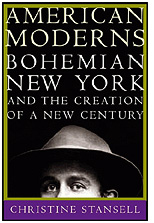
“American Moderns: Bohemian New York and the Creation of a New Century” by Christine Stansell
Tuning in, turning on and dropping out -- in the 1890s.
By Virginia HeffernanTopics: David Brooks, Books, Entertainment News
Pity the lapsed bohemian, wanted for so many crimes. Duplicity! Greed! Selling out!
In his new book, “Bobos in Paradise,” author David Brooks breaks out a coinage — Bobo, where “BOhemian” meets “BOurgeois” — to argue that America’s ruling class is now made up of defiant ’60s idealists grown older, richer and less radical. His book’s a scold: The Bobos, according to Brooks, have built their lives on opportunism, compromises and ideological legerdemain.
To parry this charge requires another big book about bygone bohemia, this one set 100 years ago: Christine Stansell’s “American Moderns: Bohemian New York and the Creation of a New Century.” Stansell rescues the notion of bohemia from its would-be debunkers, those skeptics who have, for half a century, found implausible the notion of a place whose residents live artfully and on principle. But she does so without seeming to be on a crusade: Stansell, a feminist historian at Princeton, writes narrative history, not polemic.
She acknowledges instances of hypocrisy among the footloose and the ragtag, but she also argues persuasively that bohemian life has always been a step toward the middle class. “Bohemia’s self-designated types always existed in symbiotic relation to bourgeois culture rather than in opposition to it,” as she puts it. “While bohemias signaled dissent from the profiteering of the cultural marketplace, they also provided their affiliates the means to parlay that dissent into successful careers.” Stansell’s comfort with this paradox of bohemian culture — a paradox that, year after year, makes both left- and right-wing pundits’ blood boil — might even incite readers to wonder why the bohemian fantasy regularly invites so much sadistic dissection.
Rolling out her subject in miniprofiles of picturesque artists and radicals (Emma Goldman, John Reed, Neith Boyce, Mabel Dodge, Floyd Dell), Stansell evokes the scene that sprang up in downtown New York when 19th century immigrants attempted to construct, episodically and haphazardly, a Paris-style cafe culture. At the time, alcohol was clubby, remote and expensive; coffee and tea were more democratic, and the displaced Europeans who initially gathered at the coffeehouses were eclectic, unaffiliated and largely down at heel.
Soon, students, journalists, organizers and socialites showed up — for politics or art, for reasons good and evil — to inspect the foreigners. These interlopers scoffed at 19th century squeamishness about class mixing. With their growing passion for urban “contact” (a shibboleth in Walt Whitman’s populist poetry, which they read avidly), they saw slumming as redemption rather than corruption.
Discussions of free love, feminism, abstract painting, naturalism in fiction, trade unionism and radical politics flourished among the caffeinated polyglots. The years between 1890 and 1919 thus saw the evolution of Greenwich Village. Its cafes, salons, private homes and clubs provided a social infrastructure for women looking to delay or renounce marriage and men looking to delay or renounce making a living.
Not every New Yorker got to savor the spiciness of life downtown. In spite of bohemia’s claims of inclusiveness, Stansell shows, women and African-Americans often couldn’t transcend mascot status. She’s less forthcoming, however, on bohemia’s other contradictions. The ad hoc alliance between collectivist politics and individualist art, between union organizers and free-loving art-world nudists, represents an unlikely coupling that some — Richard Rorty comes to mind — have blamed for leaving a schizo legacy for the American left. Can you lavishly express yourself and, at the same time, march in unison with a political movement? Stansell spends little time on this crucial question; art and politics are, to her, simply alternative modes of expression available to hearty souls.
In its many redemption fables, “American Moderns” occasionally strikes a note of jubilation, leaving no doubt that Stansell, whose last book, “City of Women,” was about antebellum New York, is an “I love NY” historian. If you love New York too, the satisfactions of this book may resemble self-satisfactions. Even if you don’t, vicariously snubbing the Victorians is always enjoyable. In Stansell’s telling, America’s first bohemia was a splendid and efficient racket: It kept its adherents hopeful in straitened circumstances, made their lives feel significant and ultimately made bourgeois citizens out of them.
Virginia Heffernan is an editor at Talk magazine. More Virginia Heffernan.
Related Stories
More Related Stories
-
New York's most persecuted subway artist?
-
James Franco: "I really felt I was in conversation with Faulkner"
-
"Jodorowsky's Dune": The sci-fi classic that never was
-
First look: A Chinese art-house director goes for blood
-
Pollution as ancient Chinese art
-
Chimp's blurry pictures to fetch six figures at auction
-
Alex Gibney: Julian Assange has become like "those he despises"
-
Can playing Dots on your iPhone make you smarter?
-
Must do's: What we like this week
-
First look: An Iranian director takes on Western morality
-
JJ Grey: I can't watch the news!
-
Stop comparing everything to "Girls"!
-
Beyoncé reportedly pregnant with second baby
-
Krist Novoselic: My plan to fix Congress, curb obstruction
-
Amy Poehler: I have no idea what makes a great comedy
-
Justin Bieber has less than 12 hours to save his monkey
-
Benedict Cumberbatch: I would marry Spock
-
First look: Sofia Coppola's chilly, brilliant "Bling Ring"
-
Must-see morning clip: George Packer on the decline of American institutions
-
"Parks and Recreation" star Jim O'Heir shops at A&F
-
"The Office's" sugar-coated finale
Featured Slide Shows
The week in 10 pics
close X- Share on Twitter
- Share on Facebook
- Thumbnails
- Fullscreen
- 1 of 11
- Previous
- Next
-
Lisa Montgomery embraces her nephew Thursday after a tornado tore apart her home in Cleburne, Texas. The twister killed six people and destroyed entire swaths of the North Texas town.
Credit: AP/LM Otero -
Jack McMahon, the defense attorney for abortion doctor Kermit Gosnell, speaks outside the Criminal Justice Center in Philadelphia Tuesday. His client was convicted of killing three babies in his clinic, and will serve multiple life sentences.
Credit: AP/Matt Rourke -
A photo taken Monday captures Vice President Joe Biden's response to a Milwaukee second-grader's innovative proposal to end America's epidemic of gun violence. This guy!
Credit: AP/Jenny Aicher -
Sen. Rand Paul, R-Ky., flanked by a grouper-eyed Michele Bachmann, addresses the IRS' admission that it targeted Tea Party groups in advance of the 2012 election. In an op-ed for CNN Thursday, the Kentucky senator slammed the president for his faux outrage.
Credit: AP/Molly Riley -
Ousted IRS chief Steven Miller is sworn in on Capitol Hill Friday. Miller testified before the House Ways and Means Committee on the extra scrutiny the agency gave conservative groups applying for tax-exempt status.
Credit: AP/J. Scott Applewhite -
Attorney General Eric Holder pauses as he testifies on Capitol Hill before the House Judiciary Committee Wednesday. Holder is under fire, among other things, for the Justice Department's gathering of phone records at the Associated Press.
Credit: AP/Carolyn Kaster -
O.J. Simpson sits during an evidentiary hearing at Clark County District Court in Las Vegas, Nev., Thursday. Simpson, who is currently serving a nine-to-33-year sentence in state prison for armed robbery and kidnapping, is using a writ of habeas corpus to seek a new trial.
Credit: AP/Las Vegas Review-Journal/Jeff Scheid -
Major Tom to ground control: On Sunday astronaut Chris Hadfield recorded the first music video from space, a cover of David Bowie's "Space Oddity."
Credit: AP/NASA/Chris Hadfield -
When it rains it pours. President Barack Obama speaks during a news conference Thursday with Turkish Prime Minister Recep Tayyip Erdogan, inexplicably inspiring an #umbrellagate Twitter meme.
Credit: AP/Jacquelyn Martin -
A smoke plume rises high above a road block at the intersection of County A and Ross Road east of Solon Springs, Wis., Tuesday. No injuries were reported, but the the wildfire caused evacuations across northwestern Wisconsin.
Credit: AP/The Duluth News-Tribune/Clint Austin -
Recent Slide Shows
-
The week in 10 pics
-
The week in 10 pics
-
Mobile Entertainment: 9 Amazing Drive-In Movie Theaters Still Standing
-
The week in 10 pics
-
- Share on Twitter
- Share on Facebook
- Thumbnails
- Fullscreen
- 1 of 11
- Previous
- Next
-
The week in 10 pics
-
Mobile Entertainment: 9 Amazing Drive-In Movie Theaters Still Standing
-
The week in 10 pics
-
The week in 10 pics
-
The week in 10 pics
-
The week in 10 pics
-
Netflix's April Fools' Day categories
-
The week in 10 pics
-
The week in 10 pics
-
The week in 10 pics
-
The week in 10 pics
-
The week in 10 pics
-
Slideshow: Nerd Obama
Related Videos
Most Read
-
Revenge, ego and the corruption of Wikipedia
Andrew Leonard
-
Obstruction will ruin GOP
Jonathan Bernstein
-
Jaron Lanier: The Internet destroyed the middle class
Scott Timberg
-
Is Reddit censoring openly racist users?
Fidel Martinez, The Daily Dot
-
The man behind Abercrombie & Fitch
Benoit Denizet-Lewis
-
We're living in an Ayn Rand economy
Paul Buchheit, AlterNet
-
My "truly remarkable" cancer breakthrough
Mary Elizabeth Williams
-
When the IRS targeted liberals
Alex Seitz-Wald
-
Krist Novoselic: My plan to fix Congress, curb obstruction
Krist Novoselic
-
Will you marry me -- once you're done peeing?
Tracy Clark-Flory
Popular on Reddit
links from salon.com

59 points60 points61 points | 3 comments


Comments
0 Comments