
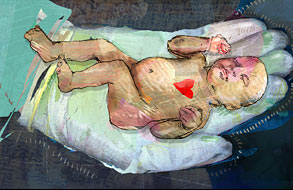

Rachel came to our E.R. one afternoon shortly before Christmas. She had been found by a friend who came to visit her — suspended by a rope around her neck.
The chart in my hand conjured up vivid images even before I entered her room. A portrait that pretty much matched her reality: not particularly pretty, her skin pallid, pasty; long, full, frizzled brown hair, indifferently gathered by a dark scrunchy. She wore dark grunge-style clothes: dark plaid shirt and jeans, a choker and metallic bangles. Couple of earrings, but not excessively pierced or tattooed. Uncommunicative. Vacant eyes. She told me too little for me to properly judge if she was inarticulate or merely silent.
It didn’t much matter, thanks to a single word on the chart: Kaiser.
Nowhere have the ravages of bottom-line scrutiny of modern medical practices so thoroughly gutted the ability to provide care for patients than psychiatry. It is akin to post-AIDS Africa: direly afflicted, worse with each acid day. And if a single story can portray a ruinous state of psychiatry today, perhaps it is the story of Rachel (not her real name) because she received routine-or-better care.
Not only did she have insurance, but hers was the only easy one to work. Kaiser provides (relatively) ample psych benefits and I wouldn’t have to grovel, beg or lie in order to get her a bed somewhere. The most time-consuming task an E.R. doctor performs, in proportion to tangible benefit to the patient, is arranging for a psychiatric admission with an insurer. There is no extreme to which these voices on the phone will not try to push us to deny an admission. A fellow E.R. doc recalls being asked if he — the E.R. doc — had gone to the house to determine if his patient actually owned the gun with which he was threatening to commit suicide.
The benefits provided by insurance companies for mental illness are starvation rations. Reimbursement to providers for face-to-face services have been cut in half over the past 10 years. Dr. John Iglehart in the New England Journal of Medicine described typical benefits as consisting of “a maximum of 20 outpatient visits and 30 hospital days each year.” They make Scrooge look like Raoul Wallenberg. With Kaiser Permanente, at least, getting through the door was far less of a Kafkaesque nightmare. They have beds and psychiatrists and are generally willing to marry them to the patient.
The E.R. is the current front line of psychiatric care. For the suicidal, the homicidal, the terrorized-by-voices, we have become the “de facto dumping ground,” says the chairman of psychiatry at Inova Fairfax Hospital, Dr. Thomas Wise. A poor choice. A physical ailment can be readily summarized and packaged, without fear of shame or indignity, in the space of a few short questions and answers. At least enough to move a patient through an immediate crisis and into decisions regarding treatment and hospitalization. This we do well. Psychiatric illness, a disorder of mind and emotion, is also a malady with varying rates of therapeutic success, just like heart or liver disease. And we train, minimally, for these emergencies, too.
But the true pathologies are buried and layered beneath deceptions, embarrassment, anger. It can take hours to establish the true degree and nature of illness. Scratching the surface of a problem, an E.R. doctor’s true specialty, in a psych patient only reveals another level of constructs to keep out strangers. When we’re the ones to whom these patients are sent, everyone suffers.
Rachel was alone when I met her. Her friend had been exiled to the waiting room, as no visitors were allowed to accompany the patient until a doctor examined her. The girl’s parents had not yet arrived and, since Rachel was 18, they were not automatically needed. The busy triage nurse and registrar would have ordinarily thought to call them but, this being the midst of a Christmas rush, other patients clamored for attention. So Rachel remained alone.
I spent a few perfunctory minutes with her; a half-hearted attempt to understand her misery, the ghoulish and lethal choice of a rope. Teenagers usually gobble down pills or slash wrists. A hanging attempt is rare. It speaks to a finality of purpose. If not for the friend, I could just as easily have been examining her in a body bag. It spooked me. Rachel’s were the deadest eyes I’d ever seen in a living person. They lacked self-reflection, doubt, any second guessing. I moved on to the other part of my job: assessing physical injury. Then I got the hell out.
I called the Kaiser line, got a psychiatrist, got assent for a hospital bed, and then I went back to Rachel to let her know she’d be admitted. A nod in acknowledgment. I never saw the friend, and Rachel never asked for her. In short, I did my job and I have nothing to be ashamed of. My other patients also had pressing needs: narcotics for broken bones, CAT scans to rule out appendicitis, an examination for a pregnant girl with vaginal bleeding. All had a legitimate claim to my time and attention. I went the extra step for Rachel and asked a social worker to step in and talk to her. Having been of little therapeutic assistance to a person facing the blackest of despairs, the least I could do was send her someone who might have time to listen to her or, at the very minimum, hold her hand and offer some company. The milk of human kindness.
There is, frankly, a dirty lie in that last paragraph. I didn’t do my job, I did the psychiatrist’s job. Sorry, another lie: I pretended to do the shrink’s job. Because pretending is all I’m really qualified to do. Insurance companies would no more pay for an anesthesiologist to perform cardiac surgery than they would if a cardiac surgeon performed anesthesia, yet an E.R. doc is deemed appropriate to perform a detailed psychiatric assessment.
As psychiatrist Dr. Karen Pratt points out, as a psychiatric patient “you want someone to listen long enough to diagnose you, to elicit specific signs and symptoms and decide on the right course of treatment. This can mean hearing almost your whole life story.”
But that scenario — a mentally ill patient in crisis meeting with a psychiatrist who has the time to listen — is woefully rare. Patients in need of immediate psychiatric assistance who are lucky enough to have insurance first call the toll-free number on their card, where they will almost universally be instructed to go to the nearest E.R.
When confronted by these poor souls stumbling into my hospital, I have phoned these toll-free numbers again trying to track down the source of this advice. This has yielded a general response that the plan cannot possibly know all the resources available in every city they cover; therefore, they cannot direct a patient to any one specific emergency psychiatric facility. Contractually, however, knowing the resources offered by their own plan is exactly their responsibility. This is met by more vague huffing and waffling including, “I don’t make the rules,” “You’d have to speak to someone higher than me” and “It’s simply a recommendation.”
Thus psych scares me more than any other field of medicine. No one cares. Period. State and county mental hospitals have shut their doors, and the beds have disappeared. In 1984, there were about 130,000 psychiatric beds in state and county hospitals in the United States; that dropped to fewer than 80,000 10 years later. Private psych hospitals have picked up some of the slack. These increased from 20,000 beds to 40,000 over the same time period. They are businesses first and foremost, however, and have profiteered on the misery of their patients. The country’s biggest network of private, for-profit psychiatric hospitals, Charter Behavioral Health Systems, declared bankruptcy this year amid the glare of an ugly “60 Minutes II” piece and allegations of neglect and fraudulent practices. Some help.
According to the National Center for Health Statistics, outpatient visits have risen steadily during the 1980s, both in absolute numbers and as a proportion of the whole population. So does this mean that hospital beds have been disappearing because we no longer need them? That’s dubious. When other diseases experience a rise in cases, hospitalizations rise as well. Something funny is going on if more psychiatric ill-health occurs in the face of fewer hospitalizations. Fifteen years ago, it was not uncommon to have patients hospitalized for months as a time as the worst of the storm burned through their psyches.
“But no one gets away with that anymore,” says Pratt, who practices in South Carolina. Nowadays a patient needs to be demonstrably dangerous — homicidal or suicidal — to gain access to precious inpatient services.
So E.R. doctors like me end up taking care of the Rachels of the world. But the E.R. is not the only place where mental illness is treated by non-psychiatrists. Dr. Ronald Manderscheid, a senior analyst at the Substance Abuse and Mental Health Services Administration (SAMHSA, part of the Department of Health), has spent much of his career tracking how mental health services are provided.
“It’s happening,” he said of this tilt toward primary-care physicians providing psychiatric care, “but I don’t have the numbers.” Why this lack of hard information? Because clinical practice guidelines, report cards or even outcome measures cannot mutually be agreed upon between practitioners and payers. “Hence,” says Manderscheid, “the field cannot dialogue or negotiate effectively with payers, for whom price is a primary, if not the only, consideration.” In other words, no one knows just how badly the state of psychiatric care has deteriorated in the name of cost-effectiveness.
With the state of psychiatric care in such disarray, is it any wonder that fewer young doctors are entering the field? There are roughly 1,000 positions open each year for residency training in psychiatry, compared to eight times that number each year for internists, and three times that number each for surgeons and pediatricians. Fewer than 500 medical students applied for these slots.
Why? Well, why would someone want to be a psychiatrist? The salary is the lowest in all of medicine after hovering around second or third lowest –after pediatrics and family practice — for years. In 1996 psychiatrists captured rock bottom. The handcuffs on clinical practice are tightest. A psychologist or psychiatric social worker has as much freedom to make clinical decisions and probably fewer work hours, not to mention the years shorter training to become a practitioner. Any takers?
The disappearance of dollars from the mental health care picture is as central as, say, severed heads are in Picasso’s “Guernica.” Insurance companies have usually allocated 3 to 5 percent of their gross expenditures on mental health services, despite the fact that nationally such services account for closer to 10 percent of all health care costs.
How do insurance companies get away with it? Maybe it’s because unlike so many other expensive, long-lasting diseases — breast cancer, Parkinson’s, heart disease — the mentally ill have no one with power to lobby for them. Sure, depression and manic depression have had their contingent of middle-class poster children, but often those who suffer from serious mental illness fall into a downward spiral in which they lose contact with those who might help them.
Schizophrenics descend toward the bottom of the socio-economic heap, no matter how high up they started. The symptoms of illness prohibit economic stability: A seriously depressed or agitated person who disrupts meetings, yells at colleagues or fears or stalks customers is not tolerated. A person suffering a heart condition, by contrast, is quietly, gently supported back into her full-time commitments. Nor would an insurance payer cut such a person loose after a single month of illness. But those with mental and emotional disorders quickly lose their financial foothold in society and never fully regain it.
For most doctors and patients, the one bright spot in psychiatric care is the brave new world of psycho-pharmacology. Dr. Rex Cowdry, medical director at the National Association for Mental Illness, describes the new-generation medications like Zoloft and Resperidol as remarkably easy for a primary-care practitioner to use. Safer and more effective, they generally lack the horrific side effects of some of the older drugs such as Navane, Thorazine or Elavil. Antidepressants, in particular, in overdoses could produce seizures or fatal arrhythmias. In other words, you could easily kill yourself with the medication the doctor had just prescribed to rid you of your suicidal tendencies.
With the new drugs, the ethical and therapeutic dilemmas are greatly reduced. The popularity of drugs like Prozac has destigmatized mental illness and allowed patients to more freely confess symptoms to their primary doctor. This saves the referral to a psychiatrist for those times when conditions deteriorate. According to Pratt, the dollars spent on Zoloft may obviate the need for hundreds or thousands of dollars spent on inpatient care: “Studies have shown this,” says Pratt. “Patients on the newer meds need fewer hospital days.”
But progress will be slow. Getting a new drug through the marathon of R&D, clinical trials and FDA review can take as much as a decade. While new drugs do help and have offset some of the damage done by dismantling the infrastructure, they cannot work miracles: They don’t take the place of a structured, inpatient bed for a suicidal teen or a violent old man.
For at least a century, we have maintained scrupulous records of infant mortality rates. A down tick in the infant death rate is — rightly –heralded as a grand achievement of any number of public health measures. A society that can protect its most defenseless creatures is a strong, prospering society.
Has the death rate among psychiatric patients gone the way of infant deaths? Are patients in the grip of acute psychoses (or depression, agitation or mania) being cared for less and less by psychiatrists and more by non-specialists? Once again, no one knows. Why? There is no mortality rate for psychiatric illness.
The National Center for Health Statistics charts health in the United States in so many ways the mind reels. It can tell you that the percentage of impoverished Mexican children with untreated cavities has doubled in the past 20 years. But it can’t tell you if those with mental health disorders are receiving better or worse care, dying more or less than 10 years ago when the safety net became unhooked.
“This is an Achilles’ heel in the health statistics system,” says Ed Hunter, an associate director at NCHS. “We don’t cross over well from general to mental health.” Teenage suicides are up, way up. But other than that, we won’t really ever know how this vulnerable segment of society is really doing. The information about the cracks in the system, the degree to which acute mental health care has shifted from psychiatrists to internists, family-care physicians, E.R. docs, just is not there. The true rate of suffering and human cost can only be guessed at. But a sense of it comes through upon hearing the rest of Rachel’s tale.
Remember, Rachel was one of the lucky ones. Because she had Kaiser, she was admitted to the hospital. After talking to a shrink for an hour or so, she was given an antidepressant. A day and a half after I saw her, she went home. Then she hanged herself again and died.
Would anything or anyone have been able to save her? Maybe not. Even for doctors who want to help, psychiatric patients are scary, unattractive and forbidding. No one cares about them and it shows. They have no home in the health care system. A call to a health plan directs patients to the nearest E.R., where often not a single person is available who is truly qualified to assess their problem. Our inability to care for them can do more damage than good. We have other patients to tend to, the ones we can (and have been far better trained to) help.
When assailed by the voices on the phone, with their ludicrous and irrational demands for deeply personal information about the patient, I start to feel agitated and violent myself. And when mistakes are made, let them be tormented by Rachel’s ghost, not me.
