
Bill Belleville

Into the jaws of destiny

Whatever you think a shark is, you're wrong -- until you look it in the eye.

  • more
    • All Share Services

Into the jaws of destiny

May 26, 2000

MONDAY

I have stopped telling my friends I’m going diving with sharks. Their reactions have been less than encouraging.

“Isn’t that, ah, fairly dangerous?” asks one, a marketing VP. “You’ll be inside a cage, right?” asks another, an editor. Lastly, from a left-brained attorney: “Sounds like a death wish to me.”

My tack has been to smile inscrutably and explain that sharks are generally shy, that a cage won’t be necessary — and, indeed, I am more likely to be attacked and bitten by a domestic pig than a shark. “Jaws” did this to us, I remind them, portraying every sleek, dorsal-finned creature as a demonic eating machine with a pea-sized brain. In fact, I say, “Snouts” would be a far more realistic danger.

No one laughs.

To reassure myself, I call up a more reasonable and informed friend, Dr. John McCosker at the California Academy of Sciences. McCosker, a renowned ichthyologist, has co-authored a book, “Great White Shark,” on the most dangerous of the breed. He sets me straight.

“Sharks have a lot more to fear from us than we do from them,” explains McCosker. Worldwide, they are over-fished for fins, meat and sport. Out of 368 species, only four — the great white, bull, tiger and oceanic whitetip — have been involved in unprovoked attacks, and then only on the rarest of occasions.

Worldwide, says McCosker, there are an average of 100 attacks on humans yearly — with about 30 fatal. But most of those are on swimmers or waders in shallow water, and most are cases of bite-and-run in which the human was mistaken for a more tasty seal or sea turtle.

McCosker also tells me it was probably a great white — instead of a whale — that swallowed Jonah. “The good news is, he was spit back up.”

I lodge all this comforting information safely inside my brain.

Outside my brain, in that little place in my mammalian stomach that secretly replays the theme to “Jaws” every time I imagine a mouth full of sharp teeth coming at me, things are still a bit unsteady.

I admit it: I do have an underlying, visceral reaction to this whole idea. Maybe it comes from the prospect of entering the ocean and getting bumped a couple of notches down the food chain by another species that’s faster, stronger and, on occasion, even more merciless than humans. Downsizing may be brutal, but it has nothing on a shark attack.

More to the point, I’m also a genetic victim of the fight-or-flight syndrome. We battle fear in great explosions of adrenaline, or we run. That was a useful reaction when we lived in caves or hid back in the tall grasses. But now that we are civilized, a more rational response is required. If I could deal with my most dramatic fear of all — the prospect of being eaten — I could learn to cope with most anything.

I pack my scuba diving gear, toss in some clothes and head for Fort Lauderdale, Fla. There I will hop aboard something called Island Express for a flight to the southernmost edge of the Bahamas and my rendezvous with aquatic, dorsal-finned destiny.

WEDNESDAY

The twin-propped Cessna 402 from Island Express Airlines taxis to a stop on the runway at the international airport at Long Island in the Bahamas. The off-white plane, apparently in the midst of re-painting, has been spot-sprayed in bursts of green, as if a kid with an aerosol can went on a rampage. It didn’t fly yesterday because of mechanic problems.

The runway is a narrow, rutted strip of asphalt thick with black tire skid marks — including a few that our own earring-studded pilot just left. The airport is a two-room wood and stucco hut split in half by a patio. A wind sock flies at the edge of the runway, not far from the turquoise sea. I’m clearly in a Jimmy Buffett song.

A large, black-skinned man comes out to greet me and picks up my gear as it’s offloaded from the plane. Like other Bahamians, he speaks in a lilting patois, a blend of African and old English flavored by 300 years of island living. He piles my two bags onto a wood bench marked “Customs.” I hand him my passport and he smiles, no mon. He is a taxi driver.

Off we go to a local German-run resort, my shark-diving base for the next few days. While there are over 150 such dives worldwide, this Long Island lodge is the granddaddy of them all — and that is a big part of why I am here. If you’re going to swim with the sharks, you might as well do it with someone who has experience.

The place exudes an efficiency not always found in the wider Caribbean — must be the Germans. Over the 3,000-acre estate, there are enough rooms for only 120 people. It is a place of seclusion, a retreat the upwardly mobile use to emotionally decompress from hectic, fast-paced, mainland lives. It is uber Marqueritaville.

Here, everyone chills out in different ways. Some rent cars and drive around the 76-mile-long island, past the ruins of colonial cotton plantations and villages like “Burnt Ground” and “Glenton’s,” maybe dropping in at a native restaurant for a meal of fresh spiny lobster. Others learn to scuba dive. If so inclined, a few swim with the sharks.

Shark-wise, the results have been good: In over 1,000 dives in 20 years, there have been no skirmishes between sharks and divers. Shark attacks must be messy, emotional affairs; I figure the Germans simply have no time for them.

My room is one of four in a spacious, ranch-style stucco and wood house, perched on the edge of the limestone island next to the frothing green surf. A sign outside shows a cartoon dolphin leaping over the words “Haus Delphin.” The air here is clean, flavored with the scent of tropical blossoms and the sea. The U.S. is not all that far from here, but it is light years away in ambience. There is no room key, no telephone or television. It is me and my regulator and the turquoise sea. It’s hard to be buttoned-down in an environment like this.

I unpack my gear and reflect on tomorrow’s dive. Going underwater is like visiting another planet, one where you have to carry your entire life support system on your back. I’ve found that the experience has the strange effect of sweeping the emotional slate clean, leaving you to pursue new challenges with a fresh perspective.

And if my diving adventures — in the Caribbean, the Bahamas and on Australia’s Great Barrier Reef — have buoyed my psyche, they have also made me more attuned to the complex world beneath the waves. The sea, that great vast unknown, has become a lot less so for me.

Still, a piece of this puzzle is missing: Sharks, skittish and cautious in the wild, have eluded me. Underwater, I have only caught fleeting glimpses of them as they dashed away in a blur of tail and fin. With scant firsthand knowledge of them, my subliminal human fear grew out of proportion to the danger they represented.

Now, I would finally have the chance to meet the fear head-on, to look it right in the beady little eyeballs. The ones set back on either side of the head — right above the mouth that seems ready to Cuisinart everything in its path.

THURSDAY

It is 9 a.m. sharp, and a flatbed truck with two benches full of smiling American and German tourists is beeping its horn at my door. It has come to take me to the sharks. I climb aboard with my gear, comforted that so many others have also chosen to overcome their shark anxieties with me today.

We drive down a dirt road paralleling the sea, past coconut palms and papayas, flowering bougainvillea and a rubber tree the size of a small house. When we reach the marina on the leeward shore of the island, everyone but me and a sturdy blonde German woman piles off the truck and onto an immense 65-foot boat. Off they go, headed for a series of deserted local beaches, giddy with their snorkeling gear and coolers of cold Kalik, the Bahamian beer.

The two of us climb aboard a smaller 31-foot inboard cruiser. I turn to the German woman, whose name is Helga. “Looks like just you and me and the sharks,” I say, adding a casual, nonchalant smile.

“No,” she corrects me. “Just you. I ride on the boat and look at them from where it is safe.” Gulp.

Bahamians Omar Daley and Christopher Carroll Smith — “Call me Smitty” — are our boat captains and underwater guides. After sojourns in Nassau, both men have returned to their remote native island. Omar is a quiet man with an athletic build, and Smitty’s lean and congenial, if a bit wired.

A dark rain cloud moves across the horizon and our boat tries to outrun it as we head for “Shark Reef.” Smitty, in his Reebok cap and workout jacket and khaki shorts, is upbeat. “‘Dis is my island, mon. I know the rain and the sunshine. We will have no problem.”

Soon, we are over the shallow, 35-feet-deep site. “Here, you have the fish and the coral and the sponges,” says Smitty. “Every-ting we need for the beau-tif-i-cation of the reef.” Then, as an afterthought, “and here, especially, we have the sharks.”

Smitty gives me the shark-wrangling history of Long Island. Years ago, a French documentary team arrived here to film sharks. But, since sharks are pelagic — strong, streamlined swimmers who generally hunt in deeper, open waters with only brief forays into the shallows — finding a subject willing to terrorize the picturesque coral reef wasn’t easy. And, except for the rare unprovoked attacks, wild sharks generally avoid humans. Indeed, the exhalation of scuba bubbles may even spook them.

So, locals obliged the French filmmakers by spearing bloody fish on the reef — a guaranteed Pavlovian dinner bell. Other photographers in search of dramatic images heard of the Long Island sharks and the shark-baiting continued. Adventurous divers later joined in on the action. And today there is a simple formula: Divers descend to the bottom, a chum bucket is dropped into the water overhead and the fun begins.

Candidly, the notion of baiting any wild animal to get it to do something it wouldn’t ordinarily do generally doesn’t sit well with me. I don’t like to see animals encouraged to perform, just because we want them to. Alligators fed in Florida’s urban lakes lose their fear of humans and learn to associate them with food — swimmers, fishermen and poodles find a spot on the menu. But here, I figure the sharks have been at it long enough to have developed a routine. Whatever happened to get the ball rolling in these parts predates my appearance by a couple of decades.

Finally, Smitty finally says out loud what I have been thinking since I first packed my dive gear. “Yea, mon, it is a fear for most people. Seeing these big animals with teeth like they want to make dinner out of you. But it is not just about the sharks; it is about facing up to fear. You do it and later, when you see a shark, you don’t have the fear.” Surely, self-help authors have written entire books elaborating on Smitty’s gunwale-side manner.

I slip into my wet suit, hoist on my scuba tank and weight belt and sit down on the stern of the boat. My feet dangle in the water as I put on my fins. I look into the clear sea below and immediately see great, brown-gray shapes moving in slow circles under me. They have been lured here by the sound of our motor and swash of our hull. It seems the show has already started.

Omar settles down beside me in his scuba gear. I can’t help but notice he is carrying a large metal pole in his hand. “Ah, Omar,” I ask, as casual as possible, “if this dive is so safe, why are you carrying that big stick ?”

“My CYA stick, mon,” explains Omar. “Cover your ass.” Then he puts his regulator into his mouth and slips under the sea, into the phalanx of circling fins.

Like a true believer, I wordlessly follow, ablaze with newfound trust. This will work, I tell myself, because Omar has done this many times before and he is not even mildly scared.

Then again, he has the stick.

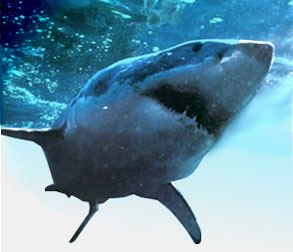
Underwater, I count seven or eight Caribbean reef sharks circling me like giant, steel-gray torpedoes. I concentrate on trying to move slowly and deliberately, like I would ordinarily do if I were here on the reef without sharks. I check my air pressure gauge, neutralize my buoyancy and — reminding myself this is perfectly natural — settle down on the sandy bottom not far from a towering mound of Technicolor corals.

As soon as I’m on the bottom, a lone seven-foot shark swims straight towards me, his mouth in a perpetual grimace, looking like Peter Falk’s Columbo on a bad hunch. For a split second, my senses freeze — along with my sphincter muscle. I want to run but I can’t, and for the most fleeting of moments, I have a sort of out-of-body experience, as if I am watching myself watch the shark.

Remembering the old adage of not showing fear to a mad dog, I stay my ground. At a distance of three feet, the shark turns abruptly, as if someone has pulled an invisible chain. This happens several more times, before the sharks tire of it and resume swimming in circles just above.

And then I figure if I am going to really swim with the sharks, I need to get off my butt and head up to their level. I do so, rising ever slowly upward. The circling sharks swim just a wee bit wider to avoid bumping me.

Some scientists suspect that sharks, with their heightened sense of smell, can even detect adrenaline. I think of the little twits with backward baseball caps who weave in and out of traffic back in Florida with NO FEAR decals on the back of their jacked-up pickups. A Caribbean reef tip shark would peel that decal in a nanosecond.

More than anything I’ve ever done, there is a be-here-now element to this experience that commands my senses. Whatever shards of anxiety remain from my top-side life — career, mortgage, deadlines — vanish.

Breathing, something I take for granted back on the surface, becomes a conscious, auditory event. In comes the good air in a long, relaxed suck; out goes the bad in a series of gently exploding exhaust bubbles. Around me, the bubbles become domes of mercury and drift up to the surface. To control myself, I control my breathing, turning it into a Zen-like exercise. As I do, the environment seems to absorb me. I become one with it.

And then something magical happens. I see the sharks more clearly. Gill slits, eyes and mouths come into focus. The grace of their swimming awes me. I watch how little they twist their body to make a turn, how small the energy investment is compared to my awkward surface-mammal gyrations. Instead of mindless eating machines, they become elegant, smooth-skinned beasts: giant, underwater panthers. I begin to admire them.

As I do, my fear dissolves with my exhaust bubbles. I settle back down to the bottom on my knees, next to Omar and his stick. He gives a signal to Smitty, who is watching the action from back on the boat.

Down into the water comes a PVC can full of fish heads and guts. New sharks I have not seen before dash to the bucket from somewhere just beyond my range of vision. There must be 30 of them in the water now, and they are fired up. The bucket is theirs.

The sharks attack the chum, slashing and biting at it. The bucket drops to the bottom in slow motion, sharks slamming into it from every which way. As it settles onto the sand, the commotion they kick up creates a storm of dust. The storm grows, spreading towards me, sharks veering in and out of it with fire in their eyes.

When the edge of the storm is only a couple of yards away, I back away gingerly, careful not to thrash about as I do.

As quickly as the frenzy started, it is over. The chum bucket, now scored with teeth marks, is empty, lying next to me on the sand.

My air is starting to run low. I carefully ascend, moving deliberately. Midway up, I pause and raise a tiny plastic underwater camera to snap photos of the remaining sharks.

As I do, I listen closely to my gut for sounds of alarm. But I hear none.

There is only the rhythm of my steady exhaust now, and it is more comforting than it has ever been.

Snakes and rapids and paradise, Oh my!

Seeking refuge in Guyana's Cashew Rains, I went to the brink, bushmaster snakes notwithstanding.

  • more
    • All Share Services

Snakes and rapids and paradise, Oh my!

It is the season of the Cashew Rains, and a sturdy Amerindian in a black cowboy hat is leading me over a trail through the thick tropical bush of Guyana. “Ready to go to the brink?” he asks. We are already skirting the edge of a deep gorge, so I say, sure, why not.

A bank of cumuli steams overhead, sent up from this broccoli of wet jungle that stretches as far as I can see. The only interruption is the “brink,” in which the Potaro River dramatically tumbles off a 740-foot-high scarp, down into a tumult of misty green. We head for a rock outcropping right at its edge.

These are the Kaieteur Falls, named for a long-gone Patamonas chief who, by legend, paddled himself in a dugout over the scarp to win the favor of the gods in a war against the ferocious Caribs. It worked.

My guide is Mike Phang, half-Arawak and half-Carib; he is the warden in charge of the land protecting these falls. We step across vast crevices in the terrain, dodge hanging lianas and spot carnivorous plants, waist-high termite mounds and a rare orange bird with a bit of a Mohawk, the Guyanese “Cock-of-the-Walk.” It’s no wonder Arthur Conan Doyle’s fictional “Lost World,” with its time-stuck ape men and dinosaurs, was set on Mount Roraima, not far to the west. Or that Sir Walter Raleigh once came looking for El Dorado, the city of gold. It still seems as if almost anything could be hidden here.

Hidden from everyone but Mike. “You are having the bromeliads here, 6 meters [20 feet] high,” he says. “You are having the jaguar, the jaguarundi, the puma. You are having the howler monkey.” All of this is delivered in a stoic monotone, not unlike that I have heard from other Amerindians — the Seminoles back in Florida, the Cocama in the Peruvian Amazon. It resonates with a quiet confidence, the emotional knowledge of place locked timelessly inside each word. “We are also having the bushmaster snake,” says Mike. “Step carefully.”

A delicate plant the size of a tree looms, nurtured by the vapor plume of the falls. “Look deep into this bromeliad and you will see the golden frog. It lives nowhere else. In its skin is a compound … 150 times as powerful as cocaine.” A Scot in our small ragtag group — head shaved clean and an accent like Sean Connery’s — squats down, puts his head into the immense green leaves and sniffs.

We have come here from Georgetown, the capital of Guyana on the northeast coast of South America, bouncing down on a dirt strip l40 miles inland via Trans Guyana Airlines. The lone pilot is German; the other passengers are the frog-sniffing Brit, his three mates and a Dutchman from Aruba. Guyana is a strange, strange place — part Caribbean, part Amazonian. It doesn’t much court visitors and I am thinking that our small white group — individually gathered from around Georgetown earlier this morning by a minivan — may be the country’s entire tourism quota for the week.

With a long colonial history that ended abruptly when the British left in 1966, Guyana is not quite sure of its legacy. It is the only English-speaking country in Latin America. Beyond that, I’m uncertain about what unites its people, nearly 90 percent of whom are East Indian-African and live on the coast. The interior forest and mountains and vast savannas are the territory of its nine Amerindian nations. There is wealth here, everyone is certain, in lumbering and mining. But no one is yet sure how much can be taken before it runs out.

Folks like Mike Phang sense there is also an interest by foreigners in his country’s virgin environment, so he will make a go of it as a warden for now. The traditional Amerindian knowledge of the bush makes it a natural for him. Gold and diamond mining paid much better, Mike tells me, but he got tired of being robbed. “Bandits are the only thing that moves fast in this country,” says Mike, a slight smile revealing the pleasure in his quiet joke. Mike was robbed nine times; twice, he shot and killed his assailants. But Guyana is a desperate country, and they kept coming.

Tomorrow, I will begin a weeklong journey that will take me even farther into this odd heart of darkness. It will eventually lead me to a rain forest reserve called Iwokrama — literally, a “place of refuge.” It is a million-acre tract tucked away between the Akaiwanna and the Iwokrama mountains. Set aside by the Guyanese government in the early 1990s, its raison d’jtre is to preserve a massive oxygen-pumping terrain that helps abate the world’s increasingly abundant carbon dioxide load, relieving global warming. I am, well, perplexed that a country like Guyana would attempt something this visionary.

After all, consider Georgetown: It is a place of once-grand cricket stadiums and colonial mansions gone to seed, wood fires scenting the air like incense and bamboo poles flying Hindu spirit flags. The U.S. State Department warns about violence against “people of wealth” in the streets, i.e. tourists. After my arrival last night, I read two very curious stories in the local Stabroek News: “Ricky Chamatalk, 24, died when, riding his motorcycle downtown without a helmet, he collided with a cow.” And more disturbingly: “Sean Warde, 25, died after being chopped about the body by two men with cutlasses, at whom he had allegedly thrown a grenade.” A cutlass, a grenade, an immobile cow — all seem so much more urgent than global warming.

But, as I was told, that was the frontier capital. The interior would be different, rural and friendly. Just watch for the bushmasters and take your anti-malaria pills, and you’d do just fine.

A place of refuge could be a very good thing, indeed — especially for a nature-minded guy like myself adrift in an industrialized world bereft of connection — and I looked forward to finally staking out some space in it. Beyond the oxygen benefit, large, undisturbed chunks of jungle like this support megafauna that is rare elsewhere — the tapir, the jaguar, the giant otter, the harpy eagle. Discovery still seems possible here, not by virtue of a remote-control device but by one’s own wits. For me, that is El Dorado enough.

For now, the pre-Cambrian brink awaits. Mike and I shuffle out to its lip. There are no guardrails or warning signs, and we step across a gaping fissure in the rock, graphically leaving solid ground behind. “Years ago,” says Mike, “that crack was so small you couldn’t get your finger in it.” Just several feet away, the shallow Potaro begins its long blackwater cascade down into the gorge.

At the bottom, the fallen river swirls furiously like a washing machine, sending up vapor that creates a rainbow in the bright tropical sun. Its energy is potent, producing a muffled echo of thunder that resonates against my skin like sensory riffles. My hair seems to be standing on end, but I am not sure if it is from the upwelling charge or the realization that one giant step would put me over the edge.

“On Feb. 4,” says Mike, with no preamble, “four white peccaries went over these falls.” Then, without further explanation, he turns and walks back over the crevice to solid ground.

- – - – - – - – - – - – - – - – - – - – -

Shouldering my single bag and backpack at dawn, I trudge out to the tarmac of the Ogle Aerodome in Georgetown to catch a flight to the Mikushi village of Annai. The plane, a boxy prop locals call the “Flying Coffin,” looks like a miniature Spruce Goose. My fellow passengers are mostly Brazilians, headed deeper into their own country. As I board through a port in the tail, a woman hands me a paper box of apple juice and what appears to be a mustard sandwich, crust trimmed off and sealed in plastic wrap.

Up we go, making a U-turn over the Caribbean Sea, which is clouded brown by sediment here, and sealed like my sandwich from Georgetown by a massive dike. The Dutch, who settled Georgetown in the 1600s, built the first seawall of wood. Now reinforced with concrete, it opens only to drain the broad Demerara River, an aquatic highway that winds inland, beyond the wooden stilt homes and shops of the capital and past a wafflelike grid of cane fields.

We fly into a cloud bank, and when we emerge barely a minute later, there is nothing but green, resplendently wild green, veined by rivers and punctuated with waterfalls. We are squarely atop the equatorial forest and swamp now, the basin between where the Orinoco and the Amazon join with the sea.

Guyana is in the middle of the thick swatch of forest called the Guiana Shield that stretches across the northern rim of South America. It holds the best of what is left of the tropical forest of this continent: In Guyana, there are 22 forested acres for each person; in Brazil, where the population is taking increasingly larger slash-and-burn whacks out of the forest, the ratio is only 3 to 1.

Another hour puts us over the Rupununi, the vast grassy savanna. Before Guyanese Brahmans lost their cachet in the world beef market, Mikushi cowboys tended cattle on this tropical range. Below, the village of Annai sprawls at the cusp of the Rupununi and Kanuku mountains. The Brazilian border is only 25 miles to the west, on the other side of the Ireng River. Down we go onto a narrow strip, dropping like a carnival ride.

As soon as we screech to a stop, there is much shouting. A Canadian photographer and I, the only passengers at this destination, are urged to pick up our bags and quickly exit through the rear. The pilot keeps his motor revved, and as soon as we are clear of the plane, it shoots away from us, leaving us in the prop wash with Colin Edwards, an expat Brit. “Welcome to the Rupununi,” says Colin, stocky, barefoot and convivial. “Breakfast is ready.”

Annai, a large village of 700 with dwellings of wattle-and-daub and thatched palm, is on one side of the strip, and Colin’s Rock View Lodge is on the other. We head to the kitchen, inside a ramshackle two-story stucco ranch house in a grove of mango trees, and settle in. Colin came to South America 30 years ago as a volunteer for the U.K.’s version of the Peace Corps, the VSO, and never left. Fluent in Portuguese from his years in Brazil, he has worked as an agronomist, a gold miner and a construction engineer (on contract, he helped build the airstrip at Jonestown for the cult that later perished in Jim Jones’ Kool-Aid massacre).

Now, by leasing this 20-acre ranch, he is trying his hand at ecotourism. “It is a pet hobby that brings together everything I have come to love about the place,” explains Colin. “The culture, the art, the frontier. I do a few hires with the Bedford (four-wheel-drive) truck and Land Rover, run the Dakota bar next door and am also the agent for the airline that flew you here.”

I sit on a bench behind a long wooden table full of pitchers of coconut milk, passion fruit juice and hot Brazilian coffee. Here, I meet Velda, Colin’s Mikushi wife, three of his eight kids and Shawndell, Velda’s 21-year-old younger sister. Shawndell, a quiet beauty in braids, looks as if she stepped out of an old Mathew Brady Indian portrait. While Shawndell helps serve, the line between employee and relative is blurred. We feast on platters of eggs, pancakes, wild cucumbers, rice and hot bread just taken from a clay kiln in the corner of the room. By the time we are finished, most of Colin’s great extended family has either joined us at the table or passed through with a friendly greeting.

Wooden shutters and doors are thrown open, and outside in the golden morning light, I can see a portion of the lush orchard — cashew, lemon, guava and almond trees — and garden that feed family and guests. Fenced enclosures nearby hold local critters — orphaned or injured — that are being nursed to health: a giant anteater, a Brazilian tapir, capybaras and spider monkeys. While most guests so far have been scientists going to and from nearby Iwokrama, Colin is optimistic that those few hardy tourists who enjoy tropical wilderness and solitude will eventually find their way here. But only a few. “I am concerned it doesn’t get out of hand,” he says. “There is something peculiar and wonderful about it here — a certain easy rapport. We would like to keep it that way.”

Tomorrow, we will travel to Surama, a smaller village at the edge of the rain forest and, from there, will venture up the wild Burro Burro River in a wooden longboat with local Mikushi as guides. In preparation, I join Colin in the living room, where he is eager to show me his collection of vintage travel-adventure books from the last century, recounting astonishing exploits of the Brits who first ventured into what they knew then as “the Guianas.”

On the walls, there is the skin of a 12-foot-long anaconda — “a small one,” says Colin — artistically incised calabash gourds, self-entwining Amerindian sculptures from the latex of the bulletwood tree, a small rack of bush deer antlers, the basketlike nest of an orapendula bird. A chameleon clamps to one wall on suckered feet; a swallow zooms overhead. In the corner is a large green-felt-covered card table, where in the evenings one can sit in a chair of woven liana and wood with a cold Banks beer and a plate of homegrown peanuts and have real conversation — for that is what one does in such a place as the low-voltage lights dim and brighten at the whim of the jerry-rigged generator.

“This is fascinating!” says Colin, effusively pulling “Waterton’s Wanderings in South America” from a shelf and thumbing through its yellowed pages. “In 1812, the explorer Charles Waterman came here and wrote of Surama. It was famous in the region, along with Annai, for the excellent poison it made — curare. They tipped their arrows and spears with it, still do, and go into the bush and hunt anything that moves … . You know, there’s so much about this place that hasn’t changed.”

- – - – - – - – - – - – - – - – - – - – -

Morning comes with the distant scream of monkeys. I jolt awake inside the mosquito net canopy over my bed. The generators are off and a mild breeze wafts through the windows, with no glass or screen to obstruct it. From inside the netting, reality seems gauzy, diffuse. I can smell coffee and warm bread from the nearby kitchen.

After breakfast, we load into a battered, mud-splattered Land Rover, orange foam bursting out of the dashboard, for the hour-and-a-half trip to Surama, traveling over a red clay strip known only as the Road. The Road is a failed attempt by the Brazilian government to build a highway from its interior, through Guyana to the Caribbean ports. You can reach Georgetown, 200 miles away, in 12 hours over the Road from here, but only in the dry weather. With two wet seasons — a long one in the winter-spring and a shorter one, the Cashew Rains, in the summer — the Road is often a quagmire. “You can go halfway by vehicle and halfway by dugout then,” explains Colin, ever enthusiastic.

We pass coconut and papaya trees ripe with fruit, grind through ruts deep enough to swallow a couple of Honda Civics and watch as tegus — 2-foot-long carnivorous lizards — scuttle across our path. Three boys with vine-woven reels and stick poles fish in a ravine. A barefoot man with a machete saunters by on horseback. There is no other traffic. Then we enter the rain forest, bucking and heaving through troughs of mud. The low scrub turns into towering jungle walls studded with red and yellow heliconia. “Adventure travel is going through the jungle in a vehicle without brakes,” says Colin, always cheerful.

Surama is in a clearing just ahead, a modest collection of thatch and wood homes, banana and cassava plants, dark red chickens and domestic peccaries roaming free. Two larger buildings are set aside as the school (“Be Regular Punctual” written on the side) and the clinic. Barefoot Mikushi children surround us, laughing and smiling. Everyone is in Western dress, but otherwise the scene might be lifted out of another century. We pile out and walk with them to a behab, a sort of open roundhouse, which serves as the village meeting center. It has started raining. “If the rain is coming from the south, from the Amazon, it will be heavy,” says Colin.

An official ceremony has been planned. Kamesh, the schoolmaster, introduces the children, who welcome me with two songs that they sing first in English and then in Mikushi (“Surama sitting in a valley/Surama you make me so happy/Brown-skinned people everywhere/Friendliness is there”). They are holding hands and swaying, their voices ineffably sweet and winsome.

All of nature seems to offer utility, myth or solace for the Mikushi. For instance, the Mutu (the blue-capped tanager) is burned and its ashes rubbed on the skin to relieve a sprain; the Korokoro (the green ibis) is seen as a barometer of rains; if you mock the Arawo (the long-tailed potoo) by imitating its cry, your hammock strings will burst. Some 30 species of ants are used, alternately, to make the bones of babies strong, to cause pari kari (an alcoholic cassava drink) to ferment, to roust a lazy man to work.

The elected village “captain,” Sydney Allicott — brother-in-law of Colin — stands for his official greeting. Outsiders are welcome here, says Sydney, choosing his words slowly and deliberately. “It is another means of educating our people to the situation in other countries — sometimes you tend to believe the whole world is like this.” And then, as if to shatter any shards of ethnocentricity I might have remaining: “Sometimes, visitors bring photographs and you see the concrete jungles and understand what can happen to a place when the people forget what is important.”

I ask Sydney what the kids do to amuse themselves, here in this non-Nintendo world. “They play … games. The fruit game — one child will be the fruit, maybe a soursop, and he ripens. When he ripens, his voice changes and everyone runs and hides. If you are found, then you must be the fruit.”

With that, we’re off into the rain, which is now falling in thick sheets. Sydney, his brother Lionel and Kamesh squeeze into the Land Rover with us and the day suddenly seems more festive as we head deeper into the forest, the soggy trail gradually leading us down inside a dark corridor of jungle. “In the rainy season, this trail would be underwater,” says Colin. Soon, a narrow stretch of brown water appears. It is Taramu Creek and it will lead us to the Burro Burro. On the bank is a long wooden boat with a motor. We pull the boat into the creek, climb aboard and head upstream.

Almost immediately, a long silvery fish that looks like a small barracuda jumps into the boat. “Fox fish,” says Sydney, admiring its sharp teeth. Later, a silver dollar — an aquarium fish back in America — follows suit, rocketing into my wet shirt and flopping about in the few inches of water in the hull. “Piru [piranha] in the river too,” says Sydney. “Maybe we will catch one.”

In addition to a cooler full of curry-flavored noodles and cassava, Colin has packed wild limes, a bottle of El Dorado rum and a mahogany-colored bow with three arrows, each tipped with a slightly different, razor-sharp metal edge. “One is for fish, one is for birds and the other … for anything larger,” explains Colin, pouring himself a healthy dose of rum. If Guyana has itself been creolized — created from a racial and cultural stew — this Brit expat has been as thoroughly transformed as anyone. Peppering his conversation with Portuguese and Mikushi, he sits barefoot, one arm around Velda, rain soaked and happy here at the edge of the Lost World, adrift somewhere between “Swiss Family Robinson” and “Lord Jim.”

Upriver on the Burro Burro we go for nearly two hours, in and out of the Cashew Rains, past keel-billed toucans and macaws, tapir wallows and a tall ceiba tree with the hollow of a harpy eagle. A flock of green parakeets passes overhead and gigantic kingfishers dive and squawk. We have passed effortlessly through one set of rapids, but another array is just ahead, churning and spitting angrily. Instead of trying to run them, we wedge in between a slew of giant black boulders. By now, we are as ragged as wet dogs. And then, the glorious tropical sun returns and all is again right with the world. I climb from the boat onto a rock the size of a small house, welcoming the chance to stretch my legs. Upstream, through the narrow foliage corridor, the Akaiwanna Mountains materialize from the steamy mist. Howler monkeys bellow off in the distance. “Keep your eye out for a jaguar,” says Colin.

We will lunch on the rocks and then drift back, we hope, by dusk. Noodles, tiny fig bananas and rum appear — along with thin sandwiches again inexplicably filled with mustard. By the time we cast off, our crew is pleasantly buzzed. The river has swollen 2 to 3 feet higher with the rains, and the modest rapids we crossed with ease are now raging. We bounce through them, ricocheting off submerged rocks and fallen trees. My adrenalin is peaking, but no one else seems terribly concerned. Somewhere in here, we lose the mahogany-colored bow.

“My Gawwd,” says Colin, a bit later. “Where is the bow?”

“Fell in the water,” says Velda, who seems quite amused by this.

“Gone overboard,” says Kamesh, equally humored by it.

“The water. My Gawwd. The water. Oh my. The bow is forever lost.”

- – - – - – - – - – - – - – - – - – - – -

I am headed finally to Iwokrama today. Down the Road I go again, this time in a more modern Land Cruiser with brakes, traveling an hour and a half more beyond Surama, all the way to the edge of the massive Essequibo River. Both the vehicle and the East Indian driver are from Iwokrama, funded by a kettle of international environmental aid monies. We pass colorful land tortoises, more tegus, a Mikushi on a bicycle. We rumble over narrow bridges made of fat wooden beams the size of railroad ties.

We stop to reconnoiter a particularly nefarious series of ruts, and I hear the sun bees — large bumblebee types — ringing loudly from inside the towering jungle, happy for this luminous, rain-free day. I walk to the Congo palms at the jungle edge and listen closely. Just above the ring of the sun bees comes the sweet two-note refrain of the toucan.

A modest wooden sign welcomes us to the Iwokrama Rainforest Preserve. Soon afterward, the jungle falls away to reveal the broad Essequibo. From here, I climb into another longboat for the short ride downstream to the field station of the preserve. As we approach, I notice the station is modeled on a typical Amerindian village — wooden structures with thatch roof, up on stilts for both ventilation and safety from flooding.

I stow my gear in one of the huts, take a quick look around and see a group of rangers, all Amerindians, assembled on chairs under a tent. I meet Vibert A.V. Welch, a big black-skinned man from Georgetown. Vibert, whose English is accented with a deep Caribbean-African patois, tells me how the scientists from around the world make new discoveries in this pristine landscape just about every time they look. “Iwokrama now has the best documented fauna in Guyana,” he says. Indeed, it may be ground zero for snakes and frogs. “Just in two weeks, a team of herpetologists found 11 new species.”

As for the tented rangers, they are having their bush knowledge augmented with insight about sustainable use of the forest, says Vibert. In the works is a grand vision — bioprospecting, education and training, preparation to guide the sort of tourists who will go to the ends of the earth to see rare birds and plants.

Part of the mission, Vibert tells me, is to record and catalog the complex and often mystical bush knowledge that has been passed along by oral tradition for centuries. There are, after all, some 2,000 plants in the wildly diverse Amazon Basin used by Amerindians — both medicinally and spiritually. Ironically, as ethnobotanists revel in the rich cultural-natural texture of the Guyanese interior, the government back in Georgetown is granting large mining and timber leases on indigenous land.

I climb back into a boat, this time with two Amerindians, Rodriguez Anton and Errol McBirney. We will visit some ancient petroglyphs today. Although I am nearly accustomed to the Anglicizing of local names here, I have to admit McBirney gives me a start. But both are good traveling companions, easy to smile and eager to share their local bush knowledge. Downstream on the Essequibo we go now in a smaller aluminum skiff, the Takatu, one of the field station’s official boats, a 40-horsepower Merc pushing us faster than I’ve been yet in the last week.

Errol is wearing a plaid ball cap with a Calvin Klein jeans logo, flip-flops, a khaki shirt and pants; Rodriguez, his long black hair curling over his collar, is decked out in a black cowboy hat with a miniature horseshoe emblem on the front, long pants and a long-sleeved shirt. Both are carrying machetes and hand lines for fishing. This time, there are life jackets. “Better put them on,” says Errol. “There will be rapids, I think.”

And sure enough, a set of healthy Class III rapids is thrashing just upstream, complete with standing waves. I notice that two young boys from a nearby village are riding through them in a log dugout. “They are playing,” says Errol. “Something to do.”

We run the jungle-rimmed Essequibo for nearly 40 miles, bouncing over more rapids, portaging the boat at the edge of others, crossing water that boils, eddies and swirls. The river mysteriously narrows and widens and I realize we are zigzagging through and around islands. Little white-rumped swallows skim over the surface like jet-propelled leaves; terns with bills as big and yellow as bananas dive and chatter. “The Essequibo comes out of the Amazon somewhere,” says Rodriguez. The entire time, we see no more humans, not a single dugout.

A few white beaches rim the edges of the shore. At low water, says Errol, beaches are everywhere, including sandy shoals in the middle of the river. Most of the rapids become exposed rocks. And the water, seeping from jungle creeks, is tannic black, not brown like it is now from the recent rain.

Finally, immense round boulders rise up from the water with a thin cover of lichens, looking like giant baby heads. Beyond the baby heads, we pull over to another clutch of rocks. Both men hop out and I follow. Rodriguez bends down and traces his fingers over etchings in one rock. They are at least 3,500 years old, he says. “A fox here … a scorpion here …” I look into an opening where one boulder leans against another and see a finer glyph, a stick figure of a man, protected here from the elements for more than three millenniums.

At lower water, many glyphs can be seen, says Rodriguez. It strikes me that lots more people may have lived along this river at one time, and I wonder out loud where they went. Rodriguez looks at me briefly. “Yes,” he says, inscrutably, and then tosses out a hand line, fishing for piru for dinner.

The rain is again falling in sheets. We sit quietly in the boat and drift through the forest to the squawk of distant parrots and the howl of monkeys. I am deep in now, soaked to the skin by the Cashew Rains, but warmed with a feeling of utter security that I seldom feel back in my more efficient world. If Shawndell were here, I’d marry her and end up, years later, losing my prize mahogany-colored bow in the rapids and not caring a lick about it. “We make it back by dark,” says Errol. “I think.”

Continue Reading Close