
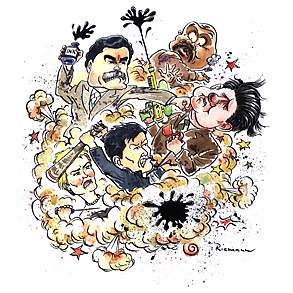

George B. Irish — balding, bespectacled, beleaguered — was sweating it out on the witness stand well after 5 on a Friday in U.S. District Court Judge Vaughn Walker’s packed courtroom May 12. The air conditioning was already gone for the weekend, but that’s not why Irish was miserable.
The head of the Hearst Corporation’s newspaper division was just another hapless witness in the media melodrama that gripped San Francisco the entire month of May: a lawsuit under federal antitrust statutes to stop Hearst, which owns the San Francisco Examiner, from buying the San Francisco Chronicle, its partner in a 35-year-old joint operating agreement (JOA), for $660 million. As part of the plan, Hearst would give the Examiner — plus a $66 million subsidy to keep it running — to San Francisco’s Fang family, the politically wired, widely reviled publishers of a chain of giveaway newspapers, and close allies of San Francisco Mayor Willie Brown.
The Examiner trial was like an ugly multi-car pileup: you couldn’t help but crane your neck and stare. Day after day, testimony revealed the vipers’-nest savagery of San Francisco politics and media — a world of journalistic self-dealing and political treachery made more ugly by the city’s unrivalled tradition of race-baiting. By the time the trial was over, charges of corruption had splattered Examiner and Chronicle management, San Francisco’s Democratic establishment — from City Hall to the U.S. Senate — and the U.S. Justice Department, whose role in hand-picking the Fangs to buy the Examiner was, to say the least, extraordinary.
Yet spectators packed Judge Walker’s stifling courtroom every day not just to rubberneck, but to get an answer to one of the oldest questions in American journalism: Why is this literate city, with its high concentration of overeducated book lovers and its new media savants, saddled with the most mediocre daily journalism in the country? And could anything Walker decides possibly change that?
Hearst’s troubles at the trial began on Day 1, when Examiner publisher Timothy White admitted to “horse trading” with Mayor Brown over Hearst’s Chronicle purchase, offering favorable editorial treatment by the Examiner if the mayor agreed to support Hearst’s acquisition. It was the testimony heard ’round the world, as media everywhere broadcast the news of a publisher violating what Hearst CEO Frank Bennack called “Journalism 101” — exchanging editorial support for business favors. Chronicle and Examiner staff howled at the breach of ethics, and Hearst immediately suspended White, who would later say he was “tired and confused” on the witness stand (though he’d made the same admission in a deposition five months earlier).
White’s testimony got the big headlines, but Irish’s was arguably the most damaging. Top Hearst Corp. management was trying to contain the damage by insisting they’d known nothing of the publisher’s dealings with the mayor. But on the witness stand, Irish was confronted with embarrassing evidence to the contrary: a set of his own handwritten notes, recording conversations in which White — who had been sent from Albany, N.Y., to preside over the Chronicle purchase — briefed Irish on his meetings with the San Francisco mayor.
The entire story of the so-called horse trade was there in black and white, in the Hearst exec’s own handwriting (cramped cursive, bad spelling and all), humiliatingly visible on a big overhead screen and a dozen computer monitors around the courtroom.
“Amazing — having a love affair,” one set of notes begins. A second note sheet — headlined “Pretty amazing. Couldn’t have gone better” — is more damning, describing a lunch (it will now be known as The Lunch) between Brown, White and Examiner Executive Editor Phil Bronstein, now nationally semi-famous as the husband of actress Sharon Stone. Getting together roughly three weeks after Hearst announced its agreement to buy the Chronicle Aug. 6, the three men frankly discussed the mayor’s concerns about the sale.
The presence of the swashbuckling Bronstein at The Lunch was especially intriguing. Depending on your perspective, the editor would emerge from the Examiner trial as either the villain or victim of the debacle, but one thing was certain: Bronstein had survived running the weaker paper for almost a decade, presiding over ever-shrinking budgets but beating the Chronicle on City Hall reporting anyway, dreaming that one day Hearst would own the city’s only remaining daily, and he would run it. Best known for his cowboy boots and macho swagger (he once donned scuba gear to wrestle an alligator that had been found in a city lake) Bronstein no doubt wanted the Chronicle sale to go forward as much as anybody in San Francisco.
According to Irish’s notes, The Lunch featured, if not horse trading, powerful men exchanging tales of powerful woe. The Examiner execs complained about Brown’s opposition to Hearst’s Chronicle purchase, and the mayor kvetched about Examiner coverage of an FBI investigation into corruption in Brown’s minority contracting program.
Courtroom spectators could read about Brown’s conversations with Attorney General Janet Reno, whose Justice Department would take a remarkably aggressive role in forcing the Examiner’s sale to the Fangs. But Brown describes Reno as “pretty laid back,” and he seems to promise he’s “not going to do more” on the matter. Then the mayor complains about the “FBI investigation getting closer scrutiny in Examiner,” but also notes that Bronstein treats him well. “I haven’t been calling Phil with problems,” the notes say.
In a follow-up e-mail also introduced as evidence, White told Irish that Brown and Bronstein got along so well “you’d think they were the best of friends.” The meeting ended with “hugs and kisses,” White said; in fact, Brown invited Bronstein and Stone to share his box at the following week’s San Francisco 49ers game.
A flustered Irish tried to distance himself from his own notes. But under cross-examination he made one admission: “From my experience I would suggest that it’s not very often that a mayor invites an editor to go to a ballgame with him.”
“Unless there is horse trading?” attorney Joseph Alioto asked.
“There is no horse trading,” Irish insisted.
But by the end of his testimony, the Hearst exec on the stand wasn’t the only one sweating, and it wasn’t for lack of air conditioning.
“‘Horse trading’ will be associated with San Francisco journalism for years to come, the way ‘expletive deleted’ is associated with Richard Nixon,” exasperated Examiner columnist Rob Morse wrote the Sunday after Irish testified. “The San Francisco Examiner is dying, and it can’t even die with dignity.”
Here in this wired city, the cultural capital of new media and all things Internet, it’s been hard not to laugh at the dark warnings about the threat to an informed democracy that the Chronicle sale to Hearst allegedly represents. It was more than a little surreal to watch a trial predicated on the lack of competition that would result should Hearst buy the Chronicle, in a courtroom packed with local reporters from all the regional dailies, the city’s two muscular alternative weeklies, ethnic papers, radio, TV and even two Internet dailies, Suck and Salon.
And yet a complex tangle of antitrust laws and exemptions in fact governed the Chronicle sale, and the lawsuit to stop the transaction charged they were broken, flagrantly. Beyond the antitrust issues, which were significant, the trial raised alarming questions of journalistic and political integrity:
Did the Justice Department bow to political pressure when it took what an antitrust expert calls a “very unusual” role blocking Hearst’s Chronicle purchase and supporting the Examiner’s sale to the Fangs? In the last 17 years, Justice has let papers in 15 cities dissolve their JOAs and create one-newspaper towns, without blocking a single dissolution or merger, before standing up to monopoly journalism in San Francisco.
And even if Justice acted on its own, many observers wonder why local Democrats, from U.S. Senator Dianne Feinstein to Mayor Brown, with support from lesser local pols allied with Brown, exerted such pressure on the Fangs’ behalf. “I think the mayor bought himself a newspaper,” one City Hall watchdog told Salon, and many others agree.
And did the Examiner soften its coverage of Mayor Brown, to try to win his support for the sale? Certainly the Examiner has sponsored first-rate investigative reporting on the City Hall minority-contracting scandal, in which the FBI alleges several black contractors, all allies of the mayor, fronted for white business owners so they could get minority-contracting status from the city, while the agency charged with minority-status enforcement for the Brown administration looked the other way. Yet the very same paper glowingly endorsed Brown for reelection last November, with nary a word of the scandal its own reporters played a role in uncovering.
San Franciscans flocked to the Examiner trial for answers. On Wednesday, when Judge Walker heard closing arguments in the case, the courtroom was so crowded that spectators spilled into the hallway, and U.S. marshals threatened to summon a tactical squad to arrest the collection of elderly lawyers, rumpled journalists (at least one reeking of liquor at 9:30 a.m.) and gadfly courtroom observers who refused to be turned away. (We compromised: The marshals opened the courtroom doors wide, and we stood back to allow free access.)
On any given day, Walker’s packed courtroom held a colorful assortment — some would call it a rogues’ gallery — of local journalists and politicos: Hearst CEO Frank Bennack and his Chronicle Publishing counterpart, John Sias, once antagonists, now reluctant allies; Ted Fang and his formidable mother Florence, owners of the San Francisco Independent, who crusaded against the Chronicle sale until their ties to local Democrats got them the surprising subsidized deal for the Examiner; and two of the city’s most talented and hated political consultants, Clint Reilly and Jack Davis (“Mean” and “Meaner” to their foes), once friends, now mortal enemies.
Reilly and Davis represent the takeover of government in San Francisco by political consultants — men (and they’re almost all men) with no ideology and little loyalty to allies, just fealty to the highest bidder. The multimillionaire Reilly — a former Jesuit turned hard-drinking political operator turned teetotaling Hearst enemy — spent $4 million of his own cash running against Brown for mayor last year before trying to buy the Examiner; now he’s the deep-pockets plaintiff in the suit to block the Chronicle sale. The notorious Davis, a gay left-wing activist turned conservative, first opposed the sale, but now backs it, because his pals the Fangs stand to become the new owners of the Examiner.
If you can only know one thing each about Reilly and Davis, it would have to be this: Reilly’s mayoral campaign crashed when Davis, a former Reilly protigi turned Willie Brown henchman, spread word of the candidate’s history of domestic violence 20 years earlier; Davis, by contrast, survived a scandal over his kinky 50th birthday party, attended by Brown and the city’s politerati, which featured a Church of Satan priest being sodomized with a Jack Daniels bottle.
Then there’s Davis’ drinking buddy, the legendary Warren Hinckle, former editor of the popular New Left magazine Ramparts, 30 years past his prime and 10 years past his last stint at the Examiner, massive in a teal sports coat, his trademark eye patch and long hair still with him even if his late basset-hound Bentley is gone. Wheezing, smelling of drink, talking too loud in the courtroom and walking too slowly in the hallway outside it, Hinckle now works as a columnist and political strategist for the Independent, crusading against enemies of the Fangs and Mayor Brown. He’s getting ready to help the Fangs take over the Examiner. “It’s gonna be a lot of fun,” he says over Guinness stouts one evening after the trial.
The Examiner trial was a lot of fun, for observers at least, but it was the kind of fun that makes you feel queasy afterwards. Judge Walker’s courtroom provided a window on a sorry, inbred newspaper universe that appears to be powered almost entirely by hate. The Chronicle owners hate the Hearst Corporation. Davis and Hinckle hate Reilly and the Examiner. Reilly hates virtually everyone, but the man he may hate most, or at least most memorably, is the Examiner’s Bronstein, who broke the consultant’s ankle in an infamous Examiner boardroom scuffle in 1993. But Davis and Hinckle hate Bronstein too: Hinckle savages him weekly in a viciously ad hominem Independent cartoon, “Mr. Sharon Stone,” dedicated to ridiculing the couple’s relationship, their squabbles, even their quest to conceive a child.
The Fangs, of course, give and get their own fair share of hate. They despise Bronstein, too. Ted Fang says simply, “He’s gone after my family.” But many in San Francisco despise the Fangs — something that may have been obscured by the predictable this-is-a-great-moment-for-multiculturalism encomiums that appeared in the local press after the Examiner sale. “Their only objective is to make money,” says Ling-chi Wang, a respected Chinatown activist who is today the chair of University of California at Berkeley’s ethnic studies department, and a rare Fang critic who will speak for the record. A Fang-run Examiner would be like the family’s Independent, he says, used “to intimidate people, including politicians, and to help whoever can do them favors and get them more power and money. I have absolutely no faith in that family at all.”
For decades San Francisco’s failure to produce a daily paper on the level of the Los Angeles Times, the Boston Globe or even (the horror!) the San Jose Mercury News has been a source of deep local shame. At the Examiner trial it was hard to resist thinking that if the assembled characters put all the talent, creativity and energy they invest in corporate scheming and ugly street brawling into journalism, San Francisco could support several Pulitzer Prize-winning papers.
That’s not likely. And so the city waits for a decision by Judge Walker to find out who will own its lackluster daily papers, under what terms, and on whose political and economic behalf.
In the absence of a court decision — Walker is expected to rule any day — the partisans have developed three competing story lines to explain the meaning of the blood feud over the Chronicle and Examiner sale.
To Clint Reilly’s attorney Joseph Alioto, himself the son of a storied former mayor, the Chronicle-Examiner story is a heartbreaking tale of staggering corporate greed and incompetence, a decades-long crusade to create a fat and happy newspaper monopoly in San Francisco. According to Alioto, the two papers used the shelter of the JOA — an antitrust exemption that let the former competitors join forces, sharing all business expenses and revenues while maintaining separate editorial staffs, in order to maintain two daily papers — to plan for an eventual newspaper monopoly. When the Justice Department balked, Hearst sold the paper to the Fangs, a sale Alioto and Reilly denounced as a “sham,” ultimately destined to fail and leave the Hearst monopoly intact.
Naturally, Hearst supporters see the issues very differently. Hearst insists that no law can compel an owner to keep a failing business alive, and the company says that without the massive support of the JOA, the Examiner would fail. Examiner admirers take an even darker view of Reilly’s lawsuit and the Fang family’s crusade against the Chronicle sale, which ended when they were allowed to buy the Examiner. They see both efforts as the ultimate revenge of corrupt political opponents “who were never able to sue the paper for libel,” in the words of an angry Will Hearst, the former Examiner publisher turned venture capitalist who now sits on the Hearst board of directors.
Indeed, the trial’s cast of characters — Reilly, Davis, Brown and the Fangs — have come in for withering scrutiny in the scrappy Examiner over the years, and it makes sense they’d be appalled by the idea that Examiner management might run the surviving Chronicle in a one-paper town. Brown once called the Examiner “toilet paper,” which is why his crusade to keep it alive when Hearst wanted to fold it (he upgraded it to “a civic treasure”) never rang true. Fang spokesman Noah Griffin, a former Examiner columnist, says with some relish: “You know the saying: Friends come and go, but enemies accumulate. The Examiner wound up with Ted, Clint, Jack and the mayor all there to block what they wanted.”
To the Fang family and its friends, Hearst’s troubles are a simple case of karma, payback for generations of arrogance and racism. From William Randolph Hearst’s crusade against the “yellow peril” of Asian immigration, to what they see as Phil Bronstein’s racially inspired attacks on a black mayor and his Chinese-American buddies, the Examiner has routinely mistreated minorities, Fang allies say, and its troubles today are a form of cosmic retribution.
“Communities of color hate the Examiner,” says Noah Griffin. “Those guys are racist as hell. With the Fang family, you have an immigrant’s story that if it were about any other group, would be applauded. But because it involves a culture that’s threatening, it’s a negative story.” To many in the city’s white elite, Griffin insists, the Fangs “are just a bunch of Chinks.”
Even Reilly’s lawsuit is a byproduct of racism, according to the Fang worldview. Warren Hinckle says Judge Walker let the suit go forward, despite widespread doubts about Reilly’s legal standing to bring an antitrust action, “because he’s not gonna give these Chinamen $66 million!”
The charge that the Examiner is a hotbed of racism is a little disconcerting, considering that it is arguably the most politically correct newspaper in the country — refusing to identify suspects by race, for instance, known for holding diversity training sessions, running puff pieces on minority leaders, its starry-eyed “The New City” series on the city’s changing demography, and generally adhering to San Francisco’s ultra-liberal political line. (“In Diversity is Strength” ran one particularly gaseous headline, over a story about the Gay and Lesbian Freedom Day Parade.) For that matter, in 15 years in San Francisco, I’ve never heard anyone refer to the Fangs as either Chinks or Chinamen besides Hinckle and Griffin, but I may run in the wrong circles.
It takes a little history to make sense of the bitterly competing narratives. The Chronicle-Examiner rivalry dates back to the 19th century, when M.H. de Young’s Daily Dramatic Chronicle battled William Randolph Hearst’s Examiner, the self-described “Monarch of the Dailies” that was the flagship paper in what was to become a vast Hearst media empire. Today’s Chron-Ex political scandals are not the most vicious in the papers’ history: Chronicle co-founder Charles de Young shot mayoral candidate Issac Kalloch in 1879 (and a year later Kalloch’s son Milton murdered de Young). William Randolph Hearst ran for mayor twice himself, unsuccessfully, and used his Examiner, which pioneered so-called “Yellow Journalism,” to bang the drums for the U.S. joining the Spanish-American War. (“You furnish the pictures,” he allegedly told artist Frederic Remington, “and I’ll furnish the war.”)
Over time the Chronicle, today one of the last major family-owned dailies in the country, became the dominant paper thanks to ’60s-era editor Scott Newhall’s emphasis on eccentric features and crusades — against the city’s bad coffee, for instance, and on behalf of clothing naked animals. The paper’s preference for goofy bon-bons over hard news reporting was immortalized in “All the President’s Men,” when Jason Robards-as-Ben Bradlee dismisses a harebrained feature idea by saying “Go sell it to the San Francisco Chronicle.”
In 1965 the two papers signed their JOA. Hearst folded its daily Call-Bulletin, moved the Examiner to the deathly afternoon slot, and became a media conglomerate — the nation’s largest magazine publisher, including Harper’s Bazaar and Esquire, and the owner of 12 papers (the Houston Chronicle and the Seattle Post-Intelligencer are probably the best) — while its flagship paper withered.
To be fair, neither paper has ever gotten its due. The Chronicle has always been a good morning read, with a reader-friendly design that calls out the day’s top stories quickly. (Confession: I still read it daily at 6 a.m., before the New York Times, for a bracing sense of proportion on what matters to readers outside New York and Washington, D.C.) In recent years the paper’s Washington bureau has broken stories the bigger dailies had to follow up on — John McCain’s flip-flop on abortion, Gary Bauer’s troubles with adultery allegations. It figured out that San Franciscans loved their columnists, and while it suffered an irreplaceable loss when Pulitzer Prize winner Herb Caen died , quirky stylists like Jon Carroll, Leah Garchik and sometimes Adair Lara carry the torch.
But the cash-poor Examiner regularly beats the Chron on local reporting. It enjoyed a renaissance in the 1980s when Will Hearst took over. The maverick Hearst scion, cousin of Patty, had done his journalistic apprenticeship at Rolling Stone in its gonzo, drug-inspired heyday. When he took over the Examiner, he revived the slogan “Monarch of the Dailies,” brought in bomb-throwing San Francisco legends Hunter S. Thompson and Hinckle, gave the paper a crisp, tabloidy redesign, dropped its newsstand price and tried to engage the stately Chronicle in a circulation war. Today, reporters Lance Williams and Chuck Finnie own the story of the Brown administration’s ethical struggles. But the Examiner’s reach has nonetheless continued to shrink, 21 percent in the last decade, to just over 100,000.
Still, in those same years there were regular rumblings that the wealthy cousins who owned the Chronicle, descendants of founders Michael and Charles de Young, wanted to sell the paper and their other limited media holdings: San Francisco’s KRON TV, Chronicle Books, and some out-of-town smaller newspapers. Nan McEvoy, briefly hailed as the Kay Graham of San Francisco, took a strong role in the Chronicle in the ’90s and steered it away from its conservative moorings. But when she tried to buy the paper, her rivalrous relatives wouldn’t sell it to her. In the end, the Chronicle owners sold out to their ancient enemies and JOA partners instead. Hearst put the Examiner up for sale, but said that if it failed to get a reasonable offer, it would fold the paper into the Chronicle, consolidating both staffs.
Of course Walker’s decision in the Reilly matter must be based on antitrust law, not on history, local politics or both papers’ long tangle of Byzantine feuds. Yet the judge made clear, with controversial rulings at every step along the way during the trial, that he viewed the seamy details of political wrangling — Tim White’s horse-trading, the Fangs’ arm-twisting, the Justice Department’s muscular intervention — quite relevant to the law at hand.
“Was there any reason for the Fang transaction, other than to curry favor with the Department of Justice and local political authorities?” Walker asked the papers’ attorneys Wednesday during closing arguments in the trial. And none of them gave him a terribly convincing answer.
Justice Department sources insist public interest, not politics, inspired their close scrutiny of the Chronicle sale. Yet Justice hadn’t actively intervened in a JOA dissolution since it forced the sale of the St. Louis Globe in 1983 (the paper folded after two years anyway). In 1988, the department let Cox Newspapers close its still-profitable Miami News, and not even seek a buyer, rather than face annihilation when its JOA with Knight Ridder’s Miami Herald expired eight years later. Cox’s reward? A share of the Herald’s profits for the next 33 years, through 2021.
So why the sudden change of heart in San Francisco, a comparatively small city whose papers’ combined circulation amounted to just over half a million?
Clint Reilly and Will Hearst agree about almost nothing. Hearst, after all, presided over a reported million-dollar settlement to Reilly after the consultant accused Bronstein of breaking his ankle, and today he calls Reilly “not a good guy.” But both men see a political conspiracy in the efforts of local politicos to get the Justice Department to block the Chronicle sale and force Hearst to sell the Examiner to the Fangs. “Willie Brown was certainly dealing, but not with Tim White,” Hearst charges. “Justice imposed a rule here they had never imposed before, because they were lobbied by political people.”
Certainly the list of Democratic politicians who rolled up their sleeves to support the Fangs’ crusade is remarkable. In January, U.S. Rep. Nancy Pelosi, Mayor Brown and City Attorney Louise Renne took time out of their hectic schedules to march over to the Examiner’s Fifth and Mission Street office and warn White personally that they would oppose the Chronicle purchase if the Examiner wasn’t sold. The next day, busy California Sen. Dianne Feinstein hosted a private lunch to introduce Florence Fang to White, and encourage the Fangs’ bid for the Examiner. Mayor Brown personally lobbied the White House and Attorney General Reno, who called Brown twice in one day to discuss her plans to scrutinize the sale for its antitrust implications.
And scrutinize she did: In the end Justice Department officials took an unprecedented role ensuring Hearst sold the Examiner to the Fangs — meeting with Ted Fang, for instance, on at least five occasions; even, according to Fang’s sworn testimony in the Reilly trial, advising him on how and when Hearst was going to improve the terms of the Examiner sale. “They met with Mr. Fang five times!” Alioto exclaimed in closing arguments. “You wonder who’s working for whom!”
“It’s very unusual,” says antitrust expert Stephen Barnett of the University of California at Berkeley. “The Justice Department appears to have taken a much more aggressive role in this case in finding a buyer for the Examiner and setting that buyer up to compete with the Chronicle than it ever has before.”
A Justice Department source who asked not to be identified denies politics played a role in forcing the Examiner sale. “We’ve now had economic studies which showed that prices increased after JOAs collapse,” the source explained. “Plus, the Hearst Corp. had deep pockets. This was hardly a ‘failing business’; it clearly had the wherewithal to be quite profitable. We thought this might be the place to take a firm stand.
“There was also,” the source adds, “intensive opposition from the community.”
That last point, at least, is debatable. In fact, the general San Francisco populace didn’t seem terribly exercised about the Chronicle sale. But Ted Fang was; he quickly organized the Committee to Stop the Monopoly, running ads in the Independent and printing up window signs to get local citizens to complain to the Justice Department about Hearst’s deal to purchase the Chronicle. The Fangs met with the mayor and other elected officials to plan strategy to protest the sale. By the early fall, local politicians were asking Justice to take a hard look at the Chronicle sale, while San Francisco’s Common Cause asked the city’s Ethics Commission to look at whether the Committee to Stop the Monopoly obeyed lobbyist registration and disclosure laws.
In any case, the political pressure worked. Fearing a protracted Justice Department investigation, Hearst sold the paper to the Fangs. The family’s political ties played a significant role in the sale, Hearst execs admitted in Walker’s courtroom. In an e-mail introduced as evidence, Hearst chief counsel James Asher told his colleagues that if they sold to the Fangs, the family “would use their extensive political connections to assist us in completing our purchase of the Chronicle.” Asked by Walker to explain the sale and the unexpected subsidy to Hearst’s longtime antagonists the Fangs, Hearst attorney Gary Halling admitted, “It’s politics.”
It remains hard to understand why Justice worked so hard to advance the Fangs’ bid for the Examiner, rather than simply forcing Hearst to put the paper up for sale with terms that would attract a legitimate competitive buyer. Clint Reilly’s attorney, Joe Alioto, says Justice never even talked to Reilly, who was himself a bidder for the Examiner. Alioto insists Justice never talked to any other potential buyer, either. “Of course not! Gimme a break,” the attorney exclaimed in a post-trial press conference.
Other sources say Justice talked with at least two other potential buyers, including Tony Ridder, CEO of Knight Ridder, which owns the fearsome San Jose Mercury News, but that Ridder wasn’t interested unless Hearst sold its share of the JOA. Ridder refused to comment on the matter.
Still, in the end, all parties to the deal say Justice made it clear that the Fangs were the department’s preferred buyer — a level of political engagement that’s widely questioned today. “It’s annoying as hell,” says the inveterate JOA basher, the San Francisco Bay Guardian’s Bruce Brugmann. “It’s not that we wanted to bid, but others would have, people with better journalistic credentials, [than the Fangs] if they’d known about the [$66 million] subsidy.”
Justice officials deny they engaged in inappropriate political deal-making. “The Justice Department conducted a thorough investigation and acted independently,” a source says.
Both sides do agree on one thing: Nobody wanted the impasse to result in litigation. Hearst was worried the Chronicle owners might back out of the deal, given the legal headaches, and even if they did not, both Hearst and Chronicle Publishing would have been stuck with massive legal bills fighting the Justice Department.
For its part, Justice was divided, with some attorneys fearing that if they took too hard a line, Hearst would stop negotiating and start litigating, just to stall long enough to get through the November election, when a new, possibly Republican administration might take a more lax approach to the antitrust issues involved in the sale. “We did not want a messy, divorce-style breakup,” a Justice source admits.
Whether or not Justice bowed to pressure from San Francisco’s powerful Democrats, the department was playing its own brand of politics. And according to either scenario, the outcome favored the Fangs. Now, critics say, the Fangs are free to take the Examiner’s subsidy and run the paper into the ground, leaving the family millions richer and Hearst with the newspaper monopoly it desired all along.
“Based on my knowledge of the Fangs, I’d say they’ll get every drop of money out of the Examiner, run a shoestring operation for three years, then let it die,” says Ling-chi Wang. Joe Alioto is even more scathing. “It was a down and dirty bribe,” the attorney says. “They never had any intention to establish a fully competitive newspaper.” But some journalists believe the Fangs have every intention of making a go of the paper.
“It’s a mistake to underestimate the family’s ambition to become a major publishing force,” says Sandy Close, editor of Pacific News Service, a longtime Fang admirer. “This isn’t just about money for them — it’s always been about being major players in the media world.”
Ted Fang, alternately charming and evasive, insists that it was his history of profitable newspapering, not his political connections, that won him the enthusiastic support of the Justice Department. He sits in his sparsely furnished office at the Independent, between a portrait of his late father, John Ta Chuan Fang, on his left and Cuban guerrilla leader Che Guevara on his right. “I’m a revolutionary,” he tells me with a slow, lopsided grin, and even his enemies have had to admire the guerrilla approach to politics Fang has excelled at.
Fang’s Independent is a mixed bag of high school sports stories, features on local do-gooders (“My Favorite Cop”), occasional substantive take-outs on neighborhood controversies, with political hatchet jobs grafted on top as needed. It’s a lot like a neighborhood shopper, the kind of thing most people read to find an ad for a gardener or a fix-it guy, when they read it at all. The giveaway is best known for sitting in people’s driveways and collecting in recycling bins.
In a pale-yellow button-down shirt and faded blue jeans, the boyish, handsome Fang looks much like the 24-year-old whose father bought him the Independent as a birthday present in 1987, even though he’s now 37. He credits his father, who died in 1992, with his determination to buy the Examiner.
John Fang came to San Francisco from Taiwan in 1952, and became an editor at the Young China Daily, one of several Chinatown papers controlled by the anti-communist Kuomintang government. Fang eventually rose to be the paper’s publisher, receiving a subsidy from the KMT. But he had bigger plans. He bought Grant Printing, the firm that still prints the Independent, and in 1979 he left Young China Daily to start Asian Week, a weekly paper that covered stories of interest to San Francisco’s rapidly growing Asian community.
The Fangs’ Independent would eventually sue the Examiner for predatory pricing, but the family’s critics say Hearst has nothing on the Fangs when it comes to tough competition. Asian Week hit a competitive paper, East West, with both barrels, Ling-chi Wang remembers. “Their advertising people would call East West advertisers and say, ‘Why are you advertising in that communist newspaper?'” Wang recalls. “And then they’d offer deep discounts on ads.”
But the Fangs have their community defenders. Sandy Close of the Pacific News Service — who happens to be close to Wang — says Ted Fang helped start YO!, the youth newspaper sponsored by PNS. “He printed it at a discount and distributed it as an insert in the Independent. In those years the only place you could find prominent photos or stories about Asian high school atheletes was in Ted’s paper,” Close adds.
Still, the Fangs’ influence was mostly confined to Chinatown until about a decade ago. That’s when the Independent signed Warren Hinckle, who’d lost his job with the Examiner thanks to too many missed deadlines and stratospheric expense accounts. Hinckle and Ted Fang’s mutual friend Jack Davis — Fang calls Davis “my brother” — brokered the new relationship, and the former Examiner columnist took off with a series of columns blasting then-Mayor Art Agnos and touting conservative police chief Frank Jordan, the political neophyte whose unlikely candidacy was the whole-cloth creation of Davis and Clint Reilly.
According to local legend, Davis and Jordan campaign press secretary Dee Dee Myers (who went on to the Clinton White House) edited Hinckle’s first Independent column. Asked if the story was true, Fang said, smiling, “Those days with Dee Dee were good.” The Fangs used all their artillery to elect Jordan, publishing Hinckle’s columns as a book titled “The Agnos Years,” at a cost of at least $30,000, and raising another $150,000 for Jordan. (Davis, Hinckle and the Fangs would eventually dump the hapless Jordan to support Willie Brown in the next election.)
Now the Fangs were players. James Fang became Jordan’s director of international trade; the entire family had the mayor’s ear. But James Fang’s work for Jordan would also cost him a $22,000 fine by the Fair Political Practices Commission, according to the SF Weekly, for laundering a $2,000 campaign contribution to Jordan by purchasing four $500 cashiers’ checks and forging family members’ signatures. Common Cause would also blast the Fangs for running various nonprofit groups they said had illegally aided Jordan, and for refusing to report “The Agnos Years” as a campaign contribution (Ted Fang defended it as advertising for the Independent).
But the charges didn’t stop the Fangs and their friends. After the Independent lost the city’s legal advertising contract to the Examiner in 1994, they sponsored a ballot measure that rewrote the city’s charter to create new criteria for awarding the contract, creating bonus points for bidders who could offer local ownership, minority status and free circulation — in other words, the Fang Independent. Measure J passed, and the Independent got the contract back, though its $517,000 bid was a full $200,000 higher than the Examiner’s.
Within San Francisco, let alone outside of it, few people fully understand what gives the Fangs their political clout. For one thing, they are prodigious fundraisers, and they run their paper to reward their friends and influence enemies. The most extreme example was their 1995 crusade to elect family friend Terence Hallinan San Francisco’s district attorney. To do so the Independent smeared his opponent, Assistant D.A. Bill Fazio, with a hit piece headlined “Tainted Prosecutor? D.A. Candidate’s Underworld Ties.”
The series of stories featured a photo montage of Fazio with a coterie of swarthy-looking Latinos and Italians, and a lot of guilt-by-association charges. Italian-American groups cried foul. Today Ted Fang says his only real regret about the Independent’s journalistic past “is using the word ‘underworld’ in that headline.”
Combative consultant Jack Davis may be the Fangs’ most intimidating asset. The former New Leftist and buddy of fratricidal porn impresarios Jim and Artie Mitchell is known for throwing food at his friends; at his enemies he throws any slur he thinks will stick, and threatens to make it public. When Examiner reporter Lance Williams did a profile of Davis in 1994, he got threatening phone calls describing him as “garbage” to be taken out. Davis and Hinckle, in fact, phoned Tim White after the Chronicle sale was announced, and threatened him with a lawsuit. “Oh, it was just a piss call,” says Hinckle. He was surprised I’d never heard the term. “You just call someone up and, you know, give ’em a hard time,” he explained, as though shocked I didn’t do that regularly myself.
Ted Fang jokes that Hinckle will be his “director of hijinks and surprises,” but insists that neither Hinckle nor Jack Davis will have “official roles” at the new Examiner. “They’re not gonna be on staff. It’s my name on the masthead.” But he adds that he’s very close to Hinckle and Davis, calling them “two of the smartest people I know, even if they do like to have fun a little bit too much.”
Although Fang is no stranger to questions about his family’s political influence, they still make him uncomfortable. He gossips easily about the zany cast of characters associated with the Examiner trial, but gets tongue-tied when asked to reflect on his family’s political crusades. He admits to being the force behind the Committee to Stop the Monopoly, but acts surprised when I note some supporters felt deceived by his role as a Committee organizer who happened to be bidding for the Examiner.
“I was the instigator — it wasn’t exactly a committee that had a lot of community meetings — but we made it clear that we had a self-interest in stopping the sale,” he says. “No one was fooled. And at the time I thought my chances of buying the Examiner were slim to none.”
Still, the very day the Chronicle sale was announced last August, Fang began preparing to bid on the paper. And while Hinckle tells me they just did that “to stay in the loop about what was happening,” Fang disagrees. “Warren’s wrong about that.” He says he first met with Justice Department officials last October, but he had heard Knight Ridder was interested in the Examiner — and he thought Justice was more interested in Knight Ridder. “I got the impression I wasn’t the only one in there.”
In the end, of course, he was the only one who mattered. Now he faces charges by Reilly, Alioto and others that he’ll take Hearst’s three-year, $66 million subsidy and run the paper into the ground. If he does so, he won’t be any the poorer. The Hearst deal contains an amazing anti-competitive incentive for the Fangs to beggar the new Examiner — if the Fangs spend less than $15 million annually, they’ll get to keep $5 million of the subsidy each year, no questions asked.
Coincidence or not, the Fangs’ business plan projects a bare-bones $15 million annual budget for the new Examiner — even though the current paper’s editorial budget alone is $17 million, and experts say a circulation department to support a reach of 100,000 (the Fangs’ stated goal, though they’ll start with a press run of 45,000) will require another $14 million. A robust advertising department, of course, would require many millions more.
When I ask Fang about charges that he plans to take the money and run, allowing Hearst to wind up with its monopoly newspaper, he seems to get choked up. “I only answer to two people, myself and my father, when it comes to the Examiner,” he says. He pauses for a very long time, then continues. “I don’t know what to say with that,” he begins.
You could say no, I suggest.
“I’m not going to even address that,” he says instead, and the interview is over.
But his lawyers addressed it, and they didn’t exactly deny it either, in post-trial briefs to Judge Walker. They argued that even if the Fang Examiner is destined to fail because of a “suboptimal allocation of resources,” Walker can’t stop it. “Entering into an improvident transaction has never been an antitrust violation,” the brief said.
Assume politics played a major role in the Fangs’ Examiner purchase. Assume Clint Reilly is a scoundrel who wants to get back at the paper for his broken ankle and tough reporting. The question around San Francisco remains: What exactly did Tim White promise Willie Brown, and what the hell was Phil Bronstein doing at The Lunch where they discussed it?
White’s fall was particularly painful because he was an open, affable boss. “It killed me, just killed me, because I liked Tim,” says Lance Williams, who is the Examiner’s star investigative reporter and has been the paper’s insurance policy against charges of selling out to Brown. Virtually every day he and partner Chuck Finnie are breaking stories about the mayor’s troubles staying on the sunny side of ethics boundaries in government.
It’s remarkable in the first place that the Examiner assigned two investigative reporters to cover the mayor’s reelection campaign, when it was about to buy the Chronicle. “There was no question they’d be dealing with the mayor,” Williams notes. “But they never pulled a punch.”
That’s why White’s “horse trading” testimony was so devastating to Examiner staffers. “It killed me because it’s so fucking stupid,” Williams says. “It was wrong because it made it seem like we have no values, and it was stupid because even if you have no values, you at least act professionally. And this was so unprofessional.”
For the record, Will Hearst disagrees. Vehemently. The very idea that there’s any larger meaning to the Tim White testimony, the Hearst-Chronicle wheeling and dealing and Reilly’s legal challenge makes Hearst apoplectic. He’s spewing invective over his car phone, trying to explain how completely stupid — “Stupid!” — he finds not Tim White’s remarks, but the furor over them.
“I think his remarks were awkward and silly, but not outrageous. I’m not sure White offered anything other than very awkward language. Nobody believes that Willie Brown would trade his support for Hearst’s Chronicle purchase for an endorsement, do they? I hope you’re smarter than that.”
But Hearst gets angriest at the suggestion there was anything wrong with Phil Bronstein being at that fateful meeting between White and the mayor.
“Oh c’mon, Joan, grow up, OK? Everybody’s acting like they’re shocked, shocked that there’s gambling in Casablanca. I see no harm in a publisher’s soliciting the mayor’s support for a business matter. And I’ve never known a politician who didn’t ask for better coverage from an editor.”
Over in his modest office in the threadbare Examiner, wearing his trademark cowboy boots, Bronstein is a good deal more patient with questions about his role in the scandal. “The truth is the first casualty of war,” he tells me, but he affably offers to try to show me the truth anyway, and walk me through the fateful lunch with White and Willie Brown to give me the “context” for the alleged “horse trading” that he says never occurred.
In a lawsuit that’s been remarkable for the personal enmity that oozes from every deposition, every pre-trial motion and post-trial brief, what’s most amazing is how much of the hatred is directed at Bronstein personally, and how his detractors have managed to repeatedly bring the case back to him.
By the Fangs’ account, Bronstein is pivotal to the chain of events that spiraled out of control in Walker’s courtroom, going all the way back to the Independent’s first suit against the Examiner over predatory pricing. “It was Phil telling our distributor he’d put us out of business” that won that case for the Fangs, one Independent source told me.
Even Reilly’s lawsuit, by their account, is a result of the consultant’s 1993 clash with the swashbuckling Examiner editor. “You know the story, right?” Noah Griffin asks me. “Phil grabbed Reilly and stepped on his ankle, deliberately broke it — it was a macho thing,” Griffin explains. The broken-ankle story, key to Bronstein’s legend, is a “Rashomon” tale: The three eye-witnesses, Bronstein, Hearst and Reilly, won’t talk about it due to settlement terms, so Bronstein’s friends and enemies get to fill in the blanks. (The Bronstein-friendly version is that Reilly got angry and Bronstein had to contain him, and the two began to tumble. Then Bronstein tried to break Reilly’s fall, but broke his ankle instead.)
Most accounts agree on one thing: that the clash was provoked by Reilly insulting the Examiner’s City Hall reporter, who was rumored to be Bronstein’s ex-girlfriend. (Bronstein strenuously denied that the reporter in question was ever a girlfriend, in an e-mail sent after this story appeared.) Bronstein’s bedroom-hopping past — he cut a swath through the newsroom and beyond, into other Examiner departments, and one of his exes is a top aide to Mayor Brown — is a key part of his legend. He jumped to citywide notice with a 1990 two-part Examiner Sunday Magazine series about his days as a foreign correspondent in the Philippines — he narrowly lost a Pulitzer for his coverage of the fall of Ferdinand Marcos to the (drat!) Mercury News — which featured two still memorable revelations: a scene where he hinted at some skin-crawling sexual tension in a private interview with Imelda Marcos, and the disclosure that he’d brought his girlfriend’s panties along on the hardship post.
But if his romantic accomplishments added to his professional luster as he climbed the corporate ladder, at some point they began to detract from it. His marriage to Sharon Stone made him a national figure, but it also made him a punch line. Last year a “Saturday Night Live” skit featuring Gwyneth Paltrow spoofing Stone featured a tall, dark, brooding man standing behind her. Asked if it’s her husband, Paltrow/Stone replied “Yes. Isn’t he creepy?”
Full disclosure time: Salon was founded by Examiner veterans, and it’s safe to say those individuals — I’m not included, though I freelanced regularly at the Sunday Magazine during its heyday — have a range of feelings about Bronstein, running the gamut from love and loyalty to contempt. Bronstein himself, in a self-pitying piece in Brill’s Content, complained about being best known as Sharon Stone’s husband and Salon editor David Talbot’s former employer. One Bronstein friend asked me how Salon could pretend to want to be fair to the Examiner editor, given the past criticism he’s endured in its pages.
Yet it’s a measure of the forces arrayed against the Examiner editor that during the trial, Bronstein actually came to seem a somewhat sympathetic figure, overmatched by his bloodthirsty opponents. Because these guys truly hate him — Hinckle, Davis, the Fangs, and maybe even his supposed buddy, Mayor Brown, whose words of praise and affection may be the most damning evidence against Bronstein to date.
But wait, Bronstein can explain all of that. Though he denied any horse-trading went on immediately after White’s testimony, a good number of journalists, including Examiner staffers, want to know exactly what did go on at The Lunch. In his crowded office, tastefully brightened up with modest pictures of his famous wife, he graciously walks me through what might be the most expensive lunch in Examiner history — even though the mayor paid.
“I’d had two or three lunches with Willie Brown over the years — once during his first campaign, two others in the next four years,” Bronstein explains, his body spread out over about three different chairs, his cowboy boots up on a seat next to me. “I’d been at some dinners where I sat next to him. The conversations were always completely trivial, given how vituperative his comments have been about us.
“Now he was running for mayor again, and I’d run into him a few times, and he kept saying, ‘Let’s have lunch,’ and I always said, ‘Fine.’ One day somebody from his staff called to set it up. I told Tim about it and he asked, ‘Do you mind if I stop by?’ and I left a message for the mayor, saying ‘Tim wants to come by, call me back if it’s a problem,’ and he didn’t.”
They went to the XYZ, an elegant if funereal downtown restaurant, all wide stripes and big upholstered chairs, attached to the tony W Hotel. That day Brown had appointed a blue-ribbon panel to look into the minority contracting scandal. “He was telling me, ‘Yes, there were unsavory people involved,’ and he said he wanted to get to the bottom of it. It was the usual PR.
“About 25 minutes into it, Tim comes by. And he says something to the effect of, ‘How do you expect any cooperation from us when you’re beating the crap out of us?’ And I thought, well, that’s a sharp elbow to throw at the mayor at the start of the conversation.”
But from there Bronstein’s memory differs from White’s e-mail and Irish’s notes. “We did talk about his letter to Janet Reno,” he admits, but he insists the other things White described never happened. “We talked about all that for maybe four minutes. Then we talked about the new [Giants] stadium. Bullshit like that.”
To some Chronicle and Examiner staffers, the most damning part of the conversation involved Brown’s complaints about two Chronicle columnists, Scott Ostler and Ken Garcia. It bothers people at both papers because it seems like the mayor was aiming at the columnists’ new employers. (After the sale of the Examiner to the Fangs was announced, Garcia endured a vituperative campaign against him in the Independent and at City Hall, for writing about seeing the throwaway Independent “yellowing in driveways” because nobody reads the free newspaper. Hinckle, Griffin, Ted Fang and their friends claimed the reference to “yellow” was a racist slur against Asians.)
Bronstein insists the complaints about Garcia and Ostler never happened. “No, that definitely wasn’t part of the conversation — unless I was tuning out, and that would have been a big tune-out. Did I go take a leak? I don’t think so.”
He also insists the three men never discussed Brown’s anger over troubles with the Examiner’s coverage of the contracting scandal — the short conversation about it happened when he was alone with Brown, the editor says. White and Brown had met before, without him, he notes, and he thinks some of the more sensitive conversations happened during that lunch. “He conflated the two discussions,” Bronstein insists.
When I ask if he thinks he could have been more careful — some journalists think it was fine for the Examiner’s publisher to meet with the mayor to discuss the sale, and it was fine for the Examiner’s editor to meet with the mayor to discuss problems with the paper’s coverage, but those conversations never should have gone on at the same table — he disagrees. More agreeably than Will Hearst did, but he disagrees.
“It didn’t strike me as being a problem because neither side benefited — Willie never supported the Chronicle purchase, and Tim never told us to go easy on Willie. Really, I felt it was a bunch of bullshit, both of them doing slightly disingenuous puffing. It was two guys bumping chests. That’s why I found the conversation totally ridiculous. Not just because the Examiner would never compromise its stories. Never in a million years would Willie support the Hearst Corp. Politics wasn’t working there, because Willie doesn’t do politics that way.”
So how does he understand White’s e-mail?
“It’s like an air pump — for whatever reason, Tim was inflating some of this. Tim wanted to advance the Chronicle purchase — not inappropriately. He was trying to play an active role in San Francisco. If you’re the publisher, it’s right to get to know people, and in this case to promote the purchase. But Willie’s very good at what he does …”
I interrupt to ask whether, as many have suggested, White was overmatched by the slippery Brown.
“I’ll let you speculate. But even if I’d sat there for that conversation — about Ostler and Garcia, everything — I wouldn’t have felt that was inappropriate. Because the reality of it is Tim never discouraged any of our coverage of the mayor. We ran a front page story about the contracting scandal right after this lunch.
“This has caused a paroxysm of self-righteousness and sanctimoniousness that’s astonishing,” Bronstein continues, with more than a trace of visible anger. “Sometimes it may seem to be only about money or getting a newspaper, but it’s also about people who don’t like our coverage. We were reporting on the Jack Davises and Clint Reillys of the world before it was fashionable, and it’s that reporting that earned us their enmity.”
As for The Lunch, he continues, “There was a certain amount of bullshitting going on. If I’m concerned Tim White is actually horse-trading … well, I’m gonna be concerned. The reality is I know what Tim White’s position is regarding our coverage of Willie, and it did not vary after that lunch.
“If there’s a quid pro quo, then Tim’s gonna say to me, lighten up.”
And that didn’t happen, I ask?
“Absolutely not. We were as aggressive as we ever were. Whatever people think of me — they accuse me of being flamboyant, there may be truth to that; I’ve made errors of judgment. But no one’s ever questioned my professional integrity. My experience was that Hearst and Tim really left us alone. We had integrity.”
It may be that the Examiner “had integrity,” past tense, since journalistic integrity is disproportionately in the eye of the beholder. Lance Williams confirms that White never interfered with his coverage.
Yet Williams admits he and others were disturbed by the Examiner’s glowing endorsement of Brown’s reelection. “Here we’d written all this stuff, and it was as though nothing we’d written about had ever been written.
“The editorial page belongs to the publisher. We all know that. I remember the days you couldn’t even read it, it was so conservative. Will Hearst kind of spoiled us, because his politics were kind of centrist, not right wing, and sometimes he might even put the page behind some series you were doing.
“Tim White was a nice guy, I liked him, I think everybody liked him, but you couldn’t tell him a damn thing about San Francisco politics. He didn’t understand it’s like the Middle East — you’ve got six generations of blood feuds going on, and if you don’t understand that you’re fucked.”
Anyone who roots for the underdog had to get a slight kick out of the Fang family’s end-run around the massive Hearst and Chronicle empires. In Judge Walker’s courtroom, the rows of Fang supporters included blacks, Asians and Caucasian reprobates like Hinckle and his friends, and they were frequently the only rows that were not lily white. Ted Fang himself is gay, and it’s hard not to see that the Fang team looks a lot like the coalition of once-liberal blacks, post-ideology whites, newly political Chinese-Americans and gays of every stripe who have remade politics in this multiracial city over the last decade. “In an Asian city,” Sandy Close asks, “isn’t it time we have an Asian Hearst?”
By contrast, the middle-aged, all-white, all-male Hearst legal team seemed out of touch with the city whose dominant daily newspaper it was trying to own. For lunch every day of the trial, the Hearst attorneys cloistered themselves in the Grill Room at Stars, a pricy local bistro. While Bennack and Irish were in town, the execs took a limousine the one block from the courthouse to the restaurant — a symbol, to those who watched it, of their white-boys-in-a-bubble detachment from the messy realities of San Francisco life. Ted Fang knows those realities first hand, and thanks to Fang, the out-of-town Hearst execs know a little more than they did before.
And yet the triumph of Brown, the Fangs and their multiracial coalition could also be used to prove what cynics about racial politicking always charged: The goal was never fairness, meritocracy or equity, but a vicious new spoils system, designed to replace corrupt white guys with corrupt guys of a different color — in the tradition of the WASPs, the Jews, the Irish and the Italians who ran the cities before. The Brown administration will long be remembered for its neglect of the poor, its inaction in the face of the continued exodus of the city’s black population, its slavish catering to the rich and its indifference to everyone else. Meanwhile, Jack Davis makes big bucks as a corporate lobbyist — developers! retail stores! — after running the mayor’s two election campaigns, and well-off black guys allegedly front for well-off white guys when competing for public contracts, and in the end, the mayor’s friends the Fangs may have gotten themselves $66 million and a daily newspaper.
Whatever Walker decides — and the range of speculation about his pending decision is huge, from letting the deals stand with no modifications, to an eccentric package of remedies that could scuttle either the Chronicle or Examiner sale or both — the trial was clearly a public relations nightmare for Hearst, Chronicle Publishing and San Francisco. “The city looked terrible!” Will Hearst hissed, and about that he’s right. The mess should also raise alarms about the future of JOAs and the antitrust provisions of the Newpaper Preservation Act. Ironically, during the trial, Denver’s two papers stated their intent to form a JOA to preserve both papers, even though in 15 out of 28 cities they’ve served as a means to kill one paper and give the survivor a monopoly.
Bay Guardian Publisher Brugmann named the 1970 NPA the “crybaby millionaires’ preservation act” (he’s since upgraded it to “billionaires”), but you don’t have to be the publisher of a competing weekly to wonder about the logic of preserving competition by allowing papers to stop competing economically. And in San Francisco, the terms of both the JOA and the Newspaper Preservation Act made it hard for anyone but Hearst to buy the Chronicle, and led to the ugly impasse the city faces today.
For one thing, a buyer other than Hearst would have had to continue the JOA — sharing 50 percent of its profits with a partner that had only 20 percent of the papers’ combined circulation, a consideration that dramatically lowered what potential buyers were willing to pay. Plus, under the JOA, Hearst had the right of first refusal and could match any other bid — terms of the contract which were not sanctioned by the NPA, and which Reilly argued were illegal in the first place.
Reilly’s case laid bare the greedy machinations of Hearst and Chronicle execs: their threats back and forth over the years to terminate the JOA and compete head to head; one attempt at cooperation (some would say collusion) in which the Chron owners considered letting Hearst fold the Examiner but still get a share of the Chronicle’s revenue; and apparent lies by Sias and Bennack about their papers’ plans for the future.
Alioto pulverized the Hearst execs. “They want to say, ‘We fired Mr. White,'” says Joe Alioto. Asked about White’s e-mails, both Bennack and Irish said they couldn’t remember. “That’s amazing,” Alioto said. “Do you think this executive trying to machinate a $660 million deal, he gets a memo from his publisher about a meeting with the mayor, and he doesn’t remember it? That’s absurd!”
There’s no telling how Walker, an unpredictable Reagan appointee who’s frequently been reversed on appeal, will rule. In the end, the judge seemed to have major reservations about the sale to the Fangs. But at the closing arguments he also seemed to have doubts about Reilly’s standing to even bring the lawsuit — which could make it hard for him to do anything but let both transactions go through. Hearst, Chronicle and Fang attorneys hammered away at Reilly’s failure to prove he would be materially harmed by the Chronicle sale, except as a Chronicle reader and subscriber who might face higher prices in a one newspaper town.
For his part, Reilly’s post-trial brief argued that he should be treated more like a state attorney general, with the power to intervene on behalf of his fellow citizens. A Chronicle attorney called that “colossal arrogance,” and insisted that based on the law, Walker will have to find Reilly without standing.
In the end the trial didn’t really answer the vexing question of San Francisco media life: Why are our daily newspapers so bad? But the question itself may be off base, reflecting the perverse combination of arrogance and insecurity that marks the city’s character.
Arrogance because, despite all the boasting, this really isn’t quite a world-class city. It’s 49 square miles of 750,000 people, with a fabled history, great views and fabulous restaurants, but you have to add in the wider Bay Area to make it the size or significance of a city that supports a great newspaper. This isn’t New York, Los Angeles, Chicago or even the nation’s political center, Washington. (It gets more formidable when you add in the wider Bay Area, but then you also add in a better newspaper, the San Jose Mercury News.)
Insecurity because the lament about the lack of a world-class daily misses what is great about the city’s media. It’s spawned innumerable journalistic experiments, from the early reporting of Mark Twain to Warren Hinckle’s Ramparts to Rolling Stone to Mother Jones to, yes, Salon, Wired, the Industry Standard, Suck. In fact, the Internet media boom probably owes a lot to some of the same traits that have made the daily papers silly: restlessness, a love of the next new thing and a hunger for the flash-in-the-pan, gold-rush novelty that may be anathema to the growing of the stolid roots of a dominant daily paper.
Hearst’s Examiner, in particular, was always both great and silly — from Ambrose Bierce to Hunter Thompson and Warren Hinckle. Personally, I always kind of liked the image of Phil Bronstein rolling around with Clint Reilly on the floor of the paper’s stately boardroom, scuffling to defend a reporter’s integrity. I’d like to think he’d have done it for hard-digging reporter Lance Williams as well as a romantic flame, and maybe he would have: Bronstein was in the gruff and brotherly habit of telling favored male editors, “Hey man, I’d take a bullet for you.”
Yet the proof is in the product, and one thing is certain: Both papers could be so much better. Hearst CEO Frank Bennack insists the Chronicle will be, once Hearst owns it. But Alioto embarrassed him on the witness stand. Not a single Hearst paper, Bennack admitted, is world class right now, though he says the Houston Chronicle is close. “We like Chronicles,” he added drolly, but Examiner staffers and the spirit of William Randolph Hearst heard it as the vilest insult.
Now it’s not even clear who will run the new Hearst Chronicle, if Walker allows the sale to proceed. Publisher White is on leave while the company investigates the “horse-trading” scandal — his office said he could not comment while the investigation proceeds. His temporary replacement, George Irish, has also been tarnished by his trial testimony, perhaps irreparably.
And while it’s long been rumored that Bronstein would take the helm of the new combined paper, some observers say the editor was also tainted by the “horse trading” scandal. Bronstein’s longtime defender Will Hearst disagrees. “This hasn’t hurt Phil, because I think the Hearst Corp. recognizes he’s kept the paper together under difficult conditions, with smaller budgets every year.
“This is a guy who never trained as a manager,” Hearst continues. “He was a foreign correspondent who started out at the San Francisco Jewish Bulletin, for God’s sake, and rose to where he is today. This guy in cowboy boots is a really solid editor, maybe the best editor working in the country today.”
Some Examiner staffers disagree. “I think Phil’s dead,” says one. “I think they need to go outside and bring in somebody without any ties to this mess.”
That could be the irony of the trial. Whatever Walker decides about Reilly’s standing, the consultant may have already exacted the ultimate revenge on the Examiner, and on Bronstein — repaying that broken ankle by shattering their dream of running the surviving daily newspaper in San Francisco.
