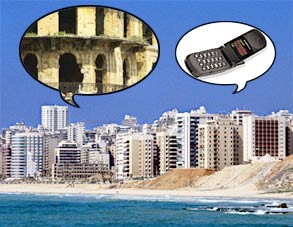

I first met Mr. Ibrahim in the Hamra district of West Beirut. At the time, I’d been searching for a pub that had been recommended to me secondhand, and I wasn’t having much luck. I was studying my street map on the corner of Hamra and Rue Jeanne d’Arc when Mr. Ibrahim approached me, looking innocuous in his blue jeans, plaid shirt and neatly trimmed goatee.
“Are you lost?” he asked me.
“Not really,” I said. “I know where I am; I just can’t find the place I want to go.”
“I am Mr. Ibrahim,” he said, gesturing grandly at the buildings of Beirut, “and this is my city.” He looked to be in his early 30s, but he spoke as if he thought of himself as a wizened old patriarch. “Where do you wish to go?”
“Well, it’s a pub that a friend of a friend told me about, but I’m not sure if you would know where …”
“This is my city!” Mr. Ibrahim bellowed happily, giving me a start. He grinned intensely as I attempted to continue.
“Oh, right. Well, I’m looking for a …”
“Where are you from?”
“I’m from America.”
“America!” Mr. Ibrahim yelled, his voice echoing through the street. Still grinning, he pulled out his wallet and produced a dollar bill. “What is this?” he asked me.
“Um, it’s a dollar.”
“And what does it say?”
“It says, ‘One Dollar.’”
“No!” Mr. Ibrahim boomed. He held the dollar up in front of my face. “It says, ‘In … God … We … Trust’!”
“In God we trust,” I repeated, not sure what the point was.
“That’s why your country is great: Because you trust in God.” Mr. Ibrahim magnanimously handed me the dollar bill. “You keep this,” he said.
“Well, that’s nice,” I said, holding the dollar back out to him, “but I don’t need a dollar as much as I need to find …”
“You keep this!” Mr. Ibrahim hollered happily, snatching the dollar from my hand and stuffing it into my shirt pocket. “Every day you must pray to God for sex, and he will give you more dollars than you ever dreamed of.”
“Pray for sex?”
“Yes, pray for sexus!” He beamed proudly, as if he’d just changed my life.
“Oh,” I said, catching his accent. “Pray for success.”
“Sex-cess!” Mr. Ibrahim yelled, suddenly looking impatient. “Where do you want to go? This is my city, and I can show you anywhere.”
“Well, a friend’s friend told me about a pub called the Hole in the Wall …” I began. As I spoke, Mr. Ibrahim pulled out his cellphone and began to furiously punch in numbers. “I’m just not sure if I’m even in the right …”
I paused as Mr. Ibrahim began to shout Arabic into his cellphone. He stopped for a moment and looked over at me. “Where do we go?”
“The Hole in the Wall.”
“The Holy Diwah!” he yelled at his phone. He punched another button and put the phone back into his pocket.
“Who was that you were talking to?” I asked.
“It’s OK; we will take you there. It is my pleasure.”
“Yes, but who’s we? Who was on the phone?”
“That was Abdul.”
“Is he a friend of yours?”
“Of course not!” Mr. Ibrahim boomed, laughing. “Abdul is my bodyguard!”
Five minutes later, a massive young man drove up in a gold Mercedes 300E. The door locks, I noticed, were tipped with rhinestones. At Mr. Ibrahim’s grand insistence, I took the shotgun seat, and for all practical purposes, I was his hostage for the next three days.
The hours before my first encounter with Mr. Ibrahim stand out in vivid contrast with what was to follow, if nothing else, for their relative peace and coherence.
I’d arrived in Beirut the previous afternoon, but I hadn’t set off to explore the city until that morning. Striking out from my hotel, I strolled past the impressively redeveloped central business district, the Roman ruins of Cardo Maximus and the idyllic campus of the American University.
The most intriguing thing I discovered that morning, however, was the stark evidence of the civil war that had once raged through the city. An abundance of bullet-scarred buildings stood in bleak contrast to the ongoing renovations, particularly along the Green Line that once separated Muslim West Beirut from the Christian East.
I’m not sure why these war remnants proved so fascinating for me. In a way, I don’t even like war tourism, as it reduces certain places — Sarajevo, Belfast, Phnom Penh — into dull, de facto thrill destinations, relevant only for the visceral buzz of recent history. Here, travelers photograph soldiers and barbed wire with the same blind compulsion that inspires them to photograph the Eiffel Tower in Paris.
In Beirut, which has been open to American travelers only since 1997, I found it difficult not to be a war tourist. The battered buildings of the old buffer zone were a grim reminder of not just the Muslim-Christian discord that symbolized the war but the international factors that started and prolonged it: French favoritism, American geopolitics, Syrian opportunism, Israeli brutality, Iranian radicalism and Palestinian rage. In some places, bullet holes in buildings were so common that they seemed a part of the architecture — a congenital concrete defect that just happened to afflict the neighborhood.
By its very definition, war tourism is a fickle activity. Stunned as I was by the evidence of war, sobered as I was by its devastation, I left the Green Line that evening looking for a place to party.
Using directions copied from a month-old e-mail, I began to walk in search of the Hole in the Wall pub. Less than an hour later, I found myself in the ruthlessly gung-ho custody of a man who called himself Mr. Ibrahim.
- – - – - – - – - – - –
When I first got into Mr. Ibrahim’s Mercedes, I thought maybe he was one of those rich guys who run with showgirls and compulsively hand out boxes of Cuban cigars and bottles of Hennessy. As it turned out, he was a celibate teetotaler who vetoed our trip to the Hole in the Wall the moment I mentioned that the place served alcohol.
We ended up driving to the Weekland, an upscale buffet restaurant that had been booked that night for a Sunni Muslim wedding. Unfazed by our lack of a reservation, Mr. Ibrahim bullied his way into getting us a table overlooking the courtyard fountain. As Mr. Ibrahim instructed Abdul the bodyguard to fill my plate with lamb, kibbe and hummus from the buffet, I took in my surroundings. Down in the courtyard, an immaculately dressed bride and groom cut their cake and posed for a photographer. Across the restaurant, groups of relatives watched this unfold live on a big-screen TV. At the tables around us, tuxedo-clad Sunni men smoked cigarettes and squinted at their cellphones. The Sunni women chatted among themselves, looking refined and downright sexy in their designer dresses and silken headscarves.
The Lebanese food was fantastic, and Mr. Ibrahim was thrilled that I ate it with such enthusiasm.
“Do you like my food?” he asked me, grinning like a madman.
“It’s great,” I said between mouthfuls.
“How about my city? Did you see my city today?”
“Yes, I walked around some this afternoon.”
“What did you see? Did you see the Hard Rock Cafe?”
“No, but I visited the American Univ –”
“That was a trick question: Beirut has two Hard Rock Cafes!”
“Wow. Well, I haven’t seen either one of them yet, but …”
“Two Hard Rock Cafes!” Mr. Ibrahim hollered happily.
“Right, but today I went walking along the old Green Line and …”
“I’m sorry, where did you say?”
“The Green Line. I went walking …”
“The Green Line is not for tourists!” Mr. Ibrahim yelled, shaking his finger at me. For the first time since I’d met him, Mr. Ibrahim was not grinning, and this gave me a chill.
“What?” I stammered.
“The Green Line has only bullets and old buildings. Why do you want to see that?”
“Well, I thought it would be interesting to …”
“Do these people look like terrorists?” Mr. Ibrahim asked, gesturing angrily at the wedding guests, his voice echoing off the walls.
“Of course they don’t look like terrorists.”
“Of course not! Look at them! This is like Europe. Does this not look like Europe?”
“Yes, it’s very nice.”
“Then why do you go to look at buildings with bullets?”
“I don’t know. I guess it just seemed …”
“There were 180 Lebanese on the Titanic!”
I stared at Mr. Ibrahim, momentarily speechless. Since it looked as if his grin might return, I decided to play along. “Really?” I said, completely oblivious to how this factoid could have any relevance. “There were 180 Lebanese on the Titanic?”
“Of course! They were all rich men, businessmen. Like Europeans. Do you think they would let terrorists onto the Titanic?”
“I’d imagine they wouldn’t.”
“Of course not! The Lebanese have always been rich people, important people. Do you know how many Lebanese there are in Bill Clinton’s cabinet?”
“I don’t know.”
“Four! There are four Lebanese in Bill Clinton’s cabinet. I know this, and I am not even American! And the president of Ecuador. Do you know where he is from?”
“Well, I’d imagine he’s from Ecuador.”
“He is from Lebanon!” Mr. Ibrahim roared, obviously having a good time again. “And when Boris Yeltsin needed surgery for his heart, where do you think his surgeon was from?”
“Lebanon?”
Mr. Ibrahim beamed at me. “I think you are a genius. The surgeon was from Lebanon. He could have had any surgeon in the world, but he wanted the best, and the best was from Lebanon.”
Mr. Ibrahim went on like this nonstop for 20 minutes. Once he had exhausted the topic of Lebanese pride, he went on to rant about the evils of tobacco and alcohol, the virtues of America, the scourge of foreign laborers in Lebanon and how Syrians smell like pigs and dogs. The whole time this was going on, Abdul blissfully ignored his boss, shoveling down plate after plate of the buffet food. Whenever Mr. Ibrahim left the table to get more food or bully the wait staff, Adbul would smile mischievously and point out cute girls in the wedding party.
Later, when Abdul was driving us back to my hotel, Mr. Ibrahim laid out our plans for the next day. “Tomorrow, we will go to Byblos,” he said. “I will show you Lebanon, and you can teach me English. How is my English? Is it bad?” Mr. Ibrahim grinned at me from the back seat, obviously fishing for a compliment.
I decided to shoot him straight. “Well, your vocabulary is good, but your …”
“I look many lessons from an institute near the American University.”
“Yes, well, your pronunciation could …”
“I speak English like an American, yes?” Mr. Ibrahim shouted. He grinned ebulliently.
“Well, kind of. But your pronunciation could use some work.”
Mr. Ibrahim looked concerned for just a fraction of a second. “You must teach me to make it better. We will be business partners: I will show you Lebanon, and you will teach me English.”
“OK, well, the best way to improve your pronunciation is to …”
“I think you are the best teacher, so I will be the best tour guide!”
“… listen and practice. Listen and practice, and your pronunciation will get better.”
“Listen and practice!” Ibrahim yelled happily.
But of course he wasn’t really listening.
Sightseeing with Mr. Ibrahim the next day turned out to be like some kind of bizarre fraternity initiation or religious penance. As we walked through the old Crusader castle and Roman ruins at Byblos, Mr. Ibrahim demanded that I peek into every single tomb, climb every single rampart and photograph every single colonnade.
“When will you come to Lebanon again?” Mr. Ibrahim would shout every time I tried to complain about this. “This is the history of my country!” As we walked from ruin to ruin, Mr. Ibrahim wanted to know my opinion about each detail of the experience, and he got grumpy whenever he thought I wasn’t being enthusiastic enough.
Amid this tireless touristic browbeating, I slowly learned things about my hellbent host. Mr. Ibrahim, I discovered, was 32 years old, the son of a Sunni Muslim father and a Maronite Christian mother. As a child, he and his family lived on the Green Line, and the young Ibrahim came to admire the American soldiers who patroled his neighborhood. Sometimes, the soldiers would give him vacuum-wrapped MREs (meals ready to eat) — dehydrated Army food that tasted like chicken or beef or coffee. Ibrahim idolized the foreign soldiers, and — much to the consternation of his family — he hung a small American flag in his bedroom. Eventually, the Americans withdrew from Beirut, and Ibrahim’s home was destroyed in the ongoing fighting. Salvaging what they could, he and his family moved in with relatives on the outskirts of town.
After the fighting subsided in 1990, Ibrahim went into business, first selling simple household items from Lebanon and later importing goods from overseas. He first became rich by introducing certain European detergents and soaps to the Lebanese market, and that’s still his main line of business — even though he speaks of branching out into jewelry and women’s shoes.
If there was something in which Mr. Ibrahim took the most pride, however, it was the fact that he had not so much as touched a girl in all his 32 years. When we traveled back down the coast toward Jounieh, I quizzed him about this, and by the time we’d taken the cable car up to the Christian shrine at Harissa, Mr. Ibrahim was happily bragging about his utter lack of a sex life. As we climbed the winding staircase up to the huge Virgin Mary statue, Mr. Ibrahim told heroic stories of celibacy with the same lusty enthusiasm most men reserve for tales of sexual conquest.
“I’ve had 30 different women who wanted to do sex with me, and I told them all no!” Mr. Ibrahim bellowed proudly, startling a group of Sri Lankan pilgrims as we spiraled our way up to the bronze Virgin. “Some of them rented hotel rooms for me! One of them showed me her panties! But do you know what I told her?”
“What did you tell her?” I asked wearily.
“I told her no!”
Oddly enough, Mr. Ibrahim was equally preoccupied with people who were highly promiscuous. Adbul, he repeatedly reminded me, had fathered two children out of wedlock. During his days as a competitive bodybuilder, Abdul had once had sex with five women over the span of three days. Another associate of Mr. Ibrahim’s, a 60-year-old Saudi man, had supposedly been married to 80 women and fathered 42 kids. This man’s latest wife was a 17-year-old Syrian girl, and on their wedding night he’d taken Viagra and had sex with her 18 times. After that night, Mr. Ibrahim noted happily, the Saudi man had been paralyzed for three days.
After Jounieh and Harissa, Mr. Ibrahim had Adbul drive us back to Beirut. At first I thought this meant I would finally get to go home, but instead we ended up cruising the city for two hours. Meticulously avoiding war-damaged areas, Mr. Ibrahim pointed out signs of the prosperous new Lebanon: shopping malls, cinemas, resort hotels and luxury high-rises. “Look!” he would holler obsessively. “This is just like Europe!”
Amid all his shouting, Mr. Ibrahim seemed to be a man who very earnestly wanted to erase all the reputation and memories from a war that had ravaged his home. Somehow, through sheer force of personality, he hoped to turn Lebanon back into a booming, Westernized country. And I think he saw me as a kind of captive emissary who could bring the good news back to America.
Consequently, I shouldn’t have been surprised when he arrived unannounced at my hotel the following morning, ranting about all the thousands of dollars in business he was passing up just so he could take me to the Chouf Mountains. Out of obligation, interpersonal cowardice and lack of a ready excuse, I consented.
About five minutes out of Beirut, however, the presence of a Syrian military checkpoint got Mr. Ibrahim onto an anti-Syria diatribe that hadn’t let up by the time we reached the mountains. The solution to the Syrian military and political presence in Lebanon, he reasoned, was to have the United States bomb the bejesus out of Damascus. After he demanded for the 23rd time that I write a letter to President Clinton in support of this diplomatic strategy, I pointed out that — technically — he could go to the White House Web site and write the letter himself.
Less than one hour later, our plans to visit Beit Ed-Dine Palace had been summarily scrapped and I found myself taking dictation from Mr. Ibrahim in a West Beirut Internet cafe.
“Do you have an e-mail reply address?” I asked him. “It’s required if you’re going to send a message to the White House.”
“Of course!” he boomed. “I use e-mail for business all the time.”
“OK, then what is it?”
“What is what?”
“Your e-mail address.”
Mr. Ibrahim grinned and fluttered his eyelids. “I have many e-mail addresses — 10, maybe 20, e-mail addresses.”
“Just give me one.”
Mr. Ibrahim’s grin wavered a bit. “I don’t remember.”
“OK,” I said diplomatically, “we’ll use mine.”
By the time we were ready to type the body of the message, Mr. Ibrahim was visibly nervous. “What do I say?” he demanded testily.
“It’s your message,” I replied. “Tell him what’s on your mind.”
“Dear President Clinton,” he dictated. “It is my great pleasure and honor to write to you today, and if you ever come to Lebanon, I will be your tour guide and I will show you that we are a rich and beautiful country, and that we are not terrorists like you think we are.” Mr. Ibrahim paused for a moment. “Is that good?”
“Sure,” I said, keying in his greeting. “It’s your message, so say what you want.”
Mr. Ibrahim grinned thoughtfully and stroked his goatee. “Why do you support Israel when you ignore Lebanon?” he said. “Are we not as good at business as them? Are we not more fashionable? Do we not love America also? So why do you give them a billion dollars while we are being invaded by Syrians, who hate America and smell like dogs?”
“Whoa, slow down,” I said, but Mr. Ibrahim had already gone manic.
“When Saddam Hussein invaded Kuwait, you bombed Baghdad!” he yelled. “So why not bomb Damascus now?”
I typed as fast as I could, wincing at Mr. Ibrahim’s reckless bravado. There was a certain sadness to what he was saying. Though created under circumstances similar to Israel’s, the nation of Lebanon has always been too small, too disorganized and too divided to avoid getting bullied by its neighbors.
“Look at us!” Mr. Ibrahim hollered. “Look at the people in this room! We are like Americans! We are like Europeans! We need business and tourists in Lebanon! We need the pope and Michael Jackson to come and see our faces …”
“I think that’s enough for now,” I interjected.
“I am not finished!” he yelled indignantly.
“The president is a busy man,” I said sagely. “It’s best to keep it short.”
“Yes, you are right,” Mr. Ibrahim said, looking a bit dazed. “Do you think he will write back?”
- – - – - – - – - – - -
The next day, Mr. Ibrahim had to work, so I visited the village of Qana, near the zone in South Lebanon occupied until recently by Israel.
But, of course, it wasn’t that simple. The night before, Mr. Ibrahim had asked me what I was going to do in his absence, and when I told him Qana, he’d nearly lost it.
“You should not go to Qana!” he’d yelled. “There is nothing to see there!”
By “nothing to see,” Mr. Ibrahim meant that the place was a reminder of war. In Qana, the main tourist attraction is a Syrian-built memorial to the 200 civilians who died when Israel shelled the town in 1996. However, since Qana is also one of the possible locations of Cana — where Jesus was said to have turned water into wine at a wedding festival — I was able to use this seemingly pious pretext to convince Mr. Ibrahim of my good intentions.
Insisting that I also visit Sidon during my southbound trek, Mr. Ibrahim gave me $20 to cover transportation and admission fees. Each time I tried to refuse the $20, he accused me of not really wanting to go to Sidon. This accusation, of course, was completely valid. I finally persuaded Mr. Ibrahim to keep the money, but he made me promise to call him with a full report as soon as I got home that evening.
By the time I’d taken two buses and a share-taxi down to Qana, the comparative serenity of traveling without Mr. Ibrahim had already made the trip worthwhile. Once in the town, I was more impressed by the sight of daily life in southern Lebanon than I was with the clumsy Syrian memorial to Israeli atrocity. South Lebanon is a predominately Shi’ite Muslim area, and huge pictures of the Ayatollah Khomeini hung on buildings and along roadsides. Some neighborhoods flew the yellow flag of Hezbollah, while others displayed the green Amal flag. Despite the violent fanaticism associated with such symbols, however, the town itself went about its business at a casual, friendly pace.
Resolving to overcome my instinctive fear of all the Hezbollah iconography in the area, I hiked out into the countryside beyond the town. After about 15 minutes of walking along a dusty road, I came to a U.N. roadblock manned by a couple of Fijian peacekeepers who introduced themselves as Vasco and Reef. The Fijians were stationed there as part of the U.N. Interim Force in Lebanon (UNIFIL), a mission that — despite its temporary-sounding name — has been in operation since the first Israeli invasion 22 years ago.
After I had been chatting with the blue-bereted soldiers for a couple of minutes, a loud explosion rang out, and a plume of smoke rose up from a hill on the horizon.
“Israelis?” I asked the Fijians nervously.
“No,” Vasco laughed. “A rock quarry.”
“How can you tell the difference?”
“Well, the Israelis usually call on the radio before they start shelling us.”
Vasco encouraged me to hang out at the checkpoint for a while, and Reef went up to the watchtower to prepare some tea. Both Fijians seemed desperate to talk to someone who was fluent in English, and I was certainly thrilled to speak with someone who let me finish my sentences. When Reef returned with cups of milky tea and toast, the three of us chatted about politics, rugby and whether or not Jesus actually came to Qana. Reef was convinced that Jesus had turned the water into wine here in Lebanon; Vasco insisted that the miracle had happened at Kafr Kanna in Israel.
After a while, a couple of local teenagers walked up to greet the Fijians, and Vasco encouraged them to give me a tour of the area. Mahmoud, the older one, jogged off down the road and came back 10 minutes later in his father’s car.
“Mahmoud,” I said as I got into the car. “Is that a Muslim name?”
“Yes, I am Sunni. But many of my friends are Christians. Maybe you’ve heard bad things about Lebanon, but we all get along in my town.”
“What about Shi’ites, do you get along with them?”
“Yes, the Shi’ites are good people. But they don’t like sin, so sometimes they stay to themselves.”
“So does that mean you’re a sinner?”
“Yes,” Mahmoud said seriously. “I like to sin very much.”
After showing me some Roman-era Christian caves on the far side of Qana, Mahmoud took me to an archaeological dig that contained a couple of ancient stone wine vats. A third stone urn sat, broken, at the edge of the pit.
“Were these used to turn water into wine?” I asked Mahmoud.
“I don’t know,” he said, “but I know they are very old. I feel bad for breaking that one.” He pointed to the fractured urn at the edge of the pit.
“That urn is enormous,” I laughed. “How could you have possibly broken it?”
“Well, my father owns a construction company, and I broke it with his bulldozer when we were building a street a couple weeks ago. I thought it was a rock until we took it out of the ground.”
I looked again at the broken urn. Archaeologists go for years without finding anything that big or old, and here Mahmoud had discovered it during his after-school job.
- – - – - – - – - – - – - – - – - – - – -
That evening, I returned to Beirut in good spirits. Buoyed by my successful foray into the south of Lebanon, I went out for an evening stroll through East Beirut and ended up stumbling upon (though not entirely by accident) none other than the Hole in the Wall pub. There, I drank a couple of beers and listened to music until just short of 10 o’clock.
When I arrived back at my hotel, Mr. Ibrahim and Abdul the Bodyguard were in the lobby waiting for me. I noticed that Mr. Ibrahim was cradling an enormous plastic tub full of pudding.
“I told you to call me!” he bellowed as soon as he caught sight of me.
“Yes, well, I was just going to call –”
“Where have you been?”
“Well, I started out by going to Qana –”
“Qana? What about Sidon?”
At this point, I was too flustered to do anything but lie outright. “Sidon,” I said. “Well, wow! It was great.”
“What did you see there?”
“The ruins. I visited the ruins.” This was a stab in the dark; for all I knew, the big attraction in Sidon was a Tijuana-style donkey show.
“The ruins!” Mr. Ibrahim yelled. I wasn’t sure what this meant until he grinned and held up the tub of pudding. “My sister made you some sweets!” he said. “We can eat it together.”
Relieved at being off the hook, I plopped down next to Mr. Ibrahim and started to spoon up the chocolate dessert. After a couple of bites, Mr. Ibrahim tugged the bowl away from me.
“You smell like Al Cole,” he said. One couch over, Adbul diplomatically picked up a magazine and pretended to read it.
“Al Cole?”
“Did you drink al-coal tonight?”
It then dawned on me what he meant. “Just a couple of beers,” I said.
“In Sidon?” Mr. Ibrahim yelled.
“Um, no,” I mumbled. “I had them here in Beirut.”
“You didn’t call me because … you … were … drinking … al-coal?” Mr. Ibrahim glowered at me. Obviously, this was a major betrayal in his moral world.
“Like I said, I was going to …”
“I have been waiting here for two hours!”
“Well you didn’t need to come all the way …”
Mr. Ibrahim shoved the tub of pudding over at me. “You eat this,” he said quietly. “I’m not hungry anymore.”
“I’m sorry, it’s just …”
“Eat it!”
“Doesn’t Abdul want …”
“Abdul is not hungry either!”
I stared down at the pudding. The plastic tub was so big that I could have used it to smuggle a bowling ball through customs at the airport. There was no way I could have eaten all of it by myself, and I secretly suspected that he’d had his sister prepare it with the sole intention of punishing me for not calling him within the proper time frame.
Gripping my spoon, I made my best effort. As I choked down the chocolate dessert, it occurred to me that my weird friendship with Mr. Ibrahim betrayed my own credulous, middle-class sense of judgment. Had someone as ruthless and narrow as Mr. Ibrahim been a penniless street sweeper with a donkey cart and a chicken instead of a Mercedes and a bodyguard, I doubt I’d have accepted his efforts to help me in the first place — and I certainly wouldn’t have let him know where I was staying. But seeing Lebanon by Mercedes and eating gourmet meals had made me rationalize Mr. Ibrahim’s idiosyncrasies. Somehow, I suspect that both his social life and his moral self-concept depended on people like me.
In the end, Mr. Ibrahim didn’t force me to eat all of the pudding. After verifying to his satisfaction that I was truly suffering from the effort, he melodramatically forgave me for not calling him, then went home for the night.
If he had any intention of surprising me with a sightseeing trek the next day, I didn’t wait around to find out. Immediately after the pudding incident, I wrote Mr. Ibrahim a note. It read: “I’m sorry to have to tell you this way, but I had to go to Syria on short notice. Thank you for your kindness and hospitality. I will remember Lebanon well.”
The next morning, I left the note with the manager of my hotel and took the first bus up the coast to Tripoli, a seaport on Lebanon’s northwestern coast. For the first hour of the bus ride, I had trouble relaxing; I kept expecting the old lady in the seat next to me to pull off a polyurethane face mask and reveal herself, grinning madly, as Mr. Ibrahim.
As for the note I left with the hotel manager, it wasn’t completely dishonest: I will indeed remember Lebanon well. It’s just that too much of any good thing has a way of wearing a man down.
Since I hadn’t had time to change my clothes that morning, I arrived at the Jordanian customs station in Aqaba with the bloodstains still on my pants. The blood had dried to the point where I didn’t look like a fresh mass murderer, but no doubt I appeared a bit odd walking through the ferry station with scallop-edged black droplets on my boots and crusty brown blotches soaked into the cuffs of my khakis.
The blood was from the streets of Cairo, which at the time had been in the midst of celebrations marking the Islamic Feast of the Sacrifice, known locally as the Eid al-Adha.
As with everything in Cairo, the Eid al-Adha was an inadvertent exercise in chaos. For the entire week leading up to the holiday, the alleys and rooftops of the city began to fill up with noisy, nervous knots of livestock brought in for the feast. Cairenes paid little mind as cattle munched clover outside coffee shops, goats gnawed on empty Marlboro packs in alleyways and skittish sheep rained down poop from apartment building balconies. For Egyptians, this preponderance of urban livestock was part of the excitement of the feast — and it was certainly no stranger for them than putting a decorated tree inside one’s house in anticipation of the winter holidays.
In Islamic societies, the Eid al-Adha is a four-day feast that commemorates Abraham’s near murder of his son, Ishmael, to prove his obedience to God. Since tradition tells us that Allah intervened at the last minute and substituted a ram for Ishmael, Muslim families celebrate the Eid by slaughtering their own animal for the feast.
Consequently, on the first morning of the Eid, all of the thousands of sheep, cows and goats that have been accumulating in Cairo during the week are butchered within the span of a few bloody hours. In keeping with tradition, devout Islamic families are instructed to keep a third of the butchered meat for themselves, give a third to friends and family and distribute the final third to the poor. For Muslims, it is an honorable ritual.
For infidel visitors to Cairo, however, the Feast of the Sacrifice seems much more like a Monty Python vision of pagan mayhem. This has less to do with the intent of the holiday than with the fact that Cairo is a very crowded city where almost nothing goes as planned. Thus, on the first morning of this year’s Eid, the lobby of my hotel resonated with vivid secondhand reports of gore: the lamb that panicked on the balcony at the last minute and avoided the knife by tumbling five stories to the alley below, the cow that broke free from its restraints with its throat half-slit and lumbered through the streets spraying blood for 10 minutes before collapsing, the crowd of little girls who started puking as they watched the death spasms of their neighbor’s sheep.
Regardless of how accurate these stories were, there was no disputing that free-flowing blood was as common as Christmas mistletoe on the first morning of the Eid. By the middle of that afternoon in Cairo, puddles of blood stood like rainwater around drainpipes, and doorjambs and minivans alike were smeared with clotted red-brown handprints.
I’ll admit that there is much more to the Muslim Feast of the Sacrifice than public displays of carnage. Unfortunately, Cairo has a way of drawing one’s attention away from nuance and subtlety. By the end of the day, I was so accustomed to seeing blood that I didn’t even realize that my pants and boots had been stained until I boarded an overnight bus headed for the Gulf of Aqaba.
For most Westerners, Islam is a religion that doesn’t quite make sense. No doubt this is largely the result of the Western press, which tends to portray Islam only in terms of its most extreme and violent factions.
When I first traveled to the Islamic world earlier this year, I’d hoped that the Arabs’ legendary hospitality would break down such barriers to religious understanding in a direct and personal way.
After 10 weeks of traveling through Egypt, I’d found that Islamic hospitality more than lived up to its reputation: Most of the Muslims I’d talked to were amiable, kindhearted people who practiced their faith with natural sincerity. By the same token, however, none of the Muslims I’d met seemed to know why they were Muslims; they just instinctively knew that their faith allowed them to live with a special sense of peace. Whenever I tried to qualify this faith in objective terms, people became defensive and impatient with me.
Reading the Koran didn’t help. Perhaps when studied in its classical Arabic form, the Koran is a heart-pounding page turner. Its English translation, however, has all the narrative appeal of a real estate contract. Nearly every page is crammed with bewildering sentences that seem to have been worded at random. An example: “But when they proudly persisted in that which was forbidden, we said to them, ‘Become scouted apes’; and then thy Lord declared that until the day of the resurrection, he would send against them those who should evil entreat, and chastise them” (Sura 7:7).
After a while, my only reaction to such verses was to stare at the page while my mind wandered about aimlessly. In this way, I ultimately found that my reflections on Allah were being offset in equal portion by thoughts of breakfast, girls I should have kissed in high school but didn’t and the lyrics to “Rhymin’ and Stealin’” by the Beastie Boys. I gave up on the Koran less than a 10th of the way through.
Thus, I considered my trip to Jordan on the second day of the Eid to be my most immediate and realistic chance of knowing the intimate ways of Islam. Just as a person can’t know Christmas by interrogating shopping-mall Santas, I figured my understanding of the Eid al-Adha lay outside the bloody distractions of Cairo. In Aqaba, I hoped, I stood a better chance of experiencing the Feast of the Sacrifice as an insider.
- – - – - – - – - – - – - – - – - – - – -
Aqaba, Jordan, owes much of its fate to the rather arbitrary international borders drawn up in Versailles, France, and London in the wake of World War I. Though the city had been used as a trading post since the days of the Edomites and Nabateans, its port and beaches never found much permanent distinction. This all changed in 1921, when Winston Churchill (who was the British colonial secretary at the time) oversaw the creation of a Transjordanian state that featured a mere 11 miles of coast on the Gulf of Aqaba. Nearly 80 years later, Jordan’s only seaport has inevitably blossomed into a dusty, yet functional resort town. Jet skis and glass-bottomed boats ply its waters, weekend revelers from Amman, Jordan’s capital, crowd its beaches and drab concrete buildings dominate its shore.
Upon arriving in Aqaba, I hiked into the city center in search of a hotel where I could change out of my bloodstained clothes. Because most hotels in Aqaba were full of Jordanians spending their Eid holiday on the beach, my only option was to rent a foam pad and sleep on the roof of a six-floor budget complex called the Petra Hotel.
I shared the roof with four other travelers, from Denmark and Canada. When I told them about my plans to celebrate the Feast of the Sacrifice in Aqaba, I got two completely different reactions. The Danes, Anna and Kat, were horrified by the thought that I would intentionally seek out Arab companionship. Both of them had just spent a week on the Egyptian beach resorts in Sharm el Sheikh and Dahab, where the aggressive local Casanovas had worn them both to a frazzle. The two spoke in wistful terms of getting back to the peace and predictability of their kibbutz in Israel.
Amber and Judith, on the other hand, stopped just short of calling me a wuss. The two Canadians had just returned from spending a couple of weeks with Bedouins in the desert near Wadi Rum. Not only did they celebrate the Eid as part of their farewell party, but they personally helped butcher the goats. To experience the Feast of the Sacrifice any other way, they reasoned, would seem a tad artificial.
“And besides,” Amber told me as I changed into clean clothes and prepared to hit the streets, “Aqaba is a tourist town. The only people you’ll find here are college kids and paper pushers on vacation from Amman. You’d have better luck getting invited to the Eid in Toronto.”
Amber had a point, but she was wrong: I was invited to celebrate the Eid before I reached the ground floor of the Petra Hotel.
My would-be host was Mohammed, a bespectacled 16-year-old who stopped me in the second-floor stairwell. “Where are you going?” he asked as I walked by.
“Well, I’m hoping to go out and celebrate the Eid al-Adha,” I said.
“The Eid!” he exclaimed. “Please come and celebrate with us!”
It was that simple. Such is the gregariousness of the Arab world.
Unfortunately for my notions of authenticity, however, Mohammed’s “Eid” consisted of him and two other goofy-looking 16-year-olds drinking canned beer in a tiny room on the second floor of the Petra. Mohammed introduced his two friends as Sayeed and Ali. Neither of them looked very natural as they grinned up at me, clutching their cans of beer.
I noticed there were only two beds. “Are you all sleeping in here?” I asked.
“Just Sayeed and Ali,” he said. “I sleep at my uncle’s house in Aqaba. My family always comes here for the Eid al-Adha.”
Mohammed poured some of his beer into a glass for me and put an Arabic pop tape into his friends’ boombox. The four of us sat in the room chatting, drinking and listening to the music. After about 15 or so minutes of this, I began to wonder what any of this had to do with the Feast of the Sacrifice. “Aren’t we going to celebrate the Eid?” I asked finally.
“Of course,” Mohammed said. “This is the Eid.”
“Yes, this is the Eid,” I said, “but won’t you be doing something special at your uncle’s house?”
“It’s not interesting at my uncle’s house. That’s why I came here.”
I looked skeptically at my three companions. “But isn’t there something traditional that you do when you celebrate the Eid?”
Mohammed thought for a moment. “We spend time with our family.”
“But you just said that you didn’t want to be with your family.”
“Yes.”
“So you aren’t really celebrating the Eid, are you?”
“No. This is the Eid!”
“How?” I asked, gesturing around the tiny room. “How is this the Eid?”
“We’re drinking beer. Many people drink during the Eid.”
Ignorant as I was about Islam, I was positive that a true Muslim holiday would have very little to do with swilling beer. “I’m sorry guys,” I announced, “but I think I’m gonna have to go now.”
Mohammed looked hurt. “But you said you came here for the Eid!”
“Yes,” I said, “but I could drink beer and listen to music back home in America. I want to do something different.”
“Maybe you want to dance?”
“Maybe,” I said. “Where can we dance?”
Mohammed reached over to the boombox and turned up the music. The three Jordanian teens leapt up and started to shake their hips to the music. There was no room to move, so they stood in place and waved their arms around. The Arabic music was as stereotypical as it could get: a snake-charming, harem-inspiring swirl of strings and drums and flutes. Mohammed took me by the arm; I stood and tried to mimic his dance moves.
“Is this an Eid dance?” I yelled over the din of the music.
“No!”
“Is this Eid music?”
Mohammed laughed. “Of course not!”
“Then why are we doing this?”
“Because it’s the Eid! It’s fun, yes?”
I told Mohammed that it was indeed fun, but that was a lie. As with freeze tag, heavy petting and bingo, many exercises in human joy are best appreciated at a very specific age. To truly understand the appeal of drinking beer and dancing with your buddies in a bland resort-town hotel room, I suspect you have to be 16 years old. I danced halfheartedly to the music, politely waiting for it to stop.
When I sat down after the first song, Mohammed happily yanked me to my feet. Twenty minutes later, the young Jordanians had moved on to the Side B songs without any sign of fatigue. I weakly shuffled in place, desperate for an excuse to leave. It occurred to me that, technically, I could just sprint out of the room and never have to talk to these guys again.
Then the inspiration hit. Leaning across the bed, I shut off the boombox and unplugged it from the wall. Mohammed and his friends looked at me in confusion.
“Let’s go,” I said to them. Carrying the boombox with an air of authority, I led the Jordanian boys up the stairwell to the roof of the Petra Hotel. There, I introduced them to Anna, Kat, Amber and Judith.
Serendipity is a rare thing, so it must be appreciated even in its humbler forms. As Mohammed, Sayeed and Ali exchanged formal handshakes with the Danes and the Canadians, I saw that their faces were frozen into expressions of rapturous terror; they had probably never been that intimate with Western women in their lives. Perhaps charmed by the boys’ awkwardness, the girls regarded the young Jordanians with sisterly affection.
I plugged in the boombox and announced that it was time to dance.
I’m not sure if that evening on the roof of the Petra Hotel meant much to any of the other parties involved, but I like to think that it was an all-around triumph: Anna and Kat were able to interact with Arabs in a charmed, unthreatening setting; Amber and Judith got to boss the boys around in colloquial Arabic and showcase their Bedouin dance steps; Mohammed, Sayeed and Ali — in their goofy, reverent, 16-year-old way — got to dance with angels on the heights of Aqaba.
For me, however, the night was a technical failure: I’d come to Jordan to experience the Islamic soul of the Eid al-Adha, and I’d ended up spearheading a secular sock hop on the roof of my hotel.
But, at a very basic level, even this was a bona fide extension of the Feast of the Sacrifice. After all, any holiday — when stripped of its identifying traditions and theologies — is simply an intentional break from the drab routines of life: a chance to eat or drink heartily with family and friends, an opportunity to give thanks to God or fate or randomly converging odds, a date to anticipate with optimism or recall with satisfaction.
With this in mind, I reckon that the ritual intricacies of feasts and festivals anywhere are mere decoration for a notion we’re usually too busy to address: that, at the heart of things, being alive is a pretty good thing.
Six stories above Aqaba, the eight of us talked and joked and danced to the Arabic tunes, improvising our moves when we weren’t sure what else to do.
Continue Reading
Close
By the afternoon of my second day in the Libyan Desert, I finally found the sense of isolation I’d been looking for. The faint white ridge-line that marked the far edge of Dakhla Oasis 37.5 miles to the north had just dropped beneath the horizon, and I found myself adrift in a sterile sea of yellow dunes. Inspired by the gorgeous absence of everything but curves and light, I unslung my pack, tossed it into the sand and sat down for a much-needed breather.
Though it seemed innocuous at the time, this was probably the act that turned the next 10 hours of my life into a wearying mix of self-loathing and dull paranoia.
Up until that moment, my hike into the sandy fringe of the world’s largest desert had been full of simple discovery and fascination. In the utter emptiness of the landscape, I found myself vividly aware of slight details: telltale irregularities in the texture of the sand; the metallic ping of the odd rocks beneath my boots; a lone ant marching up a dune, its abdomen tilted skyward. I noted a complete lack of odor in the air; I watched the rippled shadows of the landscape dissolve at midday, then deepen again in the afternoon.
This all changed just before sunset, when I opened my pack to find my gear slathered in a sodden brine of damp grit and filmy garbage. Beneath this water-slicked gear, I found my last bottle of Bakara mineral water — its thin, plastic shell burst open in the middle, its contents mostly gone. Unthinking, I sloshed the excess water out from the bottom of my pack and started spreading things out to dry in the sand.
It wasn’t until I’d begun to tally my gear that I realized the problem: Two days into the desert, I had only one bottle of drinking water remaining, and that bottle was half-empty.
There are some moments in life when unexpected situations call for momentous, life-changing acts of resourcefulness and endurance. This was not one of them. Granted, I was hiking into one of the emptiest areas in the world: To my south and west, nothing but sand and rocks lay between me and the distant, barren borders of Sudan and Libya. To my north, however, a village called Mut — the southernmost outpost of Egypt’s Dakhla Oasis — was no more than a 12-hour trudge away. Outright stupidity on my part excluded, I’d not likely be forced to jettison my gear, drink my own urine or flag down passing airplanes in the effort to survive.
Rather, my situation was far more representative of prosaic day-to-day life: It didn’t require outright heroism so much as it required thankless, forgettable drudge work. A 12-hour forced march to Mut on a half-liter of water was certainly doable; it just wasn’t desirable.
Sitting in the sand, the day going dark, I pondered other options. The only unknown factor at the time was what lay to my east. The map in my guidebook (which, I’ll confess, was not designed to aid desert trekking) showed a dotted line dropping south out of Mut — evidence of the old caravan route that once arced down to the distant sands of Sudan. By my own estimation, I could cut due east in the cool of the night and arrive at the caravan road in less than five hours. If this road were still in use, I could wait there the next morning and hitch a ride on a truck (or, I’d secretly hoped, on a camel), thus neatly avoiding the tedious slog to Mut. On the other hand, if this road were disused I would double both my hiking distance and my odds of being forced to swill my own urine.
Gathering up my gear, I took an eastward bearing off my compass and rolled the dice.
Except for certain situations involving science, warfare or divine prophecy, there is never really any practical reason to go wandering off into the desert — and this is probably the very reason why so many people are inclined to do it.
Nearly 2,500 years ago, the Greek historian Herodotus wrote that, among the Masamon tribe of western Egypt, there lived some “wild young fellows, who planned amongst themselves all sorts of extravagant adventures, one of which was to explore the Libyan Desert and try to penetrate further than they ever had before.” These youths, Herodotus noted, eventually came upon an isolated oasis, where they were attacked and imprisoned by a marauding band of dwarves.
Twenty-five centuries later, the idea of exploring lifeless stretches of sand for no good reason still carries a visceral appeal — dull dangers of dehydration and attack-dwarves notwithstanding.
In the deserts of the Arabic world, much of this mythic appeal has been perpetuated by the tales of classic explorers such as T.E. Lawrence, Wilfred Thesiger and Sir Richard Burton. When I traveled into the western sands of Egypt, however, I had yet to study the exploits of these steely, turban-wearing Brits. Rather my desert canon consisted primarily of eclectic American fare: Edward Abbey’s Utah solitaire; the cinematic fantasies of George Lucas and Steven Spielberg; wisecracking vultures in Far Side cartoons; NASA photos of Mars. Perhaps as a result of this, my inclination toward epic exploration in the Libyan Desert was offset by equal inclinations toward fantasy and irreverence.
Thus, my first impulse upon arriving in the desert town of Farafra was to buy a donkey and ride it into the sandy unknown.
On paper, riding a donkey into the desert is a perfectly legitimate low-tech adventure. Not only are donkeys less expensive than camels and more authentic than Jeeps, I figured I could sell my beast at the end of the trip and break even for the experience.
As any layman who’s tried it will know, however, shopping for donkeys in Egypt is a resoundingly humiliating experience. Not only does the American higher education system leave its graduates with very few practical skills in assessing the market value of pack animals, it would seem that the inhabitants of Egypt’s oases aren’t used to selling their livestock to foreigners. During my first morning of wandering through the dusty outskirts of Farafra, I spent two hours startling and bewildering farmers before I finally found someone who was interested in my proposition.
After a lot of sign language, a smiling old farmer hauled a load of green reeds from the back of his donkey and motioned for me to get on. Once I’d swung my legs onto the beast, the farmer smacked it on the rear and I went bouncing idiotically down the dirt road.
The donkey stopped soon after, so I climbed off and flashed the farmer a thumbs-up. I wasn’t really sure what to do next (slam the doors? kick the tires?), so I decided to cut straight to the bargain. “OK,” I said to the farmer. “Bikam? How much do you want for it?” I wasn’t ready to buy it, necessarily, but I wanted to get a feel for price.
“Pen,” he said.
Not sure what he meant, I took out a pen and some paper so he could write down the price. Smiling, he handed the paper back and pocketed the pen. As the farmer merrily returned to his work, it dawned on me that I had just purchased one 20-second donkey ride.
Since this flavor of commerce wasn’t likely to get me very far, I tried to indicate that I actually wanted to purchase the entire animal with cash. Every time I waved some money around in an effort to pantomime my desire, however, the farmer just shook his head and gestured to the donkey. “Pen!” he repeated cheerfully.
Motioning my intention to come back, I jogged over to my hotel to find a translator. Mohammed, a temperamental middle-aged fellow who worked the front desk, was my only option at the time. After exchanging a few pleasantries, I got down to business.
“I need you to help me buy a donkey,” I told him.
Mohammed scowled. “Why you want to buy a donkey?”
“I want to ride it into the desert.”
“A Jeep or camel is better. I’ll arrange you a trip.”
“I’m not really interested in that; I want to try to do it on my own.”
Mohammed raised an eyebrow in irritation. “You know how to keep a donkey?”
“What do you mean?”
“Food! Water! So it does not die!”
I realized I hadn’t considered this. “No,” I said. “Is it difficult?”
The grumpy clerk grinned at me sarcastically. “You want a desert trip by yourself?” he said, walking his fingers across the countertop. “You be your own donkey!”
Though I never did any more donkey shopping in the Egyptian oases, it took me two days before I had rationalized the disappointment and moved on to other options.
By that time, I’d continued on to Dakhla — the southwestern-most of Egypt’s big oases — and I was sharing a dorm room at the Al Qasr Hotel with a German political science student named Tomas. Tomas enjoyed the tale of my Farafra donkey encounter, but he couldn’t seem to understand my initial motive.
“Why did you want to buy a donkey?” he asked me.
“So I could travel into the desert,” I said.
“Why did you want to travel into the desert?”
“So I could be away from things. I wanted to go to a place where nothing has ever lived. I wanted to be isolated.”
“Isolated? What about the donkey?”
“Well, the donkey would just be a funny detail. You know, part of the challenge.”
“So the isolation part wasn’t really that important.”
“No, I wanted to be isolated,” I said to Tomas, still reluctant to admit that my donkey quest was based more on impulse than design. “I guess the donkey would have been part of that isolation, considering I really don’t know much about donkeys.”
“So did you want to be isolated or did you just want to feel isolated?”
“I wanted to be isolated,” I said stubbornly.
“Yes, but really. How is being isolated all that different from feeling isolated?”
After 15 minutes of simple logic, Tomas had talked me into dreaming up a new journey — a walking trek into the Great Sand Sea.
Unlike the rest of the Libyan Desert, where blowing sands mix with dry buttes and rocky moonscape, the Great Sand Sea is nothing but dunes. Covering an enormous sprawl of territory along the Egypt-Libya border, this area went unexplored and uncharted for centuries because of its complete isolation and lack of water. In 1874, the first man to cross these dunes — a German geographer named Gerhard Rohlfs — nearly died in his attempt to lead 17 camels over 420 continuous miles of waterless desert. “It was as if we were on a wholly lifeless planet,” wrote Rohlfs of the experience. “If one stayed behind a moment and let the caravan out of one’s sight, a loneliness could be felt in the boundless expanse such as brought fear, even in the stoutest heart … Here, in the sand ocean, there is nothing to remind one of the great common life of the earth but the stiffened ripples of the last simoon; all else is dead.”
Conveniently for my own purposes, a thin tongue of the Great Sand Sea stretches out into the western fringe of Dakhla Oasis. Here, I’d hoped, I could enjoy this feeling of boundless isolation without the danger of being isolated. Here, in relative safety, I could be my own donkey.
Using my guidebook map, I plotted a course that would start in Al Qasr village on the northern fringe of Dakhla, curve west and south through the desert, then boomerang back into the southern oasis village of Mut three days later.
Packing enough food and water to last the duration of the journey, I struck out for the dunes the following morning.
Tomas joined me for the first leg of the hike, since he was interested in exploring the Al-Muzawaka tombs two hours west of Al Qasr. There, we found a small network of caves that had been hollowed out by some long-ago inhabitants of the oasis. Unlike the famous tombs of Egypt’s Nile valley, there were no admission booths, souvenir stands or rifle-toting guards at the site. The only soul we saw there was an old man who walked out from a lone stone house to take us by the arm and shine a flashlight into the caves. When we tipped him 50 piasters each, he smiled and took us to an open-faced cave that contained five dusty, brittle adult mummies.
Beyond Al-Muzawaka, Tomas followed me into the first cluster of yellow dunes before turning back for Al Qasr. For the rest of the afternoon, I maintained a sloppy southwestern bead, zagging my way up and over the grand piles of sand. Still within sight of the oasis, the desert sand was abuzz with activity: shiny blue beetles, fat black flies, faded pink garbage bags. Every so often, the sand would yield broken pieces of pottery or heavy brown stones.
As recently as 50 years ago, explorers in this part of the Egyptian desert were likely to find all sorts of artifacts preserved in the sand, from flint knives to broken ostrich shells to rock paintings. Mixed in with the pre-historic relics were evidence of more recent visitors: camel bones, bits of clothing, human skeletons. Just last year, a group of American tourists crossing the desert near Bahariyya found the remains of three German soldiers — all members of a flight crew that had disappeared on an exploratory mission during World War II.
Though I’d secretly hoped to find something ancient, desiccated or macabre in the desert, I never was that lucky. At one point, I found a copper bullet slug in the sand and put it in my pocket, thinking perhaps I’d drill a hole in it and hang it on a necklace. Five minutes later I found two more bullet slugs, then another. By the time I’d collected seven bullet slugs, they didn’t seem so special any more, so I threw them all away.
The sun went down after 6, and — since I had no stove and there was obviously no firewood — I set in for the night in the lee of a huge dune. After spooning up a can of tuna for dinner, I pulled out my sleeping bag and stared at stars until I fell asleep. I woke up at first light and resumed my journey.
For the most part, the curved sameness of the Great Sand Sea precludes narrative. My second day in the dunes proceeded much like the first — the only difference being that the insects became fewer and the view of Dakhla’s ridge-line became fainter as the day went on. I filled the emptiness of the landscape with my wandering mind, stopping occasionally to take compass bearings or photograph my footprints.
In a weird way, though, I don’t really recall making much progress until I opened up my water-soaked backpack at dusk and found myself with a tough decision on my hands.
Though I didn’t know it at the time, the area beyond my little tongue of the Great Sand Sea was once thought to be a possible location for an elusive oasis town called Zerzura. Reputedly a place of palms, fresh-water springs and white birds, Zerzura’s location never could be pinned down once explorers started systematically mapping the desert 100 years ago. Early Arab historians placed it south of Siwa Oasis near the Libyan border; early British adventurers placed it west of Dakhla. Murray’s 1899 “Guide to Egypt” placed it in four different locations in the hinterland of the Egyptian southwest. Over the years, various wanderers, bandits and pilots claimed to have seen Zerzura while headed elsewhere, but none could ever find his way back.
In his classic 1935 book “Libyan Sands,” British explorer Ralph Bagnold (who was a member of the British Long Range Desert Group loosely portrayed in “The English Patient”) conceded that Zerzura would probably always be a lost oasis, having long ago been mapped under a different name and absorbed into the Egyptian geography. Still, he held on to the idea that it was out there waiting to be rediscovered in one form or another.
“I like to think of Zerzura as an idea for which we have no apt word in English,” he wrote in the conclusion to his book, “meaning something waiting to be discovered in some out-of-the-way place, difficult of access, if one is enterprising enough to go out and look; an indefinite thing, taking different shapes in the minds of different individuals according to their interests and wishes.”
This in mind, I suppose I discovered my Zerzura when I lost my water bottle in the depths of my pack. What had before been an adventure of fancy had now turned into a matter of real consequence. My Lucas-Spielberg reveries gave way to reality, and I discovered the desert all over again.
Of course, this is an assessment of hindsight. Under the pressure of the decision itself, I wasn’t so philosophical as I trudged my way east. Having been raised to make the more conservative choice in this type of situation (i.e., enduring the direct slog to Mut), I found myself unconsciously veering to the north. Every so often I would catch myself and resume my eastbound progress.
Hiking through the desert under the light of the moon was quite similar to hiking the dunes in daylight. The only difference was that the air was cool, the sand was gray and the mood was spooky. After a while my footfalls didn’t sound like they were coming from my own feet any more; I kept turning around to see if I was being followed. Even sudden patches of soft sand would give me an occasional start in the dim silence.
Eventually, my paranoid habit of veering north caught up with me, when — just short of midnight — I found a Jeep track in the sand. Since I’d been hiking what I thought was east for nearly six hours, I assumed that I’d reached the caravan road. In retrospect, this was a silly assumption: Given that Mut is the last sizable human outpost in that corner of Egypt, it would make sense that a southbound road toward Sudan would be large and well-maintained. At the time, however, I wasn’t so confident. Not sure what to do, I snuggled into the slope of a nearby dune and waited for someone to show up.
After a 10-minute doze, I heard what sounded like footsteps coming my way. Suddenly nervous, I dug my head-lamp out of my pack. The sound got louder, then stopped. It started again, stopped again, then started once more, even louder than before. It sounded like someone was stumbling through the sand in a ragged pair of scuba-flippers. Too spooked to say anything, I turned on the head-lamp and stood there with my fists clenched — looking, no doubt, like some kind of spelunker-ninja madman. Finally, I spotted the culprit: a heavy paper-and-plastic cement bag, drifting its way down the Jeep track on a hiccuping migration to Sudan. I turned off my head-lamp and sat back down.
As I listened to the cement bag flop off into the night, I caught the hint of another sound: a truck downshifting somewhere in the distance. Shouldering my pack, I crossed the Jeep track and continued east. Within 30 minutes, I could see a set of headlights; an hour later I was standing on the blacktop caravan road to Mut. My eastbound gamble had paid off: I’d found my lost oasis in the form of an asphalt road. In an indulgent show of celebration, I took a long pull from my water bottle.
Finding a flat spot far enough from the road so the nighttime trucks wouldn’t disturb me, I spread out my sleeping bag and dozed for a few hours.
Just past dawn, I packed up my gear and hitched a ride to the only place there was to go in that humble fringe of the Libyan Desert.
Continue Reading
Close
By my fourth day in Cairo, avoiding the pyramids has taken on a comfortable sort of rhythm. I have fallen into the indolent habit of waking up past noon, stumbling down to the market for oranges and falafel, then wandering into the city for afternoon sightseeing. The fewer goals I set for this activity, the more Cairo seems to bloom out from its strange corners. My favorite activity is to buy a ticket for the Metro, get off at random, walk until I’m lost, then ask directions back to the station.
In this manner, I have collected sights like souvenirs: men in alleys building lattices, baking bread, butchering chickens; a herd of goats toddling through a public plaza; Berbers in donkey carts stuck in traffic jams. I have seen the incense man swing his censer through a fruit market, collecting 10-piaster tips; I have seen women in full ninja-style chador dive onto speeding buses; I have seen pious Muslim men selling vegetables, their foreheads black with welts from praying to Mecca. I have seen garbage choking rooftops and raw sewage flowing through the medieval gate of Islamic Cairo. The call of the muezzin from the mosques — at first a strange, haunting cry — has now blended into the music of my day.
Gustave Flaubert was equally impressed by the random mundane in Cairo. “I am scarcely over the initial bedazzlement,” he wrote. “It’s like being hurled while still asleep into the midst of a Beethoven symphony, with the brasses at their most ear-splitting, the basses rumbling, and the flutes sighing away; each detail reaches out to grab you; it pinches you; and the more you concentrate on it the less you grasp the whole … It is such a bewildering chaos of colors that your poor imagination is dazzled as though by continuous fireworks as you go about staring at minarets thick with white storks, at tired slaves stretched out in the sun on house terraces, at the patterns of sycamore branches against walls, with camel bells ringing in your ears and great herds of black goats bleating in the streets amidst the horses and the donkeys and the peddlers.”
As with Flaubert, these details captivate my imagination: I go for hours at a time without feeling the slightest twinge of pyramid anxiety.
Today I return from my afternoon wanderings to find out what kind of absurdity towering Tom Bourbon has cooked up for the evening. Yesterday, he and Don the Canadian went off to find a foreign wife for a neighborhood kid they’ve dubbed (because of his eponymous T-shirt) Rolling Thunder Boy. Rolling Thunder Boy’s main impetus for finding a foreign wife is to avoid conscription into the Egyptian army — a ruse that goes back at least a couple of hundred years (in Flaubert’s day, young men were known to gouge out an eye to avoid hated conscription; the viceroy of Egypt finally circumvented this stratagem by creating a special one-eyed army regiment). Tom and Don’s solution to Rolling Thunder Boy’s dilemma was not to find him an American bride (as perhaps was hoped), but to go to the Internet cafe and enroll his name in a half-dozen mail-order marriage services based in the Philippines. On the basis of socioeconomic guesswork alone, I don’t think I’ll hold my breath for Rolling Thunder Boy’s chances, but Tom and Don remain optimistic.
Tonight, Tom suggests that — in a culinary attempt to “go native” — we visit the market, find a live animal and cook it for dinner. Last week, apparently, he and a few other members of Team Sultan failed to cook a pigeon (“we never could find any meat on it,” he explains ruefully), so tonight he wants to try to boil a rabbit or two. About half a dozen Sultanites are up for this, but this number quickly dwindles the moment the market vendor starts pulling bunnies out of the split-reed cages and sizing them up for us. By the time our two rabbits’ throats have been slit and the butcher has begun to peel off the fur, Tom and I are the only takers left. Undaunted, Tom buys a sack of vegetables, and we go upstairs to start in on the rabbit stew.
This activity proves to be an interesting study in the psychology of eating meat: After we slowly boil the rabbit along with vegetables and aromatic spices for two hours, half a dozen new Sultanites hungrily volunteer to join us for dinner. Those who saw the rabbits when they were alive, on the other hand, keep a grim distance from the kitchen.
We decide to cap off Rabbit Night by walking down Talaat Harb Street to catch an Egyptian flick at the Metro Cinema. None of us is good enough at Arabic to fully understand the dialogue, but that’s half the reason for going: The task of trying to discern the plot will add a bit of mystery and challenge to the experience. Tonight, the Metro is showing a film called “Hello America,” a comedy about an Egyptian man who travels to New York in search of the American dream.
In its portrayal of American stereotypes alone, “Hello America” provides a fascinating example of Egyptian filmmaking. From the moment the movie starts, however, I notice a strange detail: Almost all of the American-looking characters — gang members, bodyguards, cops and homosexuals alike — look a bit unkempt and vaguely emaciated. Tom eventually explains this detail: Since film work in Cairo pays a pittance, the only foreigners consistently willing to work as extras are backpackers. Over the course of the movie, Tom spots three minor characters — a robber, a cross-dresser and a homeless person — who are portrayed by current or former occupants of the Sultan Hotel.
What the film lacks in authenticity and artistic value, it makes up for in quirky moments of satire. When the main character joins what he thinks is a “freedom march,” for instance, it turns out to be a gay pride rally; when he shows affection for his young American nephew, he is accused of being a pedophile; when he relaxes in his room with a late-day sheesha, the fire marshal kicks in the door and hoses him down. Although there are a few scenes that take digs at Egyptians (when the main character is stopped at the airport for suspicious-looking luggage, he declares, “It’s OK, I’m an Arab!” and the other passengers flee screaming), the movie is certainly a reinforcement of traditional Egyptian values. Relationships take precedence over rules, individualism is suspect and family is more important than money.
When we return to the Sultan Hotel, our obligatory post-film discussion turns into a heated argument between Stu the Wrestler and Orgasm Girl about American imperialism. Relishing their roles as agitators, the two North Americans lay into each other — Stu citing statistics and examples of how America is a benevolent, impregnable superpower, Orgasm Girl quoting stats and examples of how America is an insidious, bullying neocolonizer. Not up for the Patented America Debate (an endless polemic that invariably surfaces whenever strong-minded Americans share hostel space with strong-minded near Americans), I go to bed early.
In a way, though, both Stu and Orgasm Girl are correct: America is, at this moment in history, both a benevolent superpower and a bullying colonizer. The thing is, we of Team Sultan are — without really being aware of it — a manifestation of that neocolonial instinct.
Unlike its Persian, Greek, Roman, Arabic, Ottoman, French and British predecessors, this American-influenced (but by no means American-dominated) colonialism is affecting Egypt not by military occupation, but through global osmosis: through international wealth and the strength of the dollar; through free trade and technology; through the passive threat of standing armies and nuclear bombs; through information media and pop culture; through aid workers, the English language and — yes — the surplus of good-natured budget tourists from America, Europe and Japan.
Just as ancient Rome found it was easier to maintain its empire when it treated its subjects as citizens and contributors, and just as the old Arab empire multiplied its influence by incorporating the diverse practical knowledge from within its ever-growing borders, those of us in the Sultan Hotel are part of a dynamic, hybrid strain of what might be called (to use a word that is largely pejorative these days) an American-style empire.
Even in our $2.35 beds, even as we smoke sheesha, drape ourselves in kaffiyehs, practice our Arabic and question the merit of our own societies, each of us is an inevitable extension of our own culture. We are travelers, yes, but we also constitute — to a greater extent than Flaubert and his cronies in 1850 — a de facto, somewhat innocuous (and decidedly unpretentious) occupying force.
As I drift off to sleep, I realize — with a twinge of trepidation — that I’ve run out of original, legitimate reasons to avoid the pyramids.
- – - – - – - – - – - – - – - – - – - – - – - – - – - – - – -
To travel the historical sights of Egypt is to invite information overload. Whereas less than 5 percent of Egyptian land is arable and the local oil output is a mere drop compared with Egypt’s cousins in the Persian Gulf, this old Pharaonic land has repeatedly proved to be an inexhaustible source of ancient relics.
Just last year, for example, 200 new mummies (thought to be part of a necropolis that held as many as 10,000 preserved human remains), some of them wearing golden burial masks, were discovered in the western desert. A mere four months ago, ancient symbols carved into a limestone cliff — believed to be part of the earliest known alphabet — were discovered west of Luxor. Also near Luxor, the temple precinct near Akhmim, which is still being excavated, might join Angkor Wat and the Vatican as one of the world’s biggest religious complexes.
Someday these discoveries may find a special place in the Egyptian tourist canon, but for now, none of them comes close to rivaling the popularity and allure of Gîza, Saqqara and Dahshur. Cowing to the inevitable, I arrange a trip to the pyramids on the morning of my fifth day in Cairo.
When Flaubert went to see the pyramids of Gnza and Saqqara, he traveled by horseback and slept in the desert. These days, Cairo’s urban sprawl has turned these sites into virtual suburbs. Hoping to catch all the sites in one efficient trip, I hire Hussein (the Sultan Hotel night clerk) to drive me around for the day. Stefie the Belgian, her friend Nele and a Japanese fellow named Yoshito join me; Tom, who has already been to the pyramids three times, elects to stay in Cairo.
We strike out from the Sultan early in the morning. Hussein’s driving style is a blend of good intentions and bad technique; we sputter through the stop-start Cairo traffic in second gear. At one point, when I ask Hussein the name of a towering mosque, a chubby Egyptian adolescent goes bouncing off the front fender. Fortunately, Cairo traffic is generally slow enough to preclude physical injury in this type of situation: The kid flamboyantly curses Hussein, but seems otherwise unharmed; I make a point of not asking any more questions while Hussein is driving.
Our first Pharaonic destination is Saqqara, which lies south of Cairo’s sprawl. As we leave the Nile Valley, a pale tan desert drops out from beyond the palms and canals; mud-brick houses crumble in the sun. A sign near the monument admission booth reads “Good life, immortality and happiness can be found in Egypt.”
At Saqqara, the tombs and pyramids of Teti exude a quiet, plundered grandeur. As I walk through the dusty chambers and corridors, I try to imagine these places as they might have been in their original splendor, but my brief reveries of ancient Egypt keep getting pushed aside by remembered images of the Luxor Casino in Las Vegas. This proves to be a disconcertingly persistent association, so eventually I just give in and allow my mind to wander — blending personal memories and spontaneous feelings with historical speculation. At Zoser’s step pyramid, my thoughts are interrupted by a fresh carving in the limestone near the bottom: “Edward, 1/1/2000,” it reads. And beneath that, “Fuck you.”
Such thoughtless defacement of the ancient here in Egypt is certainly nothing new. When Flaubert explored the Gnza pyramids, he expressed shock at all the recent graffiti. “One is irritated by the number of imbeciles’ names written everywhere,” he wrote. “On top of the Great Pyramid there is the name of a certain Buffard, 79 Rue Saint-Martin, wallpaper manufacturer, in black letters; an English fan of Jenny Lind’s has written her name; there is also a pear, representing Louis-Philippe.”
I return to the car and tell Hussein about the scrawl on Zoser’s pyramid, but he doesn’t seem all that shocked. As I’ve seen in so many other countries, the flagship phrase of English profanity doesn’t resonate much with Egyptians. As with Nike or McDonald’s, perhaps “fuck you” has simply become another Western trademark — a standardized mantra that tough guys say in American movies.
“You know,” I say to Hussein, “I think someone should build a huge limestone monument that says ‘fuck you,’ just so people will have to think of something different to carve on it.”
Hussein nods over at the pyramids of Zoser and Userkef. “Maybe that’s what they mean already.”
“How’s that?”
“The pyramids,” he says. “Maybe they’re Egyptain for ‘fuck you.’”
Hussein grins to show he’s joking, but for a moment I see the pyramids in an unexpected and brilliant new light.
- – - – - – - – - – - – - – - – - – - – - – - – - – - – - – -
After a stop at Dahshur, we finish our day at Gnza. There, I discover all the tourist madness I’d originally hoped to avoid, but now it seems novel in its own weird way. As I walk up to the ticket booth, swarms of pasty-faced Scandinavians pour out from pink tour buses to jostle me on the walkway; touts bully me with offers of camel rides or painted papyrus. A demoralizingly long line stretches out from the Pyramid of Cheops; Cairo’s skyscrapers tower in the distance. In front of the Sphinx, a ragged band of German hippies bangs on drums and bows in prayer; in front of the adjacent Pizza Hut, Mexican backpackers pose for photos. For some reason, this all seems perfect: I pay my ticket and see what I’m supposed to see.
“You ask me whether Egypt is up to what I’d imagined it to be,” Flaubert wrote to his mother after having been in Cairo for five weeks. “Yes, it is; and more than that, it extends far beyond the narrow idea I had of it. I have found, clearly delineated, everything that was hazy in my mind. Facts have taken the place of suppositions — so excellently so that it is often as though I were suddenly coming upon old forgotten dreams.”
At sunset, black-uniformed guards chase us out of the pyramid complex, and Stefie, Nele, Yoshito and I pile into Hussein’s car and ride back into the living heart of Cairo.
Continue Reading
Close