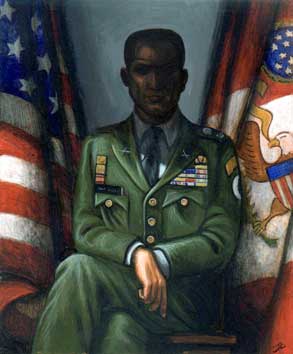

U.S. Military

Don’t ask, don’t tell, don’t fall in love

A rare peek inside the lives of gay military officers reveals staggering sacrifice, loneliness and glass ceilings.

  • more
    • All Share Services

Don't ask, don't tell, don't fall in love

It was only a matter of time. Thursday Night Club proved more popular than expected, and a noisy, animated all-male table for 20 could hardly go unnoticed in the middle of Zio’s Italian Kitchen near downtown here.

The small, conservative city at the base of Pikes Peak supports 80 evangelical Christian ministries and more than 20,000 GIs. It has emerged as a national center for Christian evangelism, particularly since Focus on the Family moved its massive operations into town. The sleepy city of 320,000 is surrounded by military installations: the Air Force Academy, the Army’s 7th Infantry at Fort Carson, two Air Force bases, the U.S. Space Command and NORAD, a small underground city inside hollowed-out Cheyenne Mountain, which monitors North American skies for the start of World War III.

The Denver Post recently dubbed it the “Vatican of Evangelical Christianity.” After Colorado’s infamous anti-gay Amendment 2 campaign was mobilized from here in 1992, gay activists labeled the area Ground Zero.

Thursday Night Club kicked off in a small restaurant in February, moved up to Zio’s in March, and the visible location immediately troubled the soldiers in the group. It’s a pretty butch crowd for a gay dinner party, but the civilians occasionally break into high-queen eruptions, provoking minor shudders in the rigid major seated next to me. Weeks later he will confide it took several shots of whiskey to draw him out into public that first time. But his appearance didn’t provoke a court martial or an investigation, and he’s been a regular ever since.

New men just kept coming out on Thursday nights, and by late March it was growing impossible to escape the curious looks. After weeks of good-natured gawking, an earnest old lady finally leaned over from the next table and asked what brought all these men together.

“Such variety!” she cooed — black, white, military, civilian and, most strikingly, ages ranging from early 20s to late 50s. One of the soldiers described them as “an eclectic mix of old queens to young military guys.”

“I’m so curious what drew you all together,” the old woman continued. “What one thing could you possibly all have in common?”

They chuckled about it briefly, then someone yelled “Promise Keepers!” referring to the conservative Christian men’s group headquartered 70 miles north, near Denver. The table exploded in laughter, but they never did give her a legitimate answer. Nobody pressed them any further, not that night anyway.

The next week they moved to Amanda’s Fonda, an offbeat Mexican restaurant favored by students, grungers and bohemians.

Army captain Brett worries about getting caught, but lately he’s more focused on the price of hiding. “I kind of regret that I missed my youth in the gay world,” he says. All those boyfriends he never had — they slipped right by while he was consumed holding up the straight front.

He doesn’t have to put up much of an act. Tonight the strapping 6-foot Filipino towers over the table, reaches out to greet late arrivals with arms like Sylvester Stallone. His deep, hearty laugh booms over the conversation. The soldiers are easy to pick out even without the buzz cut; their military bearing gives them away, the swagger as they approach the table.

Brett always pictured himself married by now. The Army encourages its officers to settle down early, and he never expected to get out of his 20s single. Most of the captains at Fort Carson are busy raising families, some are already onto their second marriage. Brett just turned 36, and he’s never even been in love.

He looks around the table at his two best friends in Colorado, staff officers like himself, just a few years behind him. Drake is a big, brash Army captain, with a quick wit and a sharp tongue. Captain Alex is a quiet Marine, thoughtful and analytical, clearly the intellectual of the group. He carries himself like a Marine, agile and fit, but not tall or beefy like the other two. Yet for all their differences, Brett is single, Drake is single, Alex is single — between the three of them, they can count exactly one serious boyfriend in their lives.

But then they haven’t really been at it that much of their lives. Like most of the gay officers they know, they didn’t come out to themselves until their late 20s, heavily invested in their military careers before they grasped their need to violate the Uniform Code of Military Justice.

Long before they dreamed of dating men, they dreamed of leading them into battle. The profession of arms. Over and over the phrase was drilled into their hearts at the academies, at Officer Candidate School and ROTC. They repeated it back with the reverence of a Trappist monk uttering his vow of silence. The earliest and noblest vocation, the same sacred calling that drew Alexander, Charlemagne and Caesar. Pope John Paul II traces his line back 2,000 years to St. Peter; Brett, Drake and Alex were taught to gaze back several thousand further, past the Hyksos, past Hammurabi.

It’s difficult for civilians to grasp the gravity of a discharge to the true believer — for any infraction, not just being gay. “It’s an identity,” Alex says. His attraction to men, that’s just one characteristic among hundreds. “Being a Marine is a fucking lifestyle!”

Most of his life, the Profession meant everything to Brett. It’s still the most important thing, but he wonders how wise it was to make it the only thing.

Now he wants a boyfriend. Eventually he’d like a husband, though all three captains are squeamish with the term, with the concept of gay marriage. They each want a “life partner.” But Brett faced a bitter choice as he prepared to advance to major this spring. The pivotal career decision would pit his dream of a soul mate directly against the profession of arms.

It was never supposed to be a conflict. They were supposed to get married, the earlier the better. “The Army still has the concept of the command team,” Drake says, and acquiring a first lady was more or less a job requirement — advisable by captain, essential by lieutenant colonel.

“Don’t ask, don’t tell” made the news regularly during the four months I spent with the captains; but it was obvious almost immediately that they had little trouble maintaining the letter of the policy. Nobody was asking, and they certainly weren’t telling. And as officers, they were largely immune to harassment.

The dirty little secret of the policy is that it never offered more than half a solution to the challenge of integrating gay men and women into the military. It attempts to accommodate enlisted gays — but ignores the central problem faced by officers.

Before the change in 1993, the chief complaints in the gay enlisted ranks were discharge and harassment. In theory, the compromise was simple: You can be as gay as you please if you just keep your mouth shut; in return, we won’t beat you up or kick you out. Fair enough if you can tolerate the closet (and if they ever figure out how to make that no-harassment promise a reality).

But the officer corps faced a different problem: not so much direct discharge, and especially not harassment, but an impenetrable glass ceiling. While presumed homosexuals are frequently tolerated in the lower ranks, even moderate suspicion will stop a rising officer’s career dead in its tracks. And officers operate under an “up or out” system: For them, stagnation equals retirement. It amounts to a subtler form of delayed discharge — after more than a dozen years invested in a hopeless career — which the policy entirely ignores.

There is one well-known defense against the glass-ceiling ejection, but it requires a staggering sacrifice. While a national debate rages on over “don’t ask, don’t tell, don’t pursue,” Brett, Drake and Alex quietly face an unwritten but parallel policy widely understood within their community: Don’t ask, don’t tell, don’t fall in love.

It’s hard to grasp the intensity of the paranoia gay officers feel about exposure without actually experiencing it. Most of Brett’s buddies ran for cover the moment they discovered a journalist among them at Hide & Seek, Colorado Springs’ only gay bar.

For weeks I had failed to coax a single active gay service member to talk, despite the best efforts of intermediaries like the Servicemembers Legal Defense Network (SLDN), the major advocacy group for their cause. “It’s just too risky for them,” says executive director Michelle Benecke. So the first Friday in February, I drove down to approach them in person.

Like most small-town gay clubs, Hide & Seek tries to accommodate a diverse and sometimes antagonistic clientele. It has adopted a separation strategy, walling off bars and dance floors for cowboys and lesbians, a narrow alcove for pool players and a deserted basement for leathermen. The niche quarters surround a center mainstream room, dominated by a small, tacky stage lined with footlights, and projecting a wide catwalk well into the cramped audience.

The main dance floor alongside it stands idle most of the night Fridays and Saturdays, while the same small band of local drag queens performs the same tired routines. Once or twice a month, the monotony is interrupted by a male strip troupe shuttled in from Denver. No one in town seems very happy with the arrangement, but it’s the only arrangement they’ve got.

The GIs were as easy to pick out at Hide & Seek as they would be weeks later at Thursday Night Club: same high-and-tight buzz cut, same military bearing. They were laid-back, warm and inviting, until someone asked what I did for a living.

When I said journalist, most of the pack bolted, but Brett stood his ground to interrogate, a couple of buddies on either side. Who are you working for? What do you want from us? What did Jack tell you? They weren’t even buying the journalist line; suddenly I was an interloper, smuggling out classified information.

You’re an informer, aren’t you? Who sent you? Jack, what did you tell him?!

“No, I swear, I’m gay!” I yelled. I patted myself down as though I’d find some kind of gay ID card, when suddenly I realized I sort of had one. I whipped out my membership card from a gay dance club in Denver. “Look, my Bent card! With my name on it. Here, check out my driver’s license.”

That calmed them down, but Brett remained wary until I joined them on the dance floor a few hours later.

I spent the next four months as a participant-observer inside Brett’s social circle, which includes several closeted gay officers and a healthy network of civilians — but very few women or enlisted men, and not a single straight GI. I became a regular at their barbecues and dinner parties, hung out at coffee shops, hiked into the mountains, slept on their couches and enjoyed dozens of rich, satisfying conversations.

Brett spent much of the period grappling with the pivotal decision of his career — “Of my life, really” — to flout the odds and pursue the profession of arms, or accept an administrative position within the Army, but outside the profession.

Brett was born in a wealthy Manila, Philippines, suburb, and dreamed of growing up to be another Gen. Douglas MacArthur. His father fanned his aspirations, regaling him with tales of the crusty old general vowing to return in 1942, and recovering the capital in three glorious weeks of battle three years later.

When Brett was 9, the family emigrated to Seattle, but retained much of its native culture. Brett was the oldest son, and to this day his father looks to him to establish the family name and produce an heir. He led a platoon through the Gulf War, proved himself under fire and later commanded a combat company in Italy.

The Gulf War gave him a quick taste of the life he dreamed of. His platoon was whisked to the Middle East on a clandestine mission: No time for training, no briefings on how to react to a Scud missile attack. They rode all night in a darkened plane, stepped out onto the tarmac unsure what continent they were deploying into. The Scud-warning alarms blasted and they scattered on the airfield. “I just remember all these people running for cover and I was thinking, where are you running? There’s no cover, there’s nothing to protect you here,” Brett said. “We were on a tarmac on an airfield — if they hit us, we’re goners. I was trying to keep them from panicking, and keep the unit together.” He held the unit together through several attacks over the next few months, donning gas masks and protective suits for anticipated chemical warheads.

But early this March, the Army sent him a CD-ROM offering another path entirely. The “Career Field Designation” form arrives once a career, just before promotion to major. After a decade of specialization, officers are given a one-time chance to select a new branch, a true fork in the road. Combat officers like Brett must finally choose between continuing in combat, or taking an operational support role that’s really quite different from “the profession of arms.”

A common civilian misconception is that most of the Army mobilizes for the battlefield in the event of war. In reality, only a fraction of the force will ever engage in combat, principally soldiers in the infantry, armor and artillery branches. The vast majority of the service focuses on feeding, supplying, transporting and otherwise supporting the combat troops. Warfare requires a parallel society, complete with lawyers, accountants, cooks and mechanics. Those branches make up the bulk of the Army, but carry little of the prestige. Most of the generals and nearly all the powerful commanders are drawn from the three “combat arms.” The problem for the professional soldier lies in the dearth of coveted combat command slots.

For an ambitious officer who dreams of leading hordes across continents, conquering evil empires, vanquishing the next Napoleon or Hitler, the Career Field Designation form is a no-brainer: He’s going to continue on his path, aiming toward battlefield general. If he wasn’t gay, Brett said, his form would have been completed in seconds.

Instead it tore him apart for months, beginning even before he received it. “Because I’m thinking about everything here,” he said. “I’m thinking about who I am, what I want to be, what I want to do, how is this going to affect my career? Everything [is] kind of converging. Ugh. This is awful!”

Col. Hagen, the Brigade Commander at Brett’s previous assignment in Italy, and a mentor ever since, was baffled at his hesitation. “My mentor was saying, ‘Why would you want to pursue operational support?’” he says. “‘You’re limiting yourself. You’ve got the capability to be a commander, why would you even consider going support?’ And I’m thinking, ‘Because I’m gay! They’ll never allow me to be a general.’”

He received the designation form in March and put it away until May.

The bachelor whispers are the first problem to surface. No matter how straight Brett walks and talks, his happily married peers can’t help noticing the infrequency of a woman on his arm.

They kid him about it frequently. “The other day CNN was broadcasting Pride,” he says, referring to the gay Millennium March on Washington in April. “And some of the guys were like, ‘Hey Brett, man, Pride!’” “Yeah, I was there!” he says he shot back.

He’ll typically disarm them with cracks like, “You know me: I like boys,” or “I’ve been trying to get you to go out with me, Hank.”

It’s the only way to deal with it, agrees Alex, the bookish Marine captain. “Someone will make a joke about being gay or some kind of deviant behavior, and I’m like: ‘Hey, that doesn’t count! Everybody does that in college.’”

The banter actually reduces the danger, they say. If they were ever confronted publicly, they would be well-practiced in defusing the issue; and a persistent accuser who refused to play along would find himself out of step with convention.

So far, none of the captains has had to face a direct accusation, but they’re sobered by the possibility. Drake is characteristically brash and animated: “No one would ever approach it like, ‘Hey, are you fucking this guy?’” he says.

It’s hard to picture anyone confronting the big, blustery Army captain so boldly. But he softens as he describes his deceptions, contemplates what might really be running through their heads. He scrounges up a date whenever he can for official functions, shows up stag perhaps 50 percent of the time. It’s a better showing than his buddies Brett and Alex, but is it good enough to keep the straight guys fooled? “Certainly the lesser of two evils is to have your peers know about it and no one say anything, than to have them confront me with it and force my hand,’” he says.

Brett and Alex echo the same deep sense of foreboding. Alex is reflective, as always, but he seems strangely unprepared for the eventual encounter. “I don’t know how I’d handle it if someone ever did ask me,” he says. “I’d want to plead the Fifth, but I wouldn’t know how to delicately do it.” Considering their elaborate subterfuges — which Alex refers to as his “counter-surveillance techniques” — it’s surprising to hear they wouldn’t simply deny it. They seem to despise the deception almost as much as they fear the exposure — and they hope to draw the line at outright denial.

“That’s the worst part of it, the sneaking and hiding,” Drake says. “I chose this life because of the honor, the integrity and the ethics of people I’d be working with. Yes, we really do believe this shit. It’s not just something you make up for recruiting. It’s really a matter of life or death for us. The unfortunate reality was I didn’t realize what was going on with me sexually at the time.”

But Drake and Alex shock me with their own ambivalence about the right of gay men and women to serve openly in the military. “Until you see man-to-man couples walking down the street hand in hand in Colorado Springs, it’s not going to happen in the Army,” Drake says. “I don’t think you can separate the moral from the gross.”

While Brett finds “don’t ask, don’t tell” ridiculous, Alex comes down somewhere in the middle — toward Drake’s side of the middle. “I wish we could get everybody not to be homophobic, but that’s not the reality,” he says. “It’s better left undisclosed.”

But he’s frustrated by some of the policy’s implementation — particularly the arbitrariness of activities deemed to be “telling” — and disgusted by continuing investigations. “The witch hunts are ridiculous,” he says.

Yet they all agree that lying and deception about their sexuality are profoundly disturbing because the essence of their role as officers is to lead by example. “My conflict is, it’s hard to be who I am,” Brett says. “As a leader, as a commander, you have to enforce the rules. Any rule” — including the underlying rules in the Uniform Code of Military Justice (UCMJ) outlawing just about every form of gay sex. Brett realizes he’s breaking the law each time he slides into bed with a man, regardless of Congress’ 1993 law exempting him from prosecution for his crimes so long as he keeps his mouth shut.

The same UCMJ provision includes seldom-enforced language banning oral sex between a husband and wife, a double standard that frustrates Brett terribly but does nothing to diminish his own ethical dilemma.

“It’s hard to be standing in front of people and acting like I am not [gay], and at the same time, having to enforce the rule” he says. “You have to set the standards, and that’s a big conflict for me … If you can’t stand in front of your people, and act as that person, then you’re a fricking hypocrite.”

Drake actually faced the hypocrisy of enforcing that rule as a company commander in North Carolina. He discovered a gay porn magazine in a soldier’s locker during a barracks inspection. In reality, possession of the magazine isn’t even grounds for an investigation, but Drake thought it might be, and immediately consulted his first sergeant. That’s when he learned that the soldier had just discussed his sexuality with the first sergeant, believing he had been outed by a peer. The fear proved false, but his statement put him in clear violation of the policy.

“I wanted to ignore it,” Drake says. “I was conflicted on two points: One, I wanted to follow the rules, and two, I wanted to do what was best for my unit. He’s a hell of a good soldier, and his soldiers would kill for him.”

He finally decided to ignore the incident, with his first sergeant’s blessing, and the soldier is still in the force. He says his own status and his sympathies for the soldier’s plight were never even a consideration. “I totally divorce myself from it as soon as I put my uniform on,” he says. “I know that’s hard for people to understand.”

But did it jar him with a sobering reminder of his own shaky position?

“As a gay man, it doesn’t bother me, because I understand that every decision I make has certain repercussions,” he says. “I’m comfortable being a gay service member, knowing I’m protected by the policy. It protects me from anyone walking up and asking if I’m gay. If anything, it gave me greater respect for the policy. The onus relies squarely on the commander. I chose what was best for my unit.” He does, however, regret that the Uniform Code of Military Justice still makes sodomy a crime.

He also regrets that homosexuality provokes a corollary problem: No officer’s wife to advance his career. Straight female officers also complain about the first lady requirement, but the role can be played by a willing officer’s husband — it just has to be played by someone.

“Officers are expected to participate in unit-sponsored social events, to which they are expected to bring dates and wives and husbands,” says SLDN’s Benecke. “And participation in that social milieu can be as important to promotion as an officer’s competence.”

The first lady tends to perform practical functions, like hosting social events and supervising the family support group, which can play a major role in unit morale. But her key role is played behind the scenes, working the highly influential spouses’ grapevine.

“They socialize, politicize — some of them are very political in trying to help the husband’s career,” Brett says. The conventional wisdom holds that an officer can coast to major on performance alone, but by colonel it’s highly political.

Even if the spouse is a poor first lady, it’s crucial to present the picture of a “Command Team,” he says. “It’s an image they’re trying to portray. They expect battalion commanders to be married.”

“It’s not denying, that’s not what it requires at all,” Benecke says. “Basically, this policy requires people to establish affirmatively a heterosexual image. And if they do not put forward that image, they will come under suspicion, and will find themselves running into a glass ceiling.” Bottom line, it’s get a wife or give up general, Brett concludes. Probably give up even colonel. “You need to,” he says. “You’ve got to have a spouse, a Command Team.”

Brett has temporally defused the marriage problem by playing the cultural card. He wants to please his father by accepting an arranged Filipino marriage, but he’s never quite had the stomach to go through with it. Every year or two, Dad flies in a candidate from Manila to grace his arm for a formal military ball, and for years Brett made a legitimate effort to court them. Several years ago he struck up an engagement. He had every intention of marrying her, but pulled out at the last minute. His sincere struggle — played out semi-publicly — has provided the perfect alibi for bachelorhood. And nothing straightens up a gay risumi quite like an engagement — Brett figures it alone bought him at least a couple years.

But he’s had quite a few years already.

Drake and Alex have no comparable alibis. But Alex may have the best out of all: He might still happily marry a woman one day. “I go back and forth,” he says. “Sometimes I think I’ll end up with a guy. Eventually I will make a choice.” He never acted on his gay urges until 1997, and it’s been mostly men since then, but he still feels attracted to women. He scoffs at the notion he’s just going through a bisexual phase, but some of his friends believe it’s only a matter of time until he settles down with men for good.

Bookish Alex feels an extra sense of isolation, stationed at Peterson Air Force Base, hundreds of miles from the nearest Marine base. He’s also quiet and reserved among strangers. He barely spoke at Brett’s barbecue where we first met, but days later he invited me into his home for an interview. The Dallas Wind Symphony swept through his tastefully understated apartment, wafting serenely through Gustav Holst’s “Moorside Suite.”

The next week he hosted a dinner party of a dozen close friends — all gay, a mix of military men and civilians — at his apartment just outside the base, and Brett invited me along. The discussion crackled with dissension on gay issues, especially marriage, gay culture and the separatism within “the community.”

Drake and Alex are frankly hostile toward liberal gay activists, and take a dim view of the isolationism of gay ghettoes. Brett isn’t exactly waving a rainbow flag, but tends to sympathize with those leading the gay-rights charge. Alex and Drake have only been out to themselves a few years, and some of the guests believe they’re still in a transitional phase, a view they clearly resent. Their frustration peaks at what they see as the homogeneity of accepted “gay culture,” which Alex calls “part of the Wal-Martization of America.”

While they enjoy the company of gay friends a great deal, Drake and Alex feel little affinity for the swishier elements of urban gay culture — particularly in contrast to the aggressive masculinity of the military life they enthusiastically embrace. Their discomfort is probably exaggerated by their sense that they’re one false move away from hurtling straight from military culture to the exclusive company of gays.

They look around the living room at the most frustrating symptom of their quandary: They’re discussing it exclusively with other gay men, a requirement imposed by the culture they embrace, which constantly threatens to eject them.

As the group sits around the fireplace debating gay life and gay politics — and it’s a diverse group despite being all-gay — it’s clear that while many of the debaters have significantly greater gay experience, Alex proves better read than anyone on one gay issue after another. He quotes liberally and effectively from an eclectic collection that spills out of bookcases stacked from living room to bedroom. Kerouac and Camus look down on Bill Buckley and Bill Bennett; Kierkegaard and Nietzsche nestle snugly around Dennis Miller.

But he has to scramble to the rear of the apartment to retrieve a passage from Michelangelo Signorile’s “Life Outside.” The gay collection is hidden away in a storage closet, piled in among combat gear, field guides and a stack of manuals on Marine Corps doctrine.

Drake only faced his sexuality two years ago, but he bears no illusions about turning back. He has no hope of an arranged marriage or falling in love with a woman. He’s contemptuous of gays who have resorted to the sham-marriage option. “I could never stand in front of God and everybody and take that oath,” he sneers.

That’s unfortunate, because of the three captains, he’s the one dead set on making general. He struts like a field marshal already: big, bright, and aggressive, with a trenchant wit he’s not shy about wielding. He’s completed two stellar combat commands, intuitively grasps the politics and plays it with the best of them. Nobody doubts his ability to earn the general’s star — except perhaps the gay officers who share his secret.

Drake meets Brett for lunch frequently, and happens to call one morning while I’m visiting, around the end of February. We’ve hit it off socially at Brett’s barbecue and Alex’s dinner party, so he agrees to a lunch interview, with Brett sitting in. Drake suggests a restaurant downtown, Brett rolls his eyes. Drake is extremely intelligent, but mildly reckless in Brett’s view: The interview will be conducted in private, he insists.

Brett and I run out to the Safeway on the corner for lunch meat and fruit. Most of the Carson GIs take advantage of the lower prices at the commissary and the PX, but Brett lives downtown, miles from post, and he’s eager to avoid off-duty contact anyway. One less chance for casual encounters with his peers, who might strike up a conversation, get to know him outside of work, suggest he join them for a couple of beers or a game of pool.

Drake elaborates on his opposition to open gay service while Brett fixes the sandwiches. “It’s too indoctrinated in our Judeo-Christian tradition,” he says. “People will always think they’re better than you.”

The reality, he says, is that most of the troops would be comfortable with most of their gay peers if they knew who they were. The military generally attracts “butch guys” regardless of their sexuality, he says. Yet he’s pessimistic about overcoming the ingrained images of gays in the service. “The stereotype is nothing but group showers and boots in the air,” he says.

He describes his future so passionately, so vividly, that it’s hard to believe he doesn’t see the contradiction. One moment he’s describing his rapid ascent toward general, minutes later a completely opposing picture of “wedded” bliss.

He acknowledges he’ll have to sacrifice much of his gay life to continue advancing up the chain of command. “I’ve chosen to put my personal life aside,” he says. “I’ve purposely sort of squelched my private life because of a sense of higher purpose.”

Yet soon, he’s bristling at the thought of sacrificing the life partner he’s still intent on finding. “I don’t want to die an old, sad fag without a mate,” he insists. “The kind you always see in the coffee shop knitting and talking to himself. I don’t want to be that guy.”

Brett calls us to the table for lunch. He’s whipped up a savory pasta salad to accompany his stuffed baguettes, carved the pineapple into steeple-shaped strips easily separated from the rind into bite-sized triangles, and laid it out sumptuously on a banana-peel platter. “Brett, this is spectacular!” Drake says. “I thought you were just making sandwiches.” Sooner or later, a gay gene had to turn up somewhere in the group; Martha Stewart, I wouldn’t have expected.

Brett ladles out generous portions of chunky clam chowder, and I force the issue of Drake’s contradiction. Drake seems to suggest he will attain his two goals sequentially, but the math is incompatible. When do you picture yourself hooked up with a lifetime partner? By 40, for sure. If it hasn’t happened by 40, chances are it never will, he says. And what’s the age generals pin on that first star? Late 40s. So, if you sacrifice until general, you’ve sacrificed for forever?

He’s not happy. He looks about ready to vomit, or possibly slug me. But Drake’s a sharp guy: He knew the visions were irreconcilable, and acknowledges it with only a minor hesitation. He may be forced to abandon his profession somewhere down the road, he says, but suddenly offers a very different reason.

“I would give up my career rather than bring shame upon the organization that’s been so good to me,” he says.

Shame? He seems a bit surprised by his own statement. “Shame in the sense that the media frenzy would be embarrassing,” he says.

We talk for several hours, but it only takes a moment before he’s speaking candidly about the obstacles ahead. “I think captains can get away with having a roommate, but majors can’t,” he says. “If you have a roommate anywhere in your 30s, you’re [gay]. I have to admit I always suspect that.”

The truth is, Drake’s just playing it by ear, hoping for some kind of miracle. He’s nearly 15 years from general; the world could change dramatically in that time. Maybe. “I don’t anticipate doing anything about it for a while,” he says.

Brett listens attentively through most of the interview, interjecting a thought only occasionally. He contemplates his own options aloud after Drake returns to work. Brett’s got a much easier out. He really does want to please his father — he might have married a stranger regardless of his sexuality.

That fiancie several years ago — did he love her?

“It was somebody I thought I could fall in love with,” he says. “She probably felt the same way. I didn’t think that was totally unrealistic. To marry somebody who your …” He breaks off. It’s clear from earlier conversations that he was about to invoke his father’s wishes, but he shies away from acknowledging it in certain moods. “… who comes from a good family,” he continues. “A good education, all that stuff. I could grow to love her. That’s sort of my cultural upbringing.”

And she was also his last chance of straightening out, he admits. He had only recently begun experimenting with men, terrified he might not be able to stop. She might have put an end to it, and in the end that’s why he called it off. The gravity of the wedding vows forced him to face the truth, and then there was no going back to women. If he married now, it would be a complete sham: to please his father, to produce an heir and to save his career.

The appeal is tantalizing, he admits, but the gravity of the deception appalling. He had thought he sabotaged the marriage option two years ago, by coming out to his father. But he could only bring himself to acknowledge “gay-leaning,” and the partial disclosure just provided Dad additional incentive to step up the pressure.

By the time the Career Field Designation form arrives in March, Brett is split 50-50 on giving in to a mail-order bride.

Wednesday: Brett makes his decision.

Dave Cullen is a Denver writer working on a memoir, "In a Boy's Dream."

Don’t ask, don’t tell 2.0

Conservatives in Congress are pushing for new ways to keep discriminating against gay and lesbian soldiers

  • more
    • All Share Services

Don't ask, don't tell 2.0 (Credit: AP/David Lewis)

People who thought the repeal of “don’t ask, don’t tell” was the final word on discrimination against gay and lesbian soldiers were mistaken. As the House of Representatives debates the National Defense Authorization Act this week, Republicans will push for two amendments to permit the military to discriminate against gay and lesbian service members, using “religious freedom” as a cover.

One amendment, offered by Mississippi Republican Steven Palazzo, would prohibit the use of military property to “officiate, solemnize, or perform a marriage or marriage-like ceremony, involving anything other than the union of one man with one woman,” even on bases in states in which same-sex marriage is legal. Rep. Todd Akin’s, R-Mo., amendment would require the military to “accommodate the conscience and sincerely held moral principles and religious beliefs of the members of the Armed Forces concerning the appropriate and inappropriate expression of human sexuality” and would prohibit “adverse personnel actions” against them.

The amendments are another step in a campaign waged by congressional Republicans, religious right activists and their allies in a new organization, the Chaplain Alliance for Religious Liberty, to protect military chaplains who discriminate against gay and lesbian service members. This campaign — infused with overheated rhetoric about repression and persecution of Christians — has emerged as a key piece of the religious right’s strategy of portraying the Obama administration and its allies as hostile to religion.

House Republicans have sought to portray anti-gay military chaplains as in need of protection to freely express their belief that homosexuality is a sin. Akin’s effort to protect the “conscience” rights of chaplains and religious service members “is trying to solve a problem that does not exist,” Aubrey Sarvis, executive director of the Servicemembers Legal Defense Network, which fought for DADT repeal, said in a statement. Sarvis added that there are already adequate protections for chaplains’ and other service members’ consciences, and no one is being punished for their personal religious beliefs. Palazzo’s amendment conflicts with Defense Department policy requiring neutral use of facilities, according to SDLN.

Last year, similar amendments in the House version of the NDAA were stripped out in conference committee. But House Republicans have persisted in their push for “religious freedom” against the rights of gay and lesbian service members to be free of discrimination, harassment and stigmatization. It’s a fight, in Akin’s words, against “[t]his liberal agenda” that “has infiltrated our military, where service members and chaplains are facing recrimination for their sincerely held moral and religious beliefs.” Akin claimed that raising “moral or religious concerns” about same sex marriage or the DADT repeal “have become potentially career-ending” for some chaplains and charged that Obama’s support for same-sex marriage “will only add fuel to this fire.”

President Obama’s new position on marriage equality, the anti-gay activists claim, is yet more evidence that the government seeks to repress their religious speech and practices and eventually drive them out of the military.

“In part this was triggered by repeal of ‘don’t ask, don’t tell,’” said Ron Crews, a retired military chaplain and executive director of the Chaplain Alliance for Religious Liberty. But he, too, tied his group’s activism to the broader claim that Obama is hostile to religious freedom.

“There’s just concern right now about this administration’s seeming lack of understanding of religious liberty issues, and this is just one symptom of that,” Crews told me. He cited the administration’s contraception coverage policy as another example. Since senior Defense Department officials are political appointees, he added, the legislative efforts are an attempt to “counterbalance” administration policy.

The Chaplain Alliance is made up of retired chaplains who are now “endorsing agents” for active military chaplains serving as representatives of their religious group or denomination. The Alliance is entirely Christian and represents 2,500 active chaplains, said Crews.

The military, said Crews, “has become another laboratory for social engineering” as the DADT repeal “validated behavior in the military that a good number of faith groups acknowledge as sinful behavior and so the government has put its stamp of approval on behavior that faith groups find sinful and harmful, actually, to the individual and to the broader society.”

To advocates for the rights of non-theists and non-Christians to be free from evangelism in the military, though, the military chaplains’ complaints ring hollow. “Chaplains are senior officers with their commanders’ ear, unfettered access to service members, and the right to preach their beliefs from the pulpit,” said Jason Torpy, president of the Military Association of Atheists and Freethinkers, which opposes the amendments and has worked to end discrimination against non-theists in the military. The MAAF has documented and advocated against aggressive evangelizing in the military, including command promotion of prayer, disparagement of non-believers, religious counseling and “spiritual fitness” programs (which promote Christianity as an essential part of military service), evangelical concerts and baptism of troops.

“These amendments are intended to give chaplains the additional power to force their beliefs on others by belittling and ridiculing fellow service members,” Torpy added. “When did the honorable concept of free exercise of religion give way to the free infliction of religion?”

“We think the language they have put forth would allow people the license to bully, and then blame it on their religion requires them to do this,” said Edwina Rogers, executive director of the Secular Coalition for America, which also opposes the amendments.

The Chaplain Alliance claims, however, that chaplains are the ones at risk of being bullied. In a letter to the House Armed Services Committee supporting a similar, stand-alone bill, the Military Religious Freedom Protection Act, the Chaplain Alliance ominously warned of a “hostility” to the chaplaincy that could cause them to lose their endorsements “because of their inability to preach, teach, or share with their fellow servants the full counsel of God,” leading to a “constitutional crisis” because “the military cannot function without the chaplaincy, much less a partial chaplaincy.”

But when I asked Crews about retaliation, he said, “we have not had any chaplains reprimanded as yet for anything they’ve said in the pulpit,” and admitted there are protections for chaplains speaking at a worship service. But, he added, “we’re not just concerned with what happens inside the walls of the chapel,” but with “the overall ministry of a chaplain.”

Crews pointed to the Strong Bonds program, which sponsors military retreats to help service members “strengthen” their marriages under the stress of multiple deployments. “The question becomes will chaplains be required to take same-sex soldiers on those retreats if the chaplain upholds the view of the definition of marriage from a biblical perspective that marriage is between one man and one woman. We’re just waiting right now for an incident to occur. This is one of the unknowns.”

Crews’ worry that chaplains will be forced, against their religious beliefs, to provide marriage counseling to same-sex couples underscores how the religious right has disregarded the Establishment Clause as it complains of religious persecution. Strong Bonds, which uses Christian materials, has long been a target of criticism from the Secular Coalition, the MAAF, and other advocates of church-state separation, for using federal money to lecture service members with sectarian religious advice.

Several years ago, Laurel Williams, an Army major who attended a Strong Bonds retreat in Orlando, Fla., in 2008, showed me an array of evangelistic materials she received there. One item was a book by Gary Chapman, described as the “leading biblical marriage counselor in the U.S.,” whose phrase “love your partner like Jesus loved the church was repeated over and over throughout the weekend seminar,” Williams told me. One book used in the program promised its readers that “you can be equipped to develop an affair with the one and only lover who can satisfy all your innermost desires: Jesus Christ.”

Torpy, of the military atheist group, obtained a copy of a strategy memorandum sent by an Akins aide to House staff and several religious right leaders, which shows Republicans decided to offer two separate amendments because it “gives us the strongest hand going into conference with the Senate.”

But Rogers said she had “high hopes” that the Senate would not adopt the amendments, even if they are passed by the House, and that they would once again be removed in conference. “To roll the clock back and say, now you can discriminate based on what you believe,” said Rogers, “sounds like a serious problem.” But discriminating based on their religion is exactly what the “religious freedom” crusaders want to achieve, and it doesn’t look like they’re going to give up any time soon.

Continue Reading Close

Sarah Posner is the senior editor of Religion Dispatches, where she writes about politics. She is also the author of God's Profits: Faith, Fraud, and the Republican Crusade for Values Voters" (PoliPoint Press, 2008).

America’s real Hunger Games

Young people are already being sacrificed at the whims of the 1%. Just look at Iraq and Afghanistan

  • more
    • All Share Services

America's real Hunger GamesU.S. Army soldiers respond after a suicide attack on the US..-led provincial reconstruction team (PRT) compound in the Behsood district of Jalalabad, east of Kabul Afghanistan, on Sunday, April 15, 15 2012. (Credit: AP Phot/Rahmat Gul)
This piece originally appeared on TomDispatch.

When I was growing up, I ate books for breakfast, lunch and dinner, and since I was constantly running out of reading material, I read everyone else’s — which for a girl with older brothers meant science fiction. The books were supposed to be about the future, but they always turned out to be very much about this very moment.

Some of them — Robert Heinlein’s “Stranger in a Strange Land” — were comically of their time: that novel’s vision of the good life seemed to owe an awful lot to the Playboy Mansion in its prime, only with telepathy and being nice added in. Frank Herbert’s “Dune” had similarly sixties social mores, but its vision of an intergalactic world of disciplined desert jihadis and a great game for the substance that made all long-distance transit possible is even more relevant now.  Think: drug cartels meet the oil industry in the deep desert.

We now live in a world that is wilder than a lot of science fiction from my youth. My phone is 58 times faster than IBM’s fastest mainframe computer in 1964 (calculates my older brother Steve) and more powerful than the computers on the Apollo spaceship we landed on the moon in 1969 (adds my nephew Jason). Though we never got the promised jetpacks and the Martians were a bust, we do live in a time when genetic engineers use jellyfish genes to make mammals glow in the dark and nerds in southern Nevada kill people in Pakistan and Afghanistan with unmanned drones.  Anyone who time-traveled from the sixties would be astonished by our age, for its wonders and its horrors and its profound social changes. But science fiction is about the present more than the future, and we do have a new science fiction trilogy that’s perfect for this very moment.

Sacrificing the Young in the Arenas of Capital

“The Hunger Games,” Suzanne Collins’s bestselling young-adult novel and top-grossing blockbuster movie, is all about this very moment in so many ways. For those of you hiding out deep in the woods, it’s set in a dystopian future North America, a continent divided into downtrodden, fearful districts ruled by a decadent, luxurious oligarchy in the Capitol. Supposedly to punish the districts for an uprising 74 years ago, but really to provide Roman-style blood and circuses to intimidate and distract, the Capitol requires each district to provide two adolescent Tributes, drawn by lottery each year, to compete in the gladiatorial Hunger Games broadcast across the nation.

That these 24 youths battle each other to the death with one lone victor allowed to survive makes it like — and yet not exactly like — high school, that concentration camp for angst and competition into which we force our young. After all, even such real-life situations can be fatal: witness the gay Iowa teen who took his life only a few weeks ago after being outed and taunted by his peers, not to speak of the epidemic of other suicides by queer teens that Dan Savage’s “It Gets Better” website, film and books aspire to reduce.

But really, in this moment, the cruelty of teens to teens is far from the most atrocious thing in the land. “The Hunger Games” reminds us of that.  Its Capitol is, of course, the land of the 1 percent, a sort of amalgamation of Fashion Week, Versailles and the KGB/CIA. Collins’s timely trilogy makes it clear that the 1 percent, having created a system of deeply embedded cruelty, should go, something highlighted by the surly defiance of heroine Katniss Everdeen — Annie Oakley, Tank Girl and Robin Hood all rolled into one – who refuses to be disposed of.

Now, in our world, gladiatorial entertainment and the disposability of the young are mostly separate things (except in football, boxing, hockey and other contact sports that regularly result in brain damage and sometimes even in death). But while the Capitol is portrayed as brutal for annually sacrificing 23 teenagers from the Districts, what about our own Capitol in the District of Columbia? It has a war or two on, if you hadn’t noticed.

In Iraq, 4,486 mostly young Americans died.  If you want to count Iraqis (which you should indeed want to do), the deaths of babies, children, grandmothers, young men and others total more than 106,000 by the most conservative count, hundreds of thousands by others. Even the lowest numbers represent enough kill to fill nearly 5,000 years of Hunger Games.

Then, of course, there are thousands more Americans who were so grievously wounded they might have died in previous conflicts, but are now surviving with severe brain damage, multiple missing limbs, or other profound mutilations. And don’t forget the trauma and mental illness that mostly goes unacknowledged and untreated or the far more devastating Iraqi version of the same. And never mind Afghanistan, with its own grim numbers and horrific consequences.

Our wartime carnage has been on a grand scale, but it hasn’t been on television in any meaningful way; it’s generally been semi-hidden by most of the American media and the government, which censored images of returning coffins, corpses, civilian casualties and anything else uncomfortable (though in our science-fiction era when every phone is potentially a video camera, the leakage has still been colossal). Most of us did a good job of being distracted by other things — including reality TV, of course.  The U.S. Ambassador and military commander in Afghanistan were furious not that our soldiers struck jokey poses with severed limbs, but that the Los Angeles Times dared to publish them last month. And those whistleblowers who took the effort to reveal the little men behind the throne are facing severe punishment.  Witness one Hunger-Games-style hero, Bradley Manning, the slight young soldier turned alleged leaker, long held in inhumane conditions and now facing a potential life sentence.

The Return of Debt Peonage

In “The Hunger Games,” kids in poor families take out extra chances in their District lottery — that is, extra chances to die — in return for extra food rations; in ours, poor kids enlist in the military to feed their families and maybe escape economic doom. Many are seduced by military recruiters who stalk them in high school with promises as slippery as those the slave trade uses to recruit poor young women for sex work abroad.

And then there’s another form of debt peonage that is far more widespread in our strange and ever-changing land: student loans. The young are constantly told that only a college education can give them a decent future. Then they’re told that, to pay for it, they need to go into debt — usually into five figures, sometimes well into six. And these debts are, in turn, governed by special laws that don’t allow you to declare bankruptcy — no matter what.  In other words, they are guaranteed to follow you all your life.

One of my close friends wept when her husband began to earn enough money to pay off her $45,000 loan, structured so that it looked like she would continue to pay interest on it for the rest of her life; not so dissimilar, that is, from the debts sharecroppers and workers in company towns used to incur.

In other words, we’re creating a new generation of debt peonage. And she’s not the worst case by far. Early in the Occupy Wall Street moment, she told me, someone arrived at Zuccotti Park in downtown Manhattan with markers and cardboard on which participants were to write their debt.  What shocked her was how many of the occupiers in their early twenties were already carrying huge debt burdens.

According to the website for Occupy Student Debt, 36,000,000 Americans have student debts.  These have increased more than fivefold since 1999, creating a debt load that’s approaching a trillion dollars, with students borrowing $96 billion more every year to pay for their educations. Two-thirds of college students find themselves in this trap nowadays. As commentator Malcolm Harris put it in N + 1 magazine:

Since 1978, the price of tuition at U.S. colleges has increased over 900 percent, 650 points above inflation. To put that number in perspective, housing prices, the bubble that nearly burst the U.S. economy, then the global one, increased only fifty points above the Consumer Price Index during those years. But… wages for college-educated workers outside of the inflated finance industry have stagnated or diminished. Unemployment has hit recent graduates especially hard, nearly doubling in the post-2007 recession. The result is that the most indebted generation in history is without the dependable jobs it needs to escape debt.

About a third are already in default. You can only hope that this bubble will burst in a wildcat strike against student debt, and if we’re lucky, a move to force tuition lower and have a debt jubilee.

The rest of us, the 99 percent, need to remember that, when it comes to public education, the crisis has everything to do with slashed tax rates — to the wealthy and corporations in particular — over the last 30 years. We went into bondage so that they might be free. Getting an education to make your way out of poverty and maybe expand your mind is becoming another way of being trapped forever in poverty. For too many, there’s no way out of the hunger labyrinth.

The Labyrinths of Poverty

Which brings us to the hungriest in our 2012 real-life version of the Hunger Games: the poor. The wealthiest and most powerful nation the world has ever seen is full of hungry people. You know it, and you know why. In this vast, bountiful, food-producing, food-wasting nation, it’s a crisis of distribution, also known as economic inequality, described at last with clarity and force by the Occupy movement.

One of the sad and moving spectacles of camps like Occupy Oakland last year was the way they became de facto soup kitchens as the homeless and hungry came out of the shadows for the chance at a decent meal. Some of the camps had really dedicated chefs who cooked superbly.  They also had rudimentary medical clinics where the poor received the healthcare they couldn’t get anywhere else.

We are in a new era of desperation, when lots of people who were getting by these last several decades aren’t anymore. There are no jobs, or the jobs available pay so abysmally that workers can barely survive on them.

Of course, we do have one arena in which meals are guaranteed, and the population there keeps growing. Six million Americans live there, and it often does get gladiatorial inside. It’s called prison, and we have the highest percentage of prisoners per population in the world, higher than in the U.S.SR gulags under Stalin. Half of them are there for drug offenses, 80 percent of those for simple possession.

Which, as I’m sure you’ve noticed, hasn’t stopped the flow of drugs meant to numb the pain we’re so good at creating here.  We should create a measure for Gross National Suffering (GNS) before we even think about the Gross National Happiness they measure in Bhutan.

And once our prisoners get out, they’re a stigmatized caste, uniquely ill-suited to survival in this economy — speaking of hunger, debt, poverty, being branded for life and hopelessness. Like universities, prisons are profitable industries, though not for the human beings who are the raw material they process.  In this age, both systems seem increasingly like so many factories.

In the Shadow of 900 Tornados

But if you want to think about all the ways we’re dooming the young, there’s one that puts the others in the shade, a form of destruction that includes not just American youth, or human youth, but all species everywhere, from coral reefs to caribou. That’s climate change, of course.

Our failure to do anything adequate about it has rocketed us into the science-fiction world Bill McKibben so eloquently warned us about in his 2010 book “Eaarth.” His argument is that we’ve so altered the planet we live on that we might as well have landed on a new one (with an extra “a” in its name), more turbulent and far less hospitable than the beautiful Holocene one we trashed.

There were 160 tornados reported on March 2nd of this year. Remember that, in April of 2011, 900 tornadoes were ripping up interior United States, and this April was similarly volatile.  Remember the unprecedented wildfires, the catastrophic floods, the heat waves, the bizarrely hot North American January and other oddities? That’s science fiction of the scariest sort, and we’re in it. Or on it, on the crazy new planet we’ve made ourselves. Here in the U.S.A sector of Eaarth in the year 2012, 15,000 high-temperature records were broken in March alone, and summer is yet to come. A town in north-central Texas hit 111 degrees — in April! What turbulent planet is this?

One grain of good news: a lot of us, even in this country, finally seem to be of aware of the strangeness of the planet we’re now on. As the New York Times reported, a new survey “shows that a large majority of Americans believe that this year’s unusually warm winter, last year’s blistering summer, and some other weather disasters were probably made worse by global warming. And by a 2-to-1 margin, the public says the weather has been getting worse, rather than better, in recent years.”

If you want to talk about hunger, talk about the unprecedented flooding that’s turned Pakistan from one of the world’s breadbaskets into a net food-importing nation, with dire consequences for the agricultural poor. Talk about China’s many impending ecological disasters, its degraded soil, contaminated air and water, its many systems ready to collapse. There’s more disruption of food production to come, a lot more, and lots more hunger, too.

Around this point in science fiction books and even history books, a revolution seems necessary. The good news I have for you this May Day is that it’s underway.

Revolution 2012

2011 was the year of strange weather, but it was also the year of global uprisings, and they’re far from over. They erupted in Russia, Israel, Spain, Greece, Britain, much of the Arab-speaking world, parts of Africa and Chile, among other spots in Latin America (some of which got their revolutions underway earlier in the millennium). Uprisings have blossomed even in what the rest of the hungry world sees as the elite Capitol, the United States and much of the English-speaking world, from London to New Zealand.

Remember that revolution doesn’t look much like revolution used to. That might be the most retrograde aspect of the very violent “Hunger Games” trilogy, the way in which the author’s imagination travels along conventional or old-fashioned lines. There, violence is truly the arbitrator of power, along with cunning, whether in the ways the teenagers survive in the gladiatorial arena or the Capitol, or how both sides operate in conflicts between the Districts and the Capitol. In our own world, the state is very good at violence, whether in its wars overseas or in pepper-spraying and clubbing young demonstrators. You’ll notice, however, that neither the Iraqis, nor the Afghanis, nor the Occupiers were subjugated by these means.

Violence is not power, as Jonathan Schell makes strikingly clear in “The Unconquerable World,” it’s what the state uses when we are not otherwise under control. In addition, when we speak of “nonviolence” as an alternative to violence, we can’t help but underestimate our own power.  That word, unfortunately, sounds like it’s describing an absence, a polite refraining from action, when what’s at stake — as demonstrators around the world proved last year — is a force to be reckoned with; so call it “people power” instead.

When we come together as civil society to exercise this power, regimes tremble and history is made. Not instantly and not exactly according to plan, but who ever expected that?

Still, many regimes have been toppled by this power, and the capacity to do so is ours in the present.  As Erica Chenoweth and Maria Stephan point out in their recent “Why Civil Resistance Works: The Strategic Logic of Nonviolent Conflict“, since 1900 people-power campaigns have been successful in achieving regime change more than twice as often as violent campaigns.

It’s May Day, a worldwide General Strike has been called, and last week tiny Occupy Norman (Oklahoma) announced that it “had won a major battle”: their city is moving all its money out of Bank of America into a local bank. Last fall’s Move Your Money campaign included city money from the outset and quiet victories like this could begin to reshape our economic landscape. Activism in the streets is so intimidating that next month’s G8 Summit scheduled for Chicago will hole up at Camp David instead.

Meanwhile last week, both the Wells Fargo and General Electric shareholders’ meetings were under siege from Occupy activists.  The Wells Fargo meeting and protests took place in San Francisco, and afterward an arrested friend of mine posted this on Facebook: “I forgot to mention that Max gave me the Hunger Games salute in jail today. It was awesome.”

In this way do fiction and reality meld in misery and triumph as, this very day, janitors in California go out on strike and even Golden Gate Bridge workers will be protesting. May Day actions are planned across the globe.

Still alive and kicking, Occupy is chipping away in a thousand places at the status quo. 350.org, the little organization that defeated the Keystone XL Pipeline (so far), is holding a global Climate Impacts Day on May 5th and plans to take on the petroleum industry in its next round of actions.

Of course, this is only a beginning, and the banking and oil companies, the 1 percent, and the prison and education rackets are more than capable of pushing back.  So we need one more tool in our arsenal, and that’s a picture of what we want, of what a better world looks like. McKibben’s “Eaarth” and “Deep Economy” offer such a picture, as does William Morris’s “News from Nowhere,” even 120-odd years later, but we won’t get that from “The Hunger Games,” which, for all its thrilling, subversive and surly delights, is all dystopia all the way home. We may still get it, however, on our stranger-than-fiction planet.

May Day is a day of liberation — a day to be seized and celebrated, a day to remember who was shot down on it and who fought for it.  It’s a day to join those who fought and fight for liberation, to imagine what its most delicious and profound possibilities might look like.

So skip work, flip a bird at the Capitol, commit your deepest love and solidarity to the young whose lives are being gambled away, feed the hungry, take a long look at how beautiful our planet still is, find your way into solidarity and people power, and dream big about other futures. Resistance is one of your obligations, but it’s also a pleasure and a way of stealing back hope.

To stay on top of important articles like these, sign up to receive the latest updates from TomDispatch.com here.

Continue Reading Close

Rebecca Solnit grew up in California public libraries and is thrilled to be revisiting them all over the state as part of the Cal Humanities California Reads project, which is now featuring five books, including her A Paradise Built in Hell: The Extraordinary Communities That Arise in Disaster.

Conservatives mad at liberal media, Obama over Afghanistan photos

Confused right-wing responses to a grisly scandal

  • more
    • All Share Services

Conservatives mad at liberal media, Obama over Afghanistan photosU.S. Army soldiers from 4-73 Cavalry Regiment, 82nd Airborne Division walk during a mission in Zhary district of Kandahar province, southern Afghanistan April 17, 2012(Credit: REUTERS/Baz Ratner)

The L.A. Times Wednesday published photos of American troops in Afghanistan posing and grinning with the body parts of dead Afghan insurgents. There are 18 photos in all of soldiers posing with human remains, all from 2010, and the Times published two of them. The newspaper received the photos from a soldier in the unit depicted, who, according to Times editors, sought to publicize “dysfunction in discipline and a breakdown in leadership that compromised the safety of the troops.”

The L.A. Times informed the Pentagon of its story and waited 72 hours before publishing. The Army, notably, had not launched a criminal investigation into the troops responsible for the photos until the Times contacted them. The Obama administration and the Pentagon have both condemned the soldiers responsible for the pictures, but also expressed disappointment in the Times for publishing them. Wired’s Spencer Ackerman refers to the photos as “yet another unforced error” for U.S. forces in Afghanistan. It’s a depressing and disturbing story, from a long and miserable war.

It’s also an opportunity, obviously, for various nuts to write asinine and offensive things.

Ralph Peters, a retired Army lieutenant colonel currently employed by the right-wing media as a cartoonish satire of bloodthirsty jingoist militarism, declared on Fox that he was furious not with the soldiers who created the disturbing photos, but with a military leadership that refused to “stand up” for our troops by not investigating them for crimes they commit. He also, naturally, blamed the liberal media:

“The real scandal is that the L.A. Times, desperate to survive, creates a scandal, publishes those pictures over the Pentagon’s objections. The real scandal is that the establishment media leaps on another chance to trash our troops. The worst of the scandal is that our leaders, in and out of uniform, rush to condemn our troops – no explanation, no context.”

“I suggest the White House spokesman Jay Carney join the military and see what it’s like himself before he condemns our troops,” Peters continued. “I’m especially appalled that those in uniform, General [John R.] Allen, our commander in Afghanistan, just jumped to trash our troops.”

(Peters, by the way, never actually saw combat during his years in the Army. That obviously doesn’t disqualify him from commenting on matters of war, but it ought to disqualify him from commenting that only people with armed forces experience can comment on matters of war.)

The “real scandal,” as ever, is not the actual scandalous thing. It’s some other thing, related to Obama’s secret radicalism or fetish for apologizing for America’s greatness, or the liberal media’s apparent hatred of our fighting boys in uniform.

At the National Review’s the Corner today, David French reports that the real scandal is not that these soldiers desecrated bodies, nor even necessarily that the L.A. Times published the photos, but that the L.A. Times didn’t publish some other thing, four years ago, that would’ve proved that Barack Obama is a Muslim, or just a guy who likes Muslims a little too much.

Let’s just reprint the whole thing because it’s a classic of the genre:

If there’s one thing that’s utterly predictable during the course of our war, it’s that major journalistic outlets will publish stories that shame our troops or place them at greater risk — but only after very public (and comically insincere) hand-wringing. I wonder … if any Afghan soldiers turn their weapons on their American allies as a reprisal, will the Times editors at least send flowers to the families of the fallen? Perhaps a card? “We’re sincerely sorry that our journalistic ‘ethics’ led to the death of your husband/wife/son/daughter, but there was a vital need to cast our war effort in a negative light. After all, the New York Times leads us in Pulitzers at the moment, and nothing says ‘Pulitzer’ like exposing two-years-old wrongdoing by privates.”

Did the soldier who sent the photos to the L.A. Times do so in order to help that struggling newspaper win a Pulitzer, do you think? Or did he do so because he is some sort of self-hating troop who wants troops like himself to be killed?

But if you’re one of those courageous and fearless “let’s tell the raw truth, and let the chips fall where they may” types, and you’re tempted to respect the L.A. Times for its journalistic integrity, let me remind you of a time when the newspaper showed restraint: When it decided — in the midst of a hotly contested presidential campaign — not to publish a videotape of Barack Obama praising former PLO spokesman Rashid Khalidi at a 2003 dinner. After all, that’s just a future president discussing one of the world’s most hot-button geopolitical issues (with a bonus appearance by applauding domestic terrorists). Move along. Nothing to see there.

The reason French knows about this shocking tape of Barack Obama praising a well-respected Columbia professor is because the L.A. Times reported on it, in great detail, repeatedly, in 2008. It didn’t release the video because its source gave them the video on the condition that they not release it. I assume the soldier who sent these Afghanistan photos did so on something like the opposite condition.

Finally, the sad lost children of Breitbart belatedly weighed in with this Big Peace post making an argument that I can’t quite follow. It is something like “the media and John McCain were mean to Donald Rumsfeld after Abu Ghraib which totally wasn’t even a big deal and it wasn’t Rumsfeld’s fault so it it will be hypocrisy if they don’t blame Obama for this thing.”

Continue Reading Close
Alex Pareene

Alex Pareene writes about politics for Salon and is the author of "The Rude Guide to Mitt." Email him at apareene@salon.com and follow him on Twitter @pareene

The army’s new photo scandal

Photos released by the LA Times show American troops posing with the corpses of Afghan suicide bombers

  • more
    • All Share Services

The army's new photo scandalIn a cropped version of a photo released by the LA Times, a soldier from the Army's 82nd Airborne Division with the body of an Afghan insurgent killed while trying to plant a roadside bomb (Credit: Los Angeles Times)
This article originally appeared on GlobalPost.

The Los Angeles Times released photos on Wednesday showing American troops posing with the mangled corpses of Afghan suicide bombers, leading the Pentagon to issue a strongly worded statement condemning the actions in the pictures, which were taken in 2010.

Global PostThe photos were provided to the newspaper by a soldier distressed about the actions of his division. He sent 18 photos saying they pointed “to a breakdown in leadership and discipline that he believed compromised the safety of the troops,” the newspaper wrote. The Army requested the newspaper withhold the images.

In a statement, the Pentagon said, “The secretary is also disappointed that despite our request not to publish these photographs, the Los Angeles Times went ahead. The danger is that this material could be used by the enemy to incite violence against U.S. and Afghan service members in Afghanistan.” The Pentagon promised to take all measures necessary to protect troops from a public backlash.

“These images by no means represent the values or professionalism of the vast majority of U.S. troops serving in Afghanistan today,” Pentagon spokesman George Little said.

The LA Times quoted its editor, Davan Maharaj, as saying, “After careful consideration, we decided that publishing a small but representative selection of the photos would fulfill our obligation to readers to report vigorously and impartially on all aspects of the American mission in Afghanistan, including the allegation that the images reflect a breakdown in unit discipline that was endangering U.S. troops.”

The U.S. military is still reeling from the January release of a video showing Marines urinating on Afghan corpses, and riots in February following the news that troops burned copies of the Quran, Islam’s holy book. Those riots killed 30 Afghans and six Americans. In March, Army sergeant Robert Bales went on a shooting rampage and killed 17 Afghan civilians, including 9 children. Bales has been charged with 17 counts of premeditated murder, according to the Associated Press.

CNN reported that the paper told the Pentagon about the pictures in March, which resulted in a criminal investigation.

George Wright, an Army spokesman, said, “such actions fall short of what we expect of our uniformed service members in deployed areas,” according to the LA Times.

Continue Reading Close

Tim Fitzsimons is a freelance print, photo and radio journalist based in Washington, D.C.

Afghanistan syndrome

Today's endless war has overtaken Vietnam in our collective consciousness as America's great military nightmare

  • more
    • All Share Services

Afghanistan syndromeWounded U.S. soldiers lie on the ground at the scene of a suicide attack in Maimanah, the capital of Faryab province north of Kabul, Afghanistan on Wednesday, April 4, 2012 (Credit: AP Photo/Gul Buddin Elham)
This piece originally appeared on TomDispatch.

Take off your hat. Taps is playing. Almost four decades late, the Vietnam War and its post-war spawn, the Vietnam Syndrome, are finally heading for their American grave.  It may qualify as the longest attempted burial in history.  Last words — both eulogies and curses — have been offered too many times to mention, and yet no American administration found the silver bullet that would put that war away for keeps.

Richard Nixon tried to get rid of it while it was still going on by “Vietnamizing” it.  Seven years after it ended, Ronald Reagan tried to praise it into the dustbin of history, hailing it as “a noble cause.” Instead, it morphed from a defeat in the imperium into a “syndrome,” an unhealthy aversion to war-making believed to afflict the American people to their core.

A decade later, after the U.S. military smashed Saddam Hussein’s army in Kuwait in the First Gulf War, George H.W. Bush exulted that the country had finally “kicked the Vietnam Syndrome once and for all.” As it turned out, despite the organization of massive “victory parades” at home to prove that this hadn’t been Vietnam redux, that war kicked back.  Another decade passed and there were H.W.’s son W. and his advisors planning the invasion of Iraq through a haze of Vietnam-constrained obsessions.

W.’s top officials and the Pentagon would actually organize the public relations aspect of that invasion and the occupation that followed as a Vietnam opposite’s game — no “body counts” to turn off the public, plenty of embedded reporters so that journalists couldn’t roam free and (as in Vietnam) harm the war effort, and so on. The one thing they weren’t going to do was lose another war the way Vietnam had been lost. Yet they managed once again to bog the U.S. military down in disaster on the Eurasian mainland, could barely manage to win a heart or a mind, and even began issuing body counts of the enemy dead.

“We don’t do body counts,” General Tommy Franks, Afghan War commander, had insisted in 2001, and as late as November 2006, the president was still expressing his irritation about Iraq to a group of conservative news columnists this way: “We don’t get to say that — a thousand of the enemy killed or whatever the number was. It’s happening. You just don’t know it.”  The problem, he explained, was: “We have made a conscious effort not to be a body count team” (à la Vietnam). And then, of course, those body counts began appearing.

Somehow, over the endless years, no matter what any American president tried, The War — that war — and its doppelganger of a syndrome, a symbol of defeat so deep and puzzling Americans could never bear to fully take it in, refused to depart town. They were the ghosts on the battlements of American life, representing — despite the application of firepower of a historic nature — a defeat by a small Asian peasant land so unexpected that it simply couldn’t be shaken, nor its “lessons” learned.

National Security Advisor Henry Kissinger was typical at the time in dismissing North Vietnam in disgust as “a little fourth rate power,” just as Chairman of the Joint Chiefs Admiral Thomas Moorer would term it “a third-rate country with a population of less than two counties in one of the 50 states of the United States.” All of which made its victory, in some sense, beyond comprehension.

A Titleholder for Pure, Long-Term Futility

That was then. This is now and, though the frustration must seem familiar, Washington has gotten itself into a situation on the Eurasian mainland so vexing and perplexing that Vietnam has finally been left in the dust. In fact, if you hadn’t noticed — and weirdly enough no one has — that former war finally seems to have all but vanished.

If you care to pick a moment when it first headed for the exits, when we all should have registered something new in American consciousness, it would undoubtedly have been mid-2010 when the media decided that the Afghan War, then 8½ years old, had superseded Vietnam as “the longest war” in U.S. history. Today, that claim has become commonplace, even though it remains historically dubious (which may be why it’s significant).

Afghanistan is, in fact, only longer than Vietnam if you decide to date the start of the American war there to 1964, when Congress passed the Tonkin Gulf Resolution (in place of an actual declaration of war), or 1965, when American “combat troops” first arrived in South Vietnam. By then, however, there were already 16,000 armed American “advisors” there, Green Berets fighting there, American helicopters flying there. It would be far more reasonable to date America’s war in Vietnam to 1961, the year of its first official battlefield casualty and the moment when the Kennedy administration sent in 3,000 military advisors to join the 900 already there from the Eisenhower years. (The date of the first American death on the Vietnam Wall, however, is 1956, and the first American military man to die in Vietnam — an American lieutenant colonel mistaken by Vietnamese guerrillas for a French officer — was killed in Saigon in 1945.)

Of course, massive U.S. support for the French version of the Vietnam War in the early 1950s could drive that date back further.  Similarly, if you wanted to add in America’s first Afghan War, the CIA-financed anti-Soviet war of the mujahideen from 1980 to 1989, you might once again have a “longest war” competition.

The essential problem in dating wars these days is that we no longer declare them, so they just tend to creep up on us.  In addition, because undeclared war has melded into something like permanent war on the American scene, we might well be setting records every day on the Eurasian mainland — if, for instance, you care to include the First Gulf War and the continued military actions against Saddam Hussein’s Iraq which, after 2001, blended into the Bush administration’s Global War on Terror, its invasion of Afghanistan, and then, of course, Iraq (again).

For those who want a definitive “longest,” however, the latest news is promising.  Obama administration negotiations with Afghan President Hamid Karzai’s government are reportedly close to complete. The two sides are expected to arrive at a “strategic partnership” agreement leaving U.S. forces (trainers, advisors, special operations troops and undoubtedly scads of private contractors) ensconced on bases in Afghanistan well beyond 2014.  If such official desire becomes reality, then the Vietnam record might indeed be at an end.

What’s important, however, isn’t which war holds the record, but that media urge in 2010 to anoint Afghanistan the titleholder for pure long-term futility.  In retrospect, that represented a changing-of-the-guard moment.

Now, skip ahead almost two years and consider what’s missing in action today.  After all, dealing with the Afghan War in Vietnam-analogy terms right now would be like lining up ducks at a shooting gallery.  Just take a run through the essential Vietnam War checklist: there’s “quagmire” (check!); dropping the idea of winning “hearts and minds” (check!); the fact that we’ve entered the “Afghanization” phase of the war, with endless rosy prognostications about, followed by grim reports on, the training of the Afghan army to replace U.S. combat troops (check!).

There are those sagging public opinion polls about the war, dropping steadily into late-Vietnam territory (check!); the continued insistence of American military officials that “progress” is being made in the face of disaster and disintegration (not quite “light at the end of the tunnel” territory, but nonetheless a check! for sure).

There are those bomb-able, or in our era drone-able, “sanctuaries” across the border (check!); American massacre stories, most recently a one-man version of My Lai (check!); a prickly leader who irritates his American counterparts and is seen as an obstacle to success (check!), and so on — and on and on.

While the Afghan War has always had its many non-Vietnam aspects — geographical, historical, geopolitical and in terms of casualties — anyone could have had a Vietnam field day with the present situation.  At almost any previous moment in the last decades, many undoubtedly would have, and yet what’s striking is that this time around no one has.  Unlike any administration since the Nixon years, nobody in Obama’s crowd now seems to have Vietnam obsessively on the brain.

What was taken as the last significant reference to the war from a major official came from Bush holdover Secretary of Defense Robert Gates.  In February 2011, four months before he left the Pentagon, Gates gave a “farewell” address at West Point in which he told the cadets, “[I]n my opinion, any future defense secretary who advises the president to again send a big American land army into Asia or into the Middle East or Africa should ‘have his head examined,’ as General MacArthur so delicately put it.”  This, press reports incorrectly claimed, was that general’s Vietnam advice for President Kennedy in 1961.  (The statement Gates quoted, however, was made in 1950 after the North Koreans invaded South Korea.)

A Vietnam Analogy Memorial

Since then, Washington generally seems to have dropped Vietnam through the memory hole.  Well-connected pundits seldom mention its example any more.  Critics have generally stopped using it to anathematize the ongoing war in Afghanistan.  In a wasteland of growing disasters, that war now seems to have gained full recognition as a quagmire in its own right. No help needed.

And yet I did find one recent exception to the general rule.  Let me offer it here as my own memorial to the Vietnam analogy. Recently in a news briefing, U.S. war commander in Afghanistan General John Allen tried to offer context for a phenomenon that seems close to unique in modern history. (You might have to go back to the Sepoy Rebellion in British India of the nineteenth century to find its like.)  Afghan “allies” in police or army uniforms have been continually blasting away American and NATO soldiers they live and work with — something now common enough to have its own military term: “green on blue” violence.  In doing so, Allen made a passing comment that might be thought of as the last Vietnam War analogy of our era.  “I think it is a characteristic of counterinsurgencies that we’ve experienced before,” he said.  “We experienced these in Iraq.  We experienced them in Vietnam… It is a characteristic of this kind of warfare.”

How appropriate that, almost 40 years later, the general, who was still attending the U.S. Naval Academy when Vietnam ended, evidently remembers that war about as accurately as he might recall the War of 1812.  In fact, Vietnamese allies did not regularly, or even rarely, turn their guns on their American allies.  In the far more “fratricidal” acts of that era, what might then have been termed “khaki on khaki” violence, the “Afghans” of the moment were American troops who reasonably regularly committed acts of violence — called “fragging” for the fragmentation grenades of the period — against their own officers.  (“Word of the deaths of officers will bring cheers at troop movies or in bivouacs of certain units,” wrote Marine historian Col. Robert Heinl, Jr., in 1971.  “In one such division… fraggings during 1971 have been authoritatively estimated to be running about one a week.”)

Still, credit must be given.  Increasingly poorly remembered, Vietnam is now one for the ages.  After so many years, Afghanistan has finally emerged as a quagmire beholden to no other war.  What an achievement!  Our moment, Afghanistan included, has proven so extreme, so disastrous, that it’s finally put the unquiet ghost of Vietnam in its grave.  And here’s the miracle: it has all happened without anyone in Washington grasping the essence of that now-ancient defeat, or understanding a thing.

The “lessons of Vietnam,” fruitlessly discussed for five decades, taught Washington so little that it remains trapped in a hopeless war on the Eurasian mainland, continues to pursue a military-first policy globally that might even surprise American leaders of the Vietnam era, has turned the planet into a “free fire zone,” and considers military power its major asset, a first not a last resort, and the Pentagon the appropriate place to burn its national treasure.

After Vietnam, the U.S. at least took a few years to lick its wounds.  Now, it just ramps up the latest military flavor of the month — at the moment, special operations forces and drones — elsewhere.

Call it not the fog, but the smog of war.

And in case you haven’t noticed, the vans are already on the block.  The Afghan Syndrome is moving into the neighborhood and the welcome wagons are out.

To stay on top of important articles like these, sign up to receive the latest updates from TomDispatch.com here.

Continue Reading Close

Tom Engelhardt, co-founder of the American Empire Project, runs the Nation Institute's TomDispatch.com. His latest book, "The United States of Fear" (Haymarket Books), has just been published.

Page 1 of 74 in U.S. Military