
Alec Appelbaum

Burgers and bullets

Will the NRA's new Big Apple eatery ever make it off the ground?

  • more
    • All Share Services

Burgers and bullets

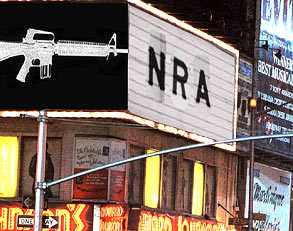
Three weeks after the National Rifle Association announced plans to open NRASports Blast, a theme restaurant aimed directly at Manhattan tourists, New York City is on the offensive.

On Monday, New York’s City Council passed a ceremonial measure officially declaring the NRA unwelcome. Though the measure has no force of law, it encourages other local agencies to reconsider the critical permits and licenses necessary to do business in New York.

Meanwhile, the NRA has identified no site in Times Square’s extensive web of parcels; it cites no manager for its store or restaurant; it declines to specify precisely what it will sell.

According to executive vice president Wayne LaPierre, NRASports Blast will fuse a gear-and-hunting store, a stretch of virtual shooting games and a restaurant serving wild game and mineral water. Nevertheless, it’s unclear how many people will actually staff the store, how the NRA will extract scarce labor and who will manage day-to-day stocking of shelves and washing of basins. Spokesperson Kelly Whitley says the group plans to “spend about $6 million on the project” — a financial gamble in a district where annual ground-floor rents (notwithstanding construction costs) can hit $7 million.

Alan Victor, a broker for available space at 49th and Broadway, says he has never heard from the group. He also doubts landlords would welcome the attendant controversy the NRA would bring — especially when unrefined but stolid businesses like Toys “R” Us are angling for the same space.

On 42nd Street itself, New York State still controls many parcels, and is unlikely to contract with a lightning rod like the NRA. 1530 Broadway — a strip with an abandoned movie theater, a cut-price electronics dealer and a gift shop — could stand a gaudy rebirth. But owner Charles Moss told me “he has never had a conversation” with the group, and claims he has “no interest” in doing so. Rumors have the NRA prowling West 57th Street, a 10-minute walk away, near the Hard Rock Cafe and the Warner Brothers Studio Store. (Planet Hollywood’s Aimee Geller says she doesn’t know whether the company is turning over its 57th Street space.) The NRA says it’s looking at six sites.

Nevertheless, despite high rents and verbal opposition, the NRA may have picked a perfect time to move into Times Square. Theme restaurants are thriving in Manhattan’s once-seedy nexus. ESPN Zone sits a few blocks from Mars 2112, where diners ride a simulated space pod. The Worldwide Wrestling Foundation bought its space on 43rd Street for $23.6 million this month, expecting to net $4 to $6 million in annual profits. Chevy’s Mexican Grill and the Asian-pastiche Ruby Foo’s have opened in the past year; B.B. King’s blues club waits in queue. Planet Hollywood International is closing its All-Star Cafi in order to make Times Square its flagship site. In such heady times, say experts and competitors, the NRA could certainly get in on the fun.

Still, any restaurant under the NRA rubric “would have to be extremely well-researched,” says Cornell Hotel Management professor Alex Susskind. Indeed, if concepts made restaurants profitable, Planet Hollywood International shares might be worth more than a Starbucks grande latte. And while the NRA is certainly adept at theatrics, it knows little about inventory. “We have a little store [at our Fairfax, Va., headquarters] where we sell T-shirts, hats and mugs,” Whitley says.

Retail expert Paul DeMeyer of Destination Development & Consulting suggests the NRA could thrill its 3.6 million members with a “brand store.” In Guam, DeMeyer notes, Japanese tourists who are not generally allowed to own guns flock to shooting galleries. A cross-section of repressed foreigners and trigger-happy Yanks could keep the NRASports Blast hopping, guesses DeMeyer. He would, though, scrap the wild-game menu. “You don’t go to a zoo and say ‘I’ll eat that lamb,’” he observes.

Meanwhile, New York natives continue to bare their teeth at the NRA. Upon hearing about NRASports Blast, New York’s liberal establishment clamped down immediately. Two weeks ago, Brooklyn Democratic Senator Charles Schumer stood in the rain atop a subway grate, calling on landlords to refute the NRA and New Yorkers to boycott any NRA establishment. “Make this the worst business decision since the Edsel,” he growled.

But can Schumer and New York’s City Council stop the NRA?

They can certainly stall things. The Council vote could hobble the opening by postponing it until the next recession. Under the city’s Byzantine zoning law, the 50 citizens who comprise Community Board 5 can block liquor and arcade licenses for vendors who offend their aesthetics. They figure to close ranks here behind the Council. It’s hard to fathom an NRA cafe without alcohol.

NRA spokesman Bill Powers maintains that negotiations continue. “We’ve been meeting with people,” he says. As with many campaigns, the NRA has proven it can sustain its plans as long as those plans frustrate its enemies. Think of NRASports Blast as a vanity project with a bullet.

Stars and Stripes forever?

It's not just iVillage in camouflage: The military paper goes online.

  • more
    • All Share Services

Grisly news of a corpse in a used car lot wasn’t exactly the kind of publicity Jack Colletti had in mind when he bought Stars and Stripes.

In May, Colletti purchased the 138-year-old private military paper, which shouldn’t be confused with European & Pacific Stars and Stripes, which split with the domestic version in 1942, and is now distributed by the Pentagon. (This overseas edition gained notoriety last weekend, when police in the nation’s capital discovered a corpse believed to be one of its editors.)

Colletti’s plan? Turn the nation’s veterans, many of whom loyally read Stars and Stripes, into consumers via a Web start-up. An agreeable former Navy officer with an MBA, Colletti, 30, had some experience in the business theater: He’d already sold an investing-club site and started iserved.com, designed to give vets career advice. Acquiring Stars and Stripes gave him a big-gun brand.

On Monday, Colletti hired decorated veteran and former Pittsburgh Steeler Rocky Bleier as a columnist and spokesman for his new venture, Stars and Stripes Omnimedia. Bleier, who suffered injuries in Vietnam before playing in two Super Bowls, now makes a living as a motivational speaker. “We are telling folks that you can make it in civilian life, and you can make it big,” says Raji Sankar, the company’s cofounder.

Why should two entrepreneurs just out of their 30s be so interested in a military site? For starters, they say it’s a largely untapped market. The company will help former soldiers plan reunions, find jobs and track military news, and it will even sell mutual funds and vintage aviation goggles, among other wares.

The idea amounts to more than iVillage in camouflage — veterans actually spend a lot of time online. Many use the Net to commune with comrades. Martin Markley of Fullerton, Calif., who served as an officer in Korea, now runs the home page of the Third Infantry Division Association. He says membership has grown 10 percent over the past few years. “I made contact via the Internet with the regimental surgeon who worked on me,” he says. Steve Van Buskirk, a spokesman for the Veterans of Foreign Wars, adds that soldiers and their children often use the Web to locate each other. “There’s probably 10 times the number of reunions that existed 10 years ago,” he says.

Marketers and other online entrepreneurs, sensing the strong public responses to “Saving Private Ryan” and John McCain’s war heroics, also see big potentials with military-themed Web ventures.

Colletti already faces an offensive from another armed forces site that recently stepped up its mass-marketing strategy. Military.com — brainchild of Harvard MBA and Naval Reserve officer Chris Michel — began as an offshoot of the D-Day Museum in New Orleans. It spent the spring lining up venture capital and board-member brass, and like Stars and Stripes, it stepped up its visibility last week. Military.com, in San Francisco, which struck a deal with A&E, five days before Colletti landed Bleier, will hawk A&E’s books, videotapes and other goods. (Ross Perot also has unveiled militaryhub.com, a relatively sparse site selling cameras and dude ranches.) “The bit that he’s had is all about Ross Perot, military hero,” says Mike Levinthal, a venture capitalist and Military.com director.

Levinthal claims there are some 70 million vets, current soldiers and military families, a vast audience that remains up for grabs. But visibility alone doesn’t guarantee veterans’ trust. Colletti, for instance, realizes he needs to freshen his publication’s sagging image. After hiring new reporters, Colletti scooped U.S. News & World report on the controversy surrounding the Associated Press’ 1999 series about a Korean War massacre. Now he wants big syndicates like Gannett to carry its content. He’s also revamping the newspaper, hoping to reach 300,000 paid subscribers by January — up from some 10,000 today. Sounds ambitious, but Van Buskirk proclaims his constituents are “delighted with the new ownership and new emphasis.”

Meanwhile, European & Pacific Stars and Stripes is less than delighted. It threatened to sue in early May over the name similarities. Colletti’s group issued a press release, defending its decisions, but resentment lingers. “Stars and Stripes is a proud name … that we will nurture and protect within our legal boundaries,” said Admiral Bill Owens, a former Joint Chiefs of Staff vice chairman who serves on Colletti’s advisory board.

Meanwhile, Military.com points out that it is way ahead of Stripes, with over 300,000 users in May, according to Media Metrix. “They’ve done a good job with their newspaper, but I do think it’s a smaller business,” Military.com’s Michel says. The company hopes to soon reach 1 million registered users through its A&E connection.

Still, this is a tough audience to charm. Carl Savino, a retired Army officer who runs a placement service and sends a job-search book to everyone leaving active duty, says the trust of veterans is very fragile and can be broken with the wrong type of marketing. And to prove their integrity, the sites risk expending their rations. That being said, Levinthal doesn’t rule out a possible partnership with its rival, with Stripes providing the news feed for his site’s memento trove.

After all, a retired Steeler and high-grade TV plugs may get these sites into the vernacular. But it will take plenty of patience and buzz to survive through what is becoming a bloody Web war.

Continue Reading Close