

Even though most of us are still in the dark about using our PowerBooks to call grandma, that may soon change. When the House voted May 10 to extend the moratorium on Net access taxes until 2006, it seemed as though the promise of free calling over the Internet might soon be realized.
But a provision inserted into a House telecommunications bill approved several days later exempts Net calls from the moratorium — an unexpected legislative gambit by the behemoth telecommunications industry that has left proponents of Internet telephony reeling. And according to them, you’ll be the one who ends up paying the price, because you’ll be the one denied free or low-fee Internet phone service.
Supporters of so-called “Voice over IP,” or VoIP, in industry lingo — which has remained largely unregulated until now — gathered Sunday at a rally to protest the May 16 legislation, which opens the door for per-minute access charges to be imposed on companies providing Internet phone service. Though oppressive June heat kept many away from the sparsely attended “Internet Freedom Rally” at the Capitol, a better indicator of the issue’s magnitude was the presence of Federal Communications Commission chairman William Kennard.
To hear Kennard tell it, the cause behind the rally — whether or not you will be able to access the Web for free or low-cost long-distance phone service — will affect billions, both in people and dollar terms. In May, Kennard joined those who provide phone service over the Net by expressing outrage when lobbyists for the major phone companies slipped in a bit of legislation that could make their business impossible.
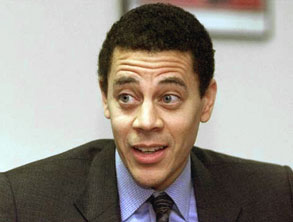
Kennard took to the stage and said he was “here for one reason, and that’s to keep this new economy humming along.” Taking great pains to underline that the issue was freedom — and not one industry’s desire to maintain its market advantage — Kennard explained that the Internet innovation of the United States is the envy of the world because it doesn’t overregulate the technology.
“As long as I’m chairman of the FCC, I’m going to do everything I can to keep this Internet free.”
A consortium of VoIP executives gathered at the rally said that what happened to them in May is just the beginning of the government’s infringement — and the possible imposition of taxes — on the Net.
“It becomes a very slippery slope,” says Jan Horsfall, president and CEO of Phonefree.com, one of the leading Web-based providers of free or low-cost phone service. “In theory and in practice, this is the first bill to get into the Senate that has anything to do with taxing the Web.”
At first, H.R. 1291 seemed innocuous enough. Written in response to a widely circulated rumor that the FCC was about to impose major fees on the Internet, the bill was meant to strip the FCC’s authority to impose a per-minute access charge on the Internet. “To prohibit the imposition of access charges on Internet service providers, and for other purposes,” the bill was titled.
But before the bill was reported out of the Commerce Committee — at a point Horsfall calls “the 11th hour” — Rep. Fred Upton, R-Mich., made an unusual addition to the “other purposes,” adding the provision that went unnoticed by VoIP advocates, including Kennard.
“I literally heard about it after the bill was passed,” the FCC commissioner said in an interview with Salon. “No one ever expected that the bill would have anything to do with IP telephony.”
But suddenly it did. “If this tax got imposed on us, or [competitor] Dialpad, it would crush these companies, it would kill us,” says Horsfall. “It would stifle innovation.”
Peter Hewitt, vice president of communications for Dialpad, seconds this. “To try to hamper growth at this point in its early stage is madness,” he says.
Surely House Republicans wouldn’t ever impose a tax on VoIP users, you say? Think again. The Upton amendment embodies the classic conundrum for House Republicans ever since they barnstormed the Capitol in November 1994 and wrenched control of the institution from tax-happy Democrats. Sums up one House source: “They always have this conflict between their ideology and what the largest player in the business thinks.”
In this case, the source says, “the big Bell companies are telling them what to do.”
So much so, in fact, that when Rep. Ed Markey, D-Mass., offered an amendment that would have kept the exemption in place — but as a flat fee, not on a per-minute basis — the amendment was defeated.
An Upton spokesman says that the VoIPs are making a big deal out of nothing. “From day one it was clear that this bill was dealing with ‘data transfers,’ not ‘voice transfers,'” says Mike Waldron.
But Michelle Tober, a spokesperson for the U.S. Telecom Association, a trade industry group that represents the Bell companies, is a bit more forthcoming. “We were concerned that the bill would have some impact on Internet telephony, so we worked on the committee level.” From USTA’s point of view, she says, “Voice calls should be treated the same, regardless of the medium they travel on.”
Translation: You shouldn’t get free or low-cost long-distance phone service on the Net, because VoIPs get to play by different rules.
Kennard says that’s the whole point. “We’re desperately trying to get away from per-minute access charges” for phone companies and everyone else, he says. First of all, the access charges far exceed the costs the phone companies pay. But more importantly, the Internet has been able to thrive because the free market largely dictates what happens. “The Internet went from a dead stop in ’95 to almost 100 million users today,” he says. “Without trying to demonize them [the phone companies] — because they’re struggling to compete in this new world,” they’re part of the “old regulatory paradigm … which was developed in a regulatory environment and is no longer relevant. So which path do you choose [for VoIPs]? The old legacy of infrastructure and regulation, or do what I’ve advocated and try to promote as much competition as you can?”
But what chances do Kennard and other VoIP supporters have in achieving their goal, given the well-founded jitteriness and deep pockets of AT&T, the Bell companies and the like?
“It’s sort of an age-old story in this city and in America,” Kennard says. “The folks that have been working Congress and the FCC — the regulated industries — they really know how to do that well. And so you have this industry that’s been regulated for 100 years, and suddenly it comes into conflict with an unregulated environment of innovators and entrepreneurs and people who are out there developing their technology and not spending their money on Washington lawyers and lobbyists. And they [the big telecoms] are at a disadvantage, frankly.”
Kennard is a huge booster of the potential of the Net — including that of VoIPs. “All those people with Internet access are going to find that they can use those Internet connections to make phone calls at a fraction of the cost, and they’re going to want to do that,” he says. “And for the most part, that’s great for Americans, because that’s going to drop the cost of phone service in our country dramatically. And the last thing we want to do is to constrain that business in its infancy, and to tell these young entrepreneurs who are out there developing and improving this technology that you can’t do this because we’re going to tax you to death.”
Not surprisingly, the big telecoms have a better argument as to why VoIPs — which one estimate says provided 1.7 billion minutes of consumers’ calls in 1999 compared to the big boys’ 7 trillion minutes, a figure that could grow to between 6 billion and 7 billion minutes in the next five years — need to be taxed. And, believe it or not, it all comes down to the needs of poor people.
“We want to preserve the affordability of telephone service for all Americans,” USTA’s Tober says. A percentage of the access charges consumers pay for regular phone service helps subsidize phone costs for low-income and rural Americans, she says. With fewer Americans using their services — instead opting for VoIPs — that subsidy will just disappear into the ether, she argues.
Horsfall calls this “perverse logic.” Internet phone service is either vastly cheaper than that provided by the Bells or free. Rural and low-income phone users will thus benefit even more.
Tober, however, points out that “you have to have a computer, though, to make those calls, and a computer’s a lot more expensive than a telephone. Not everyone in this country can afford a computer, but 94 percent of households have telephones.”
“I don’t agree with that argument,” Kennard says. “We’re seeing the Internet migrate out of the PC and into lots of wireless devices that are very cheap, like PalmPilots and wireless phones … And that will be great for consumers.”
That is, of course, only if consumers are able to fight back against the telecom giants. The Bells and AT&T are a major player in Washington. And they frequently do more than just throw a few tens of thousands of dollars at congressmen like Upton. AT&T is the No. 1 giver of soft money in the country, having contributed $1,932,719 to the two major parties this election cycle — $825,350 to the Democrats and $1,107,369 to the Republicans as of May 1. That’s more than the National Rifle Association, more than big tobacco, more than the trial lawyers or any union and even more than Dreamworks SKG.
“AT&T is among the most powerful companies in Washington because they’re giving so much money,” says Holly Bailey, a researcher at the Center for Responsive Politics. “Everywhere you go in terms of the committees there’s legislation that would affect AT&T, therefore they’re the No. 1 giver of soft money, and they’re giving a lot of PAC money” — $280,450, to be precise.
The Baby Bells aren’t doing so shabby, either. Bell Atlantic’s given $723,036 in soft money, BellSouth Corp.’s given $618,317 and MCI WorldCom’s given $396,060.
The story of Upton’s amendment doesn’t surprise Bailey. “Increasingly it seems that a lot of the legislation that’s happening is happening not in big bills but in smaller amendments that no one’s paying attention to.”
But how good a job are the VoIPs doing in getting out the word? Key House and Senate staffers knew little, if anything, about the bill. And, of course, the rally was a bust. “I hear there were only 100 people,” USTA’s Tober sneers.
“The big telecoms are doing more and more underhanded things to keep the revenue inertia because they’re losing it to new technology,” Horsfall says. “They’re trying to create an uneven playing field in back rooms of Congress. They’re trying to play the new game using old rules.”
With additional reporting by Alicia Montgomery.
